Contents · 43 sections
- What Is a Permanent Resident?
- What Does PR Residency Mean in Everyday Life?
- Is a Green Card Holder a U.S. Citizen?
- Who Issues Permanent Resident Cards?
- Who Is in Charge of Immigration in the United States?
- Green Card Basics vs USCIS Case Status
- How Do You Get a Green Card?
- Is There a Way to Get a Green Card Fast?
- Conditional vs Permanent Residence
- How Do You Know If Your Green Card Is Conditional?
- Rights and Rules for Green Card Holders
- What Rights Do Green Card Holders Have?
- Do Green Card Holders Have Constitutional Rights?
- Do Green Card Holders Have Freedom of Speech?
- What Can't Permanent Residents Do?
- Can Green Card Holders Serve on a Jury or Run for Office?
- What Are Your Duties as a Green Card Holder?
- Do Green Card Holders Have to Pay U.S. Taxes?
- Are Green Card Holders Safe From Deportation?
- How Long Can a Green Card Holder Stay Outside the U.S.?
- Absence Rules for Citizenship: The 6-Month and 1-Year Lines
- When Do Permanent Residents Need a Reentry Permit?
- What If You Stay Abroad Longer Than Your Reentry Permit Allows?
- How Long Is a Green Card Valid?
- Green Card Renewal and Replacement
- What Should You Do If Your Green Card Is Lost or Stolen?
- How Can You Track Your Permanent Resident Card?
- How Can You Check Your Immigration Status?
- What Is Your Current Immigration Status?
- How Do You Contact Immigration About Your Green Card?
- Which Number Is Your Green Card Number?
- Path to Citizenship
- What Is the General Provision for Citizenship?
- Is Speaking English a Requirement for Citizenship?
- Can You Apply for Citizenship Online?
- How Can You Prove or Check Your Citizenship Status?
- Can a Green Card or Citizenship Be Taken Away?
- Can the President Revoke Citizenship?
- Do You Have to Pay for a Green Card?
- Your First Year as a Permanent Resident
- Common Mistakes Permanent Residents Make
- Where Can You Find Trustworthy Immigration Help?
- Frequently Asked Questions
The short answer
A permanent resident is a non-citizen allowed to live and work in the United States permanently, proven by a green card (Form I-551). You can stay as long as you do nothing that makes you removable. In return you must obey the law, file taxes, not vote, and avoid long absences abroad.
At a glance
| Official name | Lawful permanent resident (LPR); card is Form I-551 |
| Who issues the card | USCIS, part of the Department of Homeland Security |
| Card validity | Most green cards are valid for 10 years; conditional green cards for 2 years |
| Big no | Voting in any federal, state or local election |
| Next step for many | U.S. citizenship through Form N-400 |
What Is a Permanent Resident?
A permanent resident is someone who is not a U.S. citizen but has been granted the right to live in the United States permanently. The official term is lawful permanent resident (LPR). The proof is the green card, formally the Permanent Resident Card, Form I-551.
What the status gives you
USCIS sums up the core rights this way: Green card holders can live and work permanently in the U.S. and are protected by U.S. law. You keep the status for life unless you give it up, abandon it or are ordered removed.
Green card vs status
The card is a document that expires. The status does not expire with the card. An expired card makes proving status harder, so renew on time, but it does not end your residence.
What Does PR Residency Mean in Everyday Life?
"PR residency" is everyday shorthand for permanent residence. In practice, it means you can take most jobs, change employers freely, buy a home, study, and come and go from the U.S. within limits. You remain a citizen of your home country unless that country's own law says otherwise.
Older terms you may still see
"Legal resident alien", "resident alien" and "green card holder" all describe a permanent resident. "Alien" is a legal term in U.S. immigration law; it is not an insult. You will still see it on older forms and notices, including the Alien Registration Number.
Two kinds of residents
Most residents hold a 10-year card. Some, mostly through recent marriage, are conditional permanent residents with a 2-year card. Both have the same everyday rights. The difference is the deadline: a conditional resident must file to remove the conditions before the 2-year card runs out, or the status can end.
Is a Green Card Holder a U.S. Citizen?
No. A green card holder is a permanent resident, not a citizen. Residents can live and work in the U.S. but cannot vote or hold a U.S. passport, and they can be deported if they become removable. Citizenship comes later, usually through naturalization on Form N-400.
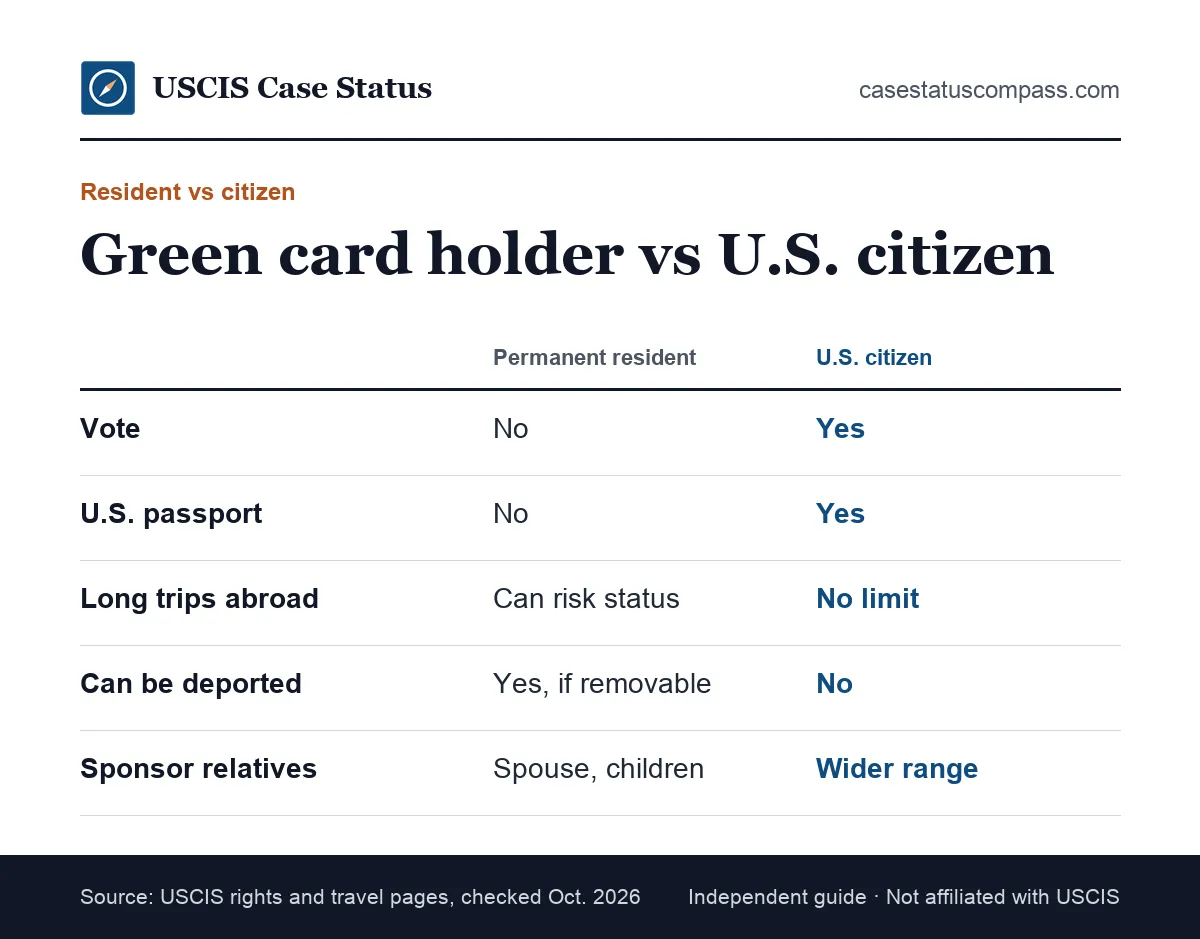
Permanent resident vs citizen at a glance
The table compares the two side by side on the points that most often affect daily life and travel.
| Topic | Permanent resident | U.S. citizen |
|---|---|---|
| Right to live in the U.S. | Yes, unless removable | Yes, always |
| Vote in elections | No | Yes (federal, state, local) |
| U.S. passport | No; uses home passport | Yes |
| Long stays abroad | Can lead to abandonment | No limit |
| Removal from the U.S. | Possible | Not possible |
| Federal jobs needing citizenship | Mostly no | Yes |
| Proof document | Form I-551 | Passport or certificate |
The pattern: a resident's rights are real but conditional, while a citizen's are permanent.
Why the difference matters
Most people feel the difference only when something goes wrong, such as a long trip, an arrest or a lost card, because a resident has fewer protections than a citizen.
Who Issues Permanent Resident Cards?
USCIS stands for U.S. Citizenship and Immigration Services, an agency of the Department of Homeland Security (DHS), approves green cards and issues the physical card. That is true whether you adjusted status inside the U.S. or entered on an immigrant visa issued abroad. USCIS also replaces and renews cards.
If you immigrated from abroad
The State Department issues your immigrant visa, but USCIS makes the card. $235 is the USCIS Immigrant Fee, a green card payment made before USCIS mails the card. The stamped immigrant visa serves as temporary proof until the card arrives.
Where the card goes
USCIS mails the card to the address on file. Our I-551 stamp guide covers temporary proof if the card is late. If you move before it arrives, update your address with USCIS right away, because cards are not forwarded reliably.
Who Is in Charge of Immigration in the United States?
No single office runs American immigration. Three DHS agencies share most of the work: USCIS handles benefits, CBP (Customs and Border Protection) handles borders and airports, and ICE (Immigration and Customs Enforcement) handles enforcement. The State Department, the Justice Department's immigration courts and the Labor Department also play roles.
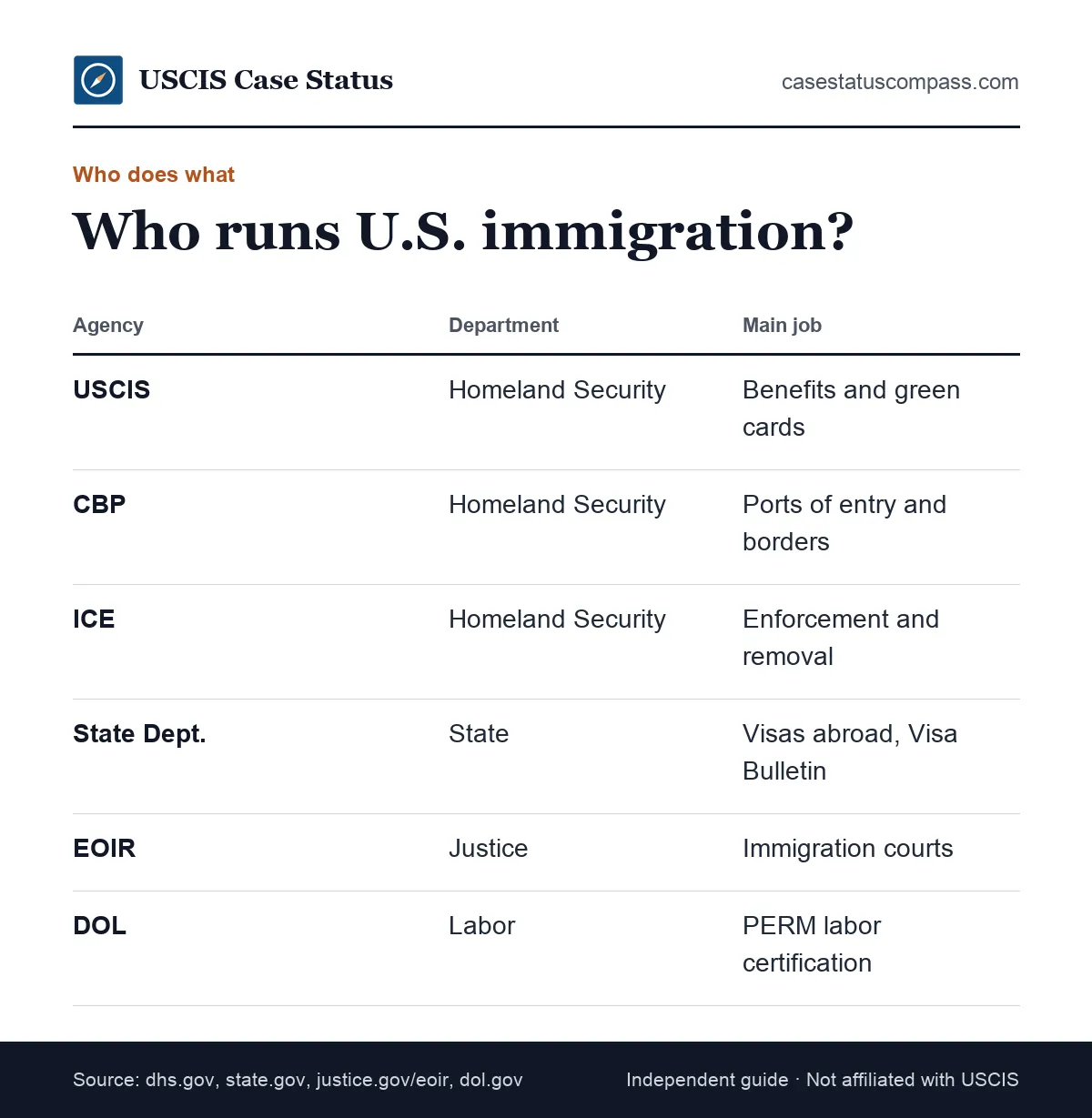
Which agency a resident deals with most
As a resident you mostly deal with USCIS for your card and citizenship, and with CBP each time you return from a trip. The State Department matters if you sponsor relatives abroad, and immigration court only if you are placed in removal proceedings.
What each agency does not do
USCIS does not run immigration courts, and CBP does not decide your green card renewal. Check who owns a step before you ask. Asking the wrong agency wastes weeks: CBP cannot see a pending I-90, and USCIS cannot fix an I-94 entry error made at the airport.
Green Card Basics vs USCIS Case Status
Your immigration status is the legal category you hold, such as permanent resident. Your USCIS case status is the progress of one application you filed, such as a renewal or a citizenship application. Status is long-lasting; case status changes week to week.
Status and case status compared
This table separates the legal category you hold from the progress of one form you filed.
| Point | Your immigration status | A USCIS case status |
|---|---|---|
| What it describes | Your legal category | One pending form |
| Example | Lawful permanent resident | "Case Was Received" on Form I-90 |
| How long it lasts | Years or for life | Until the case is decided |
| Where it is shown | Green card, I-94, notices | Case Status Online with a receipt number |
| Changes when | You naturalize, lose status or adjust | USCIS acts on that case |
How they connect
A pending case can change your status. Removing conditions turns a 2-year resident into a 10-year resident, and an approved N-400 turns a resident into a citizen. Our USCIS case status guide explains how to read each update.
How Do You Get a Green Card?
Permanent immigration to the United States of America usually runs through a family member, an employer, or humanitarian protection such as refugee or asylee status. A few other paths exist, such as special immigrant categories and the diversity visa. Each green card procedure starts with a different petition and may involve a wait.
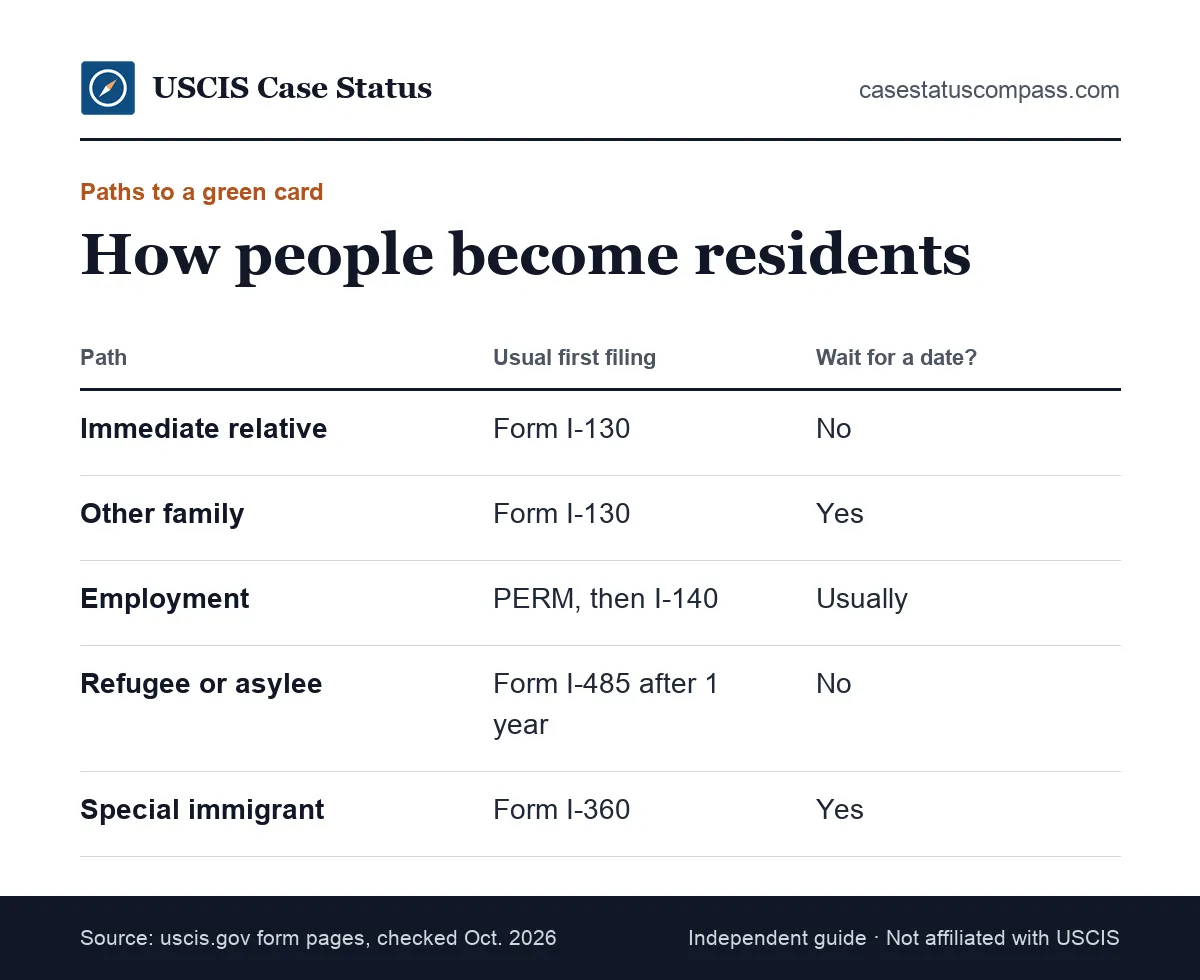
Family sponsorship
U.S. citizens and permanent residents can file Form I-130 for certain relatives. Immediate relatives of citizens have no annual cap. Other relatives wait in the green card backlog shown in the monthly visa bulletin; in November 2026, a U.S. citizen's sibling (F4) needs a priority date before Oct. 22, 2012 for most countries.
Employment
Most job-based cases start with PERM labor certification, then Form I-140, though some, like extraordinary ability, skip PERM. Our Form I-140 guide explains each. The employer usually starts and pays for the process, and many workers then wait for a current priority date before filing for the card.
Humanitarian and other paths
Refugees and asylees need 1 year of physical presence in the U.S. before filing I-485. Other paths include special immigrants on Form I-360. Once eligible, applicants in the U.S. file Form I-485; see our adjustment of status guide.
Is There a Way to Get a Green Card Fast?
There is no paid shortcut. The fastest routes are usually the uncapped ones, such as being the spouse, minor child or parent of a U.S. citizen. Premium processing does not cover green card applications. Anyone selling a "guaranteed fast" green card is a red flag.
What premium processing covers
Premium processing covers I-129 work visas, I-140 (EB-1/2/3), I-765 OPT/STEM OPT and I-539 to F/M/J. It can speed an employer's I-140 petition, but the I-485 still follows normal processing.
What really affects speed
- A complete filing with every required document
- Quick replies to any request for evidence
- A current priority date, if your category has a wait
- An up-to-date mailing address
Each item removes a common source of delay, and none of them costs extra money.
Conditional vs Permanent Residence
A conditional permanent resident has a 2-year green card instead of a 10-year card. This mostly applies to spouses whose marriage was under two years old when residence was granted. Conditional residents have the same rights, but they must file to remove the conditions before the card expires.
Removing the conditions
File in the 90 days before your 2-year card expires. For marriage cases this is Form I-751. Our I-751 guide explains joint filing, waivers and evidence. Investors use Form I-829 instead.
What the I-751 receipt does
I-751 receipt notice extends conditional status and work authorization for 48 months. Carry the receipt notice with your expired card when you travel or start a new job. Keep the original receipt notice safe, and store a copy separately.
How Do You Know If Your Green Card Is Conditional?
Look at the dates on your card. A conditional card is valid for about 2 years from the date you became a resident, while a regular card runs 10 years. The category code on the card also helps: marriage-based conditional codes include CR1 and CR6.
Reading the category code
CR1 usually means a conditional spouse who immigrated through a consulate; CR6 usually means a conditional spouse who adjusted status in the U.S. Our green card number guide explains where each code sits on the card.
Can you renew a 2-year card?
No. A conditional card cannot be renewed with Form I-90, which is meant for 10-year cards. Conditional residents file to remove the conditions instead, and that filing leads to a 10-year card.
Rights and Rules for Green Card Holders
USCIS lists three main rights and four main duties for every permanent resident. The rights cover living, working and legal protection. The duties cover obeying laws, paying taxes, staying out of elections and, for some men, registering for Selective Service. Breaking these rules can cost you your status.
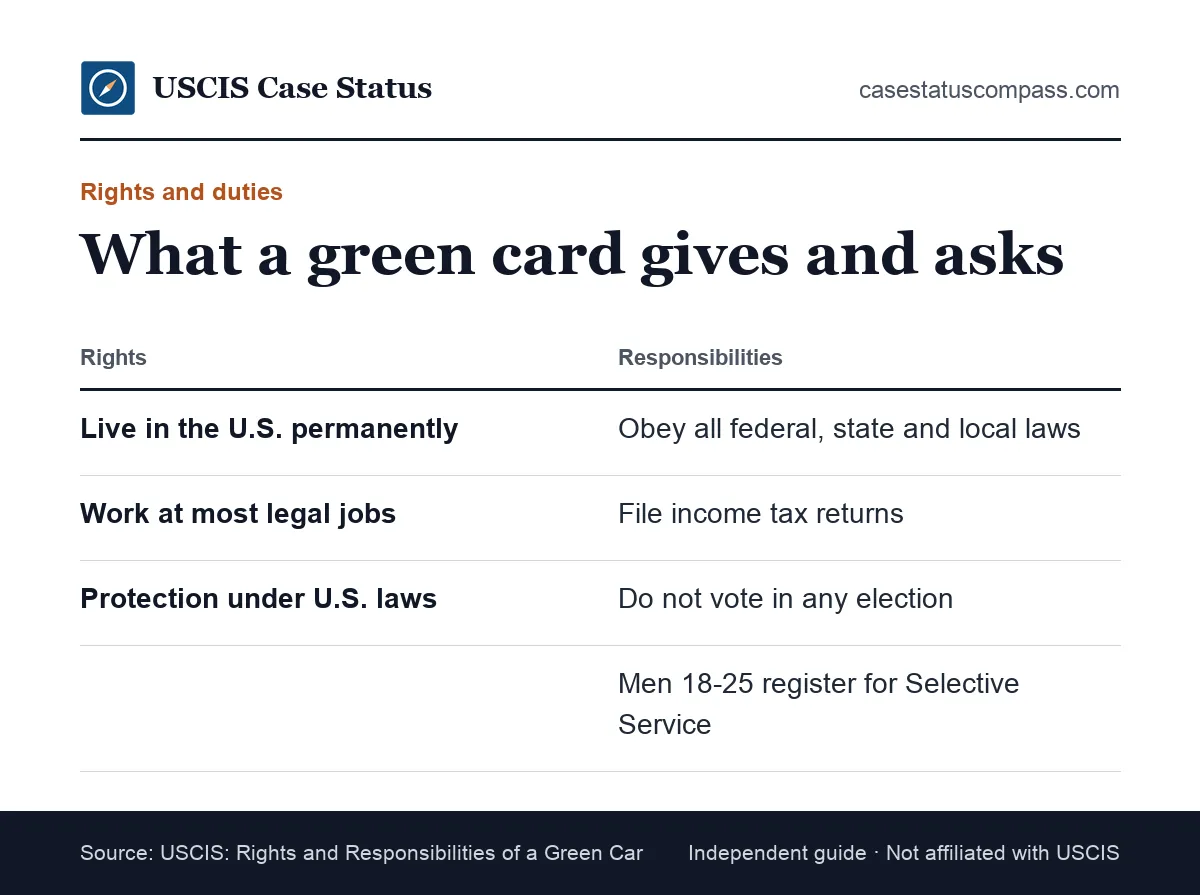
The duties in USCIS's words
Obey the law, file taxes, don't vote, and register for Selective Service (men 18-25). These apply from the day your residence begins, not from the day the card arrives.
Laws for green card holders beyond USCIS
State and local laws apply to you as they do to citizens. Some conduct, even if minor under state law, can have immigration consequences. Ask an immigration attorney before pleading guilty to any charge.
What Rights Do Green Card Holders Have?
Green card holders can live in the U.S. permanently, work for almost any employer, own property, attend school and travel abroad within limits. They can also sponsor a spouse and unmarried children for green cards and, after enough time, apply to become citizens.
Work and business
You may work at any legal job, start a business or be self-employed. A few government and security jobs are limited to citizens. Employers may ask for your card or another document from the Form I-9 list when you start a new job.
Sponsoring family
As a resident, you can file Form I-130 for a spouse and unmarried children. These relatives fall in the F2A and F2B lines and usually wait for a date. Our Form I-130 guide covers the filing.
Do Green Card Holders Have Constitutional Rights?
Yes. Most protections in the U.S. Constitution, including free speech, religious freedom, due process and protection from unreasonable searches, apply to people in the United States, not only to citizens. USCIS confirms residents are protected by all federal, state and local laws.
Do Green Card Holders Have Freedom of Speech?
Yes. Green card holders have First Amendment rights and can speak, protest and worship freely. Immigration law is separate, though: certain activities, such as support for groups designated as terrorist organizations, can make a non-citizen removable. If you are unsure whether an activity carries risk, get legal advice first.
Due process in removal cases
A resident facing removal generally has the right to a hearing before an immigration judge and to hire a lawyer at no cost to the government. Our immigration court case status guide explains how to follow a court case.
What Can't Permanent Residents Do?
Permanent residents cannot vote in federal, state or local elections, cannot get a U.S. passport, and cannot take most jobs that require citizenship. They also should never claim to be a U.S. citizen on any form, because a false claim to citizenship can have permanent immigration consequences.
Voting and voter registration
Registering to vote by mistake, for example at a driver's license office, can still cause problems later. If it happened, keep records and speak with an attorney before you file for citizenship.
Can Green Card Holders Serve on a Jury or Run for Office?
No. Jury duty and most elected offices are open only to citizens. If you get a jury summons, answer it and say you are not a citizen rather than ignoring it. Like voting, these roles open up only after naturalization through Form N-400.
What Are Your Duties as a Green Card Holder?
Your main duties are to obey all laws, file tax returns as a U.S. resident, register with Selective Service if you are a man aged 18 through 25, and keep your address updated with USCIS. These duties apply to every permanent resident, whether the card is new or old, and breaking them can affect a later citizenship application.
Do Green Card Holders Have to Pay U.S. Taxes?
Yes. You must report worldwide income to the IRS and state tax agencies as a U.S. resident. Filing as a "nonresident" to save tax can be treated as a sign you gave up your residence. Filing as a resident is also one of the ties officers look at after a long trip.
Address changes
Report a new address to USCIS within 10 days of moving (INA 265). Update your address online in your USCIS account (E-COA); a mailed AR-11 also counts. Our change of address guide shows each method.
Are Green Card Holders Safe From Deportation?
Mostly, yes, but not completely. A permanent resident keeps status unless they do something that makes them removable, such as certain crimes, immigration fraud or abandoning residence. Only an immigration judge can order a resident removed, and residents can fight the case in court.
Common reasons residents face removal
- Convictions for certain crimes
- Fraud or misrepresentation in an immigration case
- Long absences treated as abandonment
- Falsely claiming U.S. citizenship
Any one of these can lead to a Notice to Appear, so get advice before acting on a criminal charge or a long trip.
What to do if you receive a Notice to Appear
A Notice to Appear starts an immigration court case. Do not ignore it. Contact an immigration attorney right away and keep your address current with the court. Missing a hearing can lead to a removal order.
How Long Can a Green Card Holder Stay Outside the U.S.?
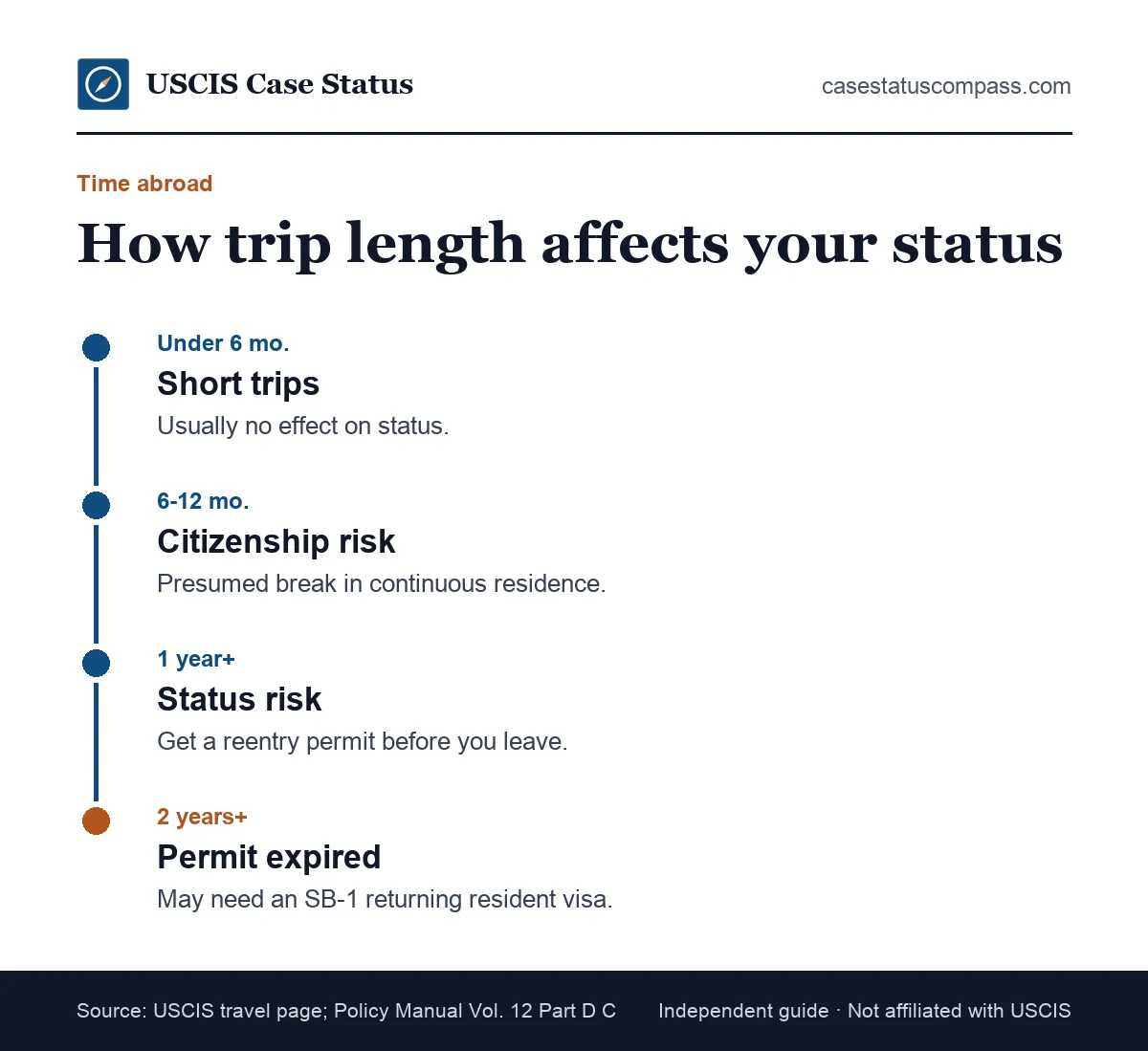
There is no exact safe number of days. USCIS says brief trips usually do not affect status. Long trips abroad can risk your green card; over 1 year is the general warning line. Shorter trips can also raise questions if your life seems to be centered abroad.
What officers look at
USCIS lists the ties that show you intend to keep living here: family, a job, a U.S. home address, bank accounts, a driver's license and filing taxes as a resident.
Where to read more
Our green card holder travel rules guide covers trip planning in depth. Before any long trip, decide whether you need a reentry permit, keep your U.S. ties active and carry proof of them when you return.
Absence Rules for Citizenship: The 6-Month and 1-Year Lines
Trips abroad matter twice: once for your green card and again for naturalization. Naturalization: a trip over 6 months is presumed to break residence; 1 year or more breaks it. A long trip can reset your citizenship clock even if your green card is safe.
Preserving residence for citizenship
Form N-470 can preserve residence for naturalization during certain long jobs abroad, such as with the U.S. government or some U.S. companies. It must usually be filed before you have been away a year.
Status vs citizenship clock
The same trip can affect the green card and the citizenship clock differently, as the table shows.
| Trip length | Green card risk | Citizenship clock |
|---|---|---|
| Short trips | Usually none | Not broken |
| Over 6 months, under 1 year | Possible questions | Presumed broken (you can rebut) |
| 1 year or more | Abandonment risk without a reentry permit | Broken unless N-470 approved |
| Over 2 years | Reentry permit expired | Broken |
When Do Permanent Residents Need a Reentry Permit?
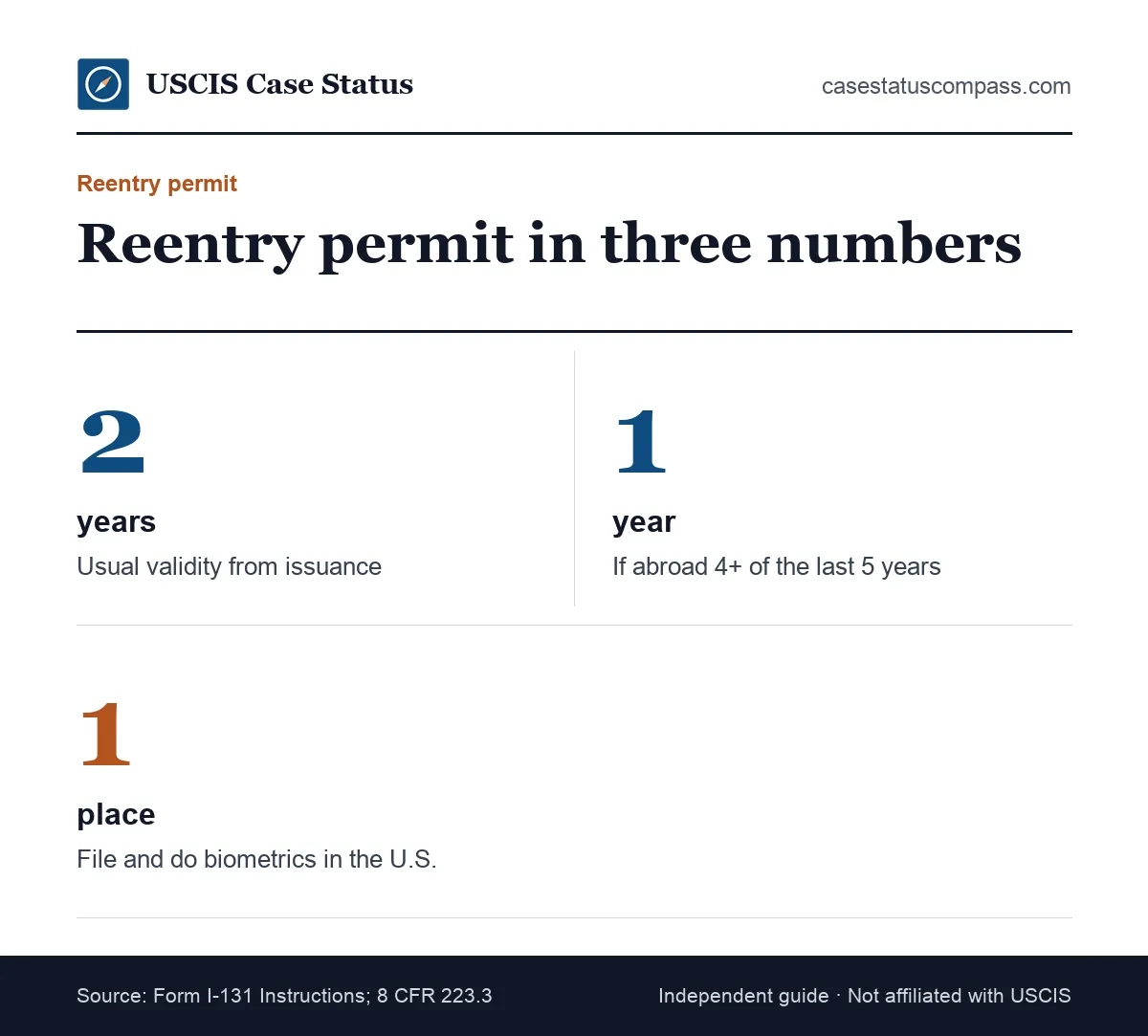
A reentry permit is a travel document for permanent residents who plan to be abroad for a year or more. It shows you did not mean to give up your residence and lets you return without a returning resident visa. Reentry permit: generally valid 2 years (1 year if abroad more than 4 of the last 5 years).
How to apply
You file Form I-131 while you are in the U.S. and attend biometrics before leaving. Reentry permits cannot be filed online. As of October 2026 the fee is $630, and a reentry permit cannot be extended. Our Form I-131 guide covers the filing.
What If You Stay Abroad Longer Than Your Reentry Permit Allows?
If you were abroad longer than the permit allowed, you may need an SB-1 returning resident visa from a U.S. embassy or consulate. You must prove the long stay was beyond your control. Without a permit or an SB-1, a long absence can be treated as abandoning your permanent residence.
How Long Is a Green Card Valid?
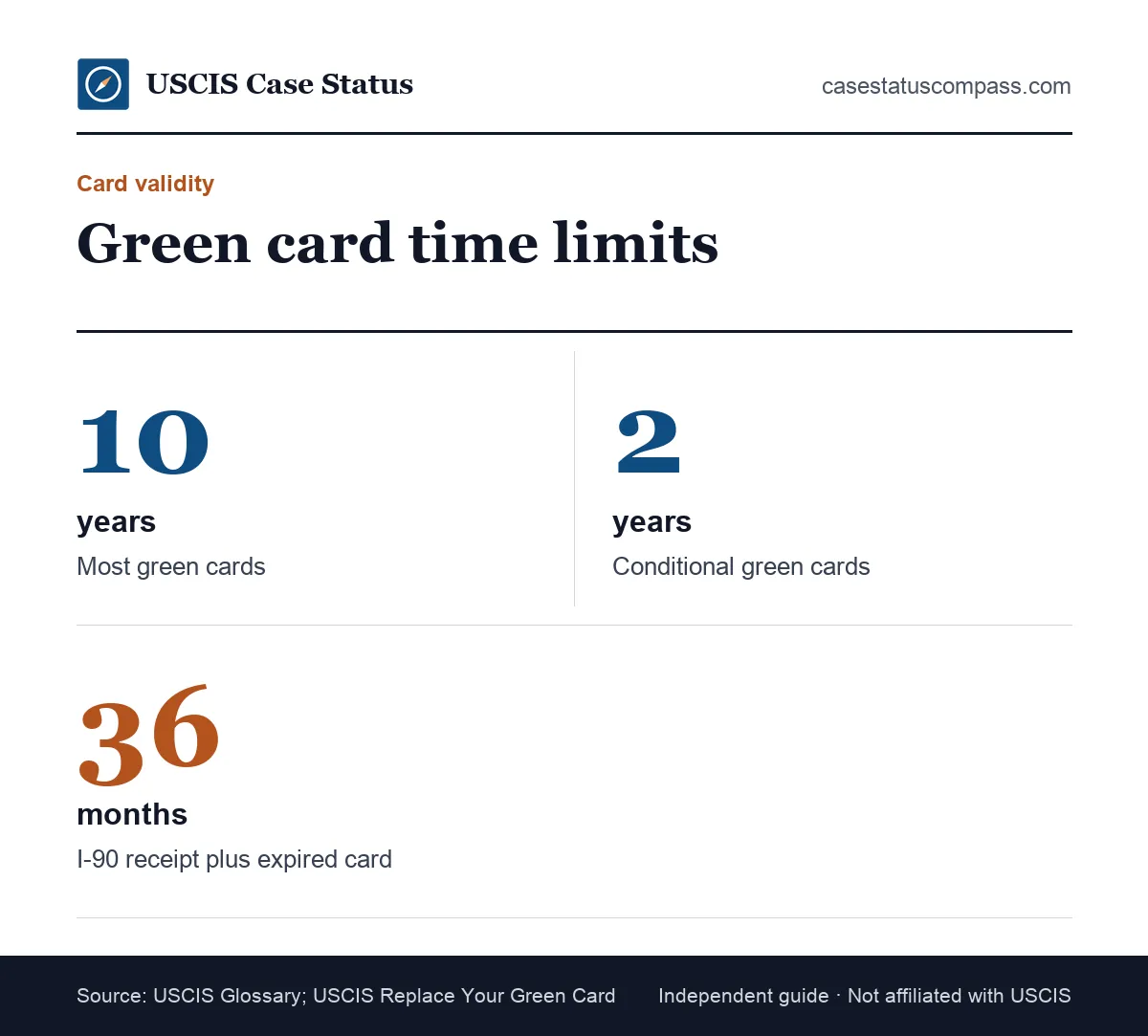
Most green cards are valid for 10 years; conditional green cards for 2 years. Some very old cards have no expiration date and should be replaced. When a 10-year card nears its end, you renew it with Form I-90; a 2-year card is never renewed, only replaced through removing conditions.
Expired card, valid status
Your residence continues after the card expires. Still, an expired card can cause trouble with employers, airlines and the DMV. File for a new card about six months before the expiration date.
Checking whether your card is valid
Look at the "Card Expires" date on the front. If it is past, or the card is damaged, file for a replacement. A receipt notice plus the expired card works as proof for a time.
Green Card Renewal and Replacement
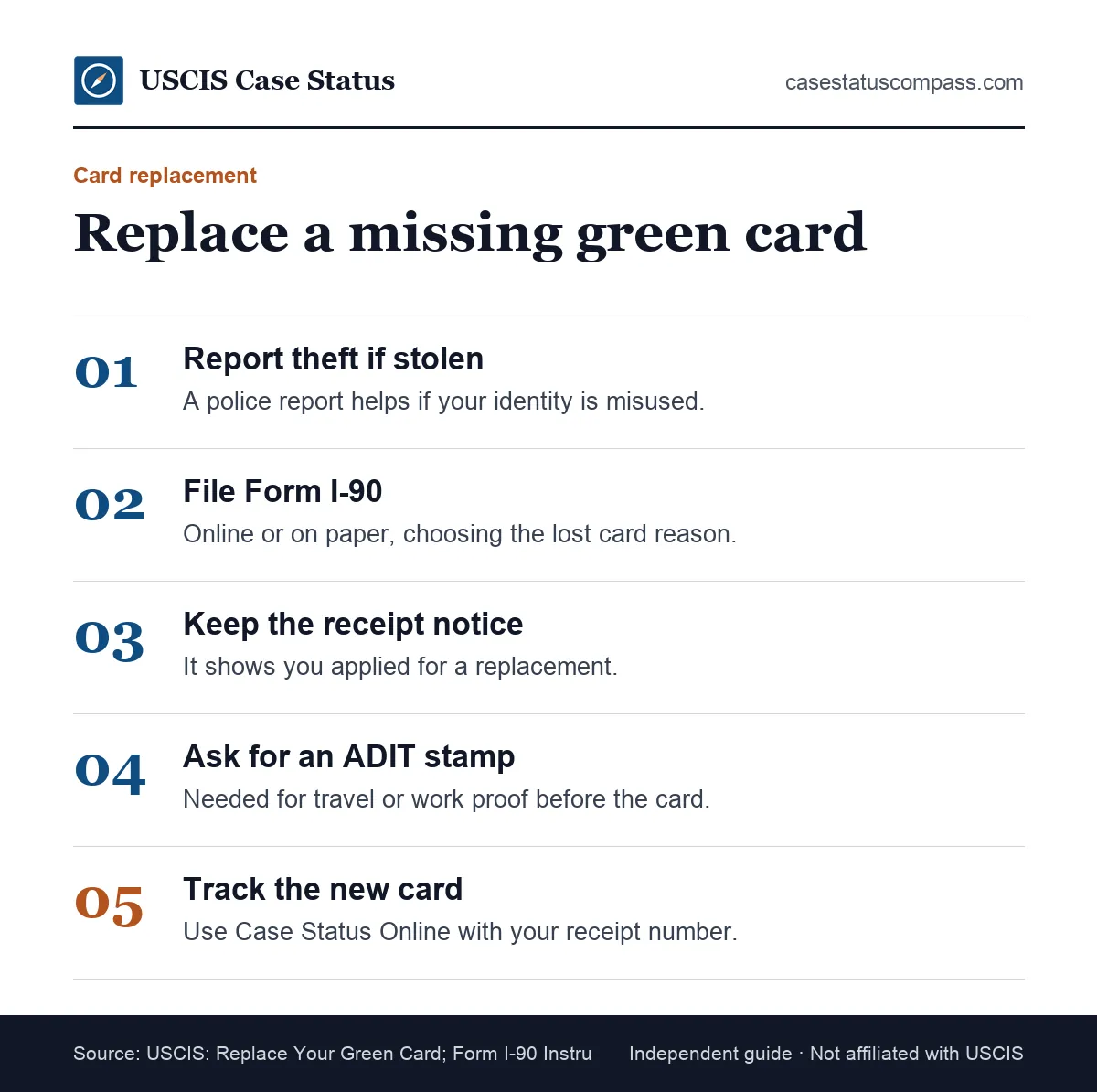
There is no separate way to extend green card validity: you use Form I-90 to renew an expiring 10-year card or replace a lost, stolen, damaged or incorrect one. As of October 2026 the fee is $465 (paper) / $415 (online). Our green card renewal guide covers the full filing.
When to file Form I-90
File I-90 if your card is lost, damaged, wrong, expiring within 6 months, or you turned 14. Conditional residents with an expiring 2-year card file Form I-751 instead. File online or on paper, and keep the receipt.
Proof while you wait
I-90 receipt notice + expired card = proof of status for 36 months from the card's expiration date. USCIS's median for I-90 cases was I-90: median 5.5 months (USCIS data, Apr.-June 2026).
What Should You Do If Your Green Card Is Lost or Stolen?
File Form I-90 for a replacement, and report a theft to the police. If you need to travel or prove work eligibility before the new card arrives, ask USCIS for a temporary I-551 (ADIT) stamp. Watch for misuse of the lost card and keep a copy of the police report with your filing records.
If you lose your card abroad
Form I-131A ($575) is the usual route: file in person at a U.S. embassy or consulate after paying the fee online. Contact the nearest U.S. embassy or consulate before you book a flight home, and bring any copy of the card you have.
Temporary proof
I-551/ADIT stamp: temporary proof of green card status; request through the USCIS Contact Center (800-375-5283). Temporary I-551 stamp: valid until its expiration date, or 1 year if no date is printed.
More detail
Our lost green card guide walks through the replacement step by step, including what to do if the card was stolen with other ID. A stolen card is a reason to watch your credit too.
How Can You Track Your Permanent Resident Card?
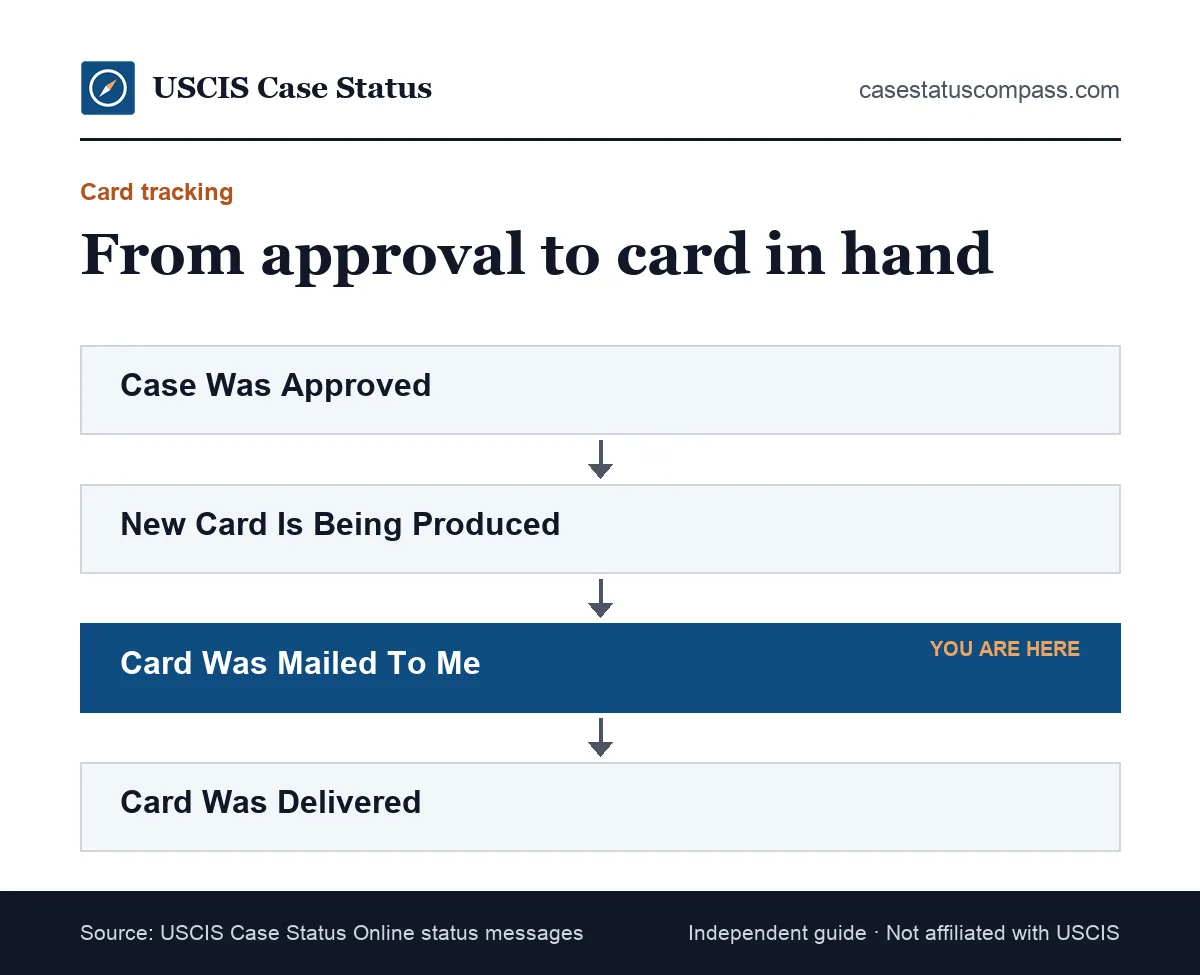
You track a new or replacement card with Case Status Online, using the receipt number on your notice. The updates move from approval to card production and mailing. Once mailed, the status often includes a tracking number you can follow with the Postal Service.
If the card was mailed but never arrived
Ask your post office first. Our card was mailed guide explains delivery tracking and when to contact USCIS. Check with neighbors and building staff, and confirm the address USCIS used matches yours.
If the card went back to USCIS
Returned green cards are held 60 business days (about 12 weeks), then re-mailed or destroyed. Update your address quickly so USCIS can re-mail it. If the case status says the card was returned, contact USCIS before that holding period ends.
How Can You Check Your Immigration Status?
To check immigration status for a pending application, use USCIS's Case Status Online with your receipt number: Case Status Online: egov.uscis.gov. To prove your status as a resident, show your green card, a valid I-551 stamp or an unexpired immigrant visa with the temporary I-551 notation.
If you have no receipt number
A free USCIS online account shows your cases if you filed online or linked a paper case. You can also call the Contact Center. Have your A-Number, full name and date of birth ready so the agent can find your file.
How employers and agencies check
Employers use Form I-9 and may use E-Verify. Many benefit agencies use a federal system called SAVE. You do not need to pay anyone to verify your status. Give a copy of your card when asked; keep the original.
What Is Your Current Immigration Status?
Your current immigration status is the category on your most recent approval, entry record or card. For green card holders it is "lawful permanent resident". Others may be in temporary (nonimmigrant) status, parole, or a pending status such as an adjustment applicant.
Common status labels
The table lists common status categories, who usually holds each one and the document that proves it.
| Label | Who it fits | Usual proof |
|---|---|---|
| U.S. citizen | Born or naturalized citizens | Passport or certificate |
| Lawful permanent resident | 10-year card holders | Form I-551 |
| Conditional permanent resident | 2-year card holders | Form I-551 (2-year) |
| Nonimmigrant | Students, workers, visitors | Visa and Form I-94 |
| Adjustment applicant | Pending Form I-485 | I-797C receipt notice |
Where to find your status on paper
Check your card, latest USCIS approval notice or CBP Form I-94 record, and ask an attorney before filing if they disagree. A mismatch, such as a wrong class of admission, is easier to fix early than during a later application.
How Do You Contact Immigration About Your Green Card?
The main immigration contact phone for green card questions is the USCIS Contact Center: 800-375-5283 (TTY: 800-767-1833). Live calls and chat: Monday to Friday, 8 a.m. to 8 p.m. Eastern. You can also use Emma, USCIS's online virtual assistant (English and Spanish), on uscis.gov or your online account. There is no single immigration helpline number or immigration hotline for every agency.
In-person help
Request an in-person appointment online at my.uscis.gov/en/appointment/v2 or call 800-375-5283. Bring your card, ID and any notices. Field offices do not take walk-ins without an appointment, so book first and arrive early for security.
More immigration contact info
Our USCIS contact number guide lists every channel and what to have ready. Calling from another country? The immigration customer service number to dial is 212-620-3418 (callers outside the U.S.).
Which Number Is Your Green Card Number?
A green card shows two numbers people confuse. The USCIS number (A-Number) identifies you across all your files. The card number identifies the physical card. Forms ask for one or the other, so check the label before you write. A wrong number can delay processing.
The A-Number on your card
Your A-Number is the 'USCIS#' printed on the front of green cards issued after May 10, 2010. See our alien number guide for where else it appears. It never changes.
The card's document number
The card number is a 13-character code on the card. It changes each time a new card is issued, while your A-Number stays the same. Forms that ask for a "receipt number" mean a USCIS case number, not this card number.
Path to Citizenship
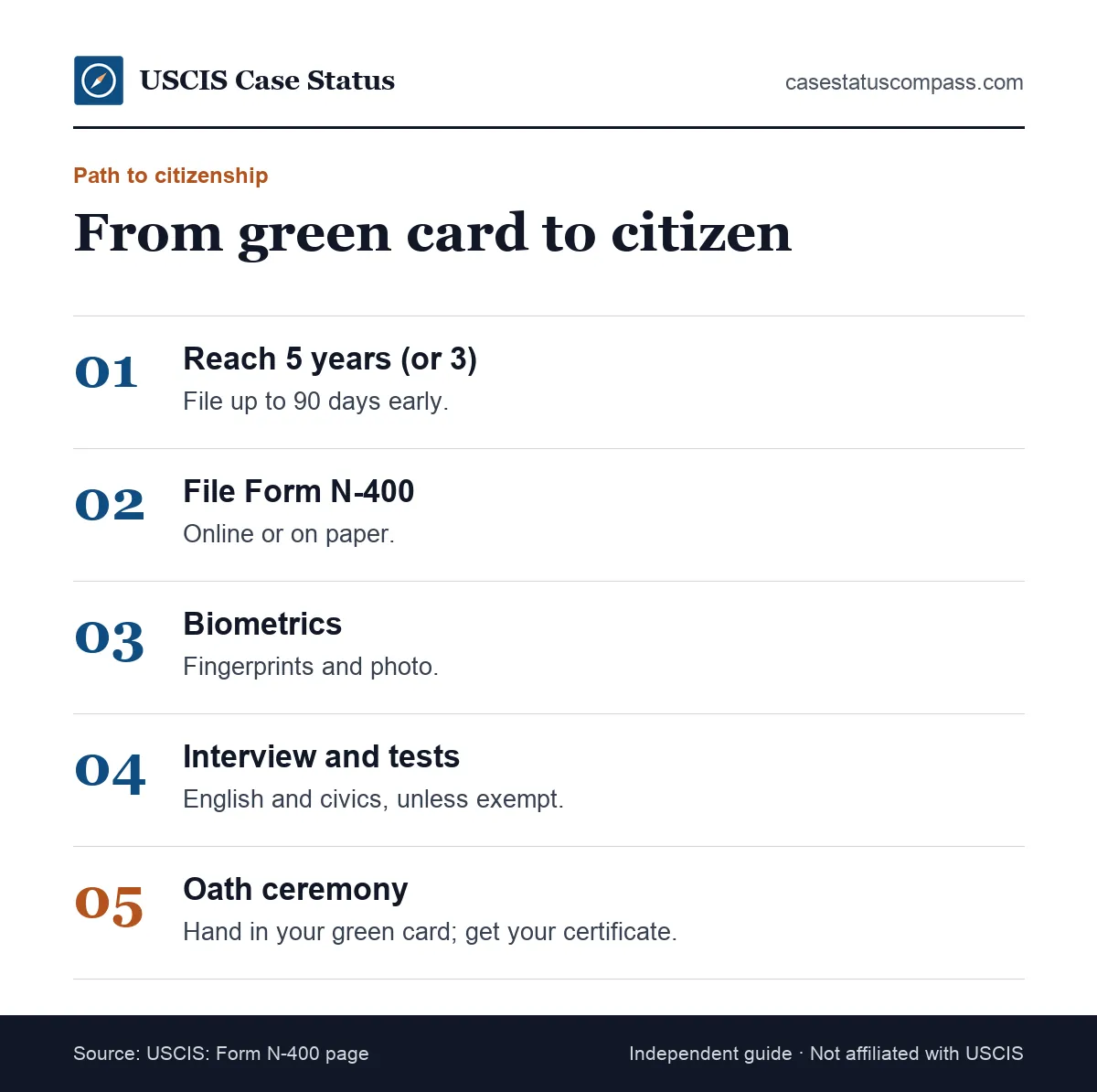
Most permanent residents can apply to become U.S. citizens after 5 years, or 3 years if married to and living with a U.S. citizen. You can file the N-400 up to 90 days before you reach 5 years (or 3 years if married to a U.S. citizen) as a permanent resident. The process uses Form N-400 and ends with a citizenship swearing-in (oath) ceremony.
The application
Our citizenship application guide covers eligibility, documents and filing. As of October 2026 the N-400 fee is $760 (paper) / $710 (online); reduced fee $380 (paper only) if household income is at or below 400% of the Federal Poverty Guidelines.
Timing
USCIS's median for N-400 cases was N-400: median 9.5 months (USCIS data, Apr.-June 2026). USCIS must decide a pending I-751 before or at the same time as the N-400.
What Is the General Provision for Citizenship?
The general provision is the standard path to citizenship for permanent residents who are not filing through marriage or military service. You need 5 years as a resident, continuous residence, enough physical presence, good moral character, and a passing result on the English and civics tests.
Requirements at a glance
- 5 years as a permanent resident (file up to 90 days early)
- Continuous residence, plus physical presence in the U.S. for at least 30 months of the 5 years (18 months of 3 years for spouses of U.S. citizens)
- 3 months living in the state or USCIS district where you file, right before filing
- Good moral character
- English and civics knowledge
When the general provision does not fit
Spouses of citizens may qualify after 3 years, and military members have special paths. The N-400 asks which basis you use. Check each path's rules before filing, because choosing the wrong one can lead to a denial and a lost fee.
Is Speaking English a Requirement for Citizenship?
Yes, for most applicants. English test: read 1 of 3 sentences and write 1 of 3 sentences correctly, and you must speak English during the interview. Older long-term residents may be exempt: 50/20: age 50+ with 20 years as a green card holder: no English test; 55/15: age 55+ with 15 years as a green card holder: no English test.
The civics test
2025 civics test: 20 questions from 128; pass with 12 correct. Our citizenship test guide has practice tips and the official question list. Study the version that applies to your filing date.
Medical exceptions
Applicants with a qualifying disability can ask a doctor to complete Form N-648. It can excuse the English and civics tests. File it with the N-400, and bring medical records to the interview in case the officer has questions.
Can You Apply for Citizenship Online?
Yes. Most permanent residents can file Form N-400 online, and the online fee is lower. You must file on paper if you ask for a reduced fee or a fee waiver. Reduced N-400 fee: request it in Part 10 of the paper N-400 (income at or below 400% of poverty).
Online account sign-up
Create an account at myaccount.uscis.gov/create-account; it will show your N-400 updates and notices. You can also link a paper-filed case with its receipt number, upload evidence and reply to requests online. Keep your login details private.
Where to apply in person
There is no walk-in office: you file online or by mail, then attend biometrics and an interview at USCIS offices. USCIS mails each appointment notice, so keep your address current and watch your online account.
How Can You Prove or Check Your Citizenship Status?
To prove citizenship status, use a U.S. passport, a Certificate of Naturalization or a Certificate of Citizenship. Those born in the U.S. use a birth certificate. If your N-400 is pending, check its progress with your receipt number in Case Status Online.
Lost proof of citizenship
Naturalized citizens can replace a certificate with Form N-565. Our naturalization certificate guide explains how. A U.S. passport also serves as proof of citizenship, and you can apply for one using your naturalization or citizenship certificate as evidence.
Children who became citizens through parents
Children who became citizens automatically may need a Certificate of Citizenship as proof. Our Form N-600 guide explains who qualifies. The rules depend on the law in force when the child met the conditions.
Can a Green Card or Citizenship Be Taken Away?
A green card can be taken away through removal by an immigration judge or if you abandon residence. Citizenship is much safer. Naturalized citizenship can be revoked only through denaturalization in federal court in limited cases, such as citizenship obtained by fraud or concealment.
Can the President Revoke Citizenship?
No president can revoke citizenship by order alone. Under 8 U.S.C. 1451, the government must bring a court case and prove the naturalization was illegally obtained or obtained by concealing facts or lying. A federal judge decides, and the process applies only to naturalized citizenship.
Giving up a green card voluntarily
Residents leaving for good can file Form I-407 to record giving up status, after getting tax and legal advice. Giving up status is permanent, and it can have tax consequences for long-term residents.
Do You Have to Pay for a Green Card?
Yes, most green card routes carry USCIS fees, and consular cases add State Department fees. For adjustment inside the U.S., the I-485 fee is $1,440 (paper) / $1,390 (online); $950 / $900 if under 14 and filing with a parent. Fees are set by the G-1055 schedule dated 10/16/26. USCIS fees are nonrefundable, even if your case is denied or withdrawn.
Fees after you have the card
Renewal costs $465 (paper) / $415 (online). Removing conditions costs $750 (paper) / $700 (online). To estimate green card costs in full, use our green card cost guide. Fees change, so check G-1055.
Fee waivers
Fee waiver: means-tested benefit, income at or below 150% of poverty guidelines, or financial hardship. Not every form can be waived, so check our fee waiver guide first. Fee waivers are filed on paper.
Your First Year as a Permanent Resident
The first year sets up good records for everything later. Check your card for errors, update your address, file taxes as a resident and plan trips carefully. Keep a copy of every notice in one folder. Each habit makes the later citizenship application easier.
Right after the card arrives
Check your name, birth date and category code. Errors caused by USCIS can be fixed with Form I-90 at no fee. Make a photocopy and store the original safely.
Ongoing habits
- Note every trip abroad with dates
- Keep tax returns and pay stubs
- Set a reminder for card expiry or the I-751 window
These records answer most questions on Form N-400 years later.
Common Mistakes Permanent Residents Make
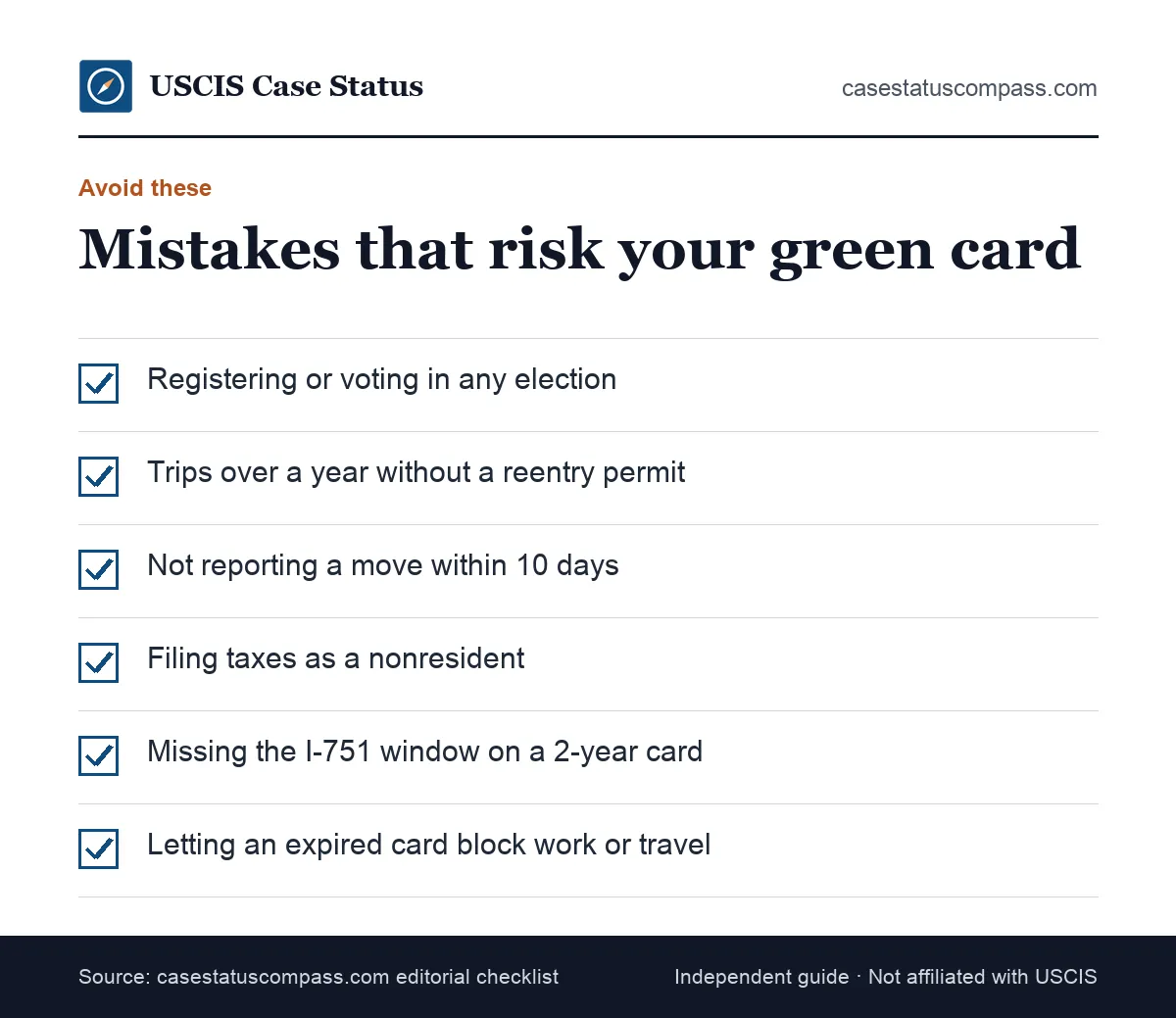
The most damaging mistakes are voting, staying abroad too long without a reentry permit, filing taxes as a nonresident and missing the I-751 deadline. Smaller slips, like not reporting a move, can still delay later applications. Each is easy to avoid with a simple record.
Mistakes with travel
Leaving for more than a year without a reentry permit is the classic error. Another is many long trips in a row, which can make officers ask whether you still live here.
Mistakes with paperwork
Missing an address change, letting a card expire or skipping the I-751 window can each cause months of delay. Keep your card, your notices and your address current, and check every form against your records.
Where Can You Find Trustworthy Immigration Help?
For trustworthy immigration information and immigration legal services, use a licensed attorney or a representative accredited by the Department of Justice at a recognized nonprofit. Many nonprofits offer free or low-cost help. Avoid "notarios" or consultants who are not authorized to give legal advice.
Free and low-cost help
For free immigration info on your options, search the Justice Department's list of recognized organizations and accredited representatives. Local bar associations also run referral services. Ask about fees before your first meeting.
Warning signs
- Promises of guaranteed results
- Requests for cash with no receipt
- Advice to lie on a form
Frequently Asked Questions
What does permanent resident mean?
A permanent resident is a person who is not a U.S. citizen but has been granted the right to live and work in the United States permanently. It lasts for life unless you give it up, abandon it through long absences or are ordered removed.
Can a permanent resident vote?
No. USCIS states that permanent residents cannot vote in federal, state or local elections. Registering or voting can lead to removal and can block citizenship later.
Do immigrants have a green card?
Not all of them. Only immigrants who became permanent residents have green cards; others hold temporary visas, parole or a pending application. Naturalized citizens also no longer have green cards because they hand them in at the oath ceremony.
Where do you get a green card?
You do not pick one up at an office. USCIS approves your case, then mails the card to your address. People applying for a green card from the USA use Form I-485; people abroad get an immigrant visa and receive the card by mail after arriving.
Can a permanent resident sponsor a sibling?
No. Only U.S. citizens who are 21 or older can petition for brothers and sisters. A permanent resident can sponsor a spouse and unmarried children. Becoming a citizen widens the list of relatives you can sponsor.
Is a green card the same as a work permit?
No. A green card shows permanent residence and already lets you work. A work permit, or EAD, is a separate card for people without permanent residence, such as adjustment applicants.
Can a permanent resident get a U.S. passport?
No. A U.S. passport is only for citizens, so residents travel on their home country's passport and show the green card on return. Once you naturalize through Form N-400, you can apply for a U.S. passport.
How do I get a green card stamp if my card is lost?
Call the USCIS Contact Center and ask for an ADIT (I-551) stamp appointment or mail option. The stamp is temporary proof of status while your Form I-90 replacement is processed.
Sources
- USCIS: Rights and Responsibilities of a Green Card Holder (Permanent Resident). www.uscis.gov/green-card/after-we-grant-your-green-card/rights-and-responsibilities-of-a-green-card-holder-permanent-resident. Accessed Oct 27, 2026.
- USCIS: International Travel as a Permanent Resident. www.uscis.gov/green-card/after-we-grant-your-green-card/international-travel-as-a-permanent-resident. Accessed Oct 27, 2026.
- USCIS Policy Manual Vol. 12, Part D, Ch. 3 (Continuous Residence). www.uscis.gov/policy-manual/volume-12-part-d-chapter-3. Accessed Oct 27, 2026.
- Form I-131 Instructions (reentry permits). www.uscis.gov/sites/default/files/document/forms/i-131instr.pdf. Accessed Oct 27, 2026.
- USCIS: Replace Your Green Card. www.uscis.gov/green-card/after-we-grant-your-green-card/replace-your-green-card. Accessed Oct 27, 2026.
- USCIS Glossary: Green Card. www.uscis.gov/tools/glossary. Accessed Oct 27, 2026.
- USCIS: Form N-400 page. www.uscis.gov/n-400. Accessed Oct 27, 2026.
- USCIS Contact Center. www.uscis.gov/contactcenter. Accessed Oct 27, 2026.
- 8 U.S.C. 1451: Revocation of Naturalization (LII). www.law.cornell.edu/uscode/text/8/1451. Accessed Oct 27, 2026.
- USCIS Form G-1055 Fee Schedule, Edition 10/16/26. www.uscis.gov/sites/default/files/document/forms/g-1055.pdf. Accessed Oct 27, 2026.
- State Department Visa Bulletin for November 2026. travel.state.gov/content/travel/en/legal/visa-law0/visa-bulletin.html. Accessed Oct 27, 2026.
- Form I-485 Instructions, Edition 09/18/26. www.uscis.gov/sites/default/files/document/forms/i-485instr.pdf. Accessed Oct 27, 2026.
- USCIS: How Do I Request Premium Processing? (updated 03/23/2026). www.uscis.gov/forms/all-forms/how-do-i-request-premium-processing. Accessed Oct 27, 2026.
- USCIS: Removing Conditions on Permanent Residence Based on Marriage. www.uscis.gov/green-card/after-we-grant-your-green-card/conditional-permanent-residence/removing-conditions-on-permanent-residence-based-on-marriage. Accessed Oct 27, 2026.
- USCIS: How to Change Your Address (updated 08/04/2026); 8 U.S.C. 1305(a) (LII). www.uscis.gov/addresschange. Accessed Oct 27, 2026.
- 8 CFR 223.3(c) (govinfo, CFR 2025 edition). www.govinfo.gov/content/pkg/CFR-2025-title8-vol1/xml/CFR-2025-title8-vol1-sec223-3.xml. Accessed Oct 27, 2026.
- Form I-90 Instructions, Edition 01/20/25. www.uscis.gov/sites/default/files/document/forms/i-90instr.pdf. Accessed Oct 27, 2026.
- USCIS Data Library: All USCIS Application and Petition Form Types, FY2026 Q3 (Apr. 1-June 30, 2026; queried 7/2026). www.uscis.gov/sites/default/files/document/data/quarterly_all_forms_fy2026_q3_v1.xlsx. Accessed Oct 27, 2026.
- USCIS: Form I-131A page (updated 06/03/2026). www.uscis.gov/i-131a. Accessed Oct 27, 2026.
- USCIS alert: Additional Mail Delivery Process for Receiving ADIT Stamp (Mar. 16, 2023; archived). www.uscis.gov/newsroom/alerts/uscis-announces-additional-mail-delivery-process-for-receiving-adit-stamp. Accessed Oct 27, 2026.
- USCIS M-274 Handbook for Employers, 7.1 (updated 10/17/2023). www.uscis.gov/i-9-central/form-i-9-resources/handbook-for-employers-m-274/70-evidence-of-employment-authorization-for-certain-categories/71-lawful-permanent-residents-lpr. Accessed Oct 27, 2026.
- USCIS Policy Manual Vol. 11, Part A, Ch. 3. www.uscis.gov/policy-manual/volume-11-part-a-chapter-3. Accessed Oct 27, 2026.
- USCIS: Checking Your Case Status Online. www.uscis.gov/tools/checking-your-case-status-online. Accessed Oct 27, 2026.
- USCIS Glossary: USCIS Number. www.uscis.gov/glossary-term/50674. Accessed Oct 27, 2026.
- USCIS Policy Manual Vol. 12, Part G, Ch. 5. www.uscis.gov/policy-manual/volume-12-part-g-chapter-5. Accessed Oct 27, 2026.
- USCIS Policy Manual Vol. 12, Part D, Ch. 1; Part G, Ch. 1 (current as of Oct. 23, 2026). www.uscis.gov/policy-manual/volume-12-part-d-chapter-1. Accessed Oct 27, 2026.
- USCIS: Study for the Test. www.uscis.gov/citizenship/find-study-materials-and-resources/study-for-the-test. Accessed Oct 27, 2026.
- USCIS Policy Manual Vol. 12, Part E, Ch. 2. www.uscis.gov/policy-manual/volume-12-part-e-chapter-2. Accessed Oct 27, 2026.
- Form N-400 Instructions, Edition 01/20/25. www.uscis.gov/sites/default/files/document/forms/n-400instr.pdf. Accessed Oct 27, 2026.
- USCIS: Online Account and Technical Support. www.uscis.gov/tools/uscis-tools-and-resources/online-account-and-technical-support. Accessed Oct 27, 2026.
- USCIS: Filing Fees (updated 02/12/2026). www.uscis.gov/forms/filing-fees. Accessed Oct 27, 2026.
- Form I-912 Instructions, Edition 07/22/25. www.uscis.gov/sites/default/files/document/forms/i-912instr.pdf. Accessed Oct 27, 2026.
casestatuscompass.com is an independent publication and is not affiliated with USCIS or any government agency. This page is general information, not legal advice. For denials, court or asylum matters, consult an immigration attorney or a DOJ-accredited representative.