Contents · 44 sections
- What Is the Green Card Number?
- Where Is the Green Card Document Number?
- Is an Older-Design Green Card Still Valid?
- Where Can I Find My Green Card Number?
- Is the Card Number on the Front or the Back?
- Green Card Document Number vs Alien Number
- What Does "Alien Card Number" Mean on a Green Card?
- What Is a U.S. Resident Alien Card Number?
- Is the I-551 Number the Same as the Green Card Number?
- How Is the Card Number Different From a Receipt Number?
- Is the Category Code Part of the Document Number?
- When Do You Need Your Green Card Number?
- How Does Form I-9 Use the Card's Document Number?
- Does an Expiring Green Card Require a New Form I-9?
- What If You Only Have an I-551 Stamp or Immigrant Visa?
- Which Number Goes on Form I-9 for an Immigrant Visa?
- Can You Look Up a Permanent Resident Card Number Online?
- How Do You Get a Card Number Back After Losing the Card?
- What Happens to the Card Number When You Renew?
- What If You Have a Conditional Green Card?
- What If Your Card Number Is Unreadable or Damaged?
- What If the Number or Other Data on Your Card Is Wrong?
- What If an Employer Typed Your Card Number Wrong?
- Does Each Family Member Have Their Own Card Number?
- Do Children Need a New Green Card at Age 14?
- What If Your Card Never Arrived?
- How Long Does One Card Number Stay Valid?
- Can an Expired Card and a Receipt Notice Prove Status?
- Does the Card Number Prove Your Immigration Status?
- Can You Give a Photocopy Instead of the Card?
- How Should You Store Your Card Number?
- Which Number Does This Form Want?
- How Is the Permanent Resident Card Number Different From an EAD Number?
- Do Green Card Holders Still Need an EAD?
- How Is the Card Number Different From the I-94 Number?
- Can Someone Misuse Your Card's Document Number?
- What Should You Do If Your Green Card Is Stolen?
- How Do You Spot a Fake Green Card or Card Number?
- Do You Keep Your Card Number After Becoming a Citizen?
- What Should You Do If You Find Two Different Numbers on Your Card?
- What Do the Machine-Readable Lines on the Back Mean?
- Green Card Number Mistakes to Avoid
- When Should You Get Help With a Card Number Issue?
- Frequently Asked Questions
The short answer
Your green card number is the document number of your Permanent Resident Card (Form I-551). It identifies that one card, not you. On current cards it is printed on the back, separate from the USCIS# on the front, which is your A-Number. A replacement card gets a new number.
At a glance
| Other names | Card number, document number, I-551 card number, permanent resident card number |
| Where on current cards | Printed on the back, apart from the machine-readable lines (layouts vary by design) |
| Starts with | Letters, then digits. The USCIS# on the front has no letters except an optional A |
| Changes when | You get any new card: renewal, replacement or removal of conditions |
| Not the same as | Your A-Number or any USCIS receipt number |
What Is the Green Card Number?
The green card number is the unique document number printed on one Permanent Resident Card. Officials call the card Form I-551, so the code is also called the I-551 document number. It tells an employer or agency which physical card you hold.
A number for the card, not the person
Think of it like a passport book number: each card made for you carries its own code, while you stay the same person.
So when a form asks for the card number, the answer depends on which card you hold today.
Why the card needs its own number
A single permanent resident may hold several cards over a lifetime: a conditional card, a 10-year card, and replacements. A card-level number lets officials confirm that the card in your hand is current and was issued to you, not reported lost or replaced.
Where Is the Green Card Document Number?
On current cards, the green card document number is printed on the back of the card. The front holds your photo, name, USCIS#, category and dates. Layouts change with each redesign, so read your card's labels.
Check the back of the card first.
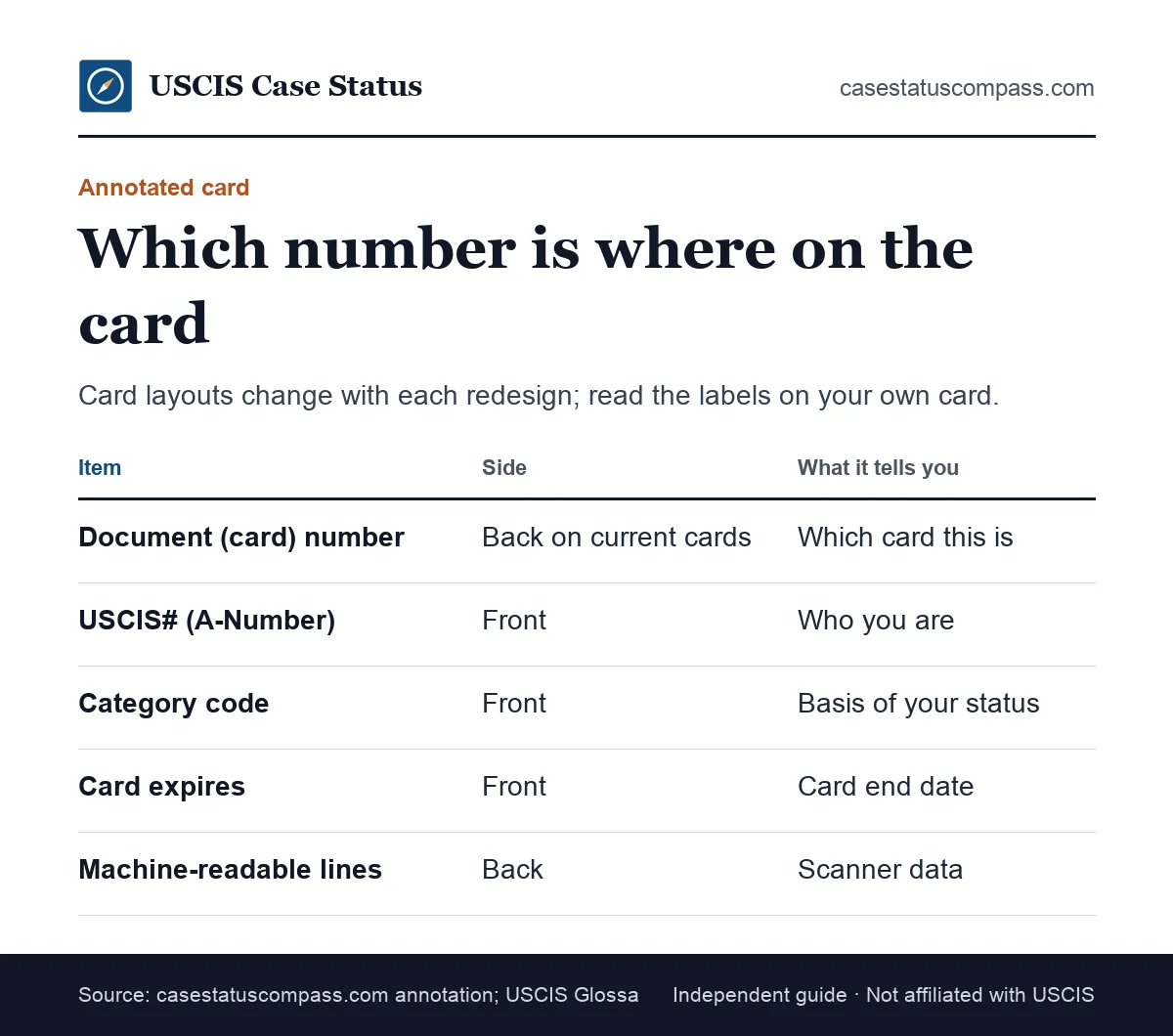
Current card design
Flip the card over. Below or beside the coded lines, you will see a printed number that begins with letters. USCIS's own I-9 pages show sample images but, as of October 2026, do not describe this placement in words.
Older card designs
Earlier designs placed numbers differently. Some showed the card number on the front, and the oldest cards may have no separate document number at all.
If yours looks different, read every label before copying.
Is an Older-Design Green Card Still Valid?
Yes, until the expiration date printed on it. USCIS's I-9 page notes that cards issued after a redesign may still use the previous design while older card stock runs out, so a newer card can look like an older one. Both designs stay valid until the card expires.
Comparing your card with USCIS samples
If your card does not match the current design, compare it with the sample images on USCIS's I-9 acceptable documents page, which show current and previous designs side by side.
Where Can I Find My Green Card Number?
You can find your green card number on the card itself, usually on the back of current designs. If you do not have the card, check a photocopy, an employer's I-9 records, or an attorney's file. USCIS does not print the card number on most notices.
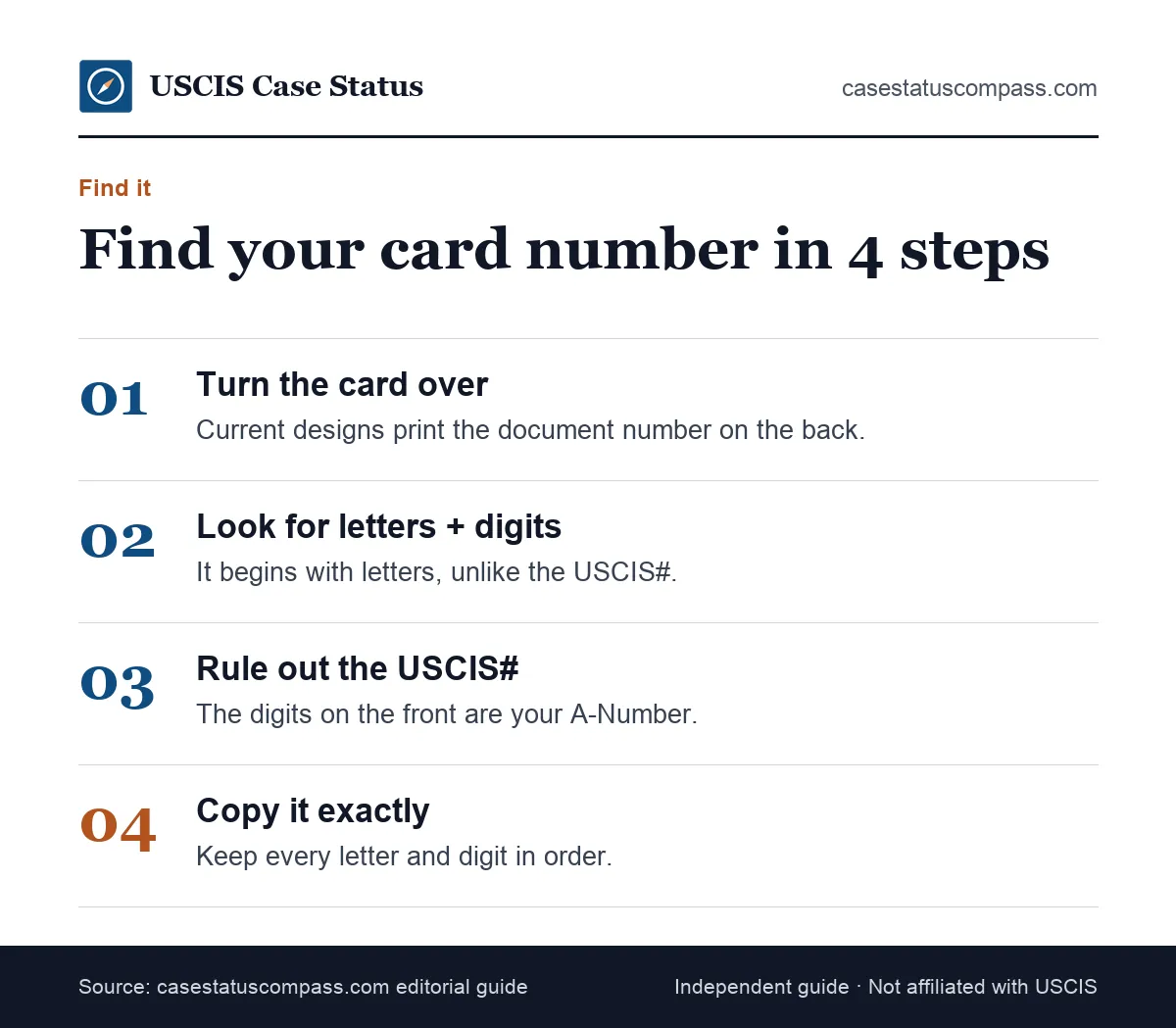
On the physical card
Hold the card under good light and turn it over. Letters like O and digits like 0 look alike, so copy the printed number slowly and check it twice.
Write it down once and keep it with your records.
When the card is not with you
- A scan or photo you saved of the back of the card
- Copies your employer kept with your Form I-9
- Copies in your attorney's or sponsor's records
Copy only from a clear image.
Is the Card Number on the Front or the Back?
On current designs, the card's document number is on the back and the USCIS# is on the front. This split is the main source of confusion: many people copy the front digits when a form wants the back code.
What the front shows
The front lists:
- Name, photo and USCIS#
- Category and country of birth
- Date of birth and sex
- "Card Expires" and "Resident Since" dates
None of those is the card's document number.
What the back shows
The back shows the Form I-551 title, the document number, and three lines of machine-readable characters. Copy the printed document number, not a string of characters from the coded lines.
Green Card Document Number vs Alien Number
The green card document number identifies one card and changes with each new card. The alien number identifies you and never changes. On Form I-9, the A-Number goes in Section 1, while the employer records the card's document number in Section 2.
The short comparison
The table compares the card's document number with the A-Number on four points that matter on forms.
| Green card document number | A-Number (USCIS#) | |
|---|---|---|
| Identifies | This one card | You, for life |
| Printed | Back of current cards | Front, after USCIS# |
| After a replacement | New number | Same number |
| Form I-9 use | Section 2, by the employer | Section 1, by you |
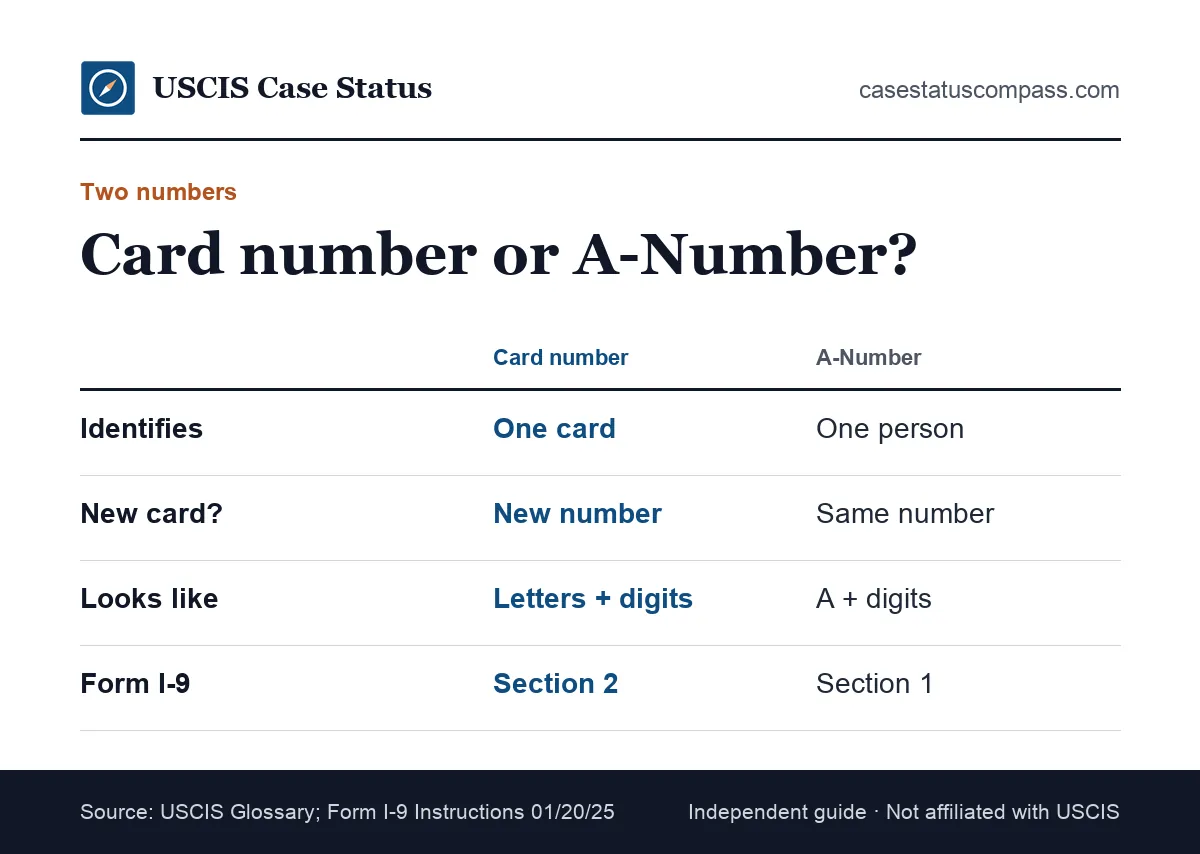
Read more about the A-Number
Our guide to the alien number explains where else the A-Number appears, such as on work permits and immigrant visas, and what to do if you never received one.
It also covers what to do about mismatches.
What Does "Alien Card Number" Mean on a Green Card?
"Alien card number" is an informal phrase that usually means the green card's document number. Some people use it for the A-Number instead, so read the form's label. If it says "card number" or "document number", give the code from the card, not the USCIS#.
Where the phrase comes from
Older cards were called Alien Registration Cards. The Form I-90 instructions still refer to a "prior edition of the Alien Registration Card." That old name explains why some people still ask for an "alien card number" today.
How to decide which one is meant
- "Card number" or "document number": the card's code
- "Alien number", "A-Number" or "USCIS#": the digits after USCIS#
- "Alien card number" with nine boxes and no letters: likely the A-Number
- Still unsure: ask the person or agency that gave you the form
What Is a U.S. Resident Alien Card Number?
A U.S. resident alien card number is the same as the green card document number. "Resident alien card" is an older, everyday name for the Permanent Resident Card.
If a form uses that phrase, give the document number printed on your card, not the USCIS# on the front.
Names for the same card
- Green card
- Permanent Resident Card
- Form I-551
- Resident alien card
- Alien Registration Card, for older editions
Each name refers to the same plastic card, so any "number" request using these words points to its document number.
Names for the same number
Card number, document number, I-551 card number, permanent resident card number and resident alien card number all describe the code that identifies one card. Only "USCIS#" and "A-Number" refer to the person-level number on the front.
Is the I-551 Number the Same as the Green Card Number?
Usually, yes. When a form asks for an I-551 card number or I-551 document number, it wants the green card's document number. One exception: a temporary I-551 stamp in a passport has its own number, which is not a card number.
The card and the form name
"I-551" is simply the official form number of the green card itself. So every "I-551 number" points to the same printed code on the card.
No separate I-551 number exists.
The I-551 stamp is different
An ADIT stamp, also called an I-551 stamp, is temporary proof placed in a passport or on an I-94. As of October 2026, USCIS describes it this way: I-551/ADIT stamp: temporary proof of green card status; request through the USCIS Contact Center (800-375-5283). Read more about the i 551 stamp and when you need one.
How Is the Card Number Different From a Receipt Number?
A receipt number tracks one application, such as your Form I-485 or I-90, and appears on your I-797 notices. The card number identifies the card that application produced. Case status tools use the receipt number. Card checks use the card number.
Receipt numbers belong to filings
As of October 2026, USCIS describes the receipt number format as 3 letters + 10 digits (13 characters), e.g. EAC2512345678; leave out dashes. Each new filing gets a new one. Our guide to the uscis receipt number explains the prefixes and where to find it on a notice.
Why the two can look alike
Both numbers start with letters and continue with digits, so they are easy to confuse. The location tells them apart: the receipt number is on a paper notice, while the card number is printed on the card itself.
Is the Category Code Part of the Document Number?
No. The category code, such as IR1, CR1 or IR5, shows the legal basis of your permanent residence. It sits on the front of the card under the USCIS#. It is not part of the document number, and forms ask for it in a separate box.
Common category examples
The table lists a few common category codes you may see and what each one usually means.
| Code example | What it usually means |
|---|---|
| IR1 / CR1 | Spouse of a U.S. citizen (CR = conditional) |
| IR2 / CR2 | Child of a U.S. citizen |
| IR5 | Parent of an adult U.S. citizen |
| DV1 | Diversity visa lottery winner |
Why the code matters
Agencies use the category to understand your status, and a "CR" code tells them your card is conditional. If you hold a 2-year card, you must remove conditions before it expires. See the conditional card section below.
When Do You Need Your Green Card Number?
You need your green card number when someone must verify the specific card you hold. The most common case is Form I-9 at a new job. Motor vehicle offices, airlines, benefit agencies and attorneys may also ask for it.
Have the original card with you, since most offices check it in person.
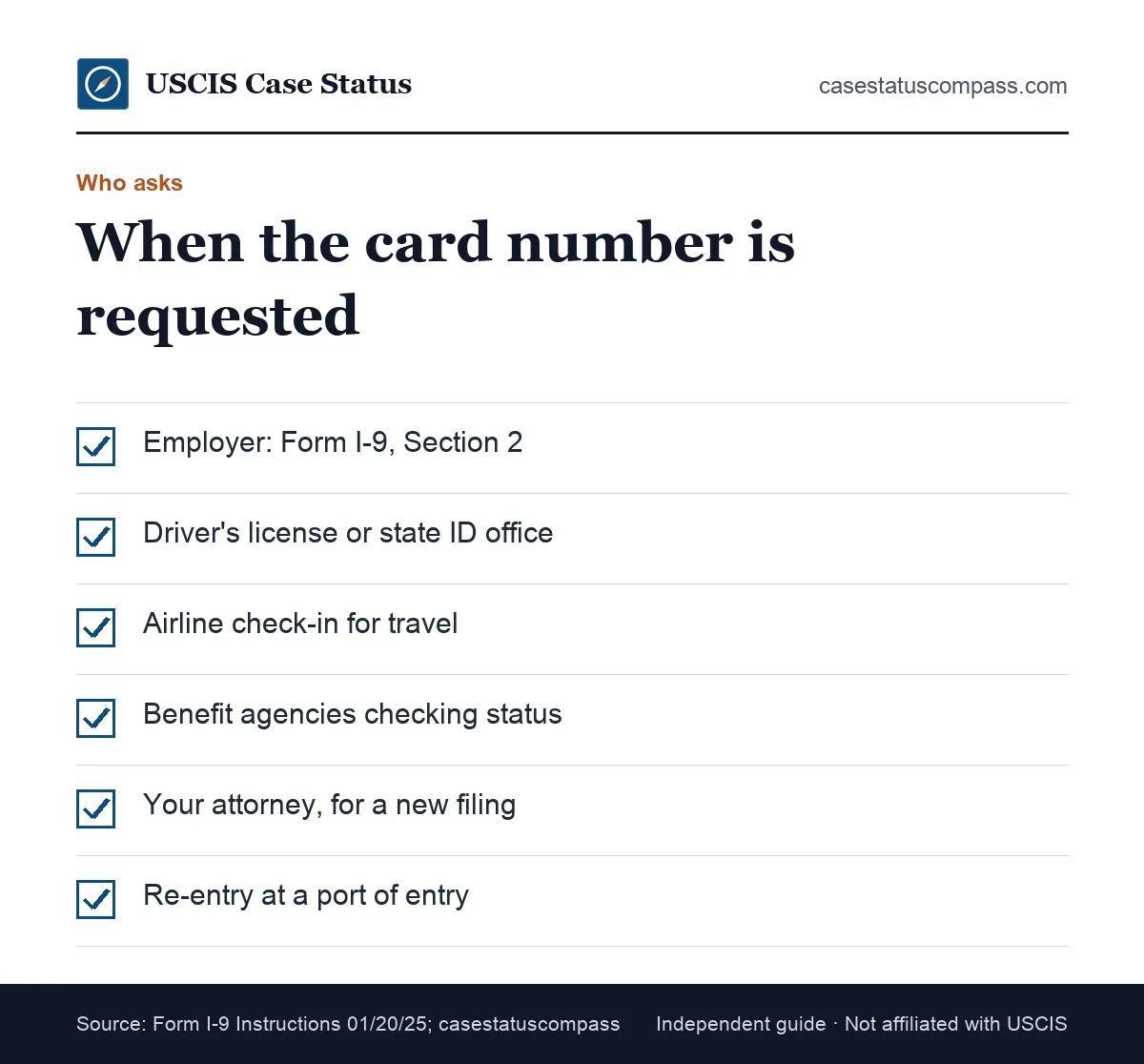
At a new job
Your employer examines your card and records the document title, issuing authority, document number and expiration date in Section 2 of Form I-9. You do not write the card number in Section 1.
At a DMV, airline or benefits office
Offices that may record your card number:
- State driver's license and ID offices
- Airlines checking travel documents
- Agencies that verify immigrant status for benefits
Bring the physical card, since rules differ by agency and state.
How Does Form I-9 Use the Card's Document Number?
On Form I-9, the green card is a List A document, which proves both identity and work authorization. The employer records its document number and expiration date in Section 2. The employee enters the separate USCIS Number (A-Number) in Section 1.
What the employee enters
According to the I-9 instructions (edition 01/20/25), a lawful permanent resident enters their "7- to 9-digit USCIS Number (A-Number)" in Section 1. Leave the card's document number for the employer's section.
Does an Expiring Green Card Require a New Form I-9?
No, not normally. The I-9 instructions say employers should not reverify permanent residents who presented a Permanent Resident Card. Your status does not end with the card's expiration date, and your current employer's I-9 stays on file.
Renew it on time anyway, as explained below.
Why you still want a valid card
An expiring card does not trigger a new I-9 at your current job, but you will want a valid card for travel and for any new employer.
You can file Form I-90 up to six months before expiration.
What If You Only Have an I-551 Stamp or Immigrant Visa?
If you have no physical card yet, you have no card number yet. Temporary proof, such as an I-551 stamp or a stamped immigrant visa, uses its own document details. The card number appears only when the actual card is printed and mailed.
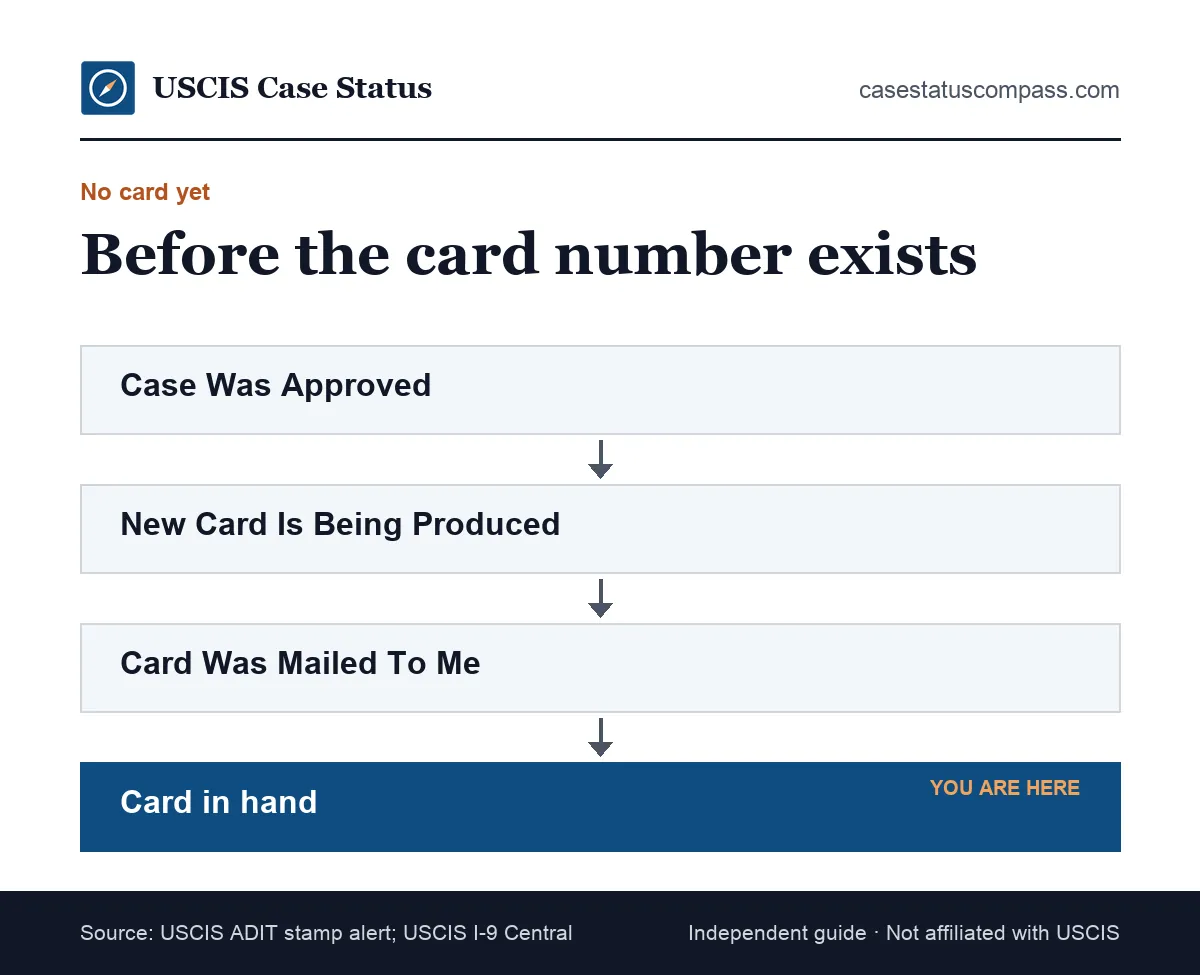
Watching for the card
Track the card through your case status. The new card is being produced update means printing has started. When it changes to card was mailed to me, watch your mail and check the delivery address USCIS has.
Which Number Goes on Form I-9 for an Immigrant Visa?
New immigrants often use the stamped immigrant visa in their passport until the card arrives. For Form I-9, USCIS I-9 Central tells employers to enter the number printed in red under the visa's "Expires On" date as the document number. That red number is not a green card number.
Can You Look Up a Permanent Resident Card Number Online?
There is no public permanent resident card number lookup online. USCIS does not let the public search card numbers by name. Employers and government agencies verify cards through restricted government systems, and only after you present the card or consent to the check.
How official checks work
Two restricted federal systems handle card checks:
- E-Verify, for enrolled employers after Form I-9 is complete
- A separate verification service for benefit agencies
Neither system is open to the public or to private websites.
Avoid lookup websites
Any site that claims to find your card number from your name is guessing or collecting your data. If you lost the number, the safest way to get a valid one is to replace the card.
How Do You Get a Card Number Back After Losing the Card?
If you lose your card, the old card number is no longer useful, because that card can be reported lost. You replace the card with Form I-90, and the new card arrives with a new document number. As of October 2026, the I-90 fee is $465 (paper) / $415 (online).
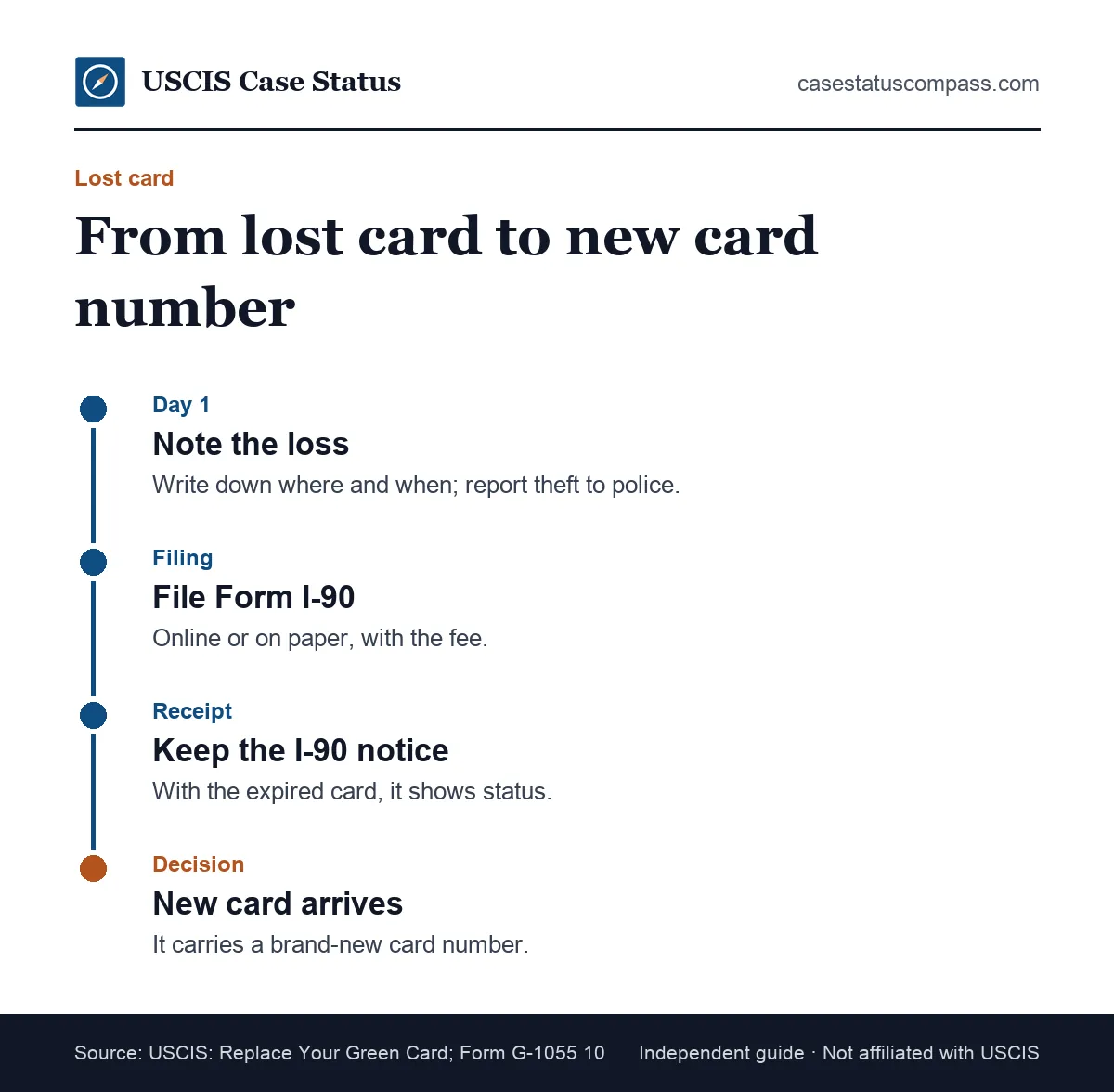
Filing Form I-90
Have your A-Number ready, because the I-90 asks for it in Part 1. Our green card renewal guide walks through the I-90 steps, documents and fee rules.
Keep a copy of the receipt.
Proof of status while you wait
As of October 2026, USCIS states: I-90 receipt notice + expired card = proof of status for 36 months from the card's expiration date. Keep the receipt with the expired card.
Asking for an ADIT stamp
If you have no card at all and need proof for travel or work, ask about an ADIT stamp through the Contact Center at 800-375-5283.
Explain why you need proof before the new card arrives.
What Happens to the Card Number When You Renew?
When you renew a green card, the new card has a new document number. Your A-Number, category and Resident Since date carry over, but any employer or agency that needs the card number will need the new one.
Note the new number and update anyone who recorded the old one.
Renewal timing and validity
As of October 2026, USCIS states: Most green cards are valid for 10 years; conditional green cards for 2 years. A 10-year card is renewed with Form I-90.
Check the expiration date on your card.
Swapping an old card edition
Some older cards have no expiration date, and Form I-90 also lets you swap an old card edition for a current one. The swapped card gets a new document number like any other new card.
Updating records after renewal
- Give your employer the new card only if they ask; reverification is not usually required
- Update your state ID or driver's license records at the next renewal
- Replace saved photos of the old card with the new one
What If You Have a Conditional Green Card?
A conditional green card is valid for two years and has its own card number. When you file Form I-751 to remove conditions and are approved, USCIS issues a 10-year card with a different document number. The receipt notice bridges the gap.
Filing window and extension
As of October 2026, USCIS says to file Form I-751 in this window: File in the 90 days before your 2-year card expires.
Mark the window on a calendar so you do not file too early or too late.
Carrying the I-751 receipt
After filing, I-751 receipt notice extends conditional status and work authorization for 48 months. Carry the receipt notice with your expired card.
Show both together when proving status at work or travel.
Fees and next steps
As of October 2026, the I-751 fee is $750 (paper) / $700 (online). Our Form I-751 guide covers evidence, interviews and what happens if your marriage ended.
Check the current fee on the G-1055 schedule before filing.
What If Your Card Number Is Unreadable or Damaged?
If the document number is scratched, faded or unreadable, the card may not pass verification. A damaged card should be replaced with Form I-90. Until then, an employer may not accept it, and you may need temporary proof for travel.
Signs the card needs replacing
- Number or photo cannot be read clearly
- Card is cracked, peeling or bent
- Machine-readable lines are scratched off
A card with any of these problems may be refused by employers or at the border.
Temporary steps
Keep a clear copy of both sides, even of the damaged card. File the I-90 and keep the receipt notice.
Carry the receipt with the damaged card when you need to prove status.
Travel before the new card arrives
If you must travel before the new card arrives, request an ADIT stamp. The contact USCIS guide explains how to ask.
Ask well before your trip, because stamp appointments are not always available right away.
What If the Number or Other Data on Your Card Is Wrong?
If your card shows a wrong name, birth date or other error, file Form I-90 to correct it. The corrected card will carry a new document number, so update anyone who recorded the old one.
Check each detail when a new card arrives.
Errors USCIS made
The fee note for Form I-90 says there is no charge when the card has a USCIS error. Include proof of the correct details and a copy of the incorrect card.
What If an Employer Typed Your Card Number Wrong?
Sometimes the card is correct but an employer or agency typed the number wrong. Ask them to fix their record, and bring the card so they can compare each character with what they entered.
Ask for a corrected copy for your records.
No new card needed
You do not need a new card or Form I-90 when the mistake is on someone else's form. Keep a copy of the corrected record.
A typo on an employer's or agency's record does not change the number printed on your card.
Does Each Family Member Have Their Own Card Number?
Yes. Every permanent resident, including each child, receives their own card with their own document number. Never use a spouse's or child's card number on your own form.
Each card is tied to one person's record.
Keeping family cards organized
Store each card copy in a folder labelled with the person's name. When a child's card is renewed or replaced, swap in the new copy right away so no one gives an old number.
Do Children Need a New Green Card at Age 14?
In many cases, yes. USCIS asks permanent residents who turn 14 to replace their card with Form I-90. The new card has a new number, so update school or job records that list the old one.
Check the I-90 instructions first for the exact timing.
When the age-14 replacement is free
As the I-90 fee note explains, there is no fee if the card expires after the child's 16th birthday. Check the card's expiration date before you pay.
Paying when not required wastes money.
What If Your Card Never Arrived?
If USCIS approved your case but the card never arrived, you have no card number to give yet. Check your case status first, then confirm your mailing address. If the card was mailed and lost, contact USCIS; you may need to file Form I-90.
Check the status message
Use Case Status Online: egov.uscis.gov with your receipt number. A "card was returned" message means the post office sent it back. Our card returned to USCIS page explains what to do next.
When to file a replacement
The I-90 fee note lists a card you never received as one case with no fee. Before you file, confirm with USCIS that the card was not returned, because a returned card may simply be mailed again to your corrected address.
How Long Does One Card Number Stay Valid?
A card's document number stays valid only as long as that card. Most cards last 10 years and conditional cards last two, according to USCIS. When the card expires or is replaced, its number stops being useful for verification, even though your status may continue.
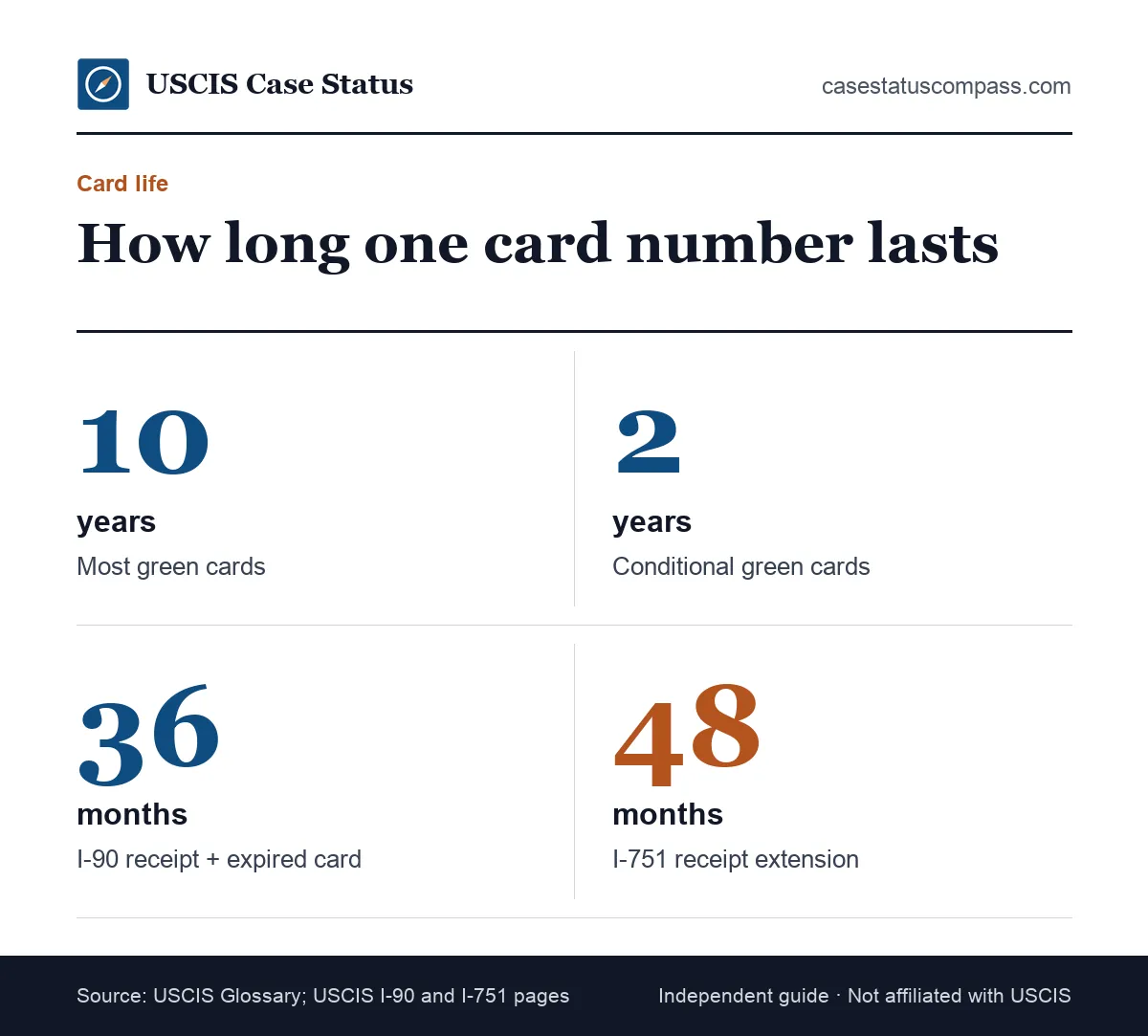
Can an Expired Card and a Receipt Notice Prove Status?
Yes, for a set period. An expired card plus the right receipt notice can still prove status. Show both papers together, because neither one works alone.
Keep the receipt with the card, and check the extension period printed on the notice before traveling or starting a new job.
The I-90 receipt extension
For an I-90, I-90 receipt notice + expired card = proof of status for 36 months from the card's expiration date. Conditional residents use the I-751 receipt in the same way.
Does the Card Number Prove Your Immigration Status?
No. The card number only identifies a card. Your permanent resident status comes from your approval and lives in your USCIS record under your A-Number. Status can continue after a card expires, and a valid-looking card does not protect status you have given up.
Status versus the document
Permanent residence does not end just because the card expires. If you are unsure about your status, talk to an attorney before you travel or file anything new.
A valid card simply makes it easier to prove.
Can You Give a Photocopy Instead of the Card?
For Form I-9, employers must examine the original card, not a photocopy. Other offices may accept a copy for their files after they see the original. A copy shows the card number, but it does not prove the card is genuine or current.
When a copy is enough
Attorneys, sponsors and some landlords may only need a copy for their records. Ask why they need it and how they will store it. Black out the number when the reader does not need it.
How Should You Store Your Card Number?
Store the card number in one safe place offline, such as a locked folder with copies of both sides of the card. A photo in an encrypted phone vault also works. Avoid saving it in unprotected email drafts, shared cloud folders or notes apps.
What to keep together
Keep the copy of your card next to your A-Number, your latest receipt notices and your passport details. If the card is lost, this folder gives you everything you need to file Form I-90 quickly.
Which Number Does This Form Want?
Most mistakes happen because the form's label is vague. Match the exact label to the right number using the tables below, which sort labels by what they point to.
Find the label in the left column, then copy the number from the place shown.
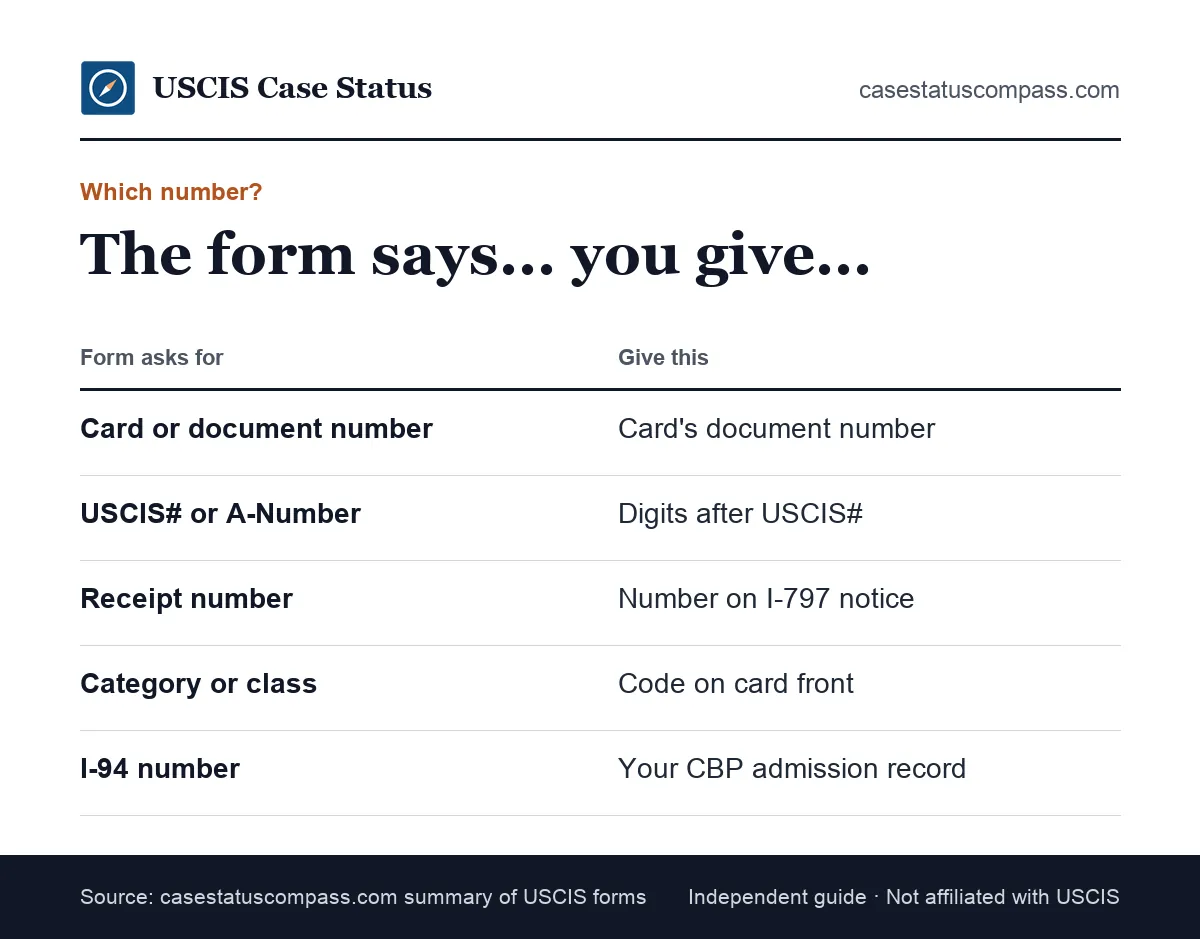
Labels that point to your card
These labels ask for the card's own document number, which changes with each new card.
| The form or person says | Give this number | Where to find it |
|---|---|---|
| "Green card number" or "card number" | Document number | Your card |
| "Document number" for an I-551 | Document number | Your card |
Labels that point to other records
These labels ask for a number about you or a filing, not the card itself.
| The form or person says | Give this number | Where to find it |
|---|---|---|
| "USCIS number" or "A-Number" | USCIS# | Front of your card |
| "Receipt number" or "case number" | Receipt number | Form I-797 notice |
| "Admission number" | I-94 number | Your CBP I-94 record |
When the label still confuses you
Ask the person who requested it, or check the form's instructions. If you still cannot tell, give both numbers and label each one clearly, such as "Card number" and "A-Number".
How Is the Permanent Resident Card Number Different From an EAD Number?
A work permit (EAD) is a different card with its own card number. Both cards show the same USCIS#, because that is your A-Number, but each card has its own document code.
Never mix the two cards' document numbers.
Which card to show your employer
Show the green card when you have it. It is a List A document on its own, so the employer does not need your EAD or any other document. Choosing which acceptable document to show is your right, not the employer's.
Do Green Card Holders Still Need an EAD?
No. A valid green card already proves work authorization on Form I-9. Many applicants hold an EAD while their Form I-485 is pending, then stop using it once the card arrives. Our work permit guide explains EAD categories.
Keep the old EAD with your immigration records.
How Is the Card Number Different From the I-94 Number?
The I-94 admission number is the record of your entry into the U.S., kept by U.S. Customs and Border Protection (CBP). It is not related to your card's document number. Most permanent residents do not need an I-94 number once they hold a card.
When you still see an I-94
You may see an I-94 if you entered on a nonimmigrant visa before adjusting status, or if an ADIT stamp was placed on an I-94. In both cases, the I-94 number is separate from the card's document number.
Can Someone Misuse Your Card's Document Number?
A card number alone is not enough to steal your immigration status, but combined with your name, birth date and photo it can help someone forge documents or pass identity checks. Treat the card number like a passport number and share it only when required.
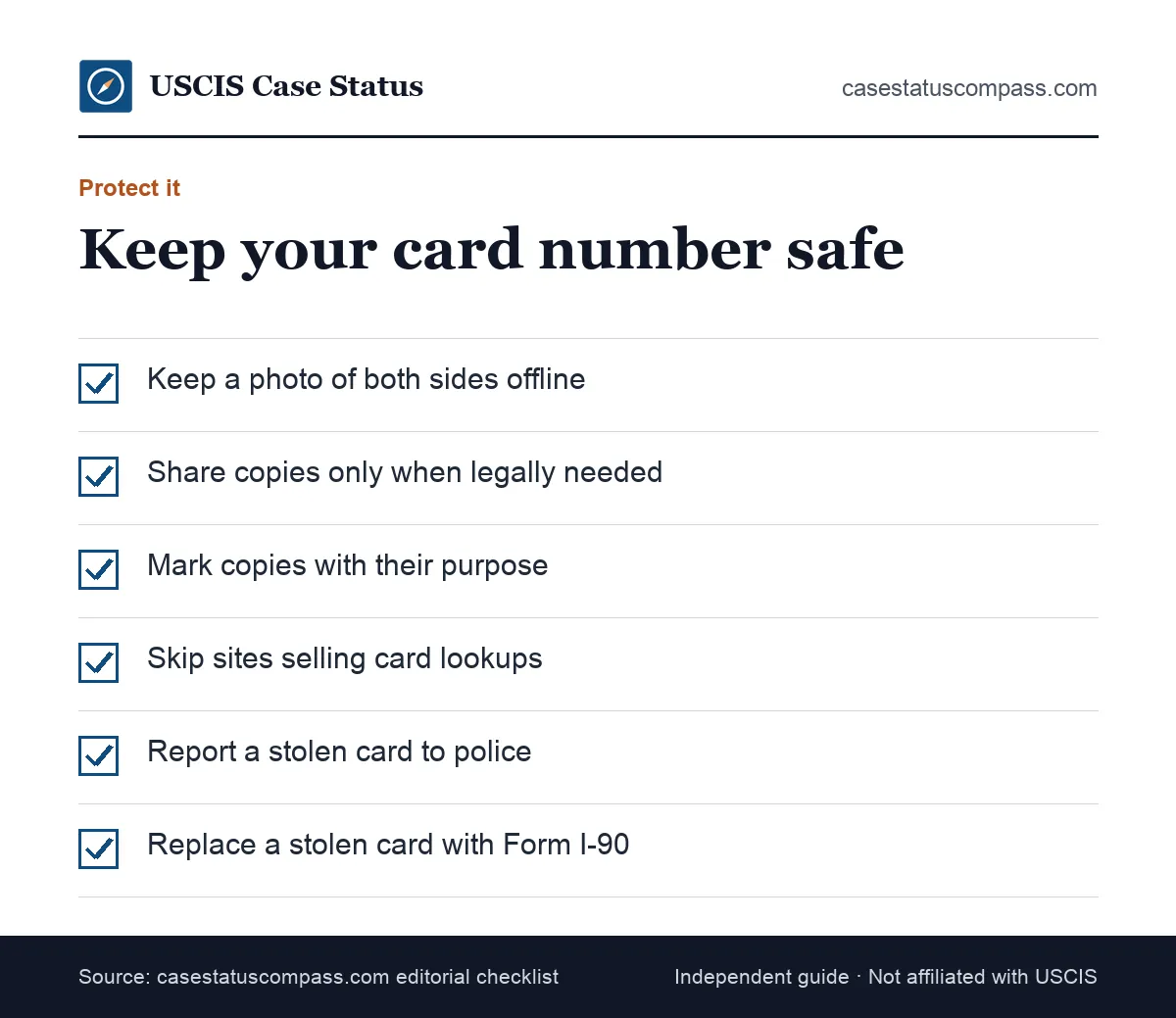
Smart copying habits
- Write "Copy for [purpose], [date]" across any copy you hand over
- Avoid emailing card photos without encryption
- Keep the original in a safe place at home when not traveling
Shred copies you no longer need.
What Should You Do If Your Green Card Is Stolen?
Report the theft to local police and keep the report. File Form I-90 for a replacement. If you suspect identity theft, also contact the Federal Trade Commission. Never give out the stolen card's number again.
Keep a copy of the police report.
Updating records with the new number
The replacement card carries a new document number. Give it to any employer, DMV or agency that recorded the stolen card's number.
Keep a list of who has the old number so you can update each one.
How Do You Spot a Fake Green Card or Card Number?
Only trained officials and authorized systems can confirm a card is real. Employers must accept a card that reasonably appears genuine and relates to the person presenting it. Do not reject a card only because its number looks unfamiliar or the design is older.
What employers should not do
Employers should not ask for a specific document or demand a newer card design. The USCIS I-9 page says current and previous card designs stay valid until the expiration date shown, so an older layout alone is no reason to reject a card.
What employees can do
If an employer questions your card, ask which rule they are applying. Point them to the USCIS I-9 acceptable documents page. If it continues, get advice from an attorney.
Keep notes of every conversation, with dates and names.
Do You Keep Your Card Number After Becoming a Citizen?
After you become a U.S. citizen, you no longer use the card's document number. Your naturalization certificate and U.S. passport become your proof of status. The old card number stays in USCIS records with your A-file, but no one should ask for it again.
What replaces the card
Two documents take over from the green card:
- The Certificate of Naturalization, proof of citizenship
- A U.S. passport, proof for travel
Our Form N-400 guide covers the citizenship steps.
Old card copies
Keep a copy of your last card with your immigration records. Future filings, such as sponsoring relatives, may ask about your past residence.
Store them with your A-Number and naturalization certificate copy.
What Should You Do If You Find Two Different Numbers on Your Card?
Seeing two numbers on your card is normal: one is the USCIS# (your A-Number) and one is the document number. Use the labels to decide which is which.
Most cards have both, so seeing two is a good sign.
A simple test
If the number appears after the label "USCIS#" and has only digits, it is your A-Number. If it begins with letters and is printed apart from the coded lines, it is the card's document number.
When the numbers do not make sense
If your card shows a USCIS# that differs from your notices, or no document number at all, ask USCIS. Call 800-375-5283. Live calls and chat: Monday to Friday, 8 a.m. to 8 p.m. Eastern.
What Do the Machine-Readable Lines on the Back Mean?
The machine-readable lines on the back of the card are coded data for scanners at airports and ports of entry. You never need to copy them onto a form.
Copy only the printed, labelled number on the card itself, never the coded lines.
Why you should not read them by hand
Independent guides describe the lines as mixing country codes, dates, names and record numbers. We could not confirm the exact layout on an official USCIS page. Copying from them risks giving the wrong number.
When the lines are damaged
If the coded lines are scratched off, the card may fail a scanner at the border or airport. Replace a badly damaged card with Form I-90 before traveling, and carry the receipt notice if the new card has not arrived.
Green Card Number Mistakes to Avoid
The most common green card number mistakes are copying the USCIS# instead, entering a receipt number, mixing up letters and digits, and giving an old card's number after a replacement. Each one can stall a job start, an ID renewal or a travel check.
Giving the wrong kind of number
These errors give a number that points to you or a filing instead of the card.
| Mistake | Result | Fix |
|---|---|---|
| Copying the USCIS# | Form points to you, not the card | Use the code on the back |
| Using a receipt number | It tracks a filing, not a card | Keep receipts for case status |
Copying errors and outdated cards
These errors come from misreading characters or using a card that has already been replaced.
| Mistake | Result | Fix |
|---|---|---|
| Giving the old card's number | Check fails or shows a replaced card | Use your newest card |
| Confusing O and 0, or I and 1 | Number does not match | Copy slowly, letter by letter |
When Should You Get Help With a Card Number Issue?
Get help from an immigration attorney or DOJ-accredited representative if your card was taken at the border, an employer keeps rejecting a valid card, or your card details do not match your records. These issues go beyond copying a number.
Situations that need expert help
- A card was confiscated or you were told your status is in question
- Your card shows a different person's data
- An agency says your card was reported lost or replaced when it was not
Where to find help
A state bar referral service can connect you with a licensed attorney.
Ask whether the attorney handles immigration cases, and bring your card, notices and any letter from the employer or agency so they can review the problem quickly.
Low-cost help from accredited representatives
Nonprofits with DOJ-accredited representatives often charge less. This page is general information, not legal advice. See our help hub for more options.
Frequently Asked Questions
Is the green card number the same as the A-Number?
No. The green card number identifies one physical card and changes when you get a new card. The A-Number, printed after USCIS# on the front, identifies you and never changes.
Does the green card number change when I renew my card?
Yes. Every new card, whether a renewal, a replacement or a 10-year card after removing conditions, has a new document number. Your A-Number, category and Resident Since date stay the same.
Can I check my case status with my card number?
No. USCIS Case Status Online uses the receipt number from your I-797 notice, not the card number. For a new filing, such as an I-90, use the receipt number from that filing's notice.
Is the card number on my I-797 approval notice?
Usually not. Approval notices show the receipt number and often your A-Number, but the card's document number is printed on the card itself.
What is the IOE number and is it my card number?
No. IOE is a prefix on receipt numbers for cases filed online, and online filers also get a separate Online Account Number. Neither is the card's document number. Our IOE case status guide explains how online-filed receipts work.
Where can I find my green card number if I lost the card?
Check saved scans of the back of the card, your employer's I-9 copies or your attorney's file. If none exist, file Form I-90; the replacement card will carry a new number anyway.
Does the resident alien card number change after removing conditions?
Yes. The 10-year card issued after an approved Form I-751 has a different document number from your 2-year card. Your A-Number stays the same.
Do I need my PR card number to travel?
You need the physical card to re-enter the U.S. as a permanent resident. Airlines may record the card number during check-in. If the card is lost abroad, contact the nearest U.S. embassy or consulate for guidance before you travel.
Sources
- USCIS: Form I-9 Acceptable Documents. www.uscis.gov/i-9-central/form-i-9-acceptable-documents. Accessed Oct 27, 2026.
- USCIS: Form I-9 Instructions, edition 01/20/25. www.uscis.gov/sites/default/files/document/forms/i-9instr.pdf. Accessed Oct 27, 2026.
- USCIS I-9 Central: Lawful Permanent Residents. www.uscis.gov/i-9-central/61-lawful-permanent-residents-lpr. Accessed Oct 27, 2026.
- USCIS Glossary: USCIS Number. www.uscis.gov/glossary-term/50674. Accessed Oct 27, 2026.
- USCIS: Form I-90 Instructions. www.uscis.gov/sites/default/files/document/forms/i-90instr.pdf. Accessed Oct 27, 2026.
- USCIS: Replace Your Green Card. www.uscis.gov/green-card/after-we-grant-your-green-card/replace-your-green-card. Accessed Oct 27, 2026.
- USCIS: Removing Conditions on Permanent Residence Based on Marriage. www.uscis.gov/green-card/after-we-grant-your-green-card/conditional-permanent-residence/removing-conditions-on-permanent-residence-based-on-marriage. Accessed Oct 27, 2026.
- USCIS alert: Mail Delivery Process for Receiving ADIT Stamp (2023). www.uscis.gov/newsroom/alerts/uscis-announces-additional-mail-delivery-process-for-receiving-adit-stamp. Accessed Oct 27, 2026.
- USCIS Form G-1055 Fee Schedule, Edition 10/16/26. www.uscis.gov/sites/default/files/document/forms/g-1055.pdf. Accessed Oct 27, 2026.
- USCIS Contact Center. www.uscis.gov/contactcenter. Accessed Oct 27, 2026.
- USCIS: Checking Your Case Status Online. www.uscis.gov/tools/checking-your-case-status-online. Accessed Oct 27, 2026.
- USCIS Glossary: Green Card. www.uscis.gov/tools/glossary. Accessed Oct 27, 2026.
casestatuscompass.com is an independent publication and is not affiliated with USCIS or any government agency. This page is general information, not legal advice. For denials, court or asylum matters, consult an immigration attorney or a DOJ-accredited representative.