Contents · 38 sections
- What Is the USCIS Contact Number?
- USCIS Contact Number and Other Official Lines at a Glance
- Is There a 24-Hour Immigration Phone Number?
- How Do You Speak to a Live Agent at USCIS?
- What Happens When a Live Agent Cannot Solve It?
- How Does Emma, the USCIS Virtual Assistant, Work?
- Can Emma Connect You to a Live Agent?
- Phone, Chat or Online Account: Which Should You Use?
- What Should You Have Ready Before You Call?
- A Simple Call Script You Can Adapt
- Online Case Inquiries (e-Request): What Can You Report?
- Can You Ask About a Case Outside Normal Processing Time?
- How Do You Request an In-Person Appointment?
- USCIS Hours: Does USCIS Work on Weekends?
- Does USCIS Work on Saturday?
- How Do Eastern Time Hours Work Where You Live?
- Which USCIS Number Works From Abroad?
- If X, Do Y: Which Contact Fits Your Problem?
- What Is the Green Card Phone Number?
- Citizenship Contact Phone Number for N-400 Cases
- Is There a DACA Phone Number?
- Is There an Immigration and Naturalization Service Phone Number?
- What Is the Homeland Security Immigration Phone Number?
- Other Immigration Phone Numbers: Court, NVC and Visas
- Can You Call a Service Center or Field Office Directly?
- When a Call Is Not Enough: Ombudsman and Congress
- Can Someone Else Call USCIS for You?
- Using the Contact Center for an Expedite Request
- Calling About an RFE or a Missing Notice
- Calling After a Move or a Returned Card
- Calling About Biometrics or Interview Appointments
- How Can You Spot a Fake USCIS Call?
- Common Mistakes When Calling USCIS
- What Happens After You Call USCIS?
- Keep a Contact Log: A Template You Can Copy
- How the Contact Center Fits Into USCIS Case Help
- When Should You Call an Attorney Instead of USCIS?
- Frequently Asked Questions
The short answer
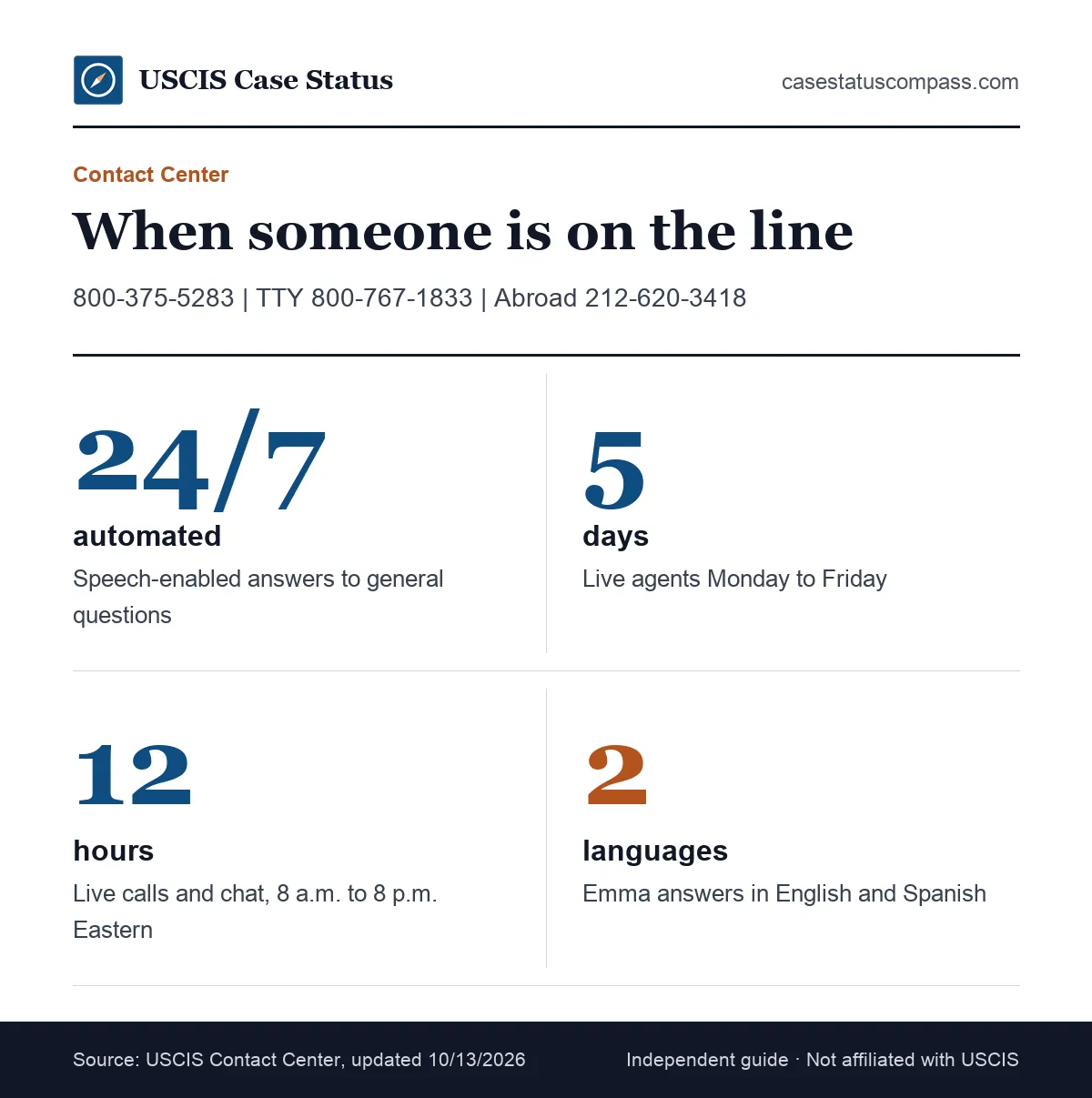
The USCIS contact number is 800-375-5283, the toll-free line for the USCIS Contact Center. Deaf and hard-of-hearing callers can use TTY: 800-767-1833, and callers abroad dial 212-620-3418 (callers outside the U.S.). An automated system answers 24 hours a day; live agents answer only on weekdays.
At a glance
| Toll-free line | 800-375-5283 |
| Deaf or hard of hearing | TTY: 800-767-1833 |
| From outside the U.S. | 212-620-3418 (callers outside the U.S.) |
| Live agents | Live calls and chat: Monday to Friday, 8 a.m. to 8 p.m. Eastern |
| Online help | Emma, USCIS's online virtual assistant (English and Spanish), on uscis.gov |
What Is the USCIS Contact Number?
The USCIS contact number is 800-375-5283. It reaches the USCIS Contact Center, the agency's main phone service for questions about applications, petitions and appointments. Agents can discuss your own case after they confirm who you are. Calls to the USCIS contact number are free from inside the U.S.
The toll-free line
This is the one contact number for immigration benefits that USCIS publishes for the public. It covers green cards, work permits, citizenship and most other USCIS forms. Treat any other number claiming to be the USCIS contact number with suspicion.
TTY for deaf and hard-of-hearing callers
USCIS lists TTY: 800-767-1833 for callers who use a teletypewriter. If you need an accommodation at an appointment, such as a sign language interpreter, use e-Request instead, as covered below.
USCIS Contact Number and Other Official Lines at a Glance
USCIS has three published phone lines: the main toll-free USCIS contact number, a TTY line and an overseas number. The table lists each official number, who it serves and when a person answers, as of October 2026. The court hotline is included because callers often confuse it with USCIS.
Official USCIS phone lines and hours
Each row shows one official line, the number to dial, the callers it is meant for and whether a person answers.
| Line | Number | Who it serves | Live answer? |
|---|---|---|---|
| USCIS Contact Center | 800-375-5283 | Anyone in the U.S. | Weekdays, 8 a.m.-8 p.m. ET |
| USCIS TTY | TTY: 800-767-1833 | Deaf or hard-of-hearing callers | Same hours |
| USCIS from abroad | 212-620-3418 (callers outside the U.S.) | Callers outside the U.S. | Hours not separately listed |
| EOIR court hotline | EOIR case hotline: 1-800-898-7180 (24/7, automated) | People in immigration court | Automated only |
Which line fits you
Call the toll-free line for anything about a USCIS application. Use TTY if you rely on text telephony. Use the overseas number only when you are outside the U.S., since the toll-free number may not connect from abroad.
Is There a 24-Hour Immigration Phone Number?
Yes. The USCIS line works as a 24-hour immigration phone number for general questions, through an automated, speech-enabled system. Automated phone line: 24 hours a day (live agents Mon-Fri 8am-8pm ET). For anything that needs a person, such as a case problem, you must call during weekday live hours.
What the automated line handles
The automated system answers common questions about forms, fees, addresses and how USCIS processes work. It is useful at night or on weekends. It can also point you to the right online tool for case status or address changes.
What still needs a person
Problems with a specific case, such as a missing notice, a wrong name on a card or an expedite request, need a live agent. Agents can look up your record after an identity check.
How Do You Speak to a Live Agent at USCIS?
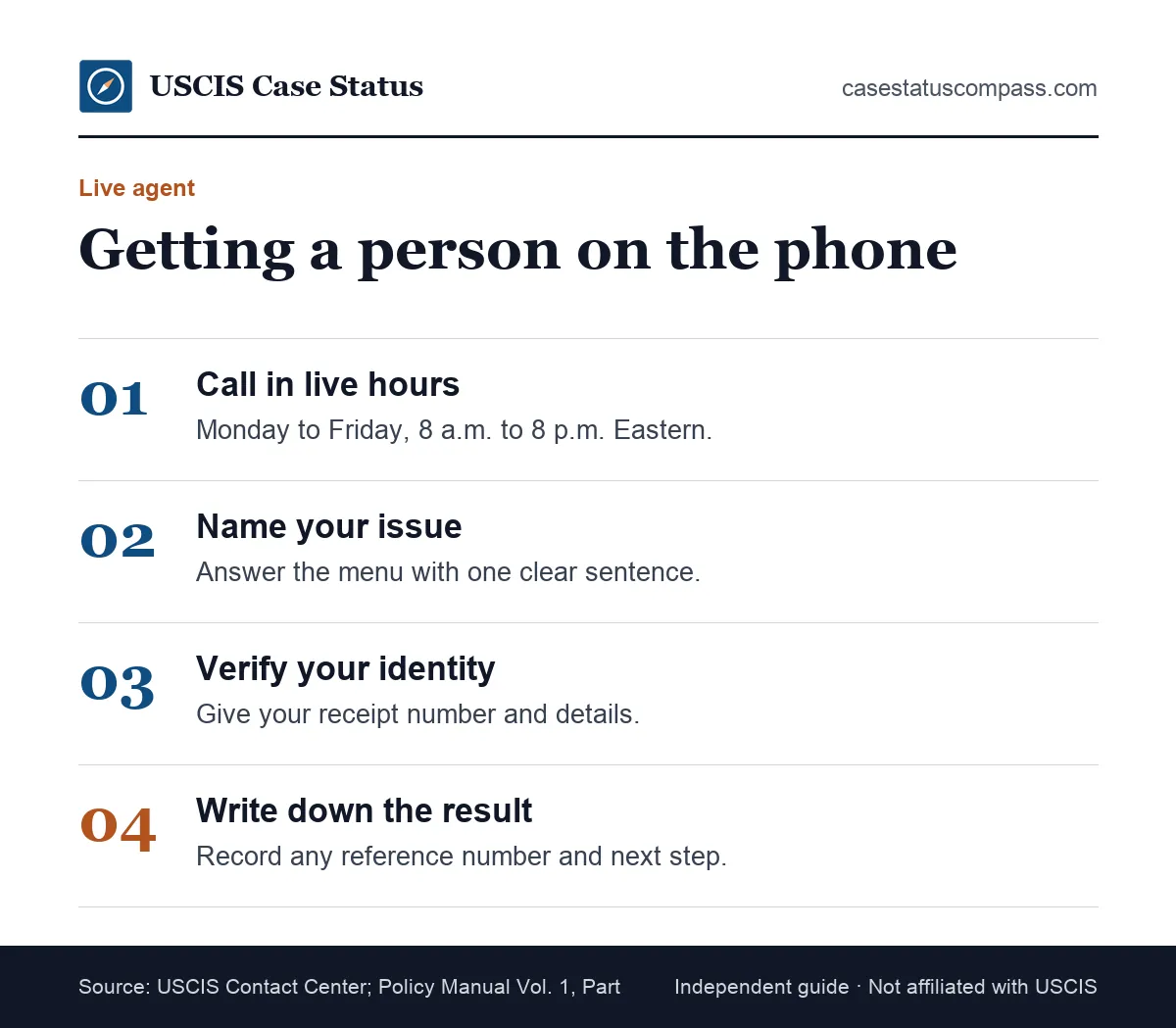
To speak to a live agent at USCIS, call 800-375-5283 on a weekday between 8 a.m. and 8 p.m. Eastern, answer the menu prompts with a short, specific description of your problem, and have your receipt number ready. The system routes case-specific issues toward an agent.
Call inside live hours
Calls outside live hours reach only the automated system. Early in the live window gives you the most time if a call drops or needs a transfer. Have your checklist ready before the window opens.
Describe your issue clearly
The speech-enabled menu listens for what you say. Name the actual problem in a few words, such as "notice never arrived" or "expedite request." Vague answers tend to loop you back to self-service options instead of an agent.
What Happens When a Live Agent Cannot Solve It?
When a first-level agent cannot resolve your question, they can refer it to a USCIS Immigration Services Officer, who reviews it and contacts you later by phone or email. This referral is often called a Tier 2 escalation. Ask for the reference number.
Referral to an officer
The USCIS Policy Manual describes Tier 1 staff as contract employees who give basic case and general information. Tier 2 officers handle harder issues. You do not choose your tier; the agent decides whether a referral is needed and creates it.
Asking for a supervisor
If an answer seems wrong or incomplete, politely ask for a supervisor. Explain what you were told and why it does not match your notice. Note the agent's name or ID in your log first.
How Does Emma, the USCIS Virtual Assistant, Work?
Emma is the USCIS online virtual assistant on uscis.gov. She answers general questions in English and Spanish and guides you through the website. Emma, USCIS's online virtual assistant (English and Spanish), on uscis.gov. She is free and available at any hour on the website.
What Emma answers
Emma handles non-case-specific questions: which form to file, where to send it, how to change an address or what a term means. If the first answer misses, rephrase with the form number, such as I-90 or N-400.
What Emma cannot do
Emma cannot see your case file, so she is best for questions about forms, fees and processes. For anything tied to your own case, use a live agent or your online account.
Can Emma Connect You to a Live Agent?
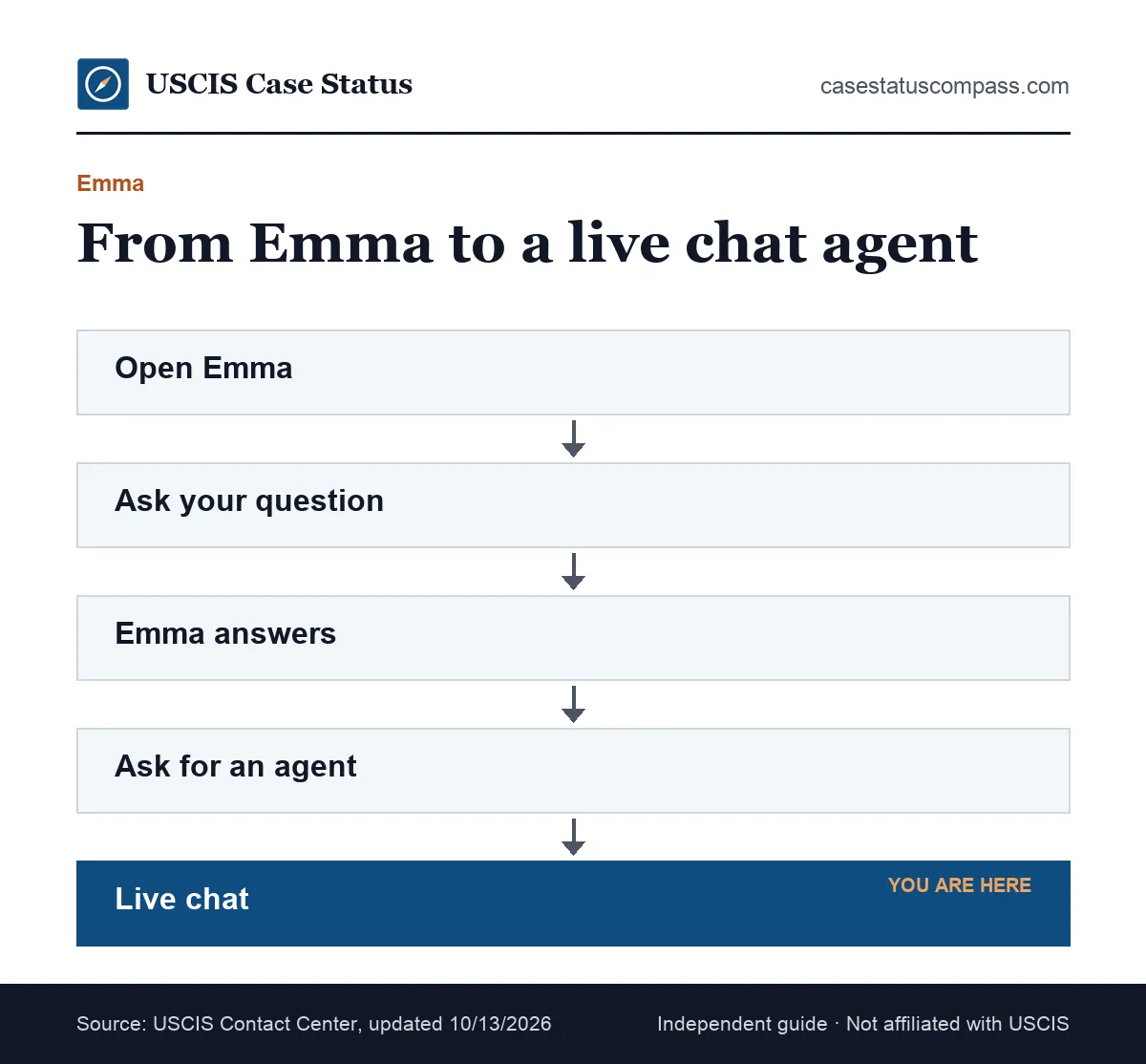
Yes. If Emma cannot answer your question, she may connect you to live chat with a USCIS agent. This handoff works only during live agent hours. Live calls and chat: Monday to Friday, 8 a.m. to 8 p.m. Eastern. Have your receipt number ready.
Asking Emma for a person
The Emma live agent handoff usually appears after Emma tries to answer. Ask your specific question first, then say you need an agent if the reply does not help. Keep the chat window open while you wait.
When live chat is closed
Outside live hours, Emma still answers general questions on her own, but no agent joins. Save case-specific problems for the next weekday, or send a secure message from your online account.
Phone, Chat or Online Account: Which Should You Use?
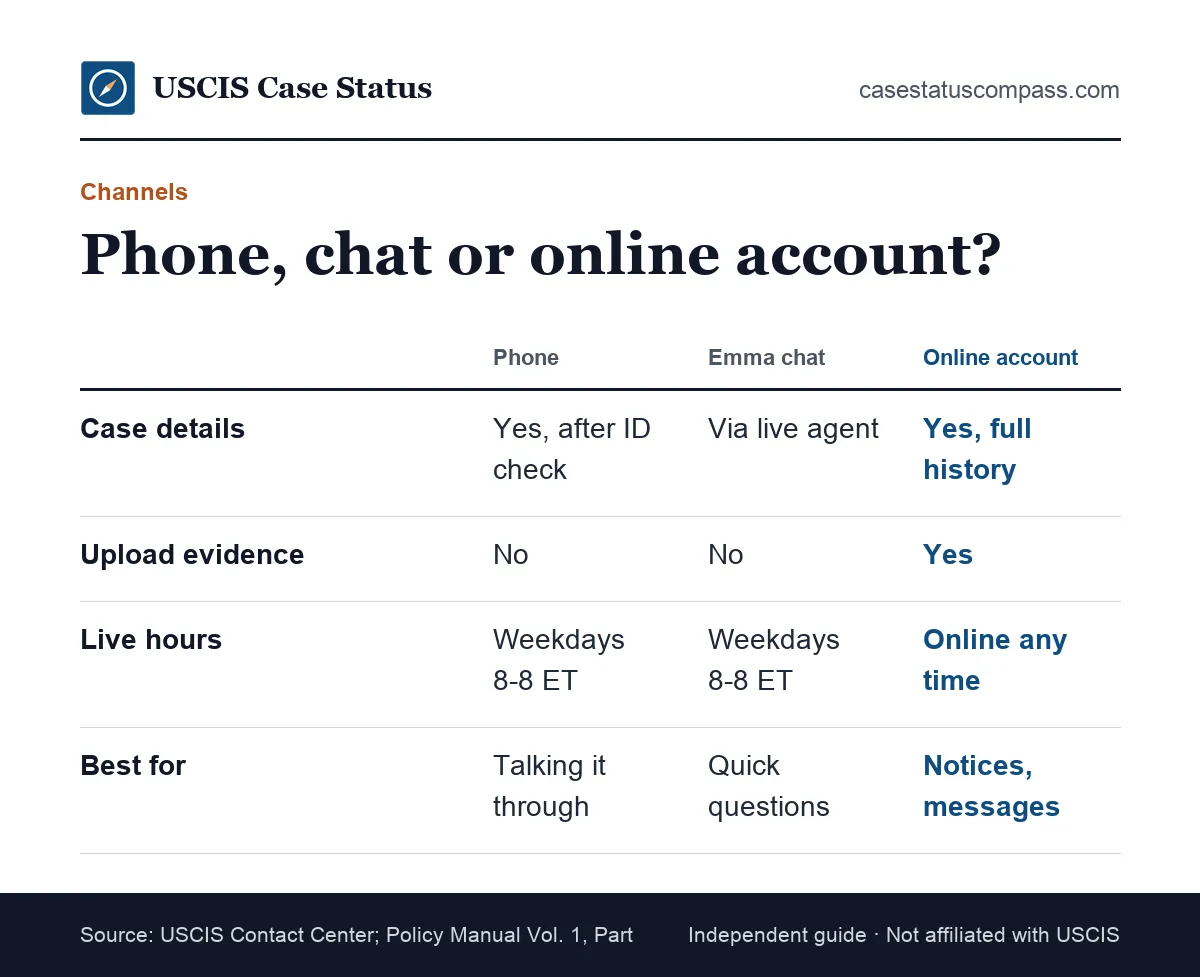
Use your USCIS online account for notices, secure messages and uploads, since USCIS calls it the preferred way to contact the agency. Use the phone or live chat when you need to talk a problem through with a person. Many people use more than one.
Phone vs Emma vs online account
Find what you need in the left column; the middle column names the best channel and the right column says why.
| Need | Best channel | Why |
|---|---|---|
| See your notices | Online account | Digital copies of most notices |
| Upload evidence | Online account | Phone and chat cannot take files |
| Ask a general question | Emma | Instant answers, English or Spanish |
| Explain a complicated problem | Phone | A person can ask follow-ups |
| Request an expedite | Phone or account | Both are official routes |
When the account wins
Free USCIS online account: case status updates, notices, link paper-filed cases. You can create one at myaccount.uscis.gov/create-account. Messages sent from the account are tied to your verified identity, so staff can share case details they cannot share through a general web form.
When the phone wins
The phone is better when your issue is unusual, urgent or hard to explain in writing. An agent can ask questions, check the record live and create a service request on the spot.
What Should You Have Ready Before You Call?
Before you call USCIS, have your receipt number, A-Number, the notice you are calling about and your address on file in front of you. Add one sentence that sums up the problem and the date it started. Having these ready shortens the identity check and keeps the agent focused on your issue.
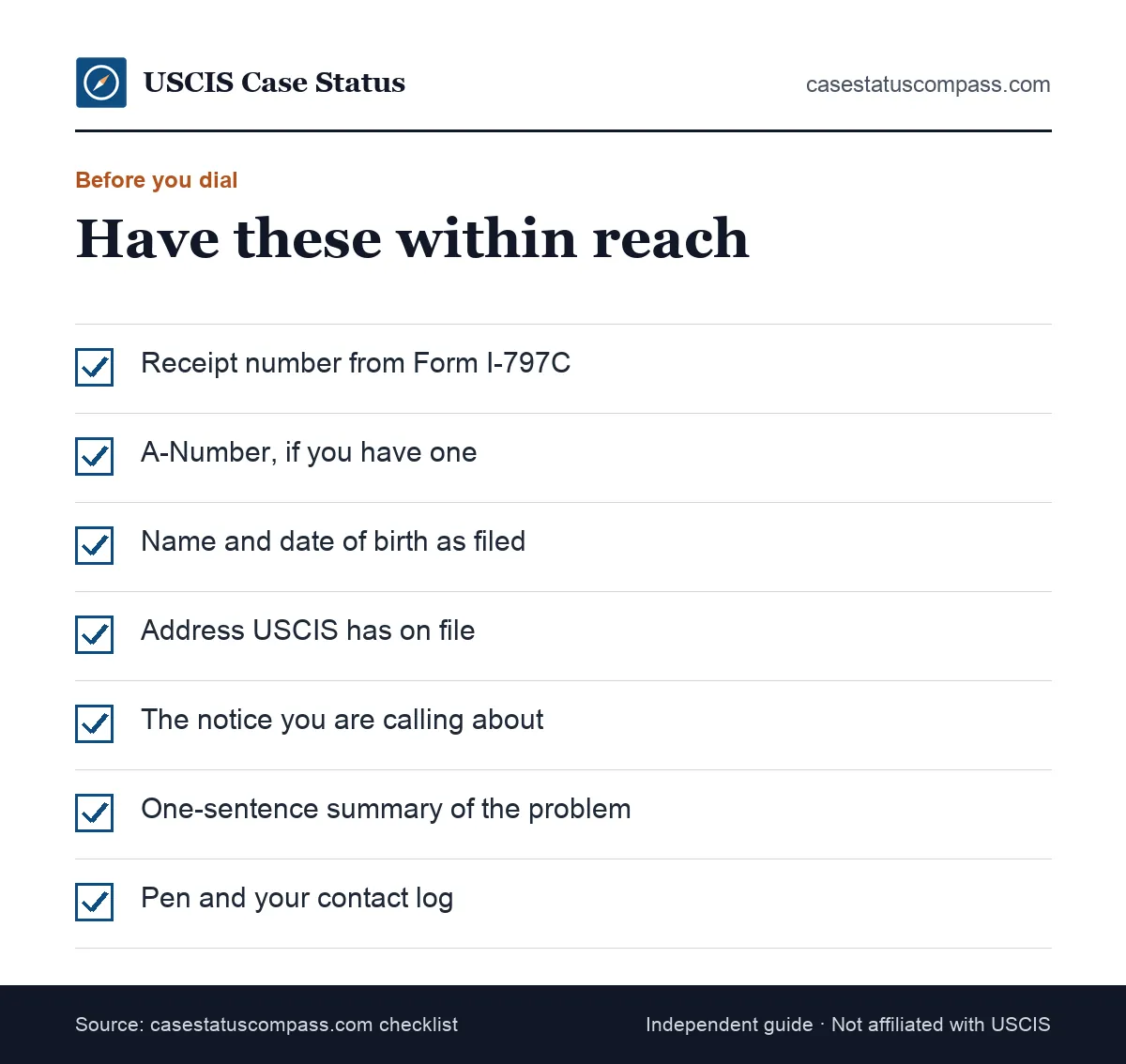
Copyable call checklist
Copy this list into your phone's notes before you dial:
- Receipt number from your Form I-797C
- A-Number, if you have one
- Full name and date of birth as filed
- Mailing address USCIS has on file
Papers to have in hand
Keep these within reach so you can read exact dates and wording to the agent:
- The notice or letter you are calling about
- One sentence describing the problem
- Pen and your contact log
Our uscis receipt number guide shows where each number sits on your notices.
Who may ask about a case
Agents generally discuss a case with the applicant or petitioner or their attorney or accredited representative. A relative calling for you may get only general information. If someone helps you on the call, stay on the line so you can confirm your identity.
A Simple Call Script You Can Adapt
State who you are, give your receipt number, describe the problem in one sentence, say what you need, and confirm the next step before hanging up. A short script keeps the call focused, which matters because the agent can act only on what you clearly ask for. Adapt the wording to your own case.
Opening the call
Try a template like this:
- "My name is [name]. I am the [applicant or petitioner]."
- "My receipt number is [three letters and ten digits]."
- "I am calling because [one-sentence problem]."
- "I would like [what you need, such as a service request]."
Ending the call
Before you hang up, ask three questions: Is there a reference number? What happens next? When should I expect a reply? Write the answers in your contact log. Read them back to the agent before the call ends so a misheard date or number is caught.
Online Case Inquiries (e-Request): What Can You Report?
e-Request is the USCIS online tool for three narrow problems: typing errors USCIS made, notices that never arrived and accommodation requests for appointments. e-Request: report USCIS typos, missing notices or accommodation needs online. It is free and needs no phone call.
USCIS typing errors
If a notice or card shows a misspelled name or a wrong date that USCIS typed incorrectly, report it through e-Request. If the mistake came from your own form, the fix is different and may need a new filing.
Notices that never arrived
e-Request handles non-delivery of notices and cards. Before you submit, confirm USCIS had your correct address. If you moved without telling USCIS, update your address first, because a resent notice will go to whatever address is on file.
Accommodation requests
You can ask for help at a biometrics or interview appointment, such as wheelchair access, a sign language interpreter or other disability accommodations. Submit it well before the date.
Can You Ask About a Case Outside Normal Processing Time?
Yes, once your case passes its case inquiry date. The official processing times tool shows that date for your form, category and office. After it, you can ask online or by phone. Asking before that date usually gets a reply telling you to wait.
Check the case inquiry date first
Case inquiry date: the earliest date USCIS will accept a question about your pending case; it can change. Compare it with the receipt date on your notice. Our uscis processing times hub explains how to pick the right form, category and office in the tool.
Where the request goes
You can submit an 'outside normal processing time' request only after your case inquiry date. You can submit through the tool's inquiry link or by calling. If your status has been frozen for months, our case status not updating guide explains what to check first.
How Do You Request an In-Person Appointment?
You request an in-person USCIS appointment online or through the Contact Center; USCIS does not accept walk-ins. Request an in-person appointment online at my.uscis.gov/en/appointment/v2 or call 800-375-5283. Appointments are for services that need you there, such as temporary proof of status, an emergency travel document or document review.
Booking online
The online tool asks what service you need and offers available dates. Have your receipt number and A-Number ready. Describe the reason in a few words, such as needing temporary proof of status, and bring the confirmation and photo ID to the office on the day.
Booking by phone
An agent can book an appointment when online booking does not work for you. Our I-551 stamp guide explains one common reason to book. Check USCIS's office closings page on the day.
USCIS Hours: Does USCIS Work on Weekends?
USCIS live agents do not work on weekends. The official schedule reads: Live calls and chat: Monday to Friday, 8 a.m. to 8 p.m. Eastern. On Saturdays and Sundays you can still use the automated phone line, Emma and your online account, but no person will answer or take a service request until Monday.
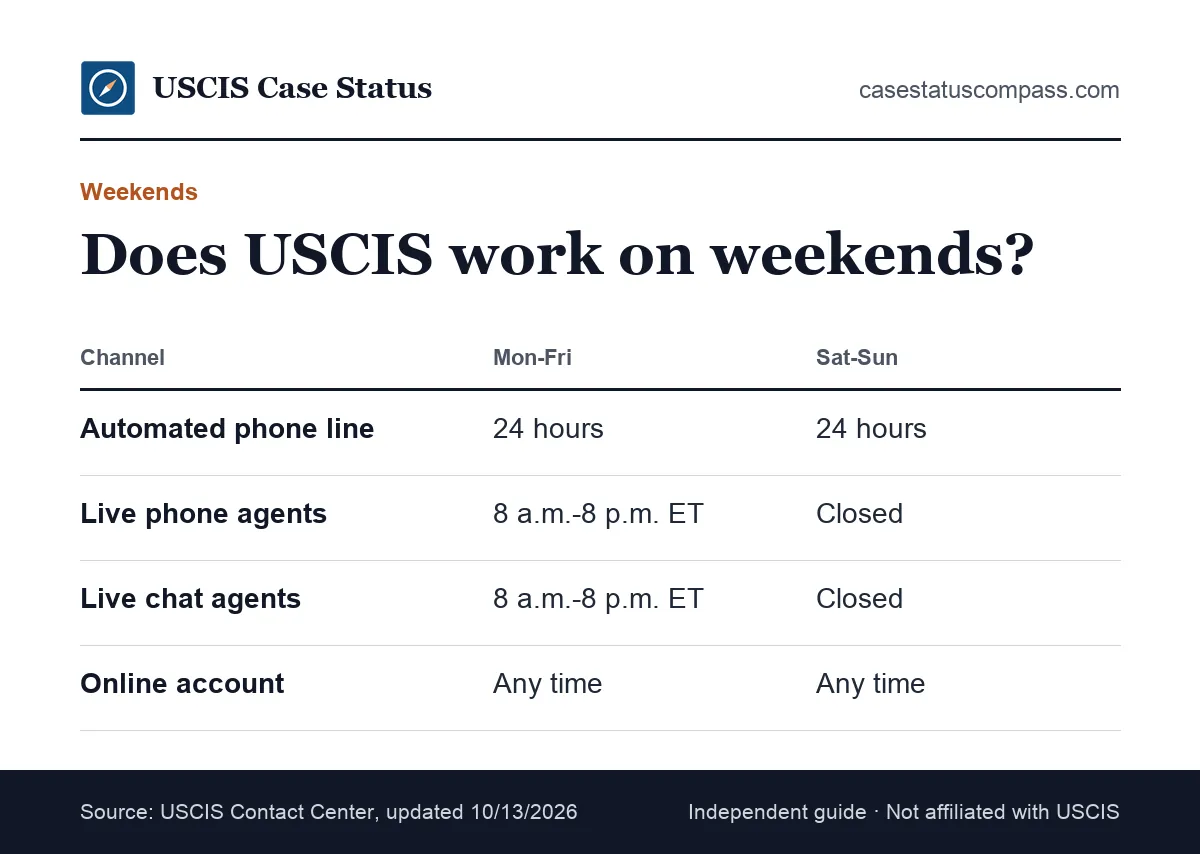
Weekday live hours
Live agents work Monday through Friday. The 12-hour window gives working people a chance to call before or after their shifts. Expect no live service on federal holidays either.
Best days to call with a deadline
If your problem has a deadline, call early in the week so there is time for a follow-up. Leave several business days of buffer, because referrals and callbacks do not happen on weekends.
What runs on weekends
The automated line, Emma and the online account stay available. You can read notices, send a secure message, update your address online and check your status. Send case questions by secure message.
Does USCIS Work on Saturday?
The USCIS Contact Center does not have live agents on Saturday. Calls on Saturday reach only the automated system. Some readers notice status updates or account changes on a Saturday; those come from records loading in batches, not from staff answering phones that day.
Saturday calls
If you call on a Saturday, the speech-enabled system can answer general questions and point you to online tools. It cannot create a referral or look up your case with an agent.
Saturday case updates
A status can change on a weekend because systems post updates when entries are processed. A Saturday update is still official. Our uscis case status checker page explains how to read an update.
How Do Eastern Time Hours Work Where You Live?
USCIS lists live agent hours in Eastern time, so convert them to your zone before calling. The 8 a.m. to 8 p.m. Eastern window is 7 a.m. to 7 p.m. Central, 6 a.m. to 6 p.m. Mountain and 5 a.m. to 5 p.m. Pacific.
West Coast and Mountain callers
Pacific callers lose the evening: live service ends at 5 p.m. Pacific. Mountain callers have until 6 p.m. If you work days, call during a morning break or lunch hour with the checklist in reach. Alaska and Hawaii callers have even earlier cutoffs.
Which USCIS Number Works From Abroad?
From outside the U.S., dial 212-620-3418 (callers outside the U.S.). Convert 8 a.m. to 8 p.m. Eastern into your local time, remembering that daylight saving dates differ by country. International rates may apply, so prepare your call checklist first. Unlike the toll-free USCIS contact number used inside the country, this overseas line is a standard paid number.
If X, Do Y: Which Contact Fits Your Problem?
Match your problem to the right channel before you call. The decision table below pairs common situations with the first contact to try and a backup if that fails. Read across the row for your problem; if the first route fails, the backup column gives the next step. Keep notes from each attempt.
Problem-to-contact table
Each row pairs a common problem with the first contact to try and a backup if that does not work.
| If this is your problem | Try this first | Backup |
|---|---|---|
| General question about a form | Emma or the automated line | Live agent |
| Notice never arrived | e-Request | Contact Center |
| USCIS typo on a card or notice | e-Request | Contact Center |
| Case past its inquiry date | Outside normal processing request | Contact Center, then Ombudsman |
| Emergency needing faster action | Expedite through Contact Center or account | Ombudsman after 60 days |
| Need temporary proof of status | Appointment request | Contact Center |
| You moved | Online change of address | Form AR-11 by mail |
| Immigration court hearing | EOIR hotline | Court clerk |
When to skip the phone
For uploads, address changes and reading notices, the online account beats a call. You avoid hold times, get a written record and can act at any hour. Save the phone for problems that need a conversation.
What Is the Green Card Phone Number?
There is no separate green card phone number. Questions about a pending green card, a card renewal or a lost card all go to the USCIS Contact Center at 800-375-5283. Before dialing the USCIS contact number, have your I-485 or I-90 receipt number and A-Number ready, since agents check identity before discussing the case.
Pending green card cases
For an I-485 case, call about missing notices, interview scheduling or a card returned to USCIS. Our Form I-485 guide explains each stage of adjustment of status. Check your online account first, since a notice may already be posted there before you dial the USCIS contact number.
Green card renewal phone number
The green card renewal phone number is the same Contact Center line. Renewals and replacements are filed on Form I-90, often online. Our green card renewal guide covers filing and what to do while the new card is pending.
Citizenship Contact Phone Number for N-400 Cases
The citizenship contact phone number is the same USCIS Contact Center line, 800-375-5283. Applicants for naturalization on Form N-400 use it for missing interview notices, rescheduling, accommodations and oath ceremony questions. There is no separate citizenship hotline. Have your N-400 receipt ready.
Pending N-400 questions
Call when an interview notice never arrived, your case is past its inquiry date or you need an accommodation. For general questions about eligibility or the civics test, Emma or the website is faster. Our citizenship application guide explains the full process.
Interview and oath scheduling
If you cannot attend your interview or oath ceremony, follow the rescheduling instructions on the notice first. Call the Contact Center if the notice gives no clear route. Keep proof of any request you send.
Is There a DACA Phone Number?
No, USCIS has no separate DACA phone number. Deferred Action for Childhood Arrivals (DACA) requesters use the main Contact Center at 800-375-5283. Agents can help with missing notices, card problems and cases past the inquiry date, but they cannot tell you how DACA litigation will affect your case. For that, check the USCIS DACA page or ask a legal aid provider.
DACA renewal questions
For a pending renewal, check your online account first, then call if a notice is missing or the case is past its inquiry date. Our daca status guide explains the renewal process and how to read each update.
Work permits linked to DACA
DACA comes with a work permit application on Form I-765. Questions about the Employment Authorization Document (EAD) card, such as a wrong name or a card that never arrived, go to the same line or through e-Request.
Is There an Immigration and Naturalization Service Phone Number?
No. The Immigration and Naturalization Service (INS) no longer exists; its duties moved to the Department of Homeland Security in 2003. People searching for an immigration and naturalization phone number today should call USCIS at 800-375-5283 for benefits questions. Old INS numbers on dated websites are not USCIS contacts.
INS became USCIS
When INS was dissolved, USCIS took over immigration benefits such as green cards and citizenship. Enforcement and border work went to other DHS agencies. Those are ICE for enforcement and CBP for the border.
What Is the Homeland Security Immigration Phone Number?
People searching for a homeland security immigration phone number usually need USCIS. DHS is the parent department, but USCIS handles benefit questions. The CIS Ombudsman is also part of DHS, but it is a separate office with its own online request form.
CBP and ICE questions
Border entry and enforcement questions belong to CBP and ICE, other DHS agencies with their own official contact pages. USCIS agents cannot answer questions about an arrest, detention or a port-of-entry problem.
Other Immigration Phone Numbers: Court, NVC and Visas
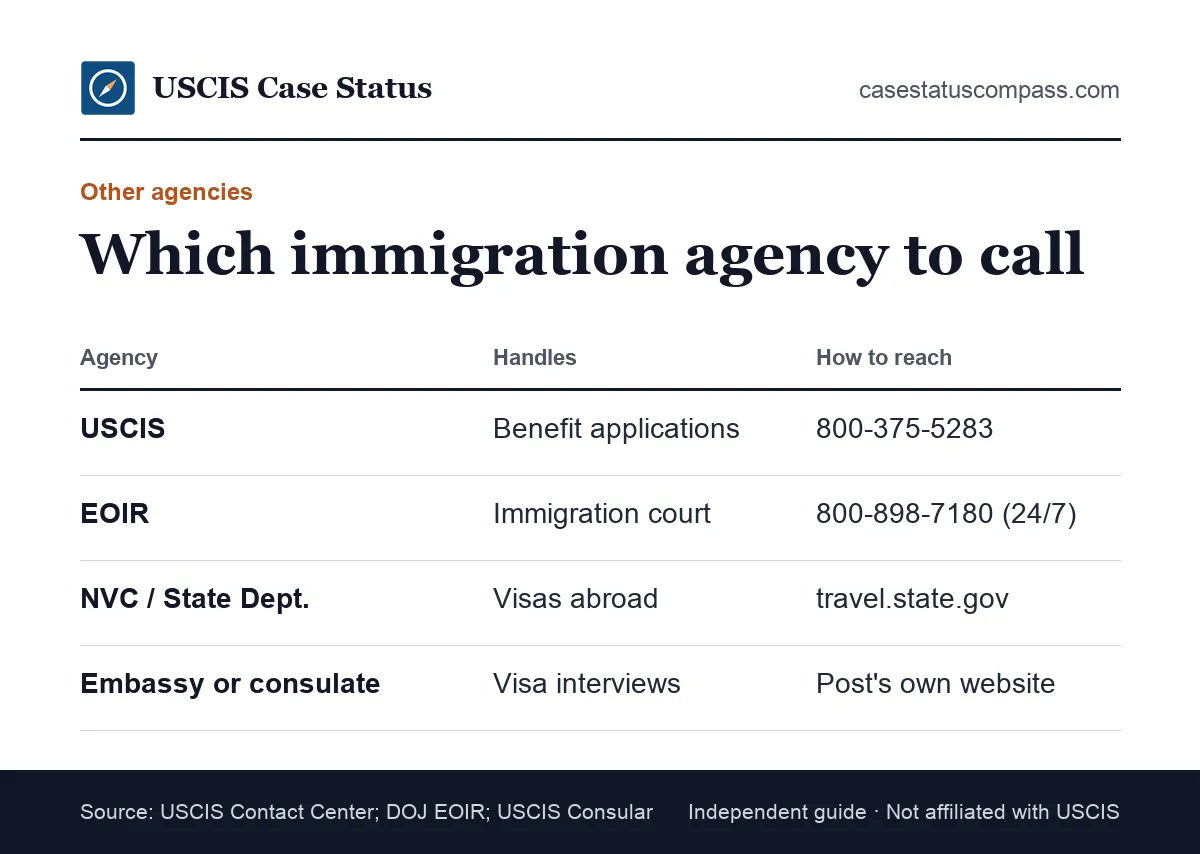
Other immigration phone numbers belong to agencies outside USCIS. Immigration court cases go to the Executive Office for Immigration Review (EOIR). Visa cases abroad go to the State Department, including the National Visa Center (NVC). Each has its own contact page.
NVC
NVC (State Department) collects visa fees and documents after USCIS approves the petition. NVC asks you to use its Public Inquiry Form only if you have not heard back within its published timeframe, because duplicate inquiries slow responses. As of Oct. 26, 2026, NVC was answering Public Inquiry Form messages received on Oct. 16, 2026; the date moves weekly on the NVC timeframes page.
NVC phone number and email
We have not verified NVC's phone number or email, so take them from travel.state.gov, never from a third-party site. Our nvc case status guide explains that stage. Have your NVC case number ready.
Immigration court
EOIR case hotline: 1-800-898-7180 (24/7, automated). You can also check online at Check immigration court cases online at acis.eoir.justice.gov with your A-number. Our immigration court case status guide explains both tools.
U.S. visa contact number
A US visa contact number depends on the embassy or consulate handling your application. Each post lists its own contact options on its official website. Our us visa status guide explains how to check a visa application.
Can You Call a Service Center or Field Office Directly?
No, USCIS service centers and field offices do not take public calls. You reach them through the Contact Center, which can create a request that goes to the office holding your file. Your receipt notice shows which office first received your case.
Service centers
Five USCIS service centers: California, Nebraska, Potomac, Texas and Vermont. They decide most paper-filed cases behind the scenes. Our uscis service centers guide explains what each one handles. None takes public phone calls.
Field offices
Field offices hold interviews and in-person services. There are 88 USCIS field offices, organized under 4 regional and 16 district offices. You visit only with a scheduled appointment or interview notice.
When a Call Is Not Enough: Ombudsman and Congress
When calls and service requests fail, two outside routes exist: the CIS Ombudsman, an independent office in DHS, and your member of Congress. Both expect you to have tried USCIS first. Neither can approve a case, but both can push USCIS to look again at a stuck or mishandled file.
CIS Ombudsman
Use the Ombudsman only after contacting USCIS within 90 days and waiting at least 60 days. The request form is listed as CIS Ombudsman: DHS Form 7001, Request for Case Assistance (online). Our uscis ombudsman guide explains what to include and what to expect.
Congressional inquiry
Your member of Congress can ask USCIS about your case after you sign a privacy release. Call your representative's or senator's local office and ask for the caseworker who handles federal agencies. They will send a privacy release to sign before contacting USCIS.
Can Someone Else Call USCIS for You?
Someone else can call for you only in limited ways. USCIS generally shares case details with the applicant, the petitioner or their attorney or accredited representative of record. A relative or friend can usually get only general information unless you are on the call to confirm your identity.
Attorneys and accredited representatives
A lawyer or DOJ-accredited representative with a Form G-28 on file can call about your case. They have the same Contact Center access. Ask yours to call for you if the issue is complex.
Family members and helpers
If a family member helps because of language or disability, stay on the line. Introduce them, confirm your own details, then let them speak. Never give your receipt number or A-Number to a stranger who offers to call for you.
Using the Contact Center for an Expedite Request
You can ask for an expedite through the Contact Center. USCIS puts it this way: Ask for an expedite through the USCIS Contact Center or your online account. The agent records your reason and sends it to the office holding your case. Have evidence ready, because USCIS decides expedites on proof, not on the call alone.
What to say
Name the expedite ground that fits, such as an emergency or severe financial loss, and give a one-sentence reason with a date. For example: "My job offer expires on [date] and my work permit is pending."
Evidence to send
USCIS may ask you to send documents, such as a doctor's letter or an employer's letter. Upload them through your account when possible. Our uscis expedite request guide lists the criteria and the evidence that fits each.
Calling About an RFE or a Missing Notice
Call about a Request for Evidence (RFE) only if something is unclear about the notice itself, such as a missing page or an unreadable deadline. Agents cannot tell you what evidence will satisfy the officer. Start the response while you wait for any answer.
RFE deadlines keep running
A call does not pause anything: RFE deadline: up to 12 weeks (the exact date is on your RFE); no extensions. I-539 and I-601A RFEs allow only 30 days, so never let a phone call delay your response.
What agents can explain
Agents can confirm that an RFE was issued, the date it was mailed and the address on file. They can resend a lost notice in some cases. They can also explain where the response should go if the notice is unclear.
What agents cannot change
Agents cannot extend an RFE deadline, review your documents or predict a decision. For help building the response, read our guide on rfe meaning or ask an immigration attorney. The USCIS contact number is for status and service problems, not for advice on which evidence to send.
Calling After a Move or a Returned Card
After a move, update your address online first, then call only if something went wrong. Report a new address to USCIS within 10 days of moving (INA 265). If USCIS already mailed a card to your old address, call quickly, because returned cards are held for a limited time before they are destroyed.
Address updates
Update your address online in your USCIS account (E-COA); a mailed AR-11 also counts. A phone call can help if the online tool fails or a case does not appear. Our uscis change of address guide covers each method and what to check after.
Returned cards
Returned green cards are held 60 business days (about 12 weeks), then re-mailed or destroyed. Call with your new address and receipt number as soon as you see the status. Our page on the card was returned to uscis status explains what follows.
Calling About Biometrics or Interview Appointments
Call about a biometrics or interview appointment when you cannot attend, the notice never came, or you need an accommodation. Biometrics can usually be rescheduled online. Interviews follow the instructions on the notice, and the Contact Center is the backup route.
Rescheduling biometrics
Reschedule biometrics online at least 12 hours before, with good cause, or call the Contact Center. Our biometrics appointment guide explains what to bring and what happens on the day.
Interview conflicts
If an emergency clashes with your interview, act before the date. Follow the notice's instructions, then call the Contact Center if you get no response. Keep a copy of every request.
How Can You Spot a Fake USCIS Call?
Spot a fake USCIS call by its demands: real Contact Center help is free, and pressure to pay by gift card, wire or cryptocurrency is a classic scam sign. Scammers can spoof caller ID to show a government number. Hang up and call 800-375-5283 yourself to check.
Red flags
Watch for threats of arrest or deportation unless you pay now, requests for your full Social Security number, and callers who refuse to let you hang up and call back. EOIR also warns that scammers spoof its number. Our uscis scam guide lists more schemes.
Verify before you pay
Compare any claim with the notices in your online account. If a caller mentions a notice you cannot find, ask for the receipt number and check it yourself. Our guide on how to verify a uscis notice explains what real notices contain.
Common Mistakes When Calling USCIS
The most common mistakes are calling before the case inquiry date, calling without your notices, calling the wrong agency, and treating a call as a substitute for a deadline. Another is giving inconsistent details from one call to the next. Each mistake wastes a call, so prepare before dialing.
Calling too early
A call before your inquiry date usually ends with "please wait." Check the processing times tool first and mark the inquiry date on your calendar so your first call counts.
Treating a call as a filing
A phone call does not change your address, answer an RFE or appeal a denial. Each of those needs its own form or online action by a deadline. Use calls to ask questions and create service requests, not to replace filings.
What Happens After You Call USCIS?
After you call USCIS, one of three things usually happens: the agent answers your question, creates a service request with a reference number, or refers the issue to an officer who follows up later. Write down which one it was.
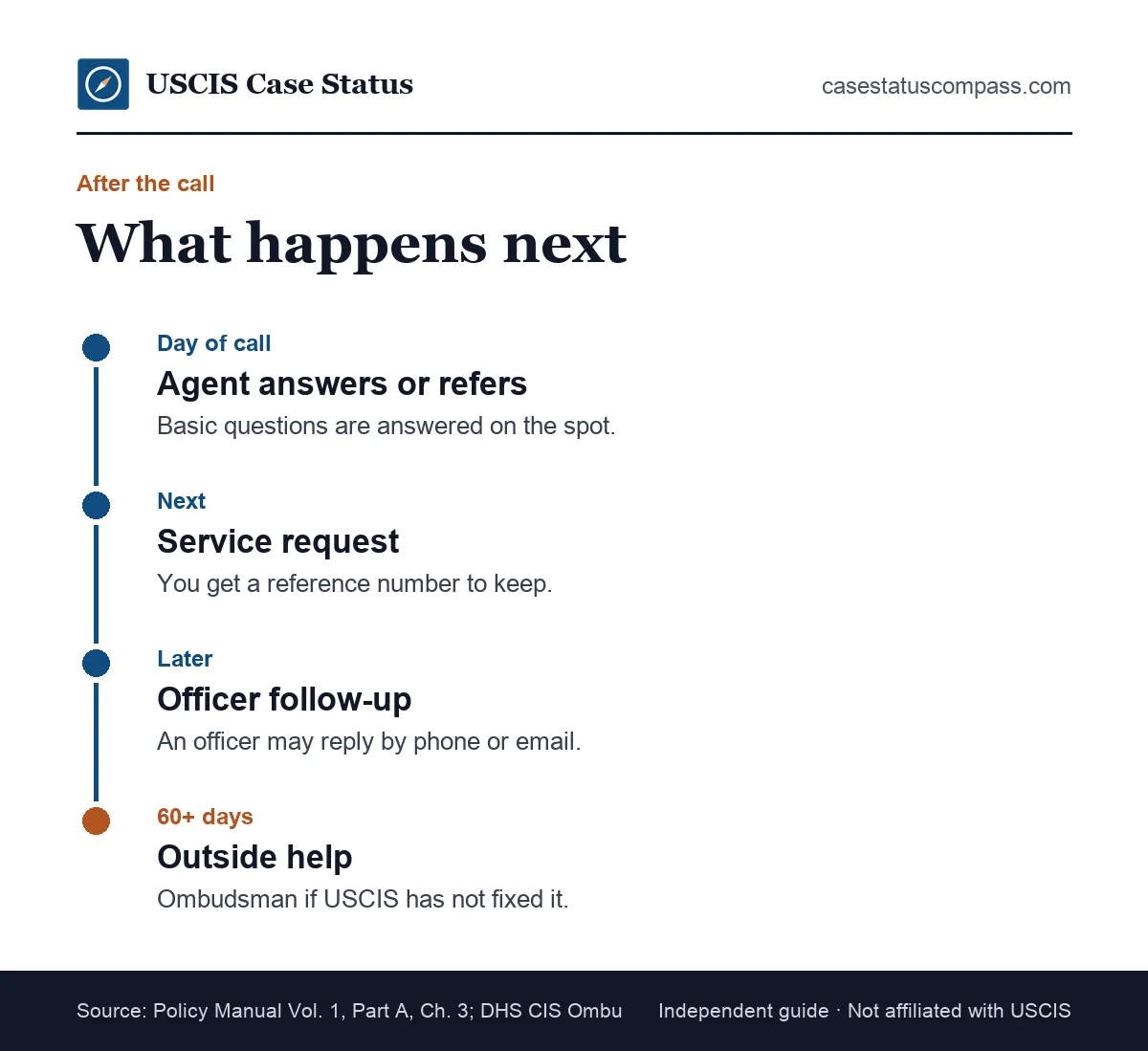
Service request referrals
A service request sends your issue to the office holding your file. Keep the reference number. If you call again, give it to the agent so they can see the history instead of starting over.
Following up
If no reply comes in a reasonable time, call back with the reference number, or send a secure message from your account. If USCIS still has not fixed the issue after at least 60 days, the Ombudsman route may open.
Keep a Contact Log: A Template You Can Copy
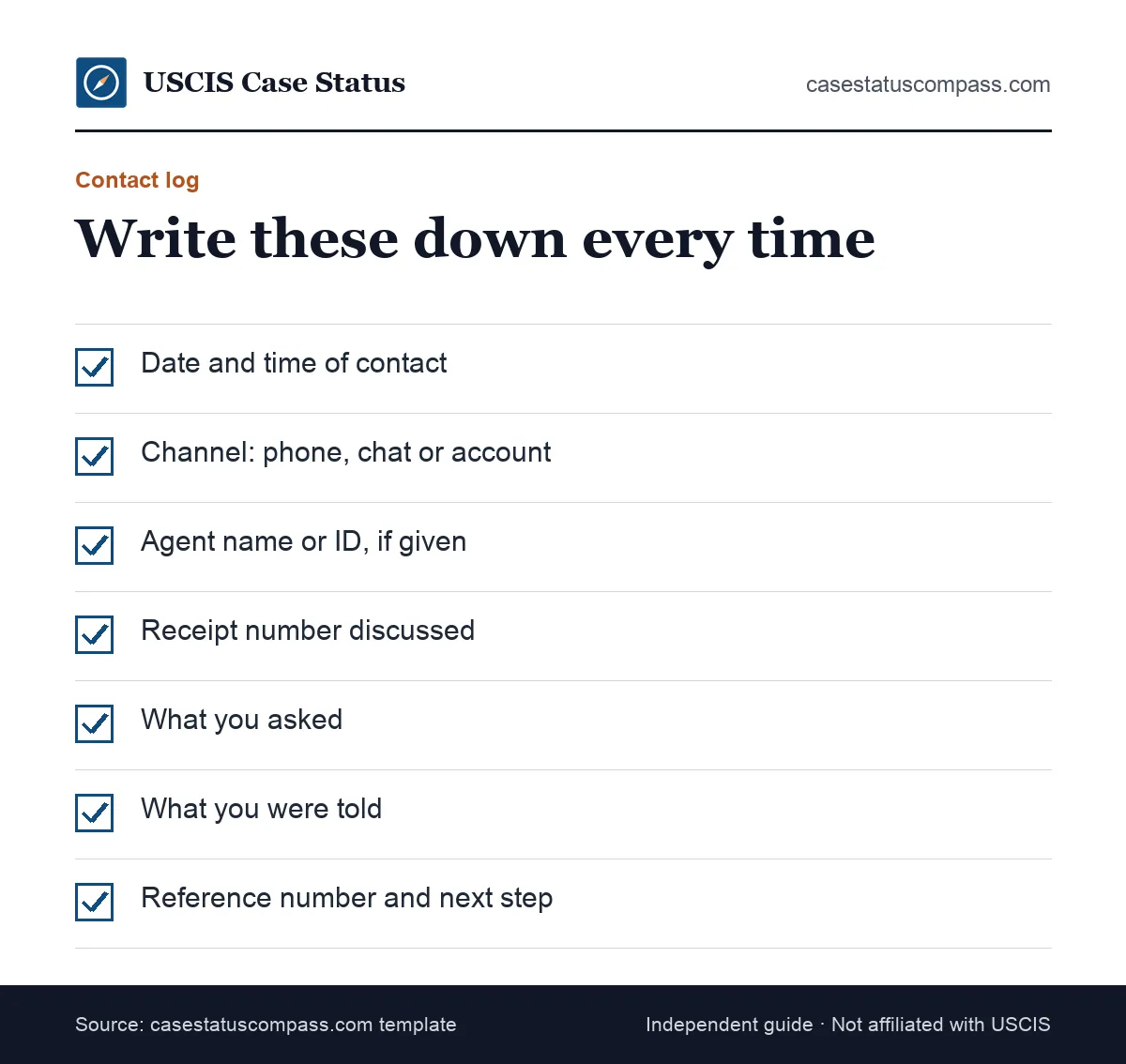
A contact log is a simple record of every call, chat and message with USCIS. It gives you the proof the Ombudsman and congressional offices ask for. Copy the template below into a notebook or spreadsheet. Start it with your first call.
Contact log template
Each row records one contact: when it happened, which channel, who you spoke with, what you asked and the reference you got.
| Date and time | Channel | Agent or ID | What you asked | What you were told | Reference |
|---|---|---|---|---|---|
| [date, time] | Phone | [name or ID] | [question] | [answer] | [number] |
| [date, time] | Emma chat | [name] | [question] | [answer] | [number] |
| [date, time] | Online account | n/a | [message topic] | [reply] | [number] |
What to record
Write the date, channel and outcome right after each contact, while details are fresh. Include exact phrases if an agent promised a step, such as "referred to an officer." Note any promised dates too.
How the Contact Center Fits Into USCIS Case Help
The Contact Center is one tool in a larger set of case help routes. It answers questions and starts service requests, but deadlines, appeals and address changes each have their own forms. Our uscis case help hub maps every problem to the right route.
When Should You Call an Attorney Instead of USCIS?
If you received a Notice of Intent to Deny, a denial or a Notice to Appear, call an immigration attorney or DOJ-accredited representative, not only the Contact Center. Agents cannot give legal advice, and these notices carry short deadlines. Call the same day if you can.
Free and low-cost legal help
Nonprofits recognized by the Justice Department employ DOJ-accredited representatives who often charge little or nothing. Our immigration lawyer cost guide explains fees and how to compare options.
Frequently Asked Questions
Do USCIS offices work on Saturdays?
USCIS live phone and chat agents do not work on Saturdays; they work Monday to Friday, 8 a.m. to 8 p.m. Eastern. Field offices see visitors only by appointment. On a Saturday you can still use the automated phone line, Emma and your online account.
Will USCIS work on a Saturday to process my case?
Your case status can change on a weekend, because USCIS systems post updates in batches. That does not mean you can reach staff on a Saturday. If your case needs action from a person, call on a weekday or send a secure message from your account.
Is the USCIS contact number free to call?
Yes. The main Contact Center number is toll-free from within the U.S., and USCIS charges nothing for help by phone, chat or e-Request. Callers abroad use a separate number, and their phone carrier may charge international rates. Anyone charging you a fee to "reach USCIS" is not USCIS.
Can I email USCIS about my case?
The USCIS Contact Center page lists phone, chat, e-Request and the online account, not an email address for case questions. The closest option is a secure message from your USCIS online account, which ties the message to your verified identity.
Can USCIS call me back?
Yes, sometimes. When a first-level agent cannot resolve your issue, it may be referred to an Immigration Services Officer, who contacts you later by phone or email. Never pay a caller you cannot verify.
Why can't the agent see my immigration court case?
USCIS and the immigration courts are separate agencies. Courts belong to the Justice Department's Executive Office for Immigration Review, so USCIS agents cannot see hearing dates or judges' decisions. Use the EOIR automated hotline or its online case portal with your A-Number instead.
Can I call USCIS just to check my case status?
You can, but it is rarely the fastest way. The automated line points case status questions to online tools, and Case Status Online or your USCIS online account shows the same record an agent sees. Call a live agent only when the status reveals a problem, such as a missing notice or a case past its inquiry date.
Is there a direct phone number for a USCIS officer?
No. USCIS does not publish direct lines for officers, field offices or service centers. The Contact Center is the immigration direct phone number for the public, and an agent can refer your issue to an officer.
Can I walk into a USCIS office without an appointment?
No. USCIS does not accept walk-ins. Book an appointment online or through the Contact Center, then bring the appointment notice and photo ID to the office.
How do I get a reference number after a call?
Ask the agent before you hang up whether a service request was created and what its number is. Write it in your contact log, because it lets the next agent see the history.
Sources
- USCIS Contact Center (updated 10/13/2026). www.uscis.gov/contactcenter. Accessed Oct 27, 2026.
- USCIS Policy Manual Vol. 1, Part A, Ch. 3: Types of Assistance. www.uscis.gov/policy-manual/volume-1-part-a-chapter-3. Accessed Oct 27, 2026.
- USCIS: Benefits of a USCIS Online Account (updated 09/18/2025). www.uscis.gov/file-online/benefits-of-a-uscis-online-account. Accessed Oct 27, 2026.
- USCIS: Online Account and Technical Support (updated 05/15/2026). www.uscis.gov/tools/uscis-tools-and-resources/online-account-and-technical-support. Accessed Oct 27, 2026.
- USCIS: How to Make an Expedite Request (updated 09/08/2026). www.uscis.gov/forms/filing-guidance/how-to-make-an-expedite-request. Accessed Oct 27, 2026.
- USCIS: How to Change Your Address (updated 08/04/2026). www.uscis.gov/addresschange. Accessed Oct 27, 2026.
- USCIS: Preparing for Your Biometric Services Appointment (updated 04/30/2026). www.uscis.gov/forms/filing-guidance/preparing-for-your-biometric-services-appointment. Accessed Oct 27, 2026.
- CIS Ombudsman tip sheet: Check Your USCIS Case Inquiry Date (Aug. 2024). dhs.gov/sites/default/files/2024-11/24_0823_cisomb_case-inquiry-date-tip-sheet.pdf. Accessed Oct 27, 2026.
- DHS CIS Ombudsman: How to Submit a Case Assistance Request (updated 04/13/2026). www.dhs.gov/case-assistance. Accessed Oct 27, 2026.
- USCIS Service Center Operations Directorate (updated 07/17/2026). www.uscis.gov/about-us/organization/directorates-and-program-offices/service-center-operations-directorate. Accessed Oct 27, 2026.
- DOJ EOIR: Customer Service Initiatives. www.justice.gov/eoir/customer-service-initiatives. Accessed Oct 27, 2026.
- DOJ EOIR: Immigration Court Information. www.justice.gov/eoir/immigration-court-information. Accessed Oct 27, 2026.
- USCIS: Consular Processing. www.uscis.gov/green-card/green-card-processes-and-procedures/consular-processing. Accessed Oct 27, 2026.
- USCIS Policy Manual Vol. 11, Part A, Ch. 3 (returned documents). www.uscis.gov/policy-manual/volume-11-part-a-chapter-3. Accessed Oct 27, 2026.
- State Department: NVC Timeframes (as of 26-Oct-26). travel.state.gov/content/travel/en/us-visas/immigrate/nvc-timeframes.html. Accessed Oct 27, 2026.
- USCIS: Field Operations Directorate (updated 05/09/2025). www.uscis.gov/about-us/organization/directorates-and-program-offices/field-operations-directorate. Accessed Oct 27, 2026.
- USCIS OLA New Member Outreach FAQs (Jan. 2021). www.uscis.gov/sites/default/files/document/questions-and-answers/5%20117%20-%20New%20Member%20Outreach%20FAQs%2001042021.pdf. Accessed Oct 27, 2026.
- 8 CFR 103.2(b)(8)(iv) (LII). www.law.cornell.edu/cfr/text/8/103.2. Accessed Oct 27, 2026.
casestatuscompass.com is an independent publication and is not affiliated with USCIS or any government agency. This page is general information, not legal advice. For denials, court or asylum matters, consult an immigration attorney or a DOJ-accredited representative.