Contents · 43 sections
- What Is a USCIS Expedite Request?
- What Does Expedited Processing Mean?
- What Is an Expedite Date?
- USCIS Expedite Criteria
- What Counts as Severe Financial Loss?
- Does Losing a Job Count as Severe Financial Loss?
- What Counts as an Emergency or Urgent Humanitarian Reason?
- Nonprofit, Government Interest and USCIS Error Grounds
- Can a USCIS Error Justify an Expedite?
- Who Can Ask for an Expedite?
- When Should You Submit an Expedite Request?
- How to Submit a USCIS Expedite Request
- What Should You Say When You Call USCIS?
- What Evidence Supports an Expedite Request?
- Expedite Request Checklist
- Sample USCIS Expedite Request Letter
- Expedite by Form
- EAD Expedite Request
- Can You Expedite an H-4 EAD?
- Can You Expedite OPT?
- I-130 Expedite Request
- I-130 Expedite Request Letter Sample
- Can You Expedite a Green Card Application?
- Should You Expedite a Green Card Renewal (Form I-90)?
- How Can You Get a Green Card Faster Than 90 Days?
- Advance Parole Expedite
- Can You Expedite an H-1B Petition?
- Can a Nonprofit Employer Expedite an H-1B?
- USCIS Expedite Request vs Premium Processing
- Can You Pay to Expedite a USCIS Case?
- NVC Expedite Request
- How Do You Ask the NVC to Speed Up a Case?
- Expedites for Asylum, Refugee and Humanitarian Cases
- After You Submit: How Long?
- How Long After an Expedite Request Is Approved?
- What Happens If USCIS Approves Your Expedite?
- What If Your Expedite Request Is Denied?
- Should You Contact the CIS Ombudsman or Congress?
- Expedite Request vs Outside Normal Processing Time Inquiry
- Common Reasons Expedite Requests Fail
- Expedite Decision Table: If X, Do Y
- Real-World Expedite Scenarios
- Frequently Asked Questions
The short answer
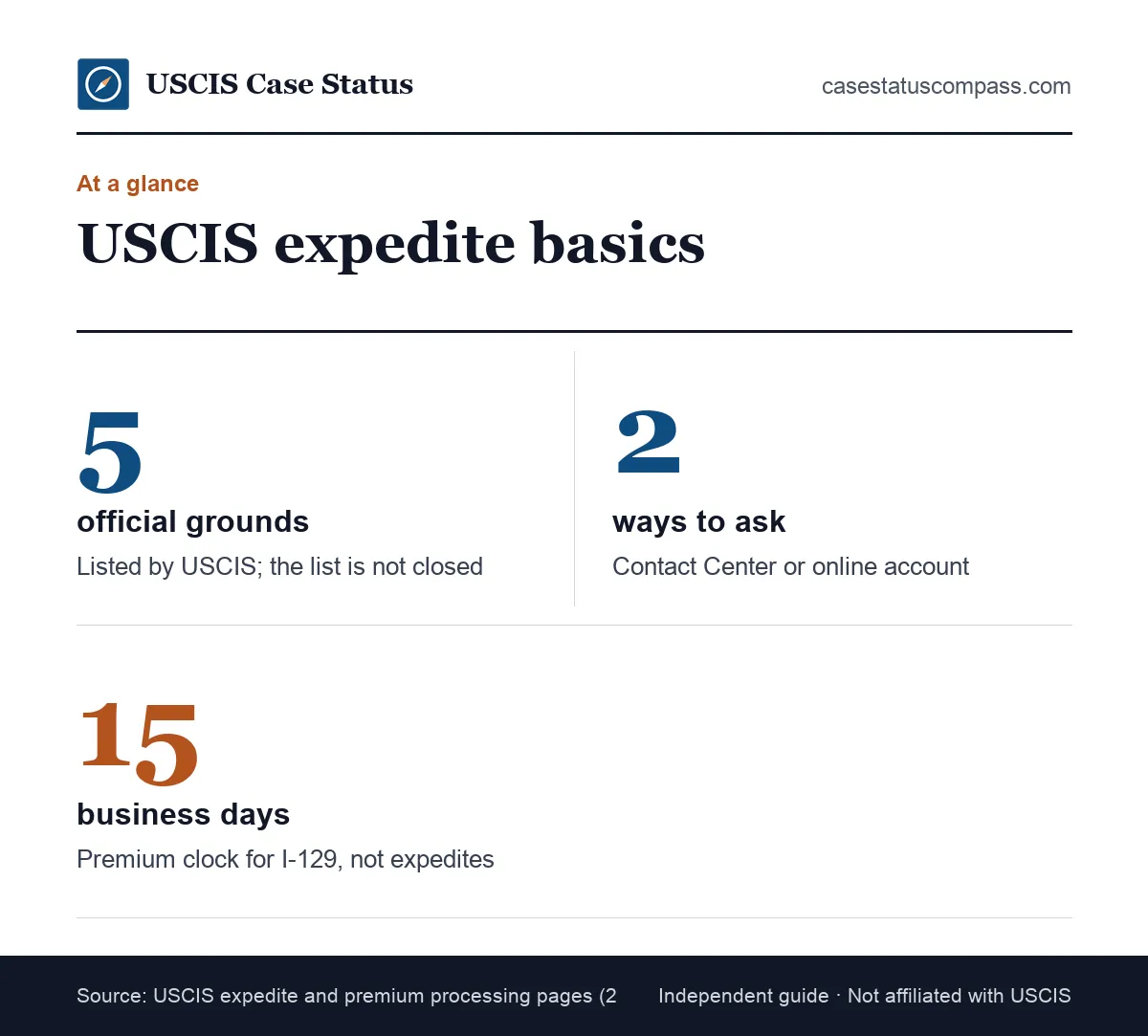
A USCIS expedite request asks USCIS to decide your pending case ahead of the normal line. You make it by calling the USCIS Contact Center or through your online account, and you need evidence that fits an official ground, such as severe financial loss or an emergency. It is free, but USCIS decides each request at its discretion.
At a glance
| Official grounds | Financial loss, emergency, nonprofit, government interest, USCIS error |
| How to ask | Ask for an expedite through the USCIS Contact Center or your online account |
| Cost | No fee is listed by USCIS. Premium processing is a separate paid service. |
| Guaranteed? | No. Meeting a ground does not guarantee USCIS will expedite. |
| Not for | Categories where premium processing is available (nonprofit exception) |
What Is a USCIS Expedite Request?
A USCIS expedite request is a request to move one pending application, petition, appeal or motion ahead of cases filed earlier. USCIS reviews each one case by case, usually based on documents you provide. The decision is in its sole discretion, and there is no form or fee.
Moving a case out of line
USCIS works cases roughly in the order received. An expedite pulls your file forward, which pushes others back, so the bar is high. Our uscis case help hub shows how expedites fit with other options.
What an expedite is not
An expedite is not an approval and does not change the rules. It is also not premium processing, a paid clock for set forms. Your case still needs every normal step.
What Does Expedited Processing Mean?
Expedited processing means USCIS has agreed to handle your case faster than its normal order because of an urgent, documented reason. It does not mean a set number of days. USCIS still completes biometrics, background checks and any interview before it decides.
Expedited vs normal order
In normal processing, your place depends on your receipt date and office workload. In expedited processing, an officer moves your file up, but steps you still owe, such as fingerprints or an interview, can slow the decision.
What Is an Expedite Date?
People say "expedite date" for the day a request was granted or for a deadline, such as a job start. USCIS does not use the phrase. Your deadline date matters most. Put that date, with proof, at the top of every request and follow-up, so the officer sees how much time is left.
Putting your deadline date in the request
State the date in the first sentence of your call or message, and match it to a document, such as a job start letter, a medical appointment or a travel itinerary.
USCIS Expedite Criteria
USCIS lists five grounds, as of its page updated September 8, 2026: Expedite criteria: severe financial loss, emergency/humanitarian, nonprofit, government interest, clear USCIS error. Each ground needs evidence, and urgency you caused by filing late does not count. Pick the one ground that fits best.
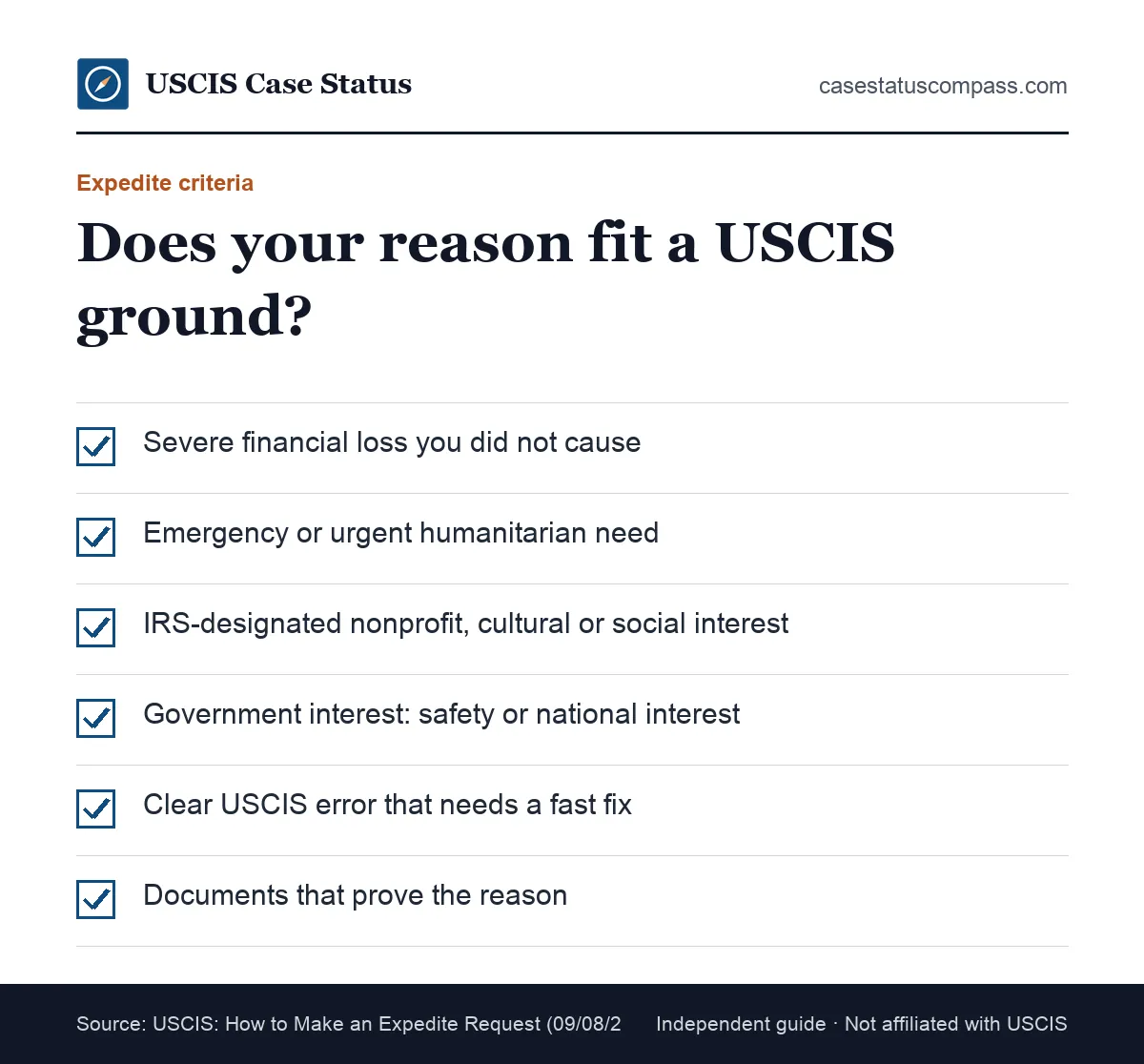
The five grounds side by side
Each row names one official ground, what USCIS looks for under it, and a typical document that proves it.
| Ground | What USCIS looks for | Example of proof |
|---|---|---|
| Severe financial loss | Real, imminent loss to a person or company | Employer letter on layoffs or a lost contract |
| Emergency or humanitarian | Serious illness, death, safety risk | Doctor letter, death certificate |
| Nonprofit (IRS-designated) | Beneficiary's role in a U.S. cultural or social interest | Letter explaining the program and timing |
| Government interest | Agency says the case is urgent | Request from an authorized official |
| Clear USCIS error | USCIS mistake causing urgent harm | Copy of the wrong card or notice |
Criteria are a minimum, not a promise
USCIS says meeting a criterion does not guarantee an expedite. Officers weigh urgency and proof. A short request with direct evidence has the best chance. One strong document beats a stack of weak ones.
What Counts as Severe Financial Loss?
Severe financial loss means a serious, specific harm to a business or a person, such as a company losing a critical contract or a person losing critical public benefits. USCIS says needing work authorization alone does not qualify, and the loss must not come from your own late filing or late response.
Business examples
USCIS examples include a company at risk of failing, losing a key contract or laying off staff. An employer letter should state the loss, the amount and the date. It should be signed by a company official.
Does Losing a Job Count as Severe Financial Loss?
A person may qualify if a specific job loss will cause real hardship. "I want to start working" is not enough. Show the job, the deadline and what you will lose, such as housing or health coverage. An offer letter with a start date helps.
What Counts as an Emergency or Urgent Humanitarian Reason?
An emergency or urgent humanitarian reason is a pressing situation affecting someone's well-being, such as serious illness, disability, the death of a close relative or friend, or extreme living conditions. USCIS also gives the example of a vulnerable person whose safety is at risk.
Illness, death and safety
These requests rest on proof: a doctor's letter on letterhead, a death certificate or obituary, and proof of relationship. Explain why waiting would cause harm, not just inconvenience. A strong doctor's letter names the condition, the treatment needed and why the timing matters.
Humanitarian case types alone are not enough
USCIS notes that a humanitarian case type, such as asylum or humanitarian parole, is not urgent by itself. You still need a separate, documented emergency. Describe it with dated proof.
Nonprofit, Government Interest and USCIS Error Grounds
The three less common grounds are an IRS-designated nonprofit whose beneficiary furthers U.S. cultural or social interests, a government interest such as public safety or national security, and a clear USCIS error. Each needs proof from someone other than you, such as the organization or agency.
Nonprofit organizations
The nonprofit must show an urgent need tied to the beneficiary's role, such as a researcher on a social program or a religious worker needed for outreach. It is the one ground allowed even where premium processing exists.
Government interest
A federal, state, tribal, territorial or local agency official must ask. Examples include a cooperating crime victim or witness, or a scientist a government lab needs. You cannot claim it for yourself.
Can a USCIS Error Justify an Expedite?
This ground needs a USCIS mistake plus an urgent need to fix it, such as a work permit printed with an error that stops you working. Examples include a wrong name, date of birth or category on a card or notice. Report the typo itself through e-Request too, and attach a copy of the faulty document plus proof of the harm, such as an employer's note.
Who Can Ask for an Expedite?
The applicant, the petitioner or their attorney or accredited representative can ask, using the case's receipt number. For the government-interest ground, the request must come from an authorized agency official. A friend or relative cannot ask for you, though they can provide supporting letters.
Applicants, petitioners and representatives
On a family petition, the petitioner or beneficiary may call; the Contact Center verifies identity. An attorney with a Form G-28 on file can submit and follow up for you.
Congressional offices and other third parties
A member of Congress can ask about your case after you sign a privacy release. That is a case inquiry, not a separate expedite channel. The same criteria apply as for a USCIS expedite request you make yourself.
When Should You Submit an Expedite Request?
Submit after you get your receipt notice, once you have checked current processing times and your case status. USCIS also asks you to finish any pending step first, such as biometrics or an evidence response. Asking too early only adds a duplicate request.
After the receipt notice
USCIS needs a receipt number, because the request attaches to a case. If an emergency exists before filing, file first, then ask. Online filers get a receipt number right away, which lets them ask sooner.
Finish pending steps first
If your case is waiting on you, an expedite will not help. Attend biometrics and answer any Request for Evidence (RFE) first. Our rfe meaning guide explains how an RFE pauses a case.
How to Submit a USCIS Expedite Request
You submit a USCIS expedite request in one of two ways: call the USCIS Contact Center (or ask Emma) with your receipt number, or choose "expedite" as the reason in your online account's secure messaging. Upload your supporting evidence to the online account either way.
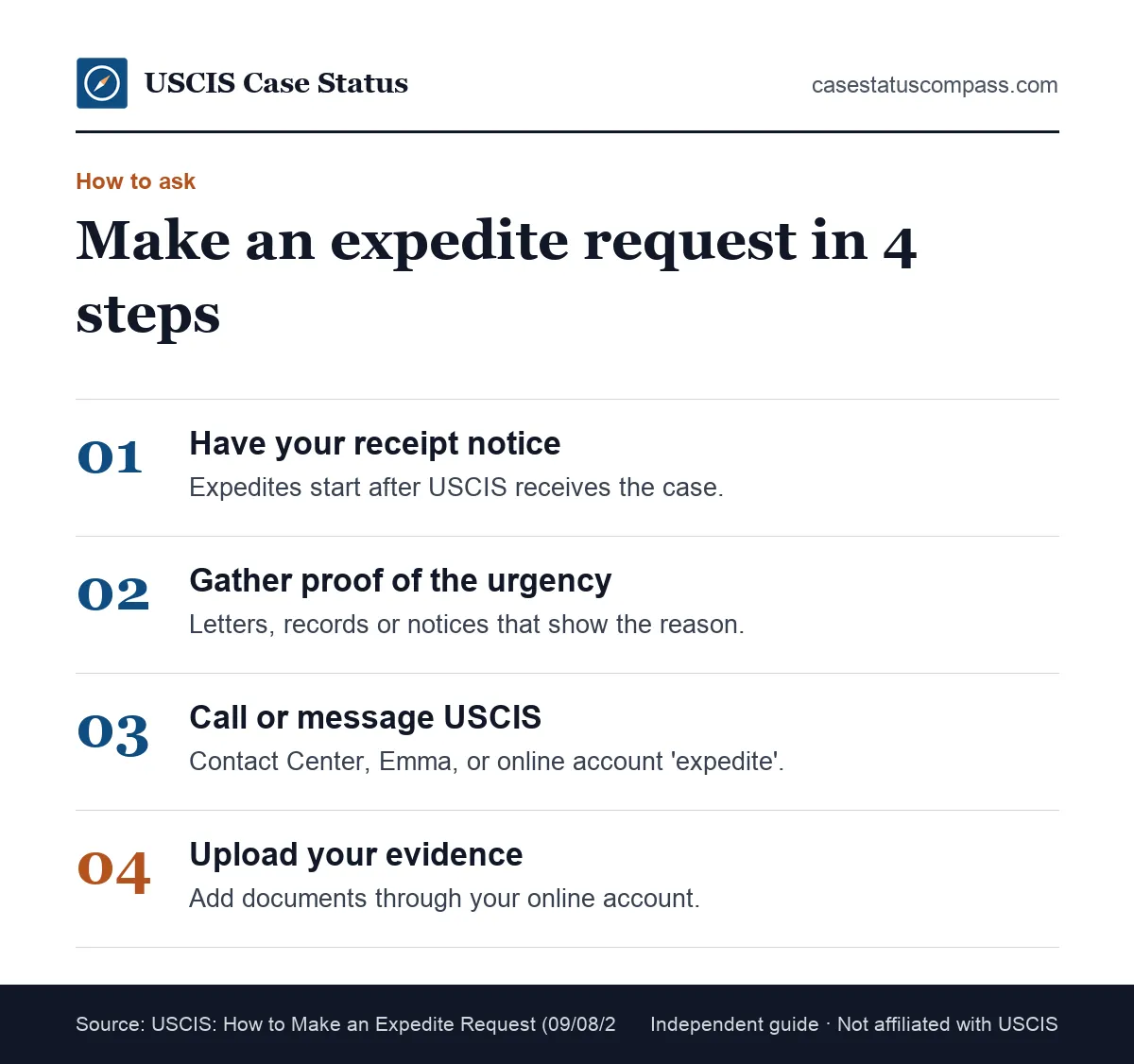
By phone
Call 800-375-5283 (TTY: 800-767-1833). Live calls and chat: Monday to Friday, 8 a.m. to 8 p.m. Eastern. Ask for an expedite, give your receipt number and state the reason briefly. Our uscis contact number guide explains how to reach a live agent.
Online
Sign in to your USCIS online account, open secure messaging and pick "expedite" as the reason. Describe the urgency and upload your documents. Save a copy of the message and your upload list.
What Should You Say When You Call USCIS?
Keep it short: receipt number, form, ground, deadline and proof. Agents type a summary into a service request, so a clear one-sentence reason helps the officer who reads it. Speak slowly when giving the receipt number, and ask the agent to read back the reason before ending the call.
A simple phone script
"I'm calling to request an expedite on receipt number [ABC1234567890], Form [I-130]. The reason is [a severe medical emergency]. My [mother] has [a serious illness], and I need [her case decided before date]. I have a doctor's letter and proof of relationship to upload."
What to have ready
- Receipt number and form type
- Your name, date of birth and A-Number, if any
- The ground you are relying on
- The date you need a decision by
- A list of documents you can upload
What Evidence Supports an Expedite Request?
Evidence must prove the urgency, not just describe it. USCIS examples include doctor or hospital letters, death certificates, employer letters, invitations and proof of relationship. Without evidence, USCIS sends instructions to submit it, which costs time. Upload it with your USCIS expedite request so the officer can decide on the first review.
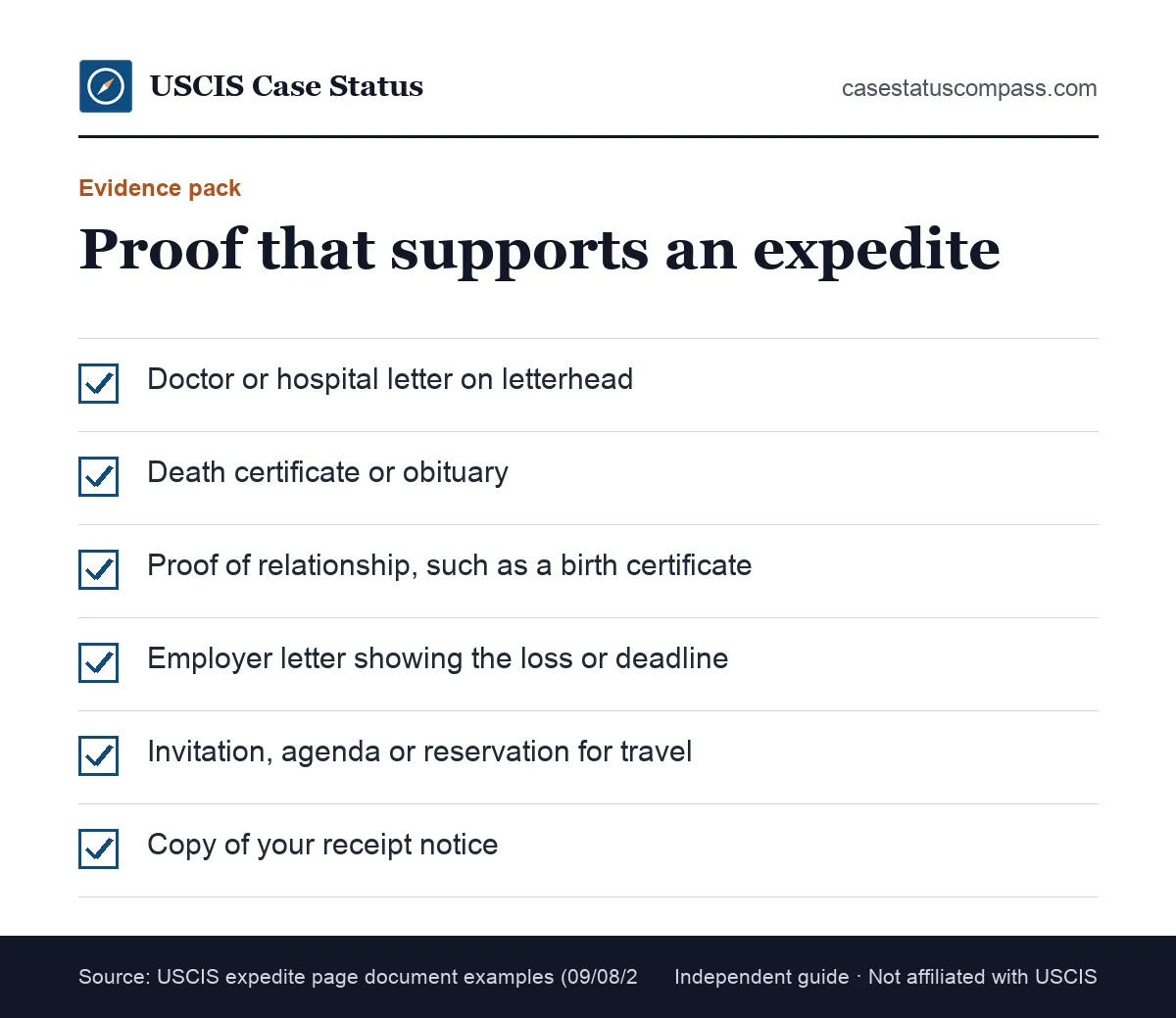
Evidence by reason
Find your reason in the left column; the right column lists the documents USCIS examples point to for it.
| Your reason | Best evidence |
|---|---|
| Death of a relative or close friend | Death certificate, obituary or funeral letter, plus proof of relationship |
| Serious illness of a relative | Doctor or hospital letter on the critical condition, plus relationship proof |
| Your own urgent medical treatment | Letter from your doctor, hospital or clinic |
| Work or professional commitment | Employer letter on letterhead, agenda or invitation |
| Wedding or personal event | Invitation or reservations; relationship proof if not your own event |
| School or academic commitment | Letter from the institution, curriculum or agenda |
Translations, dates and signatures
Add a certified English translation for any foreign-language document. Letters should be signed and recent; last year's doctor's letter will not prove an emergency today. Make sure every letter is dated.
Expedite Request Checklist
Before you ask, confirm five things: you have a receipt notice, your reason fits an official ground, the urgency is not self-caused, nothing is pending on your side, and you can upload proof. If any answer is no, fix it first.
Before you ask
- Receipt notice in hand
- Current processing time checked
- Reason matches one of the five grounds
- Urgency was not caused by late filing or late response
- Biometrics and RFE responses done
- Evidence scanned and ready to upload
- Deadline date written down
A final quality check
Could a stranger grasp the harm and the date quickly? Is every claim backed by a document? Cut anything that does not support the urgency. Then read it aloud once before you send it.
Sample USCIS Expedite Request Letter
USCIS does not require a letter; the phone or online request is the official route. A short statement still helps when uploaded with your evidence. The fill-in sample below is an example only; adapt it and check the current USCIS page.
Fill-in expedite letter template
Example only. Replace every bracket with your own details.
[Date]
Re: Expedite request, Receipt Number [ABC1234567890], Form [I-765]
Applicant: [Full name], A-Number [if any], Date of birth [MM/DD/YYYY]
I request expedited processing of the case above under the USCIS criterion of [severe financial loss / emergency or urgent humanitarian reason / clear USCIS error].
[Two or three sentences describing the urgent situation, with dates.]
If the case is not decided by [date], [specific harm, for example: I will lose my job offer at Example Clinic, which starts on (date)].
This situation was not caused by any delay in filing or responding to USCIS.
Enclosed evidence: [1. Employer letter dated (date)]; [2. Copy of receipt notice]; [3. Other proof].
Thank you for your consideration.
[Signature] [Printed name] [Phone] [Email]
How to adapt the template
Keep it to one page and name one main ground. Put the key date up front, and list documents in upload order. Sign it, add your contact details, and keep the wording factual rather than emotional.
Expedite by Form
Family forms such as the I-130 and I-485 have no premium processing, so an expedite is the fast lane. For premium-eligible categories, USCIS generally will not consider one. The table shows which applies to the forms people ask about most, so you can tell quickly whether to request an expedite or pay for speed.
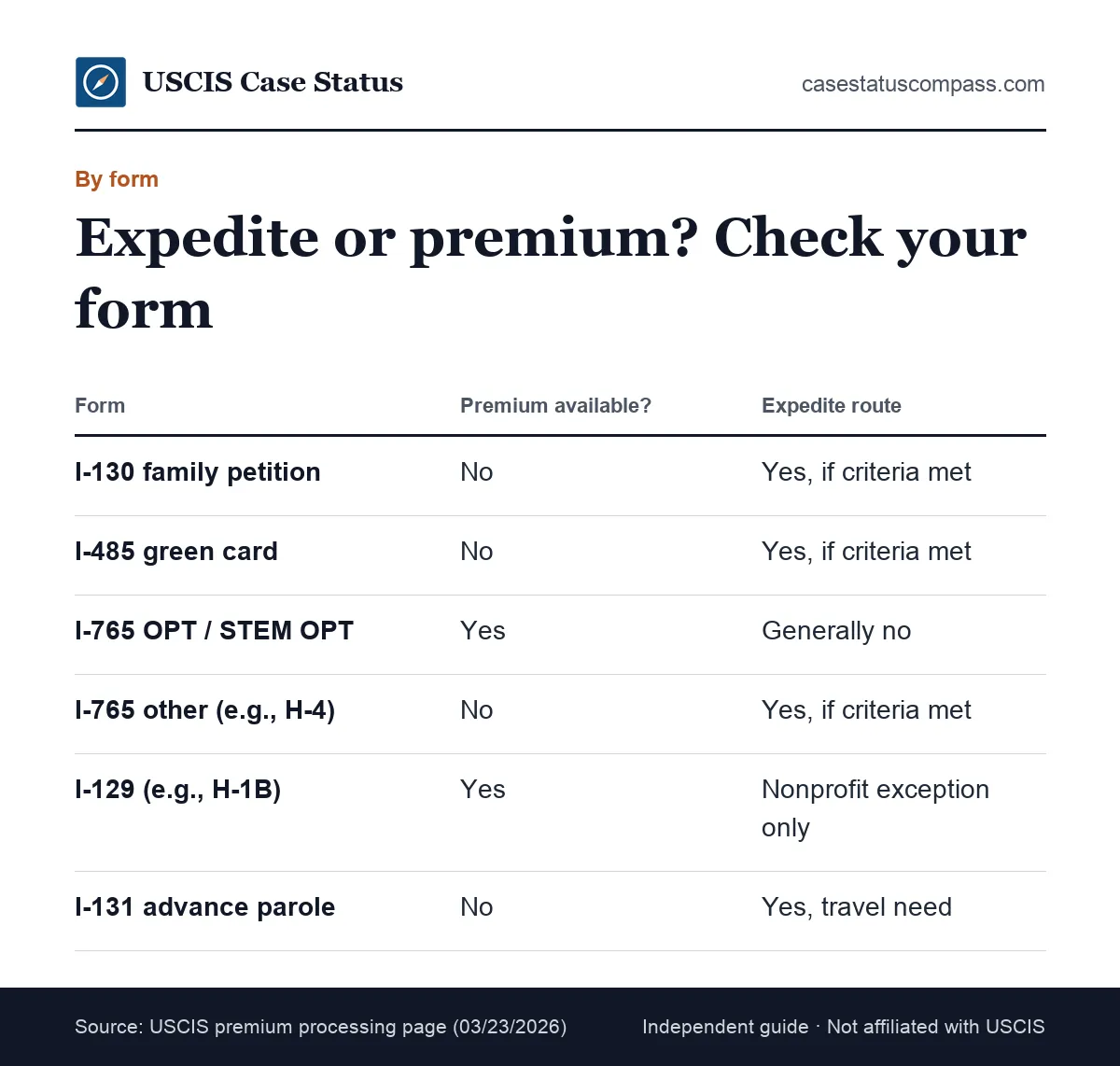
Form-by-form summary
Each row shows whether a form offers premium processing and whether USCIS will consider an expedite for it.
| Form | Premium processing? | Expedite possible? |
|---|---|---|
| I-130 family petition | No | Yes, with criteria and proof |
| I-485 adjustment of status | No | Yes, with criteria and proof |
| I-765 OPT or STEM OPT | Yes | Generally no |
| I-765 other categories (e.g., H-4, pending I-485) | No | Yes, with criteria and proof |
| I-131 advance parole | No | Yes, for an urgent travel need |
| I-129 (H-1B, L-1, O-1 and others) | Yes | Only for the nonprofit ground |
| I-140 (EB-1, EB-2, EB-3) | Yes | Only for the nonprofit ground |
| N-400 naturalization | No | Yes, with criteria and proof |
Where premium processing applies
Premium processing covers I-129 work visas, I-140 (EB-1/2/3), I-765 OPT/STEM OPT and I-539 to F/M/J. If your category is listed, an expedite will usually be refused unless you are an IRS-designated nonprofit.
EAD Expedite Request
An EAD expedite request asks USCIS to speed up a Form I-765 work permit. It can work when a specific job loss, lost benefits or a USCIS card error causes real harm. A wish to start working sooner is not enough.
When an EAD expedite fits
Strong cases include a health worker whose employer will cut staff without them, a person about to lose critical benefits, or a wrong card that blocks work. Our work permit guide covers Form I-765 itself.
Do not count on an automatic extension
Ended: renewals filed on or after Oct. 30, 2025 no longer get the up-to-540-day automatic extension (exceptions: TPS by law/Federal Register notice; STEM OPT 180 days). If your card expires soon and a job will be lost, that gap in work authorization may support a financial-loss request.
Can You Expedite an H-4 EAD?
Yes, you can ask. An H-4 EAD is a Form I-765 category that is not on the premium processing list, so the normal expedite criteria apply. You still need a documented urgent reason. Lost pay alone is weaker than a specific, dated loss.
Why H-4 EAD differs from OPT
I-765 premium processing covers only OPT and STEM OPT, so H-4 spouses cannot pay for speed on the EAD. An expedite is the only fast lane, even when the H-4 extension is filed with the H-1B.
Evidence for an H-4 EAD expedite
Include an employer letter with your role, the date you leave payroll and the business loss. Add your current card, receipt notice and proof of hardship, such as a mortgage tied to your income.
Can You Expedite OPT?
Generally no. OPT and STEM OPT work permits are eligible for premium processing, so USCIS generally will not consider an expedite for them. The faster route is to file Form I-907 with the fee. 15 business days (I-129, most I-140); 30 (I-765 OPT, I-539 F/M/J); 45 (I-140 E13 managers and NIW).
OPT premium processing route
Premium processing gives OPT a clock for a fee: $2,965 (I-129 most classes, I-140); $1,780 (H-2B/R, I-765 OPT); $2,075 (I-539 to F/J/M). A pending OPT case can be upgraded by filing the I-907 later.
When an OPT student still asks
Students with a near start date may still call; expect to be pointed to premium processing. Your designated school official can explain start-date rules. Premium is the faster and more certain path for OPT.
I-130 Expedite Request
An I-130 expedite request asks USCIS to speed up a family petition, often because the beneficiary abroad faces danger, a serious illness, or the petitioner is ill. With no premium processing for the I-130, an expedite is the only fast route.
When an I-130 expedite fits
Strong cases involve a spouse or child abroad with a serious medical condition, a gravely ill petitioner, or a safety threat. Long separation alone will not qualify. Our form i-130 guide covers the petition.
I-130 Expedite Request Letter Sample
Adapt a short paragraph like this for your online message or upload, naming one ground and one date.
Example only (fictional names). "I, Ana Example, petitioner on receipt number [IOE0000000000], request expedited processing under the emergency or urgent humanitarian criterion. My husband, Leo Example, was diagnosed with [condition] on [date]. His doctor states he needs treatment not available in [country]. Enclosed: doctor's letter dated [date], marriage certificate and receipt notice."
What the sample paragraph includes
It names the petitioner, the receipt number, one criterion, a dated diagnosis and the enclosures. Those are the pieces an officer checks first. Keep the same order in your own version.
Can You Expedite a Green Card Application?
Yes, a Form I-485 green card application can be expedited if you meet the criteria. There is no premium processing for the I-485. Medical emergencies, a petitioner's serious illness or a clear USCIS error are common grounds. Proof is still required.
Expediting Form I-485
At a field office, an expedite may bring an earlier interview rather than an instant decision. Our form i-485 guide explains each stage. Have your documents ready, since a quick interview leaves little time to prepare.
Should You Expedite a Green Card Renewal (Form I-90)?
Most Form I-90 filers do not need an expedite. I-90 receipt notice + expired card = proof of status for 36 months from the card's expiration date. Ask only for an urgent need that notice does not solve. Carry the notice with your card.
How Can You Get a Green Card Faster Than 90 Days?
There is no official 90-day green card track. Family and most employment green card cases have no premium processing at the I-485 stage, and USCIS's own medians run much longer. The legal options are an expedite with a documented emergency, and avoiding delays you control.
What the numbers show
As a reference point, I-485 (family): median 7.0 months (USCIS data, Apr.-June 2026), and I-485 (employment): median 6.0 months (USCIS data, Apr.-June 2026). These past medians show why "90 days" claims online are unrealistic.
Legitimate ways to save time
- File a complete package with all required evidence
- Respond to any RFE quickly and fully
- Attend biometrics on the first date offered
- Keep your address current on every case
- Ask for an expedite only if you meet a criterion
Advance Parole Expedite
An advance parole expedite asks USCIS to speed up a Form I-131 travel document because you must travel abroad urgently, such as for a funeral, a grave family illness or critical medical treatment. USCIS asks you to get the document before you leave.
What counts as urgent travel
A funeral, a parent in intensive care or treatment you cannot get here can qualify; a vacation or wedding trip does not. Upload a death certificate, hospital letter or appointment record.
Planning the request
The USCIS timing rule: for a travel document, request an expedite at least 45 days before leaving; for travel within 15 days, use USCIS emergency travel. Traveling while your I-485 is pending abandons it unless you have advance parole (with H/L/V/K exceptions).
A 2026 travel risk to know first
Since Aug. 13, 2026, travel on advance parole counts as a departure: over 180 days of unlawful presence can trigger the 3/10-year bar. If you were ever out of status, see an immigration attorney first. Our form i-131 guide covers the application.
Can You Expedite an H-1B Petition?
Usually not. H-1B petitions on Form I-129 are eligible for premium processing, so USCIS generally will not consider an expedite. The exception is an IRS-designated nonprofit employer whose worker furthers U.S. cultural or social interests. Everyone else seeking H-1B expedited processing uses premium processing.
H-1B premium processing instead
Premium processing for most I-129 classes runs on a 15-business-day clock once USCIS receives a proper Form I-907. Our h-1b visa guide covers the petition. The employer files Form I-907 and pays the fee.
Can a Nonprofit Employer Expedite an H-1B?
A nonprofit employer, such as a charity, may ask for an expedite instead of paying for premium. It must show the worker's role in a U.S. cultural or social interest and why timing is urgent. Proof of its IRS status should be included.
USCIS Expedite Request vs Premium Processing
A USCIS expedite request is free and discretionary: USCIS may say no, and no timeframe is promised. Premium processing is a paid Form I-907 service for listed categories, with a fixed business-day clock. The two are rarely available for the same case.
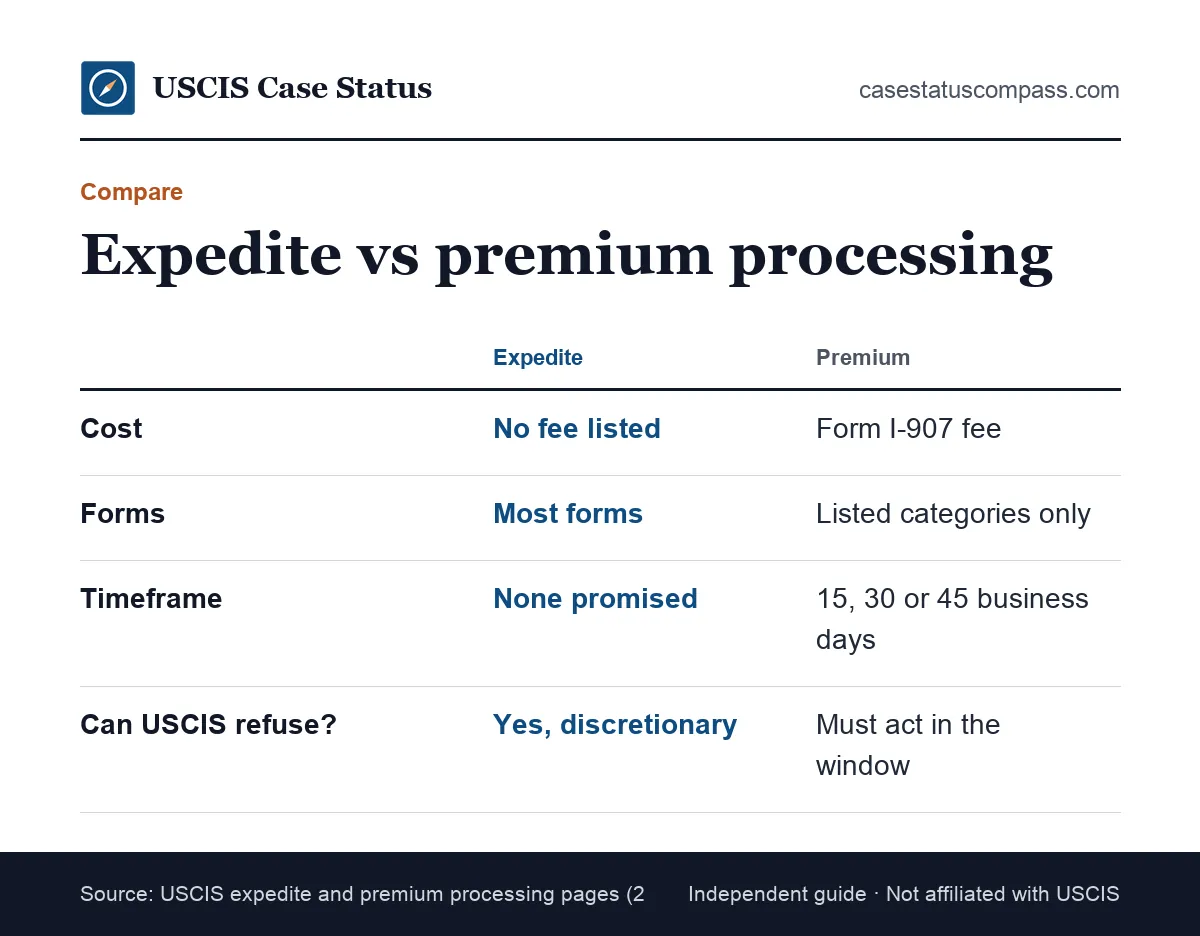
Quick comparison
- Cost: no fee listed for an expedite; a Form I-907 fee for premium
- Clock: none for an expedite; 15, 30 or 45 business days for premium
- Proof: an expedite needs evidence of urgency; premium does not
- Fee waiver: You can't get a fee waiver for premium processing
Which one to use
If your form and category are premium-eligible, an expedite is usually not an option. If they are not, premium is not an option. Our premium processing guide covers the details.
Can You Pay to Expedite a USCIS Case?
Not through an expedite. USCIS lists no fee for an expedite request. The only way to pay for speed is premium processing, and only for eligible categories. No one can sell a guaranteed expedite. Anyone offering to sell one is a scam risk.
Free means free
Calling, Emma and online messages cost nothing. An attorney may charge for legal help, which is not a USCIS fee. If someone asks you to pay USCIS for an expedite by gift card or wire, hang up.
Watch for expedite scams
Be wary of anyone claiming a special USCIS contact or promising an approval date. Our guide to uscis scams explains common tricks. Use only the official Contact Center number or your online account.
NVC Expedite Request
An NVC expedite request goes to the U.S. Department of State, not USCIS. After USCIS approves a petition for an immigrant visa abroad, NVC (State Department) collects visa fees and documents after USCIS approves the petition. The USCIS expedite page says matters pending with the State Department follow State's own expedite procedures.
Which agency has your case?
If your I-130 is pending at USCIS, ask USCIS. Once approved and sent on, the request belongs with the National Visa Center (NVC) or the embassy. Our nvc case status guide explains how to tell.
How Do You Ask the NVC to Speed Up a Case?
NVC asks you to use its Public Inquiry Form only if you have not heard back within its published timeframe, because duplicate inquiries slow responses. As of Oct. 26, 2026, NVC was answering Public Inquiry Form messages received on Oct. 16, 2026; check the NVC timeframes page, which changes weekly.
What we could not verify about NVC expedites
We have not verified NVC's expedite criteria or the form's address and fields, so start from travel.state.gov directly rather than a third-party site. Have your NVC case number ready when you look.
Expedites for Asylum, Refugee and Humanitarian Cases
Asylum office directors may consider urgent interview scheduling through the Contact Center. T, U and humanitarian parole cases have their own instructions. Each still needs a documented emergency and proof. Check the part of the USCIS expedite page for your program, since routes differ.
Asylum interview scheduling
For an affirmative asylum case, ask through the Contact Center; the asylum office with jurisdiction decides. Our asylum application guide explains the process. Once an interview is set, note that since Aug. 21, 2026, USCIS reschedules an asylum interview only for exceptional circumstances, and requests after a missed interview are due within 10 calendar days.
Refugee cases abroad
Refugees still abroad ask the Resettlement Support Center handling their case, not the USCIS Contact Center, because USCIS field staff do not schedule those interviews. Keep their case number with your documents.
T, U and humanitarian parole
USCIS lists email routes for attorneys and law enforcement on T and U cases, and written requests to Vermont or Nebraska for unrepresented petitioners. Our uscis service centers guide explains those offices.
After You Submit: How Long?
USCIS does not commit to a set response time for expedite requests. The Contact Center generally sends a response, but USCIS usually does not explain its decision. If granted, the case still needs every remaining step, so the final decision can take weeks or longer.
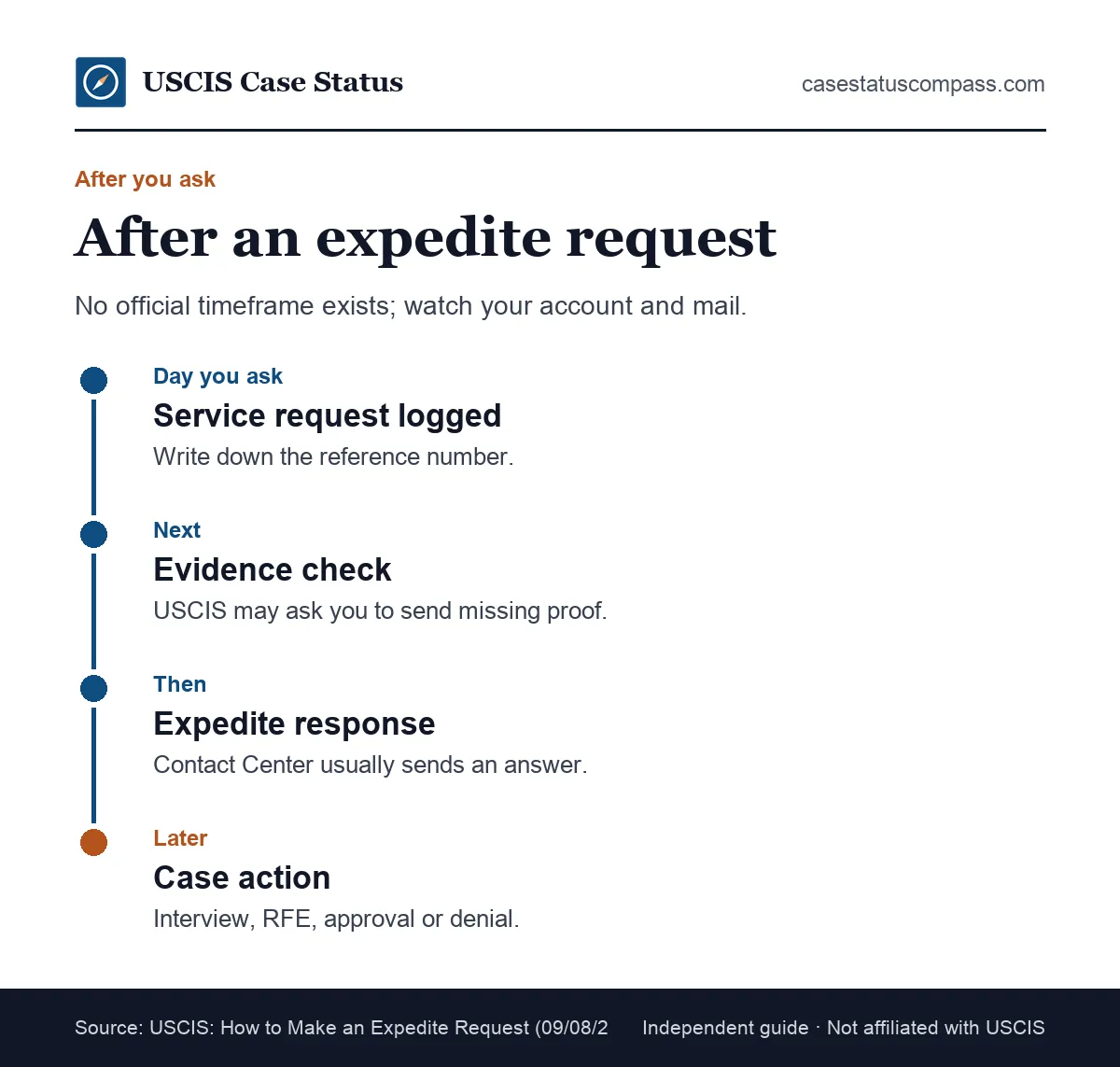
What USCIS sends back
Answers may come as an account message, letter or email. If evidence was missing, USCIS sends instructions. Keep your service request number for follow-ups. Check your account and email regularly.
How Long After an Expedite Request Is Approved?
No official number exists, and forum reports vary too much to repeat. Our case status not updating guide explains quiet periods. Movement often shows up first as a new notice rather than a decision. If nothing changes for several weeks, call back with your service request number instead of filing a new request.
Signs the expedite is working
Watch for an interview notice, an RFE, a biometrics letter or an approval. Any of these suggests an officer has picked up the file. Respond quickly to keep the momentum.
What Happens If USCIS Approves Your Expedite?
An approved expedite means USCIS agreed to move the case out of order. It is not an approval of your application. The officer still reviews eligibility and may send an RFE, schedule an interview or deny the case on the merits.
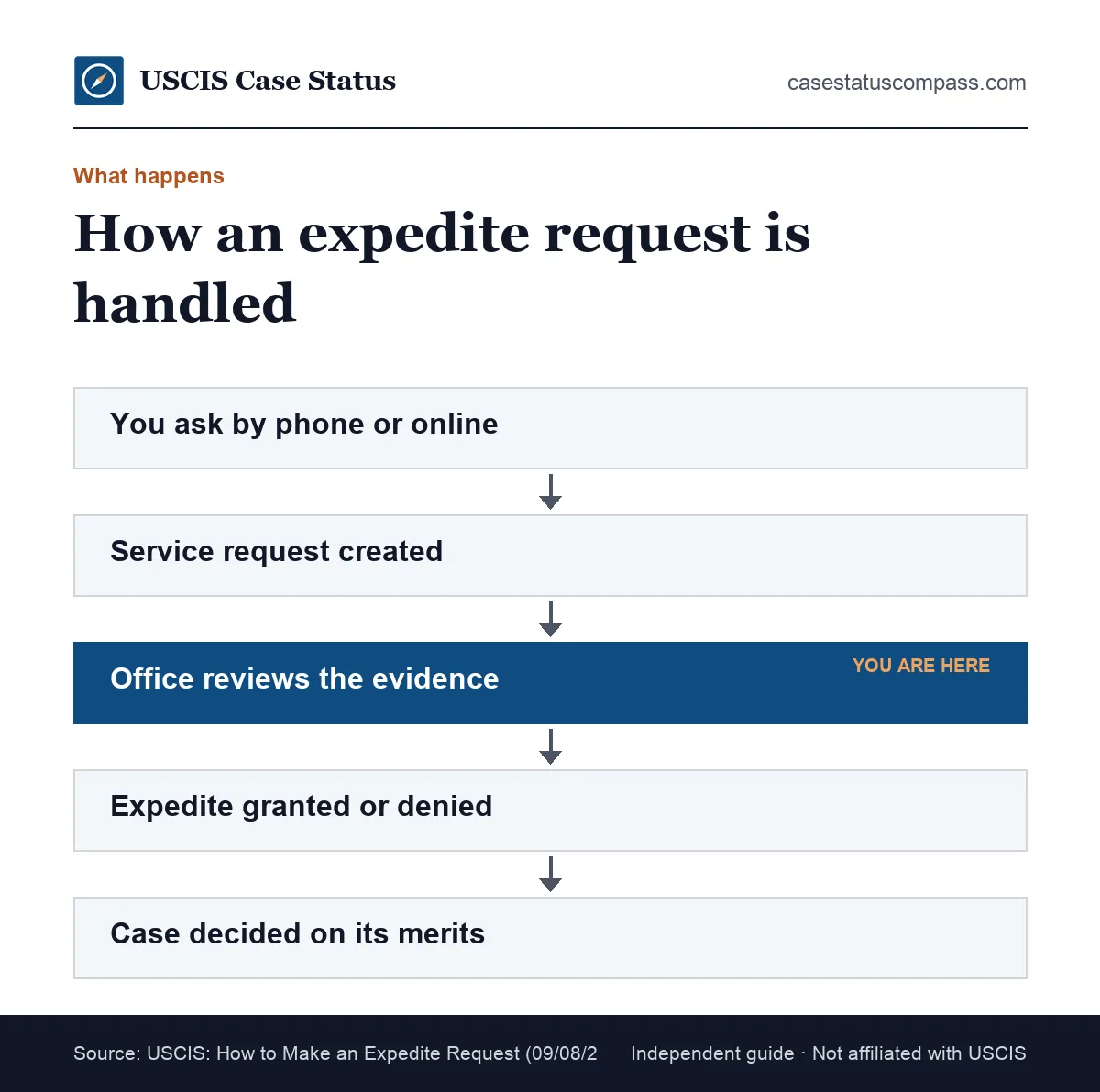
What can still slow an expedited case
USCIS lists the brakes: a step you owe (biometrics, interview, medical exam), a background check with another agency, a site inspection, or a case tied to a principal applicant. Attend any appointment USCIS sets right away, because a missed step undoes the time an expedite saved.
Keep your evidence current
Upload new proof if things change, and tell USCIS if the urgency ends. Honest updates protect your credibility. If a new deadline or diagnosis appears, upload the document with a short note explaining what changed.
What If Your Expedite Request Is Denied?
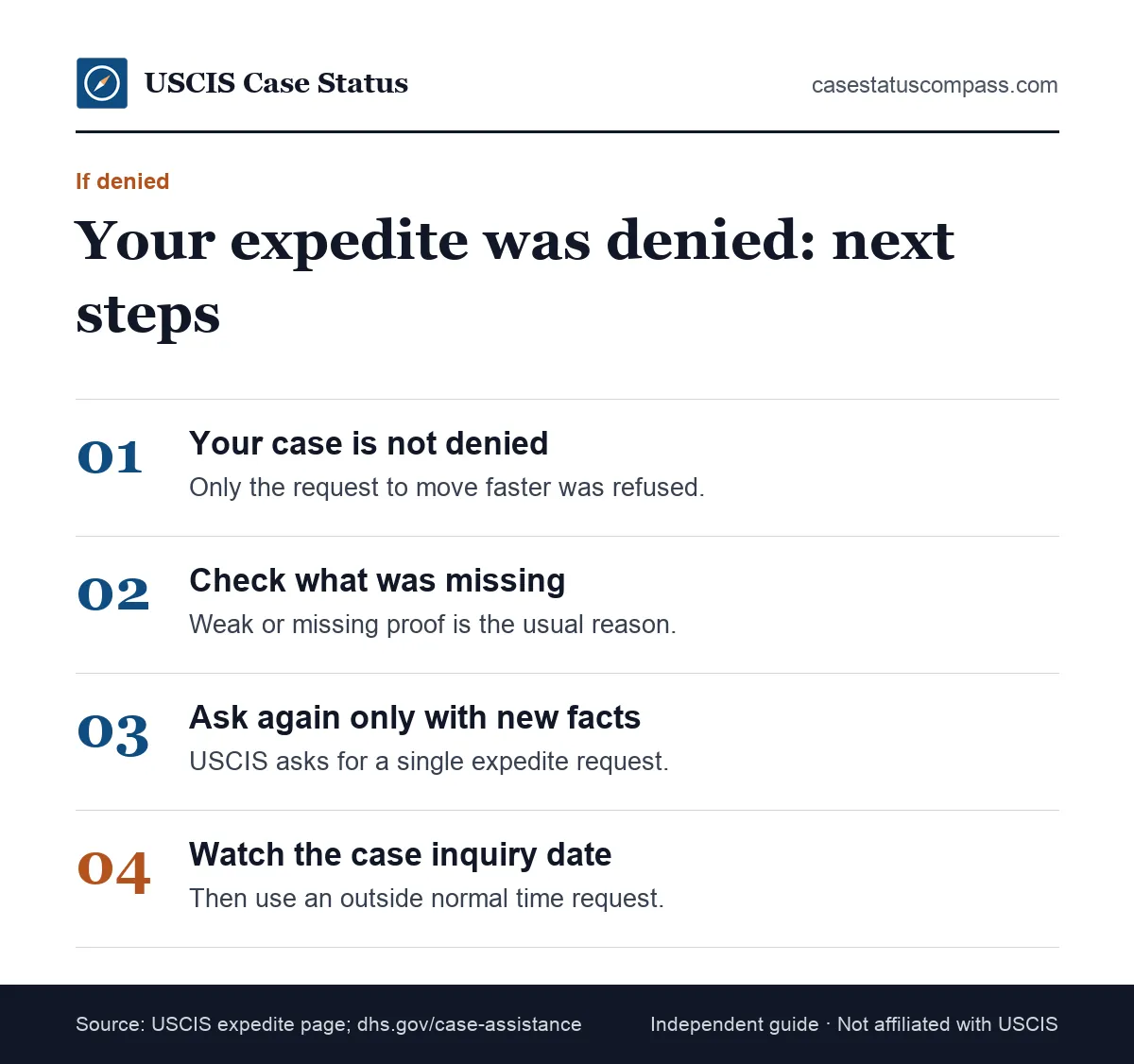
A denied expedite only means your case stays in normal order. It does not deny your application. USCIS usually gives no reason. You can wait, check your case inquiry date, or, if new facts arise, ask again with fresh evidence.
Why denials happen
Common reasons are weak proof, a reason outside the grounds, late filing, or a premium-eligible category. Asking before biometrics or an RFE response is finished is another, as is an old or unsigned letter.
Asking again
USCIS policy is to make only one expedite request, after you get your receipt notice, since duplicate requests cause delays. Ask again only when facts change, such as a new diagnosis, and explain what is new.
Should You Contact the CIS Ombudsman or Congress?
Sometimes. The CIS Ombudsman can help with emergencies or hardship under USCIS expedite criteria, within limits. A member of Congress can make an inquiry with your signed release. Neither can force USCIS to expedite. Use them after you have tried USCIS.
The CIS Ombudsman
CIS Ombudsman: DHS Form 7001, Request for Case Assistance (online). Its general rule for case help: Use the Ombudsman only after contacting USCIS within 90 days and waiting at least 60 days. A recently denied expedite is on its list of limits.
Your member of Congress
Your member of Congress can ask USCIS about your case after you sign a privacy release. Our ombudsman and congressional inquiry guide compares the two routes. Send the caseworker the same evidence you attached to your USCIS expedite request.
Expedite Request vs Outside Normal Processing Time Inquiry
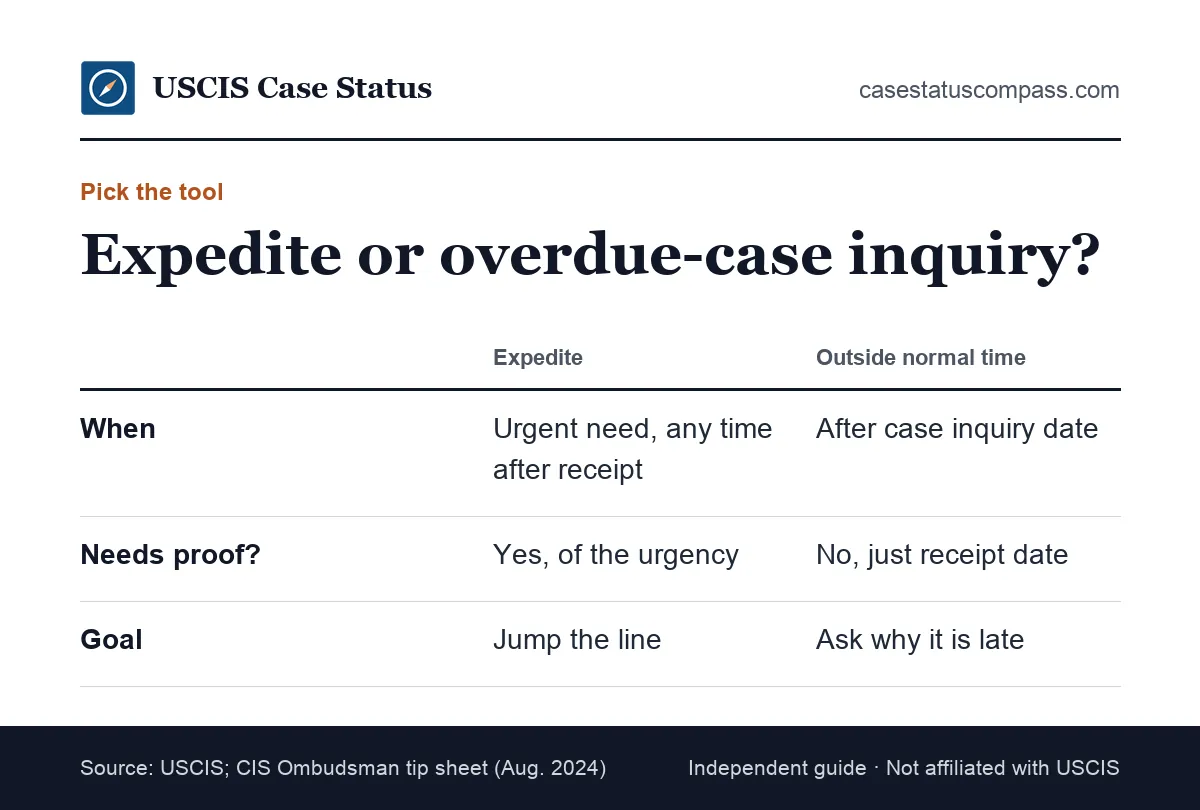
An expedite is for urgency; an outside normal processing time inquiry is for a case that is overdue. You can submit an 'outside normal processing time' request only after your case inquiry date. You can make that inquiry without any emergency, but you need to wait for the date.
Side-by-side comparison
The table contrasts the two requests on purpose, timing, evidence and the result you can expect.
| Expedite request | Outside normal time inquiry | |
|---|---|---|
| Purpose | Move ahead for an urgent reason | Ask why a late case is not decided |
| When allowed | After receipt, when urgency is real | After the case inquiry date |
| Evidence | Required | Receipt date only |
| Result | Case moved up, or stays in line | Office reviews the delay |
Find your case inquiry date
Case inquiry date: the earliest date USCIS will accept a question about your pending case; it can change. Check it in the official tool through our uscis processing times guide. If your case is already past that date, the inquiry may be the simpler route.
Common Reasons Expedite Requests Fail
Most failed expedites share the same problems: no evidence, a vague reason, self-caused urgency, a pending step on your side, or a premium-eligible category. Most can be fixed before you ask, which is why the checklist above comes first. The list below shows the specific mistakes behind most refusals.
Mistakes to avoid
- Calling without any documents to upload
- Citing "I need to work" with no specific loss
- Asking while biometrics or an RFE are still pending
- Asking for an OPT or H-1B case with premium available
- Making several duplicate requests
- Using a letter that is old or unsigned
Self-caused urgency
USCIS will not count urgency caused by filing or answering late. If your work permit lapses because you renewed late, an expedite is unlikely. File renewals early. Renewing on time avoids a gap that a USCIS expedite request is unlikely to close.
Expedite Decision Table: If X, Do Y
Use this table to pick your next step. It points to an expedite only when your reason fits USCIS criteria and you have proof; otherwise to premium processing, an overdue-case inquiry or patience. Start with the first row that applies.
Decision table
Each row pairs a common situation with the next step it calls for, from filing Form I-907 to waiting.
| If… | Then… |
|---|---|
| Your category is premium-eligible | File Form I-907 instead of an expedite |
| A relative is gravely ill and you have a doctor's letter | Request an expedite on humanitarian grounds |
| A job loss with real hardship is near | Request an expedite with an employer letter |
| USCIS printed an error that stops you working | Request an expedite for clear USCIS error |
| Your case is just slow, with no urgency | Wait for the case inquiry date, then inquire |
| Your case is past the inquiry date | Submit an outside normal processing time request |
| Your case is at NVC or an embassy | Follow State Department procedures |
When to talk to an attorney
Get legal advice for a past violation, advance parole travel, a court case or a denial. An attorney or DOJ-accredited representative can judge risks this guide cannot. Ask before you call USCIS.
Real-World Expedite Scenarios
These fictional scenarios show how the criteria work in practice: the ground, the proof and the route. Treat them as patterns, not predictions. Each one names the ground relied on, the evidence uploaded and whether an expedite is the right tool at all. Names and details are invented.
Scenario: a nurse waiting on a work permit
Maria's renewal I-765 is pending and her card expires next month. Her hospital writes that her unit will cut beds without her: severe financial loss. She uploads that letter with her receipt.
Scenario: a parent's illness abroad
Jon has a pending I-485 and his mother abroad is in intensive care. He requests an advance parole expedite with a hospital letter and his birth certificate, and sees an attorney before booking.
Scenario: a wrong date on the card
USCIS printed Priya's EAD with the wrong category, and her employer cannot verify it. She requests an expedite for clear USCIS error, uploading the card and an HR email.
Scenario: an OPT student with a start date
Wei's OPT application is pending and his job starts in three weeks. Because OPT is premium-eligible, he skips the expedite and files Form I-907, which puts the case on a fixed clock.
Frequently Asked Questions
Can we expedite the process if we are just tired of waiting?
No. A long wait alone is not an expedite ground. USCIS needs a documented reason that fits its criteria. If your case is past its case inquiry date, submit an outside normal processing time request instead, which needs no emergency.
Does an expedite request cost anything?
No. Asking for an expedite is free, whether you request it by phone, through Emma or online. The only paid route to a faster decision is premium processing, which covers eligible categories only.
Can I request an expedite before I get a receipt notice?
Generally no. USCIS asks you to wait for your receipt notice, because the request attaches to a receipt number. A few case types, such as humanitarian parole for people abroad, include urgency details with the filing instead.
How many times can I request an expedite?
USCIS asks for only one expedite request, because duplicates add work and slow things down. If your situation changes, for example a new diagnosis or a confirmed job deadline, a new request with fresh evidence can make sense.
Will an expedite request hurt my case?
No. An expedite decision does not affect whether USCIS approves your application. If USCIS refuses, the case stays in the normal line.
Can my employer request an expedite for my work permit?
Your employer cannot file the request for your own I-765, but it can write the letter that proves the financial loss. You or your attorney submit the request.
Does USCIS email me when it decides the expedite?
USCIS says the Contact Center generally sends a response, which may be an account message, a letter or an email. USCIS usually does not explain why.
Can I expedite a naturalization (N-400) case?
Yes, if you meet a criterion and have proof, such as a serious illness. N-400 cases have no premium processing. If granted, the expedite may bring an earlier interview, but you still must pass the interview and test.
Do I need a letter to request an expedite?
No. USCIS does not require a letter; the phone or online request is the official route. A short signed statement uploaded with your evidence can still help the officer see the ground and the date.
Can I expedite a DACA renewal?
You can ask if you meet a criterion and have proof. Urgency from filing late does not count, so file on time: File your DACA renewal 120-150 days before it expires.
Sources
- USCIS: How to Make an Expedite Request (updated 09/08/2026). www.uscis.gov/forms/filing-guidance/how-to-make-an-expedite-request. Accessed Oct 27, 2026.
- USCIS: How Do I Request Premium Processing? (updated 03/23/2026). www.uscis.gov/forms/all-forms/how-do-i-request-premium-processing. Accessed Oct 27, 2026.
- USCIS Contact Center. www.uscis.gov/contactcenter. Accessed Oct 27, 2026.
- USCIS Form G-1055 Fee Schedule (edition 10/16/26). www.uscis.gov/sites/default/files/document/forms/g-1055.pdf. Accessed Oct 27, 2026.
- USCIS: Form I-131 page. www.uscis.gov/i-131. Accessed Oct 27, 2026.
- USCIS: Form I-765 page. www.uscis.gov/i-765. Accessed Oct 27, 2026.
- DHS CIS Ombudsman: Case Assistance. www.dhs.gov/case-assistance. Accessed Oct 27, 2026.
- CIS Ombudsman tip sheet: Check Your USCIS Case Inquiry Date (Aug. 2024). dhs.gov/sites/default/files/2024-11/24_0823_cisomb_case-inquiry-date-tip-sheet.pdf. Accessed Oct 27, 2026.
- USCIS: Consular Processing. www.uscis.gov/green-card/green-card-processes-and-procedures/consular-processing. Accessed Oct 27, 2026.
- USCIS: Automatic EAD Extension (updated 10/29/2025). www.uscis.gov/working-in-the-united-states/information-for-employers-and-employees/automatic-employment-authorization-document-ead-extension. Accessed Oct 27, 2026.
- USCIS: Replace Your Green Card (updated 09/12/2025). www.uscis.gov/green-card/after-we-grant-your-green-card/replace-your-green-card. Accessed Oct 27, 2026.
- USCIS Data Library: All USCIS Application and Petition Form Types, FY2026 Q3 (Apr. 1-June 30, 2026; queried 7/2026). www.uscis.gov/sites/default/files/document/data/quarterly_all_forms_fy2026_q3_v1.xlsx. Accessed Oct 27, 2026.
- Form I-485 Instructions, Edition 09/18/26. www.uscis.gov/sites/default/files/document/forms/i-485instr.pdf. Accessed Oct 27, 2026.
- State Department: NVC Timeframes (as of 26-Oct-26). travel.state.gov/content/travel/en/us-visas/immigrate/nvc-timeframes.html. Accessed Oct 27, 2026.
- USCIS: Establishing Exceptional Circumstances for Rescheduling Affirmative Asylum Interviews (updated 09/04/2026); USCIS Asylum page (updated 08/26/2026). www.uscis.gov/humanitarian/refugees-and-asylum/asylum/establishing-exceptional-circumstances-for-rescheduling-affirmative-asylum-interviews. Accessed Oct 27, 2026.
- USCIS OLA New Member Outreach FAQs (Jan. 2021). www.uscis.gov/sites/default/files/document/questions-and-answers/5%20117%20-%20New%20Member%20Outreach%20FAQs%2001042021.pdf. Accessed Oct 27, 2026.
- USCIS: DACA page (updated 01/24/2025). www.uscis.gov/DACA. Accessed Oct 27, 2026.
casestatuscompass.com is an independent publication and is not affiliated with USCIS or any government agency. This page is general information, not legal advice. For denials, court or asylum matters, consult an immigration attorney or a DOJ-accredited representative.