Contents · 37 sections
- What Is NVC Case Status?
- What Happens at the National Visa Center?
- NVC Case Status vs USCIS Case Status
- How Does a Case Get From USCIS to NVC?
- How Long Does NVC Take After I-130 Approval?
- How to Check NVC Case Status
- Where Does Your NVC Case Number Come From?
- What Is the NVC Sign In and the DS-260 Login?
- What Do NVC Case Statuses Mean?
- What Does "At NVC" Mean?
- What Does Documentarily Qualified Mean?
- What Do "In Transit" and "Ready" Mean at NVC?
- What Fees Does NVC Collect?
- DS-260 and Civil Documents
- How Do You Complete the DS-260?
- Which Civil Documents Does NVC Usually Ask For?
- How Does the Affidavit of Support Work at NVC?
- What Happens If NVC Finds a Problem With Your Documents?
- NVC Processing Time
- How Long Does the National Visa Center Take to Process Documents?
- How Long From Documentarily Qualified to Interview?
- How Does the Visa Bulletin Affect an NVC Case?
- What Is the Consular Processing Procedure?
- Consular Processing vs Adjustment of Status
- How Is the NVC Interview Scheduled?
- Contacting NVC
- What Is the NVC Contact Number?
- How Do You Spot a Fake Visa Center Phone Number?
- Can You Email the National Visa Center?
- How Do You Change Your Address With NVC?
- Can You Expedite an NVC Case?
- Is There an Official NVC App?
- Is the National Visa Center a Visa Center Near Me?
- What Happens After the Embassy Interview?
- What Can Delay an NVC Case?
- What Should You Do Next at Each NVC Stage?
- Frequently Asked Questions
The short answer
To check your NVC case status, go to the State Department's free CEAC site (ceac.state.gov), choose Immigrant Visa, and enter the case number from your National Visa Center (NVC) welcome letter or email. The result shows a short label, such as At NVC or Documentarily Qualified, plus the date of the last update.
At a glance
| Who runs NVC | The U.S. Department of State, not USCIS |
| When NVC starts | After USCIS approves an immigrant petition for someone abroad |
| Official tracker | CEAC immigrant visa status check (free) |
| What you need | Your NVC case number |
What Is NVC Case Status?
NVC case status is the stage your immigrant visa case has reached at the National Visa Center, an office of the U.S. Department of State. NVC collects fees, forms and documents after USCIS approves a petition. You follow it on the State Department's CEAC site, not on USCIS tools.
NVC belongs to the State Department
The NVC is part of the State Department's consular system. As of October 2026, USCIS describes the hand-off this way: NVC (State Department) collects visa fees and documents after USCIS approves the petition. USCIS no longer controls the case once it reaches NVC, so questions about fees, forms or interviews go to the State Department.
What this page can and cannot do
We cannot see your file, and we never show live NVC data. NVC timeframes and CEAC details below come from official State Department pages; where something is not published, such as official label definitions, we say so.
What Happens at the National Visa Center?
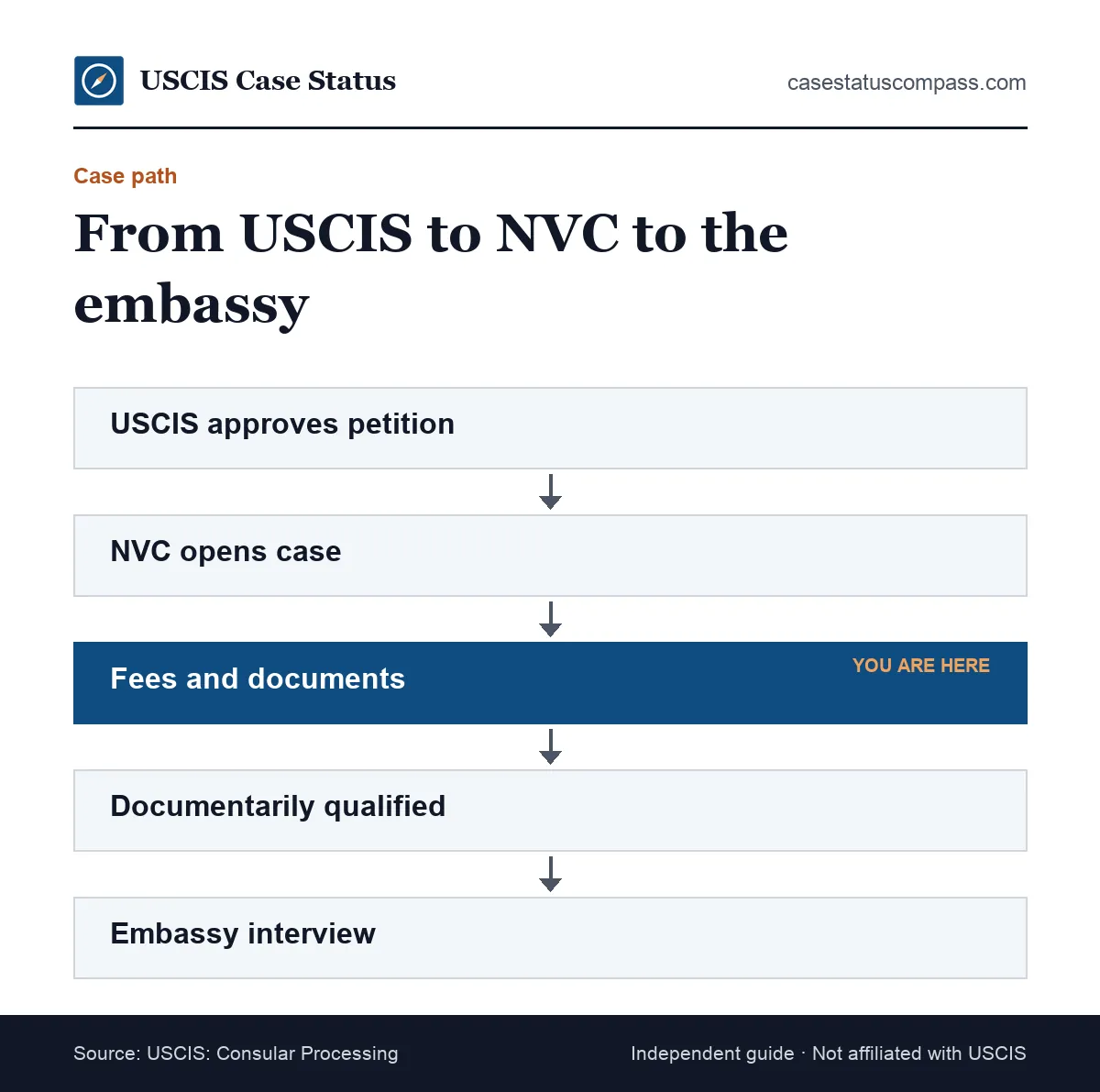
At the National Visa Center, the immigrant visa case is prepared for the embassy. NVC opens a case, bills the fees, receives the online DS-260 and civil documents, and reviews them. Once complete, the case waits for the embassy to schedule an interview.
Fees, forms and documents
The NVC stage has three jobs: pay the State Department fees, submit the immigrant visa application, and upload the supporting records. The petitioner usually handles the Affidavit of Support; the beneficiary handles personal documents.
Documentarily qualified and the hand-off
When NVC is satisfied that everything is in, the case is commonly described as documentarily qualified. Then it waits for an interview slot at the embassy or consulate. NVC does not decide the visa; it only confirms the file is complete enough for an officer to review.
NVC Case Status vs USCIS Case Status
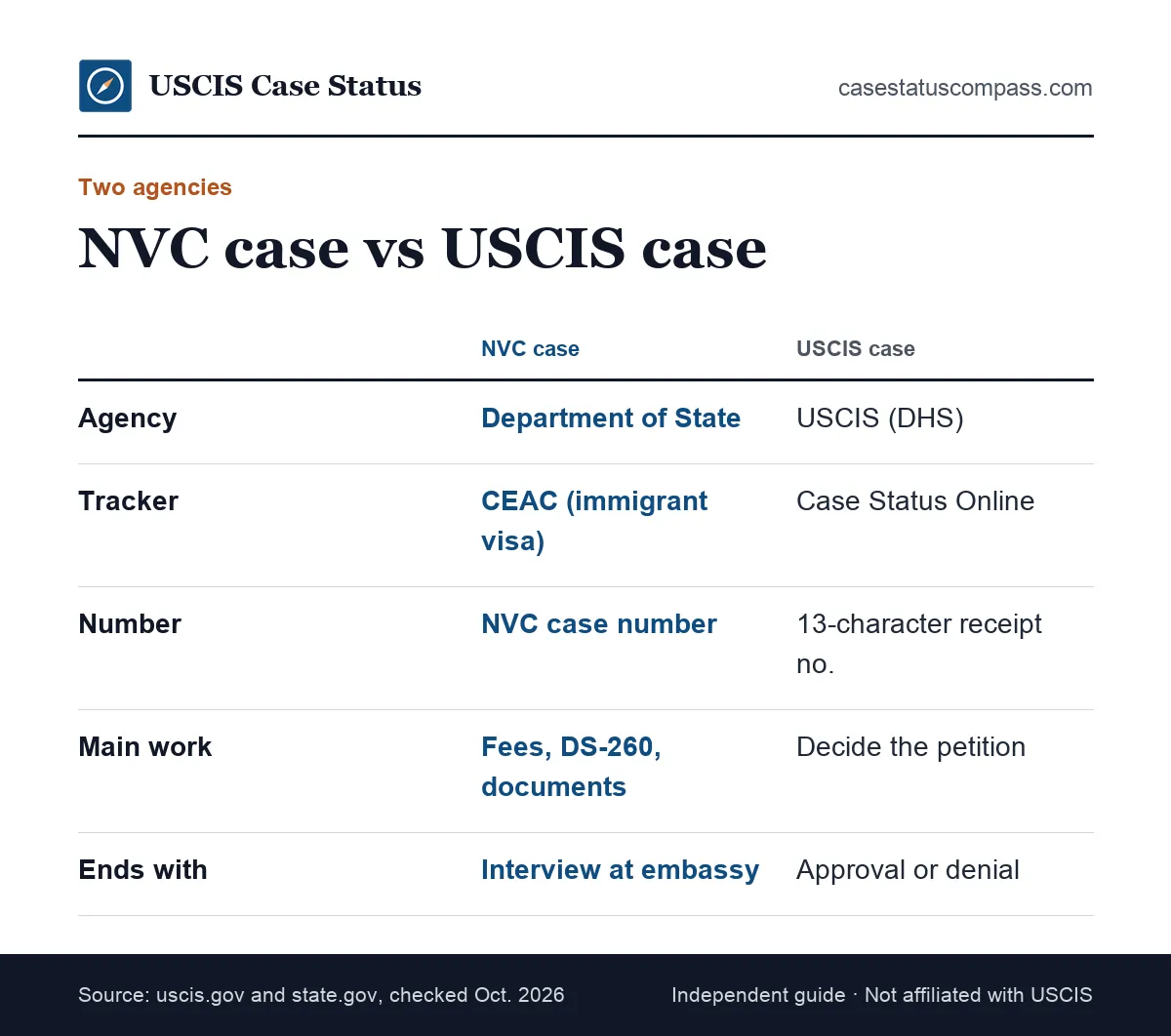
NVC case status and USCIS case status track two different cases. USCIS decides the petition, such as Form I-130. NVC prepares the immigrant visa that follows. Each uses its own number and tracker, and one does not update the other. Once the I-130 is approved, watch CEAC instead of the USCIS tool.
NVC and USCIS trackers side by side
Use this comparison to work out which office should answer your question, and which number to type into which tracker.
| Question | NVC case (State Department) | USCIS case (DHS) |
|---|---|---|
| What it covers | Immigrant visa preparation | Petition decision |
| Official tracker | CEAC immigrant visa status | Case Status Online |
| Number used | NVC case number | Receipt number on Form I-797 |
| Main forms | DS-260, Form I-864 | I-130, I-140 |
| Who answers questions | NVC or the embassy | USCIS Contact Center |
Why the receipt number stops helping
Your USCIS receipt number still identifies the petition, but Case Status Online will not show NVC steps. Our guide to uscis case status explains what the USCIS tool does show. Keep the receipt number anyway, since NVC forms and letters may refer back to the petition.
Where USCIS ends and NVC begins
USCIS's job ends with the approval notice. Our page on what an approval case decision rendered message means covers that step. New activity then appears on CEAC, usually after NVC creates its case and sends the Welcome Letter. If USCIS approved the petition weeks ago and CEAC finds nothing, compare the approval date with NVC's published case-creation date.
How Does a Case Get From USCIS to NVC?
A case gets to NVC when USCIS approves an immigrant petition for a beneficiary who will apply abroad and sends the file on. NVC then creates its own record and sends a welcome letter or email with the case number. There is nothing to file to start this step.
After the I-130 is approved
Family cases start with Form I-130, filed by the U.S. citizen or permanent resident. Our Form I-130 guide explains the petition itself. Employment cases follow the same route after an approved Form I-140.
When the petition chose the wrong path
The petition asks whether the beneficiary will apply abroad or inside the U.S. If the beneficiary is in the U.S. and eligible to adjust with Form I-485, the case may not go to NVC at all. A mismatch here can send the case the wrong way, so ask an attorney if unsure.
How Long Does NVC Take After I-130 Approval?
NVC publishes how far it has got in opening new cases, and updates it weekly. As of Oct. 26, 2026, NVC was creating cases for petitions received from USCIS on Oct. 17, 2026. If USCIS sent your petition before that date, expect your Welcome Letter soon; check spam folders too. Today's figure is on the NVC timeframes page.
What the official numbers do cover
USCIS publishes petition medians, not NVC times. For April–June 2026, USCIS's median for immediate-relative I-130s was I-130 (immediate relative): median 13.0 months (USCIS data, Apr.-June 2026). Our I-130 processing time page explains those numbers. The NVC stage comes after that median and has no official overall average.
What to do while you wait
Gather civil documents now, since many take time to order. Confirm both parties' emails are correct. If your case should already exist under NVC's published date and no message has come, ask NVC, not USCIS.
How to Check NVC Case Status
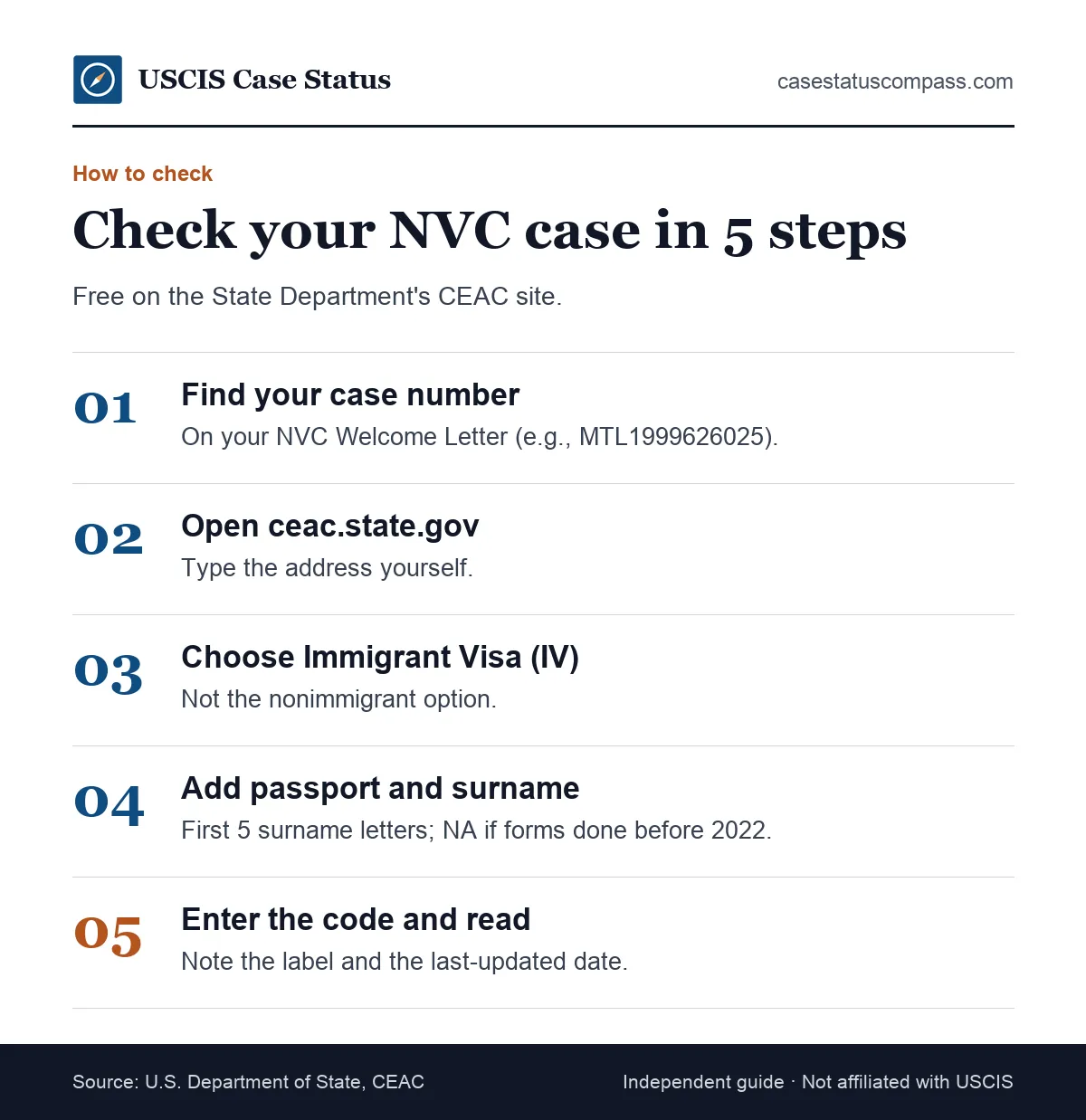
To check NVC case status, open the CEAC visa status page and choose Immigrant Visa (IV). The CEAC Visa Status Check asks for the visa application type, your case number, passport number, the first 5 letters of your surname and a security code. The result shows the current label and the last-updated date. The check is free. Each applicant in a family case may have their own record, so check each one.
Steps on the CEAC site
- Type ceac.state.gov into your browser.
- Open the visa status check page.
- Select Immigrant Visa (IV).
- Enter your case number, passport number and the first 5 letters of your surname.
- Complete the security code and submit.
If you completed your forms before January 1, 2022, CEAC asks you to enter NA in the passport and surname fields.
How to check case status with NVC directly
If CEAC does not answer your question, NVC can be asked through the official contact route on the State Department's website. Have your case number ready, plus the petitioner's and applicant's names and dates of birth. First read your account messages, which often answer the question already.
Where Does Your NVC Case Number Come From?
Your NVC case number arrives after the petition is approved: NVC's Welcome Letter gives your Case Number and Invoice ID, which you use to log in to CEAC at ceac.state.gov. It is different from your USCIS receipt number. Keep it with your case records for CEAC and every NVC inquiry. The Invoice ID in the same letter is needed to sign in, so store both together.
Where the number appears
The case number is printed near the top of NVC notices and emails. The official NVC case number format follows one pattern. An immigrant visa case number looks like CEAC's example, MTL1999626025: three letters followed by ten digits. Copy it exactly from your notice, without spaces.
Do not mix it up with the receipt number
A USCIS receipt number has 13 characters and lives on Form I-797. The NVC case number is a separate State Department number. Entering a receipt number on CEAC, or an NVC number on Case Status Online, returns an error.
What Is the NVC Sign In and the DS-260 Login?
The NVC sign in usually means logging in to the State Department's immigrant visa account on CEAC, where you pay fees, complete the DS-260 and upload documents. The DS-260 login is part of the same system. Each applicant's DS-260 is reached through that account, so one login usually covers the whole case.
Signing in for the first time
The Welcome Letter holds the two details you need: the Case Number and the Invoice ID. Enter both at ceac.state.gov to open the account. Use only the official address, and type it yourself rather than clicking an emailed link.
Immigrant visa sign in tips
Keep one email address for the case and store the login safely. If you get locked out, use the help link on the official site; never pay a third party to "recover" access.
What Do NVC Case Statuses Mean?
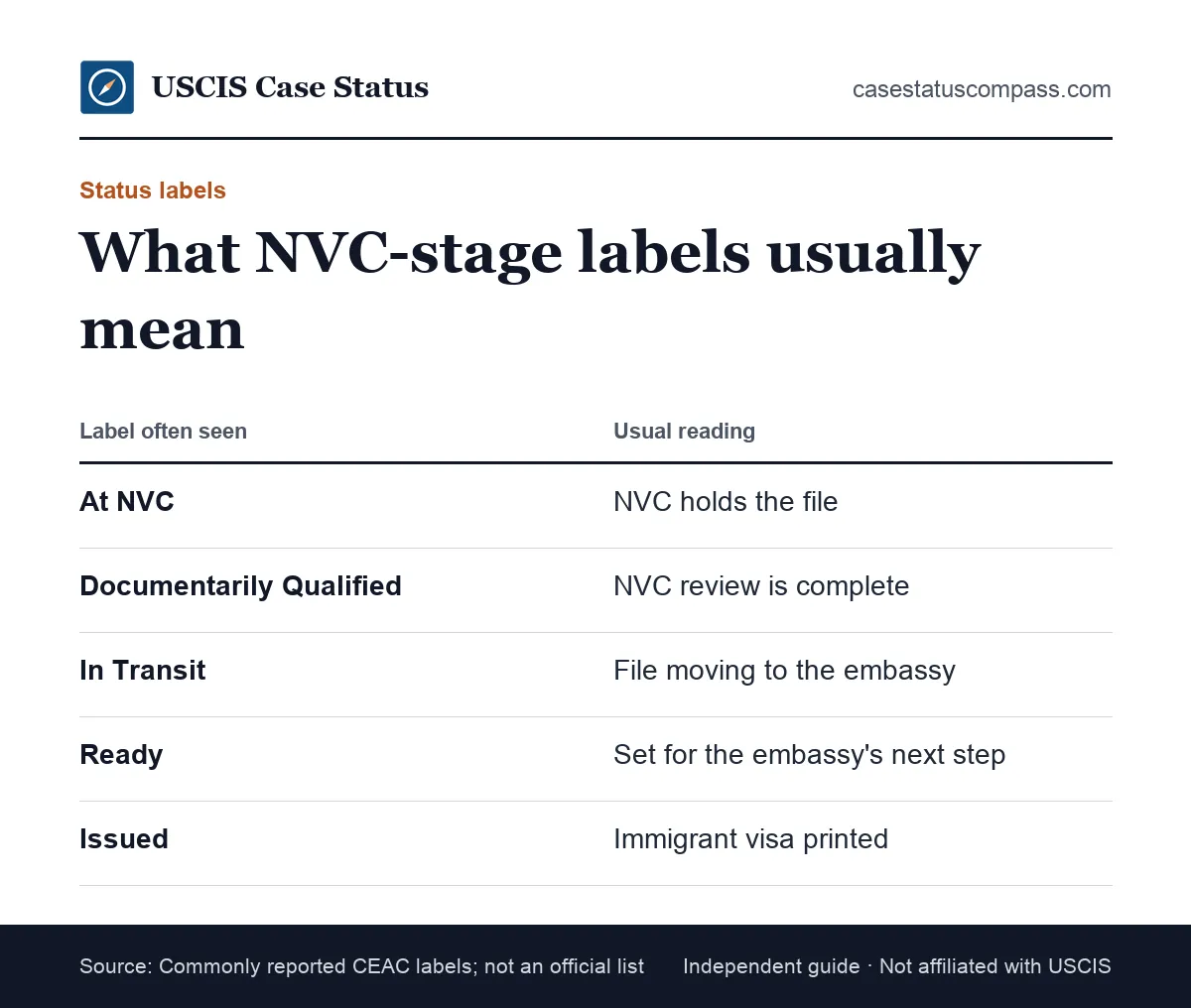
NVC case statuses are short labels on CEAC. The State Department does not publish official definitions we could find, so the readings below describe labels as commonly displayed and reported by applicants. Always read any text under the label and any NVC message, which take priority over our summary.
Common NVC labels and what to do
Treat the right-hand column as a starting point; your account messages decide. The labels appear in the order a typical case moves.
| Label commonly seen | Usual reading | What you can do |
|---|---|---|
| At NVC | NVC holds the case | Pay fees, finish DS-260, upload documents |
| Documentarily Qualified | NVC review complete | Wait for interview scheduling |
| In Transit | File moving to the embassy | Prepare for the medical exam |
| Ready | Set for the embassy's next step | Watch for the interview letter |
| Administrative Processing | Extra review after the interview | Send anything requested |
| Issued | Immigrant visa printed | Plan travel; pay the USCIS Immigrant Fee |
Why labels change slowly
A label can stay the same for weeks while NVC reviews documents. The last-updated date may move even if the label does not. Check once a week or so. A frozen label is normal unless NVC's published review date has passed your submission date.
What Does "At NVC" Mean?
"At NVC" usually means the National Visa Center has your case and is waiting on, or reviewing, fees and documents. It is the label most families see the longest. It does not mean a problem, but it does mean action may be needed on your side.
What is often still open
Common open items include unpaid fees, an unsubmitted DS-260 or missing civil documents. Your immigrant visa account usually shows which parts are complete. Work through each section until nothing is marked as missing.
When "At NVC" lasts a long time
For preference categories, the case can stay at NVC while the priority date is not current. For immediate relatives, an inquiry makes sense once NVC's published review date passes your submission date.
What Does Documentarily Qualified Mean?
Documentarily qualified (often shortened to "DQ") usually means NVC has received and accepted everything it needs. The case can then be scheduled for an interview once the embassy has a slot and, for preference cases, a visa number is available. The label alone does not show the interview date; that comes from the embassy.
DQ is not an approval
Being DQ means your paperwork is complete for NVC. The consular officer still decides the visa at the interview. Keep your originals ready, because the embassy will usually want to see them.
What to do after DQ
Watch for an interview letter by email and in your account. Read your embassy's instructions on the medical exam and any courier or document steps. Keep your address and contact details current so the letter reaches you.
What Do "In Transit" and "Ready" Mean at NVC?
"In Transit" usually means NVC is sending the file to the embassy or consulate. "Ready" usually means the case is set for the embassy's next step, often interview scheduling or the interview itself. Both are commonly reported after documentary qualification. Neither needs action from you beyond keeping documents ready.
"In Transit" to the embassy
The move from NVC to the embassy is mostly electronic. The label may change quickly or sit for a short time. If it stays for weeks, check the embassy's immigrant visa page for local scheduling news before you contact NVC.
"Ready" before the interview
"Ready" is often seen once the embassy has the case. Applicants commonly read it as interview-ready. Use the time to book the medical exam with an embassy-approved panel physician as instructed in your interview letter.
What Fees Does NVC Collect?
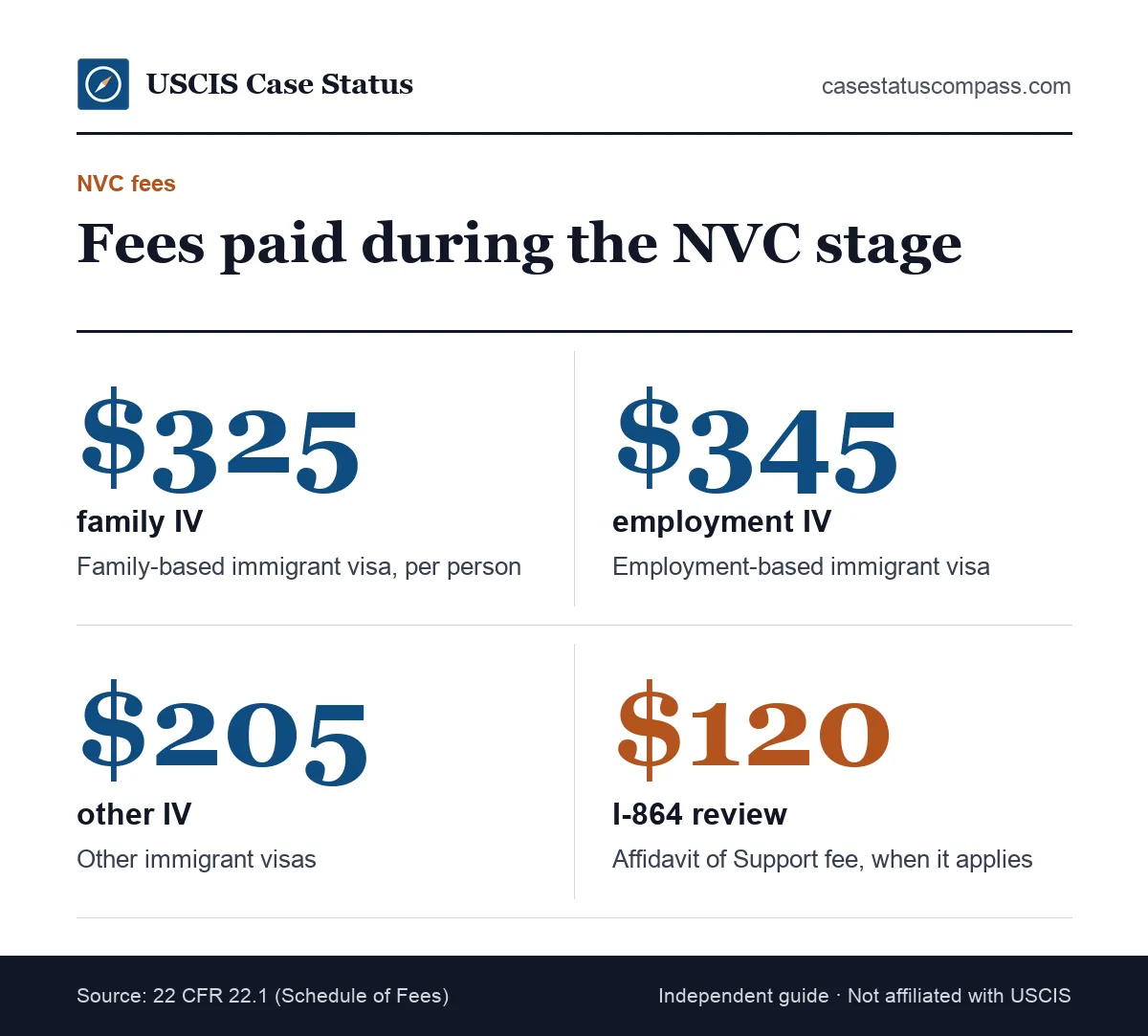
NVC collects State Department fees, not USCIS fees. As of October 2026, the fee schedule in 22 CFR 22.1 lists the Immigrant visa fee: $325 family; $345 employment; $205 other (per person). Many family cases also pay the $120 Affidavit of Support review fee (State Department, when reviewed domestically). Pay only through your official account. NVC shows each bill once it is ready, and documents usually cannot be reviewed until the fees are paid.
The immigrant visa application fee
The immigrant visa fee is charged per person, so a spouse and two children each pay. Searches for a "DS-260 fee" usually mean this fee, which covers the immigrant visa application. Pay it in your account early, because NVC reviews documents only after every fee is paid.
Fees at USCIS vs fees at NVC
Form I-130 costs $675 (paper) / $625 (online) at USCIS, and Form I-864 itself is $0 at USCIS at USCIS. NVC fees are separate. After the visa is issued, most new immigrants also pay the USCIS Immigrant Fee of $235. Our green card fees page shows the full picture.
DS-260 and Civil Documents
The DS-260 is the online immigrant visa application each applicant completes. Civil documents prove identity, family relationships and history. NVC reviews both before the case can be documentarily qualified. Most families finish the DS-260 first and upload documents as they arrive. Names, dates and places must match across the form, the petition and every record you upload.
What the DS-260 is
The DS-260 is the immigrant visa counterpart of the DS-160. It asks about identity, addresses, work, travel, family and eligibility. We could not confirm the State Department's current DS-260 instructions online, so follow the guidance shown inside the form itself.
How civil documents fit in
Civil documents back up what you wrote on the DS-260. A birth certificate proves a parent-child tie; a marriage certificate proves a spouse tie. Upload clear scans and keep the original documents for the interview.
How Do You Complete the DS-260?
You complete the DS-260 online in your immigrant visa account, one form per applicant. Answer every question truthfully and consistently with your petition and documents, then keep the confirmation. Children need their own DS-260, usually completed by a parent. Save your answers often, since sessions can time out.
Before you start the DS-260
Gather passports, past addresses, work history, travel dates and family details. Look up any prior visas and immigration history. Inconsistent dates between the DS-260 and the I-130 are a common cause of interview questions.
After you submit
Save the confirmation page. If you later notice a mistake, follow the State Department's instructions for reopening or correcting the form, or explain the error at the interview. Do not ignore errors; officers compare every answer.
Which Civil Documents Does NVC Usually Ask For?
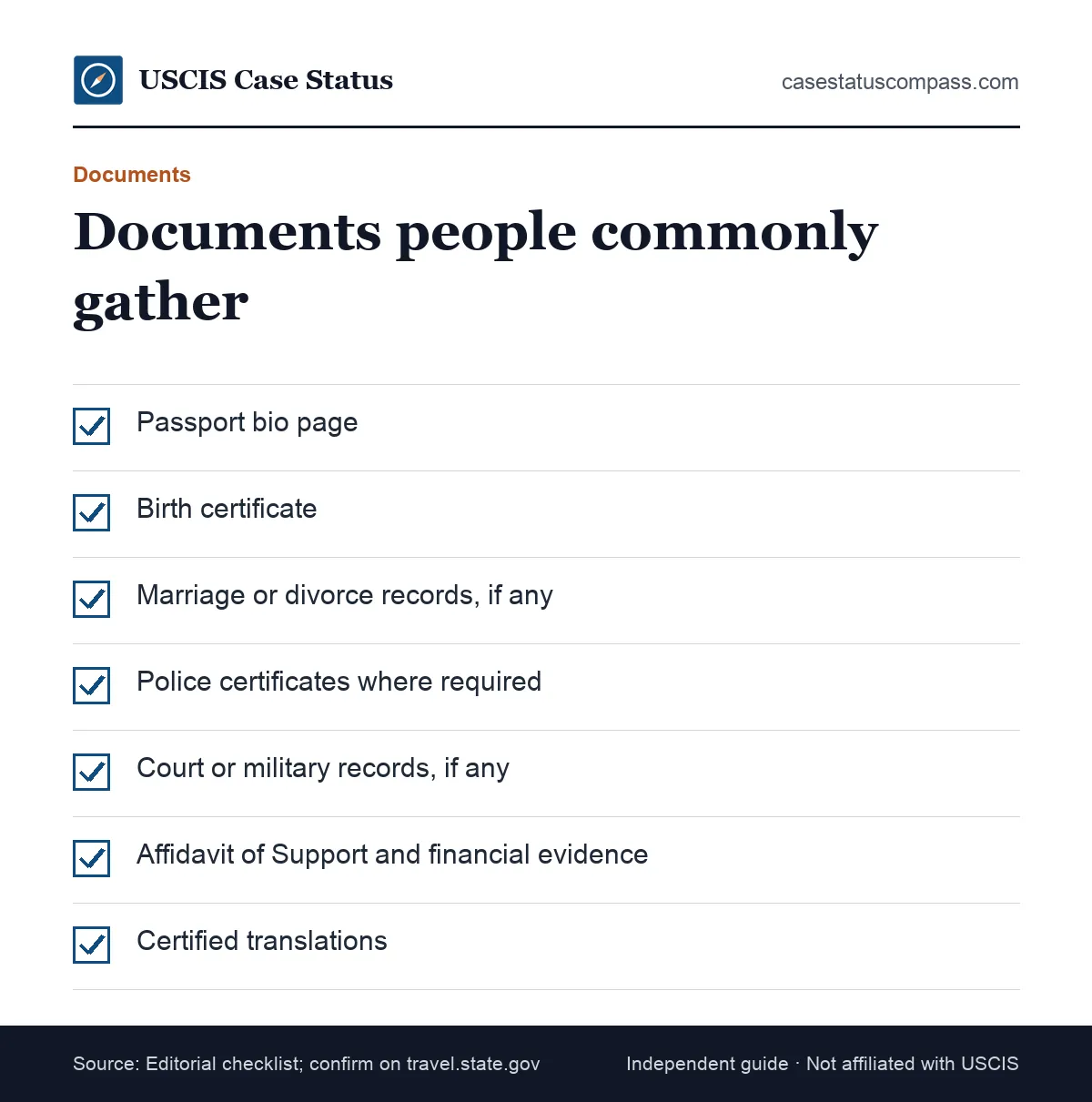
NVC usually asks for documents that prove identity, relationships and background, such as a passport, birth certificate, marriage records and police certificates. Exact requirements depend on the country. The State Department's reciprocity page lists what each country issues and accepts.
Country-specific rules
Some countries do not issue certain records, or issue them only from certain offices. The reciprocity page explains alternatives, such as which office issues a police certificate and what to send if a birth record does not exist. Check it for every country where you lived long enough to need a record.
Translations
Documents not in English generally need a certified translation. The translator usually certifies that they are competent and that the translation is accurate. Upload the original-language document and the translation together in one file.
How Does the Affidavit of Support Work at NVC?
Most family-based immigrants need a Form I-864 Affidavit of Support from the petitioner, submitted at the NVC stage. As of October 2026, the I-864 instructions say: Sponsors need income of at least 125% of the poverty guidelines (100% for active-duty military sponsoring spouse/child). The current edition is 08/24/26. Older editions can be rejected, so download the form from USCIS before signing.
Income thresholds and joint sponsors
The 2026 poverty guidelines set the bar: 2026 I-864P (from Mar. 1, 2026): 125% = $27,050 (household of 2), $34,150 (3), $41,250 (4). If the petitioner falls short, a joint sponsor can help: Up to two joint sponsors; each must qualify alone at 125%. Our Form I-864 guide explains the evidence. A joint sponsor files a separate I-864 and uploads their own tax and income proof.
How long the promise lasts
The affidavit is a legal promise to support the immigrant. Per the instructions, The support obligation ends at citizenship or 40 quarters of work (about 10 years). A divorce does not end it. Sponsors should read the form's obligation section before signing, and ask a lawyer if unsure.
What Happens If NVC Finds a Problem With Your Documents?
If NVC finds a problem, it usually marks the document as not accepted and explains what is needed. Common issues are unclear scans, missing pages, the wrong version of a record or a missing translation. The case cannot become documentarily qualified until the issue is fixed.
Common reasons documents are not accepted
- Blurry or cropped scans
- A short-form certificate where a long form is required
- Missing translation or translator certification
- Expired passport or police certificate
- Financial evidence that does not match the I-864
Each of these is fixable, but each fix sends the case back to the review queue.
Resubmitting correctly
Read the reason given and fix only that item. Upload the fix in the same section. Do not re-upload documents that were accepted, and check that the new scan is clear and complete before you submit. Then note the date, since review starts again from then.
NVC Processing Time
NVC processing time has three parts: how fast you pay and upload, how long NVC takes to review, and how long the embassy takes to schedule. NVC publishes the first two as dates on its timeframes page. NVC updates its published timeframes once a week, so check it often.
NVC timeframes this week
These are the dates NVC reported for each of its main queues in its last weekly update.
| NVC step | Where NVC was (as of Oct. 26, 2026) |
|---|---|
| Creating new cases | cases received from USCIS on Oct. 17, 2026 |
| Reviewing documents | documents submitted on Aug. 18, 2026 |
| Answering inquiries | inquiries received on Oct. 16, 2026 |
Scope matters: NVC timeframes cover immediate relative, family preference and employment preference cases, not diversity, special immigrant, K (fiancé) or adoption cases. See the official NVC timeframes for this week's dates.
The part you control
The processing time at NVC is shortest when every document is accepted the first time. Order records early, scan clearly, and match names and dates across forms. Pay bills the day they appear.
How Long Does the National Visa Center Take to Process Documents?
How long the National Visa Center takes to review documents changes weekly. As of Oct. 26, 2026, NVC was reviewing documents submitted on Aug. 18, 2026. NVC reviews a case only after all fees are paid and the required documents are in: the petitioner's Affidavit of Support, financial evidence, the applicant's DS-260 and civil documents. Each resubmission goes back into that queue. If you submitted documents on or before that date and your account shows no update, read your messages first, then consider an inquiry. For NVC case status questions, CEAC and your account remain the main sources.
How to read the official timeframe
NVC shows the date of submissions it is reviewing now. Compare it with your submission date. If yours is earlier and nothing has changed, an inquiry is reasonable. If yours is later, waiting is normal.
Why some cases move faster
Cases with complete, clean uploads usually need only one review. Cases with rejected items need several. Immediate-relative cases also avoid the priority-date wait that slows many preference cases. Clear, well-labeled uploads also save time.
How Long From Documentarily Qualified to Interview?
The time from documentarily qualified to interview depends on the embassy's capacity and, for preference cases, visa availability. Some embassies schedule quickly; others have long backlogs. We could not verify an official average, so watch your account and the embassy's own announcements.
Embassy backlogs
Each embassy schedules immigrant visa interviews based on its staff and demand. Two cases qualified on the same day can get different dates. Check the embassy's site for scheduling notes, and see our US visa status guide for the consular side.
Preference cases and visa numbers
For family preference and employment cases, the embassy cannot schedule until a visa number is available. That depends on the Visa Bulletin. A DQ case with a non-current priority date will wait.
How Does the Visa Bulletin Affect an NVC Case?
The Visa Bulletin controls when preference cases can move from NVC to an interview. As of October 2026, USCIS explains that The State Department publishes the Visa Bulletin monthly: Final Action Dates vs Dates for Filing. Immediate relatives of U.S. citizens are not subject to the bulletin wait. Preference applicants can still pay fees and submit documents early, so they are ready when the date becomes current.
Annual limits
Congress caps how many preference visas are issued each year: Yearly limits: 226,000 family preference visas; 140,000 employment-based. Categories with heavy demand move slowly. Our visa bulletin guide explains how to read the charts. The per-country limit also slows applicants from heavily demanded countries.
Categories at NVC
Family cases fall under F1-F4 family and EB-1 to EB-5 employment categories (INA 203). A spouse of a U.S. citizen is an immediate relative; a spouse of a permanent resident is F2A and depends on the bulletin. The category on your approval notice tells you which applies.
What Is the Consular Processing Procedure?
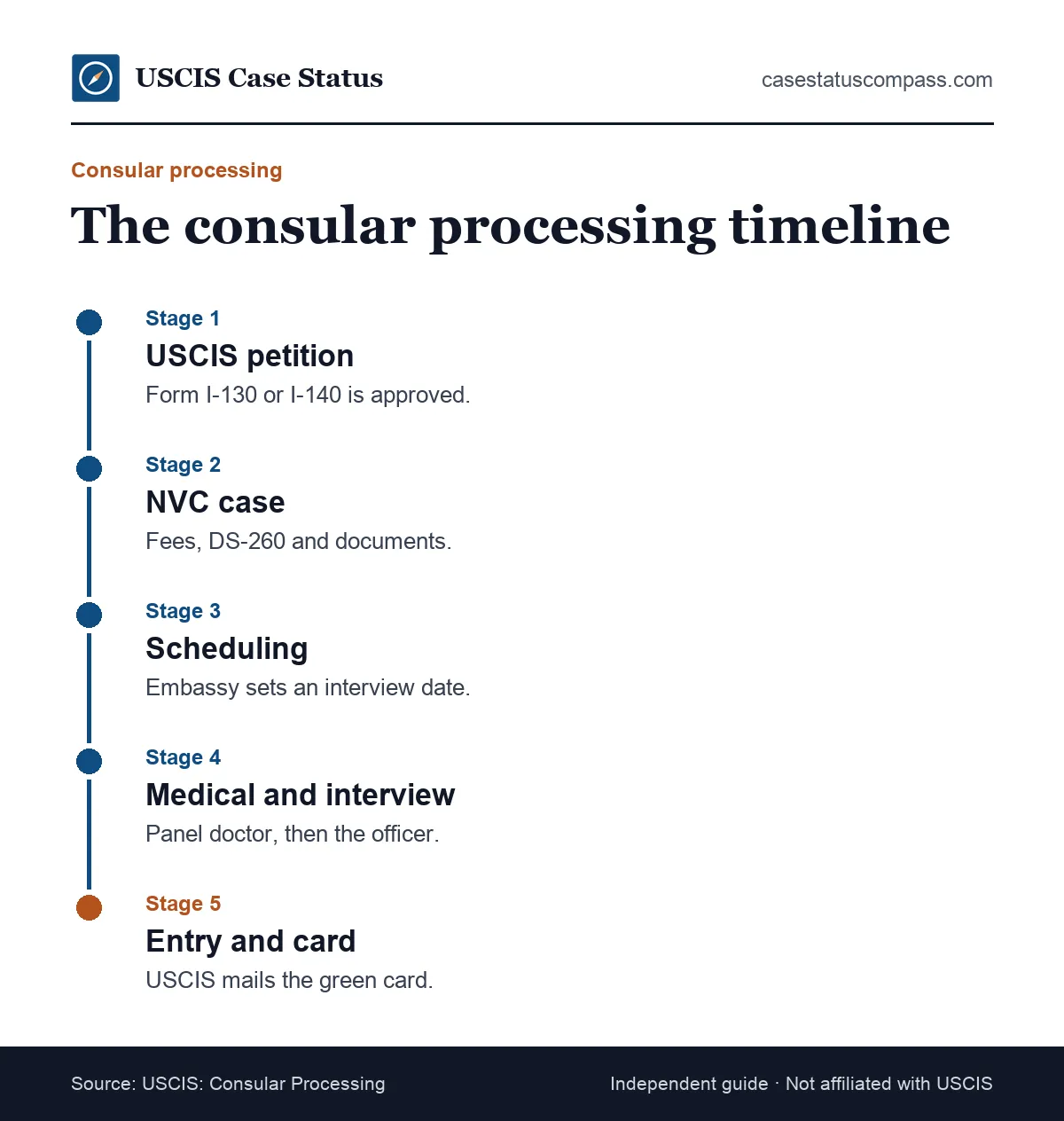
Consular processing is the route to a green card for someone outside the U.S. The procedure is: USCIS approves the petition, NVC prepares the case, the embassy interviews the applicant, the visa is issued, and the immigrant becomes a permanent resident on entry.
The consular processing procedure, step by step
- The petitioner files Form I-130 or I-140 with USCIS.
- USCIS approves and sends the case to NVC.
- NVC collects fees, the DS-260, the I-864 and documents.
- The embassy schedules the medical exam and interview.
- The officer issues the immigrant visa or asks for more.
- The immigrant enters, and USCIS mails the green card.
Who does what
USCIS decides the petition. NVC handles paperwork. The consular officer decides the visa. CBP admits the immigrant at the border. USCIS then produces the card. Knowing who does what tells you where to send each question.
Consular Processing vs Adjustment of Status
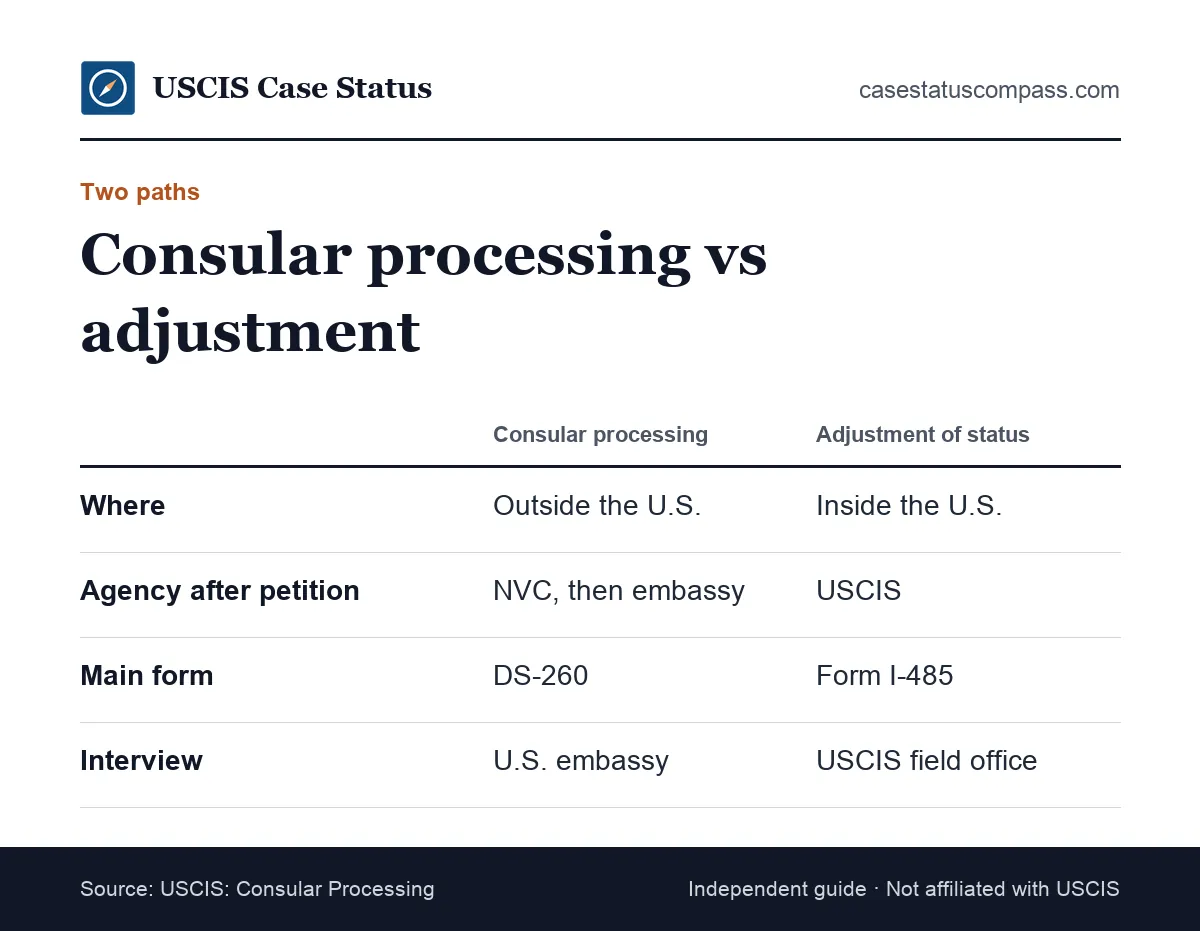
Consular processing and adjustment of status are the two ways to become a permanent resident. Consular processing happens abroad through NVC and an embassy. Adjustment of status happens inside the U.S. with Form I-485. Which one applies depends mainly on where the beneficiary is and whether they are eligible to adjust.
Comparing the two green card routes
Both routes end in permanent residence, but almost every step differs, from the agency to the tracker you watch.
| Feature | Consular processing | Adjustment of status |
|---|---|---|
| Where the applicant is | Outside the U.S. | Inside the U.S. |
| Agency after petition | NVC, then embassy | USCIS |
| Main application | DS-260 | Form I-485 |
| Interview location | U.S. embassy or consulate | USCIS field office |
| Status tracker | CEAC | Case Status Online |
When adjustment may be an option
If the beneficiary is already in the U.S. and eligible, adjustment avoids the NVC stage entirely. Our Form I-485 guide explains who can adjust. Switching routes is a legal decision, so talk with an attorney first.
How Is the NVC Interview Scheduled?
The embassy or consulate schedules the interview, usually after the case is documentarily qualified and a visa number is available. You are told by an interview letter in your account and by email. Some embassies use an IV scheduling tool or courier system for follow-up steps.
The IV scheduling tool
Applicants often mention an IV scheduling tool, which some posts use to let attorneys or applicants request a slot. We could not confirm which posts use it now. Your embassy's immigrant visa page explains its method.
Preparing for the interview
Book the medical exam with an approved panel physician. Gather originals of every uploaded document, plus anything newer, and read the embassy's checklist. Bring your interview letter, passport and photos as the embassy instructs.
Contacting NVC
Contact NVC when CEAC and your account do not answer a question, such as a rejection you do not understand. NVC asks you to use its Public Inquiry Form only if you have not heard back within its published timeframe, because duplicate inquiries slow responses. As of Oct. 26, 2026, NVC was answering Public Inquiry Form messages received on Oct. 16, 2026. Before writing, check that your question is not already answered in your account, and gather the case number and names.
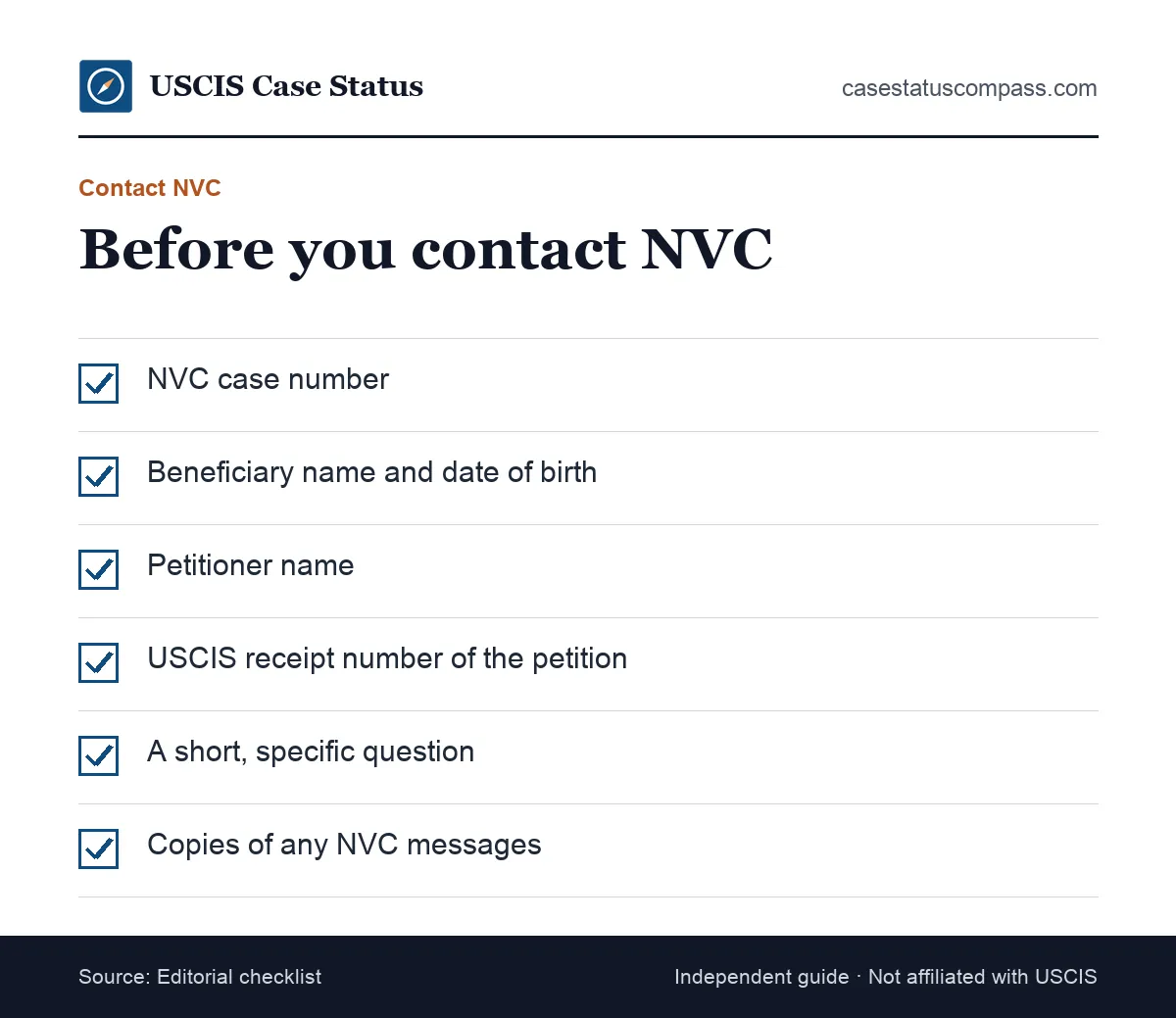
The NVC public inquiry form
The Public Inquiry Form is NVC's online inquiry form. We have not verified its address or fields, so open it from the State Department's NVC pages rather than a search result. Include your case number and one specific question.
What NVC can and cannot answer
NVC can explain document status, fees and case location. It cannot predict an interview date, decide your visa or give legal advice. Petition questions go to USCIS. Interview questions go to the embassy once it has the case.
What Is the NVC Contact Number?
The NVC contact number is published by the State Department on its NVC contact page. We have not verified the number, so we do not print it here. Copy the number from the official page to avoid scam lines, and keep your case number ready when you call.
Why the USCIS number will not help
The USCIS Contact Center at 800-375-5283 answers questions about USCIS cases only. It cannot see NVC records. Our contact USCIS page explains what USCIS can help with. Calling USCIS about NVC fees or documents wastes time.
How Do You Spot a Fake Visa Center Phone Number?
Search results for "visa center USA phone number" or "national visa center customer service" include paid listings and scam lines. A real NVC agent never asks you to pay by gift card or wire. Use only the number on the State Department's NVC contact page. Our immigration scams guide lists warning signs.
Can You Email the National Visa Center?
You can usually reach the National Visa Center in writing through its official online inquiry form, which works like email. We could not confirm whether a separate NVC email address is in use, so rely on the form linked from the State Department's site.
Writing a clear inquiry
Put the case number first. State the problem in one or two sentences, with the date it started. Attach nothing unless asked, and send one message. Sending again resets nothing and adds to the queue.
Keeping a record
Save a copy of every message you send and receive. If you later need an attorney or a member of Congress, this record shows what you tried. Note the date and a one-line summary of each reply.
How Do You Change Your Address With NVC?
To change your address with NVC, update it in your immigrant visa account or tell NVC through the official inquiry route. USCIS and NVC keep separate records, so a USCIS address change does not update NVC. Update both if both apply.
NVC and embassy records
The NVC change of address matters because interview letters and courier deliveries use your contact details. Update email and phone too. If you move abroad, the embassy may also need the new address for document delivery.
USCIS address rules
People living in the U.S. have their own duty: Report a new address to USCIS within 10 days of moving (INA 265). Update your address online in your USCIS account (E-COA); a mailed AR-11 also counts. Our change of address guide covers the USCIS side. Petitioners in the U.S. who move should update both: USCIS for the petition record and NVC for visa mail. A sponsor's new address may also need to match the I-864.
Can You Expedite an NVC Case?
You can ask for an NVC expedite request for urgent reasons, such as a serious medical need or a safety risk. NVC and the embassy decide, and the request is not guaranteed. The request goes to the State Department, not USCIS. Include proof, because a request without evidence is rarely granted.
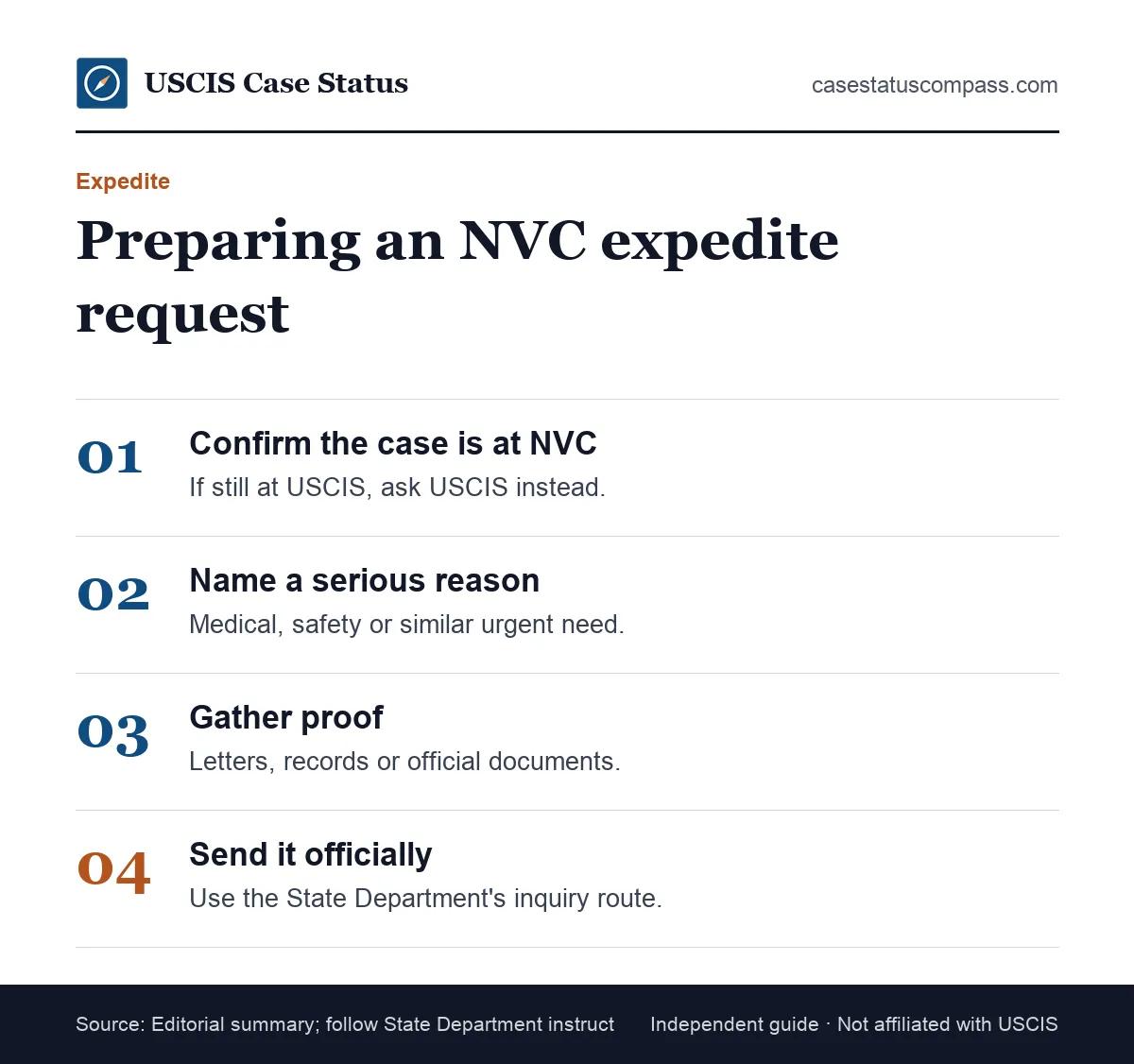
NVC vs USCIS expedite requests
A uscis expedite request covers cases still pending at USCIS. USCIS lists criteria such as Expedite criteria: severe financial loss, emergency/humanitarian, nonprofit, government interest, clear USCIS error. Once the case is at NVC, follow the State Department's process instead. We could not verify its current criteria.
What an NVC expedite request usually includes
A typical request, shown here only as an example structure, includes:
- The NVC case number and beneficiary name
- The reason in two or three sentences
- Proof, such as a doctor's letter or official record
- The date by which action is needed and why
Is There an Official NVC App?
We found no official NVC app. The State Department's tools run on ceac.state.gov. Apps that claim to track "NVC case status" are third-party products that may collect your personal data. If an app asks for your Invoice ID, passport number or a payment, close it, because only the official account needs those details.
What third-party apps can show
Most tracker apps scrape public status pages or ask you to log your own dates. None can speed a case. They may show other users' dates, which can be wrong and are not official.
Safer ways to stay updated
Bookmark the official CEAC status page and turn on account email notifications if offered. Check spam folders for State Department mail, and check your NVC case status weekly instead of daily.
Is the National Visa Center a Visa Center Near Me?
No. The National Visa Center is a processing office that does not serve walk-in visitors. Searches for a "visa center near me" or "immigration visa center" usually mean an embassy, a consulate, a visa application center abroad or a USCIS field office.
NVC is not a public office
All NVC work is done online and by mail. You do not attend appointments there, so a site selling an "NVC appointment" is not official. If someone offers to book you a visit or a faster review there for a fee, treat it as a scam.
Offices you might actually need
Abroad, the embassy or consulate interviews you, and some countries use application centers for biometrics or courier pickup, all separate from NVC. In the U.S., USCIS field offices handle green card interviews for adjustment cases only.
What Happens After the Embassy Interview?
After the interview, the officer either issues the immigrant visa, asks for more documents, or refuses it. If issued, you receive the visa in your passport and travel to the U.S. Your NVC case status on CEAC then shows a final label such as Issued.
Entering the U.S. as an immigrant
On entry, CBP admits you as a permanent resident. As of October 2026, USCIS's employer handbook notes: Temporary I-551 stamp: valid until its expiration date, or 1 year if no date is printed. Our green card basics guide explains what a permanent resident can do. Keep the passport with the visa stamp safe.
Paying the USCIS Immigrant Fee
Before USCIS mails the green card, most new immigrants pay the USCIS Immigrant Fee of $235. This is paid online to USCIS, not to NVC. Our US visa status guide covers what CEAC shows after issuance.
What Can Delay an NVC Case?
The most common NVC delays are unpaid fees, an unfinished DS-260, rejected documents, an I-864 that does not meet the income rule, a non-current priority date and embassy backlogs. Most are fixable. The ones on your side are the fastest to clear, and each fix starts with reading your account messages carefully. The rest depend on visa numbers and embassy capacity.
Delays you can fix
- Pay every fee bill as soon as it appears
- Finish each applicant's DS-260
- Upload clear, complete, translated documents
- Add a joint sponsor if income falls short
Each item on this list is within your control, so work through it in order.
Delays you cannot fix
Priority date waits and embassy backlogs depend on the government. Under INA 203(g), a petition's registration is terminated if the applicant does not apply for the visa within one year of notice of visa availability; it can be reinstated within two years if the delay was beyond the applicant's control. Respond to every NVC message even while you wait, so the case stays active. If the case is old, ask NVC whether it is still open.
What Should You Do Next at Each NVC Stage?
What to do next depends on where the case stands. If an NVC message or embassy letter gives different instructions, follow those instead. Most cases need only a few steps: pay, submit, wait for review, then prepare for the interview. The table below lists the usual move for each label.
If-then guide for each NVC case status
Find the situation that matches your account, then take the action beside it before you contact anyone.
| If your NVC case status shows… | Do this |
|---|---|
| No welcome message yet | Check spam; confirm the petition was approved for consular processing |
| At NVC, fees unpaid | Pay fees in your account |
| At NVC, documents rejected | Fix only the item named and resubmit |
| Documentarily Qualified | Prepare originals; watch for the interview letter |
| Ready or interview scheduled | Book the medical exam; follow embassy instructions |
| Refused after interview | Read the letter; send requested items or seek advice |
When to get legal help
Get help from an immigration attorney or DOJ-accredited representative if a past immigration violation, criminal record, unlawful presence or a waiver may be involved.
Frequently Asked Questions
How long does NVC take after I-130 approval?
NVC publishes a weekly case-creation date; the latest one appears in the case-creation section above and on NVC's timeframes page. If your petition left USCIS before that date and no Welcome Letter came, check spam folders and confirm the petition chose consular processing.
Can I check NVC case status without a case number?
The CEAC check needs your NVC case number. If you never received it, check the petitioner's and beneficiary's email, including spam, and any attorney's records. You can then contact NVC through its official inquiry form with names, dates of birth and the USCIS receipt number.
Is NVC part of USCIS?
No. The National Visa Center is part of the U.S. Department of State. USCIS, part of the Department of Homeland Security, decides the petition and then sends the case to NVC. The two agencies use different numbers and different trackers.
Does NVC interview applicants?
No. NVC prepares the case: fees, the DS-260 and documents. The interview takes place at a U.S. embassy or consulate abroad, where a consular officer decides whether to issue the immigrant visa.
Does NVC charge fees for the I-130?
No. The Form I-130 fee is paid to USCIS when the petition is filed. NVC bills only State Department fees, such as the immigrant visa application fee and, for many family cases, the Affidavit of Support fee, through your official account.
Is there an NVC expedite request sample?
We could not verify an official NVC template. A request usually states the case number, the urgent reason in a few sentences, supporting proof and the date by which action is needed. Send it through the official inquiry route.
Can I use the NVC for a K-1 fiancé visa?
K-1 cases pass through NVC briefly on the way to the consulate, but NVC's published timeframes do not apply. NVC timeframes cover immediate relative, family preference and employment preference cases, not diversity, special immigrant, K (fiancé) or adoption cases. Our K-1 visa guide explains the fiancé process.
What if my NVC case status has not changed in months?
First check your immigrant visa account for unpaid fees or rejected documents. For preference cases, check the Visa Bulletin. If everything is complete and your submission date is earlier than the State Department's published review date, send an inquiry through the official form.
Sources
- USCIS: Consular Processing. www.uscis.gov/green-card/green-card-processes-and-procedures/consular-processing. Accessed Oct 27, 2026.
- U.S. Department of State: Immigrant Visa Process. travel.state.gov/content/travel/en/us-visas/immigrate/the-immigrant-visa-process.html. Accessed Oct 27, 2026.
- U.S. Department of State: Consular Electronic Application Center (CEAC). ceac.state.gov/CEACStatTracker/Status.aspx. Accessed Oct 27, 2026.
- 22 CFR 22.1: Schedule of Fees for Consular Services. www.ecfr.gov/current/title-22/chapter-I/subchapter-A/part-22/section-22.1. Accessed Oct 27, 2026.
- USCIS: Form I-864 Instructions. www.uscis.gov/sites/default/files/document/forms/i-864instr.pdf. Accessed Oct 27, 2026.
- USCIS: Visa Availability and Priority Dates. www.uscis.gov/green-card/green-card-processes-and-procedures/visa-availability-priority-dates. Accessed Oct 27, 2026.
- USCIS Data Library: Quarterly All Forms Report, FY2026 Q3. www.uscis.gov/sites/default/files/document/data/quarterly_all_forms_fy2026_q3_v1.xlsx. Accessed Oct 27, 2026.
- USCIS Form G-1055, Fee Schedule (edition 10/16/26). www.uscis.gov/sites/default/files/document/forms/g-1055.pdf. Accessed Oct 27, 2026.
- State Department: NVC Timeframes (as of 26-Oct-26). travel.state.gov/content/travel/en/us-visas/immigrate/nvc-timeframes.html. Accessed Oct 27, 2026.
- 22 CFR 22.1 Schedule of Fees for Consular Services (LII). www.law.cornell.edu/cfr/text/22/22.1. Accessed Oct 27, 2026.
- USCIS: Form I-864 page (updated 09/04/2026). www.uscis.gov/i-864. Accessed Oct 27, 2026.
- USCIS: Form I-864P, 2026 HHS Poverty Guidelines (updated 02/27/2026). www.uscis.gov/i-864p. Accessed Oct 27, 2026.
- INA 203 / 8 U.S.C. 1153 (LII). www.law.cornell.edu/uscode/text/8/1153. Accessed Oct 27, 2026.
- USCIS Contact Center (uscis.gov). www.uscis.gov/contactcenter. Accessed Oct 27, 2026.
- USCIS: How to Change Your Address (updated 08/04/2026); 8 U.S.C. 1305(a) (LII). www.uscis.gov/addresschange. Accessed Oct 27, 2026.
- USCIS: How to Make an Expedite Request (updated 09/08/2026). www.uscis.gov/forms/filing-guidance/how-to-make-an-expedite-request. Accessed Oct 27, 2026.
- USCIS M-274 Handbook for Employers, 7.1 (updated 10/17/2023). www.uscis.gov/i-9-central/form-i-9-resources/handbook-for-employers-m-274/70-evidence-of-employment-authorization-for-certain-categories/71-lawful-permanent-residents-lpr. Accessed Oct 27, 2026.
casestatuscompass.com is an independent publication and is not affiliated with USCIS or any government agency. This page is general information, not legal advice. For denials, court or asylum matters, consult an immigration attorney or a DOJ-accredited representative.