Contents · 38 sections
- What Is USCIS Case Help and Who Is This Guide For?
- Which USCIS Problem Do You Have?
- How Do the Case Help Topics Fit Together?
- Gather These Before You Ask for Help
- How Do You Know If Your USCIS Case Is Really Delayed?
- Status Not Updating: What Does a Frozen Status Mean?
- Can You Ask USCIS to Speed Up Your Case?
- Is Premium Processing an Option for Your Form?
- Expedite vs Premium Processing: Which One Applies?
- What Is an Outside Normal Processing Time Request?
- USCIS Asked for More: Evidence Requests and Notices
- What Does an RFE Mean for Your Case?
- What Does a Notice of Intent to Deny Mean for You?
- What Happens If You Miss an RFE or NOID Deadline?
- Does a Partial RFE Response Count as an Answer?
- Biometrics and Interview Problems
- Your Case Was Denied: What to Do First
- Can You Appeal a USCIS Denial?
- Reopen, Reconsider or Appeal: How the Three Compare
- Should You Refile Instead of Appealing?
- Contacting USCIS: Every Channel at a Glance
- What Is the USCIS Phone Number?
- How Do You Call USCIS From Outside the U.S.?
- When Should You Book an In-Person Appointment?
- Service Centers and Field Offices: Who Has Your File?
- When Should You Contact the CIS Ombudsman?
- How Does a Congressional Inquiry Work?
- The Escalation Ladder: Which Contact Comes First?
- You Moved: Update USCIS on Time
- What Happens to Mail Sent to Your Old Address?
- Is Your Case in Immigration Court or at NVC Instead?
- How Can You Avoid Scams When You Need Help Fast?
- When Is It Time to Get an Immigration Attorney?
- How Can You Find Affordable Immigration Help?
- Case Problems by Form: Where Trouble Shows Up
- A Sample Timeline for Escalating a Delayed Case
- All USCIS Case Help Guides in One Place
- Frequently Asked Questions
The short answer
USCIS case help starts with naming your problem. A slow case needs a check against its case inquiry date. A request for evidence or notice of intent to deny needs a full answer by the printed deadline. A denial gives you about 30 days to appeal or file a motion. A move must be reported within 10 days.
At a glance
| Main phone line | 800-375-5283 (TTY: 800-767-1833) |
| Live agent hours | Live calls and chat: Monday to Friday, 8 a.m. to 8 p.m. Eastern |
| Deadline after a denial | Appeal or motion: file within 30 days (33 if the decision was mailed) |
| Address change rule | Report a new address to USCIS within 10 days of moving (INA 265) |
| Who runs this guide | An independent site; we are not USCIS |
What Is USCIS Case Help and Who Is This Guide For?
USCIS case help means the official routes for fixing a problem with a pending or decided immigration case: delays, evidence requests, denials, missed notices and moves. This USCIS case help hub is for applicants, petitioners and families who need to pick the right route before they call, write or file anything.
The problems this hub covers
This guide groups case trouble into five families: delays, requests from USCIS, denials, contacting USCIS and moving. To look up where your case stands, use our main uscis case status page first.
What this site can and cannot do
We are an independent publication. We cannot see your file, call USCIS for you or change a decision. We explain each option in plain English and point you to the official tool or form.
Which USCIS Problem Do You Have?
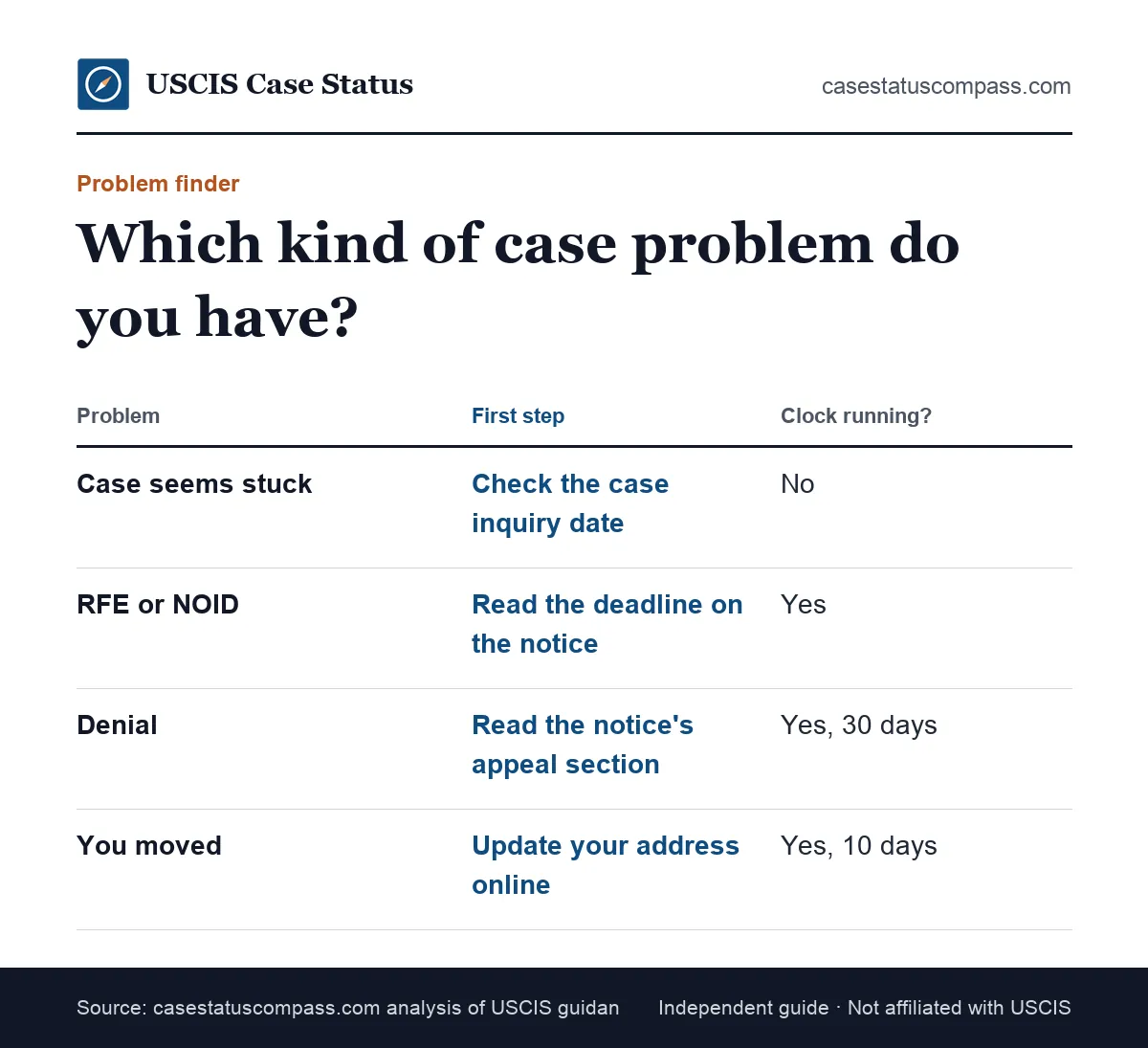
Match your situation to one row of the decision table below. Each row names the first action and the guide to read. If two rows fit, such as a denial after a missed RFE, start with the row that has the earliest deadline, because appeal and response windows are short and cannot be extended.
Decision table: problem, first step, guide
Each row pairs a common problem with the single action that protects your case first, then links to the full guide.
| If this happens | Do this first | Full guide |
|---|---|---|
| Status unchanged for months | Compare your receipt date with the case inquiry date | Status not updating |
| Emergency or severe loss | Gather proof and ask for an expedite | Expedite request |
| Form qualifies for a faster clock | Consider Form I-907 | Premium processing |
| Request for Evidence arrived | Note the deadline; send one full response | Request for evidence |
| Notice of Intent to Deny arrived | Answer in time, ideally with counsel | NOID guide |
| Case was denied | Read the appeal section of the notice | Options after a denial |
| You want the decision reviewed | Choose appeal, reopen or reconsider | Motions and appeals |
| You moved | Update your address online within 10 days | Address change guide |
| USCIS has not answered you | Check the Ombudsman entry rules | Ombudsman and Congress |
How to use the decision table
Read only the first action column at first. It is the one step that protects your case before anything else. Do that step today, then open the guide in the last column for the full process and the evidence it needs.
When two problems overlap
Some cases hit two rows at once, such as a move during an RFE. Handle the item with the shortest clock first: update your address the same day, then work on the evidence.
How Do the Case Help Topics Fit Together?
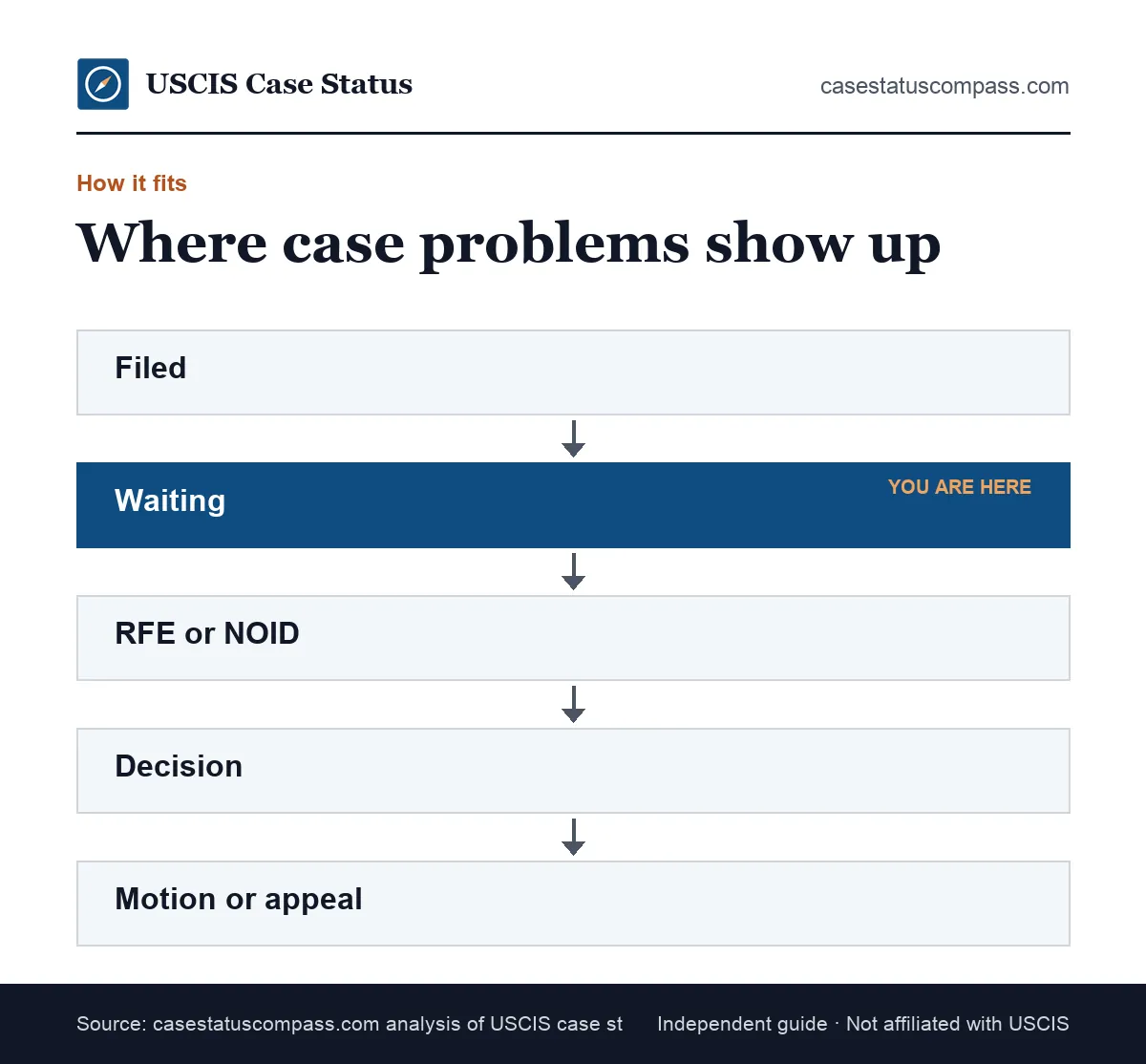
The USCIS case help topics follow the path of a case. Delays happen while you wait. Evidence requests and NOIDs happen during review. Denials, appeals and motions come at or after the decision. Knowing where your case sits on that path tells you which problems can still happen and which are already behind you.
Waiting, review and decision
During the waiting stage, your tools are the processing times tool, expedites and premium processing. During review, you answer what USCIS asks. After the decision, you accept it, ask for review on Form I-290B, or refile.
The contact layer underneath
Phone, chat, online messages and appointments are not separate problems. They are the channels you use to solve the others. Pick the channel after you know the problem: an expedite goes through the Contact Center or online account, a typo through e-Request.
Your mailing address at every stage
Your mailing address works the same way: every notice at every stage travels to the address USCIS has on file, so keep it current. A missed RFE or interview notice is the most common way a simple move turns into a denial.
Gather These Before You Ask for Help
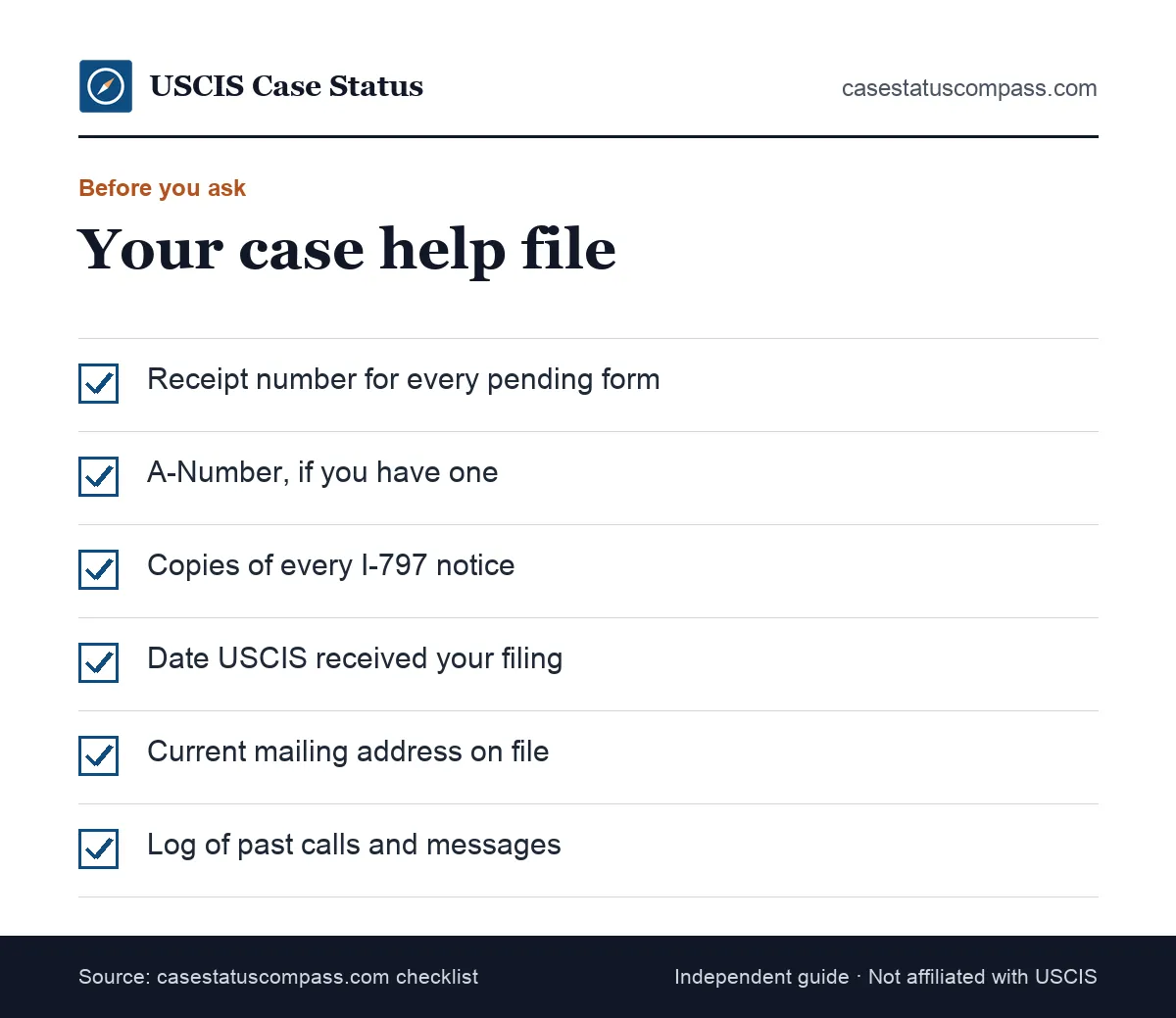
Before you call, message or file, put your key case details in one place. Agents, the Ombudsman and congressional staff all ask for the same items. Having them ready shortens every call and makes any written request complete on the first try. Missing a receipt number or an A-Number is the usual reason a request gets sent back.
Copyable case help checklist
- Full legal name and date of birth as filed
- Receipt number for every pending form
- A-Number (USCIS number), if you have one
- Form type, category and receipt date
- Mailing address on file and when it last changed
- Dates and reference numbers of past contacts
- A one-line summary of the problem
Where each item comes from
Your receipt number and receipt date are on the Form I-797C receipt notice, and the A-Number appears on most notices and cards. Our uscis receipt number guide shows where to look. Your online account stores copies too. Free USCIS online account: case status updates, notices, link paper-filed cases.
How Do You Know If Your USCIS Case Is Really Delayed?
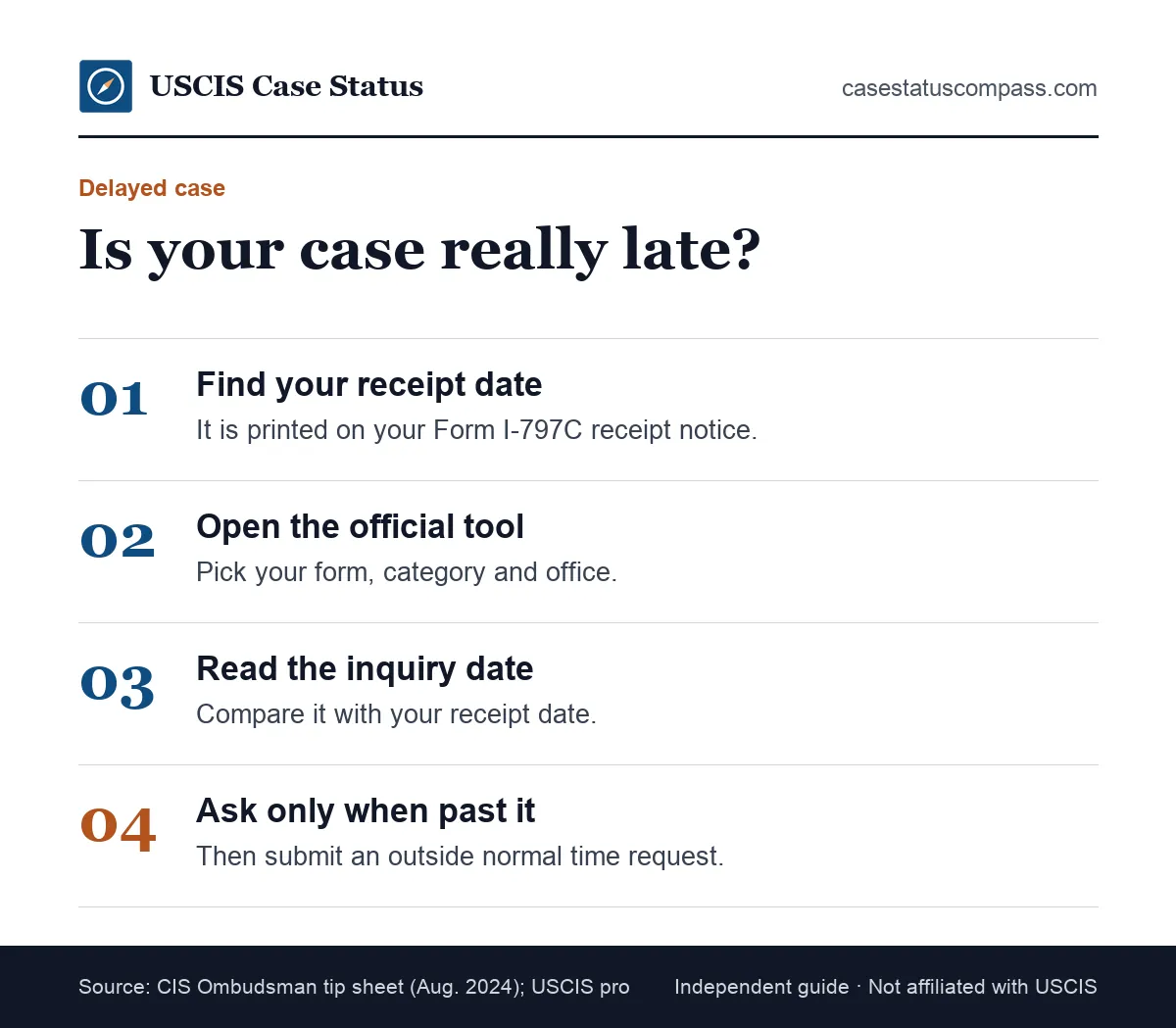
Your USCIS case is delayed only when your receipt date falls before the case inquiry date shown in the official tool for your form, category and office. Our uscis processing times hub explains how to read each figure. Check the tool again monthly, because the date moves.
Normal wait or real delay
Silence alone is not a problem. The USCIS data library counted 12.8 million cases pending at USCIS (end of June 2026), so queues are long. A real delay starts when your case is older than the posted inquiry point for your form and office.
The case inquiry date
Case inquiry date: the earliest date USCIS will accept a question about your pending case; it can change. If your receipt date is earlier, you may ask about the case. The USCIS tool shows how long it took to finish 80% of cases in the past 6 months.
Status Not Updating: What Does a Frozen Status Mean?
A frozen status usually means no new public action has been recorded, not that your case is lost. USCIS changes the message only when a step is logged. Many cases are approved straight from a status that has not changed in months. Look in your online account for new documents before you worry, and keep watching your mail.
Why quiet stretches happen
Most of a case's life is spent in queues. An officer may not open the file for months, while security checks run in the background. Name checks and fingerprint results do not show as status updates.
When silence needs action
Act when your case is past its inquiry date, an expected notice never came, or an update shows an error. Our guide on uscis case status not updating covers each scenario.
Can You Ask USCIS to Speed Up Your Case?
Yes, you can ask USCIS to speed up a case with an expedite request, but approval is discretionary. USCIS weighs each request against set criteria, such as severe financial loss or an urgent humanitarian need. Strong proof matters more than urgency in your words.
The expedite criteria
As of September 2026, USCIS summarizes its grounds this way. Expedite criteria: severe financial loss, emergency/humanitarian, nonprofit, government interest, clear USCIS error. Meeting a ground does not guarantee a faster decision.
How expedite requests are made
Ask for an expedite through the USCIS Contact Center or your online account. Our uscis expedite request guide explains which evidence works for each ground and how to follow up.
Is Premium Processing an Option for Your Form?
Premium processing is a paid service that puts certain employment and student forms on a fixed business-day clock. It covers listed forms such as Form I-129 and Form I-140, not family forms, the I-485 or the N-400. You cannot buy it for a case type that is not listed.
Forms and timeframes
Premium processing covers I-129 work visas, I-140 (EB-1/2/3), I-765 OPT/STEM OPT and I-539 to F/M/J. The clocks run 15 business days (I-129, most I-140); 30 (I-765 OPT, I-539 F/M/J); 45 (I-140 E13 managers and NIW).
Fees and the RFE pause
Form I-907 costs $2,965 (I-129 most classes, I-140); $1,780 (H-2B/R, I-765 OPT); $2,075 (I-539 to F/J/M). You can't get a fee waiver for premium processing. Also, An RFE stops the premium clock; a new period starts when USCIS gets your response. Our premium processing guide explains when the fee is worth paying.
Expedite vs Premium Processing: Which One Applies?
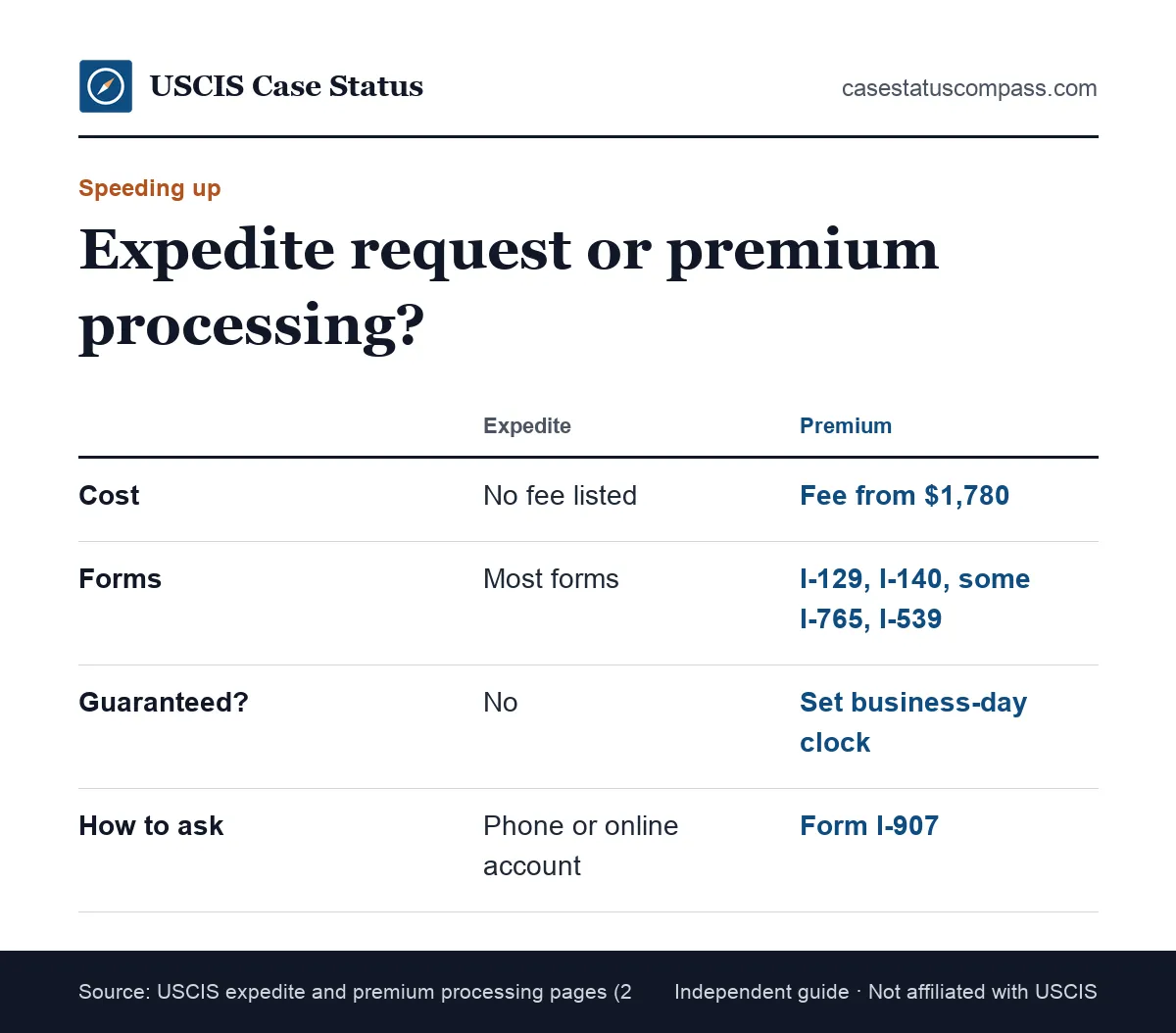
Use premium processing when your form is on the premium list and you can pay the fee. Use an expedite request when your form is not premium-eligible and you meet a listed ground. USCIS generally will not consider an expedite for a form where premium processing is available.
When an expedite is off the table
The main exception is an IRS-designated nonprofit. A family petition has no premium option, so an expedite is its only speed route. For a premium-eligible form, expect USCIS to point you to Form I-907 instead of reviewing an expedite.
Choosing between them
If both could fit, weigh the cost of waiting against the premium fee. For a job start date, premium processing buys certainty. For a medical emergency on a family case, a well-documented expedite request is the realistic choice.
What Is an Outside Normal Processing Time Request?
An outside normal processing time request is a service request asking USCIS to check a case that has run past its case inquiry date. It is not an expedite and does not jump the line. It asks USCIS to look at a stalled file.
When you can file it
You can submit an 'outside normal processing time' request only after your case inquiry date. If your form is missing from the tool, the CIS Ombudsman notes you can generally ask once it has been pending more than six months.
What to include
Give your receipt number, form, office and receipt date exactly as printed, plus a short, factual description. Save the service request reference USCIS gives you, because the Ombudsman and congressional offices ask for proof that you contacted USCIS first.
USCIS Asked for More: Evidence Requests and Notices
When USCIS asks for more, it mails a notice listing what it needs and a deadline. The two main types are the Request for Evidence (RFE) and the Notice of Intent to Deny (NOID). Both pause the decision, and neither deadline can be extended.
RFE versus NOID side by side
Both notices stop the decision until you answer, but the risk and the response window differ.
| Request for Evidence (RFE) | Notice of Intent to Deny (NOID) | |
|---|---|---|
| What it signals | Something is missing or unclear | USCIS plans to deny unless you rebut |
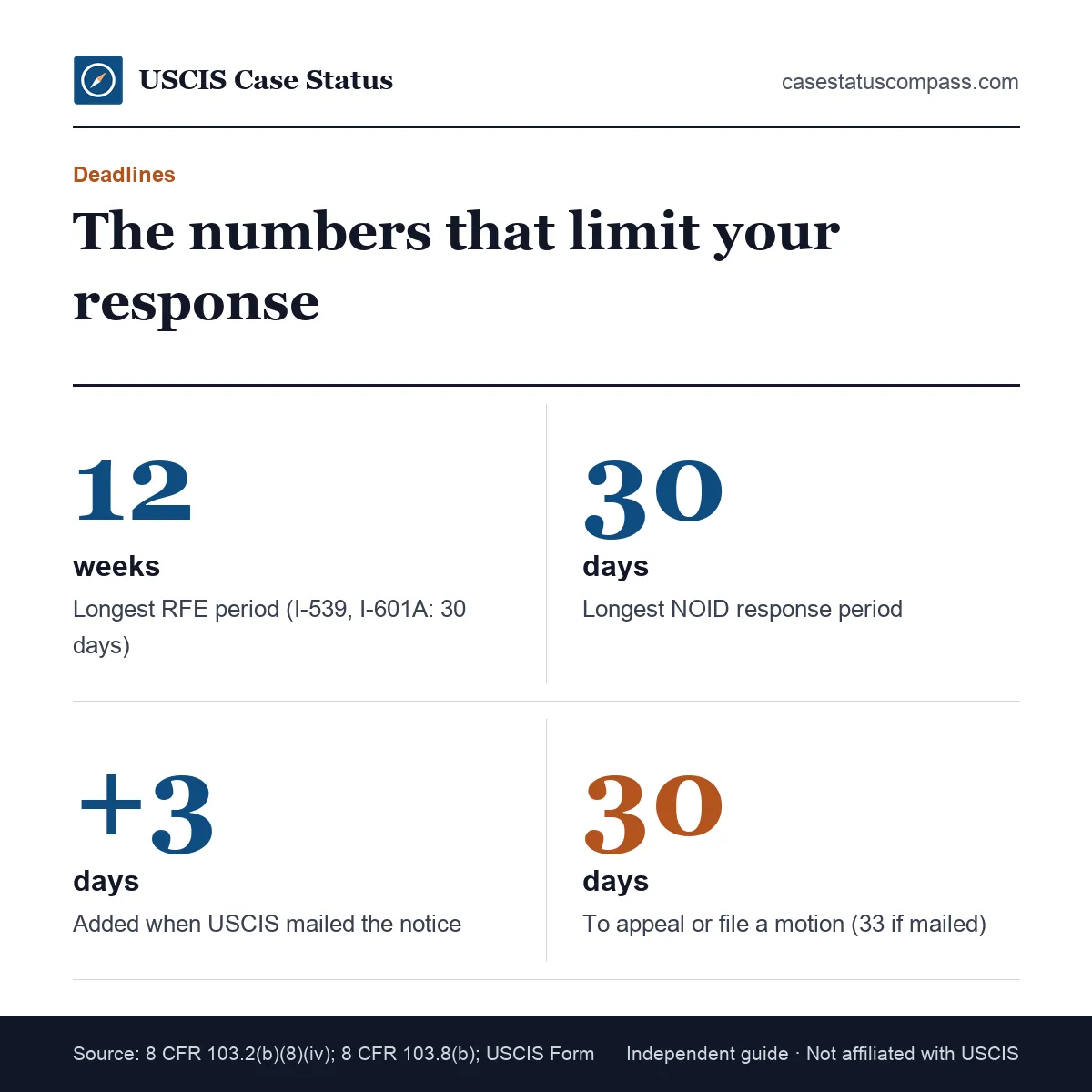
| Longest response period | Up to 12 weeks (I-539, I-601A: 30 days) | Up to 30 days |
| Extensions | No | No |
| Mailed notice | Add 3 days | Add 3 days |
| Typical help | Gather documents | Rebuttal, often with counsel |
Reading the deadline correctly
The due date is printed on the notice. If USCIS mailed the notice, add 3 days to the deadline. Count from the notice date, not the day you opened it, and mail early enough that USCIS receives your answer in time.
One response, all at once
The Policy Manual rule is strict: send every requested item in one response; a partial reply is treated as a request for a decision on the record. Send it as a single package.
What Does an RFE Mean for Your Case?
An RFE means the officer cannot approve your case on the current evidence and is giving you a chance to fill the gap. It is common and is not a denial. RFE deadline: up to 12 weeks (the exact date is on your RFE); no extensions. One exception: RFEs for Form I-539 and Form I-601A allow at most 30 days (all other forms up to 84 days), plus 3 days if mailed.
Request for evidence basics
An RFE lists each issue, the legal standard and examples of acceptable proof. Answer every item, even ones you think you already covered. Put a copy of the RFE notice on top of your reply.
When a document does not exist
If a document does not exist, explain why and send secondary evidence. Our guide on rfe meaning walks through common RFE types. A letter from the issuing office stating that no record exists often helps.
How an RFE affects timing
The decision clock pauses while USCIS waits for you. For premium cases, a new premium period begins on receipt of the response. Answering early, rather than on the last day, restarts review sooner.
What Does a Notice of Intent to Deny Mean for You?
A Notice of Intent to Deny (NOID) means USCIS has found grounds to deny your case and is giving you one chance to answer first. It is more serious than an RFE because the officer has reached a tentative conclusion. NOID deadline: up to 30 days; no extensions.
Why a NOID is more serious
An RFE asks for missing pieces. A NOID explains why the officer thinks you do not qualify, sometimes based on information from outside your filing. You get one chance to rebut it.
Getting help with a NOID
With a short window and a tentative denial, a NOID is the moment to call an immigration attorney or DOJ-accredited representative. Our notice of intent to deny guide explains how rebuttals are organized.
What Happens If You Miss an RFE or NOID Deadline?
If you miss an RFE or NOID deadline, USCIS can decide the case on the evidence it already has, which often means a denial. The regulations allow no extra time. A denial for a missed deadline can sometimes be cured by refiling, but the fee is lost. If the notice was delayed by the mail, keep the envelope as proof.
Decision on the record
Under USCIS policy, if you don't respond, USCIS can deny the case as abandoned, on the record, or both. If the request was for something essential, such as proof of a qualifying relationship, expect a denial for lack of evidence.
Does a Partial RFE Response Count as an Answer?
Yes, and that is the risk. Sending only some items counts as asking for a decision on the record. If one document is late, send everything else with a written explanation and proof you requested the missing item. You will not get a second chance.
Biometrics and Interview Problems
Biometrics and interview problems include missed appointments, schedule conflicts and notices that never arrived. They matter because USCIS may treat a missed appointment as abandonment. Act before the date whenever you can: rescheduling in advance is simple, while fixing a missed appointment afterward means proving good cause.
Missed or conflicting biometrics
Missing biometrics can lead to denial for abandonment. The rescheduling rule is strict. Reschedule biometrics online at least 12 hours before, with good cause, or call the Contact Center. Our biometrics appointment guide covers how to request a new slot.
Interview notices and conflicts
Each interview notice lists the office, date and documents to bring, and that list is the one to follow. If two notices clash, call the Contact Center right away to confirm.
Rescheduling an interview
If you cannot attend, use the notice's rescheduling instructions before the date. Our uscis interview hub explains each interview type. Keep proof of the request and any new notice. Missing it can stop the case.
Your Case Was Denied: What to Do First
If your case was denied, read the whole denial notice before acting. It gives the reasons and says whether you can appeal, file a motion or neither. Note the date on the notice, since most deadlines run from it. Appeal or motion: file within 30 days (33 if the decision was mailed).
Read the denial notice closely
Look for the legal reason for the denial, the evidence the officer relied on and the section on appeal rights, and mark any factual error. Those notes shape your next step.
Status and work permits after a denial
Our guide for when an i 485 denied notice or other denial arrives covers status, work permits and next steps. A denied I-485 can also end a work permit based on it, so ask a lawyer quickly.
Fees are not refunded
USCIS fees are nonrefundable, even if your case is denied or withdrawn. Budget for a new fee if you refile, or the Form I-290B fee if you challenge the decision. Our page on the case was denied status explains what the online message itself means.
Can You Appeal a USCIS Denial?
You can appeal many USCIS denials, but not all; the denial notice says whether an appeal is available. Appeals and motions are filed on Form I-290B, which carries a fee and a short filing window counted from the decision date.
Form I-290B basics
Form I-290B, Notice of Appeal or Motion, is the one form for appeals, motions to reopen and motions to reconsider. The fee is $800 (some humanitarian categories $0; fee waiver possible). You file it with USCIS at the address on its form page, never directly with the appeals office.
The filing window
Appeal or motion: file within 30 days (33 if the decision was mailed). A late appeal is rejected, though USCIS may treat it as a motion. Our motion to reopen guide explains each path and its evidence.
Reopen, Reconsider or Appeal: How the Three Compare
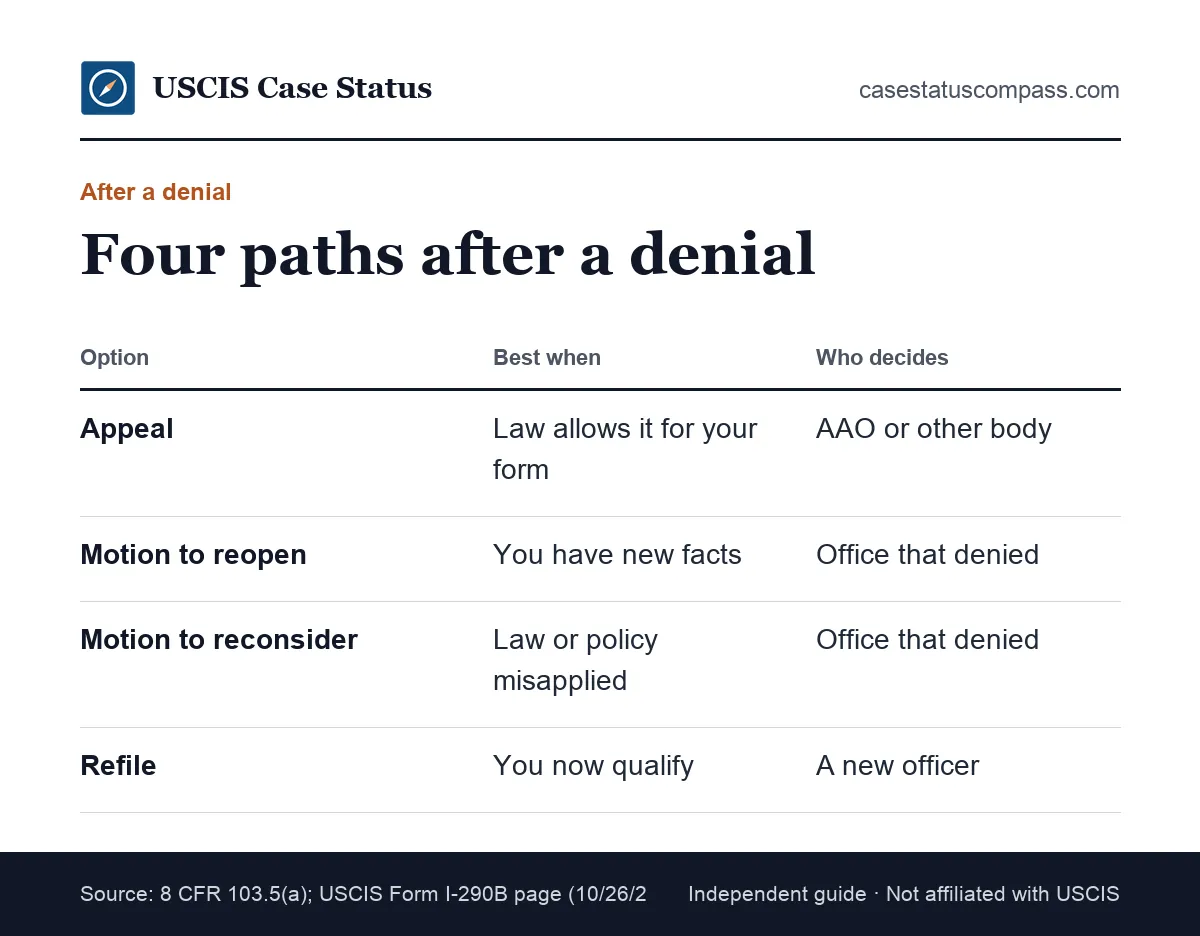
A motion to reopen asks the same office to look again because of new facts. A motion to reconsider argues the office misapplied law or policy to the record it had. An appeal asks a higher body, usually the Administrative Appeals Office (AAO), to review the decision.
Side-by-side comparison table
The three options share one form and one deadline but differ in what you must show.
| Motion to reopen | Motion to reconsider | Appeal | |
|---|---|---|---|
| Core argument | New facts with evidence | Legal or policy error | Decision was wrong |
| New evidence | Yes, required | No, record at the time | Often brief only |
| Who decides | Office that denied | Office that denied | AAO or other body |
| Deadline | 30 days (33 if mailed) | 30 days (33 if mailed) | 30 days (33 if mailed) |
Which path fits your denial
Reopen = new facts and evidence; reconsider = the decision got the law or policy wrong. A document found after the decision points to reopening. An officer who misread the law points to reconsideration.
Should You Refile Instead of Appealing?
Refiling is often faster and simpler than an appeal when the denial turned on evidence you can now supply, or when your situation changed so that you now qualify. An appeal makes more sense when you were eligible all along and the officer made a clear legal mistake.
When refiling makes sense
Refiling suits denials for abandonment, a missed RFE deadline or a problem you have since fixed, such as an income shortfall on an affidavit of support. It skips the motion queue.
What refiling costs and changes
You pay a new fee and get a new receipt number; the old case stays closed. USCIS fees are nonrefundable, even if your case is denied or withdrawn. Your new case starts at the back of the queue, so compare that wait with a motion.
When to get legal advice first
Get advice if the denial mentions fraud, misrepresentation, criminal history, unlawful presence or a Notice to Appear. These issues can affect every future filing and may send your case to immigration court.
Contacting USCIS: Every Channel at a Glance
USCIS offers five main contact channels: your online account, Emma and live chat, the Contact Center phone line, e-Request and in-person appointments. USCIS describes the online account as its preferred channel for case questions. Every channel is free to use.
Contact channels compared
Choose the channel by what you need done, not by which one feels fastest to reach.
| Channel | Best for | Availability |
|---|---|---|
| Online account | Notices, secure messages, expedite requests | Online at any time |
| Emma and live chat | General questions, then a live agent | Live calls and chat: Monday to Friday, 8 a.m. to 8 p.m. Eastern |
| Contact Center phone | Case questions, service requests | Automated phone line: 24 hours a day (live agents Mon-Fri 8am-8pm ET) |
| e-Request | USCIS typos, missing notices, accommodations | Online |
| In-person appointment | Services needing you there | By request only |
Online account and e-Request
Your account holds notices and history and lets you send a secure message. General web forms get only general answers, since staff cannot share case details outside a verified channel.
When to use e-Request
e-Request: report USCIS typos, missing notices or accommodation needs online; it is not for general questions. Use it, for example, when your notice spells your name wrong or never arrived after a status said it was mailed.
Phone and chat
The phone line and Emma's chat reach the same Contact Center. First-level agents answer basic questions and may refer harder ones to an Immigration Services Officer, who replies later by phone or email.
What Is the USCIS Phone Number?
The main USCIS phone number is the Contact Center at 800-375-5283, with TTY: 800-767-1833 for deaf and hard-of-hearing callers. There is also 212-620-3418 (callers outside the U.S.). Live calls and chat: Monday to Friday, 8 a.m. to 8 p.m. Eastern.
Automated line and identity checks
Automated phone line: 24 hours a day (live agents Mon-Fri 8am-8pm ET). Have your receipt number ready, because agents verify identity before discussing a case. Our full guide to the uscis contact number covers reaching a live agent.
How Do You Call USCIS From Outside the U.S.?
Dial the overseas number listed in the section above. It reaches the same Contact Center, so plan around U.S. Eastern time. If your question is about a visa interview at an embassy or consulate, the State Department handles it, not USCIS, so call the post handling your case.
When Should You Book an In-Person Appointment?
Book an in-person appointment only for a service that needs you there, such as temporary proof of status or an emergency travel document. USCIS does not take walk-ins. Request an in-person appointment online at my.uscis.gov/en/appointment/v2 or call 800-375-5283. Bring your appointment notice.
Requesting an appointment
Use the online tool first. If you cannot book online, call the Contact Center, describe the service you need and ask whether an appointment is the right route. Our I-551 stamp guide shows one of the most common reasons people book.
Service Centers and Field Offices: Who Has Your File?
USCIS decides most paper cases at service centers and holds interviews at local field offices. Your receipt notice and receipt-number prefix show which office first took your case. The office matters for processing times, since each has its own posted figure and inquiry date.
The five service centers
As of July 2026, the official list reads: Five USCIS service centers: California, Nebraska, Potomac, Texas and Vermont. These centers take no walk-ins or public calls; you reach them through the Contact Center. Our uscis service centers guide explains what each handles.
What field offices do
Field offices handle interviews and in-person services near where you live, and they are where most green card and citizenship interviews take place. 88 USCIS field offices, organized under 4 regional and 16 district offices.
After a file is transferred
A file can move between offices to balance work, shown as a case was transferred update. After a transfer, check processing times for the new office. Your receipt number stays the same.
When Should You Contact the CIS Ombudsman?
Contact the CIS Ombudsman after you have already tried USCIS and the problem remains. The Ombudsman is an independent office within the Department of Homeland Security (DHS), not part of USCIS. It reviews stuck cases and errors but cannot decide your benefit or give legal advice.
Entry rules
Use the Ombudsman only after contacting USCIS within 90 days and waiting at least 60 days. It also turns away cases before the inquiry date, recent expedite denials and cases with a congressional inquiry under 45 days old.
How to submit
The official request form is listed as CIS Ombudsman: DHS Form 7001, Request for Case Assistance (online). Attach your service request references and notices. Our uscis ombudsman guide explains what to write.
How Does a Congressional Inquiry Work?
A congressional inquiry is a request from your representative's or senator's office to USCIS about your case, sent through a dedicated liaison channel. Your member of Congress can ask USCIS about your case after you sign a privacy release.
The privacy release
Most offices use their own privacy release form. The person the case is about must sign it, and it usually asks for name, date of birth and receipt number or A-Number.
The Escalation Ladder: Which Contact Comes First?
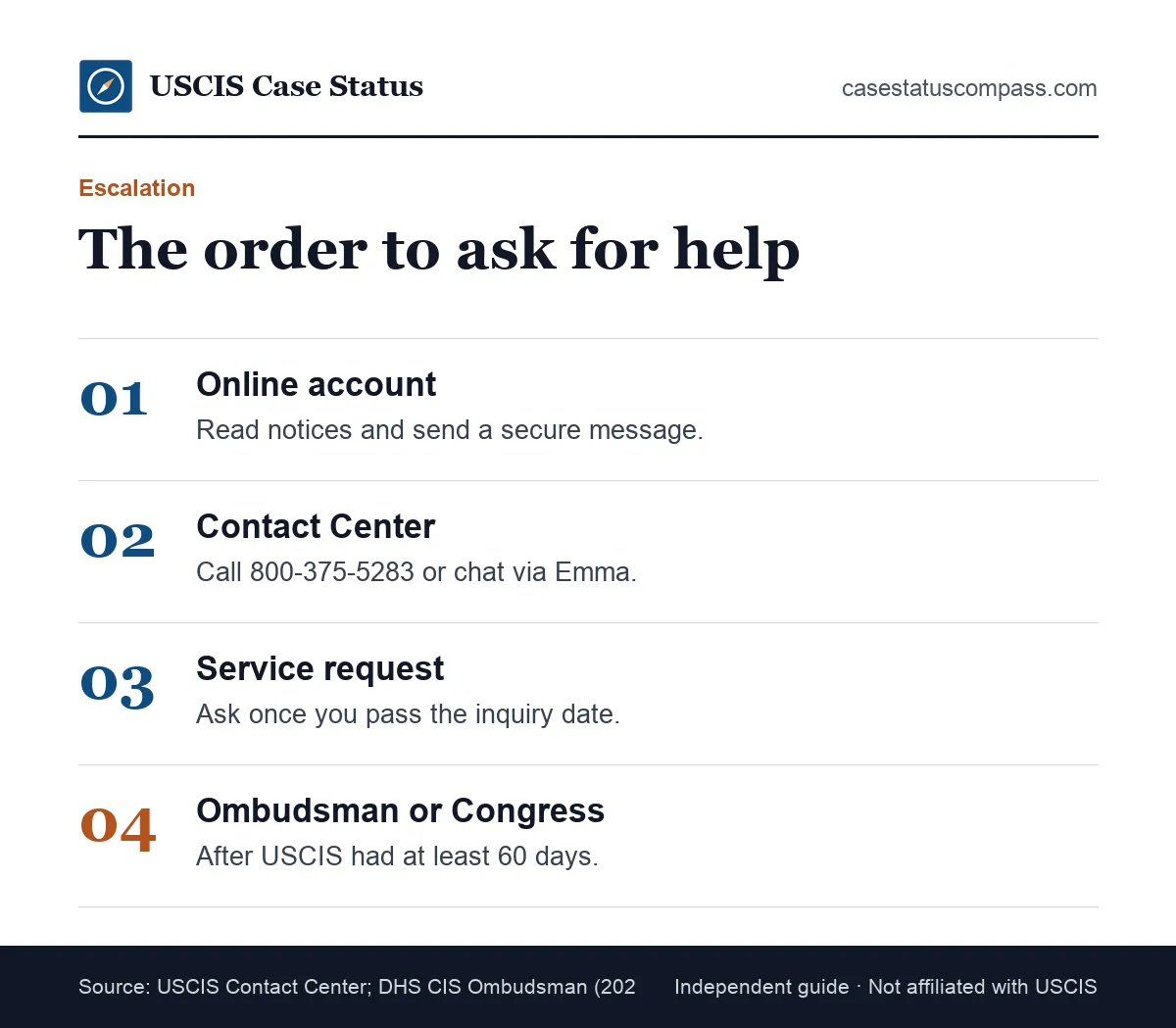
The escalation ladder runs from self-service to outside help: your online account and Emma, then the Contact Center, then a formal service request, and only then the CIS Ombudsman or Congress. Each higher rung expects proof you tried the lower ones, so skipping steps backfires.
Why order matters
The Ombudsman asks whether you contacted USCIS in the last 90 days, and congressional staff ask the same. A paper trail of earlier attempts, with dates and reference numbers, is your entry ticket to each higher rung.
Keeping a contact log
Record the date, channel, agent name or ID, reference number and outcome of every contact. When you fill in Form 7001 or a privacy release, copy entries straight from the contact log.
You Moved: Update USCIS on Time
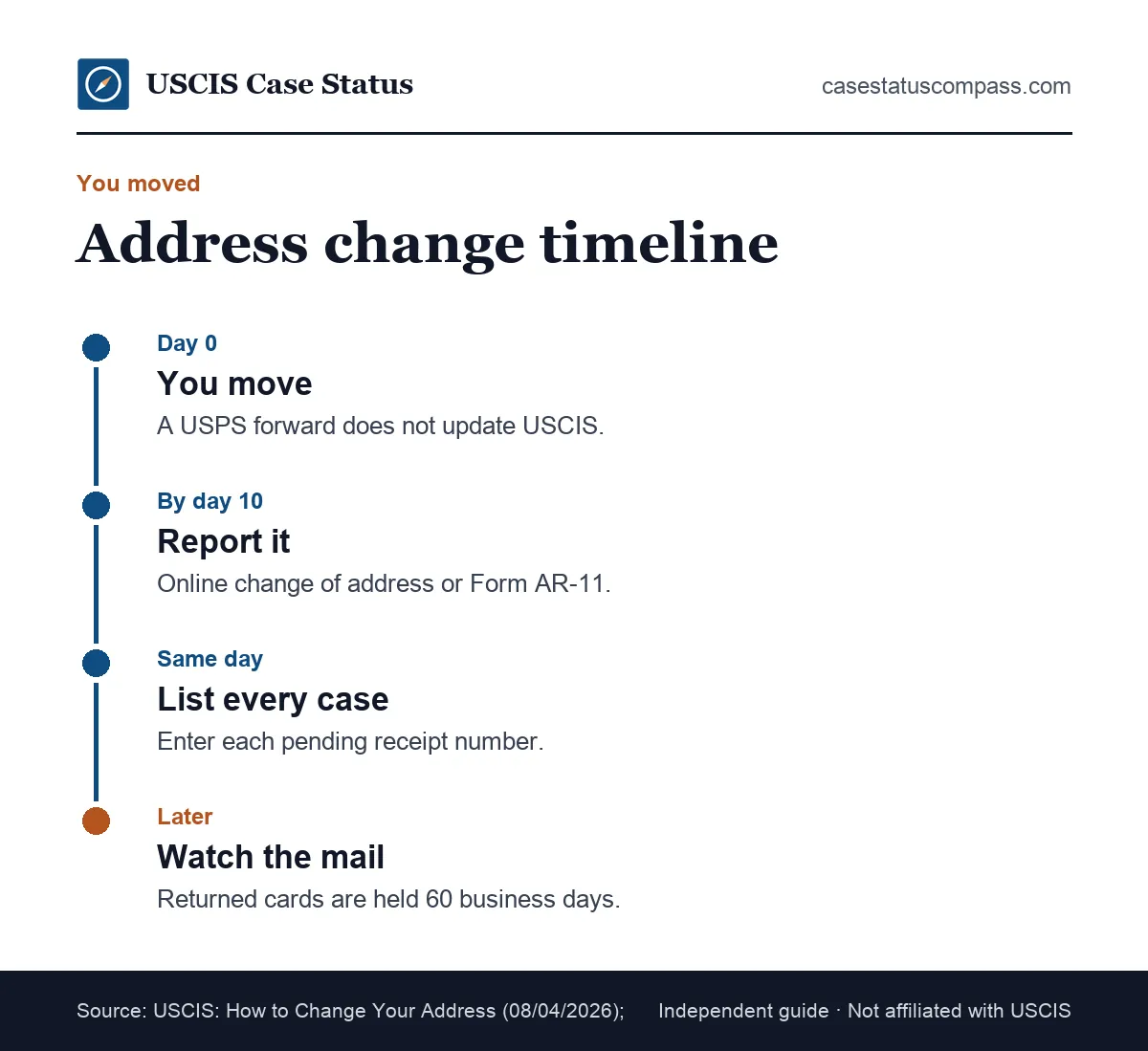
If you moved, tell USCIS within 10 days and update every pending case. A U.S. Postal Service change of address does not reach USCIS. Update your address online in your USCIS account (E-COA); a mailed AR-11 also counts. Do both, and also tell the post office so stray mail is forwarded while the update takes effect.
The 10-day rule
Report a new address to USCIS within 10 days of moving (INA 265). The duty applies to most noncitizens in the U.S., with or without a pending case. Diplomats on A and G visas and visa waiver visitors are exempt from it.
Online change versus Form AR-11
Update your address online in your USCIS account (E-COA); a mailed AR-11 also counts. A paper Form AR-11 meets the legal duty but may not update pending cases by itself. Our uscis change of address guide covers both methods step by step.
What Happens to Mail Sent to Your Old Address?
Mail sent to an old address may be forwarded, returned to USCIS or lost. Deadlines on notices such as an RFE still run from the date USCIS mailed them, and returned cards are held only for a limited time. Ask the new resident to hand over USCIS mail.
Missed notices
If a notice may have gone to an old address, look for a digital copy in your online account. If there is none, report non-delivery through e-Request or call the Contact Center.
Returned cards
Returned green cards are held 60 business days (about 12 weeks), then re-mailed or destroyed. If USCIS destroys the card after a late address change, a replacement usually means a new fee. Our guide to the card was returned to uscis status explains the timing.
Is Your Case in Immigration Court or at NVC Instead?
Some problems fall outside USCIS case help altogether. If your case is in removal proceedings, the immigration court under the Executive Office for Immigration Review (EOIR) controls it. If USCIS approved your petition and you await a visa abroad, the National Visa Center (NVC) at the State Department handles the next steps.
Immigration court cases
USCIS agents cannot answer questions about court hearings. For hearing dates, EOIR runs its own line. EOIR case hotline: 1-800-898-7180 (24/7, automated). Our immigration court case status guide explains the portal and hotline.
NVC and visa cases
NVC (State Department) collects visa fees and documents after USCIS approves the petition. Questions about visa fees, documents or interviews abroad go to the State Department. Our nvc case status guide explains that stage.
How Can You Avoid Scams When You Need Help Fast?
Avoid scams by using only official .gov channels, refusing anyone who promises a guaranteed or faster approval for a fee, and checking every notice against your online account. Help from the USCIS Contact Center costs nothing. Pressure to pay today is a warning sign.
Red flags to watch for
Be wary of callers demanding payment by gift card or wire, websites that look official but are not on a .gov domain, and "notarios" offering legal advice. Our uscis scam guide lists common schemes and how to report them.
Check a notice before you act
If a letter or email pushes you to pay or act fast, compare it with the documents in your account and the receipt number on your Form I-797. Our guide on how to verify uscis notice authenticity shows what to check.
When Is It Time to Get an Immigration Attorney?
Get an immigration attorney or DOJ-accredited representative when you receive a NOID, a denial, a Notice to Appear, or any notice mentioning fraud, criminal history or unlawful presence. Also get advice before choosing among an appeal, a motion and refiling, since these choices affect later cases.
Situations that call for legal help
Seek advice for court proceedings, inadmissibility issues, complex eligibility RFEs and any case where your status or work permit is about to lapse. Get advice early, not after a denial.
How Can You Find Affordable Immigration Help?
Start with nonprofits. Nonprofits with accredited representatives often charge low fees. Confirm the person is a licensed attorney or on the Justice Department's accredited list. Our guide to immigration lawyer cost explains common fee structures and what they include.
Case Problems by Form: Where Trouble Shows Up
Different forms need different kinds of USCIS case help. Green card cases often see RFEs and interviews, work permits face gaps in authorization, citizenship cases hit test and interview issues, and employment petitions lean on premium processing. Knowing your form's weak spot helps you prepare.
Problems and guides by form
Find your form, note its usual problem, then open its guide for status meanings and fees.
| Form | Common problem | Where to read more |
|---|---|---|
| I-485 green card | RFEs, interviews, denials | Form I-485 guide |
| I-765 work permit | Long waits, work gaps | work permit guide |
| I-130 family petition | Long queues, no premium | Form I-130 guide |
| N-400 citizenship | Interview and test issues | citizenship application guide |
| I-751 conditions | Long waits, extensions | Form I-751 guide |
| I-140 employment | Premium processing, RFEs | Form I-140 guide |
Green card and work permit cases
Adjustment cases bundle several forms, so one problem can touch others. A move or missed biometrics can affect the I-485 and I-765 together. Check each receipt number separately online, since each form has its own.
Citizenship and family petitions
N-400 problems usually center on the interview and civics test. Family petitions such as the I-130 cannot use premium processing, so expedites and patience are the only speed tools. Our uscis forms hub covers each form in depth.
A Sample Timeline for Escalating a Delayed Case
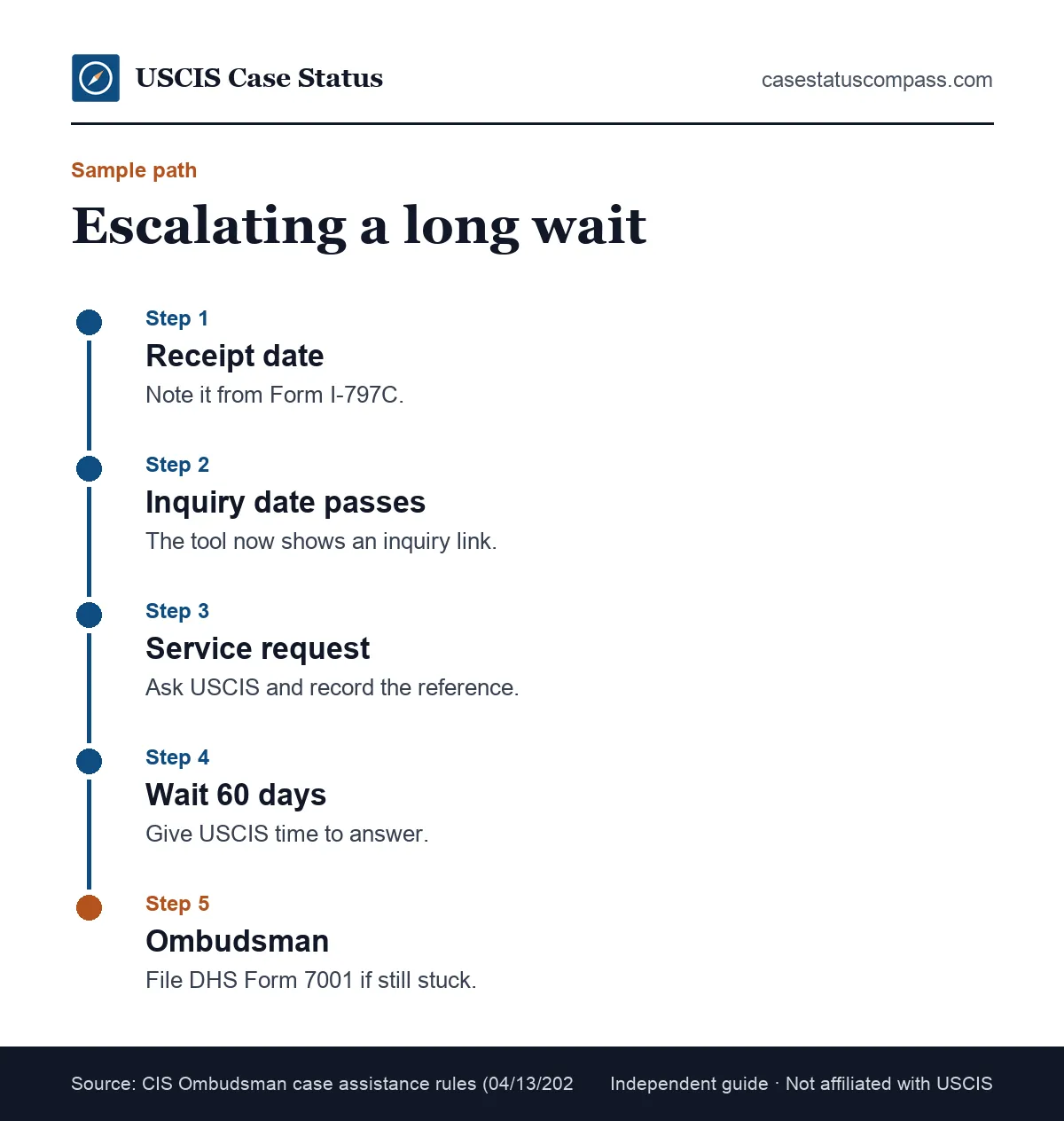
A sample escalation has five steps: note your receipt date, wait for the inquiry date to pass, submit a service request, give USCIS at least 60 days, then file with the CIS Ombudsman if nothing changed. Write each date down as it happens, because every later source of USCIS case help, the Ombudsman included, asks when you last contacted USCIS.
Before the inquiry date
Use this time to check your account, confirm your address and make sure you answered every notice. A service request filed before the inquiry date is usually turned away, so wait.
Expedites at any stage
If an emergency arises, an expedite request is available at any point; it does not depend on the inquiry date. Gather proof of the emergency before you call, and make only one request.
After the inquiry date
Submit the service request and record its reference number. If no answer comes, call the Contact Center and cite it. After 60 days with no fix, the Ombudsman route opens, provided your last USCIS contact was within 90 days.
All USCIS Case Help Guides in One Place
This section lists every guide in the USCIS case help hub, grouped by the problem it solves. Use the group that matches your situation: delays and speed, notices and decisions, or contact and address. Each guide is written for one problem and links back here.
Delay and speed guides
Open these when a case is slow or you need it decided sooner; they cover the inquiry date, expedite grounds and the I-907 fee:
Notice and decision guides
Open these when a notice asks for something or a decision arrives:
- Request for evidence (RFE) guide
- Notice of intent to deny (NOID) guide
- What to do after a denial
- Motions and appeals on Form I-290B
Contact and address guides
- How to contact USCIS
- Service centers explained
- Ombudsman and congressional help
- Change of address with USCIS
Frequently Asked Questions
What should I do if my USCIS case is stuck?
Check whether your case is past its case inquiry date in the official processing times tool, using the form, category and office on your receipt notice. If it is, submit an outside normal processing time request and keep the reference. If 60 days pass without a fix, you may contact the CIS Ombudsman.
Can USCIS help me over the phone with my specific case?
Yes. Contact Center agents can discuss your case once they verify your identity, so have your receipt number and personal details ready. Agents cannot approve a case or change a decision.
Does an RFE mean my case will be denied?
No. A Request for Evidence means the officer needs more proof before deciding, and many cases are approved after a complete response. Send every requested item in one package before the deadline.
How long do I have to respond after a denial?
For most USCIS denials, you have 30 calendar days from the decision to file Form I-290B for an appeal or motion, or 33 days if USCIS mailed the decision. Some revocation appeals have shorter windows. The appeal section of your denial notice says which options apply.
Can I get my fee back if USCIS denies my case?
Generally no. USCIS filing and biometric fees are final and nonrefundable, whatever the outcome and even if you withdraw. If you refile, you pay a new fee.
Who can help with my USCIS case for free?
The Contact Center, Emma and your online account are free official channels, and the CIS Ombudsman and your member of Congress charge nothing. For legal advice, look for a nonprofit with DOJ-accredited representatives.
Is the CIS Ombudsman part of USCIS?
No. The CIS Ombudsman is an independent office within the Department of Homeland Security. It steps in when USCIS has not resolved a problem after you contacted it. It cannot approve your case, give legal advice or replace an appeal or motion.
Sources
- USCIS Contact Center (updated 10/13/2026). www.uscis.gov/contactcenter. Accessed Oct 27, 2026.
- USCIS Policy Manual Vol. 1, Part A, Ch. 3: Types of Assistance. www.uscis.gov/policy-manual/volume-1-part-a-chapter-3. Accessed Oct 27, 2026.
- USCIS: How to Make an Expedite Request (updated 09/08/2026). www.uscis.gov/forms/filing-guidance/how-to-make-an-expedite-request. Accessed Oct 27, 2026.
- USCIS: How Do I Request Premium Processing? (updated 03/23/2026). www.uscis.gov/forms/all-forms/how-do-i-request-premium-processing. Accessed Oct 27, 2026.
- USCIS: Form I-290B, Notice of Appeal or Motion (updated 10/26/2026). www.uscis.gov/i-290b. Accessed Oct 27, 2026.
- 8 CFR 103.2 (RFE and NOID response periods). www.law.cornell.edu/cfr/text/8/103.2. Accessed Oct 27, 2026.
- 8 CFR 103.5 (motions to reopen and reconsider). www.law.cornell.edu/cfr/text/8/103.5. Accessed Oct 27, 2026.
- 8 CFR 103.8 (service by mail). www.law.cornell.edu/cfr/text/8/103.8. Accessed Oct 27, 2026.
- USCIS: How to Change Your Address (updated 08/04/2026). www.uscis.gov/addresschange. Accessed Oct 27, 2026.
- DHS CIS Ombudsman: How to Submit a Case Assistance Request (updated 04/13/2026). www.dhs.gov/case-assistance. Accessed Oct 27, 2026.
- CIS Ombudsman tip sheet: Check Your USCIS Case Inquiry Date (Aug. 2024). dhs.gov/sites/default/files/2024-11/24_0823_cisomb_case-inquiry-date-tip-sheet.pdf. Accessed Oct 27, 2026.
- USCIS: Filing Fees (updated 02/12/2026). www.uscis.gov/forms/filing-fees. Accessed Oct 27, 2026.
- USCIS: Filing Locations and Online Filing Options Updates. www.uscis.gov/forms/us-citizenship-and-immigration-services-filing-locations-and-online-filing-options-updates. Accessed Oct 27, 2026.
- USCIS Service Center Operations Directorate (updated 07/17/2026). www.uscis.gov/about-us/organization/directorates-and-program-offices/service-center-operations-directorate. Accessed Oct 27, 2026.
- DOJ EOIR: Customer Service Initiatives. www.justice.gov/eoir/customer-service-initiatives. Accessed Oct 27, 2026.
- USCIS Data Library: All Forms, FY2026 Q3. www.uscis.gov/sites/default/files/document/data/quarterly_all_forms_fy2026_q3_v1.xlsx. Accessed Oct 27, 2026.
- USCIS: Benefits of a USCIS Online Account. www.uscis.gov/file-online/benefits-of-a-uscis-online-account. Accessed Oct 27, 2026.
- USCIS Form G-1055 Fee Schedule, Edition 10/16/26. www.uscis.gov/sites/default/files/document/forms/g-1055.pdf. Accessed Oct 27, 2026.
- USCIS Policy Manual Vol. 1, Part E, Ch. 6 (current as of Oct. 23, 2026). www.uscis.gov/policy-manual/volume-1-part-e-chapter-6. Accessed Oct 27, 2026.
- USCIS: Preparing for Your Biometric Services Appointment (updated 04/30/2026). www.uscis.gov/forms/filing-guidance/preparing-for-your-biometric-services-appointment. Accessed Oct 27, 2026.
- USCIS: Field Operations Directorate (updated 05/09/2025). www.uscis.gov/about-us/organization/directorates-and-program-offices/field-operations-directorate. Accessed Oct 27, 2026.
- USCIS OLA New Member Outreach FAQs (Jan. 2021). www.uscis.gov/sites/default/files/document/questions-and-answers/5%20117%20-%20New%20Member%20Outreach%20FAQs%2001042021.pdf. Accessed Oct 27, 2026.
- USCIS Policy Manual Vol. 11, Part A, Ch. 3. www.uscis.gov/policy-manual/volume-11-part-a-chapter-3. Accessed Oct 27, 2026.
- USCIS: Consular Processing (updated 07/20/2023). www.uscis.gov/green-card/green-card-processes-and-procedures/consular-processing. Accessed Oct 27, 2026.
casestatuscompass.com is an independent publication and is not affiliated with USCIS or any government agency. This page is general information, not legal advice. For denials, court or asylum matters, consult an immigration attorney or a DOJ-accredited representative.