Contents · 42 sections
- What Is a USCIS Notice of Intent to Deny?
- What Does "Intent to Deny" Mean for Your Case?
- How Does a NOID Show Up in Your Case Status?
- NOID vs RFE: What Is the Difference?
- Can a Weak RFE Reply Lead to a Notice of Intent to Deny?
- NOID vs Denial and Other "Intent" Notices
- What Are a Notice of Intent to Revoke and a NOIT?
- Why Does USCIS Issue a Notice of Intent to Deny?
- What If a NOID Relies on Derogatory Information?
- Can USCIS Intend to Deny as a Matter of Discretion?
- Does USCIS Have to Send a NOID Before Denying?
- When Is a NOID Mandatory Before a Denial?
- Common NOID Reasons by Form
- NOIDs in Marriage-Based Green Card Cases
- NOIDs in Employment Petitions
- Does a NOID Stop the Premium Processing Clock?
- How Long Do You Have to Respond to a NOID?
- How Do You Calculate Your NOID Deadline?
- Can You Get an Extension on a NOID?
- What Happens If You Miss the NOID Deadline?
- How to Respond to a Notice of Intent to Deny
- How Do You Read a NOID Line by Line?
- How to Build a Point-by-Point Rebuttal
- What Evidence Works Best in a NOID Response?
- How Do You Make an Affidavit Count in a NOID Response?
- Should You Send Everything at Once?
- Cover Letter Template for a NOID Response
- NOID Response Checklist
- How Do You Submit a NOID Response?
- "If X, Do Y": NOID Decision Table
- Should You Hire a Lawyer for a NOID?
- Mistakes That Weaken a NOID Response
- What Happens After You Respond?
- Can a Case Be Approved After a NOID?
- What Are Your Options If Your Case Is Denied After a NOID?
- Can a NOID Lead to Removal Proceedings?
- Address Changes and Missed NOIDs
- Contacting USCIS About a NOID
- Three NOID Scenarios and What Each Person Did
- What Records Should You Keep After a NOID?
- NOID Essentials to Remember
- Frequently Asked Questions
The short answer
A notice of intent to deny (NOID) is a USCIS letter saying an officer plans to deny your application or petition and explaining why. It is not a final decision. You can respond with evidence and arguments, usually within 30 days (plus 3 days if mailed). A complete, on-time reply is your best chance to change the outcome.
At a glance
| Is it a denial? | Not yet. It is a warning that a denial is planned. |
| Response deadline | NOID deadline: up to 30 days; no extensions |
| Mailed notices | If USCIS mailed the notice, add 3 days to the deadline |
| Can you ignore it? | No. Silence almost always ends in a denial. |
| Should you get help? | Yes. Talk to an immigration attorney or DOJ-accredited representative. |
What Is a USCIS Notice of Intent to Deny?
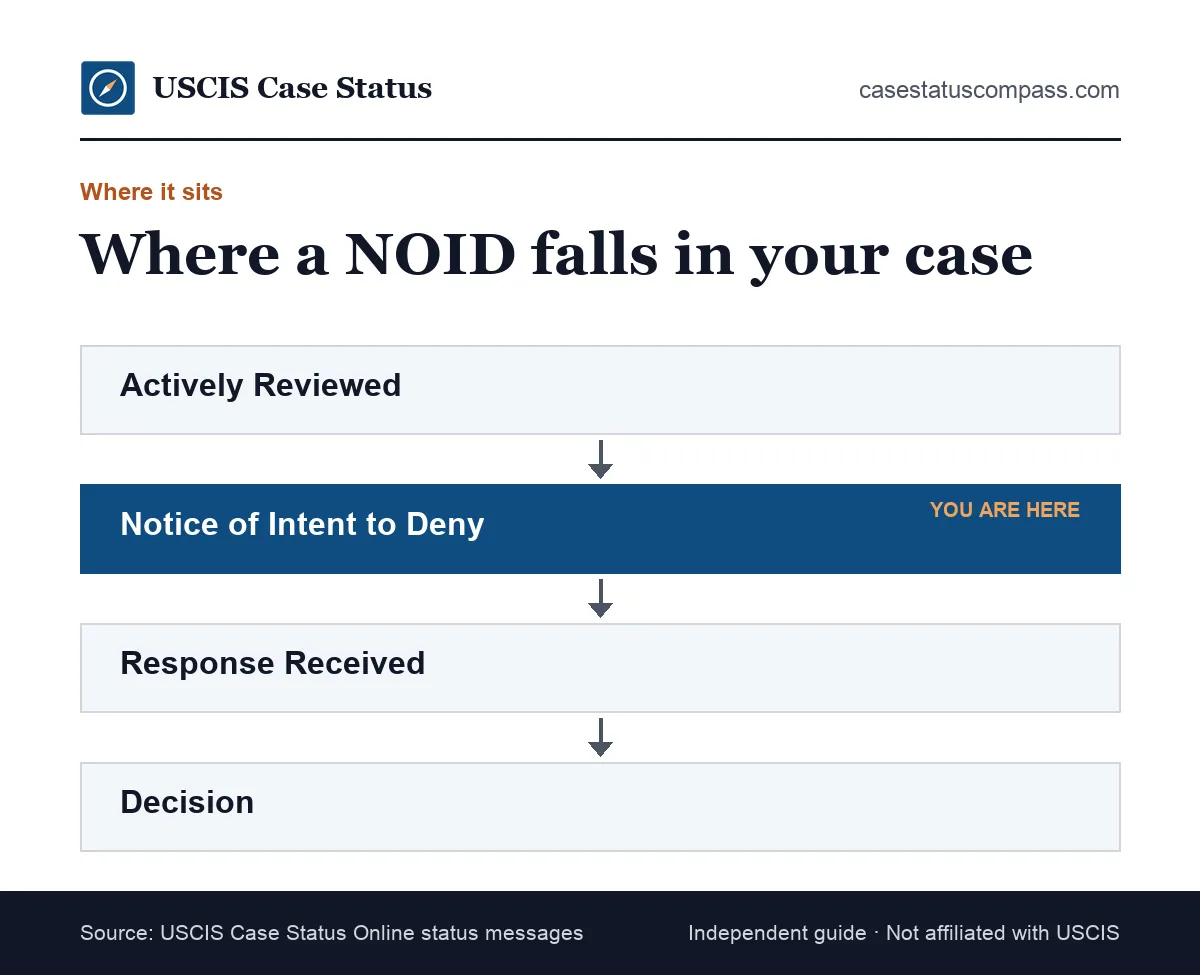
A notice of intent to deny is a written warning from U.S. Citizenship and Immigration Services (USCIS). It tells you the officer reviewing your case has found reasons to deny it, lists those reasons, and gives you one chance to answer before a decision.
What the letter usually contains
The USCIS Policy Manual says a NOID should name the unmet requirements, explain why the evidence falls short, describe adverse information, suggest helpful evidence and state the response date.
Which USCIS office issues it
The office holding your file issues it: a service center, the National Benefits Center, a field office or an asylum office. The letterhead names that office, and your reply goes to the address it gives, not to a general filing address.
How the NOID reaches you
It usually arrives by mail, and may also appear in a linked online account. See the uscis case help hub for other notices that can interrupt a case. Open every USCIS envelope the day it arrives.
What Does "Intent to Deny" Mean for Your Case?
Intent to deny means the officer has reached a preliminary conclusion against you, based on the record as it stands. The case is still open. The officer must consider your response before deciding. A reply that answers each stated reason with records can still change the result.
A preliminary finding, not a final one
Nothing has been decided, no appeal clock has started, and the notice itself does not change your status. Treat it as the officer's draft reasoning, which you can correct with proof.
Why USCIS warns you first
A NOID gives you fair notice before a decision that may be hard to undo. It matters most when the officer relies on information you may not know about. Use that warning to fill the gaps it names.
How Does a NOID Show Up in Your Case Status?
A NOID often appears online as a status saying a notice of intent to deny was sent, with the date it was issued. The status line never contains the reasons, so you need the full letter before you can plan a response.
What the online status tells you
The status shows no deadline either. Check it on Case Status Online: egov.uscis.gov with your receipt number. If it mentions a NOID and no letter has come, act fast: the clock is already running.
If the status says NOID but no letter came
- Check your USCIS online account for an uploaded copy.
- Confirm USCIS has your current address.
- Call the USCIS Contact Center at 800-375-5283 and ask for the notice to be resent.
- Note the date and the agent's details for your records.
NOID vs RFE: What Is the Difference?
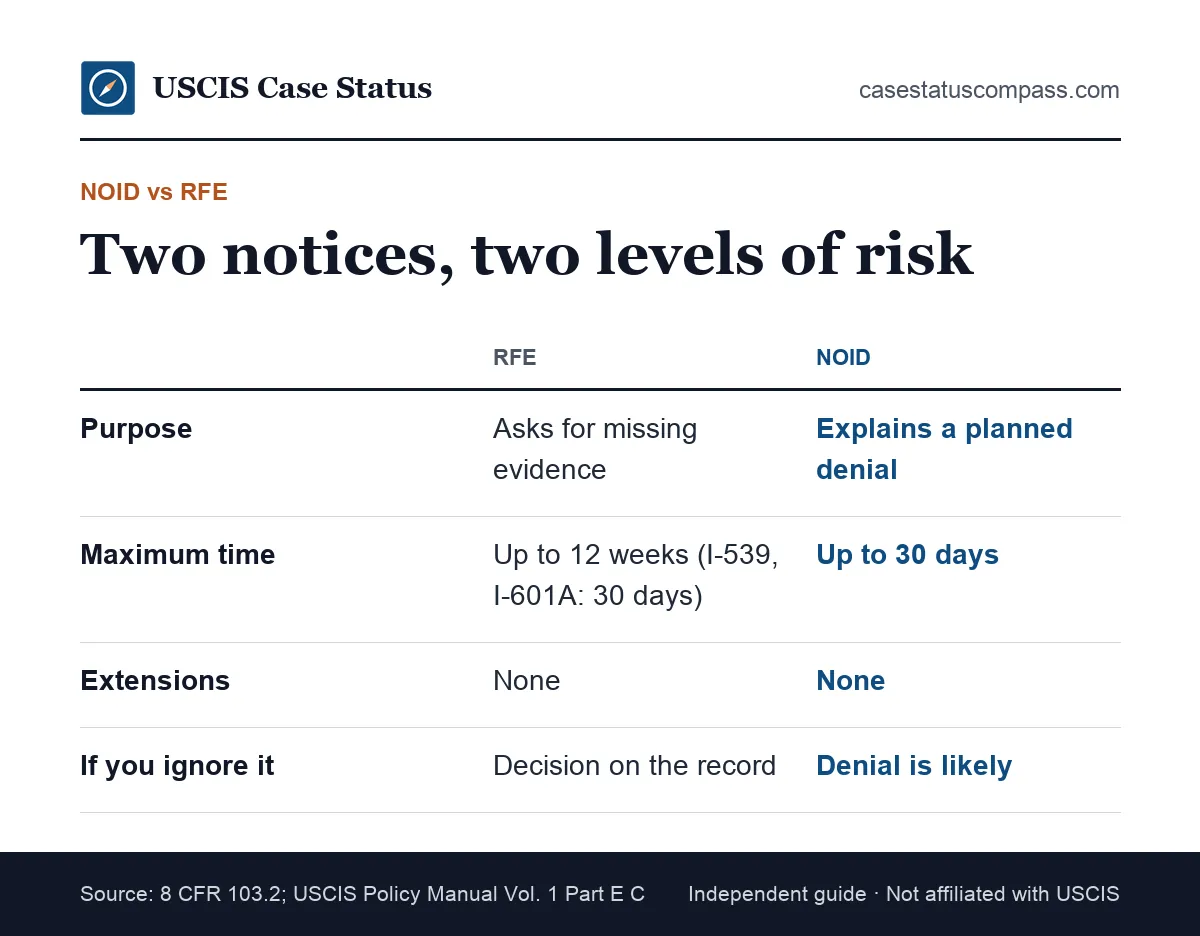
A request for evidence (RFE) asks for documents the officer needs to decide. A NOID says the officer already plans to deny and explains why. The RFE is a gap in the file; the NOID is a written case against you.
Side-by-side comparison
The table lines up the two notices on message, deadline, trigger and what happens if you stay silent.
| Feature | Request for Evidence (RFE) | Notice of Intent to Deny (NOID) |
|---|---|---|
| Main message | "We need more to decide." | "We plan to deny, and here is why." |
| Deadline | RFE deadline: up to 12 weeks (the exact date is on your RFE); no extensions; I-539 and I-601A: 30 days | NOID deadline: up to 30 days; no extensions |
| Typical trigger | Missing or weak evidence | Ineligibility, adverse information or discretion |
| Tone | Neutral request | Formal warning |
| If you do not reply | Decision on the record | Denial is very likely |
The shorter NOID window is the biggest practical difference. See rfe meaning and responses for the RFE side.
Can a Weak RFE Reply Lead to a Notice of Intent to Deny?
Officers sometimes send a NOID after an RFE reply that did not settle the issue. Read the two notices together: the gap between what was asked and what you sent is often the heart of the problem. Close that gap first.
NOID vs Denial and Other "Intent" Notices
A NOID comes before a decision; a denial notice is the decision. USCIS also uses related warnings, such as a notice of intent to revoke (NOIR) for an approved petition and a notice of intent to terminate (NOIT) for some statuses.
What Are a Notice of Intent to Revoke and a NOIT?
A NOIR says USCIS may take back something it already approved, such as a petition. A NOIT warns that a status or benefit may end. Both give reasons first, then a chance to respond, on the deadline printed on that notice.
What a denial notice looks like instead
A denial is a final written decision that states the reasons and usually whether a motion or appeal is possible. Our page on the case was denied status message explains the online wording.
Why Does USCIS Issue a Notice of Intent to Deny?
USCIS issues a notice of intent to deny when the record, as it stands, does not prove eligibility, when adverse information has surfaced, or when the officer plans to deny as a matter of discretion. The notice must explain those reasons.
Eligibility gaps the officer found
The most common trigger is a requirement the evidence does not prove: an unproven marriage, a sponsor below the income rules, or an employer that has not shown it can pay the offered wage.
What If a NOID Relies on Derogatory Information?
If USCIS plans to rely on derogatory information you are unaware of, the Policy Manual says it must first give you notice and a chance to rebut it. A site visit report, a database hit or a third-party statement can all count, though classified material may be withheld.
Can USCIS Intend to Deny as a Matter of Discretion?
Some benefits, such as adjustment of status, are discretionary. An officer may find you eligible yet lean toward denial after weighing negative factors. Answer with positive ones: family ties, work history, rehabilitation or hardship. Back each factor with documents, such as tax records or letters from employers.
Does USCIS Have to Send a NOID Before Denying?
Usually not. The USCIS Policy Manual gives officers discretion to deny: USCIS can deny without an RFE or NOID if there is no legal basis for approval or initial evidence is missing. A NOID is required only in limited situations, so getting one is a chance many applicants never get.
The general rule
Officers may deny outright when required initial evidence is missing or the request has no legal basis. A NOID suggests the officer thinks the right evidence or explanation could still matter.
When Is a NOID Mandatory Before a Denial?
The Policy Manual requires a NOID before denying some adoption filings (Forms I-800A and I-800) on mandatory grounds and certain physician I-485 cases tied to national interest waivers, and notice before relying on unseen derogatory information. Outside these, a NOID is the officer's choice.
Common NOID Reasons by Form
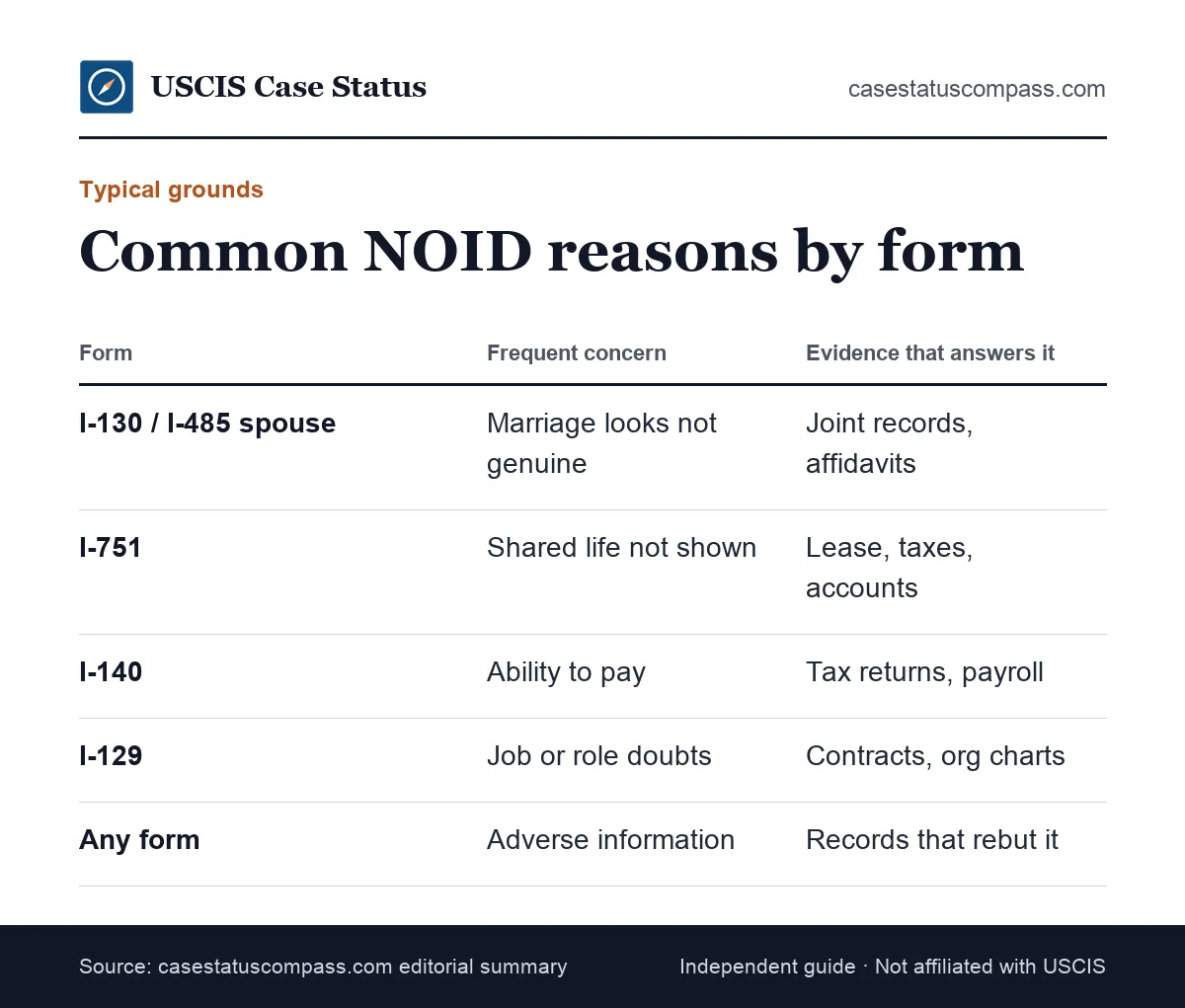
The grounds in a NOID depend on what the form must prove. Marriage cases focus on whether the relationship is real, employment cases on the job and the employer, and every form can draw a NOID over adverse records.
NOID grounds and helpful evidence by form
Each row pairs a form with a concern officers often raise and the kinds of evidence that tend to answer it.
| Form | Concern often raised | Evidence that tends to help |
|---|---|---|
| I-130 spouse petition | Marriage entered to get immigration benefits | Joint lease, shared bills, photos over time, affidavits |
| I-485 adjustment | Admissibility or discretion | Court records, waivers, proof of lawful entry |
| I-751 conditions | Shared life after the green card not shown | Taxes filed jointly, insurance, children's records |
| I-140 immigrant petition | Ability to pay or job requirements | Tax returns, payroll records, experience letters |
| I-129 work petition | Specialty role or employer relationship | Contracts, itineraries, organizational charts |
| I-129F fiancé petition | In-person meeting or intent to marry | Travel records, photos, messages |
Your own notice controls; use the table only to spot evidence you may have missed.
Family-based filings
Family cases test the relationship and the sponsor. Expect questions about a real marriage, a parent-child link or whether the sponsor meets the income rules. Our Form I-130 guide explains what the petition must prove.
Employment-based filings
Employer petitions draw NOIDs about wages, the job offer or the worker's experience. The employer leads the reply; the worker supplies proof of qualifications, such as degrees and experience letters.
NOIDs in Marriage-Based Green Card Cases
Marriage cases draw NOIDs when officers doubt the relationship is bona fide, meaning entered for love rather than immigration benefits. The concern often follows an interview where spouses' answers differed or a file that lacks joint records. A strong reply rebuilds the shared-life story with documents.
Bona fide marriage concerns
Officers look for a shared life: living together, mixed finances and being known as a couple. Joint bank and lease records and sworn statements from friends help. Our marriage green card page lists typical proof.
Interview answers that did not match
Address each conflicting answer directly, explain why it differed (an interpreter mix-up, for example) and back it with records. "We were nervous" rarely works alone. See our green card interview guide.
NOIDs in Employment Petitions
In employment cases, a NOID often questions the employer's ability to pay, whether the job really exists as described, or whether the worker meets the stated requirements. Because the employer is usually the petitioner, its records carry most of the weight.
Ability to pay and the job offer
For an I-140 petition, the officer may want proof the employer could pay the wage from the priority date onward: tax returns, audited financials or payroll records. Gaps for any year need an answer.
Does a NOID Stop the Premium Processing Clock?
Yes. If you paid for premium processing, the NOID pauses the guarantee. USCIS lists these timeframes: 15 business days (I-129, most I-140); 30 (I-765 OPT, I-539 F/M/J); 45 (I-140 E13 managers and NIW). See our premium processing guide. The NOID itself counts as USCIS's action within the window.
When the premium clock restarts
USCIS says an RFE or NOID stops the clock, and a new period starts when USCIS receives the response. Every day you hold the reply adds a day to the wait, so send it early.
How Long Do You Have to Respond to a NOID?
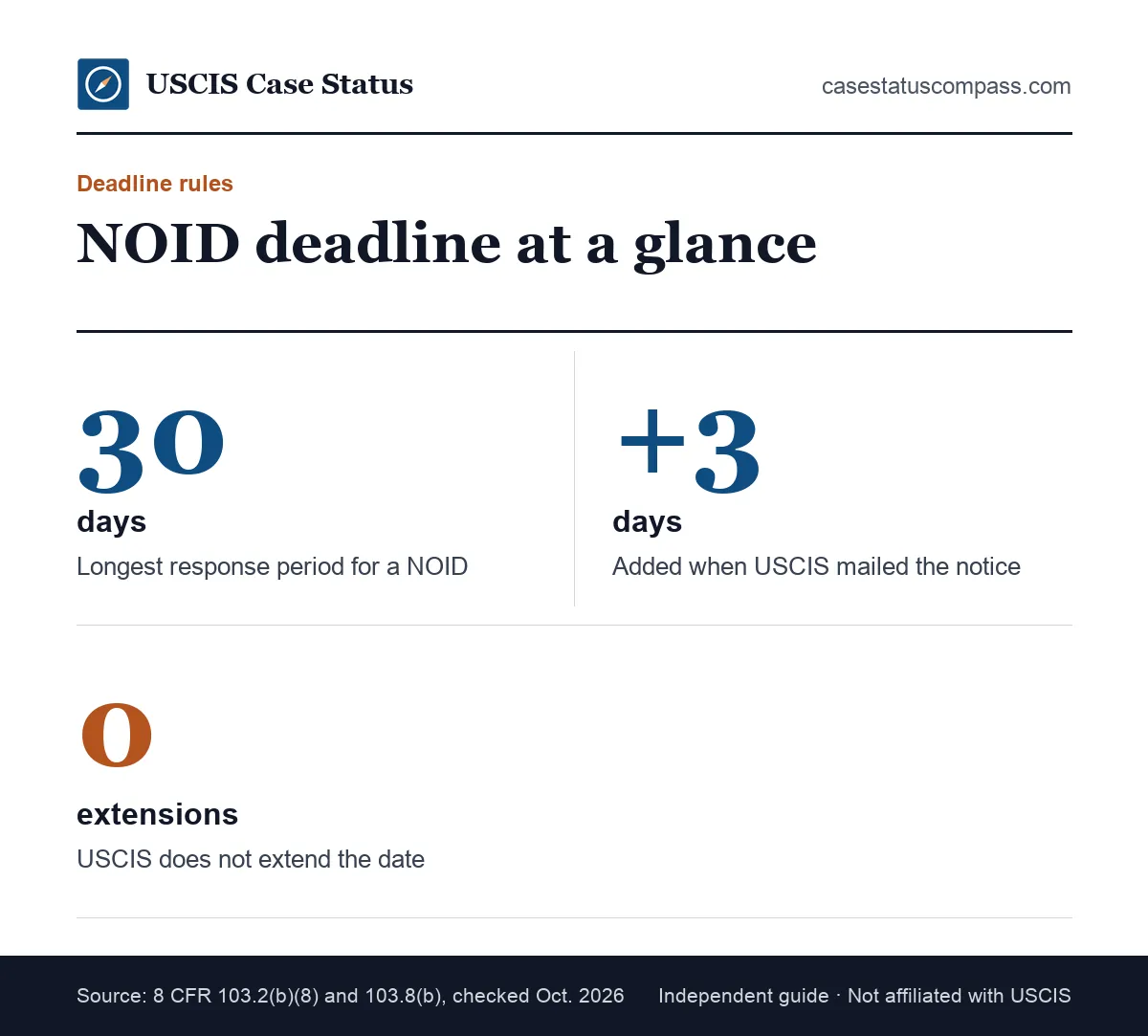
The response period for a NOID is short. Under 8 CFR 103.2, the rule is: NOID deadline: up to 30 days; no extensions. If USCIS mailed the notice, a separate rule applies: If USCIS mailed the notice, add 3 days to the deadline. Your exact date is printed on the notice, and that date controls.
The 30-day maximum
Thirty days is the outer limit, and some NOIDs give less. Find the "respond by" language, write that date on page one, and count from the notice date, not the day you opened it.
The extra 3 days for mail
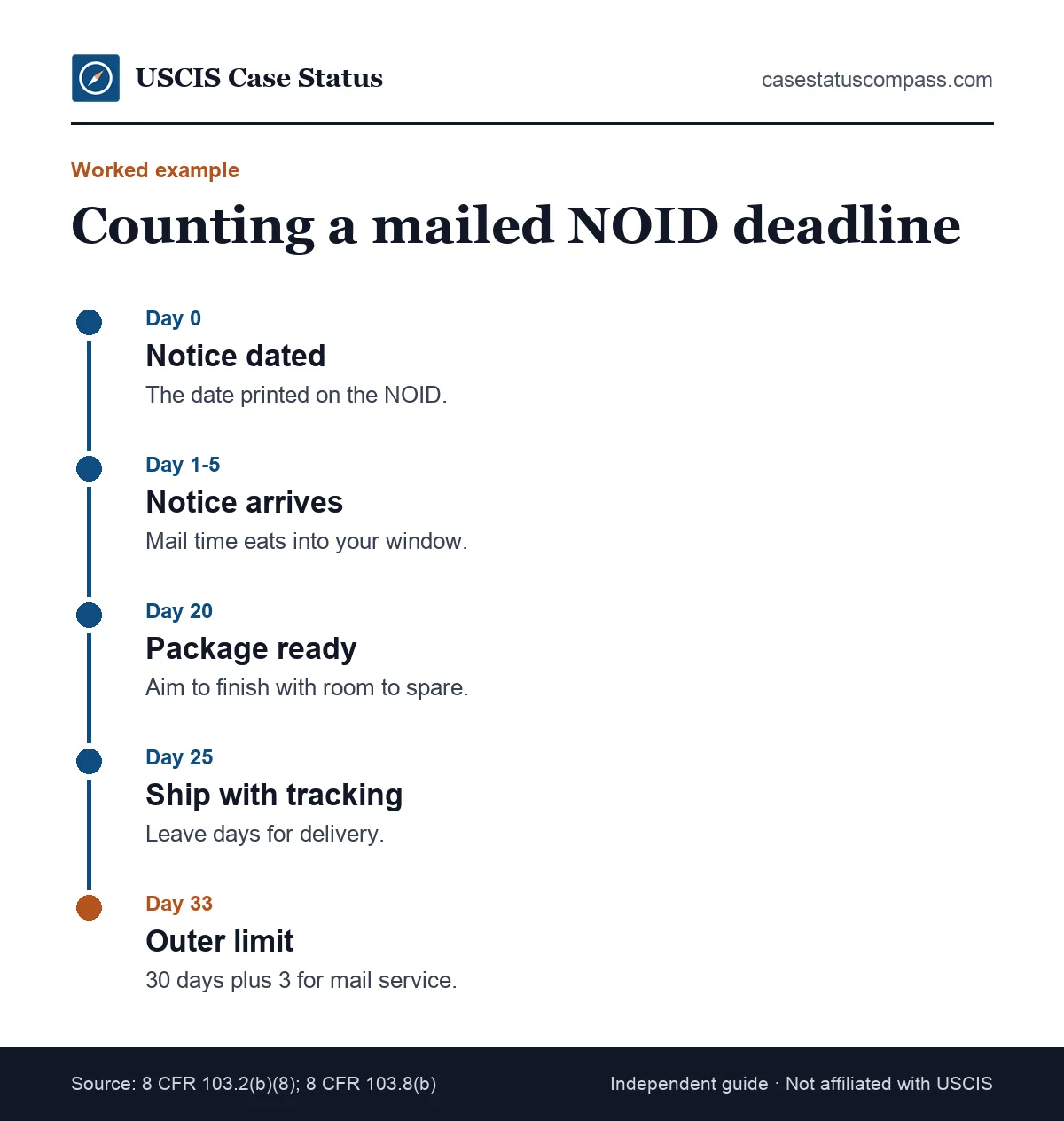
Under 8 CFR 103.8, mail service is complete on mailing, and 3 days are added. A 30-day NOID therefore runs to a maximum of 33 days from the mailing date.
How Do You Calculate Your NOID Deadline?
Start with the date printed on the notice. Add the number of days the NOID gives you, then add 3 days only if it was mailed. The result is the day USCIS must receive your response, not the day you post it. Build in delivery time.
Worked example with a mailed notice
A mailed NOID dated March 2 gives 30 days, to April 1. Adding 3 mail days makes April 4 the outer limit. If the letter takes five days to reach you, you have about four weeks, so ship by late March with tracking.
Notices uploaded to your online account
The Policy Manual says electronic service is complete on the day USCIS uploads the notice to your account, so the 3 mail days do not apply. Count from the upload date.
Can You Get an Extension on a NOID?
No. The regulations do not allow extensions for a NOID response. If a document cannot arrive in time, send what you have by the deadline, explain what is missing and why, and show the steps you took to get it.
Why asking for more time does not work
Agents cannot change the date, and a letter asking for more time is not a response. Spend those days gathering evidence instead, starting with the records that take longest to arrive.
When a record is truly out of reach
Foreign civil documents and court records can take weeks. Include proof you asked for them, the best secondary evidence you have and a sworn statement explaining the delay. Name the date you expect the record, if you know it.
What Happens If You Miss the NOID Deadline?
Under the Policy Manual, if you don't respond, USCIS can deny the case as abandoned, on the record, or both. Silence leaves the officer nothing new to weigh. You also lose the chance to answer before the decision. Mark the deadline the day the notice arrives.
Abandonment vs decision on the record
Abandonment treats you as having given up; a decision on the record uses only what is already in the file. Either way you get a denial notice, and USCIS fees are nonrefundable, even if your case is denied or withdrawn.
If you missed it already
Speak to an immigration attorney or DOJ-accredited representative now; a motion may be possible once the denial arrives. Our case denied help page covers the choices. Do not wait; motion deadlines are short.
How to Respond to a Notice of Intent to Deny
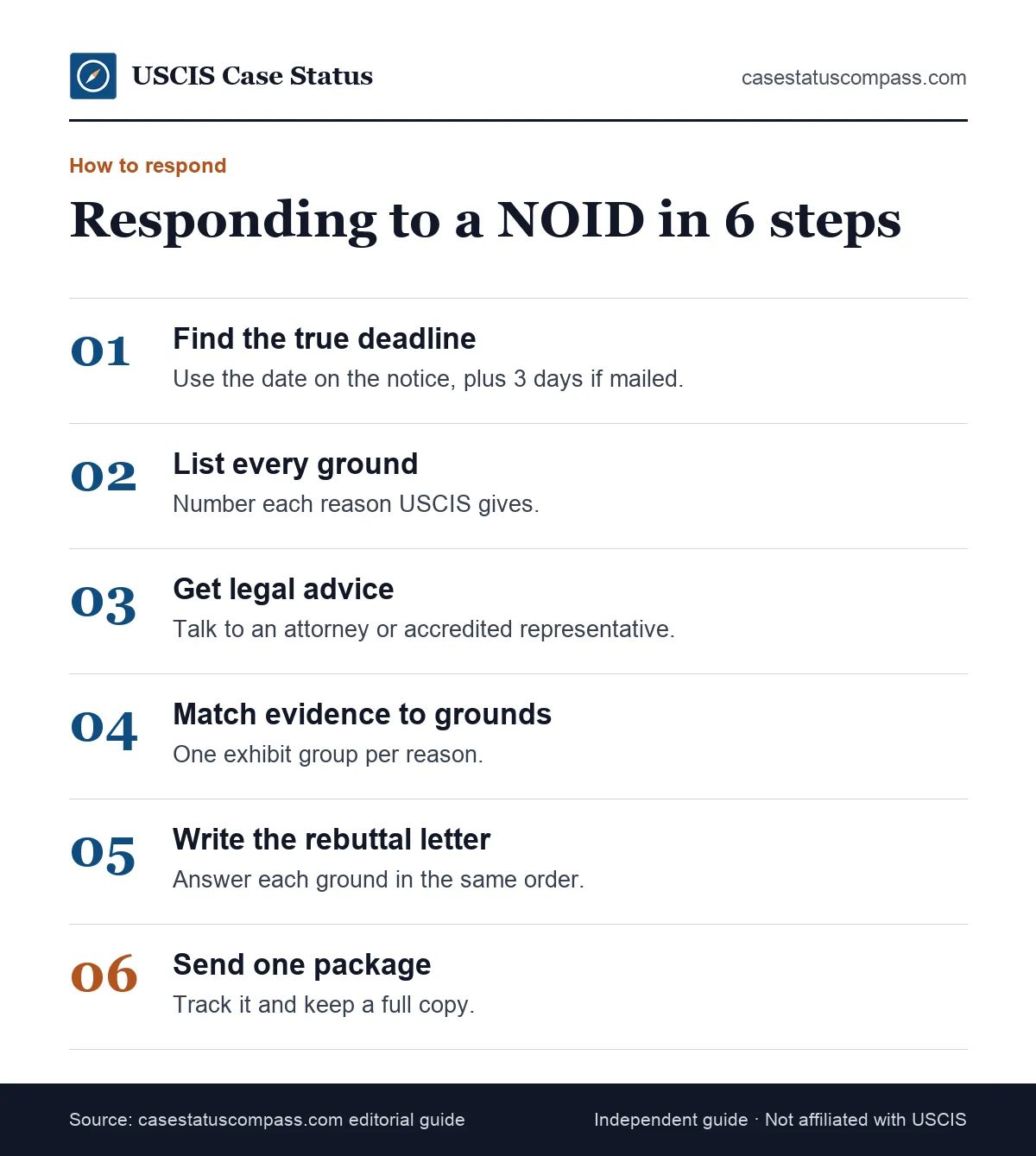
To respond to a notice of intent to deny, answer every ground in the order USCIS listed it, attach evidence for each one, and send a single complete package that arrives before the deadline. Good responses read like a point-by-point rebuttal, not a pile of documents.
The response in order
- Write the true deadline on the notice and on your calendar.
- Number each reason the officer gives.
- Book a consultation with a qualified legal adviser.
- Gather evidence for each numbered reason.
- Draft a letter that answers each reason in turn.
- Assemble, sign, copy and send one package with tracking.
Who signs and who sends
The applicant or petitioner signs their own statements. If a representative is on record with a Form G-28, they usually prepare and send the package. Never let anyone sign your name.
How Do You Read a NOID Line by Line?
Read the whole notice twice before collecting a single document. Underline every requirement it says is unmet, every fact it calls inconsistent and every piece of evidence it suggests. Those underlined phrases become your checklist of grounds, and each needs an answer.
Separate grounds from background
NOIDs often recite the case history first. The grounds usually follow phrases such as "the evidence does not establish." Copy each ground into a numbered list. Background facts need no answer unless they are wrong.
Note the evidence USCIS suggests
Suggested documents are a strong hint about what would persuade the officer. If you cannot supply one, say so and offer the closest substitute, explaining why it proves the same point.
How to Build a Point-by-Point Rebuttal
A rebuttal letter mirrors the NOID's structure. Under each numbered ground, restate the concern in one sentence, give your answer in plain words, and point to the exhibits that prove it. The officer should be able to check your reply against the notice, ground by ground.
A simple structure that works
- Ground 1: the concern in one line
- Response: your answer in two or three short paragraphs
- Evidence: "See Exhibits A-1 to A-6"
- Repeat for every ground, then add a brief closing request for approval.
Tone and length
Stay factual and polite, and skip emotional appeals. A clear page per ground beats ten pages of narrative. A lawyer may add a legal argument citing regulations. Short, plain sentences are easier for an officer to check.
What Evidence Works Best in a NOID Response?
The best evidence is specific, dated and from an independent source. Official records beat personal statements, and documents created at the time beat ones made for the case. Sworn statements help most when they support records rather than replace them.
Evidence strength at a glance
The table ranks common evidence types from strongest to supporting, with a tip for presenting each one.
| Evidence type | Strength | Tips |
|---|---|---|
| Government records (tax transcripts, court dispositions) | Strong | Request certified copies early |
| Bank, lease and insurance records | Strong | Show both names and a span of dates |
| Employer and payroll records | Strong | Match figures to tax filings |
| Photos and messages | Moderate | Label dates, places and people |
| Affidavits from others | Supporting | Include the writer's ID and contact details |
| Your own statement | Supporting | Explain gaps; do not just repeat claims |
Build each answer on the top rows, then use statements to explain them.
Primary records first
Lead with records issued by a government, bank, employer or school. Put a short exhibit index at the front so the officer can find each item quickly. Label every page with its exhibit number.
How Do You Make an Affidavit Count in a NOID Response?
An affidavit should give the writer's name, address, relationship to you, how they know the facts, and specific events with dates. Signed and sworn statements carry more weight than casual letters. Attach a copy of the writer's ID, and make sure every date matches your records.
Should You Send Everything at Once?
Yes. Send your whole response in one package. USCIS policy is to send every requested item in one response; a partial reply is treated as a request for a decision on the record. Plan the timeline so every exhibit is ready before shipping.
One complete package
Assemble everything you have, including proof of any pending requests, and send it together. If a key item arrives late, ask a lawyer how to handle it. Do not hold the whole package for it.
Why partial replies backfire
Officers may not hold your file open for a second mailing. Make the package as complete as possible and name anything still pending in the letter. A partial reply may be treated as your final word.
Cover Letter Template for a NOID Response
A one-page cover letter tells the mailroom and the officer what the package is. Below is an example only, with fictional details. Adapt it to your case; the instructions on your notice take priority over this template. Keep the letter to one page.
Copyable example
RE: Response to Notice of Intent to Deny Receipt Number: IOE0000000000 (example) Applicant: Jane Example | Form: I-485 | Notice dated: [date]
Dear Officer, Enclosed is my timely response to the Notice of Intent to Deny dated [date]. The response addresses each ground in the order listed in the notice:
- Ground 1 [short description], Exhibits A-1 to A-6
- Ground 2 [short description], Exhibits B-1 to B-4 I respectfully request that USCIS approve my application. Sincerely, [signature, printed name, date]
Adapting it safely
Replace every bracket and the example receipt number, and list grounds in the same order as the notice. Never state facts you cannot prove; a false statement is a bigger problem than the NOID.
NOID Response Checklist
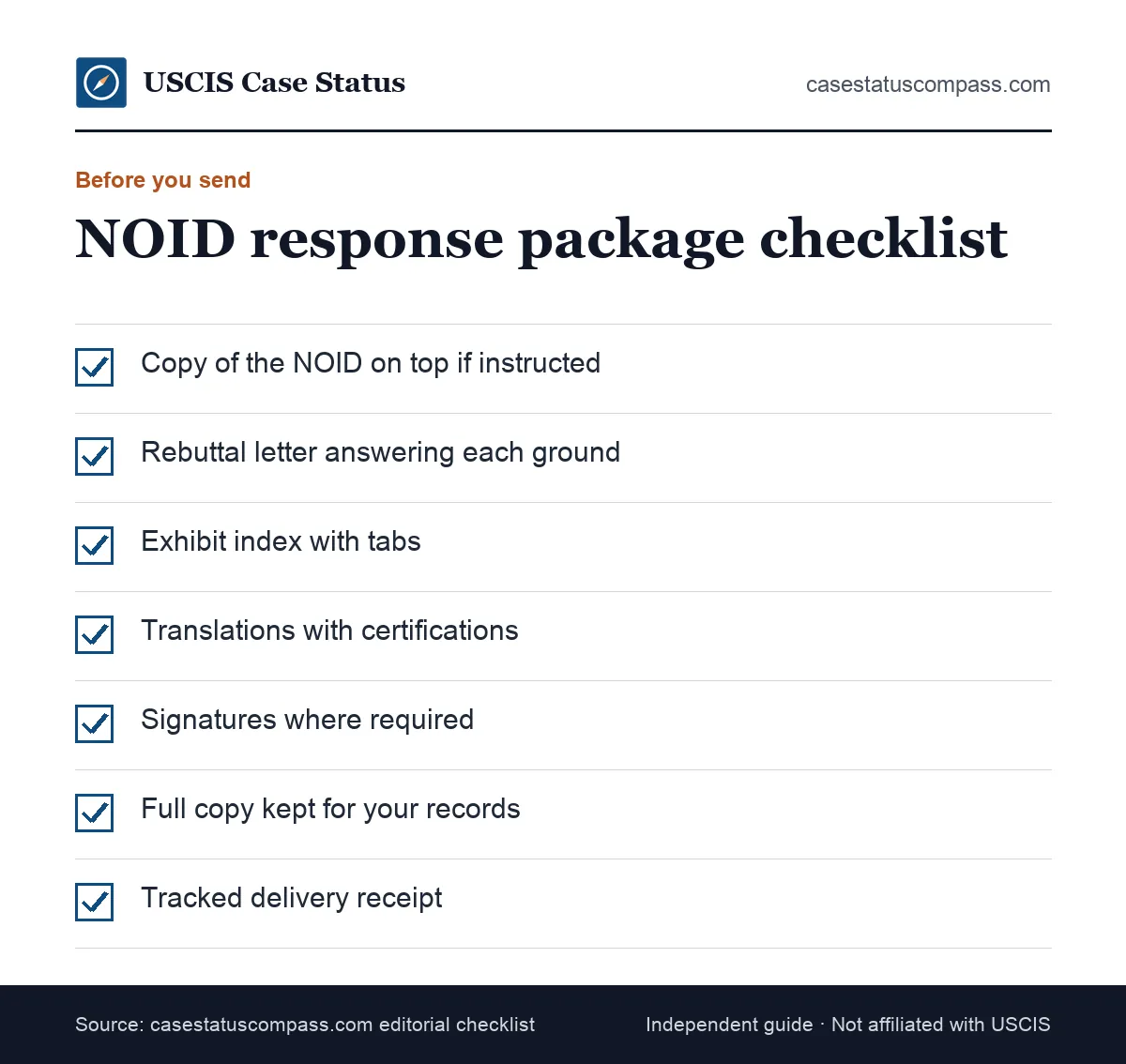
Run this checklist the day before you ship. It catches what sinks strong replies: a missing signature, an untranslated record or no copy kept. Tick each box only after checking the actual item, not your memory of packing it. If anything is missing, fix it before you book delivery.
Package contents
- Copy of the NOID, placed on top if the notice tells you to
- One-page cover letter
- Rebuttal letter answering every numbered ground
- Exhibit index with tabs or labels
- Certified English translations of foreign-language documents
- Signatures and dates where required
Before it leaves your hands
These last checks protect you if the package goes missing:
- Full copy scanned and saved
- Mailing address checked against the notice
- Tracked delivery booked with time to spare
- Deadline, tracking number and shipping date written in your case log
How Do You Submit a NOID Response?
Send the response exactly as the notice instructs: to the address it gives, or through your online account if it allows upload. Do not use a general filing address from a form page. The notice's own instructions override anything you read elsewhere, including this page.
Paper responses
Use a service with tracking and proof of delivery. USCIS changed many filing addresses in 2026 (New USCIS mailing addresses from Oct. 7, 2026; old addresses accepted if postmarked by Nov. 9, 2026), so follow the address on the notice.
If USCIS cannot find your reply
Your delivery proof protects you if the reply is lost in the mailroom. Keep it with your copy of the package; our contact USCIS guide explains how to raise a missing response.
Online responses
If the notice allows an upload in your online account, use clear scans and save the confirmation screen. Online submission removes mail time. Check that every file opened correctly before you submit.
"If X, Do Y": NOID Decision Table
Different situations call for different first moves. If more than one row fits, deal with the closest deadline first and get legal advice on the rest. The table is planning help, not legal advice; a fraud or criminal ground always calls for a lawyer first.
Situations and first moves
Find the row that matches your situation and take the first step in the right column.
| If this is your situation | Do this first |
|---|---|
| The status shows a NOID but no letter arrived | Check your online account; call USCIS to resend |
| The NOID cites adverse information you have never seen | Get an attorney; request records if advised |
| A document will not arrive before the deadline | Send everything else plus proof of your request |
| You moved after filing | Update your address today, then respond |
| The NOID followed an RFE reply | Compare both notices and fix the gap |
| You paid for premium processing | Respond fast; the guarantee restarts on receipt |
| The deadline has already passed | See a lawyer about options after the decision |
| The NOID concerns a marriage interview | Address each mismatch with records |
After that first step, the full response steps above still apply.
Choosing your row
Pick the row with your biggest risk. Adverse information calls for legal help before you write anything. A missing document calls for proof of your request, and a move calls for an address update before anything else.
Should You Hire a Lawyer for a NOID?
In most cases, yes. A NOID means an officer has already built reasons to deny, and a reply often needs both evidence and legal argument. An immigration attorney or a DOJ-accredited representative can spot issues you may miss, such as a waiver you need or a fact that creates new risk.
Signs you need help urgently
- The NOID mentions fraud, misrepresentation or criminal records.
- You are in the U.S. and may lose status if denied.
- The concern involves admissibility or a waiver.
- You do not understand the legal basis given.
Finding qualified help
Use a licensed attorney or a DOJ-recognized organization. Avoid "notarios" not authorized to give immigration legal advice. Check the Justice Department's roster of recognized organizations before paying anyone.
Mistakes That Weaken a NOID Response
The most common mistakes are answering only part of the notice, sending late, and adding new statements that clash with the existing file. A careful final review catches most of them before the package ships. Ask a second person to read it against the notice.
Skipping a ground
If the notice lists three concerns and you answer two, the third stands. Give every ground its own heading and exhibits, even one that seems minor. Officers decide on every ground they listed.
Creating new inconsistencies
Check every date, address and name against your forms and interview. A clash can become a credibility problem. If the original filing was wrong, say so and correct it. Hiding a known mistake can turn a fixable error into a misrepresentation finding.
Leaving no delivery buffer
Shipping on the last allowed day assumes nothing goes wrong in transit. USCIS must receive the reply by the deadline, so a weather or courier delay can turn a strong response into a late one.
What Happens After You Respond?
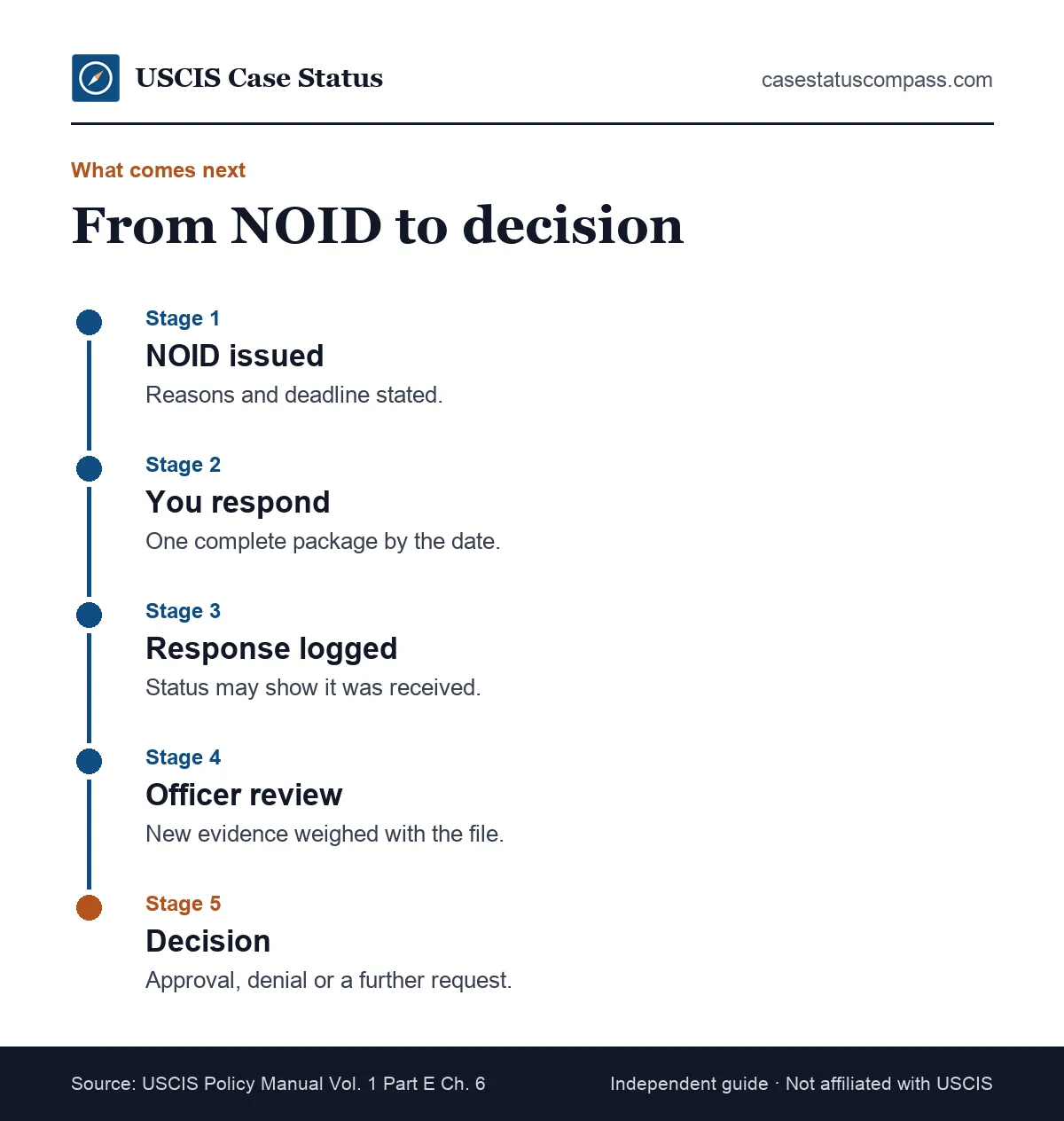
USCIS logs your response, adds it to the file and returns the case to an officer. The officer weighs the new evidence against the stated grounds and then approves, denies or, sometimes, asks for something more. USCIS does not publish a set timeframe for this step.
Status changes to expect
Your status may show the response was received, then go quiet during review. If months pass, our guide to a uscis case status not updating explains how to check whether the case is overdue.
Possible outcomes
- Approval: the evidence resolved the grounds.
- Denial: at least one ground was not overcome.
- Another request: the officer asks about a related point.
- Interview: some offices schedule an interview to clarify facts.
Can a Case Be Approved After a NOID?
Yes. Many cases are approved after a NOID when the response answers every ground with solid evidence. The notice signals serious doubt, not a fixed outcome. Your chances depend on whether the problem is fixable: missing proof can be supplied, but a legal bar usually cannot be argued away.
What tends to tilt the outcome
Strong responses address every ground, rely on independent records and explain inconsistencies honestly. Where the issue is legal, legal analysis beats extra documents. Weak replies simply repeat the original filing and leave the officer's doubts in place.
Realistic expectations
If the NOID cites a statutory bar the law does not let USCIS waive, more evidence may not help. An attorney can say whether a waiver or a different strategy fits better.
What Are Your Options If Your Case Is Denied After a NOID?
If USCIS denies after a NOID, you may be able to file a motion to reopen or reconsider, file an appeal for forms that allow it, or refile when your eligibility is clear. USCIS states the timing rule: Appeal or motion: file within 30 days (33 if the decision was mailed). Act quickly.
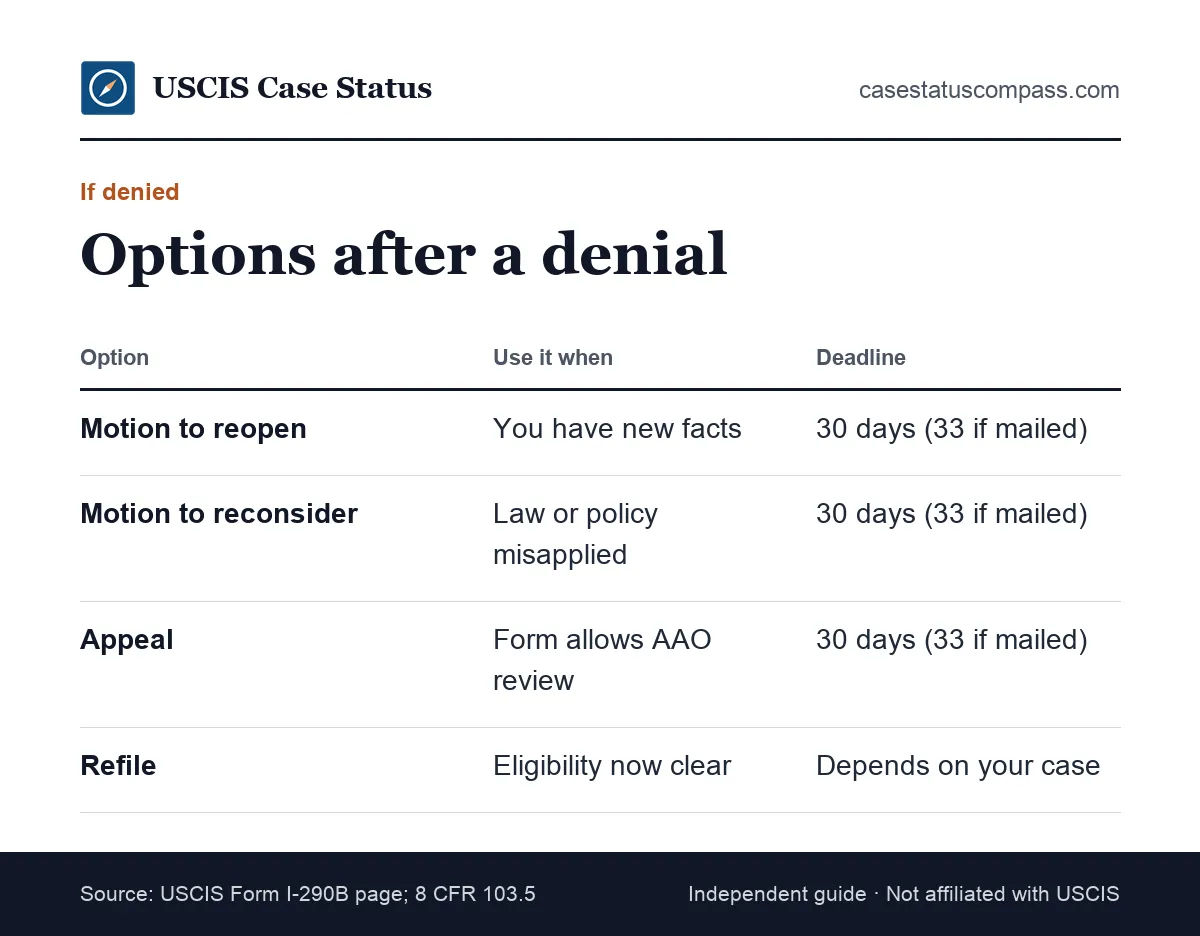
Motion to reopen vs motion to reconsider
USCIS explains the difference: Reopen = new facts and evidence; reconsider = the decision got the law or policy wrong. Pick the motion that matches why you think the denial was wrong.
Filing Form I-290B
Motions and appeals are filed on Form I-290B. The fee is $800 (some humanitarian categories $0; fee waiver possible). Our guide to a motion to reopen or appeal walks through each path.
Refiling instead
A new filing with stronger evidence can be cleaner than a motion, but costs a new fee. Decide with an attorney before the 30-day window closes. Refiling makes sense only if the gap is fixed.
Can a NOID Lead to Removal Proceedings?
A NOID alone does not start removal proceedings. But if the case is later denied and you have no other lawful status, USCIS may issue a Notice to Appear (NTA), which sends the case to immigration court. Ask an attorney early about that risk.
Who is most at risk
People whose only basis for staying is the pending case, such as an out-of-status adjustment applicant, face the most risk. A separate valid status lowers it, though status gaps can arise.
If you receive a Notice to Appear
An NTA moves the matter to the Executive Office for Immigration Review (EOIR). Our page on immigration court case status explains how to track a court case. Get a lawyer before the first hearing.
Address Changes and Missed NOIDs
A NOID mailed to an old address still counts as served once it is mailed. The rule: Report a new address to USCIS within 10 days of moving (INA 265). Updating online is fastest. A missed NOID can mean a denial you never saw coming.
Updating your address correctly
USCIS explains: Update your address online in your USCIS account (E-COA); a mailed AR-11 also counts. A post office forwarding order does not update USCIS. Our uscis change of address guide shows how to update every pending case.
If a NOID went to your old address
Contact USCIS right away for a copy and keep proof of when you learned of it. The sooner you act, the more of the response window you keep. Ask the agent to confirm the deadline in USCIS's system.
Contacting USCIS About a NOID
USCIS can resend a notice, confirm the deadline in its system or log a response it cannot find. It cannot discuss the merits of the NOID or extend the deadline. Use the Contact Center for these practical questions, and keep your receipt number ready.
Contact Center phone and hours
The Contact Center number is 800-375-5283 (TTY: 800-767-1833). Live calls and chat: Monday to Friday, 8 a.m. to 8 p.m. Eastern. Have the NOID date and your receipt number ready, and note the agent's name and the call date.
e-Request for a missing or mistyped NOID
For notice typos or missing mail, USCIS lists: e-Request: report USCIS typos, missing notices or accommodation needs online. Use it when the status shows a NOID that never reached you.
Which office has your file
The NOID's letterhead shows the issuing office. Our uscis service centers page explains what each center handles, and your receipt number prefix often hints at where the case started.
Three NOID Scenarios and What Each Person Did
These fictional examples show how different grounds call for different responses. They illustrate approach, not likely results, and do not replace advice on your own facts. In each one, the reply matched a specific document to each ground the officer named.
Scenario: a spouse case after a tense interview
Maria and Daniel gave different wedding dates at the interview. Their reply sent the certificate, the venue invoice and sworn statements: one had named the civil ceremony, the other the religious one. Each point matched a document.
Scenario: an employer facing an ability-to-pay ground
A small company's I-140 drew a NOID over a net loss on its tax return. Its attorney sent payroll records showing the wage was already being paid, for the exact year questioned.
Scenario: a conditional resident with thin joint records
Amir's I-751 NOID found no shared life shown. He sent joint tax transcripts, a lease renewal and a joint car loan. Our Form I-751 guide lists expected evidence. Each record covered the period after the green card.
Scenario: an old arrest in a background check
Lena's I-485 NOID cited an arrest record she thought was sealed. Her attorney obtained the certified court disposition showing dismissal and explained it in a short statement, matching the ground word for word.
What Records Should You Keep After a NOID?
Keep a complete, organized copy of everything tied to the NOID for as long as the case and any later filings are open. You may need it for a motion, a future application, a naturalization filing or a court case. A digital and paper copy together is safest.
The core file
Store these four items together, in paper and digital form, for as long as any related case is open:
- The NOID and any earlier RFE
- Your full response with exhibits
- Delivery proof and tracking
- Any decision notice that follows
Why it matters later
A later N-400 or renewal may raise the same questions. Your old response lets you answer consistently, and any new form should match what you said. An officer reviewing a later case may read the earlier file.
NOID Essentials to Remember
A NOID is serious but answerable. Know your exact deadline, answer every ground with real evidence, send one complete package with tracking and get qualified legal help. The points below sum up what matters for each side of the case.
For applicants
If you filed the case yourself, focus on these rules:
- Count from the notice date; add 3 days only if mailed.
- Never let a ground go unanswered.
- Do not ask for an extension; none is available.
For petitioners and employers
- Lead with your own records: tax filings, payroll, contracts.
- Coordinate with the beneficiary so facts match.
- If premium processing applies, respond early to restart the clock.
Frequently Asked Questions
What does NOID stand for?
NOID stands for Notice of Intent to Deny. USCIS sends it when an officer plans to deny an application or petition but first gives you a chance to respond. It lists the reasons and a response date of up to 30 days, plus 3 days if mailed.
Is a NOID worse than an RFE?
Generally, yes. An RFE asks for evidence the officer needs; a NOID says the officer will deny unless you change their mind. The NOID deadline is up to 30 days, against up to 12 weeks for most RFEs.
Can I respond to a NOID without a lawyer?
You can, and USCIS will consider it. An immigration attorney or DOJ-accredited representative can still spot legal issues, waivers and risks you may miss. If the NOID mentions fraud, criminal history or admissibility, professional help is strongly recommended.
Does a NOID mean USCIS suspects fraud?
Not necessarily. Many NOIDs concern ordinary evidence gaps, such as missing joint records or unclear tax figures. If any ground uses words like fraud, misrepresentation or false statement, talk to an immigration attorney before you send anything to USCIS.
Will USCIS interview me after a NOID?
Sometimes. Most NOID responses are decided on paper, but an officer may schedule an interview, or a second one, to clarify facts. If one is scheduled, bring originals of the documents you sent.
Can I withdraw my application after a NOID?
Yes, you can ask USCIS to withdraw the filing instead of responding, but the fee is not returned and a withdrawal can affect later filings or your status. Talk to an immigration attorney before choosing that route over a response.
Does intent to deny mean my status ends now?
No. The notice itself does not change your status or work authorization. Your situation changes only if a final denial follows, so keep following your current status rules.
How do I know USCIS received my NOID response?
Check your delivery confirmation first; your online status may also show the response was received. If weeks pass with no sign of receipt, contact USCIS with your receipt number and tracking details.
Sources
- USCIS Policy Manual, Volume 1, Part E, Chapter 6: Evidence (RFEs and NOIDs). www.uscis.gov/policy-manual/volume-1-part-e-chapter-6. Accessed Oct 27, 2026.
- 8 CFR 103.2: Submission and adjudication of benefit requests. www.law.cornell.edu/cfr/text/8/103.2. Accessed Oct 27, 2026.
- 8 CFR 103.8: Service of decisions and other notices. www.law.cornell.edu/cfr/text/8/103.8. Accessed Oct 27, 2026.
- 8 CFR 103.5: Reopening or reconsideration. www.law.cornell.edu/cfr/text/8/103.5. Accessed Oct 27, 2026.
- USCIS: Form I-290B, Notice of Appeal or Motion. www.uscis.gov/i-290b. Accessed Oct 27, 2026.
- USCIS: How Do I Request Premium Processing?. www.uscis.gov/forms/all-forms/how-do-i-request-premium-processing. Accessed Oct 27, 2026.
- USCIS: Change of Address. www.uscis.gov/addresschange. Accessed Oct 27, 2026.
- USCIS Contact Center. www.uscis.gov/contactcenter. Accessed Oct 27, 2026.
- USCIS: Filing Fees. www.uscis.gov/forms/filing-fees. Accessed Oct 27, 2026.
- USCIS: Checking Your Case Status Online. www.uscis.gov/tools/checking-your-case-status-online. Accessed Oct 27, 2026.
- USCIS: Filing Locations and Online Filing Options Updates. www.uscis.gov/forms/us-citizenship-and-immigration-services-filing-locations-and-online-filing-options-updates. Accessed Oct 27, 2026.
- USCIS Form G-1055 Fee Schedule, Edition 10/16/26. www.uscis.gov/sites/default/files/document/forms/g-1055.pdf. Accessed Oct 27, 2026.
casestatuscompass.com is an independent publication and is not affiliated with USCIS or any government agency. This page is general information, not legal advice. For denials, court or asylum matters, consult an immigration attorney or a DOJ-accredited representative.