Contents · 39 sections
- What Is Form I-140?
- Is the I-140 an Immigrant Petition?
- Who Files Form I-140?
- EB-1 Petitions: Extraordinary Ability, Researchers and Managers
- EB-2 and the National Interest Waiver
- EB-3 Skilled Workers, Professionals and Other Workers
- Which I-140 Categories Need PERM?
- From PERM to I-140: How the Two Cases Connect
- Why Does the PERM Green Card Path Have Two Case Numbers?
- How Do You File Form I-140?
- What Documents Do You Need for Form I-140?
- Where Do You File Form I-140? (I-140 Filing Address)
- Where Can You Get the Form I-140 PDF and Instructions?
- How Much Does the I-140 Cost in 2026?
- Can Form I-140 Be Premium Processed?
- How Do You Upgrade a Pending I-140 to Premium Processing?
- Can You File the I-140 With Form I-485?
- How Do You Track Your I-140?
- I-140 Case Status Sequence: Receipt to Decision
- What Does an I-140 RFE Usually Ask For?
- Form I-140 Approved: What Comes Next?
- I-140 Approved While You Are in Your Home Country
- What Is a Priority Date on an I-140?
- Can You Keep Your Priority Date After an I-140 Approval?
- Is an Approved I-140 a Green Card?
- I-140 Processing Time: Summary and Where to Check
- What Can You Do If Your I-140 Is Denied?
- Can an Employer Withdraw an Approved I-140?
- What Happens to Your I-140 If You Change Jobs?
- How Does an Approved I-140 Help H-1B Workers?
- Can You Search NIW Case Approvals?
- Form I-140 vs Form I-130: Two Immigrant Petitions
- Common I-140 Petition Problems
- Mistakes to Avoid With Your I-140
- Does an I-140 Cover Your Spouse and Children?
- Real-World I-140 Scenarios
- If-Then Guide for Your I-140
- When Is an I-140 Case Worth Independent Legal Advice?
- Frequently Asked Questions
The short answer
Form I-140, Immigrant Petition for Alien Workers, is the USCIS form that asks to classify a foreign worker in an employment-based green card category: EB-1, EB-2 or EB-3. An employer usually files it after a certified PERM, though some workers can self-petition. Approval sets your place in line but is not a green card.
At a glance
| Agency | USCIS (the PERM step before it is run by the Department of Labor) |
| Current edition | 06/07/24 |
| Fee (as of October 2026) | $715 (paper) / $665 (online) + Asylum Program Fee $600 ($300 small employer or self-petitioner; $0 nonprofit) |
| Who files | The employer, or the worker in EB-1A and EB-2 NIW cases |
| How to track | Receipt number on Case Status Online: egov.uscis.gov |
What Is Form I-140?
Form I-140 is the petition USCIS uses to decide whether a foreign worker qualifies for an employment-based immigrant category. It is the bridge between a job offer, or proven ability, and a green card. The form itself grants no status; it establishes the category and the priority date.
EB-1, EB-2, EB-3
The I-140 petition covers three preference groups. EB-1 is for people with extraordinary ability, outstanding researchers and multinational managers. EB-2 is for advanced-degree professionals and people of exceptional ability. EB-3 covers skilled workers, professionals and other workers.
National Interest Waiver (NIW)
The National Interest Waiver is an EB-2 option that waives the job offer and the PERM requirement. You file for yourself and must show your work has substantial merit and national importance, and that waiving the usual rules benefits the United States.
What "I-140" means in plain words
When people say "my I-140," they mean the immigrant visa petition on their behalf. Think of it as USCIS confirming you fit a job-based category. The actual green card comes later, through Form I-485 or an immigrant visa.
Is the I-140 an Immigrant Petition?
Yes. The I-140 is an immigrant petition: it supports permanent residence, not a temporary visa. That separates it from Form I-129, which covers temporary workers such as H-1B. Approval makes you the beneficiary of an immigrant category, waiting for a visa number.
Immigrant vs nonimmigrant petitions
Nonimmigrant petitions, such as an H-1B on Form I-129, let you work for a set period. An I-140 visa petition looks toward a permanent stay. Many workers have both at once: an H-1B for today and an I-140 for the future.
Petition vs application
A petition asks USCIS to recognize a category for someone. An application asks for a benefit for yourself. The I-140 is a petition; Form I-485 is the application that turns it into a green card.
Who Files Form I-140?
A U.S. employer files most I-140 petitions for a named worker. Two groups can file for themselves: EB-1A extraordinary-ability applicants and EB-2 NIW applicants. Either way, the worker is called the beneficiary, and the filer is the petitioner. The filer controls the notices.
Employer-sponsored petitions
In EB-2 and EB-3 cases with PERM, the employer is the petitioner. It signs the form, proves it can pay the offered wage and receives USCIS notices. Most employers use an immigration attorney, who files Form G-28 to appear on the case.
Self-petitioners
Self-petition filers sign as both petitioner and beneficiary. USCIS's I-140 page gives them specific instructions, such as answers in Part 1 that differ from employer filings. They need no employer and no labor certification.
EB-1 Petitions: Extraordinary Ability, Researchers and Managers
EB-1 is the first employment-based preference and needs no PERM. It has three parts: extraordinary ability (EB-1A), outstanding professors and researchers (EB-1B) and multinational managers or executives (EB-1C). Only EB-1A allows a self-petition. All three skip the labor market test, so the evidence in the petition itself carries the whole case. Each part has its own proof standard in the instructions.
EB-1A: extraordinary ability
EB-1A suits people at the top of their field in science, arts, education, business or athletics. Evidence often includes major awards, published work about you, judging others' work and high pay. No job offer is required.
EB-1B and EB-1C: employer-filed
EB-1B needs a qualifying employer offer for a research or teaching role. EB-1C is for managers or executives transferred by a multinational company. Both are filed by the employer without labor certification.
EB-2 and the National Interest Waiver
EB-2 covers professionals with an advanced degree, or its equivalent, and people of exceptional ability. Most EB-2 cases need a certified PERM and a job offer. The EB-2 NIW route removes both, but the evidence must show national importance. Both routes share one visa line.
EB-2 with PERM
The employer completes PERM, then files the I-140 with the certified labor certification. USCIS checks that you held the required degree and experience by the priority date. Experience gained after that date does not count, so gather proof dated before the PERM filing.
EB-2 NIW evidence
NIW petitions rely on a detailed plan, letters from experts, publications or projects, and proof you are well placed to advance the work. A strong cover letter that ties each document to the standard helps the officer.
EB-3 Skilled Workers, Professionals and Other Workers
EB-3 is for skilled workers whose jobs need training or experience, professionals with a bachelor's degree, and other workers in jobs needing less training. Every EB-3 case requires a job offer and a certified PERM before the I-140. No self-petition exists.
Skilled workers and professionals
These subgroups need proof of the required training, experience or degree. Experience letters must list your title, duties and dates, and match the requirements on the labor certification. Professionals also need a U.S. bachelor's degree or a foreign equivalent with an evaluation.
Other workers
The other-workers subgroup covers jobs that need less training or experience than skilled roles. It often has a separate, longer wait in the visa bulletin than skilled workers. In November 2026, the Final Action Date for other workers is June 1, 2022 for most countries, against June 15, 2024 for skilled workers and professionals.
Which I-140 Categories Need PERM?
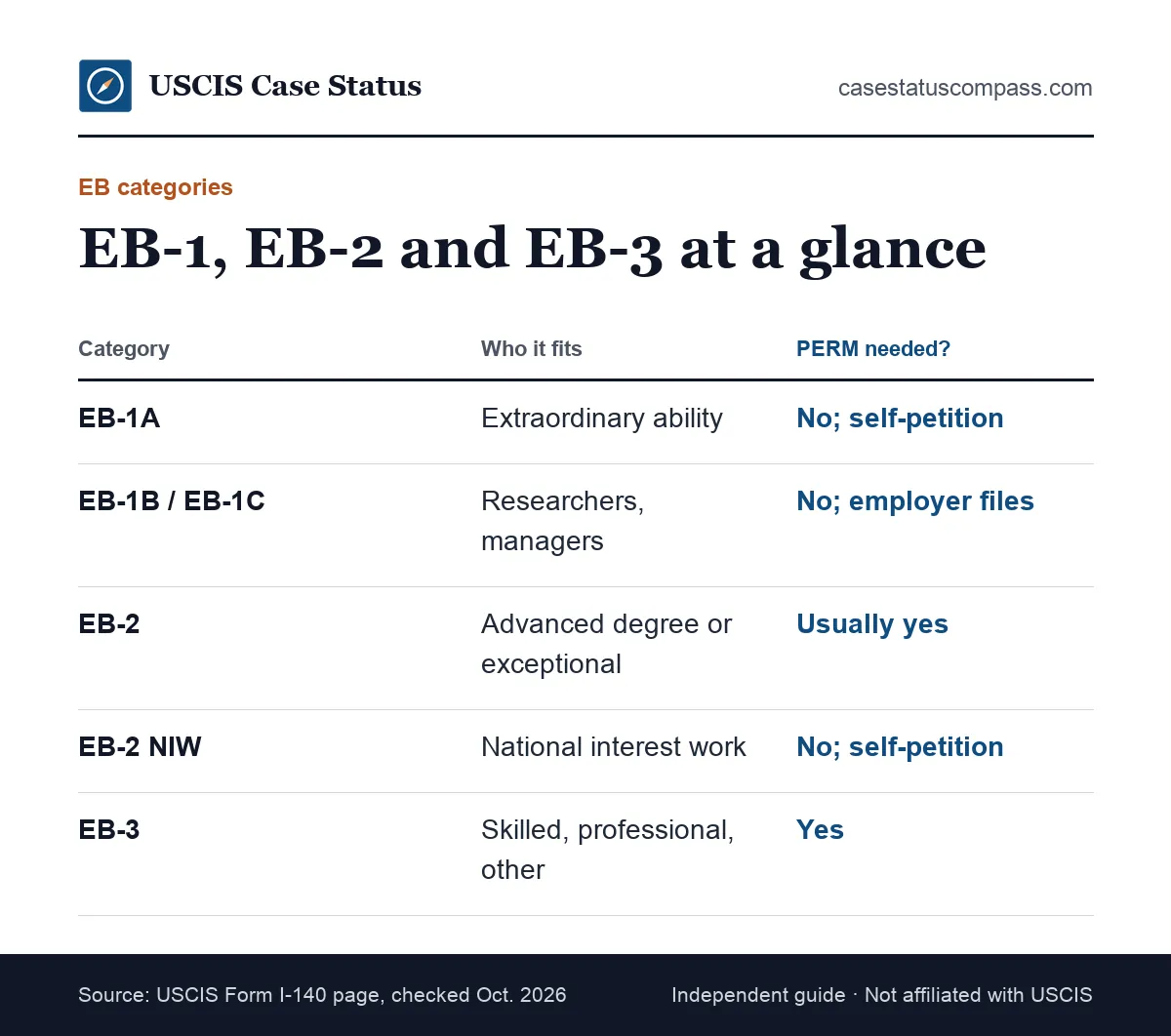
Most EB-2 and all EB-3 petitions need a certified PERM labor certification from the Department of Labor. EB-1 petitions and EB-2 National Interest Waiver petitions do not. The table shows each category, who files and whether PERM comes first.
| Category | Who files | PERM required? |
|---|---|---|
| EB-1A extraordinary ability | Worker or employer | No |
| EB-1B researcher or professor | Employer | No |
| EB-1C multinational manager | Employer | No |
| EB-2 advanced degree | Employer | Yes |
| EB-2 National Interest Waiver | Worker or employer | No |
| EB-3 skilled worker or professional | Employer | Yes |
| EB-3 other worker | Employer | Yes |
Categories that require labor certification
For these, the employer must test the U.S. job market through DOL first. If you are tracking that step, use our perm case status guide, which covers FLAG and each DOL label.
Categories that skip PERM
EB-1 and NIW filers go straight to USCIS. This saves the DOL stage but puts more weight on the evidence in the petition itself. Officers judge each criterion from the documents alone, so a thin file is more likely to draw an RFE than in a PERM case.
From PERM to I-140: How the Two Cases Connect
PERM is the Department of Labor's certification of a job offer; the I-140 is the USCIS petition built on it. The employer attaches the certified ETA-9089 to the I-140. PERM answers whether the job can be offered; the I-140 answers whether this worker qualifies.
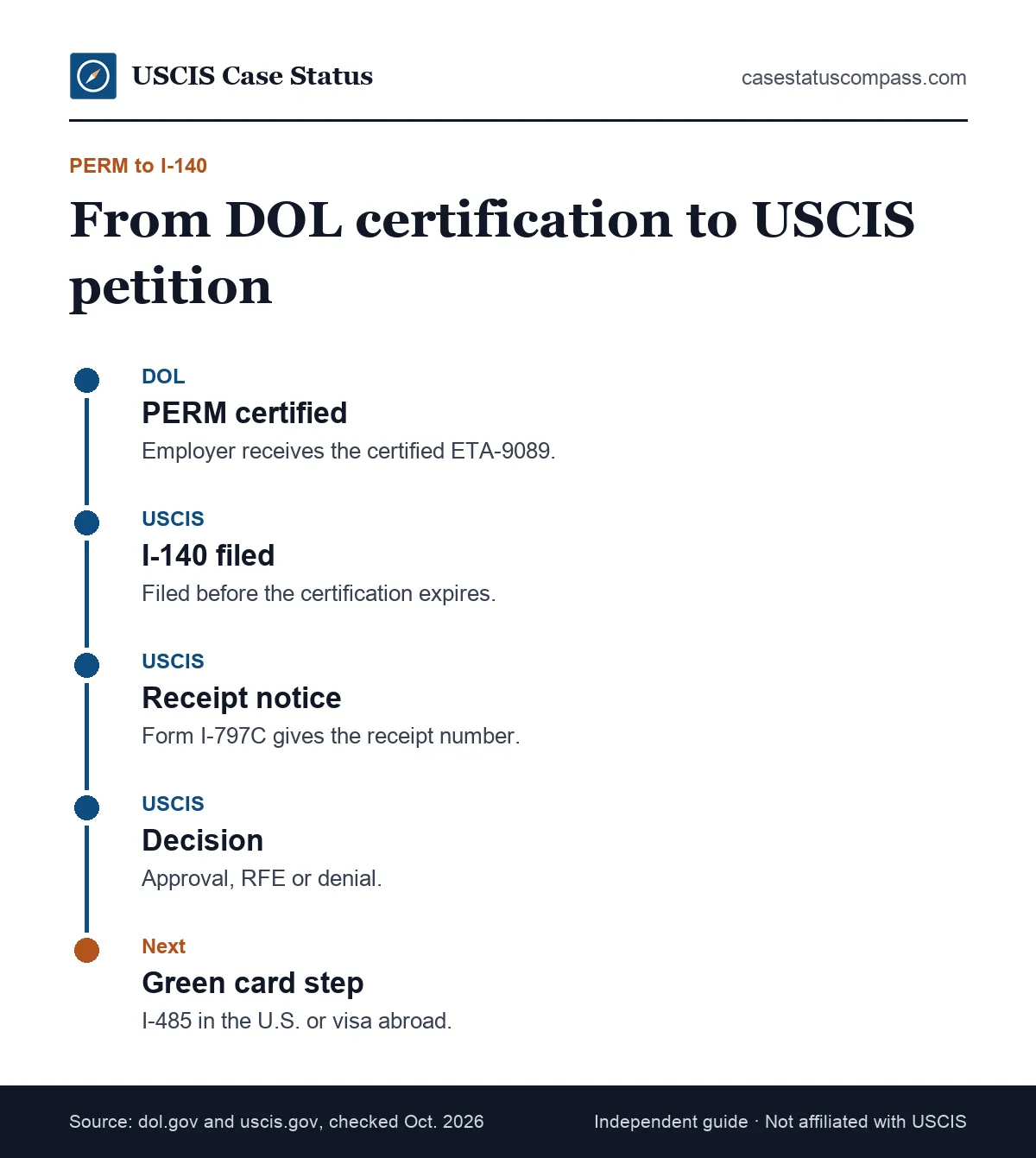
The certified ETA-9089 goes with the petition
USCIS needs the certified labor certification with the I-140. The job title, requirements and wage must match. Errors made at DOL can resurface as I-140 questions. Compare the two side by side before filing, and send a copy of the certified form, not a draft, so the officer sees the final version DOL approved.
The certification's validity window
A labor certification stays valid only for a limited period after DOL certifies it. USCIS's I-140 page says it must receive the petition before that period ends, so employers file soon after certification.
Why Does the PERM Green Card Path Have Two Case Numbers?
A PERM green card case has a DOL case number for the labor certification and a USCIS receipt number for the I-140. Keep both, because each agency searches only its own. Write them on one page with the filing dates, since later steps such as Form I-485 and H-1B extensions ask about both cases.
How Do You File Form I-140?
To file Form I-140, choose the category, gather evidence, use the current edition, pay the fees, and file online or by mail at the address USCIS lists. PERM cases add the certified ETA-9089. Premium processing is requested with Form I-907.
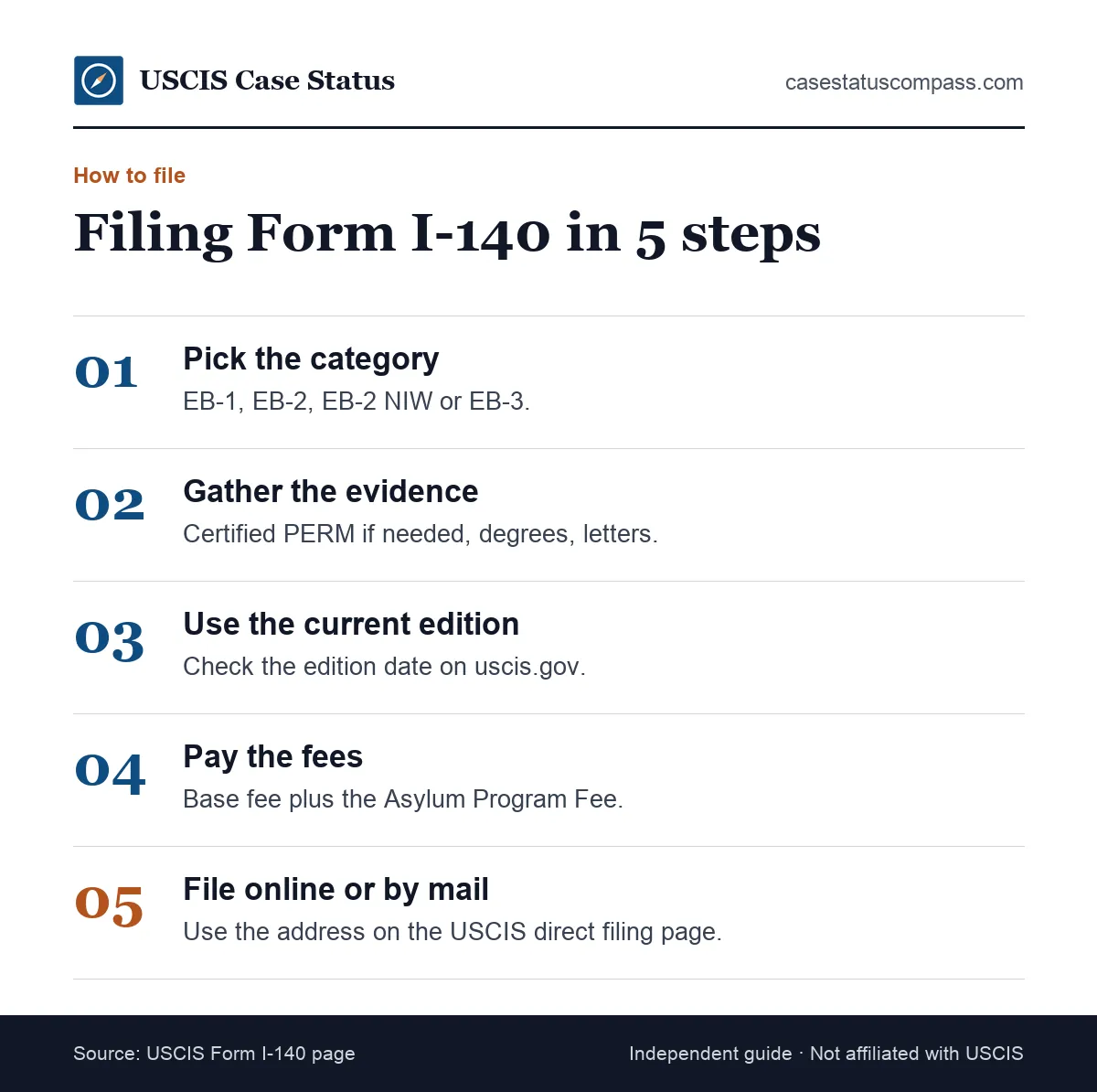
I-140 process steps
- Confirm the category and whether PERM is required.
- Download the current form and instructions from uscis.gov.
- Complete the form and sign it.
- Attach evidence and translations.
- Pay the base fee and the Asylum Program Fee.
- File online or mail the package.
Online or paper filing
USCIS lists a lower online fee for the I-140. Its form page explains limits: for example, when an I-140 is filed together with Form I-907 for premium processing, it must be mailed. Check the page before you choose.
Package order
USCIS asks filers to stack each package in order: fee payment, Form G-1145 if used, Form G-28 if used, the form, then evidence. A clean order helps intake. Label each evidence section with a tab and list it in a short cover letter, so the officer can match every document to the claim it supports.
What Documents Do You Need for Form I-140?
I-140 documents fall into two groups: proof about the employer and proof about the worker. PERM cases need the certified labor certification, the worker's degrees and experience letters, and proof the employer can pay. EB-1 and NIW cases add category evidence.
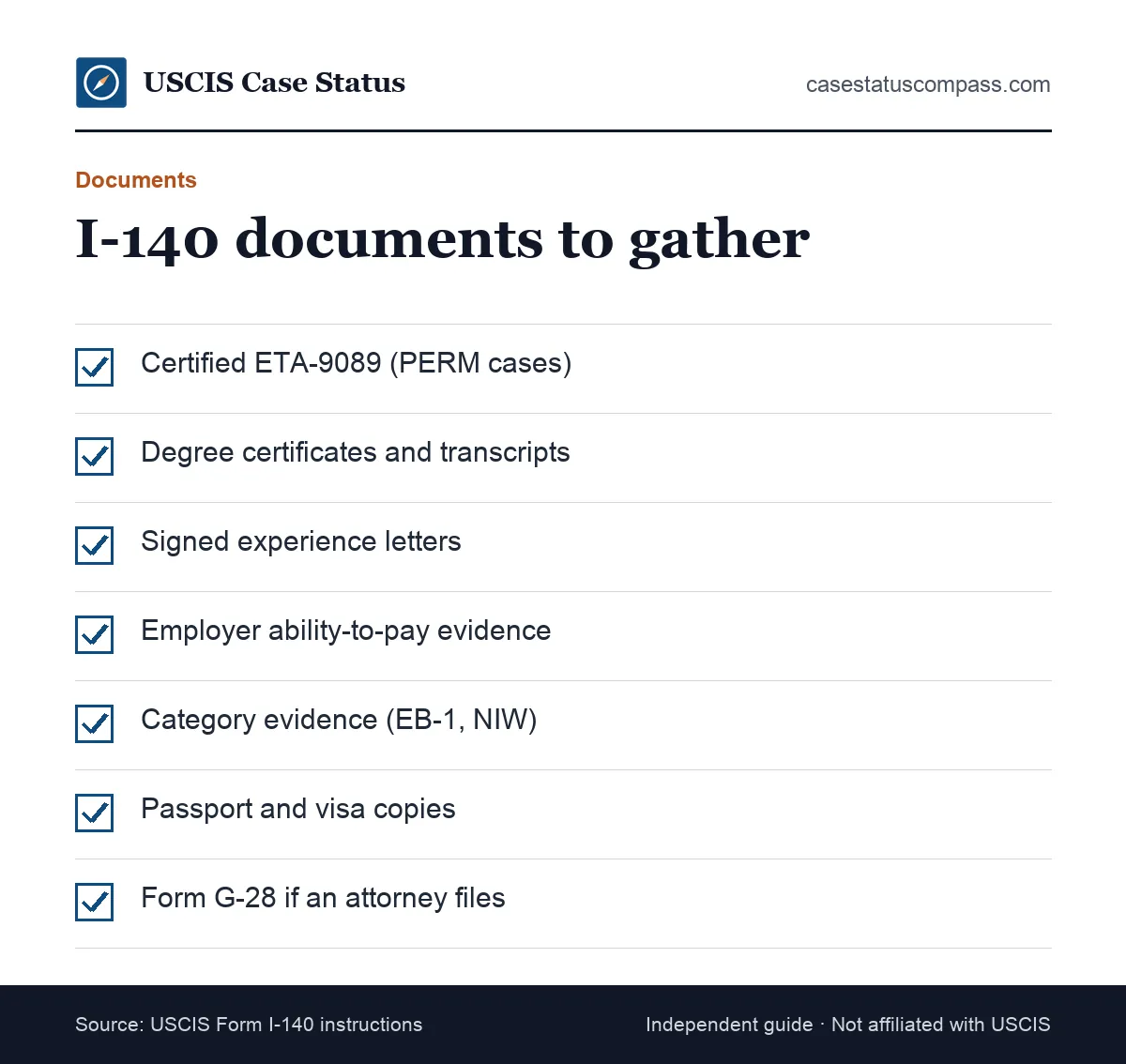
Employer and beneficiary evidence
- Certified ETA-9089 (PERM cases)
- Ability-to-pay proof, such as annual reports or tax returns
- Degree certificates, transcripts and evaluations
- Experience letters with title, duties and dates
- Passport biographic page and any U.S. visa pages
A copyable I-140 filing checklist
- Correct category confirmed
- Current edition (06/07/24)
- Every page signed where required
- Certified labor certification attached, if needed
- Translations with certificates
- Base fee and Asylum Program Fee paid
- Correct filing address or online account
- Copies of everything kept
Where Do You File Form I-140? (I-140 Filing Address)
The I-140 filing address depends on whether you file alone, with Form I-485, or with Form I-907 for premium processing, and on where the worker will work. USCIS lists every option on its "Direct Filing Addresses for Form I-140" page. Check it on the day you mail.
The direct filing address page
The direct filing address for I-140 cases is on uscis.gov, not on the form. USCIS changes lockboxes from time to time, so we do not copy addresses here. Use the page's table to match your situation, then pick the USPS or courier address.
Standalone, concurrent and premium filings
A standalone I-140, an I-140 filed with an I-485, and an I-140 filed with Form I-907 can each go to different places. Sending a package to the wrong lockbox can lead to rejection.
Filing online instead
Online filing skips addresses entirely. Create an account at myaccount.uscis.gov/create-account and file there if your filing type is allowed online. The receipt appears in the account at once, and you upload evidence as PDFs instead of mailing copies. Online filing also costs less.
Where Can You Get the Form I-140 PDF and Instructions?
Download the Form I-140 PDF and its instructions only from uscis.gov/i-140. As of October 2026, the edition is 06/07/24. USCIS forms are free to download; any site charging for the blank form is not official. The same page links the filing addresses and fee details.
Checking the edition date
The edition date is printed at the bottom of every page of the form and the instructions. An outdated edition can be rejected, so check it right before filing. Mixed pages also risk rejection.
Reading the I-140 form instructions
The I-140 form instructions explain each part, the evidence for each category and the fee. Read the category section that fits you before collecting documents. It lists the exact evidence officers expect, such as the EB-1A criteria or the ability-to-pay records for employer cases.
How Much Does the I-140 Cost in 2026?
As of October 2026, USCIS Form G-1055 lists the I-140 fee as $715 paper / $665 online. The Asylum Program Fee is separate and depends on employer size or type. Our USCIS fee schedule guide covers every form. Each fee is paid separately.
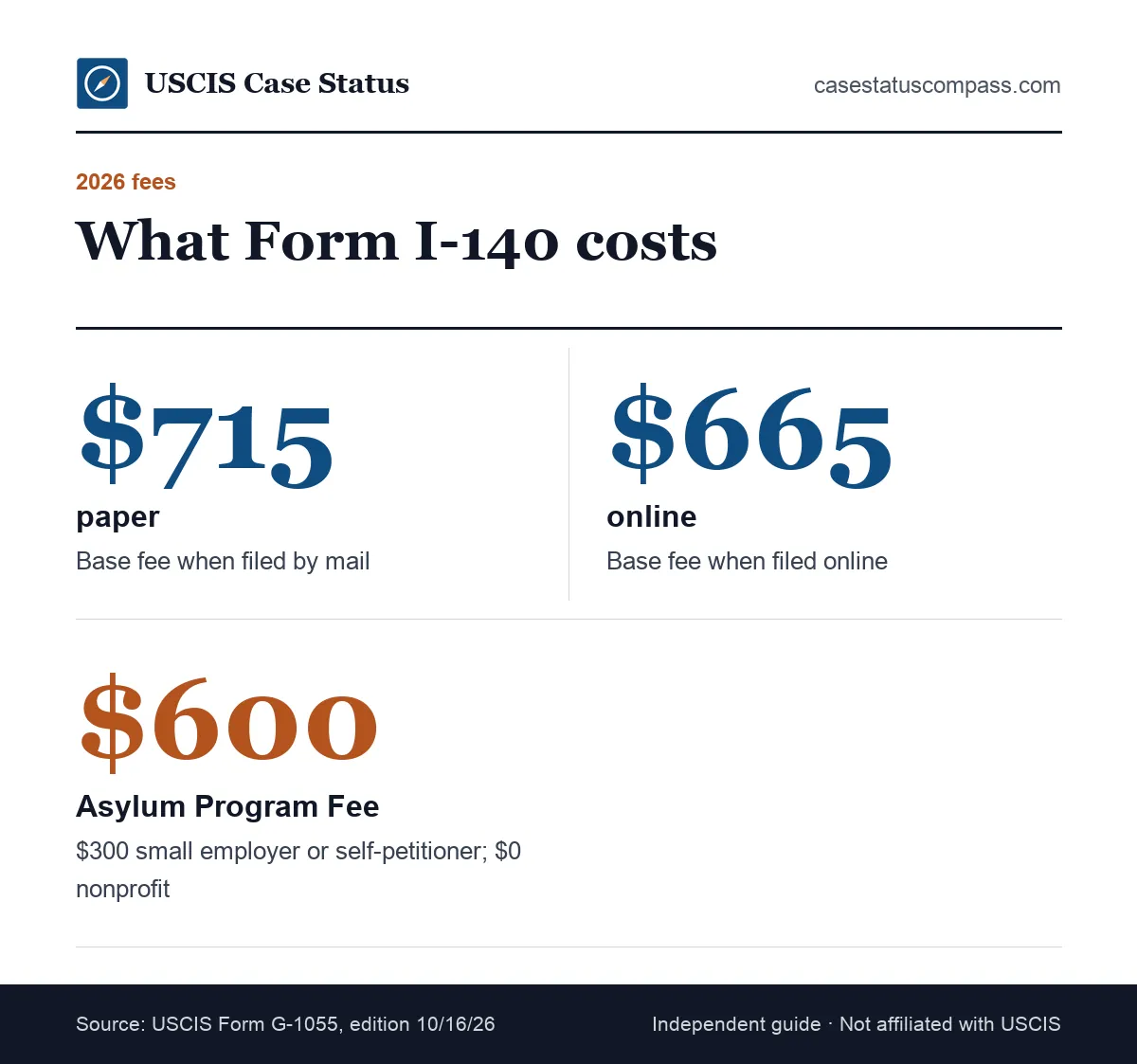
Base fee and Asylum Program Fee
The table shows the Asylum Program Fee each filer adds to the base fee.
| Filer | What to pay |
|---|---|
| Most employers | Base fee + $600 Asylum Program Fee |
| Small employer or self-petitioner | Base fee + $300 Asylum Program Fee |
| Nonprofit employer | Base fee only (Asylum Program Fee $0) |
The base fee itself is $665 online or $715 on paper, so nonprofits pay the least.
Premium processing is extra
Premium processing has its own fee on Form I-907: $2,965 for most I-140 categories, per G-1055. Our premium processing page has the details. It does not change approval odds.
Can Form I-140 Be Premium Processed?
Yes, USCIS offers premium processing for I-140 petitions in many categories through Form I-907. It guarantees faster action, not approval. Requests can be filed with the I-140 or later, while the petition is pending. Not every category qualifies, so check the I-907 page first.
How premium processing works
You file Form I-907 with its fee. USCIS then must take action within the premium period, which may be an approval, a denial or a request for evidence. The periods are 15 business days (I-129, most I-140); 30 (I-765 OPT, I-539 F/M/J); 45 (I-140 E13 managers and NIW).
How Do You Upgrade a Pending I-140 to Premium Processing?
You upgrade by filing Form I-907 for the petition that is already pending. If the I-140 was filed online with an IOE receipt number, USCIS's form page says a standalone I-907 can be uploaded online. Otherwise, mail it to the address USCIS lists for upgrades, and track the same I-140 receipt number afterward.
Can You File the I-140 With Form I-485?
Yes, if your priority date is current for your category and country and you are in the U.S. You can file the I-140 and Form I-485 together, called concurrent filing. USCIS says to keep each package's evidence separate, even in one shipment.
When concurrent filing makes sense
Concurrent filing lets you apply for a work permit and travel document with the I-485 while the I-140 is pending. It only works when a visa number is available. Check the visa bulletin chart USCIS names for that month before you file.
Keep the packages separate
Each form needs its own fee, cover sheet and evidence set. Clip each package on its own and label it, so intake staff do not mix pages between the two forms. See our Form I-485 guide for adjustment details.
How Do You Track Your I-140?
To track an I-140, enter the 13-character receipt number from your Form I-797C notice on USCIS Case Status Online. Online filers can also follow the case in their USCIS account. The employer or attorney receives the notices. Workers can still search the number.
Using the receipt number
The receipt number follows the format 3 letters + 10 digits (13 characters), e.g. EAC2512345678; leave out dashes. Ask your employer for it if you did not receive a copy. Our receipt number guide shows where it sits on each notice.
What the I-797C notice confirms
I-797C = Notice of Action (receipt, rejection, transfer, appointment, re-open); not proof of status by itself. It confirms USCIS has the I-140 and starts your tracking record. Check the names, category and received date on it right away.
I-140 Case Status Sequence: Receipt to Decision
Most I-140 cases follow a short sequence: received, actively reviewed, then approved, sometimes with a request for evidence in between. The table shows each status, what it means and what to do. Timing varies, so use the official tool for times.
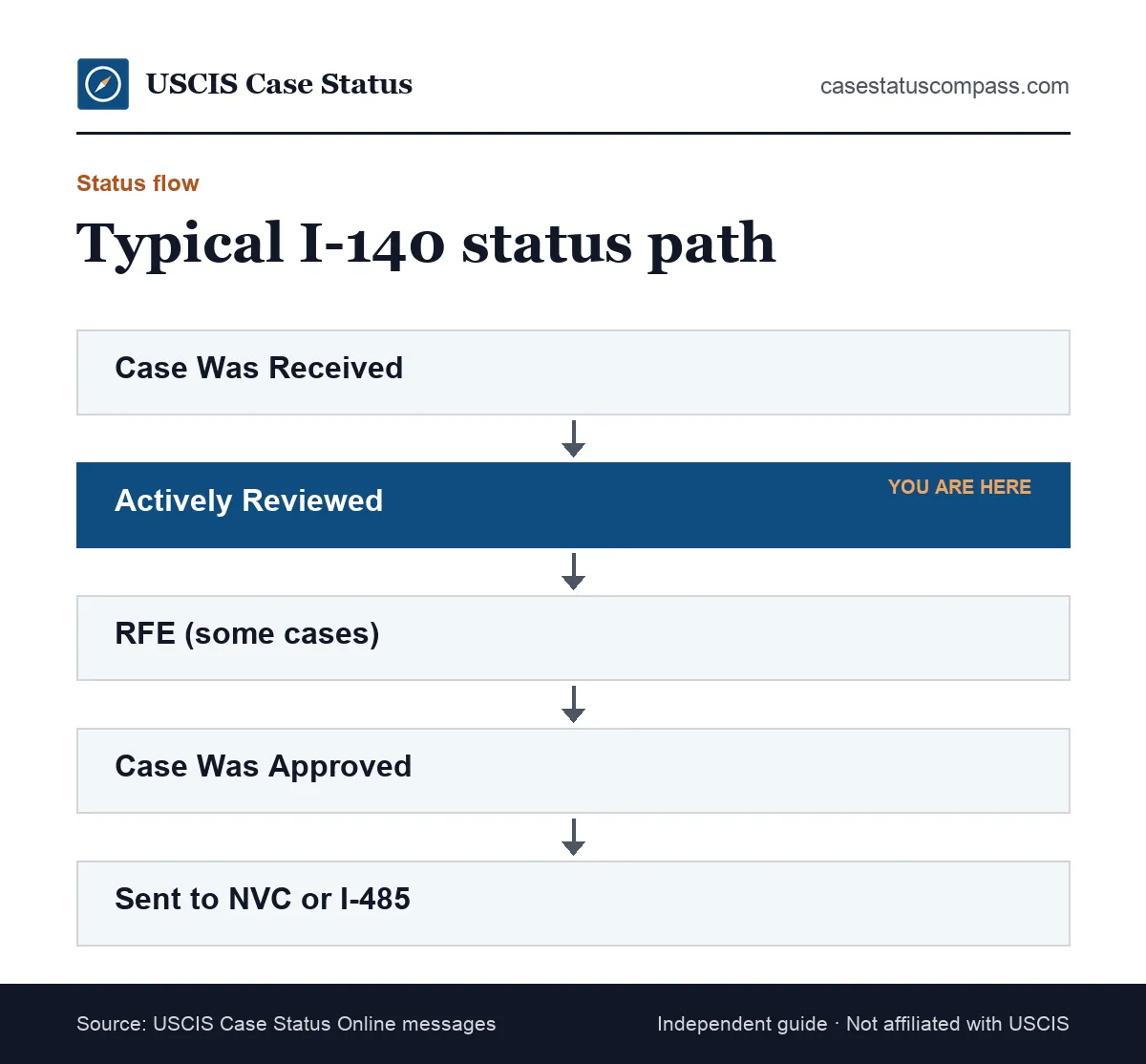
| Status | Meaning | What to do |
|---|---|---|
| Case Was Received | USCIS accepted the petition | Save the I-797C |
| Case Is Being Actively Reviewed | An officer is working on it | Keep the address current |
| Request for Evidence Was Sent | More proof needed | Respond by the deadline |
| Response to RFE Was Received | Your reply arrived | Wait for a decision |
| Case Was Approved | Petition granted | Plan the green card step |
| Case Was Denied | Petition refused | Review options quickly |
Reading each status
Statuses describe the last action, not the next one. A long gap after receipt is common. The approval notice, not the online label, is the official record. Save the notice.
Approved but no notice yet
The approval notice usually follows by mail to the petitioner or attorney. See what Case Was Approved means for how notices arrive. Ask the employer or attorney for a copy as soon as it lands, because you will need it for later steps.
What Does an I-140 RFE Usually Ask For?
An I-140 request for evidence (RFE) asks the petitioner to send proof USCIS found missing. Common topics are the employer's ability to pay, the worker's experience by the priority date, and category evidence in EB-1 and NIW cases. The deadline is printed on the notice.
Common RFE topics
- Ability to pay the offered wage since the priority date
- Experience letters missing duties or dates
- Degree equivalency for foreign degrees
- Evidence for each EB-1 or NIW criterion
- Proof the job offer is still active
Answering an RFE
Reply once, completely, before the deadline. Our request for evidence guide explains how to organize a response. Put the RFE notice on top, answer each point in the order listed, and send everything in one package; USCIS will not wait for a second mailing.
Form I-140 Approved: What Comes Next?
After Form I-140 is approved, your next step depends on where you are and whether your priority date is current. In the U.S., you file Form I-485 when eligible. Abroad, the case moves to the National Visa Center. Approval alone gives no status or work permission.
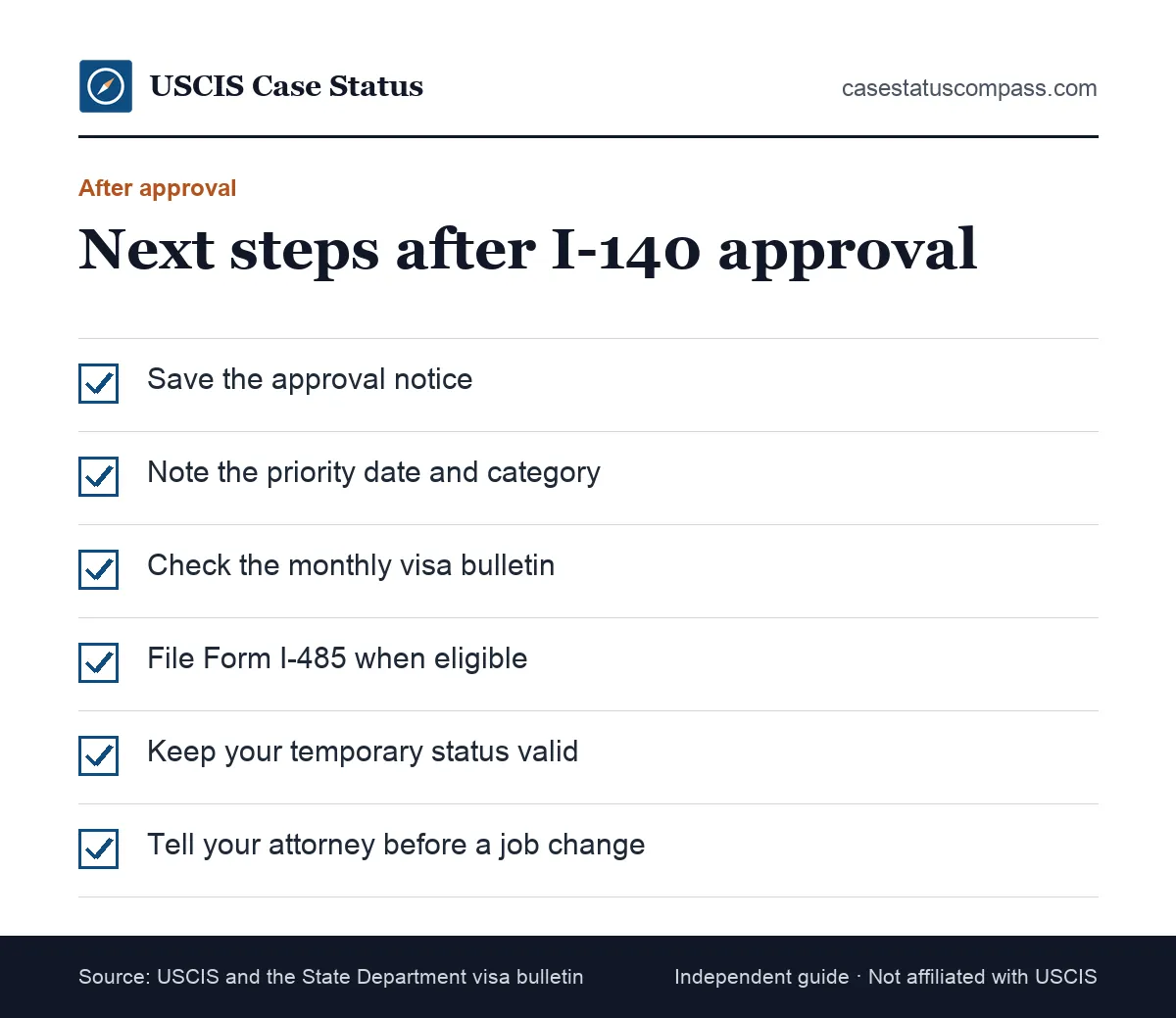
Next step after I-140 approval in the U.S.
If your date is current and you are in lawful status, file Form I-485 if you have not already. Many applicants file Form I-765 and Form I-131 with it. Each needs its own form and fee.
When your priority date is not current
You wait. Check the State Department visa bulletin each month. Meanwhile, keep your temporary status, such as H-1B, valid and up to date. Dates can move backward as well as forward, so a date that was current last month may not be current now.
Keep the approval notice safe
The approval notice shows your category and priority date. You will need it for the I-485, for H-1B extensions and for any future job move. Keep the original and a scan.
I-140 Approved While You Are in Your Home Country
If your I-140 is approved while you are in your home country, you complete the green card through consular processing. USCIS sends the approved petition to the State Department's National Visa Center (NVC). You then file Form DS-260 and attend an interview abroad.
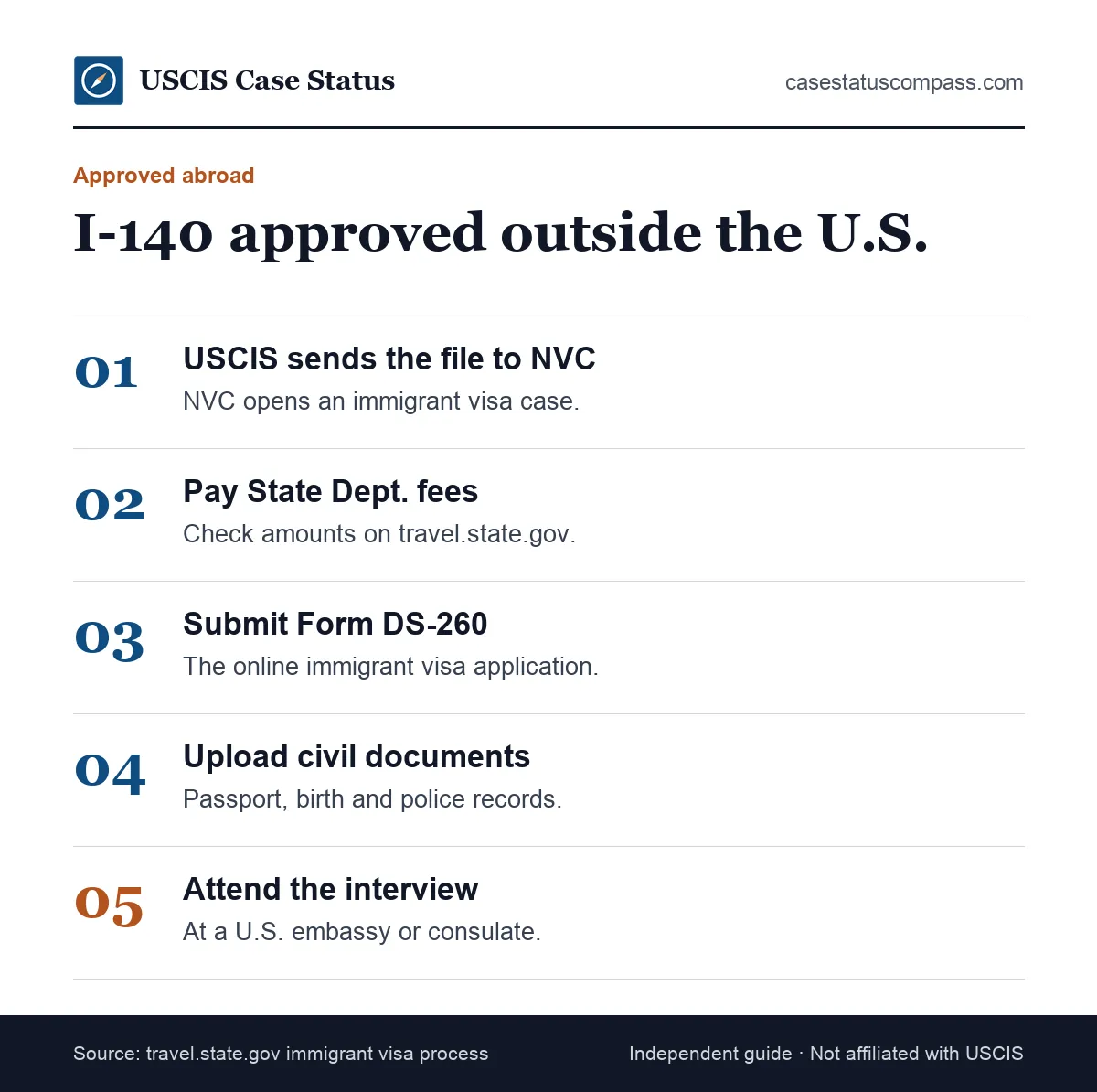
What NVC does
NVC opens an immigrant visa case, collects fees and documents, and schedules the interview once a visa number is available. The State Department immigrant visa fee for employment cases is $345 per person (22 CFR 22.1).
After the visa is issued
People who get an immigrant visa pay the USCIS Immigrant Fee ($235, per G-1055) so USCIS can produce the green card after entry. Pay it before you travel to the U.S., and keep the receipt, because the card is not produced until the fee is paid.
What Is a Priority Date on an I-140?
Your priority date is your place in line for an employment-based visa number. In PERM cases it is generally the date DOL accepted the labor certification. In EB-1 and NIW cases it is the date USCIS received the I-140. It appears on the approval notice.
How the visa bulletin uses it
Each month, the State Department's visa bulletin lists cut-off dates by category and country. When your date is earlier than the cut-off, you can move forward. The oversubscribed chargeability areas are mainland China, India, Mexico and the Philippines, so each has its own column. The November 2026 Final Action chart is below; it changes monthly, so confirm on the State Department's Visa Bulletin page before you act.
| Category | All areas | China (mainland-born) | India | Mexico | Philippines |
|---|---|---|---|---|---|
| EB-1 | Current | Aug. 1, 2023 | Feb. 1, 2023 | Current | Current |
| EB-2 | Apr. 1, 2025 | Oct. 1, 2021 | Nov. 1, 2013 | Apr. 1, 2025 | Apr. 1, 2025 |
| EB-3 | June 15, 2024 | Jan. 22, 2022 | Jan. 22, 2014 | June 15, 2024 | Aug. 15, 2023 |
| EB-3 Other Workers | June 1, 2022 | Oct. 1, 2019 | Jan. 22, 2014 | June 1, 2022 | Jan. 1, 2022 |
| EB-4 | Dec. 15, 2022 | Dec. 15, 2022 | Dec. 15, 2022 | Dec. 15, 2022 | Dec. 15, 2022 |
| Certain Religious Workers | Dec. 15, 2022 | Dec. 15, 2022 | Dec. 15, 2022 | Dec. 15, 2022 | Dec. 15, 2022 |
| EB-5 Unreserved | Current | Dec. 1, 2016 | Dec. 1, 2023 | Current | Current |
| EB-5 Rural (20%) | Current | Current | Current | Current | Current |
| EB-5 High Unemployment (10%) | Current | Current | Current | Current | Current |
| EB-5 Infrastructure (2%) | Current | Current | Current | Current | Current |
Why it matters for EB-2 status questions
People asking about their EB-2 status often mean their priority date. Checking it against the bulletin answers that question better than the case status tool. An EB-2 worker born in India, for example, compares it with Nov. 1, 2013 in November 2026.
Can You Keep Your Priority Date After an I-140 Approval?
Often, yes. An approved I-140 can preserve the priority date for a later petition in many cases, even with a new employer. The rules depend on whether the petition was revoked and why. Ask an attorney before relying on it.
When a date can carry over
If you later get a new I-140 in an eligible category, the earlier priority date may be retained. The new petition should mention the earlier approval and its receipt number.
When it may be lost
Revocation for fraud, misrepresentation or a material error can cancel the earlier date. Get legal advice if USCIS sends a notice of intent to revoke. Respond by the deadline on that notice.
Is an Approved I-140 a Green Card?
No. An approved I-140 is an approved petition, not permanent residence. It confirms your category and priority date. You still need an approved Form I-485 or an immigrant visa, and a visa number must be available. Approval is one step of three.
What approval gives you
Approval gives you a recognized category, a priority date and, for many H-1B workers, a basis for longer extensions. Keep the notice handy. It also supports a later I-485 or immigrant visa.
What approval does not give
It does not give lawful status, a work permit or travel permission. Keep your current visa valid until the green card process ends. Do not let an H-1B or other status lapse just because the petition was approved.
I-140 Processing Time: Summary and Where to Check
USCIS posts current I-140 processing time figures by category and service center on its official tool at egov.uscis.gov/processing-times. USCIS's quarterly data show I-140: median 3.9 months (USCIS data, Apr.-June 2026). That is a median; the live tool uses a different, 80% measure. See our i 140 processing time guide.
Using the official tool
Choose I-140, then the category and the office on your receipt notice. The tool shows how long most cases take there. It is a different measure from the median above, so the two numbers will not match. Compare your receipt date with the tool's figure.
Premium vs regular timing
Premium processing shortens the time to a decision for eligible categories. It does not change visa bulletin waits after approval. For an oversubscribed category, a fast approval may only mean a longer wait for the visa number, so weigh the fee against that.
What Can You Do If Your I-140 Is Denied?
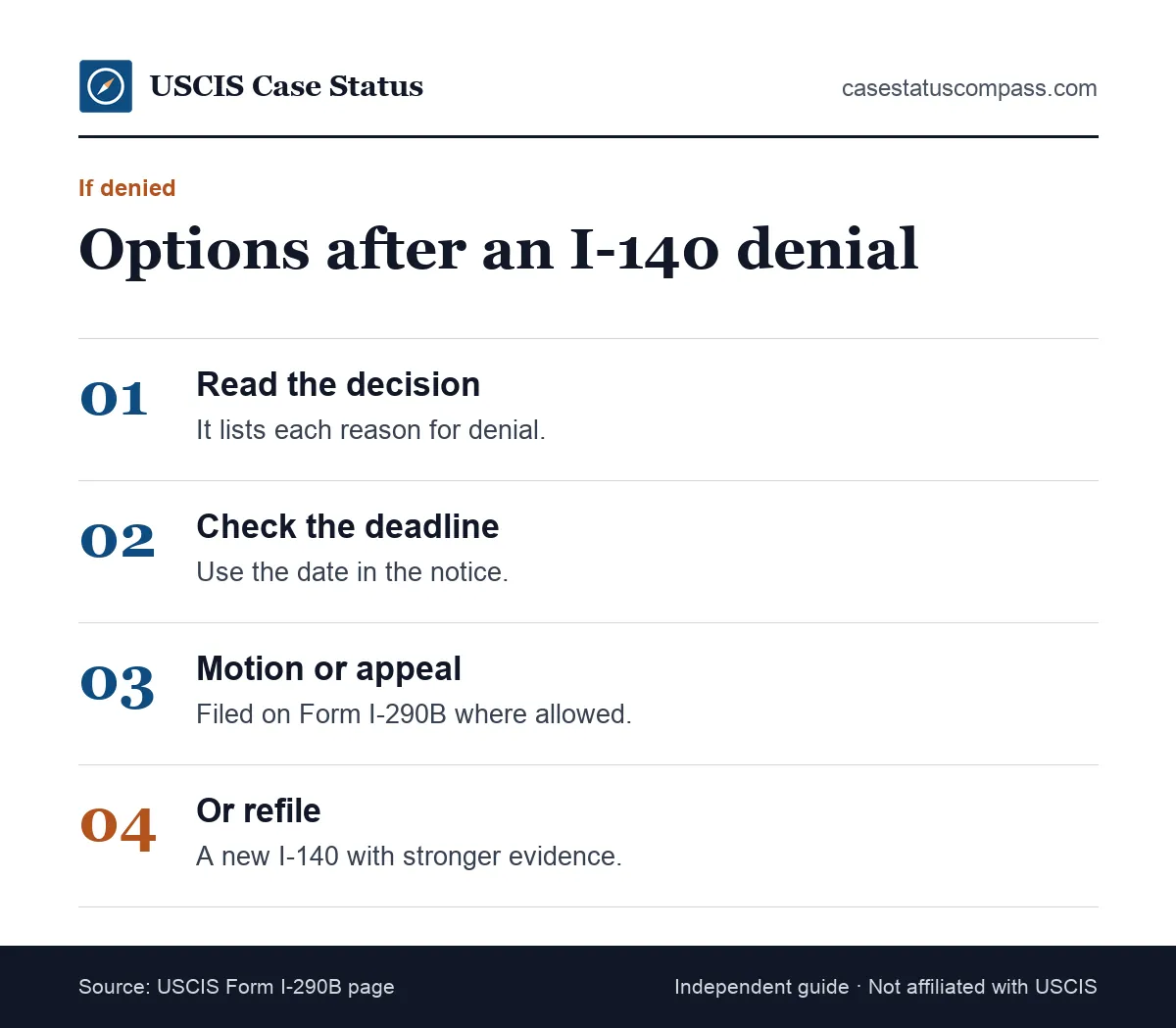
If your I-140 is denied, the decision lists the reasons and options. The petitioner may file a motion to reopen or reconsider, or an appeal to the Administrative Appeals Office (AAO), on Form I-290B where allowed. Many petitioners simply refile with stronger evidence.
Motions and appeals
A motion asks the same office to look again; an appeal goes to the AAO. Deadlines are short and run from the decision. Our appeal and motion options page explains each one.
Refiling a new petition
A new I-140 can fix weak evidence. In PERM cases, it must still be filed while the labor certification remains valid. USCIS states: A PERM labor certification expires 180 days after DOL certifies it.
Can an Employer Withdraw an Approved I-140?
Yes. An employer can ask USCIS to withdraw an I-140 at any time, often after the worker leaves. Under current rules, a petition approved for a certain period before withdrawal generally keeps your priority date, unless it was revoked for specific reasons.
What withdrawal changes
Withdrawal ends the employer's sponsorship. Your earlier priority date may still help with a new employer's petition. Ask for a copy of the request, and keep your approval notice.
What to do
Ask your employer if it plans to withdraw, and talk to an attorney about protecting your place in line. Keep copies of the approval notice and receipt number, since a new employer's attorney will need them.
What Happens to Your I-140 If You Change Jobs?
A job change affects your I-140 depending on timing. Before approval, the petition usually depends on the original job. After an I-485 has been pending a while, some workers can move to a same or similar job under portability rules. Get advice first.
Before I-140 approval
Leaving usually ends the case for that employer. A new employer may need a new PERM and petition. Ask before you resign, since the new employer must usually restart both steps.
After approval and a pending I-485
Portability rules may let you switch to a similar job. USCIS uses Supplement J for this. Ask an attorney if your move qualifies. Keep proof the new job matches. Keep proof the new job matches in duties and pay level.
How Does an Approved I-140 Help H-1B Workers?
For many H-1B workers, an approved I-140 makes H-1B extensions beyond the usual limit possible while waiting for a visa number. It does not change H-1B status by itself. Your employer files H-1B extensions separately on Form I-129. Track that receipt on its own.
Extensions tied to the I-140
An approved petition can support H-1B extensions past the usual limit when a visa number is not yet available. Check eligibility with your attorney. The extension petition must show the approved I-140 and that a visa number is still not available.
Tracking both cases
Keep the H-1B and I-140 receipt numbers separate. Our guide to H-1B status covers the temporary visa side. Log each receipt number with its form type, filing date and the decision date, so you can answer quickly when a later form asks.
Can You Search NIW Case Approvals?
No public tool lets you search other people's NIW case approvals. You can only track your own petition with its receipt number. Some sites post statistics or user reports, but they are not official and may be incomplete.
Tracking your own NIW petition
Use the receipt number on Case Status Online or your USCIS online account. The status labels work the same as other I-140 cases. Self-petitioners receive the notices directly unless an attorney filed Form G-28.
Using unofficial data carefully
User-reported approval dates can help you set expectations but are not a forecast. Use the official tool for times. Do not pay any site for status checks or promised approval odds.
Form I-140 vs Form I-130: Two Immigrant Petitions
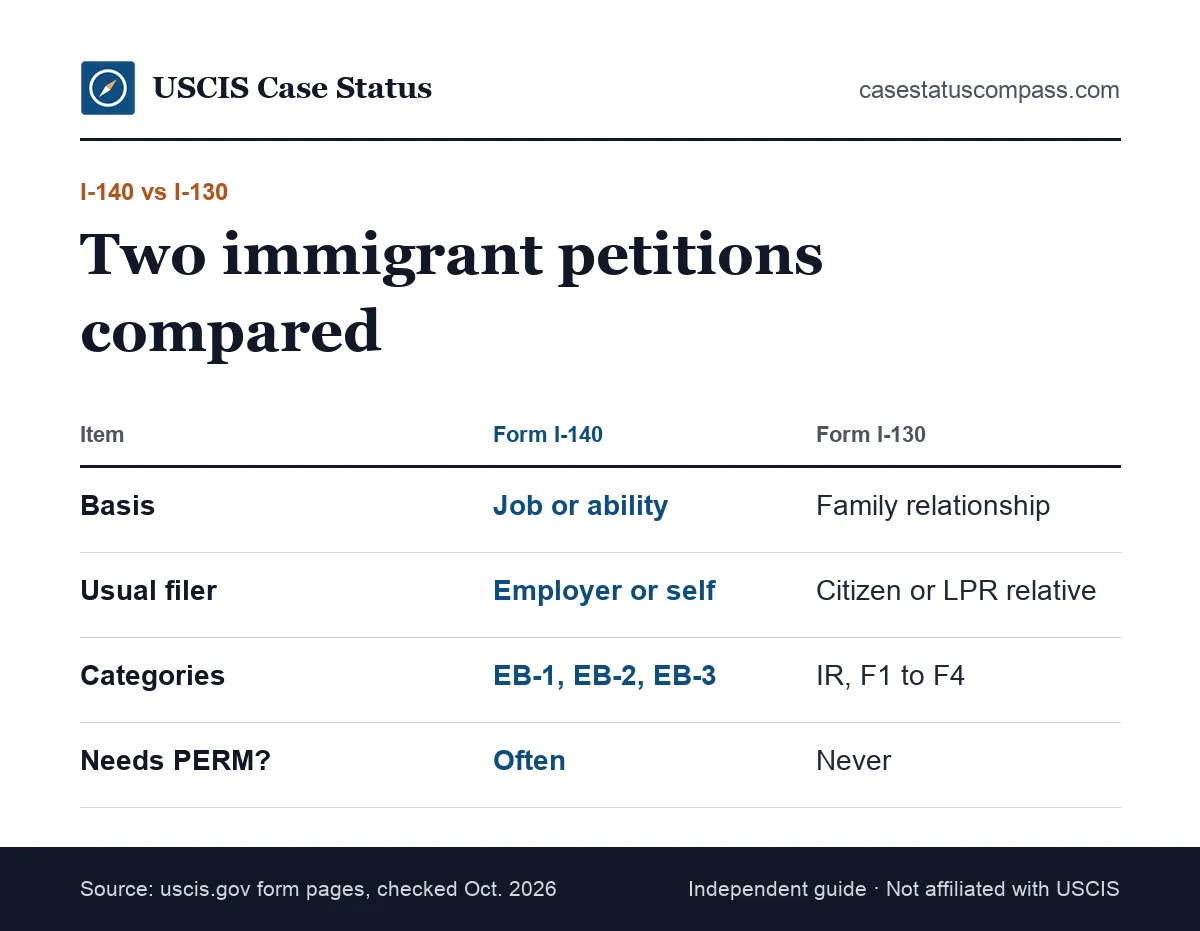
Form I-140 and Form I-130 are both immigrant petitions, but one is job-based and the other family-based. The I-140 is filed by an employer or a self-petitioner; the I-130 by a U.S. citizen or green card holder for a relative. Neither grants a green card alone.
Key differences between the two petitions
The I-140 usually needs PERM or a waiver and rests on a job offer, exceptional ability or national interest. The I-130 rests on proof of a family tie. Fees, filing addresses and Visa Bulletin charts also differ, so never mix one form's evidence with the other.
Which petition fits you
Pick the I-140 if your path is your job or exceptional ability. Pick the I-130 if a qualifying relative will sponsor you. Our guide to Form i 130 covers the family route.
Common I-140 Petition Problems
The most common I-140 problems are a wrong filing address, an outdated edition, a missing fee, weak ability-to-pay proof and experience that does not match the labor certification. Most can be avoided by checking USCIS pages and the PERM record before filing.
Rejections at intake
Rejections usually come from a wrong address, an old edition, a missing signature or an unpaid Asylum Program Fee. A rejected petition is returned without review. Fix the error and refile at once.
Problems found during review
Ability-to-pay gaps and experience mismatches lead to RFEs. Make sure experience letters match the certified job requirements exactly. Ability to pay must be shown from the priority date onward, for every year.
Mistakes to Avoid With Your I-140
The costliest I-140 mistakes are missing the labor certification's validity window, choosing the wrong category and counting experience gained in the same job you are being sponsored for. Each can lead to denial or a restart. Plan the filing with your attorney.
Timing mistakes
- Filing after the labor certification expires
- Letting temporary status lapse while waiting
- Missing an RFE deadline
- Waiting too long after PERM certification
- Ignoring a notice of intent to revoke- Ignoring a notice of intent to revoke
- Missing a visa bulletin window
Evidence mistakes
- Letters without dates, duties or signatures
- Foreign degrees without an evaluation
- NIW evidence that does not match the standard
- Untranslated foreign documents
- Missing proof of the employer's ability to pay
Does an I-140 Cover Your Spouse and Children?
Your spouse and unmarried children under 21 are not named on the I-140, but they can usually get green cards as derivative beneficiaries. They file their own Form I-485 or immigrant visa applications based on your approved petition and priority date.
Derivatives in the U.S.
Each family member files a separate I-485 with its own fee. They may also apply for work and travel permits. Each also attends biometrics, and a child's age can matter.
Derivatives abroad
Family members abroad follow NVC consular processing with you or join later. Each files a separate DS-260 and pays its own immigrant visa fee. A spouse and children can attend the interview with you, or follow later and join you in the U.S.
Real-World I-140 Scenarios
These typical situations show how I-140 rules play out. They are examples, not legal advice. Each one shows the facts, the issue and the step taken. The names are fictional, and real cases depend on the full facts of each file.
Scenario 1: EB-2 worker with a current date
Ana's PERM was certified. Her employer filed the I-140 and her I-485 together because her priority date was current. She also filed for a work permit and travel document with the I-485.
Scenario 2: NIW researcher abroad
Dev self-petitioned under the NIW from abroad. After approval, his case moved to NVC for consular processing. He filed the DS-260, uploaded civil documents and waited for the interview notice.
Scenario 3: Job change after approval
Sam's I-140 was approved, then he changed jobs. His new employer filed a fresh PERM and petition, citing the earlier approval's priority date. Sam kept copies of the old notice.
If-Then Guide for Your I-140
Use this table to match your situation to the right next step. It covers common points in an I-140 case. For anything involving a denial, revocation or job change, talk to an immigration attorney or DOJ-accredited representative. If two rows fit, act first on the one with a deadline.
I-140 next-step table
Read the left column first, then follow the matching step.
| If… | Then… |
|---|---|
| PERM is certified | File the I-140 before it expires |
| You are EB-1A or NIW | Self-petition; no PERM needed |
| You got an RFE | Reply once, fully, by the deadline |
| Approved; date current; in U.S. | File Form I-485 |
| Approved; you are abroad | Follow NVC steps |
| Approved; date not current | Watch the visa bulletin |
| Denied | Review motion, appeal or refiling |
Most rows depend on two facts: whether the petition is approved and whether your date is current.
Using the guide
Find your row, take the step, then record the date. Ask your attorney before any change of job or status. Keep a dated note of each step, with receipt numbers, so later forms are easy to complete.
When Is an I-140 Case Worth Independent Legal Advice?
Get your own advice from an immigration attorney or DOJ-accredited representative if your I-140 is denied, faces revocation, or depends on a job change. Self-petitioners in EB-1A and NIW cases also benefit from help shaping evidence. Your employer's lawyer represents the employer.
Red flags to watch for
Be wary of anyone who guarantees approval, charges for blank forms, or asks you to pay costs the employer must cover. Official forms are free on uscis.gov.
Frequently Asked Questions
Is the I-140 an immigrant petition?
Yes. The I-140 is an immigrant petition that supports permanent residence through an employment-based category. It is different from temporary worker petitions such as the H-1B on Form I-129. Approval gives you a category and priority date, but you still need Form I-485 or an immigrant visa for the green card.
Can I-140 be premium processed?
Yes, in many categories. The petitioner files Form I-907 with its fee, either with the I-140 or while it is pending. USCIS then acts within the premium period, which can be approval, denial or a request for evidence. Check uscis.gov for eligible categories and current timeframes.
Can I file Form I-140 for myself?
Only in some categories. EB-1A extraordinary-ability applicants and EB-2 National Interest Waiver applicants can self-petition. All other categories need a U.S. employer to file, and most EB-2 and EB-3 cases also need a certified PERM labor certification first.
Do I need PERM before filing an I-140?
It depends on the category. Most EB-2 cases and all EB-3 cases need a certified PERM from the Department of Labor. PERM is not required for any EB-1 petition or for an EB-2 petition that asks for a National Interest Waiver. Your PERM status is checked on DOL's FLAG system, not on uscis.gov.
Where do I mail my I-140?
USCIS lists the addresses on its "Direct Filing Addresses for Form I-140" page. The right address depends on whether you file alone, with Form I-485, or with Form I-907, and on the work location. Check the page the day you mail, or file online if allowed.
Does an approved I-140 let me work?
No. An approved I-140 does not give work authorization or status. Keep your current visa, such as H-1B, valid. If you file Form I-485, you can apply for a work permit on Form I-765 with it.
What happens if my I-140 is approved when I am in my country?
You do not file Form I-485. USCIS forwards the approved petition to the National Visa Center, which tells you how to pay the immigrant visa fee, submit the online DS-260 and upload civil documents. Once your priority date is current, the U.S. embassy or consulate in your country interviews you and decides the visa.
How do I check my I-140 status?
Use the 13-character receipt number from your I-797C notice on USCIS Case Status Online, or sign in to your USCIS online account if the petition was filed online. If your employer filed, ask its attorney for the receipt number.
Sources
- USCIS: I-140, Immigrant Petition for Alien Workers. www.uscis.gov/i-140. Accessed Oct 27, 2026.
- USCIS: Direct Filing Addresses for Form I-140. www.uscis.gov/forms/all-forms/direct-filing-addresses-for-form-i-140-immigrant-petition-for-alien-worker. Accessed Oct 27, 2026.
- USCIS Form G-1055 Fee Schedule. www.uscis.gov/g-1055. Accessed Oct 27, 2026.
- USCIS: Checking Your Case Status Online. www.uscis.gov/tools/checking-your-case-status-online. Accessed Oct 27, 2026.
- USCIS Check Case Processing Times. egov.uscis.gov/processing-times/. Accessed Oct 27, 2026.
- USCIS: How Do I Request Premium Processing?. www.uscis.gov/forms/all-forms/how-do-i-request-premium-processing. Accessed Oct 27, 2026.
- U.S. Department of State: Visa Bulletin. travel.state.gov/content/travel/en/legal/visa-law0/visa-bulletin.html. Accessed Oct 27, 2026.
- USCIS Form G-1055 Fee Schedule, Edition 10/16/26. www.uscis.gov/sites/default/files/document/forms/g-1055.pdf. Accessed Oct 27, 2026.
- USCIS: Online Account and Technical Support. www.uscis.gov/tools/uscis-tools-and-resources/online-account-and-technical-support. Accessed Oct 27, 2026.
- USCIS: Form I-797 Types and Functions (updated 01/24/2025). www.uscis.gov/forms/filing-guidance/form-i-797-types-and-functions. Accessed Oct 27, 2026.
- 22 CFR 22.1 Schedule of Fees for Consular Services (govinfo, CFR 2025 edition). www.govinfo.gov/content/pkg/CFR-2025-title22-vol1/xml/CFR-2025-title22-vol1-sec22-1.xml. Accessed Oct 27, 2026.
- USCIS Data Library: All USCIS Application and Petition Form Types, FY2026 Q3 (Apr. 1-June 30, 2026; queried 7/2026). www.uscis.gov/sites/default/files/document/data/quarterly_all_forms_fy2026_q3_v1.xlsx. Accessed Oct 27, 2026.
casestatuscompass.com is an independent publication and is not affiliated with USCIS or any government agency. This page is general information, not legal advice. For denials, court or asylum matters, consult an immigration attorney or a DOJ-accredited representative.