Contents · 41 sections
- What Is a Biometrics Appointment?
- Why Does USCIS Need Your Biometrics?
- Which Applications Require a Biometrics Appointment?
- Do You Pay a Separate Biometrics Fee?
- What Does "Biometrics Appointment Was Scheduled" Mean?
- What If Your Biometrics Appointment Notice Never Arrives?
- How Do You Read Your Biometrics Appointment Notice?
- What Do the Codes on a Biometrics Notice Mean?
- How Do You Verify a Biometrics Notice Is Real?
- What Is an Application Support Center?
- How Do You Find an ASC Near You?
- Can You Book a Biometrics Appointment Yourself?
- What Should You Bring to Your Biometrics Appointment?
- What If Your ID Has Expired or You Have None?
- What Should You Leave at Home?
- What Happens at the Application Support Center, Step by Step?
- What Is the Digital Signature at Biometrics?
- Can You Correct Mistakes on Your Case at the ASC?
- How Long Does a Biometrics Appointment Take?
- Can You Walk In Early for Biometrics?
- Can Family, a Lawyer or an Interpreter Come With You?
- How Do You Reschedule a Biometrics Appointment?
- What Counts as Good Cause to Reschedule Biometrics?
- What If You Miss Your Fingerprint Appointment?
- Can You Fix a Denial After Missing Biometrics?
- How Do You Request Accommodations for Biometrics?
- What Happens After Biometrics?
- What Happens After a Biometrics Appointment for a Green Card?
- After Biometrics for a Work Permit or Card Replacement
- After Biometrics for Citizenship and I-751 Cases
- How Long After Biometrics Until a Decision?
- When Should You Contact USCIS About a Delay After Biometrics?
- Will USCIS Call You Back for Biometrics Again?
- What If Your Fingerprints Cannot Be Read?
- Can You Get Your FBI Record From Your Biometrics?
- Biometrics Timeline: From Notice to Next Step
- Biometrics vs Interview vs Medical Exam: Which Is Which?
- Mistakes to Avoid With Your Biometrics Appointment
- If X, Do Y: Biometrics Decision Table
- Printable Biometrics Day Checklist
- Frequently Asked Questions
The short answer
A biometrics appointment is a short visit to a USCIS Application Support Center (ASC) where staff take your fingerprints, photo and digital signature. USCIS uses them to confirm your identity, run background checks and, for some forms, make your card. It is not an interview. Bring your I-797C notice and a valid photo ID.
At a glance
| Where | An Application Support Center named on your notice |
| What is collected | Fingerprints, photo and signature, as needed |
| What to bring | Bring your I-797C appointment notice and a valid photo ID to the ASC |
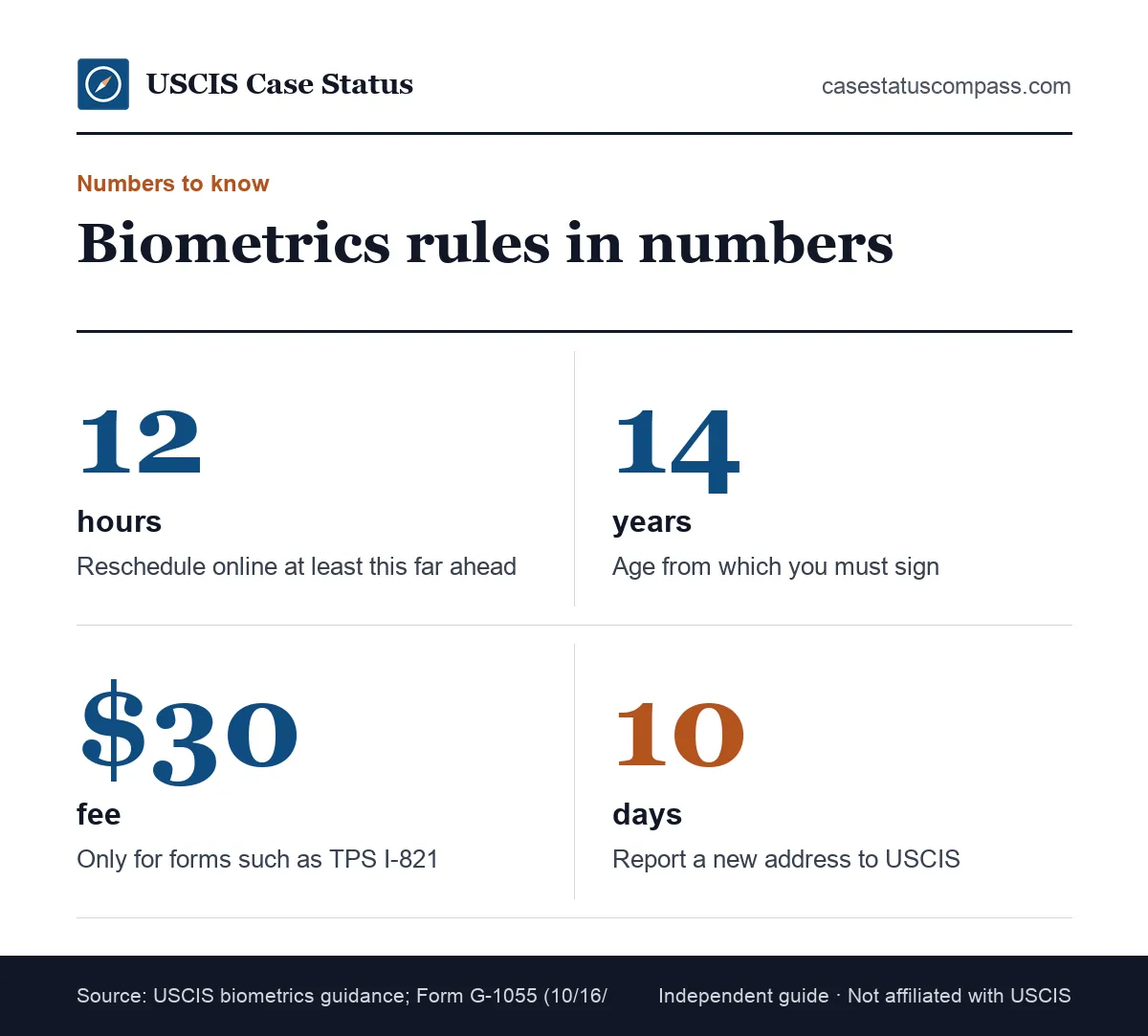
| Rescheduling | Reschedule biometrics online at least 12 hours before, with good cause, or call the Contact Center |
| If you miss it | Missing biometrics can lead to denial for abandonment |
What Is a Biometrics Appointment?
A biometrics appointment is a scheduled visit where USCIS collects your fingerprints, photograph and signature at an Application Support Center. USCIS says these let it confirm your identity and run required background and security checks. No officer reviews your case there.
What USCIS collects
Depending on your form, the ASC takes digital fingerprints, a photo and an electronic signature. Staff follow the codes on your notice to decide which items to take.
Children may need only some of these.
What it is not
A biometrics appointment is not a medical exam and not an interview. Staff do not take blood or ask about your eligibility. They cannot answer questions about your case.
Bring case questions to the Contact Center instead.
Why Does USCIS Need Your Biometrics?
USCIS uses biometrics for two jobs: background and security checks on almost every benefit application, and the photo and signature printed on cards. Your fingerprints go to the FBI and other databases, and the results feed into your case review.
Background and security checks
Your fingerprints are checked against criminal and immigration records. A clear result lets the officer move on; a match may lead to questions at an interview or a request for court records.
Making your card
For Form I-90 and Form I-765, USCIS says your biometrics also produce the replacement green card or Employment Authorization Document (EAD). The photo and signature you give at the ASC are the ones printed on the card.
Which Applications Require a Biometrics Appointment?
Most applications for a green card, work permit, card replacement, citizenship or removal of conditions lead to a biometrics appointment. USCIS decides from the form you filed and sends the notice automatically.
You do not request it separately, and one notice can cover more than one pending form if you filed them together, such as an I-485 with an I-765.
Common forms that trigger biometrics
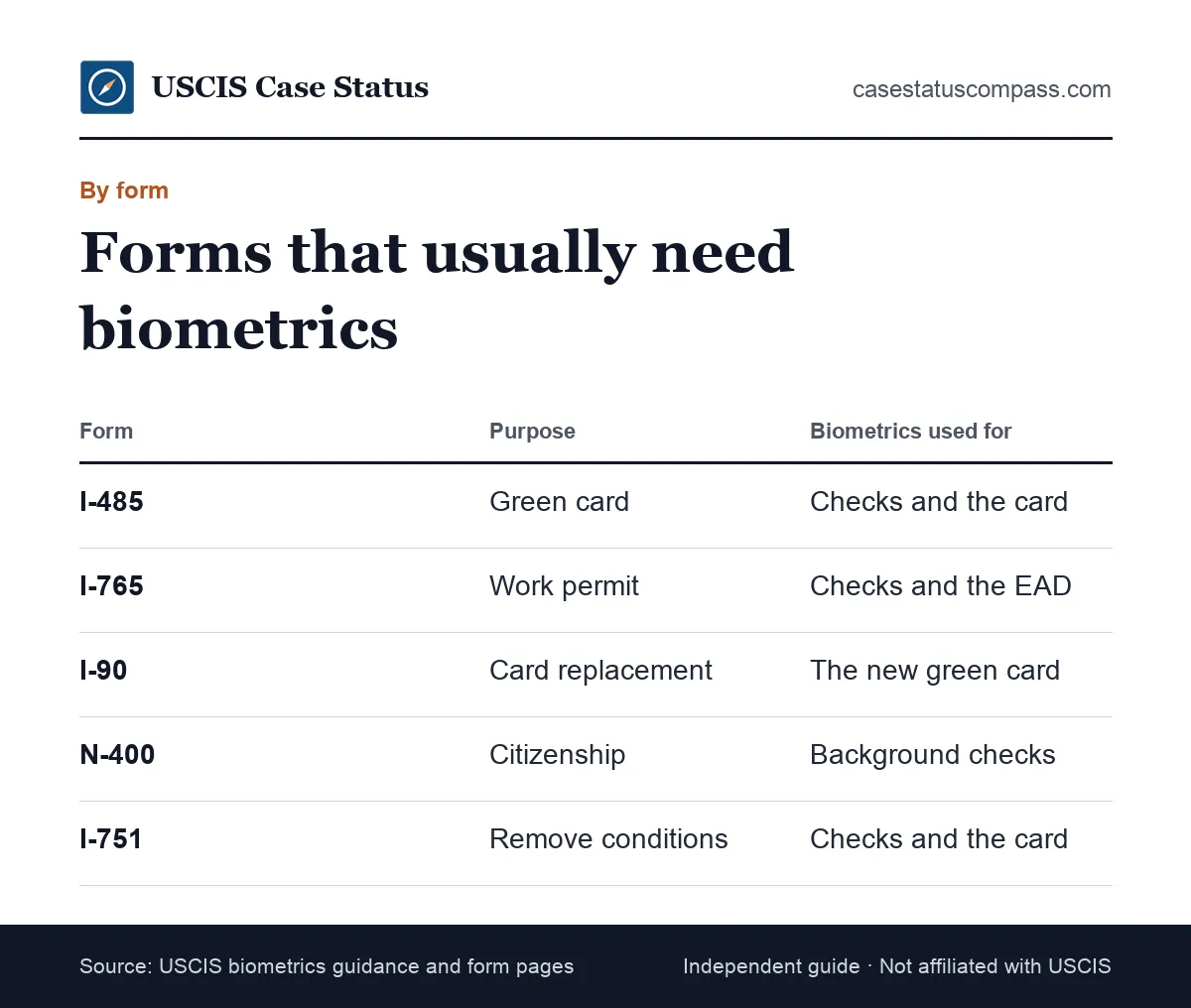
These are the forms most often linked to an ASC visit, with the reason USCIS takes your prints for each.
| Form | What it is for | What USCIS uses biometrics for |
|---|---|---|
| I-485 | Green card from inside the U.S. | Checks and the green card |
| I-765 | Work permit (EAD) | Checks and the EAD card |
| I-90 | Renew or replace a green card | The new card |
| N-400 | Citizenship | Background checks |
| I-751 | Remove conditions on residence | Checks and the 10-year card |
| I-821 | Temporary Protected Status | Checks and documents |
Children and age rules
Children listed on a case may get their own notice. USCIS says anyone 14 or older must sign. For younger ones, children under 14 don't have to sign; a parent or legal guardian may sign for them.
Do You Pay a Separate Biometrics Fee?
For most forms, no. Biometrics included in most fees (separate $30 for TPS I-821 and some EOIR forms). The biometrics fee was folded into most filing fees by the April 1, 2024 fee rule, so you pay it with your form fee.
When a separate biometrics fee still applies
As of the G-1055 edition dated October 16, 2026: $30 biometric services fee, only where G-1055 lists it (e.g., TPS I-821, some EOIR forms). Check our Form G-1055 fee schedule guide before filing, because fees change.
Never pay at the ASC
No one at the Application Support Center collects money. If someone asks you to pay to "book" or "speed up" biometrics, it is a scam.
Report the contact to the FTC: ReportFraud.ftc.gov, the FTC's scam reporting site.
What Does "Biometrics Appointment Was Scheduled" Mean?
Biometrics appointment was scheduled is a USCIS case status update. It means USCIS has set a date for your fingerprints and mailed you an I-797C notice with the time and ASC address. It is a normal early step, not a sign of a problem.
The status update vs the paper notice
The online status tells you an appointment exists; the appointment notice gives the details. If you have a USCIS online account, a digital copy often appears there. Use the notice, not the status line, to plan your trip.
What If Your Biometrics Appointment Notice Never Arrives?
If the status says scheduled but no letter comes, check your online account first. e-Request: report USCIS typos, missing notices or accommodation needs online. The appointment still stands even without the paper, so do not let the date pass while you wait for the mail.
Keep your mailing address current
A missing notice often traces back to an old address on file. Make sure USCIS has your current one: Report a new address to USCIS within 10 days of moving (INA 265). Our change of address guide explains how.
How Do You Read Your Biometrics Appointment Notice?
Your biometrics appointment notice is a Form I-797C, Notice of Action. It lists the applicant's name, receipt number, ASC address, date and time, and what to bring. I-797C = Notice of Action (receipt, rejection, transfer, appointment, re-open); not proof of status by itself.
Fields to check on the notice
- Applicant name and A-Number, if shown
- Receipt number of the case
- ASC address, date and time
- Instructions on ID and reschedule options
- A code telling staff which biometrics to collect
Our guide to the I-797C notice of action explains every part of the form.
What Do the Codes on a Biometrics Notice Mean?
Many notices show a short code that tells ASC staff what to collect. We could not confirm the meaning of each code on an official USCIS page, so do not try to decode it. Simply bring the notice; staff read the notice code at check-in. A relative's notice may show a different code, because different forms need different items.
How Do You Verify a Biometrics Notice Is Real?
Check that the receipt number on the biometric appointment letter matches your case in Case Status Online or your USCIS online account. Real notices come from USCIS by mail or appear in your account.
If the number shows no case, do not attend; contact USCIS instead.
Cross-check with official tools
Look up the receipt number on egov.uscis.gov and confirm the status says an appointment was scheduled. Then check the ASC address with the USCIS office locator. Our guide on how to verify a USCIS notice walks through each check.
Warning signs of a fake
- A request to pay a fee for the appointment
- A phone number or email that is not on uscis.gov
- An address that is not a listed ASC
- Pressure to act today or lose your case
What Is an Application Support Center?
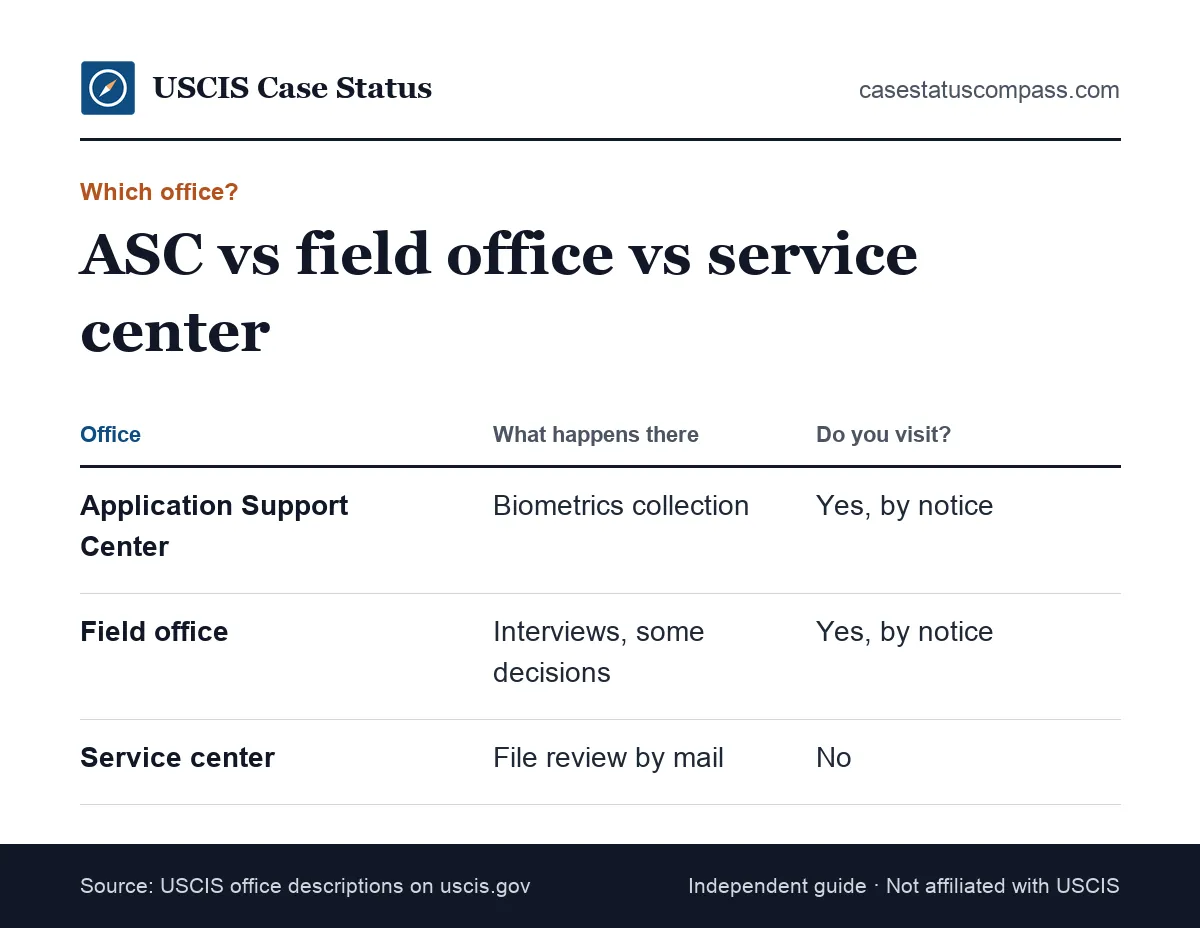
An Application Support Center (ASC) is a USCIS office whose main job is collecting biometrics. It is separate from the field office where interviews happen and from the service centers that review files by mail.
You do not choose your ASC; USCIS assigns it.
ASCs vs field offices and service centers
Some people search for a "US biometrics center" when they mean an ASC. Field offices hold interviews, while USCIS service centers handle paper processing and never meet applicants. Only the ASC takes your fingerprints for most cases.
Mobile and homebound biometrics
For homebound or mobile visits, USCIS says people who can't leave home or hospital for medical reasons can request a mobile or homebound biometrics appointment. Ask through the disability accommodation process or the Contact Center well before your date.
How Do You Find an ASC Near You?
USCIS assigns you an applicant support center based on the address on file, usually one near your home. To look up locations and hours, use the USCIS Service and Office Locator on uscis.gov.
The notice itself lists your assigned office.
Searching "ASC near me"
Search engines often show third-party listings for "ASC near me" or "biometric office near me." Confirm any address with the official USCIS locator before you travel.
Some listings are outdated or run by businesses.
Moving to a different ASC
USCIS is clear: you can switch ASCs only by rescheduling in advance; walk-ins at a different ASC are not processed. To switch, reschedule in your online account and pick the new location before the original appointment.
Can You Book a Biometrics Appointment Yourself?
No. You cannot book a biometrics appointment from scratch. USCIS schedules it after it accepts your filing and mails the notice. What you can do is reschedule an existing appointment, for good cause, through your USCIS online account.
Ignore sites that offer to book a slot for a fee.
Why you wait for USCIS
The appointment is linked to your receipt number and the codes for your form. If you filed months ago and never received a notice, check your status and contact USCIS.
Services that claim to book slots
Some websites offer to "book" or "get earlier" biometrics for a fee. They cannot do anything you cannot do yourself in your free account. Our guide to USCIS scams shows how to spot them.
What Should You Bring to Your Biometrics Appointment?
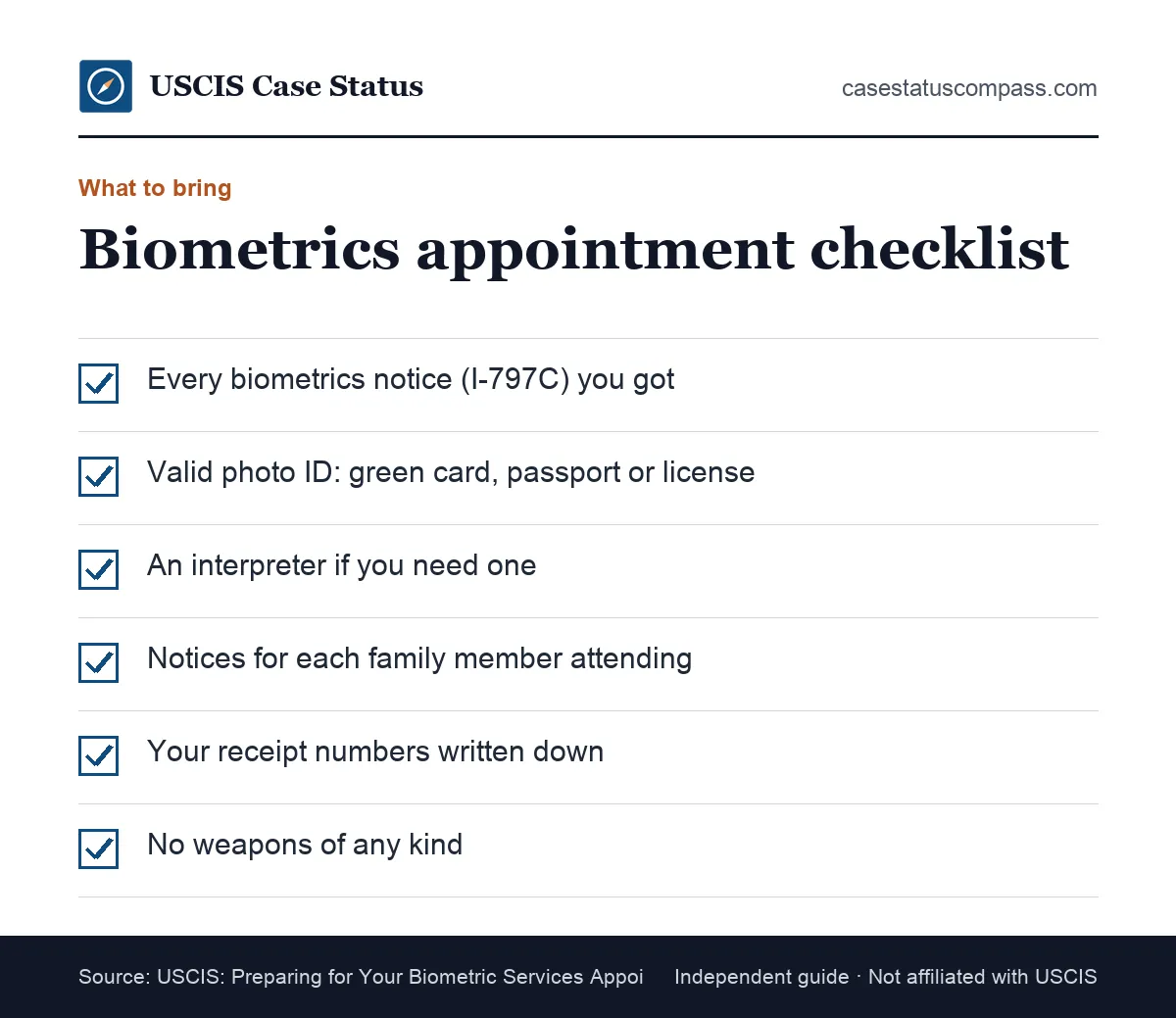
Bring two things USCIS requires: every biometrics notice you received and a valid photo ID such as a green card, passport or driver's license. USCIS also says you may bring an interpreter if you do not understand spoken English.
The night before, check that the name on your ID matches the name on the notice, and bring proof of any legal name change if they differ.
The required items
- Your I-797C appointment notice (all of them if you got more than one)
- Valid photo ID: green card, passport or driver's license
- Notices for any child or relative booked with you
Helpful extras
These items are not required, but they make check-in and signing smoother:
- A list of your receipt numbers
- Your EAD or other immigration card, if you have one
- Glasses you need to read and sign
What If Your ID Has Expired or You Have None?
USCIS asks for a valid photo ID. If your only ID has expired or you have none, contact USCIS before the appointment to ask what the ASC will accept. Do not wait until the day; staff may turn you away without acceptable identification.
Ask before the date
Call the Contact Center at 800-375-5283 (TTY: 800-767-1833) or use Emma, USCIS's online virtual assistant (English and Spanish), on uscis.gov. Explain what ID you have. If you need more time to get ID, ask to reschedule more than 12 hours ahead.
Keep the paper trail
If you have a receipt for a passport renewal or a pending ID, bring it along with any other photo ID you have. Note the date and name of anyone you speak with at USCIS.
What Should You Leave at Home?
Leave all weapons at home: federal law bans weapons, including firearms, knives, pepper spray and ammunition, at every USCIS facility. Rules on phones, food and large bags can differ by ASC, so check your notice. If you carry something banned, you may be turned away and have to reschedule.
Weapons and banned items
Pepper spray and pocket knives are the items people forget most often. Security will not hold them for you, so you may have to leave and return, risking your appointment slot. Empty your pockets and bag at home.
Phones and personal items
Many ASCs allow phones but ban photos or calls inside. A small folder with your notice and ID is all you truly need.
Follow the guards' instructions on silencing devices.
What Happens at the Application Support Center, Step by Step?
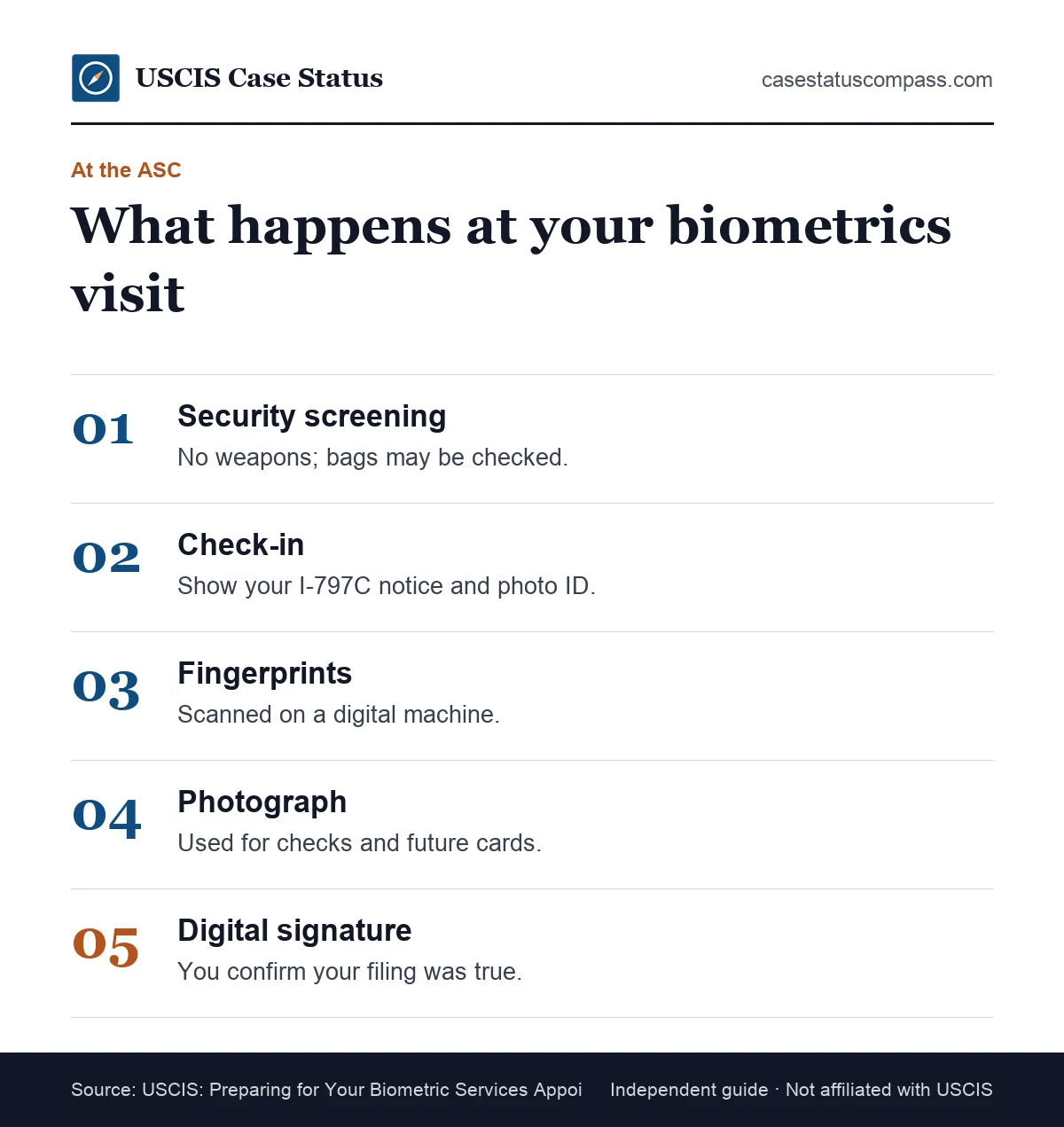
At the ASC you pass security, check in with your notice and ID, wait to be called, then give your fingerprints, photo and signature at a station. Staff confirm your details and you leave.
Most visits are short once you are called.
Security and check-in
A guard screens you at the door. At the front desk, staff check your notice and ID and give you a number or ask you to wait. Family members with their own notices check in at the same time.
At the biometrics station
A technician scans your fingers on a digital machine, takes your photo and asks you to sign on an electronic pad. If a print does not scan well, they may repeat it. You may also be asked to confirm your name and birth date.
Before you leave the ASC
Check that every family member with a notice has finished before anyone leaves. Keep your appointment notice afterward; staff often stamp it, and it is your proof that you attended if a question comes up later.
What Is the Digital Signature at Biometrics?
USCIS explains that for some forms you give a digital signature at the ASC to reaffirm your application. With this digital signature, USCIS says you are reaffirming that everything in your filing was "complete, true, and correct at the time of filing," under penalty of perjury. Treat it as seriously as signing the form itself.
What you are confirming
By signing, you confirm your form was accurate when you filed it. If you realize something on your form was wrong, do not sign to cover it up. Tell USCIS and consider talking to an immigration attorney before the appointment.
Signatures for children
Applicants 14 or older must sign. For younger children, a parent or legal guardian may sign, or the child may sign if able. Bring the child's notice and be ready to help them with the photo.
Can You Correct Mistakes on Your Case at the ASC?
No. USCIS says, "We cannot change your name or other personal information during your ASC appointment." ASC staff collect biometrics only. To fix a typo or update details, use the official correction channels instead.
Report a USCIS typo with e-Request after your visit.
How to fix errors instead
If USCIS made a typo on a notice, use the online e-Request tool. For other changes, such as a new address, update your account. A legal name change usually needs evidence sent to the office handling your case.
Race and ethnicity entries
USCIS notes that ASC systems may limit race and ethnicity to a single category. Your original answers on the form stay in your permanent record, so the ASC entry does not change what you filed.
How Long Does a Biometrics Appointment Take?
The collection itself is short, often just a few minutes at the station. USCIS publishes no official length for a biometrics appointment, and the total visit depends on how many people are waiting. Plan for extra time so you are not rushed.
Time at the station
Fingerprints, photo and signature take little time when prints scan cleanly. Dry or worn fingertips can take longer to capture. Children and family groups take longer because each person goes through the steps.
Waiting and travel
The line at security and the wait after check-in vary by ASC and time of day. Arrive a little before your slot, allow for parking.
Early morning slots are often quieter, but crowds vary, so leave extra time for traffic.
Can You Walk In Early for Biometrics?
USCIS's preparation page does not address walk-ins or early visits. Go on the date and time on your notice. Arriving a little early on your own date is wise; showing up on a different day without rescheduling may mean you are turned away.
Arriving early on your own date
Some ASCs may take you before your slot if they are not busy, but that is not guaranteed. Getting there early mainly protects you from traffic, parking and security delays.
Coming on a different day
If you need an earlier or later day, reschedule officially. Turning up unannounced on another date risks being sent home and leaves your real appointment in place.
you can switch ASCs only by rescheduling in advance; walk-ins at a different ASC are not processed.
Can Family, a Lawyer or an Interpreter Come With You?
Yes. USCIS says family members, attorneys or accredited representatives may come with you, but your attorney does not need to attend. If you do not understand spoken English, you may bring an interpreter.
Guests may be asked to wait outside the station.
Family members with appointments
Each person needs their own notice. If relatives have notices for different dates or ASCs, they must follow their own notice or reschedule. Do not assume a parent's notice covers a child.
Interpreters and representatives
An interpreter helps you follow instructions at check-in and at the station. A lawyer is rarely needed, since staff ask no questions about your eligibility.
Bring the interpreter's photo ID too.
How Do You Reschedule a Biometrics Appointment?
You can reschedule biometrics in your USCIS online account if you have good cause and act at least 12 hours before the appointment. Reschedule biometrics online at least 12 hours before, with good cause, or call the Contact Center. Do not mail a reschedule request.
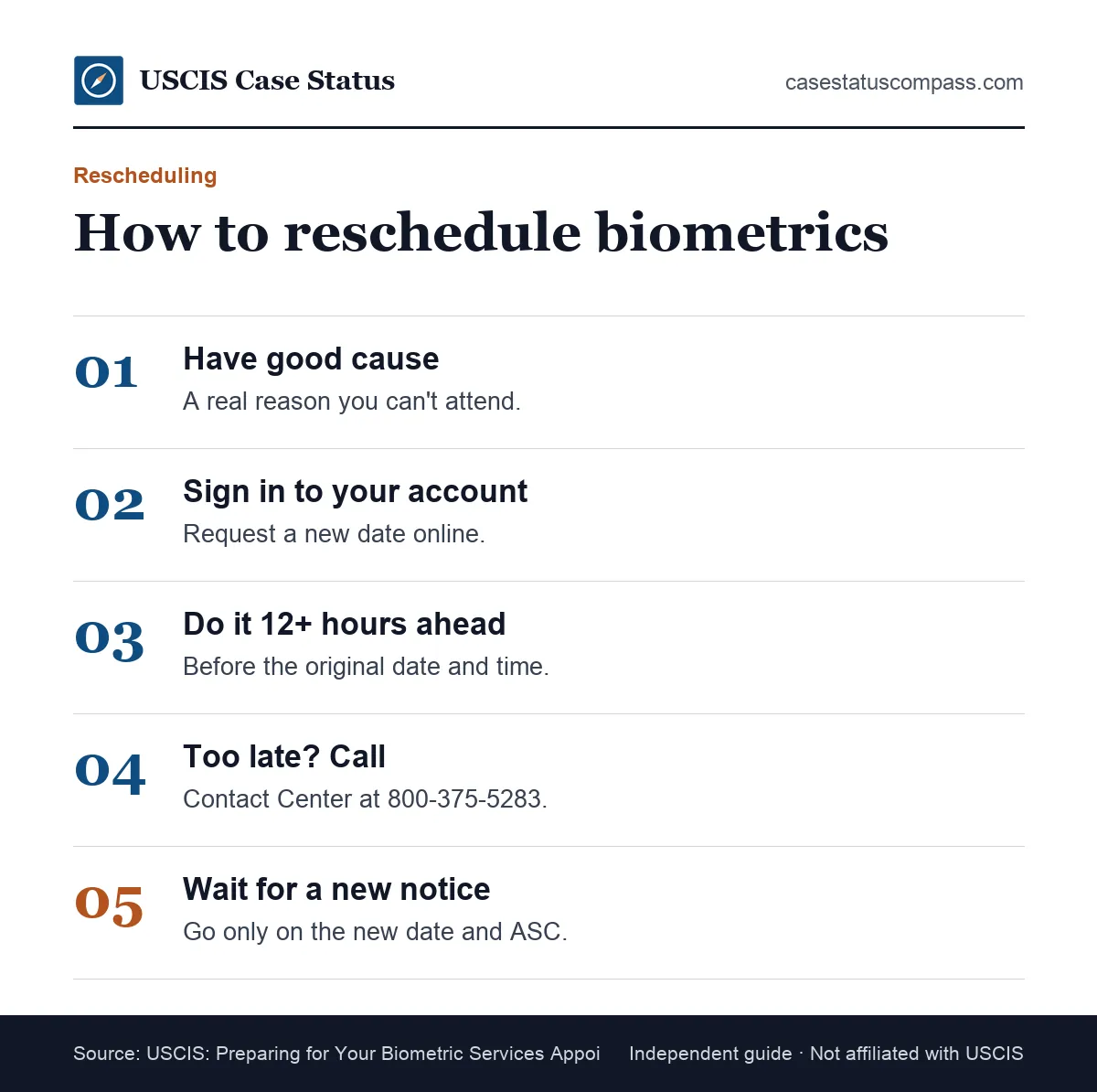
Rescheduling online
- Sign in to your USCIS online account.
- Open the case and choose the reschedule option.
- Give the reason and pick a new date or ASC.
- Save the new notice and use only that one.
Our guide to the USCIS online account explains how to link a paper case.
When it is less than 12 hours away
USCIS says to call the Contact Center at 800-375-5283 if you are within 12 hours or already missed the appointment. You can also use Emma, USCIS's online virtual assistant (English and Spanish), on uscis.gov.
What Counts as Good Cause to Reschedule Biometrics?
USCIS requires good cause to reschedule but its preparation page does not list every reason. Common examples include illness, a medical procedure, a family emergency, a funeral, or travel booked before the notice arrived. Keep proof of your reason.
Ask for the new date before the original appointment passes, so the record shows a reschedule rather than a missed visit.
Strong reasons
These are examples of serious conflicts, each paired with the proof worth keeping in case USCIS asks.
| Reason | Proof to keep |
|---|---|
| Illness or hospital stay | Doctor's note or discharge papers |
| Birth of a child | Hospital record |
| Death in the family | Funeral notice |
| Court date or jury duty | Court notice |
| Travel booked before the notice | Booking confirmation |
Weaker reasons
Wanting a closer date, a routine work shift or simple inconvenience are weaker reasons. Each reschedule pushes your case back, so attend the original date whenever you can.
Ask your employer for time off first.
What If You Miss Your Fingerprint Appointment?
If you miss biometrics without rescheduling in time or without good cause, USCIS may consider your case abandoned and deny it. Missing biometrics can lead to denial for abandonment. Act the same day you realize you missed it.
The sooner you contact USCIS, the more likely your explanation reaches the file before an officer makes a decision.
What to do right away
Call the Contact Center at 800-375-5283, explain why you missed it and ask for a new date. Keep proof of your reason, such as a medical note, and write down the call details.
Can You Fix a Denial After Missing Biometrics?
Sometimes, but a denial for abandonment can be hard to undo. Read the notice carefully, note its date and talk to an immigration attorney quickly, because the time to act is short. Our page on options after a case is denied explains the general paths.
Filing a motion to reopen
A motion on Form I-290B is a common route. The timing rule: Appeal or motion: file within 30 days (33 if the decision was mailed). Reopen = new facts and evidence; reconsider = the decision got the law or policy wrong. Gather proof of good cause, such as a medical record or evidence the notice went to a wrong address.
How Do You Request Accommodations for Biometrics?
You can request a disability accommodation for your ASC appointment. As of October 2026, the official route is: request accommodations online or at 800-375-5283; asylum and NACARA 203 applicants must call. Ask early, because special arrangements take time.
Give your receipt number and the date and ASC location from your notice, so the request is matched to the right visit.
Types of help you can ask for
Examples include wheelchair access, a sign language interpreter or extra time at the station. For people who cannot leave home or hospital, ask about a homebound or mobile appointment.
State the exact help you need and why, so the ASC can arrange it before your date rather than on arrival.
Ask early
Make the request as soon as the notice arrives. Accommodations can take time to arrange, and a late request may mean rescheduling.
Keep a record of the request date and any reply.
What Happens After Biometrics?
After biometrics, USCIS runs background and security checks and your case moves to review. What comes next depends on the form: an interview, a request for evidence, a card or a decision. Your status may show that fingerprints were taken, then active review.
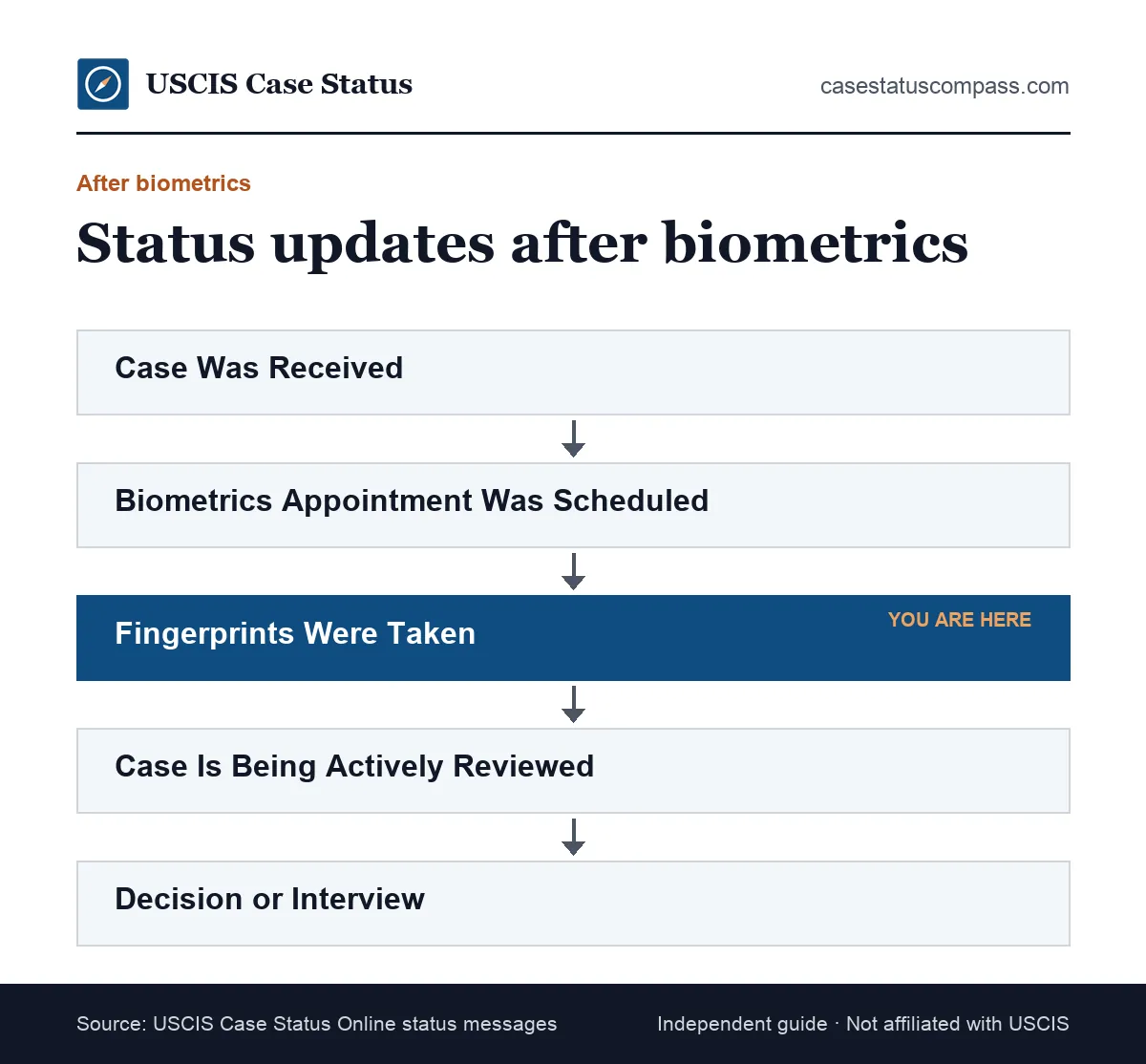
Status updates you may see
Many cases show a fingerprint update, then the message that your case is being actively reviewed by USCIS. Others show nothing for weeks. Both are normal; the checks run in the background.
What you should do
Keep your address current, watch your mail and online account, and do not travel abroad on a pending green card case without permission. You do not need to contact USCIS just because biometrics are done.
What Happens After a Biometrics Appointment for a Green Card?
After green card biometrics for Form I-485, USCIS completes background checks and then either schedules an interview at your field office or, in some cases, decides without one. Green card interviews are required unless waived; the family petitioner usually attends too.
The interview stage
Most applicants next receive an interview notice. Our guide to green card interview questions covers what to expect. How long the gap lasts varies; our guide on how long after biometrics the interview comes covers that question in depth.
Linked work and travel permits
If you filed Form I-765 or I-131 with your I-485, the same biometrics usually serve those forms. The EAD or travel document may arrive before the green card decision. See our Form I-485 guide for the full process.
Travel while the I-485 is pending
Finishing biometrics does not make international travel safe. Traveling while your I-485 is pending abandons it unless you have advance parole (with H/L/V/K exceptions). If you must leave, wait until the advance parole document is in hand; our Form I-131 travel document guide explains it.
After Biometrics for a Work Permit or Card Replacement
For Form I-765 and Form I-90, biometrics usually lead straight toward a card. USCIS says the biometrics produce the EAD or replacement green card, so after review you may see an approval and card production update.
Watch your account for these messages.
Work permit (I-765)
After biometrics, the EAD application goes to review, then approval and card production. Read our Form I-765 work permit guide for filing rules and edition requirements.
The new card is mailed to your address on file.
Green card replacement (I-90)
After biometrics, many I-90 cases move to card production without an interview. Our Form I-90 renewal guide explains what the receipt notice proves while you wait.
Keep it with your expired card.
After Biometrics for Citizenship and I-751 Cases
For Form N-400, biometrics are followed by the citizenship interview, where you also take the English and civics test. For Form I-751, USCIS may decide the case from the file or call you to an interview.
Neither form has a fixed wait after biometrics, so check the processing times tool for your form and office rather than counting weeks.
Citizenship (N-400)
Next comes the citizenship interview and the naturalization civics test. If approved, the last step is the oath ceremony, where you become a citizen.
Watch for the interview notice by mail.
Removal of conditions (I-751)
After biometrics, an I-751 is reviewed and either approved, sent an evidence request or set for interview. See our Form I-751 guide for what the receipt notice extends.
Store the I-751 receipt notice with your green card, because the notice is what extends the card while the case is pending.
How Long After Biometrics Until a Decision?
USCIS publishes no separate "after biometrics" wait. The total time depends on the form and office. For a green card, USCIS's median for April–June 2026 is shown below with its date, and the official tool shows current times.
The two numbers measure different things, so they rarely match.
Official numbers for green card cases
I-485 (family): median 7.0 months (USCIS data, Apr.-June 2026); I-485 (employment): median 6.0 months (USCIS data, Apr.-June 2026). These cover the whole case, not just the time after biometrics. Right now, family and employment I-485 cases take 8.5 to 42.5 months, depending on category and office (USCIS data retrieved Oct 27, 2026). Our green card processing time page explains both measures.
When Should You Contact USCIS About a Delay After Biometrics?
Case inquiry date: the earliest date USCIS will accept a question about your pending case; it can change. Before that date, waiting is normal, even if your status has not changed since the fingerprint visit. After it, you can submit an inquiry through your account or call the Contact Center. Have your receipt number and biometrics date ready.
Will USCIS Call You Back for Biometrics Again?
Sometimes. A second biometrics appointment can happen if your fingerprints could not be read, if you file a new application, or if your case is reopened. A new notice simply means USCIS needs another capture; go to it like the first.
New filings and renewals
Each new filing, such as a work permit renewal or a later N-400, can bring its own notice. Keep every notice with your records so you know which case each one belongs to.
What If Your Fingerprints Cannot Be Read?
Worn or damaged fingertips can produce prints the FBI rejects. Manual work, some skin conditions and age can all wear down the ridges. If this happens, USCIS usually sends a new biometrics notice; attend it and follow its instructions, because a second capture is the normal fix.
Twice-rejected prints and the interview
The USCIS Policy Manual lists twice-rejected fingerprints among reasons a green card case may need an interview. Bring every biometrics notice you received to that interview so the officer can see each attempt.
Can You Get Your FBI Record From Your Biometrics?
USCIS points applicants to the FBI's own process. You can get your FBI Identity History Summary through the procedures in 28 CFR 16.32, and challenge errors under 28 CFR 16.34. The ASC itself does not give you a copy of your record.
Why you might want it
If you have any arrest history, knowing what the FBI record shows helps you prepare court records before an interview. It also lets you correct mistakes, such as a charge shown without its dismissal.
Getting legal advice
If the record shows anything unexpected, talk with an immigration attorney before your interview. Old or minor incidents can still matter in immigration cases.
Bring a copy of the record to that meeting so the attorney can review each entry.
Biometrics Timeline: From Notice to Next Step
The biometrics timeline starts with your receipt notice and ends with the next step in your case. The table shows the order and your tasks, not official durations, which vary by form and office.
Track each stage in your online account.
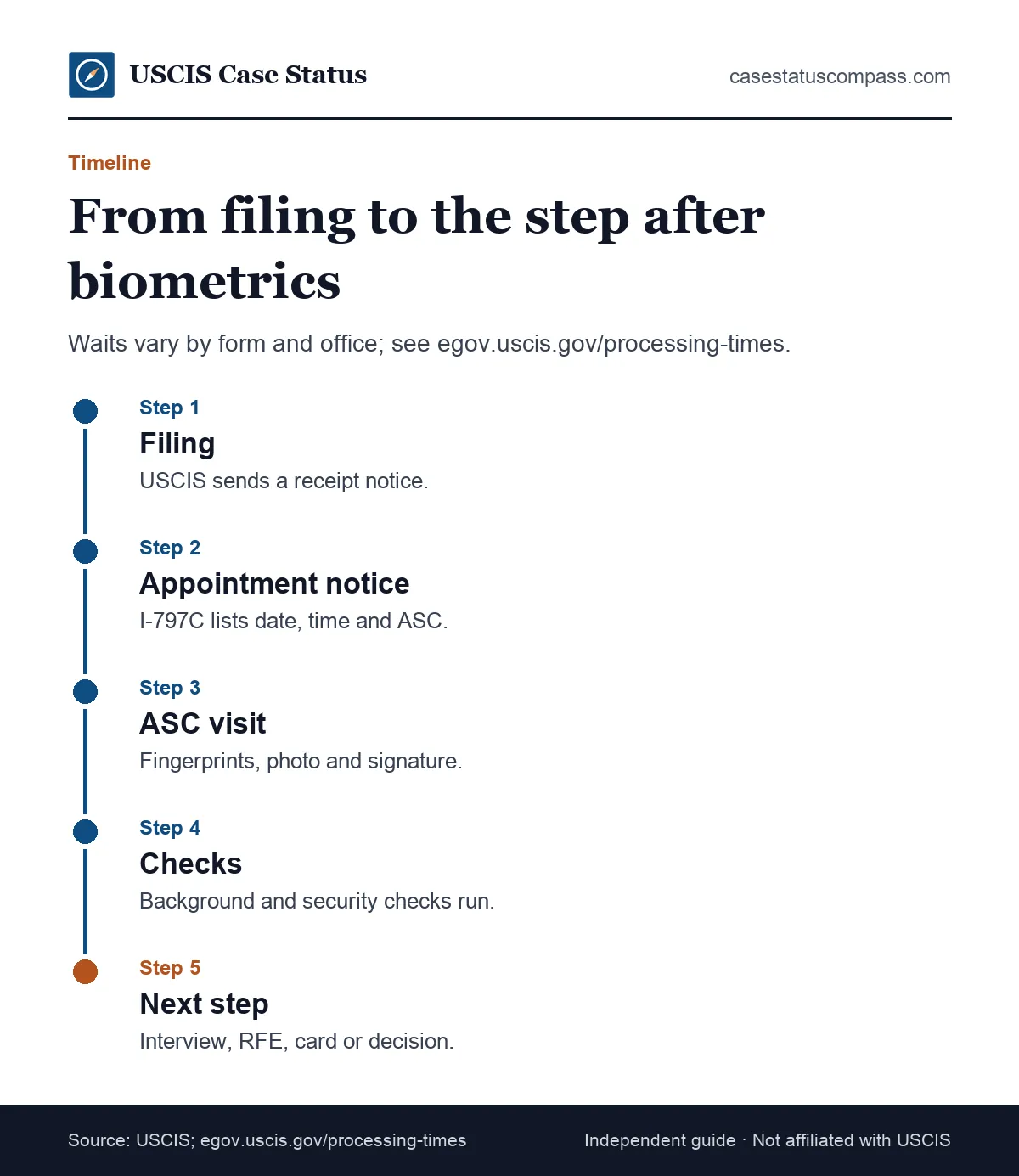
Stage-by-stage table
Read the table top to bottom; each stage starts only after the one above it is complete.
| Stage | What happens | What you do |
|---|---|---|
| Filing | USCIS accepts your form | Save the receipt notice |
| Notice | I-797C gives the ASC, date and time | Check details and ID |
| ASC visit | Prints, photo, signature | Bring notice and ID |
| Checks | FBI and security checks run | Keep your address current |
| Next step | Interview, RFE, card or decision | Watch mail and account |
Where the receipt notice fits
The first notice you get is usually the receipt. Our page on the case was received status explains what it means before biometrics are set.
Save it with your biometrics notice.
Biometrics vs Interview vs Medical Exam: Which Is Which?
A biometrics appointment collects identity data at an ASC. A green card interview tests eligibility with an officer at a field office. The immigration medical exam is done by a civil surgeon you choose. All three are separate steps.
Biometrics and interviews each come with their own USCIS notice, while you book the medical exam yourself with the civil surgeon.
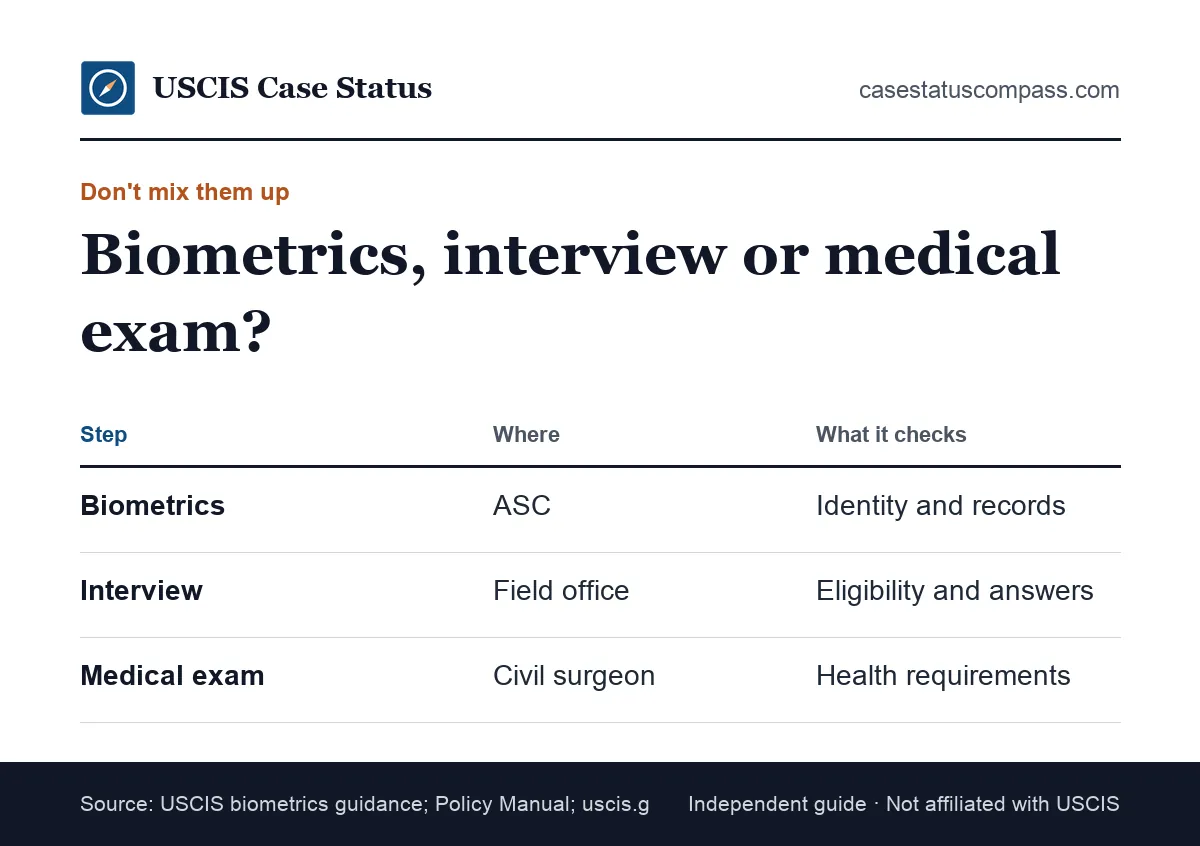
Side-by-side comparison
The comparison shows who runs each step, how it is scheduled and what you leave with.
| Point | Biometrics | Interview | Medical exam |
|---|---|---|---|
| Who runs it | ASC staff | USCIS officer | Civil surgeon |
| Questions about your case | No | Yes | Health only |
| How it is set | USCIS notice | USCIS notice | You book it |
| Result | Prints and photo | Decision or RFE | Sealed I-693 |
The medical exam is your job
Unlike biometrics, you arrange the medical exam yourself. Our guide to the immigration medical exam (Form I-693) explains how and when.
Send the sealed I-693 with your I-485 (required since Dec. 2, 2024), so many applicants complete it before biometrics.
Mistakes to Avoid With Your Biometrics Appointment
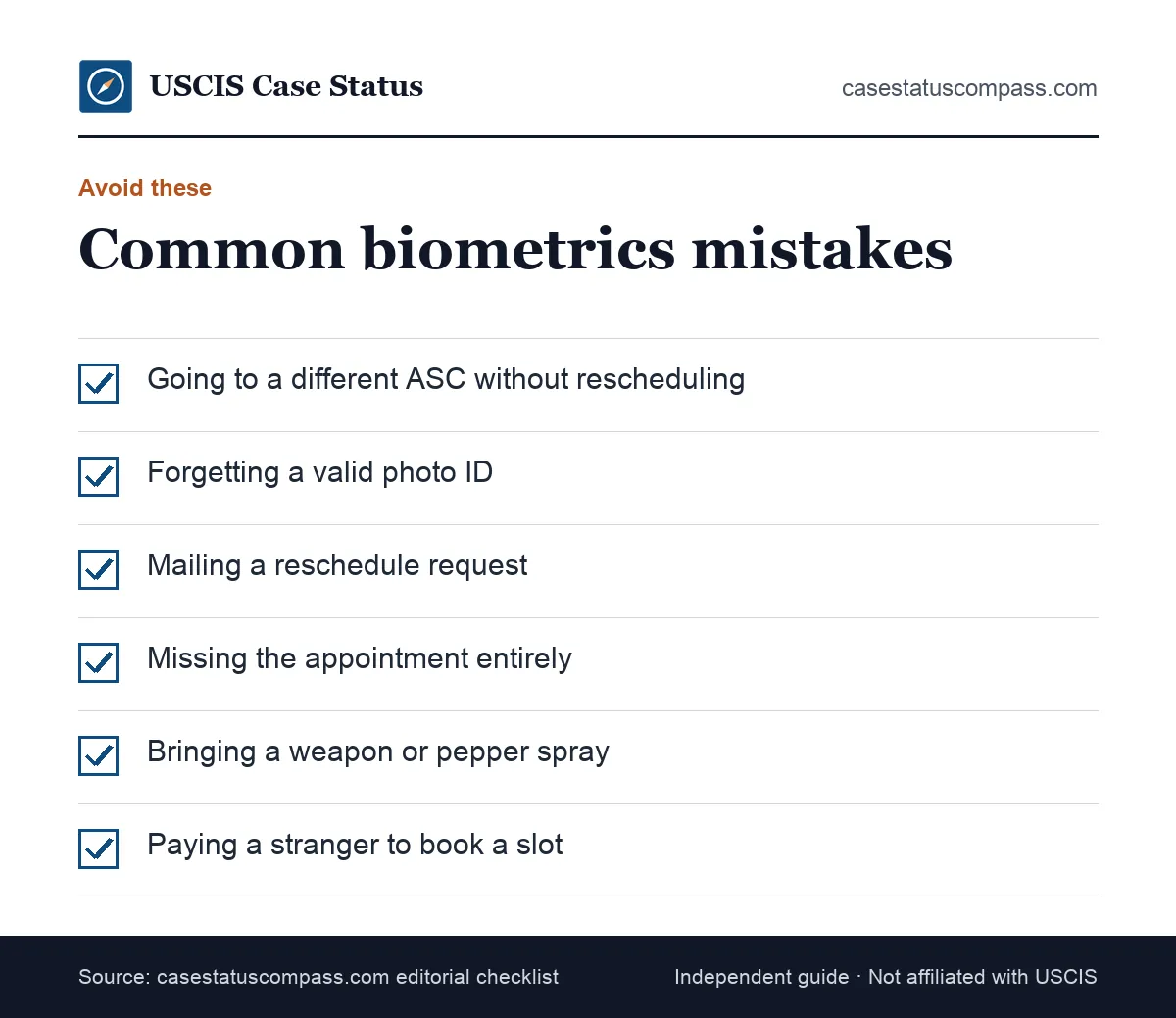
The costliest biometrics mistakes are missing the date, going to the wrong ASC and forgetting a valid ID. Each one can delay your case or, in the worst case, lead to a denial for abandonment.
Reading the notice the day it arrives, checking the ASC address and setting out your ID the night before prevents all three.
Scheduling mistakes
- Going to a different ASC without rescheduling
- Mailing a reschedule request instead of using your account
- Waiting until under 12 hours before to ask
- Ignoring a notice because the status already changed
Day-of mistakes
Forgetting ID or the notice
Bringing pepper spray or a pocket knife
Leaving before all family members are done
Signing without reading what the signature confirms
Going to an ASC other than the one on your notice
If X, Do Y: Biometrics Decision Table
Use these tables when something unexpected happens around your ASC biometrics appointment. Each row gives the safest next step. For denials or criminal records, talk to an immigration attorney.
Keep proof of every contact with USCIS, such as a confirmation page or a call date.
Before the appointment
These rows cover common problems that come up between the notice and your ASC visit.
| If… | Then… |
|---|---|
| Status says scheduled, no letter | Check your account; use e-Request |
| You moved | Update your address; reschedule to a new ASC |
| You are sick | Reschedule online 12+ hours ahead |
| Under 12 hours to go | Call the Contact Center |
After the appointment
These rows cover what to do once your prints have been taken and you are waiting.
| If… | Then… |
|---|---|
| No update for weeks | Normal; check your inquiry date |
| A second notice arrives | Attend it; keep both notices |
| Interview notice arrives | Prepare documents and answers |
| You missed the date | Call USCIS the same day |
Printable Biometrics Day Checklist
This printable checklist covers the night before and the morning of your visit. Print it or save it on your phone.
Tick each item as you go, and keep the list with your notice so every family member with an appointment is covered.
The night before
Find every biometrics notice in the household.
Check each name, date, time and ASC address.
Put valid photo IDs in one folder.
Plan your route and parking.
Set an alarm with time to spare for traffic.
At the ASC
- Arrive a little early, on your own date.
- Check in each family member together.
- Read the signature screen before signing.
- Keep the notice; you may need it later.
For a full map of every USCIS appointment, see our USCIS interviews and biometrics hub.
Frequently Asked Questions
Is the biometrics appointment an interview?
No. A biometrics appointment only collects fingerprints, a photo and a signature at an Application Support Center. Staff do not ask about your eligibility and cannot see your case file. If your case needs an interview, USCIS sends a separate notice for a field office, usually after your background checks are done.
Do I have to attend biometrics if I did it before?
Yes, if you receive a notice, attend it. USCIS decides when it needs new biometrics, such as for a new application or unreadable prints. Ignoring a notice because you gave fingerprints in the past can lead USCIS to treat the case as abandoned.
Can I bring my children to the biometrics appointment?
Yes. Children with their own notices must attend, and you can usually bring younger children who have none. Bring each child's notice and a quiet activity in case the wait is long.
Can I go to a different ASC than the one on my notice?
Not without rescheduling first. USCIS warns that going to a different ASC without rescheduling means your appointment will not be processed. Use your USCIS online account to reschedule and pick the new location, at least 12 hours before your original appointment, and bring the new notice.
Will biometrics show my criminal record?
Your fingerprints are checked against FBI and other records, so arrests usually appear even if charges were dropped. That is why you should disclose every arrest on your forms and bring certified court records to any interview. If you are worried about your record, talk to an immigration attorney before your appointment.
Can I change my name at the biometrics appointment?
No. USCIS says it cannot change your name or other personal information during your ASC appointment. Use e-Request for a USCIS typo, update your address in your online account, and send name-change evidence to the office handling your case.
Does a biometrics appointment mean my case will be approved?
No. Biometrics is a routine step that almost every applicant goes through, so it says nothing about the outcome. It shows USCIS accepted your filing and is starting background checks. The decision comes later, after an officer reviews your file and, in many cases, interviews you.
Can someone else go to my biometrics appointment for me?
No. The visit captures your own fingerprints, photo and signature, so you must attend in person with your notice and photo ID. A relative, attorney or interpreter may come with you but cannot replace you. If you cannot attend, reschedule for good cause instead.
What should I wear to biometrics?
Wear normal, comfortable clothing. Your photo may be used on a card, so avoid hats and anything that hides your face unless worn for religious or medical reasons. Remove sunglasses for the photo. There is no dress code.
Sources
- USCIS: Preparing for Your Biometric Services Appointment (updated 04/30/2026). www.uscis.gov/forms/filing-guidance/preparing-for-your-biometric-services-appointment. Accessed Oct 27, 2026.
- USCIS: Form I-797 Types and Functions. www.uscis.gov/forms/filing-guidance/form-i-797-types-and-functions. Accessed Oct 27, 2026.
- USCIS Form G-1055 Fee Schedule (Edition 10/16/26). www.uscis.gov/sites/default/files/document/forms/g-1055.pdf. Accessed Oct 27, 2026.
- USCIS Contact Center. www.uscis.gov/contactcenter. Accessed Oct 27, 2026.
- USCIS Policy Manual, Vol. 7, Part A, Ch. 5: Interview Guidelines. www.uscis.gov/policy-manual/volume-7-part-a-chapter-5. Accessed Oct 27, 2026.
- USCIS: How to Change Your Address. www.uscis.gov/addresschange. Accessed Oct 27, 2026.
- USCIS Check Case Processing Times. egov.uscis.gov/processing-times/. Accessed Oct 27, 2026.
- USCIS Data Library: All Forms, FY2026 Q3. www.uscis.gov/sites/default/files/document/data/quarterly_all_forms_fy2026_q3_v1.xlsx. Accessed Oct 27, 2026.
- FTC: How To Avoid Immigration Scams and Get Real Help (Nov. 2023); USCIS Report Immigration Scams page. consumer.ftc.gov/articles/how-avoid-immigration-scams-and-get-real-help. Accessed Oct 27, 2026.
- USCIS: Form I-290B page (updated 10/26/2026). www.uscis.gov/i-290b. Accessed Oct 27, 2026.
- 8 CFR 103.5(a) (LII). www.law.cornell.edu/cfr/text/8/103.5. Accessed Oct 27, 2026.
- Form I-485 Instructions, Edition 09/18/26. www.uscis.gov/sites/default/files/document/forms/i-485instr.pdf. Accessed Oct 27, 2026.
- CIS Ombudsman tip sheet: Check Your USCIS Case Inquiry Date (Aug. 2024). dhs.gov/sites/default/files/2024-11/24_0823_cisomb_case-inquiry-date-tip-sheet.pdf. Accessed Oct 27, 2026.
- USCIS: Form I-693 page (updated 07/24/2026); I-485 Instructions 09/18/26. www.uscis.gov/i-693. Accessed Oct 27, 2026.
casestatuscompass.com is an independent publication and is not affiliated with USCIS or any government agency. This page is general information, not legal advice. For denials, court or asylum matters, consult an immigration attorney or a DOJ-accredited representative.