Contents · 36 sections
- How Much Does an Immigration Medical Exam Cost?
- What Is Form I-693?
- Who Needs an Immigration Medical Exam?
- Who Can File Only the Vaccination Part of Form I-693?
- What Is a Civil Surgeon?
- Civil Surgeon vs Panel Physician: What Is the Difference?
- What Makes Up the Immigration Medical Exam Cost?
- Which Tests Are Part of the Immigration Medical Exam?
- Do You Need a Chest X-Ray?
- What Vaccines Does the I-693 Require?
- How Do Vaccination Records Lower Your Exam Cost?
- What If You Cannot or Will Not Get a Vaccine?
- Does Insurance Cover the Immigration Medical Exam?
- Can You Get Missing Vaccines From Your Own Doctor First?
- How Do You Compare Civil Surgeon Prices?
- Should You Choose the Cheapest Civil Surgeon?
- How Much Does the Medical Exam Cost for Children and Families?
- Cost of Green Card Medical Exam by Situation
- Worked Example: Estimating Your Exam Bill
- How Do You Prepare for the Immigration Medical Exam?
- What Happens During the Immigration Medical Exam?
- How Long Does the Exam Process Take?
- What Is eMedical?
- Why Does the Sealed Envelope Matter?
- When Must You Submit Form I-693?
- How Long Is Form I-693 Valid?
- What Happened to the 60-Day Signature Rule?
- Does a Denied or Withdrawn I-485 Mean a New Exam?
- What Are Class A and Class B Medical Conditions?
- Can You Fail the Immigration Medical Exam?
- What I-693 Mistakes Cost You Money?
- What If USCIS Sends an RFE About the Medical Exam?
- Is Form N-648 the Same as the I-693 Exam?
- Does a Fee Waiver Cover the Medical Exam?
- How Immigration Medical Exam Cost Fits Your Green Card Budget
- Frequently Asked Questions
The short answer
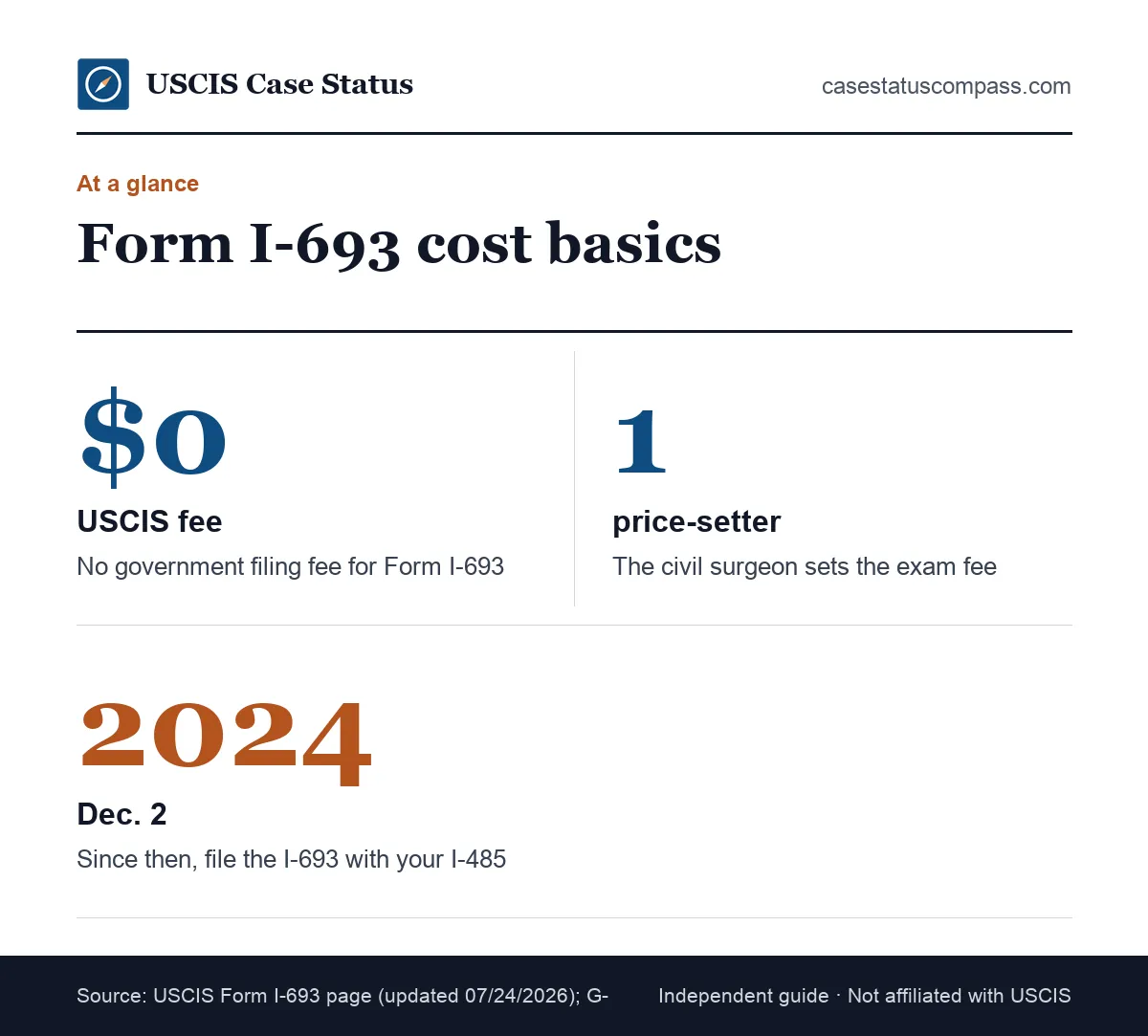
Immigration medical exam cost is set by the civil surgeon, not USCIS: $0 USCIS fee; the civil surgeon sets the exam price. Your bill depends on the clinic's base fee plus any TB test, blood tests, chest x-ray and vaccines you still need. Compare several civil surgeons, bring your vaccination records, and file the sealed Form I-693 with your I-485.
At a glance
| USCIS fee for Form I-693 | $0 USCIS fee; the civil surgeon sets the exam price |
| Who sets the price | Each USCIS-designated civil surgeon |
| When to file it | Send the sealed I-693 with your I-485 (required since Dec. 2, 2024) |
| How long it lasts | An I-693 is generally valid only for the application it was filed with |
| Biggest cost drivers | Missing vaccines, extra lab tests, follow-up visits |
This guide expands on the medical step in our Form I-485 adjustment of status guide.
How Much Does an Immigration Medical Exam Cost?
The immigration medical exam cost has no official price. USCIS charges no filing fee for Form I-693, and each civil surgeon sets their own fee. USCIS itself says fees vary and suggests calling several doctors to compare. Your final bill also depends on tests and vaccines.
Why prices differ between clinics
Clinics bundle services differently. One quote may include the TB blood test and paperwork; another may bill each lab test and vaccine separately. Compare itemized quotes, not headline prices.
What USCIS charges
As of October 2026, the G-1055 fee schedule (edition 10/16/26) lists $0 USCIS fee; the civil surgeon sets the exam price. You still pay the I-485 filing fee separately: $1,440 (paper) / $1,390 (online); $950 / $900 if under 14 and filing with a parent. Our green card fee breakdown shows the full government side.
What Is Form I-693?
Form I-693, the Report of Immigration Medical Examination and Vaccination Record, is the civil surgeon's record showing you are not inadmissible on health grounds. Most people applying for a green card inside the U.S. need one. You fill in Part 1; the doctor completes the rest and seals it.
Who completes which part
You complete your personal details in Part 1 but do not sign until the civil surgeon tells you to. The doctor records the exam, lab results and vaccinations, then signs. USCIS rejects unsigned forms, so both signatures matter.
The current edition
The current edition is 01/20/25. If the civil surgeon signed on or after July 3, 2025, only that edition is accepted. Check that the edition date appears on every page.
Who Needs an Immigration Medical Exam?
Nearly everyone applying for a green card through adjustment of status inside the U.S. needs a full I-693 exam. Some refugees, asylee family members, K visa holders and certain Afghan nationals may submit only the vaccination part.
If you are unsure which group you fall into, check the I-693 instructions first.
Adjustment of status applicants
Family, employment and humanitarian applicants filing Form I-485 usually need the exam. Spouses in a marriage-based green card case and relatives of a Form I-130 petitioner are included. Each family member needs their own form.
Applicants in immigration court
If your green card application is before an immigration judge, follow the instructions from the immigration judge or office that asked for the exam. Our immigration court case status guide explains how to check court dates.
Who Can File Only the Vaccination Part of Form I-693?
Some applicants who had an overseas medical exam may file a partial I-693: Parts 1-5, Part 7 and Part 10, the vaccination record. It usually costs less because the civil surgeon reviews only vaccinations.
Bring the overseas exam records to the clinic so the doctor can confirm you qualify.
Refugees and asylee family members
Refugees who had an overseas exam by a panel physician may file the partial form. So may derivative asylees who had an overseas exam and apply within one year of becoming eligible. Our asylum guide explains how asylee family members qualify.
K-1 to K-4 visa holders
K visa holders whose overseas exam was no more than one year before filing may file a partial form, needed only if the overseas vaccination record was incomplete. See our K-1 fiancé visa guide and K-1 fee breakdown.
Afghan nationals paroled through Operation Allies Welcome
Certain Afghan nationals paroled through Operation Allies Welcome may also file the partial form. Again, they need it only if their overseas vaccination record was incomplete.
Bring the overseas vaccination record so the doctor can see the gaps.
What Is a Civil Surgeon?
A civil surgeon is a licensed doctor designated by USCIS to perform immigration medical exams inside the U.S. Only designated doctors may complete Form I-693, except Public Health Service officers. Your regular doctor cannot sign it unless they hold the designation on the exam date.
Who can be designated
Only currently licensed doctors of medicine (M.D.) and doctors of osteopathy (D.O.) can be designated. The doctor must be designated when the exam is done. An exam by the wrong doctor is wasted money.
Blanket designations
Some groups have a blanket designation. State and local health departments may do the vaccination assessment for refugees adjusting status. Military doctors may examine eligible service members, veterans and dependents at a military treatment facility.
Civil Surgeon vs Panel Physician: What Is the Difference?
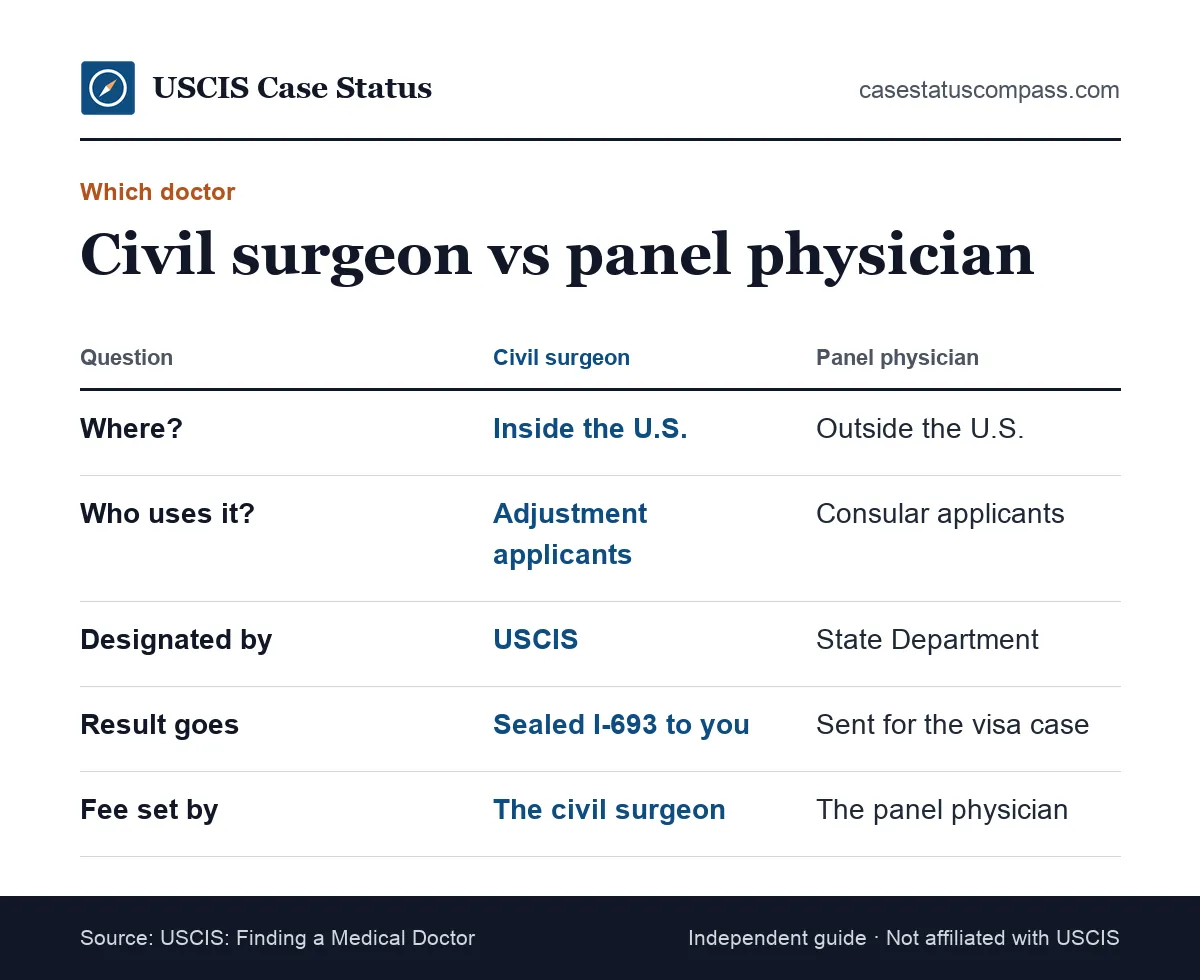
A civil surgeon examines applicants inside the U.S. for Form I-693. A panel physician examines immigrant visa applicants abroad for the State Department. Each sets their own fee, so consular applicants pay the panel physician's fee abroad.
Neither fee is paid to USCIS.
Civil surgeon and panel physician side by side
| Feature | Civil surgeon | Panel physician |
|---|---|---|
| Location | Inside the U.S. | Outside the U.S. |
| Applicants | Adjustment of status (I-485) | Immigrant visa and K visa |
| Designated by | USCIS | U.S. Department of State |
| Record | Sealed Form I-693 | Exam forms for the visa case |
| Fee set by | The civil surgeon | The panel physician |
The table compares where each doctor works and who designates them. The location of your case decides which doctor you need.
Consular processing applicants
If your relative's petition goes to the State Department, follow the embassy's instructions for its panel physicians. Our NVC case status guide explains where that case goes after USCIS.
Moving from one to the other
If you entered on a K visa after a panel exam, you may need only a partial I-693 when you adjust. If your overseas exam found a serious condition, you may need a new exam in the U.S.
What Makes Up the Immigration Medical Exam Cost?
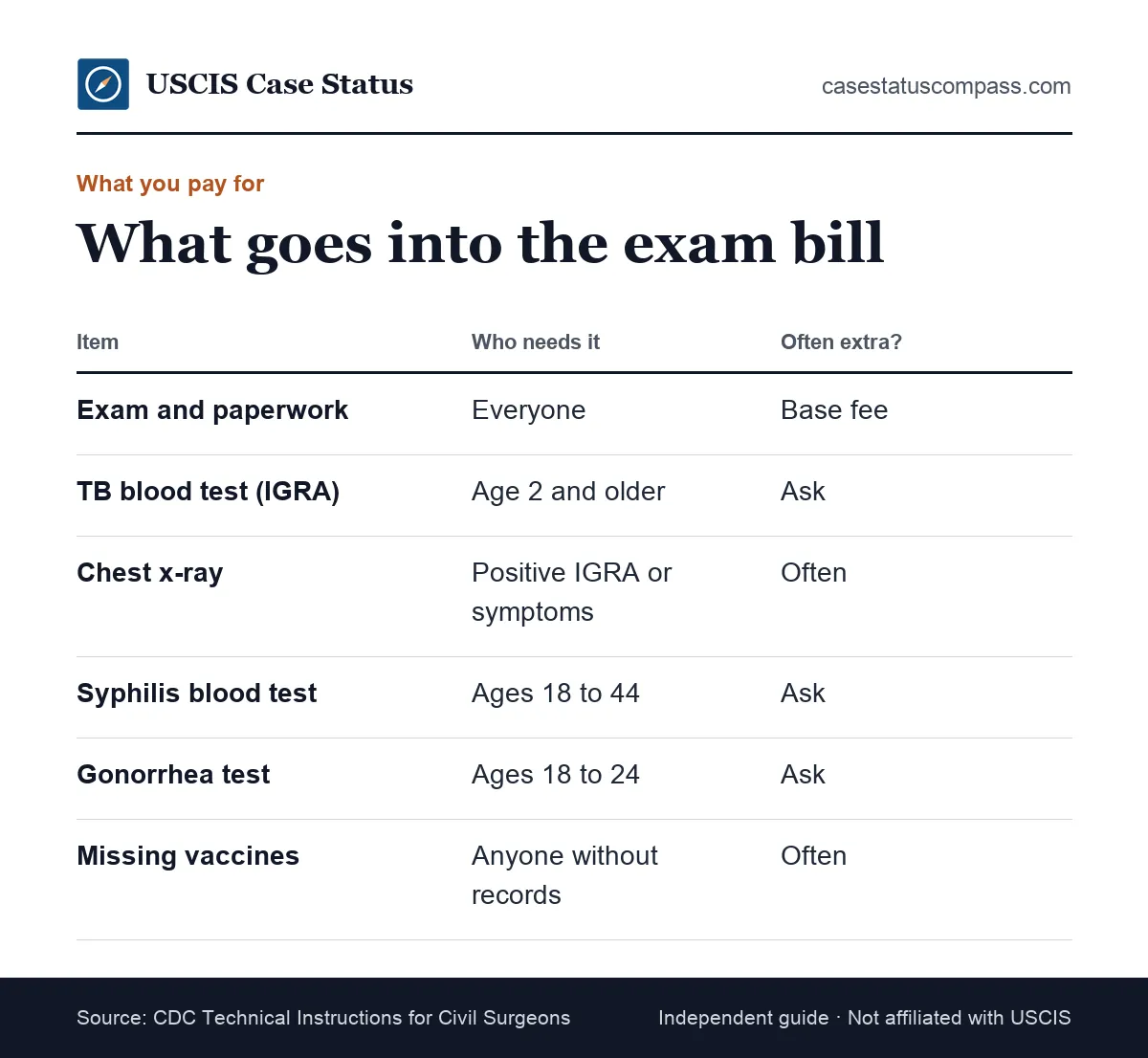
Your immigration medical exam cost is the base exam fee plus age-based lab tests, any chest x-ray and any vaccines you lack. The CDC sets which tests a civil surgeon must perform, so the list is the same everywhere, but each clinic prices them differently.
The base exam fee
The base fee usually covers the history review, physical exam, paperwork and the eMedical record. Ask whether it includes the TB blood test and the follow-up visit to review results.
Add-on tests and vaccines
Lab tests depend on your age. Vaccines depend on your records. A chest x-ray is needed only in certain cases. These items explain why two people at the same clinic can pay very different amounts.
Which Tests Are Part of the Immigration Medical Exam?
Under the CDC Technical Instructions, checked October 2026, the exam covers medical history, a physical and mental health check, tuberculosis screening, syphilis and gonorrhea testing for certain ages, Hansen's disease and vaccinations. HIV is not part of the exam.
Required tests by age
| Test | Who must have it (CDC) | When it can add cost |
|---|---|---|
| TB blood test (IGRA) | Age 2 and older | Lab fee if not bundled |
| Chest x-ray | Positive IGRA, known HIV, TB signs or symptoms | Imaging fee |
| Syphilis blood test | Age 18 to under 45 | Lab fee |
| Gonorrhea test (NAAT) | Age 18 to 24 | Lab fee |
| Other ages | Tested only if infection is suspected | Rarely |
Find your age in the middle column to see which tests apply. Each test outside your clinic's base fee is a possible extra charge.
Tuberculosis screening
All applicants age 2 and older need an interferon-gamma release assay (IGRA) blood test. A positive result leads to a chest x-ray and possibly more evaluation.
Ask whether the IGRA is in the base price.
Syphilis and gonorrhea tests
Applicants aged 18 to under 45 are tested for syphilis, and those aged 18 to 24 for gonorrhea. Outside those ages, testing happens only when the doctor suspects infection. Ask whether these labs are included in the quote.
Do You Need a Chest X-Ray?
A chest x-ray is required only if your IGRA is positive, you have known HIV infection, or you have signs or symptoms of TB. Most applicants with a negative IGRA do not need one. When required, it usually adds an imaging charge to your bill.
When the x-ray leads to more steps
If the x-ray suggests active TB, the doctor may refer you to a health department for more testing or treatment. That can mean more visits and costs, and the I-693 waits until the evaluation is done.
Bringing past results
If you had a chest x-ray or TB treatment before, bring the records. They do not replace the required test but help the doctor interpret results.
They may also speed up any follow-up review.
What Vaccines Does the I-693 Require?
The CDC requires age-appropriate vaccines against diphtheria, tetanus, pertussis, polio, measles, mumps, rubella, rotavirus, Hib, hepatitis A, hepatitis B, meningococcal disease, varicella, pneumococcal disease and influenza. Which apply depends on your age and records. Missing doses are a common cost driver.
Age-based requirements
Not every vaccine applies to everyone. Rotavirus applies only to young infants, and hepatitis A to children from 12 months through 18 years. The civil surgeon uses the CDC table to decide which you need.
Flu season rules
The influenza vaccine is required when it is available in the U.S., usually fall through early spring. Outside flu season, the doctor records "not flu season." Timing your exam can change whether you pay for a flu shot.
How Do Vaccination Records Lower Your Exam Cost?
Complete vaccination records are the simplest way to lower your bill. If you can prove past doses, the civil surgeon records them instead of giving new shots.
Missing records usually mean paying for new doses. Start collecting proof as soon as you decide to file, since records from abroad can take weeks to arrive.
Gather records early
Ask relatives, schools or clinics abroad for copies well before your exam. Records should show the vaccine name and date. Ask the clinic whether records in another language need a translation.
Ask about immunity blood tests
For some diseases, the civil surgeon may accept a lab test showing immunity in place of a dose. Ask whether that is an option for you, and compare its price with the cost of the vaccine.
What If You Cannot or Will Not Get a Vaccine?
If a vaccine is not medically appropriate, the civil surgeon records one of four blanket reasons on Form I-693, and you do not need to apply for a waiver. A religious or moral objection is different: you must request an individual waiver from USCIS.
The four blanket reasons
- Not age-appropriate
- A medical contraindication or precaution
- Not enough time to complete the series
- Influenza vaccine not available (not flu season)
The doctor marks the reason on the form, so no separate waiver fee applies.
Individual waivers for objections
Refusing a medically appropriate vaccine is recorded as incomplete. An applicant with a sincere religious or moral objection must ask USCIS for an individual waiver, which adds paperwork and often legal costs. Our immigration lawyer cost guide explains how to price that help.
Does Insurance Cover the Immigration Medical Exam?
Often not. USCIS notes that many civil surgeons do not accept health insurance, and insurance may not cover many parts of the exam. Call both your insurer and the clinic before you book.
Get the clinic's answer in writing.
What to ask your insurer
Ask whether the plan covers routine vaccines, TB blood tests and chest x-rays when ordered by an out-of-network doctor. Ask about reimbursement forms if you pay the clinic first.
Keep every receipt.
Can You Get Missing Vaccines From Your Own Doctor First?
Often, yes. Some people get missing routine vaccines from their own doctor before the exam, then bring the vaccination records to the civil surgeon for review. Ask the civil surgeon in advance whether they accept those records, so you do not pay for the same dose twice.
How Do You Compare Civil Surgeon Prices?
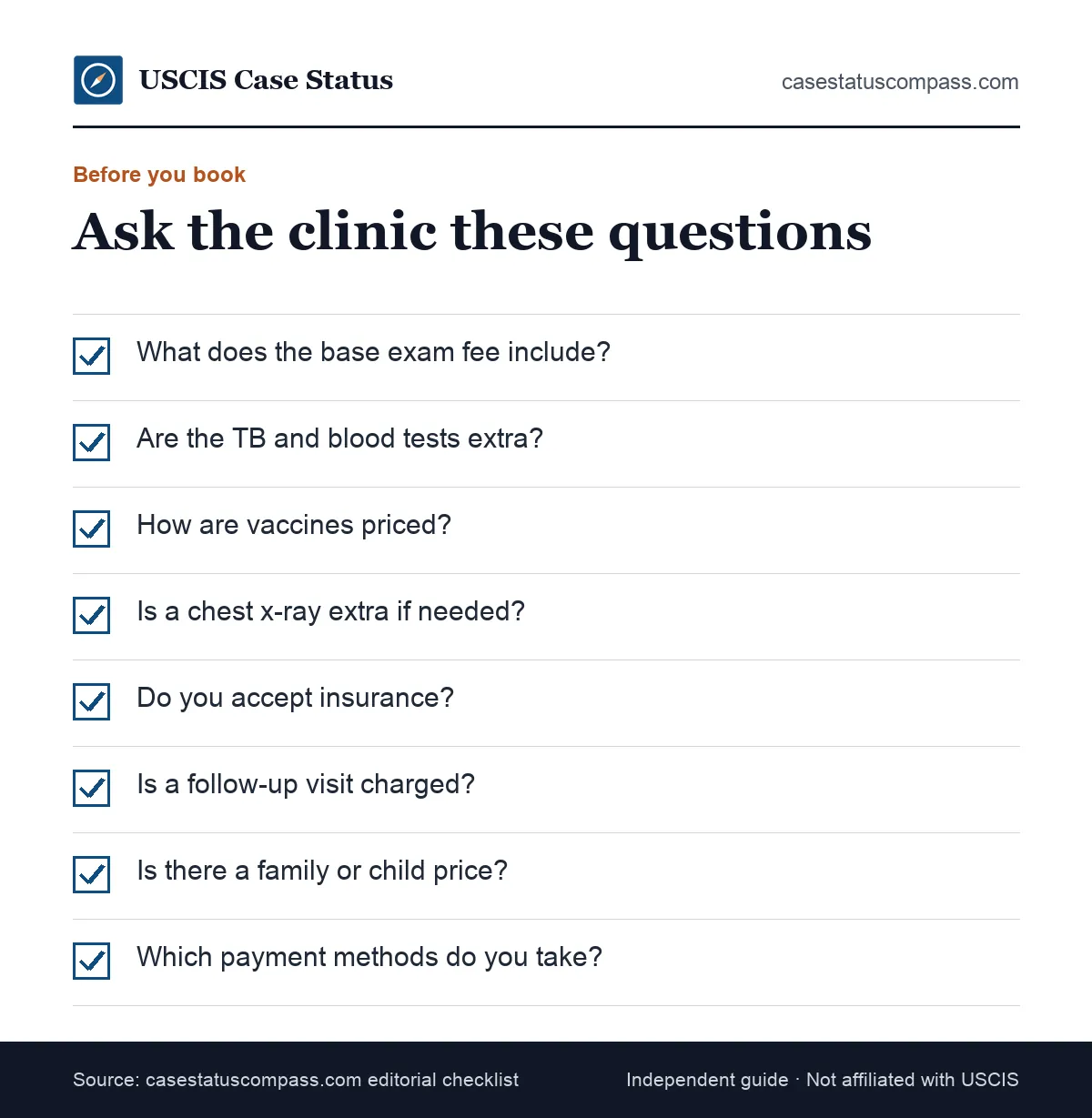
Find designated doctors with the USCIS Find a Civil Surgeon tool, then call two or three clinics and ask each the same questions. Write down every answer so you compare like with like.
Ask for itemized prices, not totals.
Questions to ask each clinic
What does the base fee include?
How are tests and vaccines priced?
Does a follow-up visit cost extra?
Which payment methods do you take?
Is the I-693 form and sealed envelope included?
How soon are results ready?
Using the official doctor search
The tool lists designated civil surgeons near you. You can also call the USCIS Contact Center at 800-375-5283, or see our ways to contact USCIS. Avoid ads; see our USCIS scams guide.
Watch out for "all-inclusive" offers
A low headline price may exclude labs or vaccines. An "all-inclusive" price may still exclude an x-ray. Ask for an itemized list in writing or by email before you book.
Should You Choose the Cheapest Civil Surgeon?
Not automatically. The cheapest base fee can become the most expensive bill once labs, vaccines and follow-up visits are added. A clinic that seals forms correctly the first time also saves you from a repeat exam.
Compare final totals, not the advertised base fee.
What to weigh besides price
Check each clinic against these points before you book:
- The doctor appears in the official USCIS search
- The quote is itemized and in writing
- The clinic knows the current I-693 edition
- Lab results return quickly enough for your filing plan
How Much Does the Medical Exam Cost for Children and Families?
The immigration medical exam cost for children often differs from adults because tests and vaccines depend on age. Children under 2 do not get the IGRA, while infants may need several routine vaccines. Families booking together can ask the clinic about a family appointment.
Age-based differences
A toddler may need more vaccine doses but fewer lab tests, while a teenager may need catch-up doses. Teenagers also need the IGRA. An adult in their twenties may need the IGRA, syphilis and gonorrhea tests.
Booking a family appointment
Ask whether the clinic can see everyone on the same day and whether it offers a per-family price. Each person still gets their own sealed Form I-693.
Bring every child's records.
Cost of Green Card Medical Exam by Situation
The cost of a green card medical exam changes with your situation. The table shows items each applicant is likely billed for. It lists no prices on purpose, because fees for medical examination for immigration are set by each clinic.
Billed items for five typical applicants
| Situation | Base exam | IGRA | Other labs | Vaccines | X-ray |
|---|---|---|---|---|---|
| Adult 30, full records | Yes | Yes | Syphilis | Few or none | Only if IGRA positive |
| Adult 22, no records | Yes | Yes | Syphilis, gonorrhea | Several | Only if IGRA positive |
| Child age 1 | Yes | No | No | Routine series | Rare |
| Adult 50, positive IGRA | Yes | Yes | Only if suspected | Varies | Yes |
| K-1 entrant, overseas exam within 1 year | Vaccination review only | No | No | Missing doses only | No |
Each row lists the items a clinic would usually bill for that applicant. Use the closest row to build your question list.
Reading the table
Find the row closest to your case. Each "Yes" is a line item to ask about. If your quote lacks one, ask whether it is included or billed later.
Then compare clinics.
Partial form applicants
Refugees, some asylee family members, K visa holders and certain Afghan nationals may need only the vaccination review. Ask the clinic for its price for a vaccination-only partial I-693.
Bring the overseas record.
Worked Example: Estimating Your Exam Bill
This fictional example shows how to turn clinic answers into an estimate. Maria, 27, is adjusting status through marriage and has partial childhood records. She calls two clinics and writes down each answer before choosing.
The names and details are invented.
Blank clinic comparison worksheet
| Line item | Clinic A | Clinic B |
|---|---|---|
| Base exam and paperwork | ||
| IGRA included? | ||
| Syphilis test included? | ||
| Vaccines she lacks (priced each) | ||
| Chest x-ray if needed | ||
| Follow-up visit | ||
| Estimated total |
Copy one column for each clinic you call. A blank cell is a question you still need answered before you compare totals.
Step 1: Fill in each clinic's answers
Maria enters every item. Clinic A has the lower base fee but charges the IGRA and follow-up separately. Clinic B bundles both.
She also asks whether her missing doses are priced each, then writes the estimated total for both clinics.
Step 2: Add it to her filing budget
Maria adds the medical total to her government fees and any legal costs. Our overview of USCIS fees and the worked budget in our lawyer guide show how the pieces combine.
Step 3: Book and confirm in writing
Maria books Clinic B and asks it to email the itemized quote. At the follow-up visit she checks that the bill matches the quote before paying.
She keeps the receipt.
How Do You Prepare for the Immigration Medical Exam?
Preparing means bringing the right documents and vaccination records, knowing your medical history and confirming the clinic's instructions on fasting or forms. Good preparation avoids a second paid visit, the easiest exam cost to prevent.
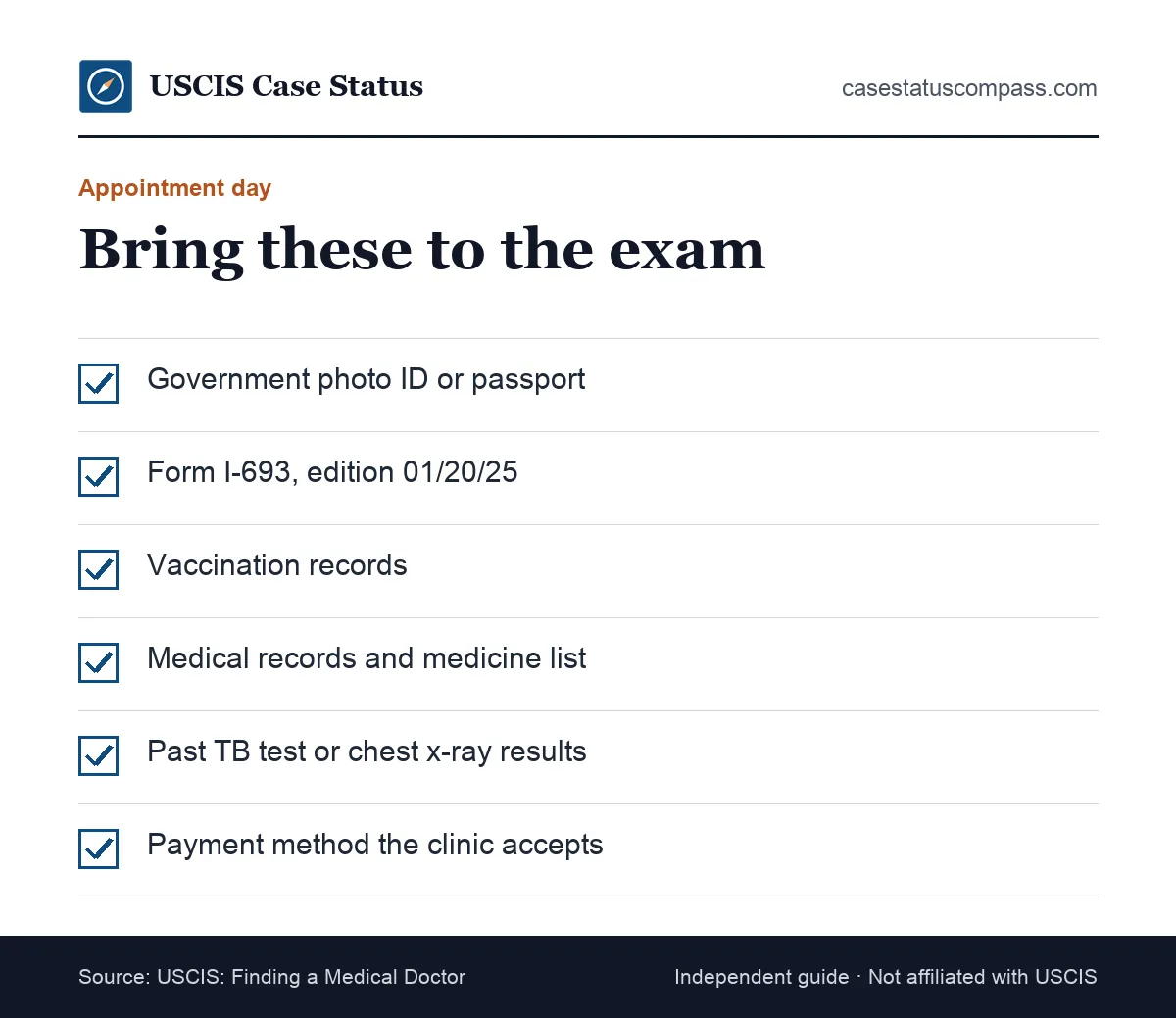
Call ahead to confirm.
What to bring on exam day
A photo ID
The current Form I-693, Part 1 completed but unsigned
Vaccination and other medical records
Payment
Your passport, if it differs from the photo ID
A list of current medicines
The clinic's itemized quote
Filling in Part 1
Print the current edition from uscis.gov or ask whether the clinic supplies it. Fill in your name and details exactly as they appear on your I-485. Do not sign until the doctor says so.
Medical history to disclose
Be honest about past illnesses, hospital stays, treatments and medicines. The doctor must record relevant history, and an incomplete answer can lead to more tests later.
Bring any treatment records.
What Happens During the Immigration Medical Exam?
The civil surgeon reviews your history and records, does a physical and mental health exam, orders age-based tests, checks or gives vaccines and later signs and seals Form I-693.
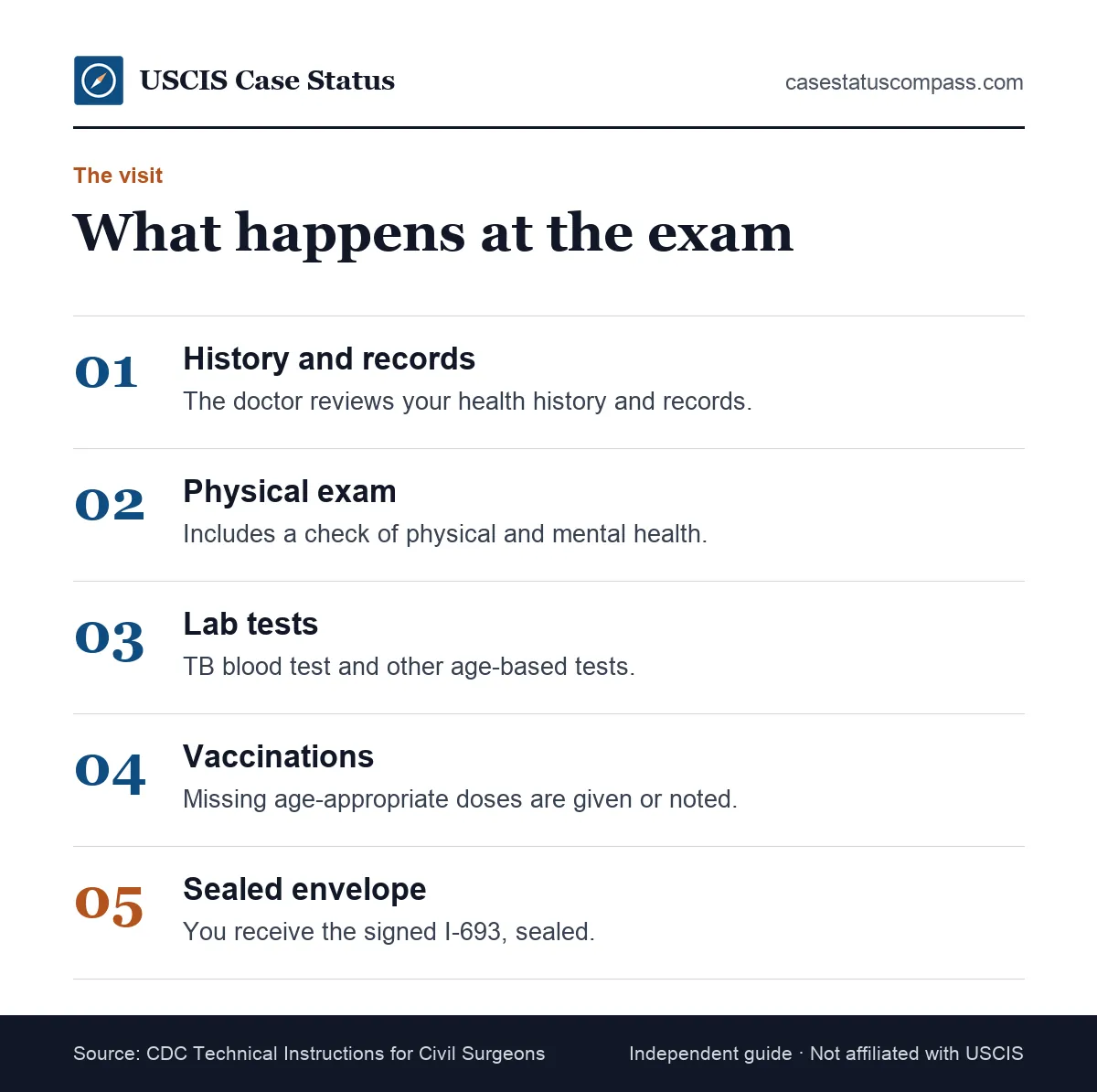
Most applicants finish in one or two visits. Budget for a second trip if your lab results need review.
The first visit
Expect questions, a physical exam and a blood draw for the IGRA and any other labs. Vaccines may be given the same day if your records show gaps.
Pay as agreed.
The follow-up visit
When results come back, the doctor may finish the form or ask you to return. If more evaluation is needed, the form waits until it is done. Ask whether the follow-up visit is included.
How Long Does the Exam Process Take?
The exam is separate from your biometrics appointment and can take one visit or several, depending on lab results, missing vaccines and any referral. The civil surgeon cannot seal the form until required results are back.
Ask for an estimate.
Planning around filing
Book the exam before you finish the rest of your filing package. If you are waiting on a visa bulletin date, ask how long the clinic needs from first visit to sealed form.
When delays add cost
A positive IGRA, a health department referral or a vaccine series that needs a later dose can stretch the timeline and add visits. Ask what triggers extra appointments.
Book early to absorb them.
What Is eMedical?
eMedical is the CDC's electronic system for immigration medical exams. USCIS says civil surgeons must register for it. You do not use eMedical yourself, but the doctor records your exam there and still gives you the completed Form I-693.
What it means for you
eMedical changes the doctor's workflow, not your filing duties. You still receive the sealed form and submit it to USCIS, either by mail or by uploading it online.
Keep a copy for your records.
If the clinic mentions a records fee
Some clinics fold administrative work into the base fee. If a separate charge for records or forms appears, ask what it covers before you agree.
Get it in writing before the exam.
Why Does the Sealed Envelope Matter?
The civil surgeon gives you Form I-693 in a sealed envelope. If you file on paper, send the original sealed envelope with your I-485; do not open it. If you file online, USCIS tells you to open it, upload the completed form and keep the original.
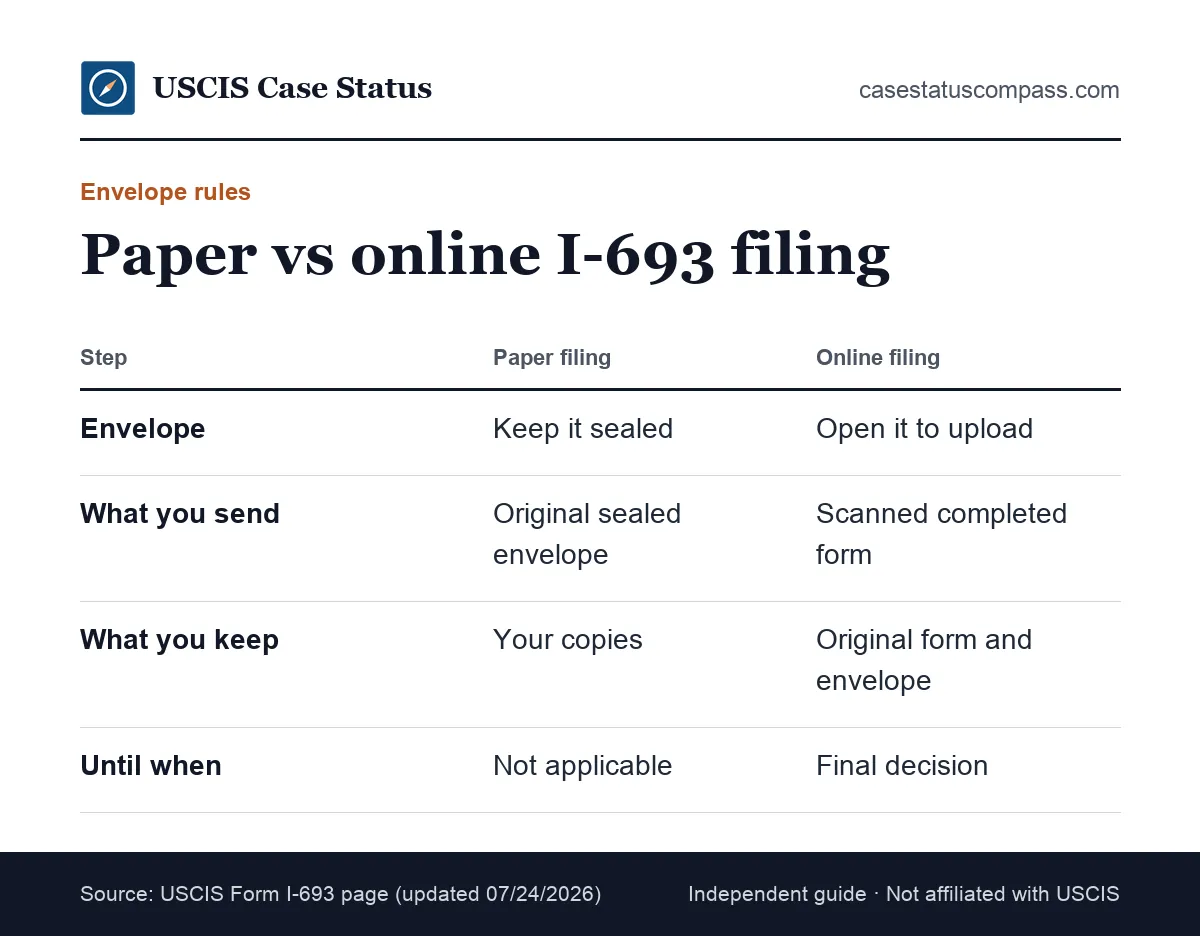
Paper filing
USCIS says not to accept a Form I-693 that is not sealed. Mail the unopened envelope with your package. An opened envelope can be refused, which may mean paying for a new exam.
Online filing
Online I-485 filers open the envelope, upload the completed form and keep the original form and envelope until USCIS makes a final decision. USCIS may ask to see them at the interview. Our green card interview guide explains what to bring.
When Must You Submit Form I-693?
You must submit Form I-693 with your I-485: Send the sealed I-693 with your I-485 (required since Dec. 2, 2024). If it is missing, USCIS may reject the whole package. The exam must happen before you file.
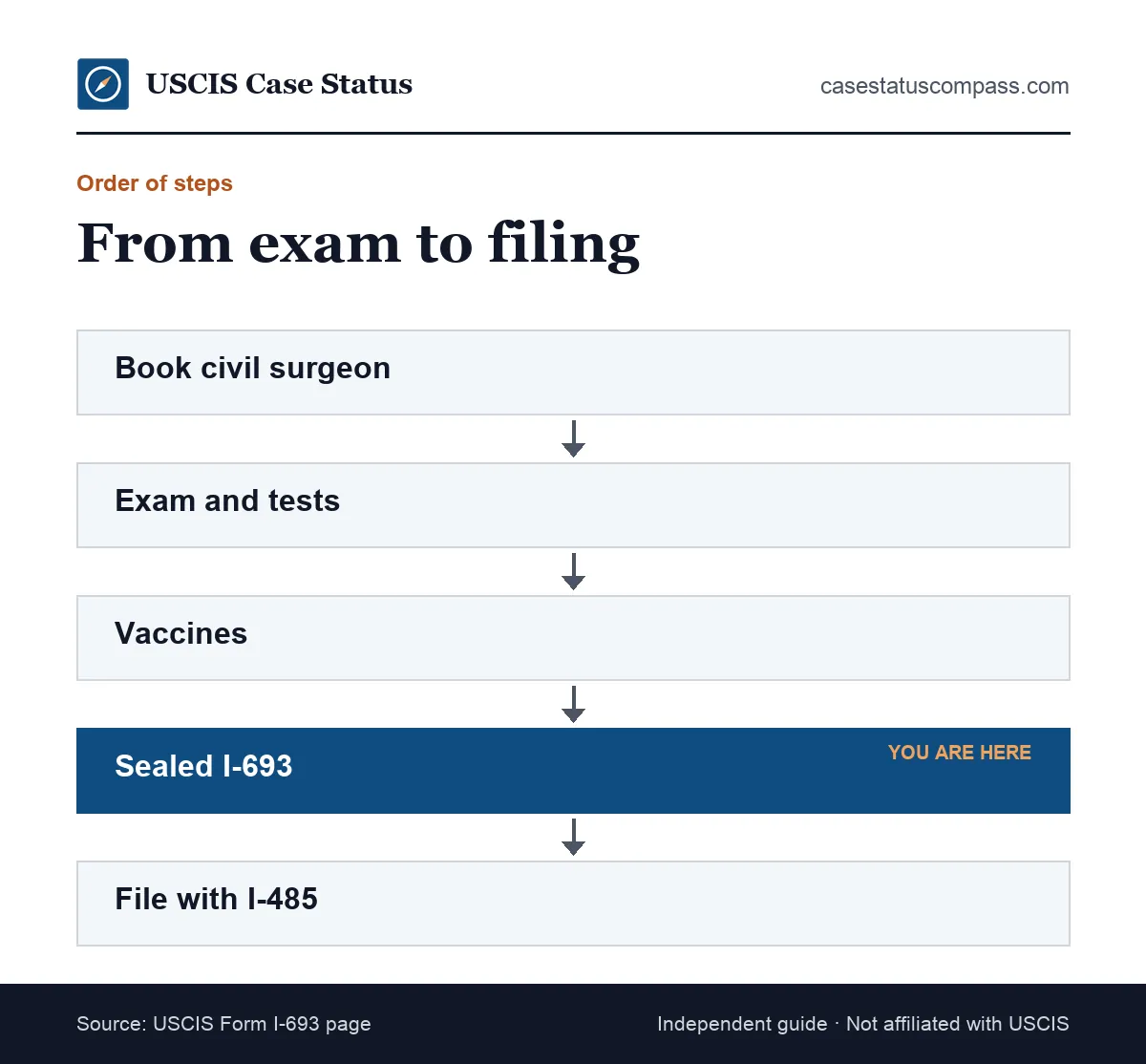
Do not send it separately later.
What rejection costs you
A rejected package is returned with the fee, but you lose time and may need to rebuild it. Since the I-485 also requires the current edition, 09/18/26 (01/20/25 and 09/04/26 editions rejected on/after Sept. 18, 2026; no grace period), check both before mailing.
If your package was rejected with an opened envelope
USCIS says that if the lockbox rejects a package with the envelope opened, you may refile with the original opened form, your supporting documents and a copy of the rejection notice.
How Long Is Form I-693 Valid?
Under the USCIS Policy Manual, An I-693 is generally valid only for the application it was filed with. That change took effect June 11, 2025, and it is the main reason an old exam rarely carries over to a new filing.
Forms signed before and after November 1, 2023
A form signed on or after November 1, 2023 counts only while the application it was filed with is pending. Forms signed before then keep their value for two years from the signature.
Tied to one application
The June 11, 2025 rule means you cannot reuse an exam for a different application later. Plan to pay for a new exam if you ever file a new I-485.
Officers can ask for a new form
Even a valid form does not end the review. An officer may request more evidence or a new I-693 if your health may have changed or the form seems inaccurate.
What Happened to the 60-Day Signature Rule?
The old 60-day I-693 signature rule no longer applies (removed Mar. 31, 2023). It once required filing within 60 days of the doctor's signature. USCIS waived it on December 9, 2021 and removed it on March 31, 2023.
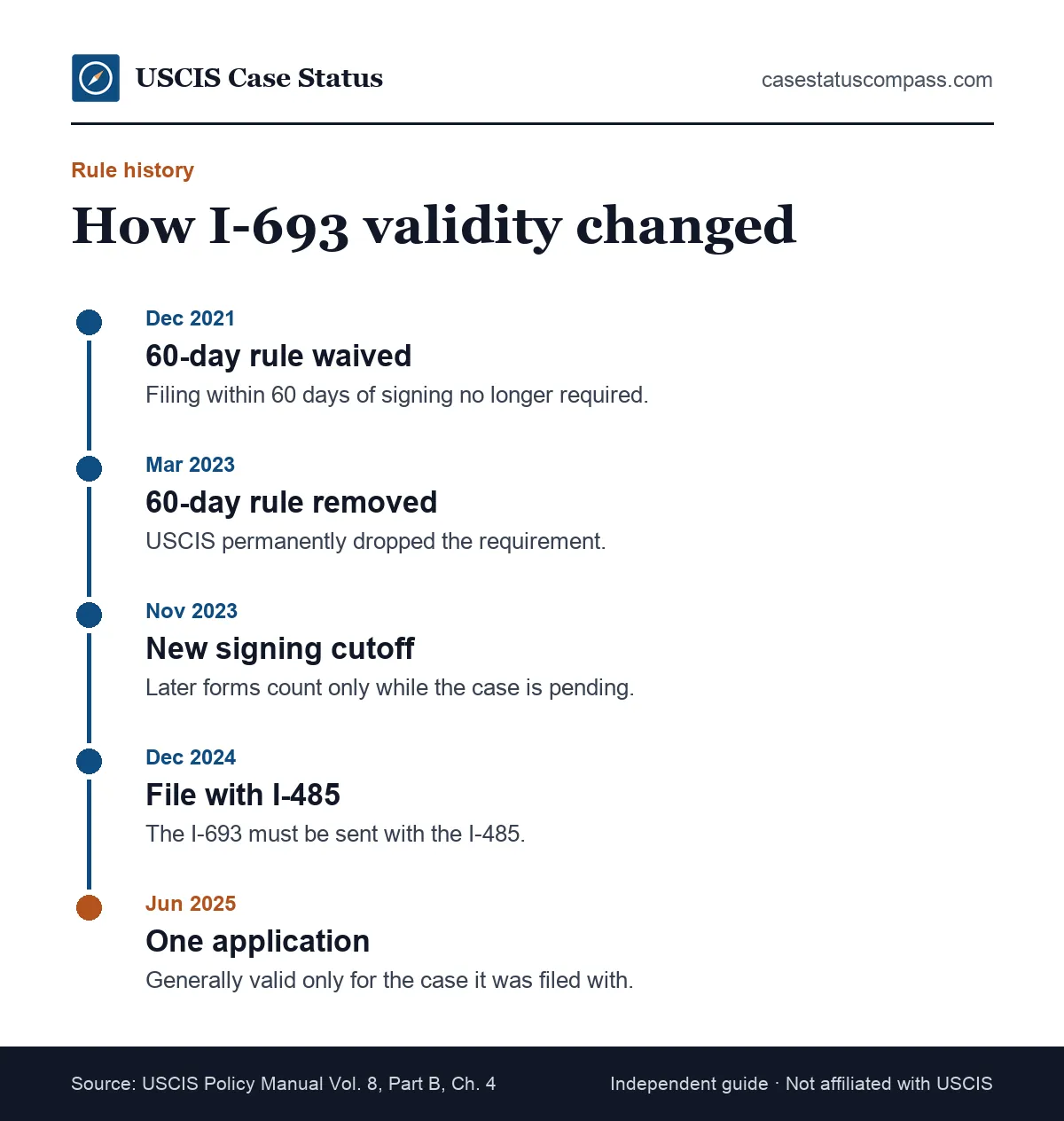
Ignore any 60-day deadline you read elsewhere.
Why older advice is outdated
Many websites still mention the 60-day rule or a two-year validity period. The I-693 instructions also mention two years, but the Policy Manual is newer and controls. Rely on the current USCIS pages.
What this means for scheduling
You no longer race a 60-day clock, but you must have the sealed form ready before filing. Schedule the exam once your other documents are nearly complete.
Avoid booking months early.
Does a Denied or Withdrawn I-485 Mean a New Exam?
Yes, generally. If the application your I-693 was filed with is denied or withdrawn, the Policy Manual says you must submit a new, signed I-693 with any future application that needs one. That means paying the civil surgeon again, so budget for it.
Planning after a denial
Read the denial notice first. Our guide to what to do after a denial explains your options. If you refile, book a new exam before submitting the new package.
Budget for the second exam.
Fees are not refunded
Neither USCIS nor the doctor refunds an exam because the case ended. On the government side, USCIS fees are nonrefundable, even if your case is denied or withdrawn.
Plan your filing carefully so you pay for the exam only once.
What Are Class A and Class B Medical Conditions?
A Class A condition is a health finding that makes an applicant inadmissible unless waived or treated, such as active TB. A Class B condition is a significant health issue that does not make you inadmissible but may need follow-up. Either can add visits and costs.
Class A findings
If the doctor finds a Class A condition, you may need treatment before the form is completed, or a waiver. If an overseas exam found one, you may need a new full exam in the U.S.
Class B findings
A Class B finding is recorded on the form, and the doctor may recommend follow-up care. It does not bar the green card, but follow-up appointments are an extra cost.
Can You Fail the Immigration Medical Exam?
There is no pass or fail score. The exam records whether a health-related ground of inadmissibility applies. Most applicants have no such finding. If one appears, treatment, a vaccination or a waiver may resolve it, but each can add cost and time.
Common reasons for extra steps
A positive TB test, an untreated infection or missing vaccines are the most common reasons a form is not finished at the first visit. Each needs follow-up before the doctor can sign.
When to get legal help
If the doctor mentions a waiver, a past drug-use finding or a mental health concern, talk to an attorney or DOJ-accredited representative before filing.
Do this before you mail your I-485, since a health-related finding can affect the whole application.
What I-693 Mistakes Cost You Money?
The costliest mistakes are using a non-designated doctor, an outdated form edition, a missing signature, an opened envelope on a paper filing and filing the I-485 without the I-693. Each can lead to rejection, an RFE or a repeat exam.
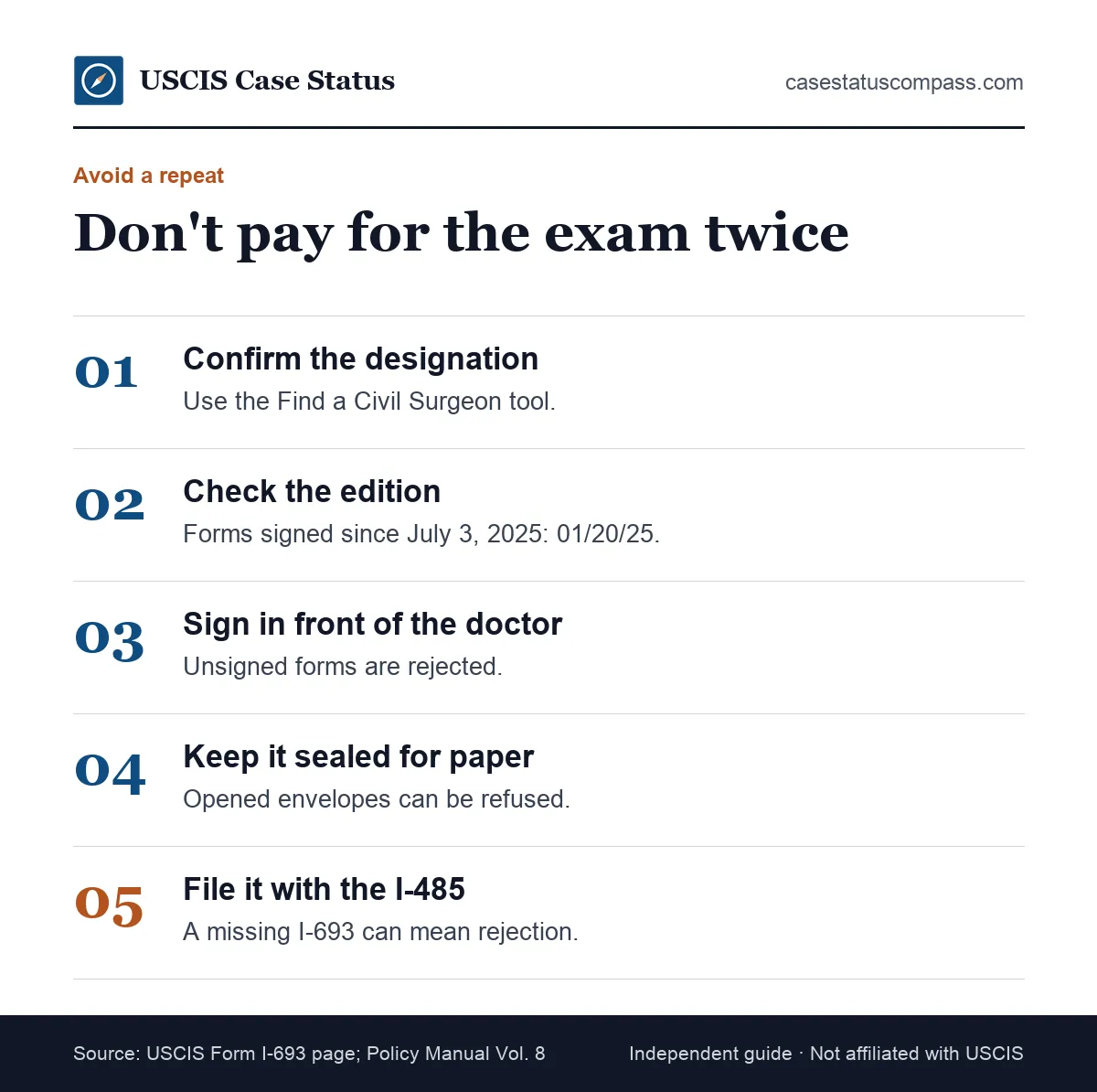
Paperwork errors
- Wrong edition for a form signed on or after July 3, 2025
- Your signature missing from Part 1
- Pages from different editions mixed together
- Name or birth date not matching your I-485
Process errors
Booking a doctor who is not on the USCIS list
Opening the envelope before a paper filing
Mailing the I-485 first and the exam later
Losing the clinic's receipt
Checking the package before mailing
Confirm the sealed I-693 is inside the package before you mail it. Our I-485 cover letter guide helps you list every item so nothing is missing.
Check the envelope is still sealed.
What If USCIS Sends an RFE About the Medical Exam?
A Request for Evidence about the I-693 means USCIS needs a corrected or new form. Read it carefully, return to a civil surgeon if needed and reply by the deadline. For an RFE, RFE deadline: up to 12 weeks (the exact date is on your RFE); no extensions.
Common medical RFEs
Typical requests involve an incomplete vaccination record, an unsigned form or a form that may no longer reflect your health. USCIS should not ask for a new form just to meet rules that did not apply when the doctor signed.
Responding on time
Book the civil surgeon right away, since labs can take time. Our guide to answering a USCIS Request for Evidence explains how to send the response.
Send the new form before the RFE deadline.
Is Form N-648 the Same as the I-693 Exam?
No. Form N-648 is a medical disability exception for the naturalization English and civics tests. It has a different purpose and doctor rules. As of October 2026, $0 USCIS fee (the doctor may charge).
Some citizenship applicants need both, at different stages.
When N-648 applies
Citizenship applicants with a qualifying disability ask a doctor to certify it on Form N-648. Our citizenship test guide explains the exception.
It is filed with Form N-400 or brought to the naturalization interview.
Different doctors, different fees
An N-648 can be completed by other licensed medical professionals, not only civil surgeons. Their charge for the certification is separate and set by them.
Ask for the price up front.
Does a Fee Waiver Cover the Medical Exam?
No. A USCIS fee waiver covers only eligible USCIS fees, not the civil surgeon's bill. The waiver request costs $0 (no fee to request a fee waiver), and the bases are: Fee waiver: means-tested benefit, income at or below 150% of poverty guidelines, or financial hardship.
Lowering the doctor's bill
Ask clinics about payment plans, family prices and vaccine pricing. Bring complete records. Compare at least two itemized quotes before you book.
Ask about cash prices and whether vaccines cost less elsewhere.
Lowering the government side
If you qualify, a waiver can reduce what you pay USCIS for some forms. Our USCIS fee waiver guide explains which forms qualify and how to apply.
Check eligibility first.
How Immigration Medical Exam Cost Fits Your Green Card Budget
The immigration medical exam cost is one line in your adjustment budget, next to the USCIS filing fees and any legal or translation costs. Price the exam early, because the sealed form must go in with your I-485.
Add the full immigration medical exam cost before you file.
Medical exam and USCIS fees in one budget
| Item | Paid to | Amount (as of October 2026) |
|---|---|---|
| Form I-485 | USCIS | $1,440 (paper) / $1,390 (online); $950 / $900 if under 14 and filing with a parent |
| Form I-765 (optional work permit) | USCIS | $520 (paper) / $470 (online); $260 with a pending I-485 filed on or after Apr. 1, 2024. H.R. 1 add-ons: initial asylum-applicant (c)(8) EAD $0 + $570; initial TPS/parolee EAD base fee + $570; renewal TPS/parolee base fee + $280; renewal (c)(8) base fee + $275 |
| Form I-693 | USCIS | $0 USCIS fee; the civil surgeon sets the exam price |
| Civil surgeon exam, labs and vaccines | Civil surgeon | From your itemized quote |
The table shows each cost, who is paid and the amount. Only the civil surgeon line varies by clinic.
Adding the other forms
Many applicants also file Form I-864 and Form I-765. Our affidavit of support guide and work permit guide explain each one.
Add each form's fee to the budget table above before you file.
After you file
Once USCIS accepts your package, a receipt notice follows. Our page on what "Case Was Received" means and our green card processing time guide explain what comes next.
Frequently Asked Questions
Does USCIS charge a fee for Form I-693?
No. As of October 2026, USCIS charges no filing fee for Form I-693. The cost comes from the civil surgeon, who sets their own price for the exam, lab tests and vaccines.
Can my regular doctor do the immigration medical exam?
Only if your doctor is designated by USCIS as a civil surgeon on the date of the exam. Otherwise, the form will not be accepted. Confirm the designation with the USCIS Find a Civil Surgeon tool.
Can I file my I-485 and send the medical exam later?
No. Since December 2, 2024, USCIS requires Form I-693 to be submitted with Form I-485, and a package without it may be rejected. Get the sealed form from the civil surgeon before you mail or submit your application online.
Can I reuse my medical exam if I file again?
Generally not. Since June 11, 2025, a Form I-693 is generally valid only for the application it was filed with. If that application is denied or withdrawn, you need a new exam for any future application that requires one.
What happens if I open the sealed envelope?
For a paper filing, USCIS may refuse an opened or altered envelope, which can mean paying for a new exam. Online filers are the exception: USCIS tells them to open it, upload the form and keep the original until a final decision.
Is the COVID-19 vaccine required for the green card medical exam?
The CDC vaccination table for civil surgeons, checked October 2026, does not list COVID-19 among required vaccines. Ask your civil surgeon which vaccines apply on your exam date.
Does the medical exam include an HIV test?
No. HIV infection was removed from the list of health-related grounds of inadmissibility in 2010, and testing is not part of the standard exam. Known HIV infection does, however, mean the civil surgeon must order a chest x-ray for TB screening.
Do I need to fast before the immigration medical exam?
Follow your clinic's own instructions. The CDC tests are mostly blood tests and a physical exam, but clinics differ, so ask about fasting and forms when you book to avoid a second visit.
How long does it take to get I-693 results?
It depends on your lab results, missing vaccines and any referral. The civil surgeon cannot seal the form until required results are back, so ask the clinic how long it needs from first visit to sealed form.
Do I use a civil surgeon if I am consular processing?
No. Immigrant visa applicants abroad see a panel physician designated by the State Department and pay that doctor's fee. Civil surgeons and Form I-693 are only for adjustment of status inside the U.S.
Sources
- USCIS: Form I-693, Report of Immigration Medical Examination and Vaccination Record. www.uscis.gov/i-693. Accessed Oct 27, 2026.
- USCIS: Finding a Medical Doctor (civil surgeon). www.uscis.gov/greencard/medical-exam-find-a-doctor. Accessed Oct 27, 2026.
- USCIS Policy Manual, Volume 8, Part B, Chapter 4. www.uscis.gov/policy-manual/volume-8-part-b-chapter-4. Accessed Oct 27, 2026.
- CDC: Technical Instructions for Civil Surgeons. www.cdc.gov/immigrant-refugee-health/hcp/civil-surgeons/index.html. Accessed Oct 27, 2026.
- CDC: Vaccination Technical Instructions for Civil Surgeons. www.cdc.gov/immigrant-refugee-health/hcp/civil-surgeons/vaccination.html. Accessed Oct 27, 2026.
- CDC: Tuberculosis Technical Instructions for Civil Surgeons. www.cdc.gov/immigrant-refugee-health/hcp/civil-surgeons/tuberculosis.html. Accessed Oct 27, 2026.
- CDC: Syphilis Technical Instructions for Civil Surgeons. www.cdc.gov/immigrant-refugee-health/hcp/civil-surgeons/syphilis.html. Accessed Oct 27, 2026.
- CDC: Gonorrhea Technical Instructions for Civil Surgeons. www.cdc.gov/immigrant-refugee-health/hcp/civil-surgeons/gonorrhea.html. Accessed Oct 27, 2026.
- USCIS Form G-1055 Fee Schedule (edition 10/16/26). www.uscis.gov/sites/default/files/document/forms/g-1055.pdf. Accessed Oct 27, 2026.
- USCIS Contact Center (uscis.gov). www.uscis.gov/contactcenter. Accessed Oct 27, 2026.
- USCIS: Form I-485 page (updated 10/07/2026). www.uscis.gov/i-485. Accessed Oct 27, 2026.
- USCIS: Filing Fees (updated 02/12/2026). www.uscis.gov/forms/filing-fees. Accessed Oct 27, 2026.
- 8 CFR 103.2(b)(8)(iv) (LII). www.law.cornell.edu/cfr/text/8/103.2. Accessed Oct 27, 2026.
- Form I-912 Instructions, Edition 07/22/25. www.uscis.gov/sites/default/files/document/forms/i-912instr.pdf. Accessed Oct 27, 2026.
casestatuscompass.com is an independent publication and is not affiliated with USCIS or any government agency. This page is general information, not legal advice. For denials, court or asylum matters, consult an immigration attorney or a DOJ-accredited representative.