Contents · 40 sections
- How Much Is a K1 Visa in 2026?
- How Much Does a Fiancé Visa Cost in Total?
- K-1 Visa Cost Breakdown by Stage
- I-129F Filing Fee
- Who Pays the I-129F Fee?
- Can the I-129F Fee Be Waived?
- Can You Pay Less for the I-129F?
- Is the I-129F Fee Refundable?
- Consular and Medical Fees
- How Much Is the K-1 Medical Exam Abroad?
- How Much Is the K-1 Visa Fee at the Embassy?
- What Other Documents Cost Money Abroad?
- Does a K-1 Visa Holder Pay the USCIS Immigrant Fee?
- Travel and Wedding Costs Within 90 Days
- Adjustment of Status After Marriage
- How Much Is the I-485 Fee for a K-1 Spouse?
- What Does the Medical Exam Cost After Arrival?
- Should You Pay for a K-1 Work Permit?
- Should You Pay for Advance Parole (I-131)?
- Does the H.R. 1 Parole Fee Apply to K-1 Spouses?
- K-1 Visa Cost for K-2 Children
- What Is the Total K-1 Visa Cost?
- K-1 Visa Cost Worksheet for Your Case
- How Much Is a K1 Visa Total for a Fiancée and Child?
- Is a K-1 Visa Cheaper Than a CR-1 Spouse Visa?
- How Long Does the K-1 Process Take, and Does Time Cost Money?
- What Costs Come After the K-1 Green Card?
- Which K-1 Fees Can Be Waived or Refunded?
- How Do You Pay K-1 Fees?
- How Do You Pay the K-1 Visa Application Fee?
- How to Lower Your K-1 Visa Cost Legally
- Common K-1 Budget Mistakes
- Should You Pay for a K-1 Attorney?
- Is the K-1 Visa Price the Same in Every Country?
- What Does the I-864 Affidavit of Support Cost?
- Does a Prior Marriage Add to the K-1 Cost?
- What If the Consulate Returns the Petition?
- What Happens to Costs If You Miss the 90-Day Deadline?
- How the K-1 Costs Fit Together
- Frequently Asked Questions
The short answer
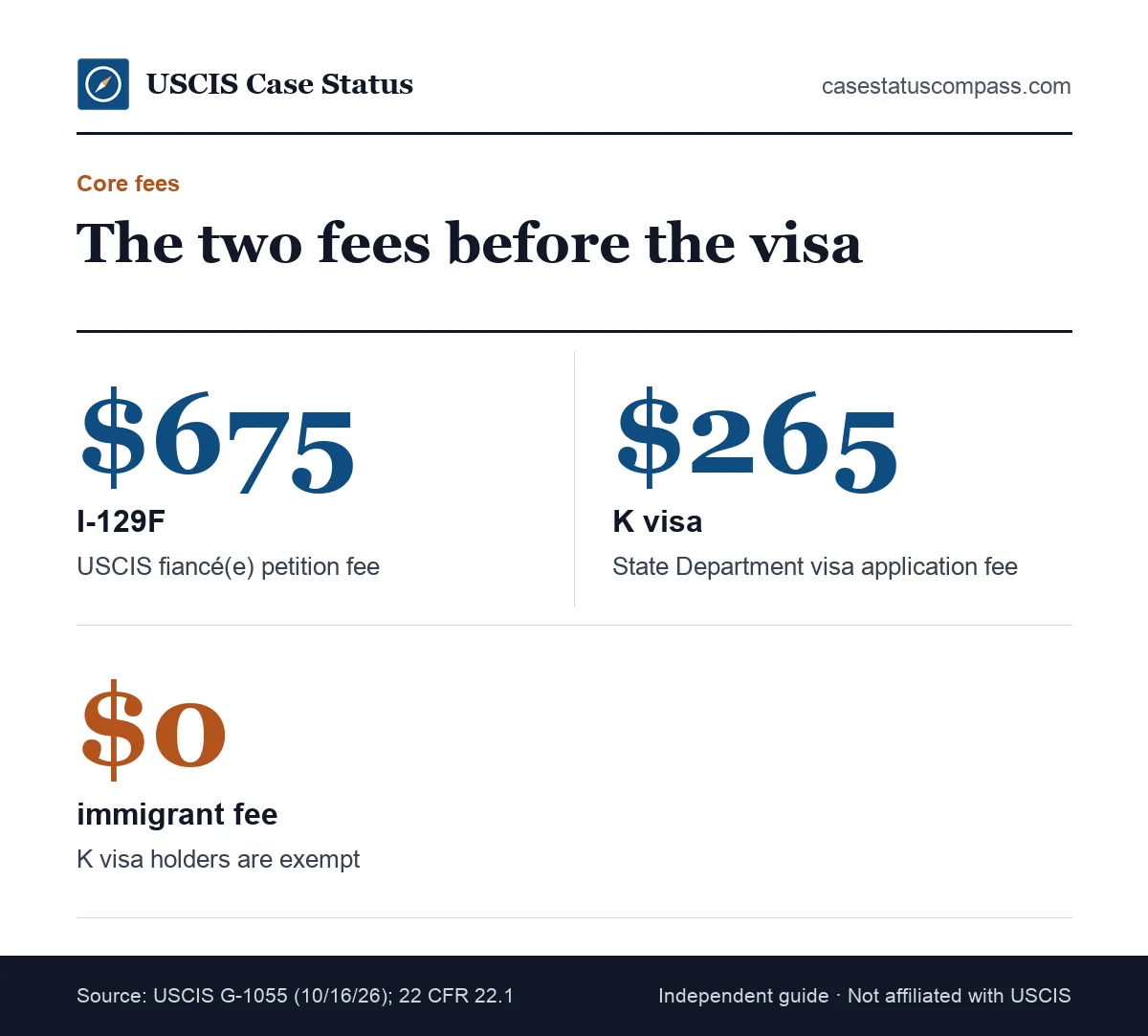
The K-1 visa cost starts with two government fees: $675 for Form I-129F at USCIS and a $265 K (fiancé) visa application fee at the State Department, or $940 together (our sum). After the wedding, the green card application (Form I-485) adds $1,440 (paper) / $1,390 (online); $950 / $900 if under 14 and filing with a parent. Medical, travel and document costs vary.
At a glance
| I-129F petition | $675 (USCIS, G-1055 10/16/26) |
| K visa fee | $265 K (fiancé) visa application fee (22 CFR 22.1) |
| Green card after marriage | Form I-485: $1,440 paper / $1,390 online |
| USCIS Immigrant Fee | None: K visa holders are exempt |
| Who runs this site | An independent guide, not USCIS or the State Department |
How Much Is a K1 Visa in 2026?
As of October 2026, the core K1 visa price is $940 in government fees to reach the United States (our sum): $675 for Form I-129F and $265 for the K visa application. Including the Form I-485 green card filing after the wedding, government fees reach about $2,330 to $2,380 (our sums).
This page covers cost only. Our USCIS filing fees hub lists other forms, and our K1 visa guide covers the process.
The short version
These three fixed fees are the ones every K-1 case pays. Each row shows who collects the money and when.
| Stage | Fee (Oct. 2026) | Paid to |
|---|---|---|
| Fiancé(e) petition | $675 | USCIS |
| K visa application | $265 K (fiancé) visa application fee | State Department |
| Green card (I-485) | $1,440 paper / $1,390 online | USCIS |
What the total does not include
The $940 and $2,380 figures cover only government fees. They leave out the medical exam abroad, police certificates, translations, passport costs, flights, the wedding and any attorney. Those can match or exceed the fees, depending on your country.
How Much Does a Fiancé Visa Cost in Total?
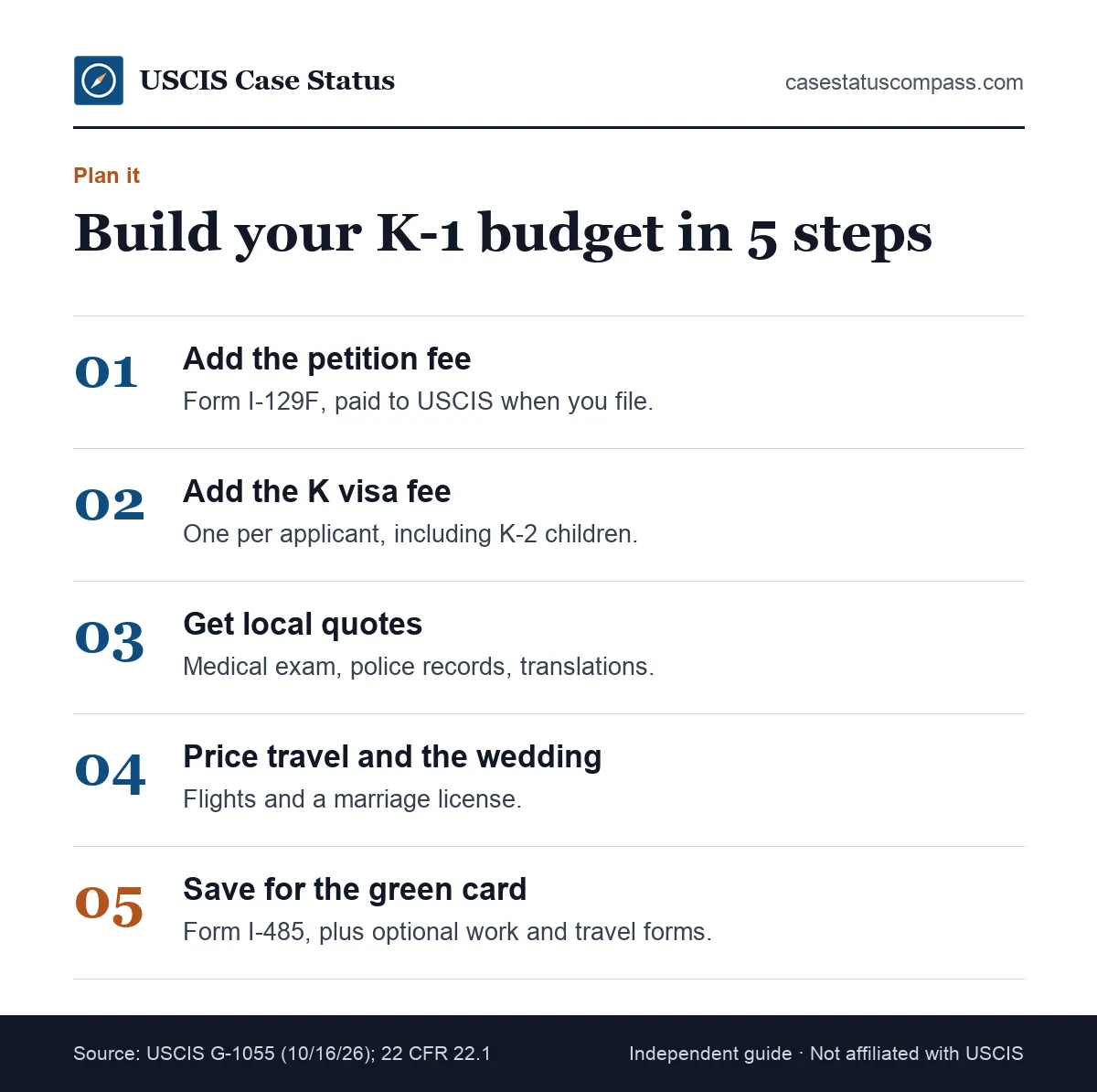
A fiancé visa costs $940 in government fees up to the visa, then $1,390 to $1,440 for the I-485 after marriage, for $2,330 to $2,380 in required government fees (our sums of the official amounts). Optional work and travel permits and private costs come on top.
Required government fees only
- Form I-129F: $675.
- K visa application: $265.
- Form I-485 after marriage: $1,440 paper or $1,390 online.
That totals $2,380 on paper or $2,330 with an online I-485 (our arithmetic). No other form is mandatory.
With the common optional forms
Many couples add a work permit and advance parole with the I-485. With an I-765 at $260 and a paper I-131 at $630, the government total on paper becomes $3,270 (our sum). A parole fee may also apply when advance parole is granted; see the I-131 section below.
K-1 Visa Cost Breakdown by Stage
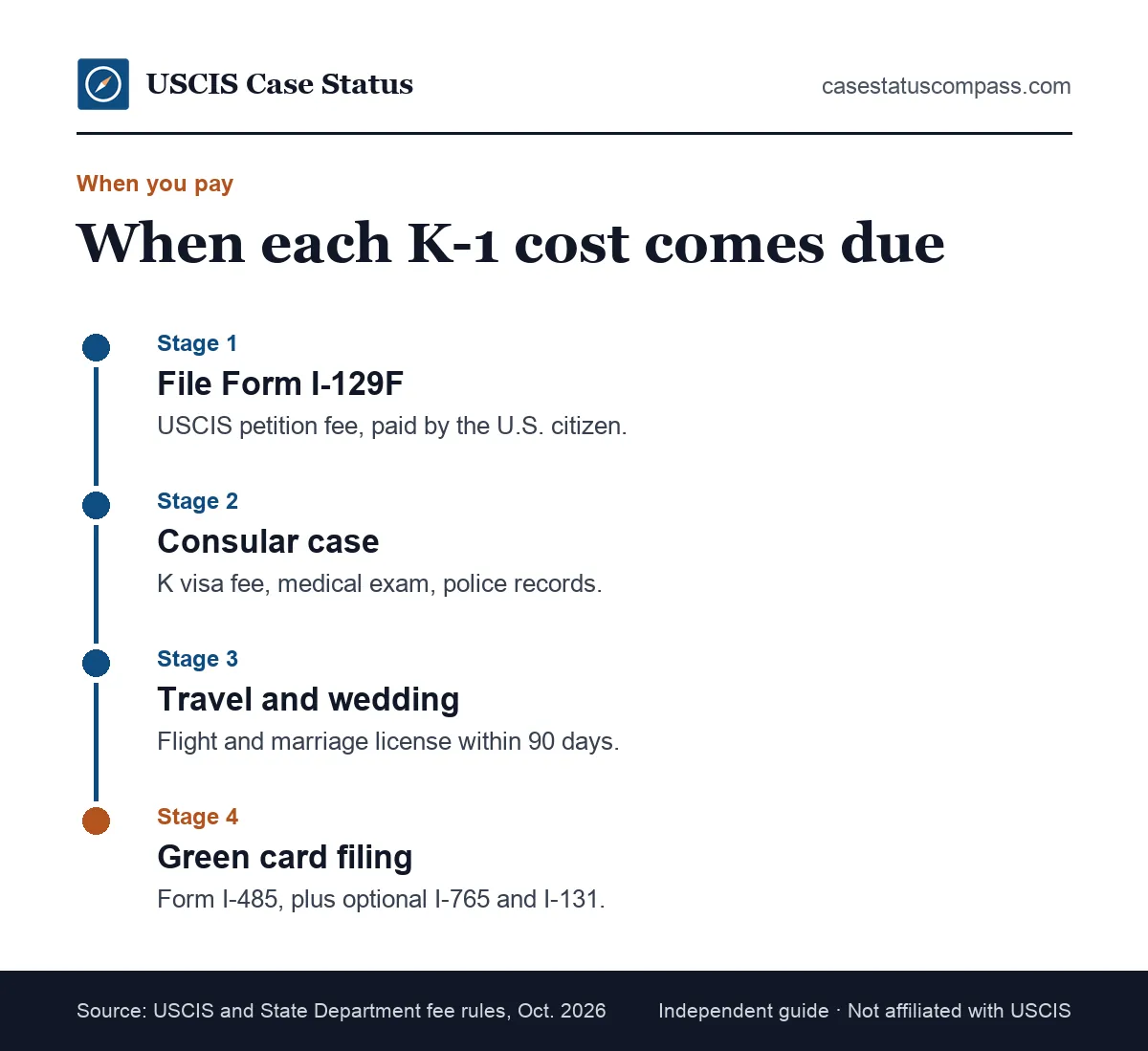
The k1 visa cost breakdown has four stages: the USCIS petition, the consular visa, travel and marriage, and the green card filing. Each has its own payee and timing, so budget them separately. Stages one and four are fixed government fees. Stages two and three depend on your country, airline and county.
Stage-by-stage table
Read each row as one stage of the journey, in order. The last column tells you whether you can shop around on price.
| Stage | What you pay for | Typical payee | Fixed or variable |
|---|---|---|---|
| 1. Petition | Form I-129F | USCIS | Fixed |
| 2. Consular | K visa fee, medical, police records | State Dept., doctor, police | Mixed |
| 3. Arrival | Flights, marriage license | Airlines, county clerk | Variable |
| 4. Green card | I-485, optional I-765/I-131 | USCIS | Fixed |
Why staging matters
The petition fee is due at filing, the visa fee after USCIS approval, and the I-485 only after the wedding. Saving per stage keeps one surprise, such as a costly medical exam, from delaying the next step.
I-129F Filing Fee
The I-129F filing fee is $675, set by the USCIS fee schedule (Form G-1055, edition 10/16/26). The U.S. citizen petitioner pays it when filing. It covers USCIS review of the fiancé(e) petition, not the visa or the green card.
What the fee covers
The fee pays for USCIS to decide whether you and your fiancé(e) qualify. One rule it checks: K-1: you must have met in person within the 2 years before filing (waivers possible). Biometrics are generally built into USCIS fees: Biometrics included in most fees (separate $30 for TPS I-821 and some EOIR forms).
Use the right edition
USCIS lists the current I-129F edition as 01/20/25. A wrong edition can be rejected, and you would have to file again. Check the form page the week you mail the petition.
Who Pays the I-129F Fee?
The U.S. citizen petitioner files Form I-129F and normally pays the fee. Couples can share the cost, but the payment goes with the citizen's filing. The fiancé(e) abroad does not file anything with USCIS at this stage. Anyone may supply the money.
Children on the same petition
Unmarried children of the fiancé(e) can come too: K-2: the fiancé(e)'s unmarried children under 21. They are listed on the parent's I-129F, so there is no second petition fee for them.
Can the I-129F Fee Be Waived?
No. Form I-129F is not on the USCIS fee waiver list, so the petitioner must pay in full. Our USCIS fee waiver guide shows which forms can be waived and why the fiancé petition is not one of them. Budget for it upfront.
Can You Pay Less for the I-129F?
No. As of October 2026, the fee schedule lists one I-129F amount, $675, with a no-fee exception only for K-3 petitions based on an I-130 already filed. There is no reduced rate for low income, no online discount, and no family rate when K-2 children are listed. Every K-1 petitioner pays the same amount, whatever their state or income.
No premium processing
USCIS says Premium processing covers I-129 work visas, I-140 (EB-1/2/3), I-765 OPT/STEM OPT and I-539 to F/M/J. The I-129F is not on that list, so you cannot pay extra to speed it up.
The K-3 exception
The no-fee line applies only to K-3, a little-used spouse category tied to a pending I-130. A K-1 fiancé(e) petition always pays the full fee. Do not mark the K-3 box on a fiancé(e) petition to avoid the fee; the petition would be wrong for your case.
Is the I-129F Fee Refundable?
No. USCIS keeps fees whatever the outcome: USCIS fees are nonrefundable, even if your case is denied or withdrawn. An expired petition's fee is gone too, and a new petition means a new fee. A denial keeps the fee as well.
When couples pay twice
The most common double payment comes from an approved petition that lapses before the visa is issued. USCIS notes: An approved K-1 petition is valid for 4 months (can be revalidated). If it cannot be revalidated, you may need a new I-129F and a second fee.
Protecting the first fee
- Use the current edition and sign the form.
- Send complete evidence to avoid denials.
- Respond to any request for evidence on time.
- Keep the consular case moving after approval.
Each step above keeps the first petition alive, so you do not pay for a second one.
Consular and Medical Fees
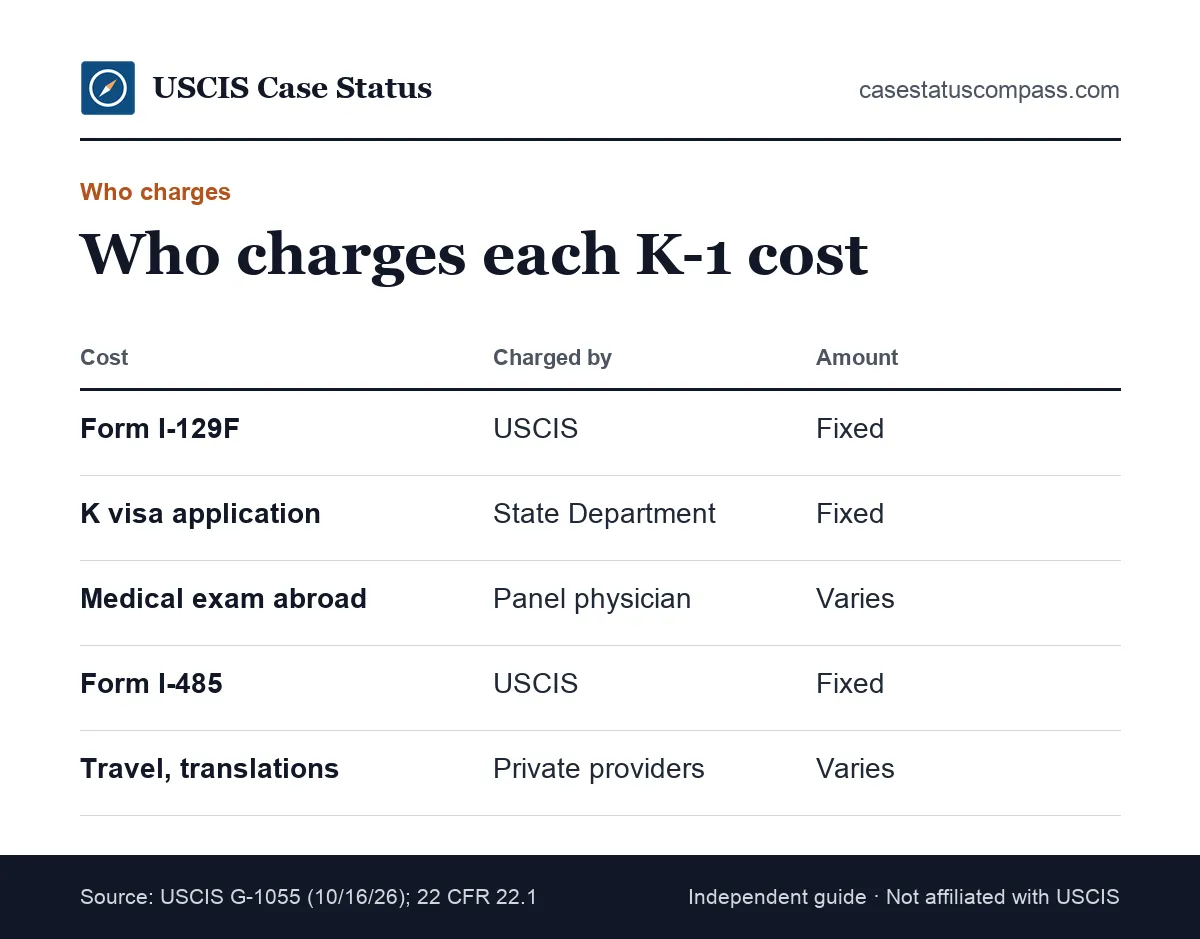
The consular stage costs the K visa application fee, $265 K (fiancé) visa application fee, plus the medical exam and documents your fiancé(e) needs abroad. The visa fee is fixed by federal regulation (22 CFR 22.1). Medical and document prices vary by country.
The K visa application fee
The State Department lists the $265 K (fiancé) visa application fee in item 21(d) of its schedule of fees. Each K visa applicant pays it, including each K-2 child. It is paid per applicant.
How Much Is the K-1 Medical Exam Abroad?
A panel physician approved by the State Department performs the exam abroad. We could not verify a standard price, because each physician sets it, and vaccinations or tests may add more. Ask the clinic named by your embassy for a written quote.
Vaccinations and extra tests
Bring every vaccination record you have. Doses the physician cannot confirm may have to be given again at the clinic, usually for an extra charge, and some tests depend on age. Ask what the quote covers before you book.
How Much Is the K-1 Visa Fee at the Embassy?
The K-1 visa fee at the embassy is $265 K (fiancé) visa application fee, per applicant, under 22 CFR 22.1. It is a State Department fee, separate from anything paid to USCIS. Pay it only after USCIS approves Form I-129F and the case reaches the consulate.
Is there a visa integrity fee?
H.R. 1 created a visa integrity fee for some nonimmigrant visas. The State Department's Fees for Visa Services page did not list a visa integrity fee as of Oct. 27, 2026, so we do not state an amount. Check that page again before the interview.
Keep the payment receipt
Embassies usually need proof of payment to book or attend the interview. Save the receipt as a PDF and a printout, and bring it to the appointment with the passport and civil documents.
What Other Documents Cost Money Abroad?
Beyond the visa fee and medical exam, your fiancé(e) usually pays for a passport, police certificates, certified civil documents and translations. These costs vary widely by country, so get local prices early. None of them are USCIS or State Department fees.
Common document costs to price
- A passport valid for travel.
- Police certificates from countries of residence.
- Birth certificate and divorce or death records.
- Certified English translations.
- Photos that meet visa photo rules.
Ask each office for current prices and processing times, because a slow record can hold up the interview date.
Proof of financial support
The consulate checks that your fiancé(e) will not need public support. Our affidavit of support guide explains the income rules that apply after marriage. At the consular stage, the embassy tells you which support form it wants.
Does a K-1 Visa Holder Pay the USCIS Immigrant Fee?
No. USCIS lists K nonimmigrants as exempt from the USCIS Immigrant Fee, which is $235 for people entering on immigrant visas. A K-1 fiancé(e) enters as a nonimmigrant and gets the green card later through Form I-485. K-2 children are exempt too.
Why K-1 costs differ from immigrant visas
An immigrant visa holder pays an immigrant visa fee and the USCIS Immigrant Fee, then receives a green card by mail. A K-1 entrant skips both but pays the much larger I-485 fee after the wedding.
Do not pay it by mistake
Third-party sites sometimes list the Immigrant Fee as a K-1 cost. It is not. If asked to pay it, check the official USCIS Immigrant Fee page before paying anything. USCIS fees are nonrefundable, so a mistaken payment is usually lost.
Travel and Wedding Costs Within 90 Days
After the visa is issued, budget for the flight and the wedding. The 90-day rule sets the clock: K-1: marry within 90 days of entering the U.S.. Flights and the ceremony are private costs. Budget for them before the interview, so a late booking does not push the wedding date past the deadline.
The visa's own deadline
USCIS notes: K-1 visa: valid up to 6 months, one entry. Book travel inside that window. A missed window can mean starting the consular stage again, with new fees. Fares often rise closer to departure.
Marriage license and certificate
The county or city where you marry charges for the license and certified copies of the certificate. You need a certified copy for Form I-485, so order more than one. Ask the clerk for current prices.
Adjustment of Status After Marriage
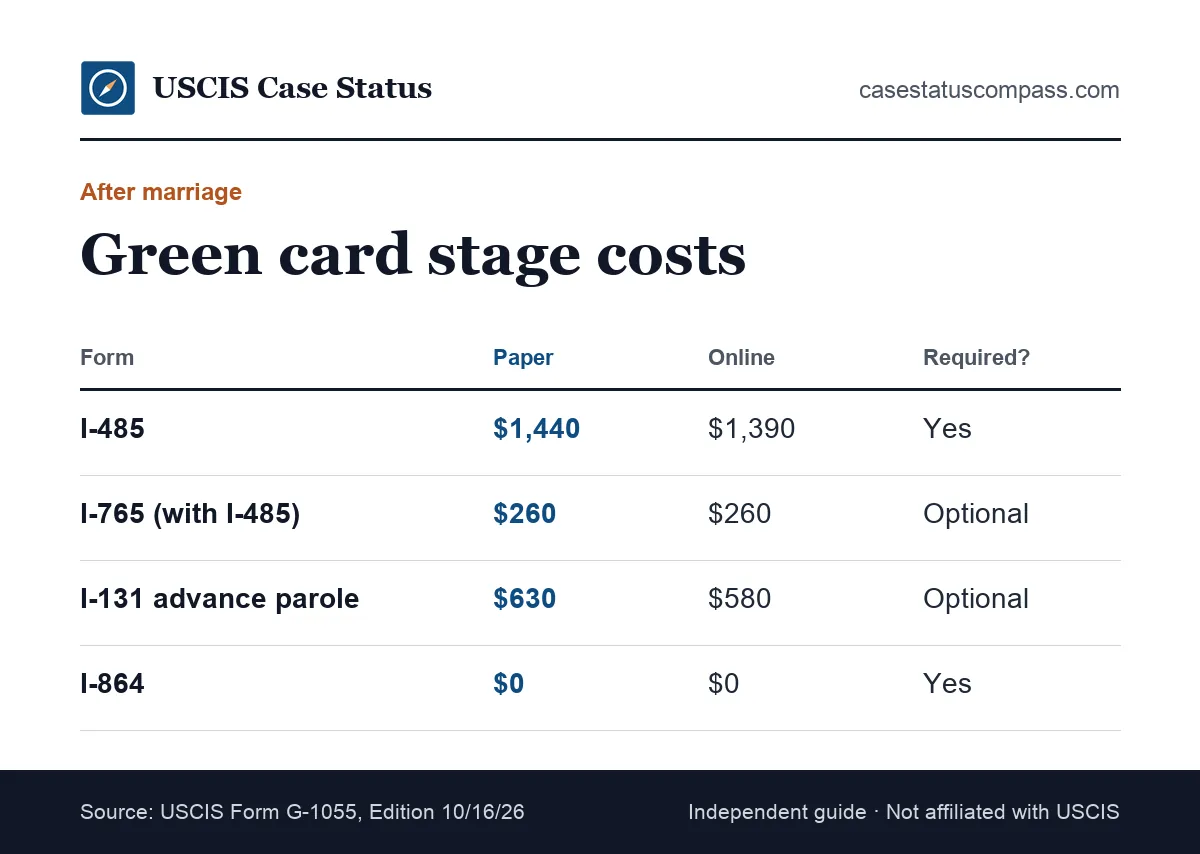
Adjustment of status is the green card step after the wedding. The K-1 spouse files Form I-485, which costs $1,440 paper / $1,390 online. The citizen spouse adds Form I-864 at $0 at USCIS. This is usually the single largest K-1 fee.
No second petition
A K-1 spouse does not file a new I-130, because the approved I-129F supports the I-485. That saves the $675 (paper) / $625 (online) that a spouse entering any other way would pay. Our adjustment of status guide covers the full package.
Current I-485 edition
USCIS requires I-485 edition 09/18/26 (01/20/25 and 09/04/26 editions rejected on/after Sept. 18, 2026; no grace period). Check the edition date printed at the bottom of each page before anyone signs.
Filing the I-485 online
You can also file online, which costs $1,390 instead of $1,440 on paper as of October 2026. Check the I-485 page for which categories can file online. The online filing route also lets you pay through Pay.gov.
How Much Is the I-485 Fee for a K-1 Spouse?
The I-485 fee for a K-1 spouse is $1,440 paper / $1,390 online, under Form G-1055 (10/16/26). It includes biometrics. A K-2 child under 14 filing with a parent pays $950 on paper or $900 online. There is no separate biometrics fee.
Full I-485 fee line
USCIS lists: $1,440 (paper) / $1,390 (online); $950 / $900 if under 14 and filing with a parent. The same amount applies whether the K-1 spouse married one week or ten weeks after arrival, as long as the marriage was to the petitioner within 90 days.
Can the I-485 fee be waived?
Generally no for K-1 spouses. I-485 waivers are limited to certain categories, mainly applicants exempt from the public charge ground. For green card costs on other paths, see how much a green card costs.
What Does the Medical Exam Cost After Arrival?
USCIS charges $0 USCIS fee; the civil surgeon sets the exam price for Form I-693. The civil surgeon in the U.S. sets the exam price, and the form must go with your I-485: Send the sealed I-693 with your I-485 (required since Dec. 2, 2024). Ask local civil surgeons for quotes.
One exam, one application
USCIS now says: An I-693 is generally valid only for the application it was filed with. Budget for the exam during the I-485 stage, and read the I-693 instructions for what a K-1 entrant must submit.
Shopping for a civil surgeon
Use the USCIS civil surgeon locator and compare written quotes. Ask whether vaccinations, blood tests and the sealed envelope are included. Our immigration medical exam guide explains what the exam involves.
Should You Pay for a K-1 Work Permit?
A work permit is optional. Filed with or after a pending I-485 filed on or after April 1, 2024, Form I-765 costs $260 as of October 2026. Many K-1 spouses file it with the I-485 so they can work while the green card is pending.
Two ways to file
The table compares filing the work permit right after entry with filing it alongside the I-485 after the wedding.
| Option | When | Fee (Oct. 2026) | Trade-off |
|---|---|---|---|
| I-765 with the I-485 | After the wedding | $260 | Valid through the pending case |
| I-765 on K-1 status | Right after entry | $520 paper / $470 online | Tied to the short K-1 stay |
Is it worth it?
If the K-1 spouse plans to work before the green card arrives, $260 is usually small next to lost wages. Our work permit guide explains the categories. Filing with the I-485 is usually cheaper.
Check the I-765 edition first
Before paying, confirm the I-765 edition rule: 08/21/25 (the 09/15/26 edition is NOT accepted because of a Sept. 14, 2026 court order). A package on an older edition can be rejected, which delays the work permit and means sending the filing again.
Should You Pay for Advance Parole (I-131)?
Advance parole is optional and costs $630 (paper) / $580 (online); $0 if your I-485 was filed before Apr. 1, 2024 with the fee. H.R. 1 Immigration Parole Fee $1,050 when parole is granted (some exceptions). You need it only if the K-1 spouse must travel abroad while the I-485 is pending. Without it, leaving the U.S. can abandon the green card application.
Why travel is risky without it
USCIS warns: Traveling while your I-485 is pending abandons it unless you have advance parole (with H/L/V/K exceptions). A trip could mean losing the I-485 fee and starting over. If no travel is planned, many couples skip this form.
Does the H.R. 1 Parole Fee Apply to K-1 Spouses?
The fee schedule lists an Immigration Parole Fee of $1,050 when parole is granted. One exception covers advance parole travelers: the parole fee does not apply to an INA 245 adjustment applicant returning from temporary travel abroad, if CBP agrees at the port of entry. Ask an attorney before relying on it. Our advance parole guide has the details.
K-1 Visa Cost for K-2 Children
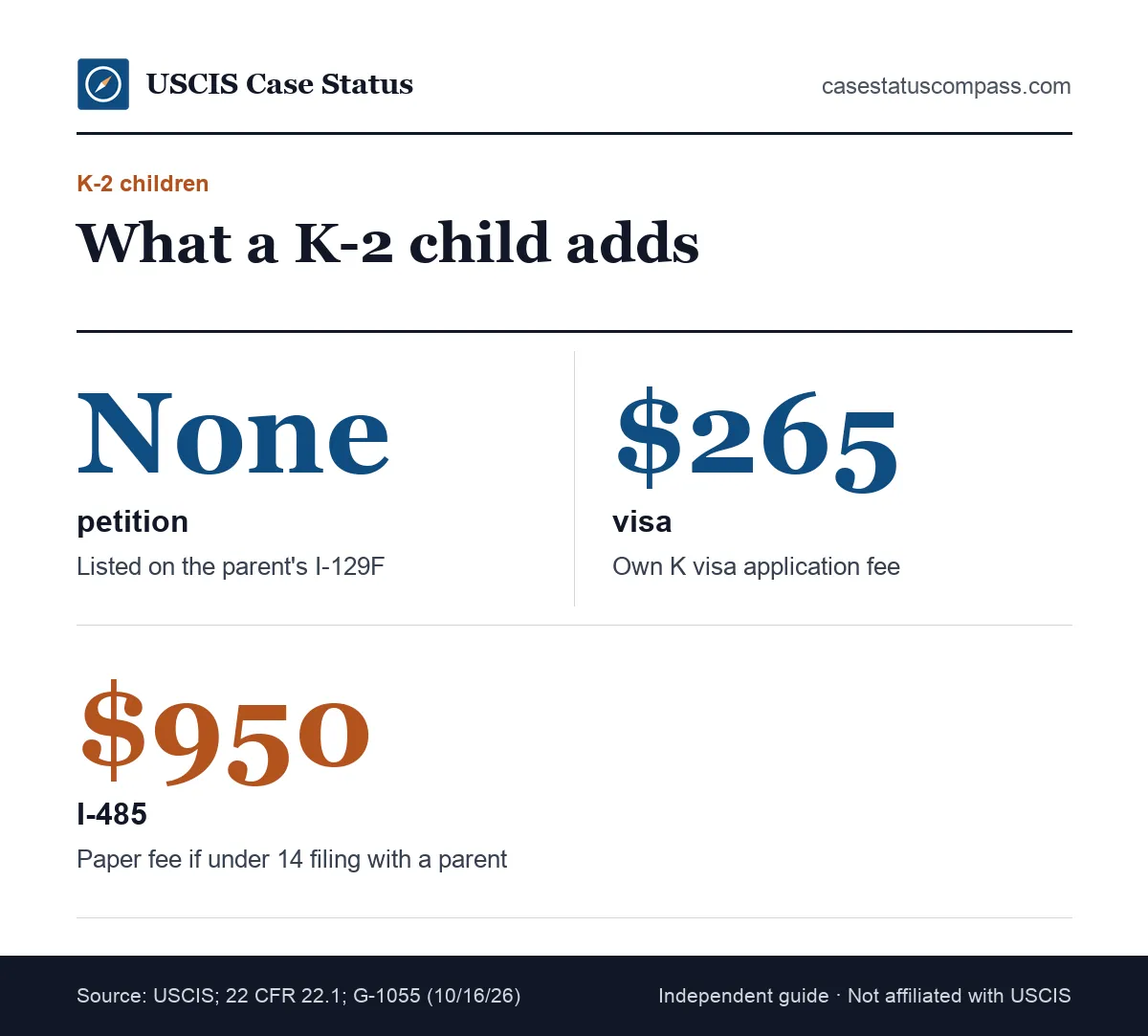
Each K-2 child adds a K visa fee of $265 and, after arrival, a separate Form I-485. Children are listed on the parent's I-129F, so there is no extra petition fee. A child under 14 filing with a parent pays the lower I-485 fee.
Per-child fee table
This table shows each K-2 child's share by age group. A child's age on the I-485 filing date decides the rate.
| Item | Child under 14 | Child 14 to 20 |
|---|---|---|
| I-129F | Included | Included |
| K visa fee | $265 | $265 |
| I-485 (paper / online) | $950 / $900 with a parent | $1,440 / $1,390 |
Timing for children
A K-2 child should file Form I-485 together with, or after, the K-1 parent's case. Ask an attorney if a child is close to turning 21, because the deadlines for K-2 children are strict.
What Is the Total K-1 Visa Cost?
The total K-1 visa cost in government fees is $2,330 to $2,380 for a single fiancé(e) who files only the required forms, by our sums of the October 2026 fees. Adding an I-765 and I-131 raises it to about $3,220 to $3,270. Private costs come on top.
Total K-1 cost table
This table adds the required lines first, then the optional work and travel permits. Use the column that matches how you will file the I-485.
| Item | Paper total | With online I-485 | Required? |
|---|---|---|---|
| Form I-129F | $675 | $675 | Yes |
| K visa fee | $265 | $265 | Yes |
| Form I-485 | $1,440 | $1,390 | Yes |
| Form I-864 | $0 | $0 | Yes |
| Required subtotal | $2,380 | $2,330 | |
| Form I-765 with I-485 | $260 | $260 | Optional |
| Form I-131 advance parole | $630 | $630 | Optional |
| With work and travel | $3,270 | $3,220 |
What is left out on purpose
The table excludes the medical exam, documents, flights, the wedding and legal help, because they vary. It also leaves out the H.R. 1 Immigration Parole Fee, which applies only if parole is granted and has exceptions.
K-1 Visa Cost Worksheet for Your Case
Use this k1 visa cost worksheet to price your own case. Start with the fixed government lines, then add quotes for the variable lines. Multiply the per-person lines by the number of travelers, including K-2 children. Write the quotes in pencil, and update your k1 visa cost total as real prices come in.
Fill-in worksheet
Copy this table into a spreadsheet or onto paper. Fill in the number of people for each line, then add up the right-hand column.
| Line | Per person | Number of people | Your total |
|---|---|---|---|
| I-129F petition | $675 (once) | 1 | |
| K visa fee | $265 | ___ | |
| Medical exam abroad | Your quote | ___ | |
| Documents and translations | Your quote | ___ | |
| Flights | Your quote | ___ | |
| I-485 | $1,440 / $1,390 (or $950 / $900 under 14) | ___ | |
| I-765 / I-131 (optional) | $260 / $630 | ___ | |
| Civil surgeon (U.S.) | Your quote | ___ |
How Much Is a K1 Visa Total for a Fiancée and Child?
Take a fictional couple bringing a fiancée and her 10-year-old son, filing on paper. Fixed fees: $675 + ($265 × 2) + $1,440 + $950 = $3,595 (our sum). One petition covers both, but each pays a visa fee and files an I-485.
Adding a work permit to the example
Adding the fiancée's $260 work permit brings the example to $3,855 (our sum), before medical exams and flights. The example files no I-765 for the son, so only one work permit fee appears.
Is a K-1 Visa Cheaper Than a CR-1 Spouse Visa?
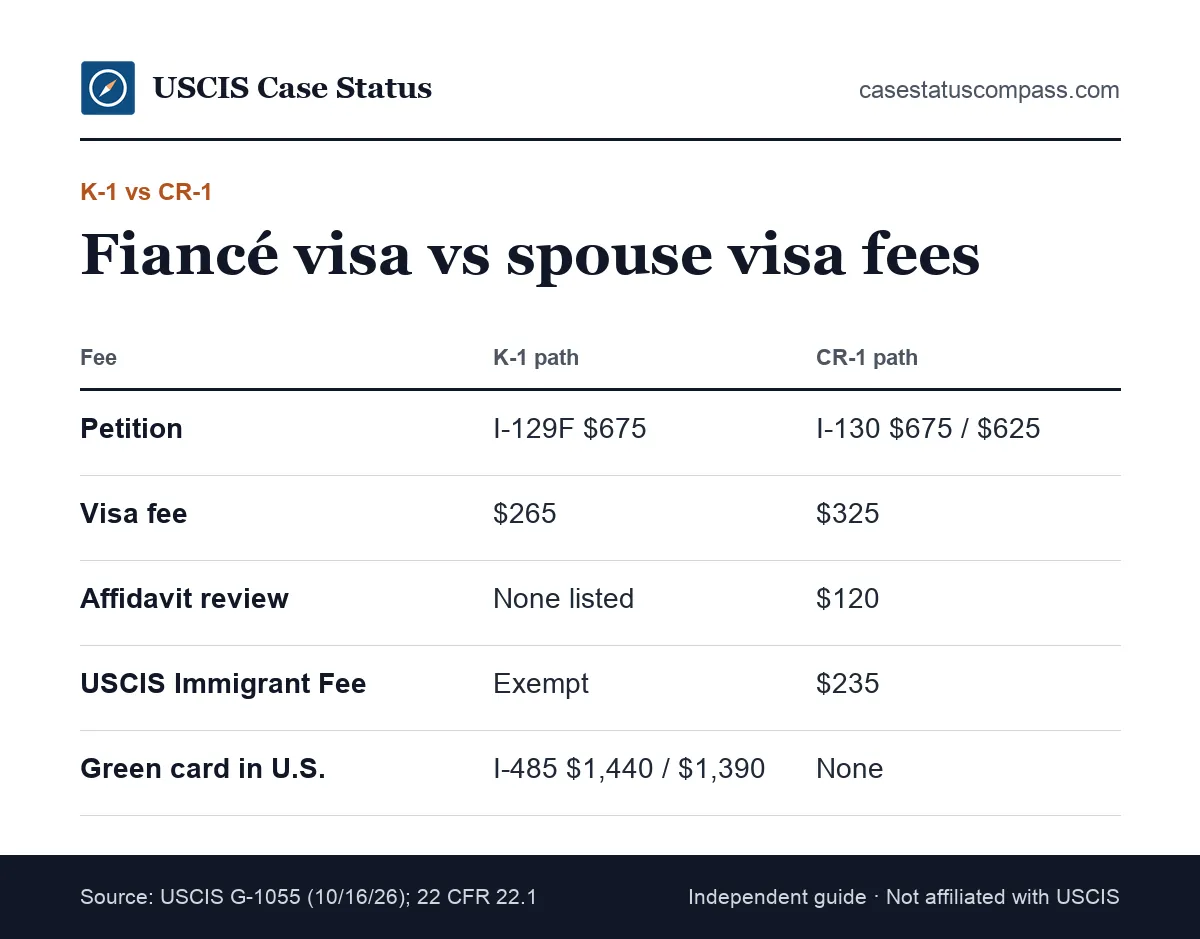
Usually not. A K-1 couple pays $675 + $265 + the I-485, while a CR-1 spouse visa couple pays the I-130, a $325 immigrant visa fee, a $120 affidavit review fee and the $235 USCIS Immigrant Fee, with no I-485. The K-1 path often costs more in government fees.
Fee comparison table
This table sets the K-1 and CR-1 fee lines side by side, so you can see where each path costs more.
| Fee | K-1 fiancé(e) | CR-1 spouse |
|---|---|---|
| Petition | I-129F: $675 | I-130: $675 (paper) / $625 (online) |
| Visa | $265 K (fiancé) visa application fee | Immigrant visa fee: $325 family; $345 employment; $205 other (per person) |
| Affidavit review | Not a K-1 fee | $120 Affidavit of Support review fee (State Department, when reviewed domestically) |
| USCIS Immigrant Fee | Exempt | $235 |
| Green card in U.S. | I-485: $1,440 paper / $1,390 online | None (card mailed) |
Cost is not the only factor
The K-1 lets you marry in the U.S. and the spouse can file for work authorization soon after. The CR-1 requires marriage first but delivers a green card on arrival. Our marriage green card guide compares the two processes.
How Long Does the K-1 Process Take, and Does Time Cost Money?
USCIS's median for Form I-129F in April–June 2026 was I-129F: median 9.0 months (USCIS data, Apr.-June 2026). For the live figure, most cases currently take 13 months (USCIS data retrieved Oct 27, 2026). Every month of waiting adds private costs, such as visits, phone bills and document renewals, so plan the budget across the full timeline.
Read the official tool
USCIS explains: The USCIS tool shows how long it took to finish 80% of cases in the past 6 months. Check egov.uscis.gov/processing-times for your service center. For stage-by-stage timing, see our k1 visa processing time guide.
Hidden costs of waiting
- Police certificates or medical results that go stale.
- Passport renewals during the wait.
- Visits while the case is pending.
- Rebooking flights after a delayed interview.
Set aside a buffer for these before you file the petition.
What Costs Come After the K-1 Green Card?
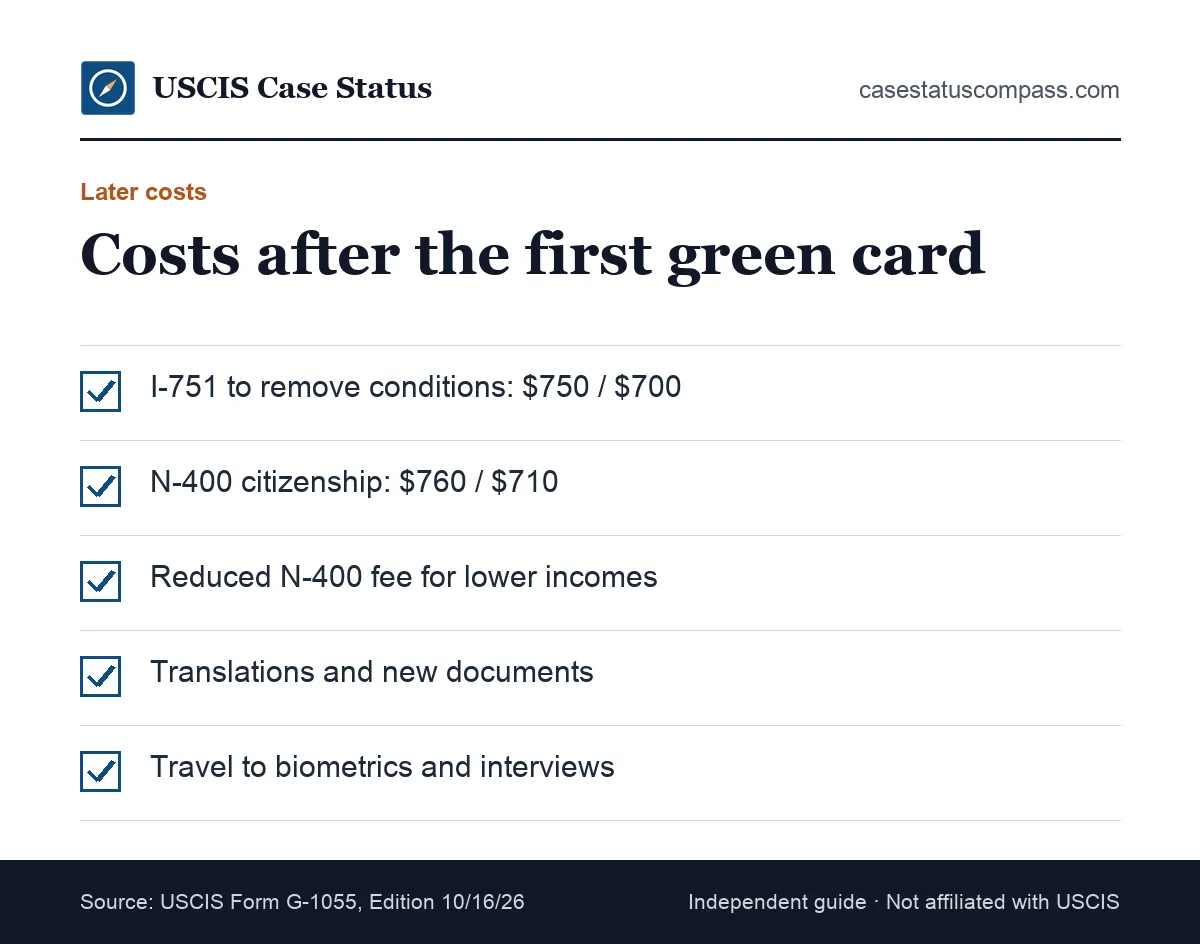
A K-1 spouse married less than two years at approval gets a conditional card: Most green cards are valid for 10 years; conditional green cards for 2 years. Removing conditions on Form I-751 costs $750 (paper) / $700 (online). Citizenship later costs $760 (paper) / $710 (online); reduced fee $380 (paper only) if household income is at or below 400% of the Federal Poverty Guidelines.
Removing conditions
USCIS says: File in the 90 days before your 2-year card expires. Budget for the I-751 about two years after approval. Our Form I-751 guide explains the evidence. Fees may rise by then.
Citizenship and card renewals
Once eligible, the spouse can naturalize; our page on how much it costs to become a US citizen breaks down the N-400 budget. Holders who stay residents renew the 10-year card later; see the green card renewal fee.
Which K-1 Fees Can Be Waived or Refunded?
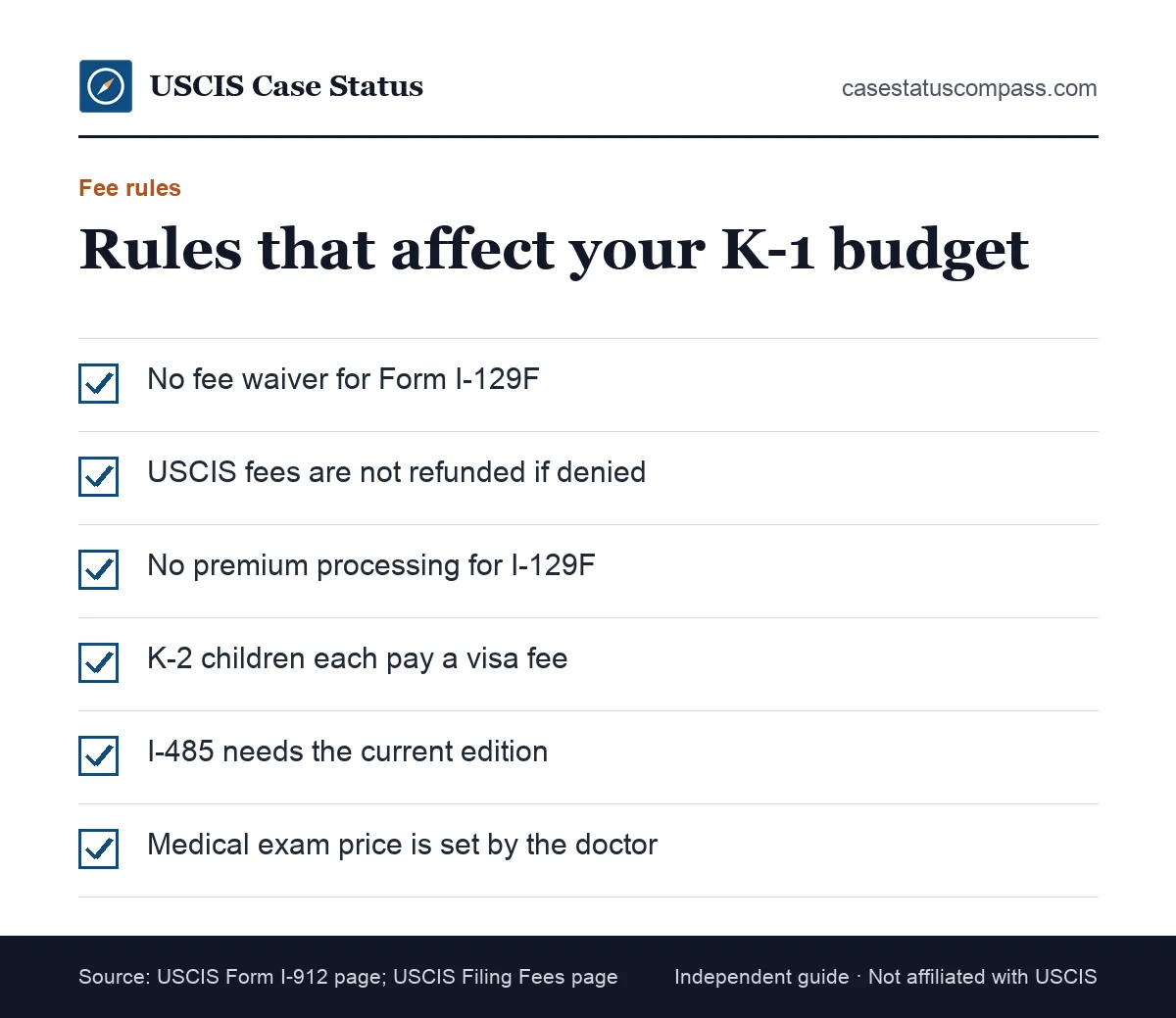
Almost none. Form I-129F cannot be waived, the State Department visa fee is not a USCIS fee, and most K-1 spouses cannot waive the I-485. USCIS fees are not refunded if a case is denied or withdrawn. Plan for full payment.
Waivers
The USCIS waiver list leaves out the I-129F. The I-485 is waivable only for certain categories. A K-1 spouse with a low income should still budget the full fee and ask an accredited representative about any exception.
Refunds
USCIS states: USCIS fees are nonrefundable, even if your case is denied or withdrawn. State Department fees follow their own rules. Treat every payment as final and double-check each filing before sending it.
How Do You Pay K-1 Fees?
You pay K-1 fees to two agencies: USCIS for Forms I-129F and I-485, and the State Department for the K visa fee. Each has its own payment method, and a wrong payment can get a filing rejected. Keep every receipt together.
Paying USCIS on paper
Paper filings use Form G-1450 or G-1650, because checks, money orders and cashier's checks are accepted only with an approved Form G-1651 exemption. Also, make paper payments payable to the U.S. Department of Homeland Security (not 'DHS' or 'USDHS'). Read the filing fees page and the form instructions before you mail anything.
Paying USCIS online
Forms filed online, such as the I-485 when your category allows it, are paid inside your USCIS online account when you submit. The online I-485 also costs less: $1,390 instead of $1,440.
How Do You Pay the K-1 Visa Application Fee?
Your embassy's instructions explain how to pay the $265 K (fiancé) visa application fee. Use only the official payment channel and keep the receipt. Never pay a visa fee to a person or a site the embassy did not name.
Paying for a K-2 child's visa
Each K-2 child pays a separate $265 visa fee, so a parent bringing two children pays it three times. Follow the embassy's payment steps for each applicant and keep one receipt per person.
How to Lower Your K-1 Visa Cost Legally
You cannot reduce the fixed government fees, but you can avoid repeat payments and overspending on variable costs. The biggest savings come from never filing twice. Check every form against the current edition and the fee schedule before mailing. A careful first filing is the cheapest one. The list below shows where couples usually save.
Practical savings
- File the I-485 online to pay the lower fee.
- Skip advance parole if no travel is planned.
- Compare panel physician and civil surgeon quotes.
- Order extra certified marriage certificates once.
- Use a nonprofit for help instead of a high-fee service.
Savings that backfire
Skipping evidence, using an old form edition or ignoring the 90-day rule can cost far more than any saving. A denied I-129F or a rejected I-485 means paying the fee again.
Common K-1 Budget Mistakes
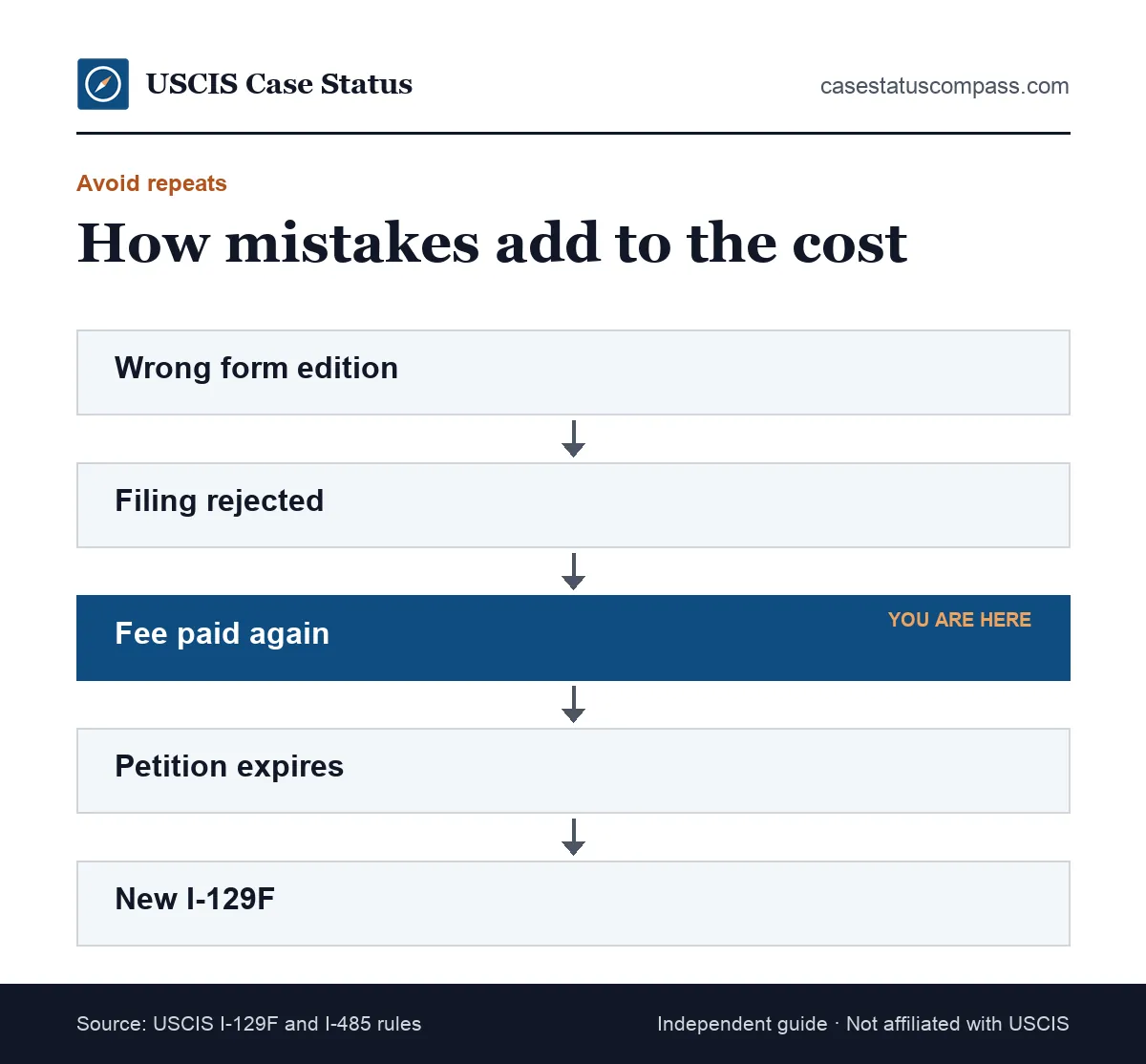
The most common K-1 budget mistakes are forgetting the I-485 fee, counting the USCIS Immigrant Fee that K-1s do not pay, and missing K-2 children's fees. Others come from repeat filings after a rejection or a lapsed petition. Most are easy to avoid.
Mistakes in the plan
- Treating the $940 visa-stage sum as the total cost.
- Forgetting each K-2 child's visa and I-485 fees.
- Paying the Immigrant Fee that does not apply.
- Ignoring medical and translation costs.
Mistakes in the filing
- Old I-129F or I-485 editions.
- Unsigned forms or wrong fee amounts.
- Marrying after the 90-day deadline.
- Traveling abroad without advance parole.
Each of these can mean a rejected filing, a denial or a lost green card case. Check edition dates and signatures, and set a calendar reminder for day 90.
Should You Pay for a K-1 Attorney?
An attorney is optional; USCIS and the State Department do not require one. Legal help is worth it for past visa denials, criminal records, prior marriages abroad that are hard to document, or children close to 21. We do not list prices, because they vary by firm.
When help is worth the cost
- A past visa refusal or immigration violation.
- An arrest or conviction for either partner.
- A missed or near 90-day deadline.
- A petition returned by the consulate.
In these cases, paying for advice early can cost less than a second filing.
Lower-cost help
A DOJ-accredited representative at a nonprofit may charge less than a private firm. For general budget planning, our immigration lawyer cost guide explains how fees are usually structured. Check their credentials.
Is the K-1 Visa Price the Same in Every Country?
The government part of the K-1 visa price is the same everywhere: $675 for the petition and $265 for the visa. What changes by country is the private part, listed below. Ask the embassy and local providers for written prices, since the private costs can be larger than the government fees in some countries.
Fixed in every country
USCIS fees follow Form G-1055, and the K visa fee follows 22 CFR 22.1. Neither depends on the embassy or the fiancé(e)'s nationality. So a couple in Manila and one in Lagos pay the same fees to USCIS and the State Department.
What changes by country
- Medical exam prices set by local panel physicians.
- Police certificate and civil document fees.
- Translation rates and courier costs.
- Airfare to the U.S. port of entry.
Get local quotes for each item before you set a budget.
What Does the I-864 Affidavit of Support Cost?
Form I-864 costs $0 at USCIS at USCIS, but it carries an income requirement. The citizen spouse files it with the I-485 after the wedding: Sponsors need income of at least 125% of the poverty guidelines (100% for active-duty military sponsoring spouse/child). A sponsor who falls short may need a joint sponsor.
Income figures for 2026
USCIS lists: 2026 I-864P (from Mar. 1, 2026): 125% = $27,050 (household of 2), $34,150 (3), $41,250 (4). Check uscis.gov/i-864p for Alaska, Hawaii and larger households. Count the K-1 spouse in the household size.
If income is too low
USCIS allows help: Up to two joint sponsors; each must qualify alone at 125%. Assets can also count. Our affidavit of support guide explains the options. A joint sponsor pays no USCIS fee.
Does a Prior Marriage Add to the K-1 Cost?
Yes, a little. If either partner was married before, you must prove the marriage ended, which means ordering certified divorce decrees or death certificates, plus translations. Hard-to-get records can add fees and weeks to the timeline. Start early, because these records raise the k1 visa cost only slightly but can delay it a lot.
Documents to order early
- Final divorce decree or annulment record.
- Death certificate of a former spouse.
- Certified English translations of each.
Request them from the court or registry that issued them, as soon as you decide to file. Some offices take months, and certified copies often carry their own fee.
Why delays cost money
Missing proof can trigger a request for evidence or a returned petition. Each delay can mean new police certificates or a new medical exam. Those repeat costs can add up to more than the original fee.
What If the Consulate Returns the Petition?
If the consulate sends the I-129F back to USCIS for review, the case slows and costs can rise. The original fee is not refunded, and if the petition is later revoked, a new filing means a new $675. Plan for extra time.
Costs a returned petition can trigger
- A new I-129F fee if you refile.
- Repeat medical exam or police records.
- Attorney help with the review.
- Extra visits while the case is stuck.
Budget for these if the consulate signals doubts. A lawyer can tell you whether to answer or refile.
How to lower the risk
Send strong proof of the relationship and the in-person meeting. Answer interview questions honestly and keep your story consistent with the petition. Bring copies of photos, messages and travel records to the interview, and make sure both partners know the key dates.
What Happens to Costs If You Miss the 90-Day Deadline?
Missing the 90-day window is expensive. K-1 status ends, and the spouse generally cannot adjust through the original petition in the usual way. Fixing it usually needs an attorney, and some couples must restart with a new petition and new fees.
Why the deadline is firm
USCIS states: K-1: marry within 90 days of entering the U.S.. K-1 status cannot be extended, so plan the wedding date before travel. Missing it can mean new fees and a fresh petition.
What to do if you are close
Book the marriage license appointment early. If the deadline is already near or passed, talk to an immigration attorney before filing anything else. Many counties issue a marriage license quickly, but some have waiting periods. Check the clerk's rules first.
How the K-1 Costs Fit Together
K-1 costs fit into three blocks: getting the visa ($940 in government fees, our sum), getting the green card (the I-485 and optional forms), and keeping status (I-751, then citizenship). To keep your k1 visa cost on track, budget for each block in turn, since the green card and keep status blocks come months or years after the visa. Recheck the fee schedule before each stage.
The full path at a glance
Each row is one block of the K-1 path, with its main forms and the government fees that apply.
| Block | Main forms | Government fees (Oct. 2026) |
|---|---|---|
| Visa | I-129F, K visa | $675 + $265 |
| Green card | I-485, I-864, optional I-765/I-131 | $1,390 to $2,330+ (our sum) |
| Keep status | I-751, later N-400 | $700 to $760 each |
Where to go next
Our guide to H-1B visa fees covers employer-paid work costs, and our Form G-1055 fee schedule guide lists every form on one page.
Frequently Asked Questions
How much does a K1 visa cost?
As of October 2026, a K1 visa costs $940 in government fees to reach the U.S. (our sum): $675 for Form I-129F and $265 for the visa. After the wedding, Form I-485 adds $1,440 on paper or $1,390 online.
How much does it cost to get a K1 visa including the green card?
Required government fees total $2,330 to $2,380, by our sums: the I-129F, the K visa fee and Form I-485. Adding a work permit and advance parole raises that to about $3,220 to $3,270.
Who pays the K-1 visa fees?
The U.S. citizen usually pays the I-129F fee because they file the petition. The fiancé(e) pays the K visa fee and medical exam abroad. The I-485 fee is paid with the spouse's application after the wedding.
Do K-1 visa holders pay the USCIS Immigrant Fee?
No. USCIS lists K nonimmigrants as exempt from the USCIS Immigrant Fee. That fee applies to people who enter on immigrant visas, such as CR-1 spouses. A K-1 fiancé(e) instead pays the Form I-485 fee after marrying.
Can I get a fee waiver for the K-1 visa?
No. Form I-129F is not on the USCIS fee waiver list, and the State Department K visa fee is set separately. Most K-1 spouses also cannot waive the I-485 fee.
Is the K-1 visa fee charged per person?
Yes for the visa. Each applicant, including each K-2 child, pays the $265 K visa fee. The I-129F fee is paid once for the whole family. Each person who adjusts status also files their own Form I-485.
Is the medical exam included in the K1 visa fee?
No. The $265 visa fee covers only the State Department application. The panel physician abroad charges separately, and after the wedding a U.S. civil surgeon charges again for the Form I-693 exam filed with the I-485.
How much is the K1 visa fee for a child under 14?
A child under 14 pays the same $265 K visa fee as an adult. The saving comes later: filing Form I-485 with a parent costs $950 on paper or $900 online.
What happens to the fees if the K-1 visa is denied?
USCIS fees are not refunded, even if the case is denied or withdrawn. Do not expect the State Department visa fee back either; check its rules. If you refile, you pay again, so a complete first filing controls the total cost.
Sources
- USCIS Fee Schedule, Form G-1055 (Edition 10/16/26). www.uscis.gov/g-1055. Accessed Oct 27, 2026.
- USCIS: Form I-129F, Petition for Alien Fiancé(e). www.uscis.gov/i-129f. Accessed Oct 27, 2026.
- USCIS: Visas for Fiancé(e)s of U.S. Citizens. www.uscis.gov/family/family-of-us-citizens/visas-for-fiancees-of-us-citizens. Accessed Oct 27, 2026.
- 22 CFR 22.1, Schedule of Fees for Consular Services (LII). www.law.cornell.edu/cfr/text/22/22.1. Accessed Oct 27, 2026.
- USCIS: Form I-485, Application to Register Permanent Residence. www.uscis.gov/i-485. Accessed Oct 27, 2026.
- USCIS: Form I-693, Report of Immigration Medical Examination. www.uscis.gov/i-693. Accessed Oct 27, 2026.
- USCIS: USCIS Immigrant Fee. www.uscis.gov/forms/filing-fees/uscis-immigrant-fee. Accessed Oct 27, 2026.
- USCIS: Filing Fees. www.uscis.gov/forms/filing-fees. Accessed Oct 27, 2026.
- USCIS processing times. egov.uscis.gov/processing-times/. Accessed Oct 27, 2026.
- USCIS Form G-1055 Fee Schedule, Edition 10/16/26. www.uscis.gov/sites/default/files/document/forms/g-1055.pdf. Accessed Oct 27, 2026.
- 22 CFR 22.1 Schedule of Fees for Consular Services (govinfo, CFR 2025 edition). www.govinfo.gov/content/pkg/CFR-2025-title22-vol1/xml/CFR-2025-title22-vol1-sec22-1.xml. Accessed Oct 27, 2026.
- Form I-129F Instructions, Edition 01/20/25. www.uscis.gov/sites/default/files/document/forms/i-129finstr.pdf. Accessed Oct 27, 2026.
- USCIS: How Do I Request Premium Processing? (updated 03/23/2026). www.uscis.gov/forms/all-forms/how-do-i-request-premium-processing. Accessed Oct 27, 2026.
- 8 CFR 214.2(k)(5) (LII). www.law.cornell.edu/cfr/text/8/214.2. Accessed Oct 27, 2026.
- State Department: Fees for Visa Services. travel.state.gov/content/travel/en/us-visas/visa-information-resources/fees/fees-visa-services.html. Accessed Oct 27, 2026.
- USCIS Policy Manual Vol. 8, Part B, Ch. 4. www.uscis.gov/policy-manual/volume-8-part-b-chapter-4. Accessed Oct 27, 2026.
- USCIS: Form I-765 page (updated 10/07/2026). www.uscis.gov/i-765. Accessed Oct 27, 2026.
- Form I-485 Instructions, Edition 09/18/26. www.uscis.gov/sites/default/files/document/forms/i-485instr.pdf. Accessed Oct 27, 2026.
- DHS notice 'Immigration Parole Fee Required by HR-1 Reconciliation Bill', FR Doc. 2025-19564, 90 FR (Oct. 16, 2025); also G-1055 10/16/26 Appendix B. www.govinfo.gov/content/pkg/FR-2025-10-16/pdf/2025-19564.pdf. Accessed Oct 27, 2026.
- USCIS Data Library: All USCIS Application and Petition Form Types, FY2026 Q3 (Apr. 1-June 30, 2026; queried 7/2026). www.uscis.gov/sites/default/files/document/data/quarterly_all_forms_fy2026_q3_v1.xlsx. Accessed Oct 27, 2026.
- CIS Ombudsman tip sheet: Check Your USCIS Case Inquiry Date (Aug. 2024). dhs.gov/sites/default/files/2024-11/24_0823_cisomb_case-inquiry-date-tip-sheet.pdf. Accessed Oct 27, 2026.
- USCIS Glossary: Green Card. www.uscis.gov/tools/glossary. Accessed Oct 27, 2026.
- USCIS: Removing Conditions on Permanent Residence Based on Marriage. www.uscis.gov/green-card/after-we-grant-your-green-card/conditional-permanent-residence/removing-conditions-on-permanent-residence-based-on-marriage. Accessed Oct 27, 2026.
- Form I-864 Instructions, Edition 08/24/26. www.uscis.gov/sites/default/files/document/forms/i-864instr.pdf. Accessed Oct 27, 2026.
- USCIS: Form I-864P, 2026 HHS Poverty Guidelines (updated 02/27/2026). www.uscis.gov/i-864p. Accessed Oct 27, 2026.
casestatuscompass.com is an independent publication and is not affiliated with USCIS or any government agency. This page is general information, not legal advice. For denials, court or asylum matters, consult an immigration attorney or a DOJ-accredited representative.