Contents · 39 sections
- What Is a K1 Visa?
- Who Can File for a K1 Visa?
- What Does "Legally Free to Marry" Mean?
- The In-Person Meeting Requirement
- Can You Get a Waiver of the K-1 Meeting Requirement?
- How to File for a K-1 Visa (I-129F)
- What Goes in a K-1 Application Packet?
- K-1 Process Steps
- What Happens After You File Form I-129F?
- Reading Your I-129F Receipt Number
- The I-129F Status Sequence
- Tracking Your K-1 Case
- How Does a K1 Tracker Work?
- Are Third-Party K1 Tracker Sites Safe?
- What Happens When USCIS Approves the I-129F?
- How Do You Get Your NVC Case Number?
- The Consular Stage: DS-160, Medical and Interview
- What Happens at the K-1 Visa Interview?
- What If the Consulate Sends the Petition Back?
- K-2 Visas for Children
- How Do K-2 Children Get Green Cards?
- Entering the U.S. on a K1 Visa
- The 90-Day Marriage Rule
- What Happens If You Do Not Marry Within 90 Days?
- Can a K-1 Holder Work in the US?
- Can a K-1 Holder Travel Abroad?
- After Arrival: Marriage and Adjustment of Status
- Forms You File After the Wedding
- The Green Card Interview After a K-1
- Conditional Green Card and Form I-751
- K-1 Time and Cost Summary
- K-1 vs CR-1 Spousal Visa: Which Fits?
- Why Is My K-1 Case Not Moving?
- Common K-1 Application Mistakes
- Red Flags and Relationship Fraud Concerns
- K-1 Filing Checklist You Can Copy
- If-Then Guide for K-1 Situations
- When Should a K-1 Couple Get Legal Help?
- Frequently Asked Questions
The short answer
A K1 visa lets the foreign fiancé(e) of a U.S. citizen enter the United States to marry within 90 days. The citizen files Form I-129F with USCIS, the State Department issues the visa abroad, and after the wedding the spouse files Form I-485 for a green card.
At a glance
| Petition form | Form I-129F, edition 01/20/25 |
| USCIS filing fee | $675 |
| Marriage deadline | K-1: marry within 90 days of entering the U.S. |
| Who files | The U.S. citizen fiancé(e) |
| Green card step | Form I-485 after the wedding |
What Is a K1 Visa?
A K1 visa is a nonimmigrant visa for the foreign fiancé(e) of a U.S. citizen. It allows a single entry so the couple can marry in the United States within 90 days. For other immigration forms, see our USCIS forms guide.
Who the K-1 visa is for
The visa is for couples who are engaged, not yet married, where one partner is a U.S. citizen. Green card holders cannot file for a fiancé(e). Both partners must be free to marry.
K-1, K-2 and K-3 at a glance
The K-1 is for the fiancé(e). The K-2 is for that person's eligible unmarried children listed on the petition, who travel on the same case. List each child on the petition so they can follow later.
The rarely used K-3 category
The K-3 is a rarely used spouse category tied to a pending I-130. USCIS charges no I-129F fee for a K-3 based on an I-130 you already filed. Most married couples skip it.
Who Can File for a K1 Visa?
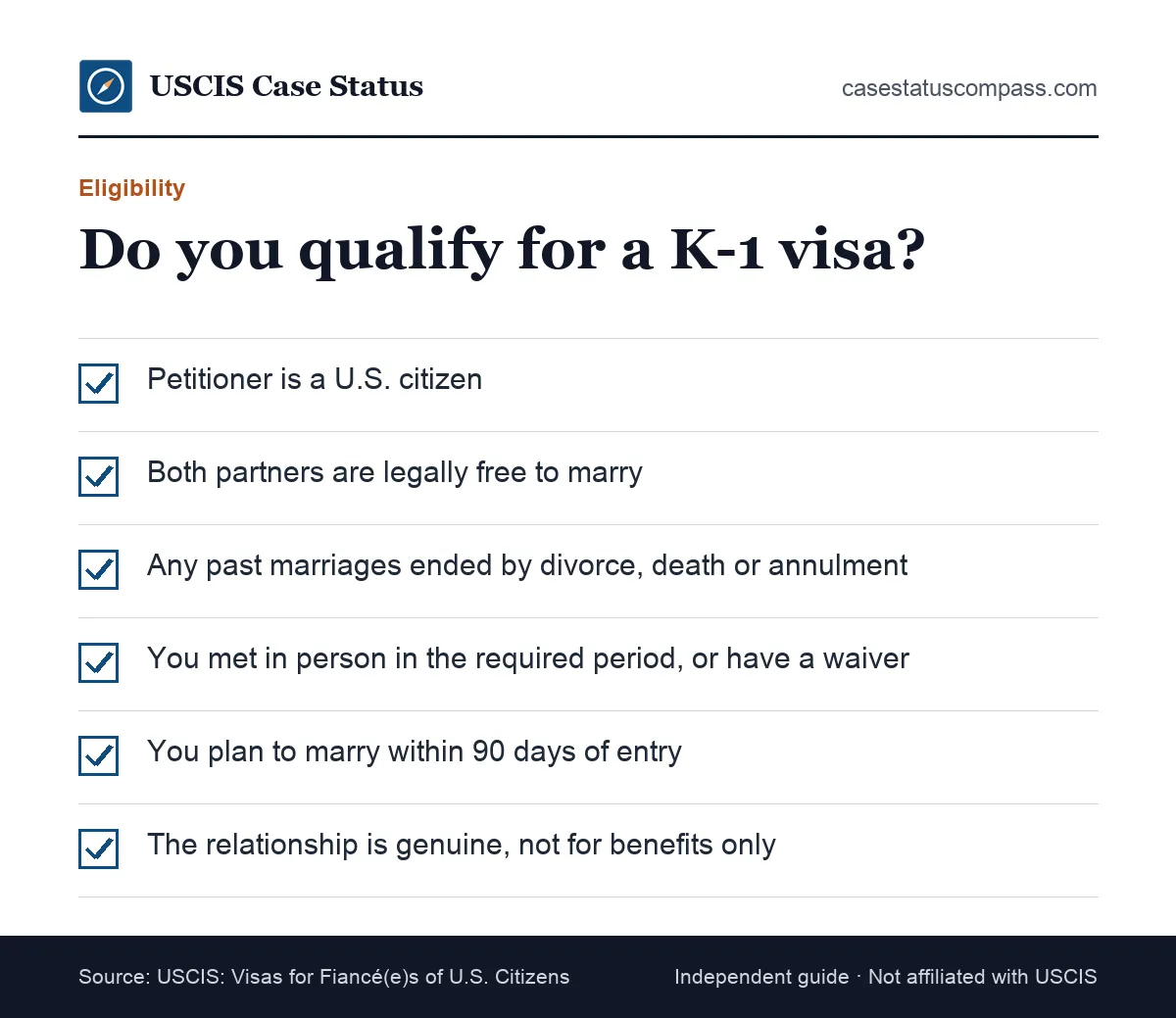
Only a U.S. citizen can file for a K1 visa, using Form I-129F. Both partners must be legally free to marry, must have met in person within the period USCIS requires (or qualify for a waiver), and must intend to marry within 90 days of the fiancé(e)'s entry.
Requirements for the petitioner
The petitioner must be a U.S. citizen, whether by birth or naturalization. They must show the relationship is genuine and that they intend to marry. Later, at the green card stage, they also sponsor the spouse financially with Form I-864.
Requirements for the foreign fiancé(e)
The beneficiary must be free to marry, intend to marry the petitioner, and be admissible to the United States. Past immigration violations or certain criminal history can create problems at the consulate. Disclose everything honestly and get advice if unsure.
What Does "Legally Free to Marry" Mean?
"Legally free to marry" means neither partner is still married to anyone else and both can marry under the law of the U.S. state where the wedding will happen. Every earlier marriage must have ended by divorce, death or annulment before the I-129F is filed, with proof.
Ending prior marriages
A divorce that is "in progress" does not count. The final divorce decree, a death certificate or an annulment order must exist before filing. Filing too early is a common reason for denial, and a new petition is needed once the marriage has legally ended.
Proof USCIS expects
Include copies of each final decree or certificate for both partners. Documents in another language need a certified English translation. If a past spouse's name changed, explain the link so the officer can match records quickly.
The In-Person Meeting Requirement
The K-1 petitioner and fiancé(e) must have met in person at least once within the period USCIS sets before filing. Video calls do not count. USCIS can waive the meeting only for strict cultural customs or extreme hardship to the petitioner. Check the I-129F page for the exact window.
What counts as proof
Good evidence of the in-person meeting includes boarding passes, passport stamps, hotel receipts and dated photos together. A short sworn statement describing when and where you met ties the documents together.
Can You Get a Waiver of the K-1 Meeting Requirement?
A meeting waiver request goes in with the I-129F and explains why meeting would break long-standing cultural or religious customs, or cause extreme hardship. Waivers are discretionary. Get legal help before relying on one. K-1: you must have met in person within the 2 years before filing (waivers possible).
How to File for a K-1 Visa (I-129F)
To file for a K1 visa, the U.S. citizen completes Form I-129F, Petition for Alien Fiancé(e), attaches evidence and pays the USCIS fee. As of October 2026, USCIS accepts edition 01/20/25 and lists the fee as $675. Sign it.
Use the right edition and fee
Download the form from uscis.gov/i-129f each time, because an old edition can be rejected. The fee comes from Form G-1055, edition 10/16/26. Our k1 visa cost guide explains every USCIS and State Department charge.
How and where to send it
The I-129F page lists the current filing address or online option for your situation. Keep a full copy of the packet and the delivery tracking number, since you may need both for evidence requests later.
What Goes in a K-1 Application Packet?
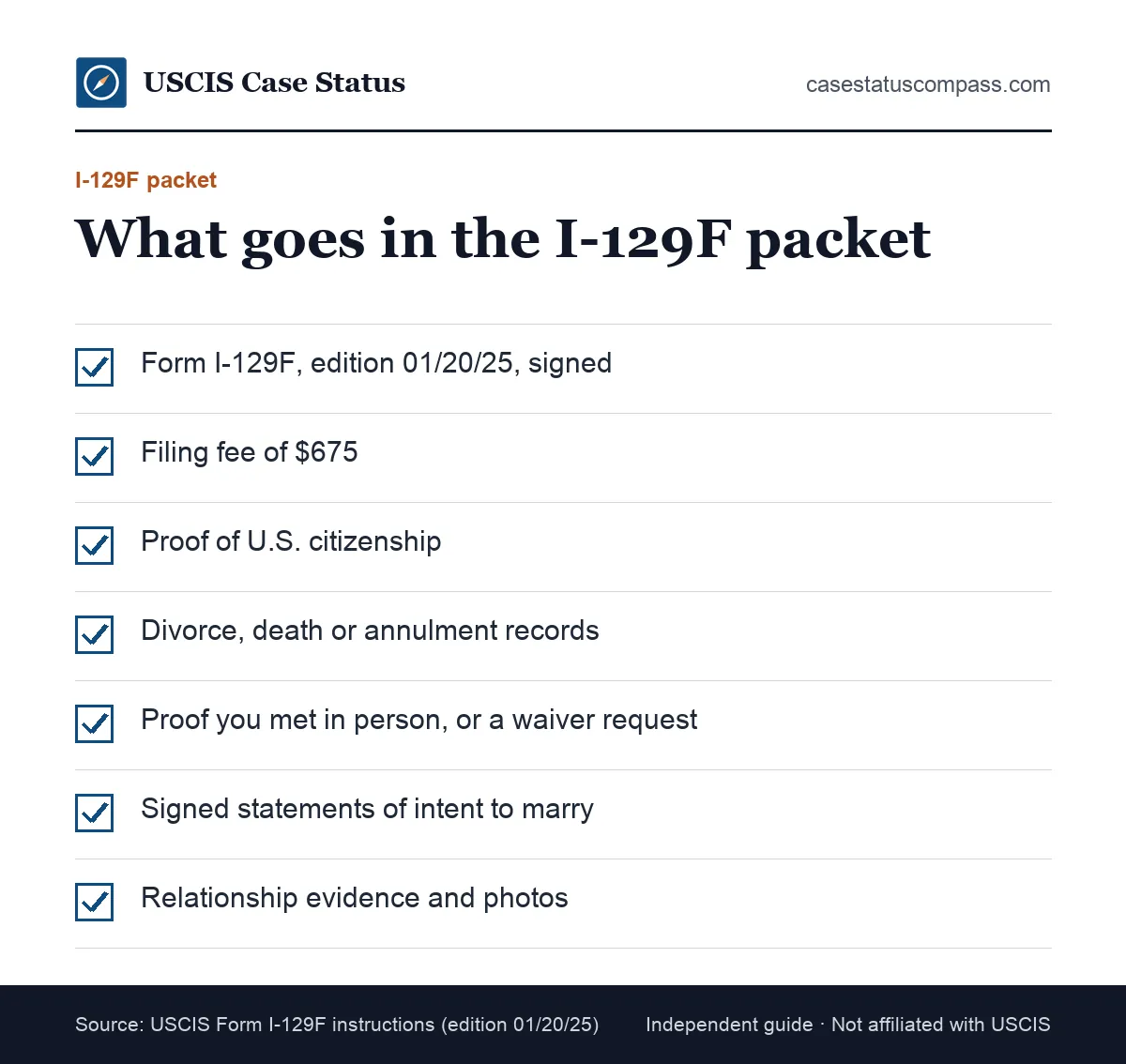
A complete K-1 application packet contains the signed Form I-129F, the fee, proof of citizenship, proof prior marriages ended, proof you met in person, statements of intent to marry from both partners, and evidence the relationship is real. A thin K1 application leads to evidence requests and delays.
Core documents
- Signed Form I-129F on the current edition.
- U.S. passport, naturalization certificate or birth certificate.
- Final divorce decrees or death certificates, if any.
- One passport-style photo of each partner, if the instructions ask.
- Translations of any foreign documents.
Relationship evidence
Strong relationship evidence shows a real bond: travel records, photos across time, message history samples and wedding plans. Quality beats volume. Label each item with dates so the officer sees the story without guessing.
K-1 Process Steps
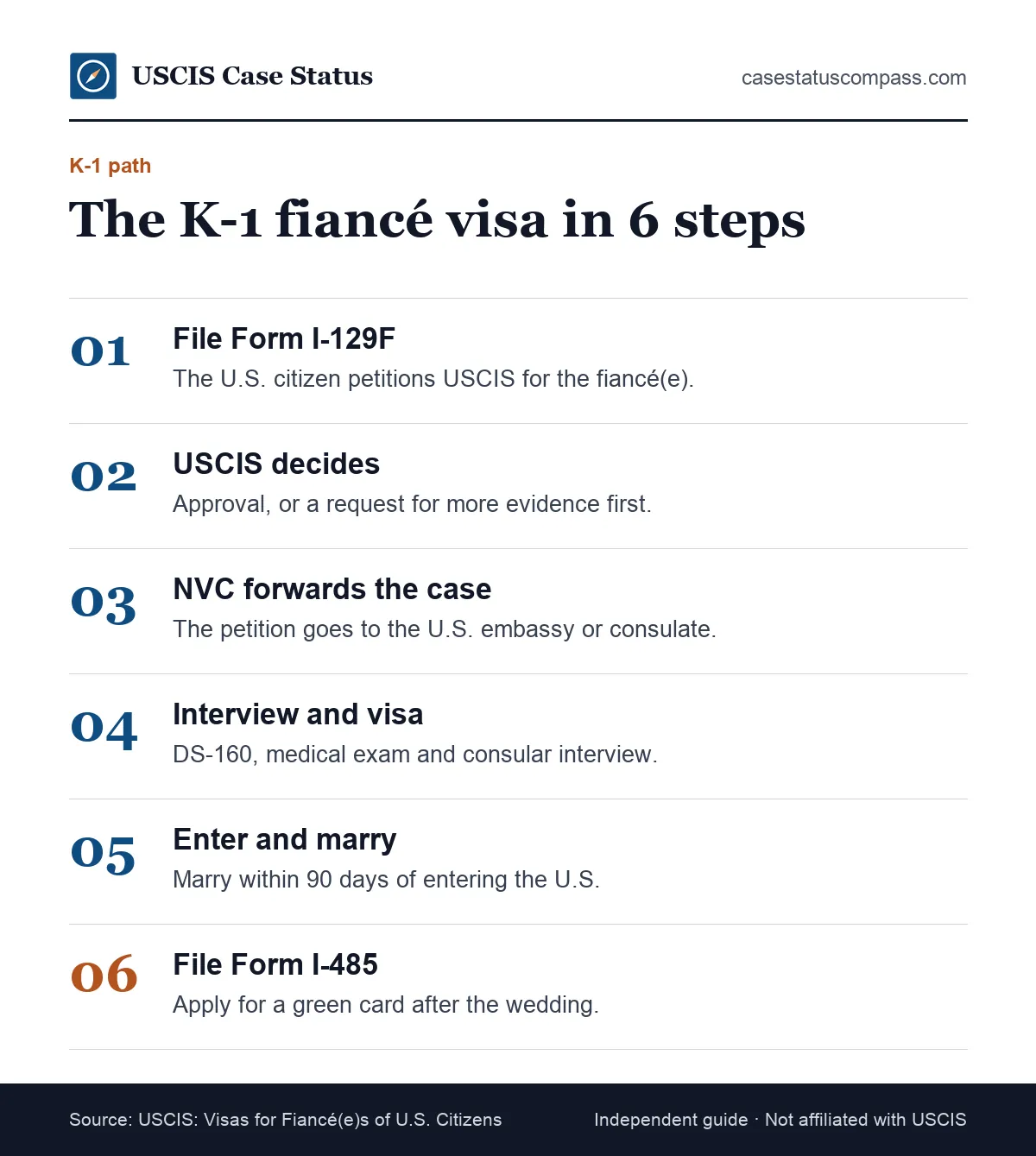
The K-1 process has two halves. In the USCIS half, the citizen files Form I-129F and waits for a decision. In the State Department half, the National Visa Center (NVC) forwards the approved case to a consulate, which interviews the fiancé(e) and issues or refuses the visa.
The USCIS half
USCIS sends a receipt notice, may send a Request for Evidence (RFE), and then approves or denies. Approval does not grant a visa. The approved petition then goes to the State Department.
The State Department half
The NVC routes the file to the embassy or consulate, usually where the fiancé(e) lives. The fiancé(e) completes Form DS-160, has a medical exam, attends the interview and, if approved, gets the visa in the passport.
What Happens After You File Form I-129F?
After you file Form I-129F, USCIS sends a Form I-797C receipt notice with a 13-character receipt number. The case then waits for review. USCIS may send an RFE or approve directly. Most couples then wait several months with no new update, which is normal for this form; keep your contact details current.
The receipt notice
The I-797C receipt proves USCIS accepted the petition and fee. It lists the receipt number, received date and the petitioner's name. Check that both names are spelled right; contact USCIS quickly if there is an error.
If USCIS asks for more evidence
An RFE lists exactly what is missing and the reply deadline. Send everything requested in one package, with the RFE notice on top. Our RFE help page explains how to respond well.
Reading Your I-129F Receipt Number
Your I-129F receipt number has 3 letters and 10 digits. The letters show the office that first received the petition, such as IOE for online filing or a service center code for paper. Enter it without dashes or spaces in Case Status Online.
What the prefix tells you
USCIS lists these prefixes: EAC = Vermont SC; WAC = California SC; LIN = Nebraska SC; SRC = Texas SC; NBC/MSC = National Benefits Center; YSC = Potomac SC; MCT = I-539 filings; IOE = online/electronic filing. A K-1 case can be moved later and still keep its first prefix. Our receipt number decoder explains each code in more detail.
The I-797C notice itself
The receipt notice is I-797C = Notice of Action (receipt, rejection, transfer, appointment, re-open); not proof of status by itself. It is not travel permission and not a visa. Our Form I-797C guide labels each part of the notice.
The I-129F Status Sequence
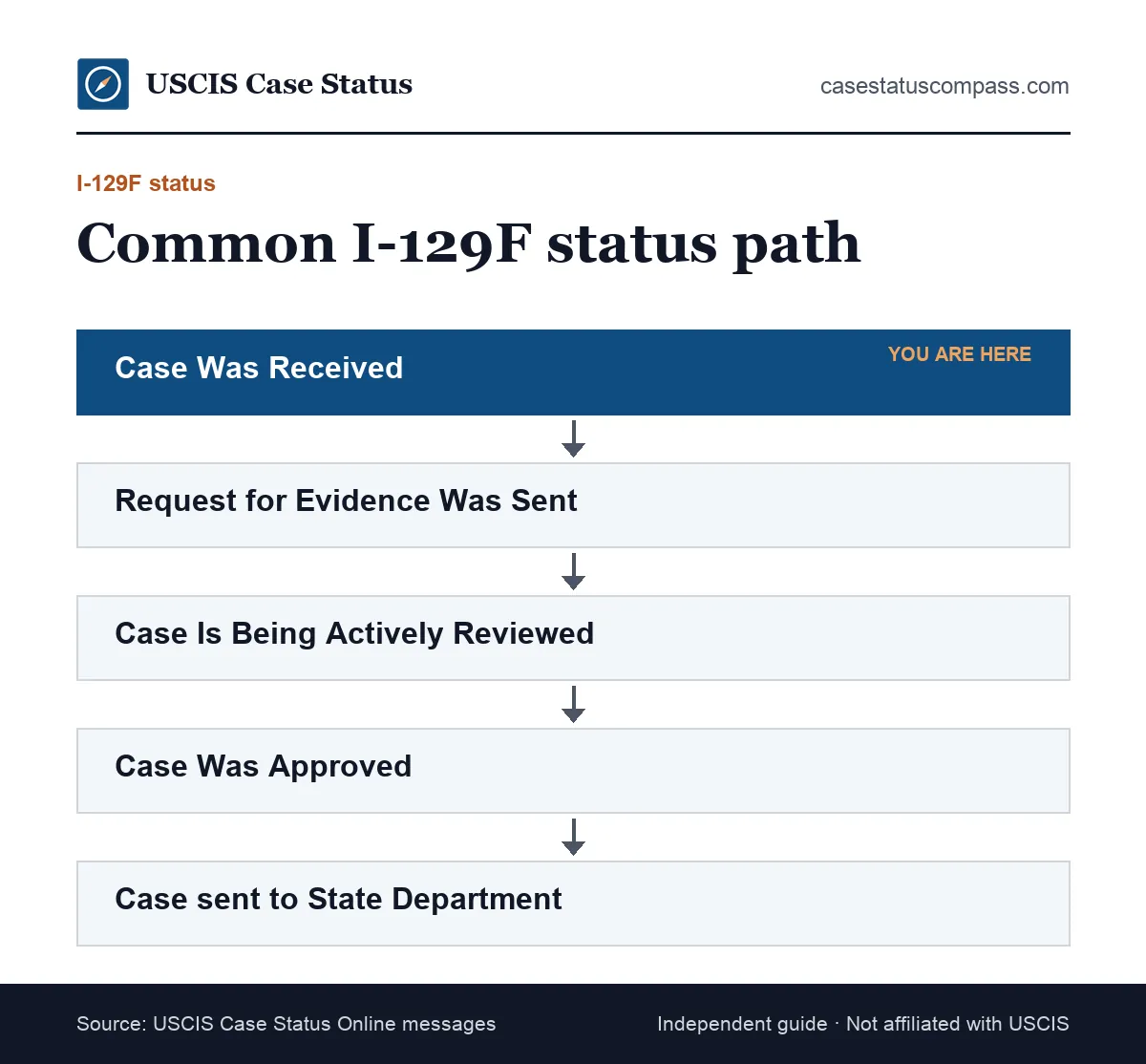
A Form I-129F petition usually moves from Case Was Received to approval and then to a message saying the case was sent to the Department of State. Some petitions add an evidence request or a transfer. Quiet stretches between updates are normal.
Status, meaning and timing
The table lists each status in its usual order with what it means. The final USCIS step is the transfer to the State Department, not a visa.
| Status update | What it means for a K-1 | When it usually appears |
|---|---|---|
| Case Was Received | Petition and fee accepted | Soon after filing |
| Case Was Transferred | Moved to another USCIS office | Any time before a decision |
| Request for Evidence Was Sent | Officer needs more proof | During review |
| Case Is Being Actively Reviewed | Officer is working the file | Before a decision |
| Case Was Approved | Petition approved; I-797 notice mailed | End of USCIS review |
| Approved case sent to the Department of State (wording varies) | File is on its way to NVC | After approval |
| Case Was Denied | Petition refused, reasons given | End of USCIS review |
Why no day counts
USCIS posts current I-129F times at egov.uscis.gov/processing-times, and they move often. For a fuller breakdown, see our k1 visa processing time guide, which owns the "how long" question. Check the tool yourself.
Tracking Your K-1 Case
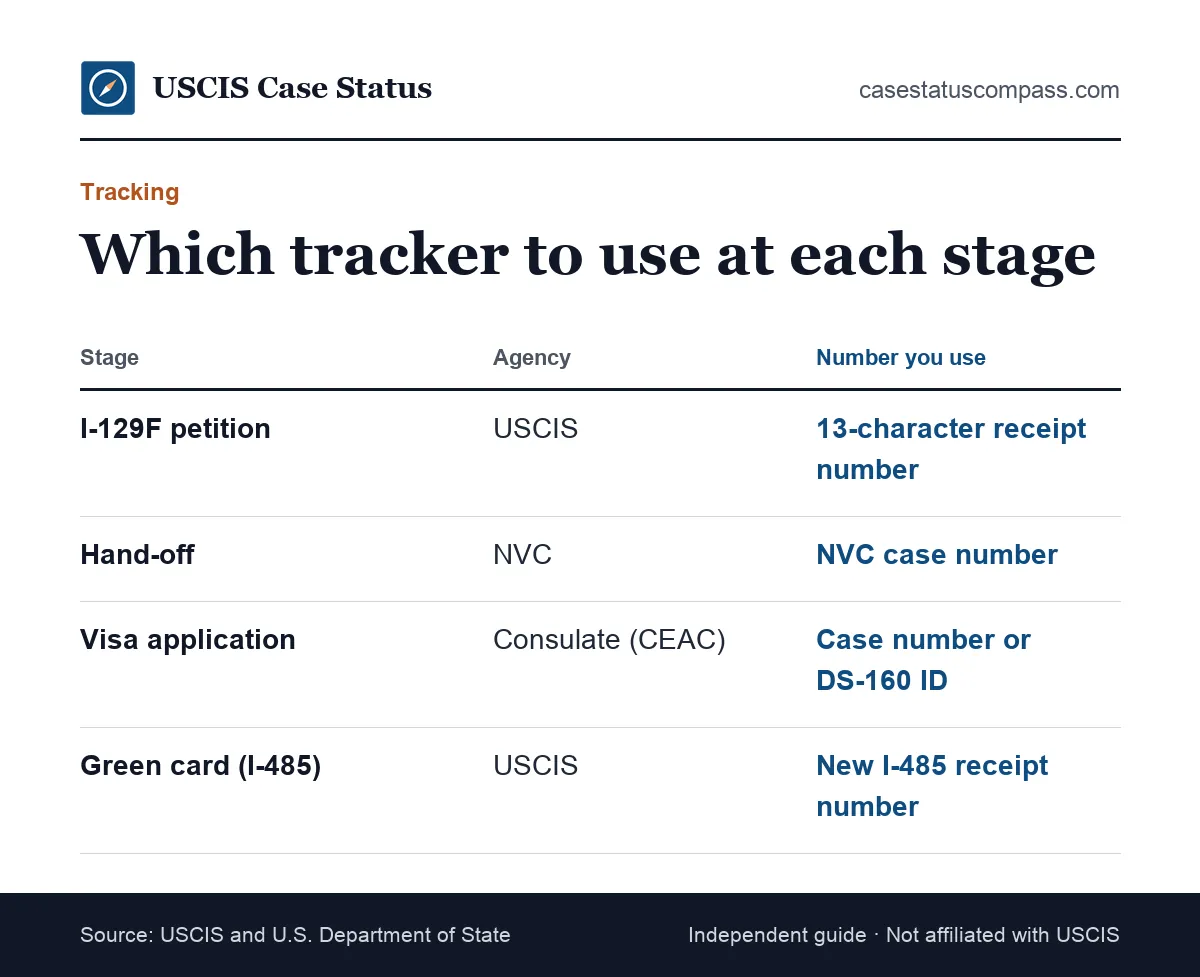
Tracking a K-1 case means using three tools in turn. Track Form I-129F on USCIS Case Status Online, then get the NVC case number after approval, then follow the visa application on the State Department's CEAC site. Each tool uses a different number, so keep all of them.
One case, three trackers
The table shows which tracker to use at each stage and which number it needs. Switch trackers when the case moves from USCIS to NVC and then the consulate.
| Stage | Agency | Tracker | Number |
|---|---|---|---|
| Petition | USCIS | Case Status Online | I-129F receipt number |
| Hand-off | NVC | NVC public inquiry | NVC case number |
| Visa | Embassy or consulate | CEAC status check | Case number or DS-160 ID |
| Green card | USCIS | Case Status Online | I-485 receipt number |
Keep a simple log
Write each number in one note with the date you got it. Add the date of every status change. A log makes calls faster and delays easier to spot.
How Does a K1 Tracker Work?
A K1 tracker is any tool that shows where a fiancé visa case stands. The official trackers are free: Case Status Online for USCIS and CEAC for the consulate. Treat other sites as context only. Use the receipt number for USCIS and the case number for CEAC.
Official trackers
Case Status Online at Case Status Online: egov.uscis.gov shows the I-129F update. A USCIS online account gives Free USCIS online account: case status updates, notices, link paper-filed cases. CEAC shows the visa stage once the consulate has the file.
Are Third-Party K1 Tracker Sites Safe?
Community timelines can help you compare, but people post selectively. Never share a USCIS password, passport scan or Social Security number with a tracker. Official status checks never cost money. Use them to set expectations, not to decide whether your own case is late. Only the official tool can tell you that.
What Happens When USCIS Approves the I-129F?
When USCIS approves the I-129F, it mails an approval notice to the petitioner and sends the petition to the National Visa Center. The fiancé(e) cannot travel yet; the visa application comes next. An approved K-1 petition is valid for 4 months (can be revalidated).
The approval notice
The I-797 approval notice confirms the petition was approved and the date. Keep the original safe and send a copy to your fiancé(e) for the interview. Our approved case status page explains what the approval message means across forms.
What approval does not do
Approval is not a visa. The consulate makes its own decision after the interview and can still refuse. The validity of the approved petition is limited, so move promptly through the NVC and consular steps.
How Do You Get Your NVC Case Number?
You get your NVC case number after USCIS sends the approved I-129F to the National Visa Center. NVC creates a record and forwards it to the consulate. Many couples contact NVC through its public inquiry form a few weeks after approval to get the number for CEAC tracking.
What NVC does on a K-1
For K-1 cases, NVC mainly routes the file to the right consulate. Unlike immigrant visa cases, there is usually no long document stage at NVC. The fiancé(e) works directly with the consulate after the hand-off.
Tracking at NVC
Our NVC case status guide explains how NVC numbers look and how to ask about them. Once the consulate has the file, switch to the State Department visa tracker described in our U.S. visa status guide.
The Consular Stage: DS-160, Medical and Interview
At the consular stage, the fiancé(e) completes Form DS-160 online, has a medical exam with an embassy-approved panel physician, gathers civil documents and attends the visa interview. The consulate's own instructions control this stage, including which fees to pay and where.
Form DS-160 and civil documents
The DS-160 is the online nonimmigrant visa application. The consulate also asks for a passport, birth certificate, police certificates and the medical results. Follow the embassy's checklist exactly; it varies by country.
The medical exam
Only a panel physician approved by the embassy can do the visa medical exam. Bring vaccination records. Results usually go to the consulate in a sealed envelope or electronically. Keep any copies the doctor gives you.
What Happens at the K-1 Visa Interview?
At the K-1 visa interview, a consular officer checks identity, the relationship and admissibility. The officer may ask how you met, wedding plans and family details. If approved, the visa is printed in the passport. Bring original documents and copies.
When the consulate puts the case on hold
If more documents are needed, the officer may hand you a letter listing them, and the case waits until you send them. Follow the consulate's instructions for delivery exactly, and keep proof of when you sent each item.
What officers focus on
Officers look for a genuine relationship and consistent answers between partners. They also review the medical results and police certificates. Prepare by reviewing your own I-129F, since answers that clash with it raise concerns.
Preparing for questions
Couples often prepare for a later USCIS interview too. Our list of green card interview questions covers the relationship questions that often come up at both stages. Answer honestly and do not memorize scripts.
What If the Consulate Sends the Petition Back?
If the consulate doubts the relationship or finds a problem, it can send the petition back to USCIS for review. USCIS may then reaffirm the approval or start steps to revoke it. This can add months, so respond to every notice and consider legal help.
Why petitions get returned
Common reasons include inconsistent answers, doubts about the meeting, or new facts such as an earlier marriage not disclosed. The consulate writes a memo explaining its concerns. Ask for any notice in writing.
Your options
If USCIS sends a notice of intent to revoke, the petitioner can submit evidence in reply. Some couples file a new petition instead. An attorney can help weigh those choices for your facts.
K-2 Visas for Children
A K-2 visa lets the eligible unmarried children of the K-1 fiancé(e) come to the United States. The children must be listed on Form I-129F; no separate petition is needed. They can travel with the parent or after, but not before the K-1 parent enters.
Who qualifies
The child must be the K-1 fiancé(e)'s child, unmarried and within the age limit USCIS sets. Each child applies for a K-2 visa at the consulate. List every child on the I-129F, even if they will not travel right away.
How Do K-2 Children Get Green Cards?
If the couple marries within the 90 days, K-2 children can apply for green cards too. They must stay unmarried and apply at the same time as the parent or later. Track each child's I-485 receipt separately. Keep copies.
Entering the U.S. on a K1 Visa
Entering the United States on a K1 visa means presenting the visa at a port of entry, where a Customs and Border Protection (CBP) officer decides on admission. The visa allows a single entry. Once admitted, the 90-day period to marry starts.
The CBP decision
A CBP officer makes the final call at the border; a visa alone does not guarantee entry. Carry the sealed packet the consulate gave you, if any, plus your passport and the approval notice copy.
Check your I-94 record
After entry, look up your I-94 record on the CBP website. Confirm the class of admission and dates are right. Errors can affect your green card filing, so correct them early through CBP.
The 90-Day Marriage Rule
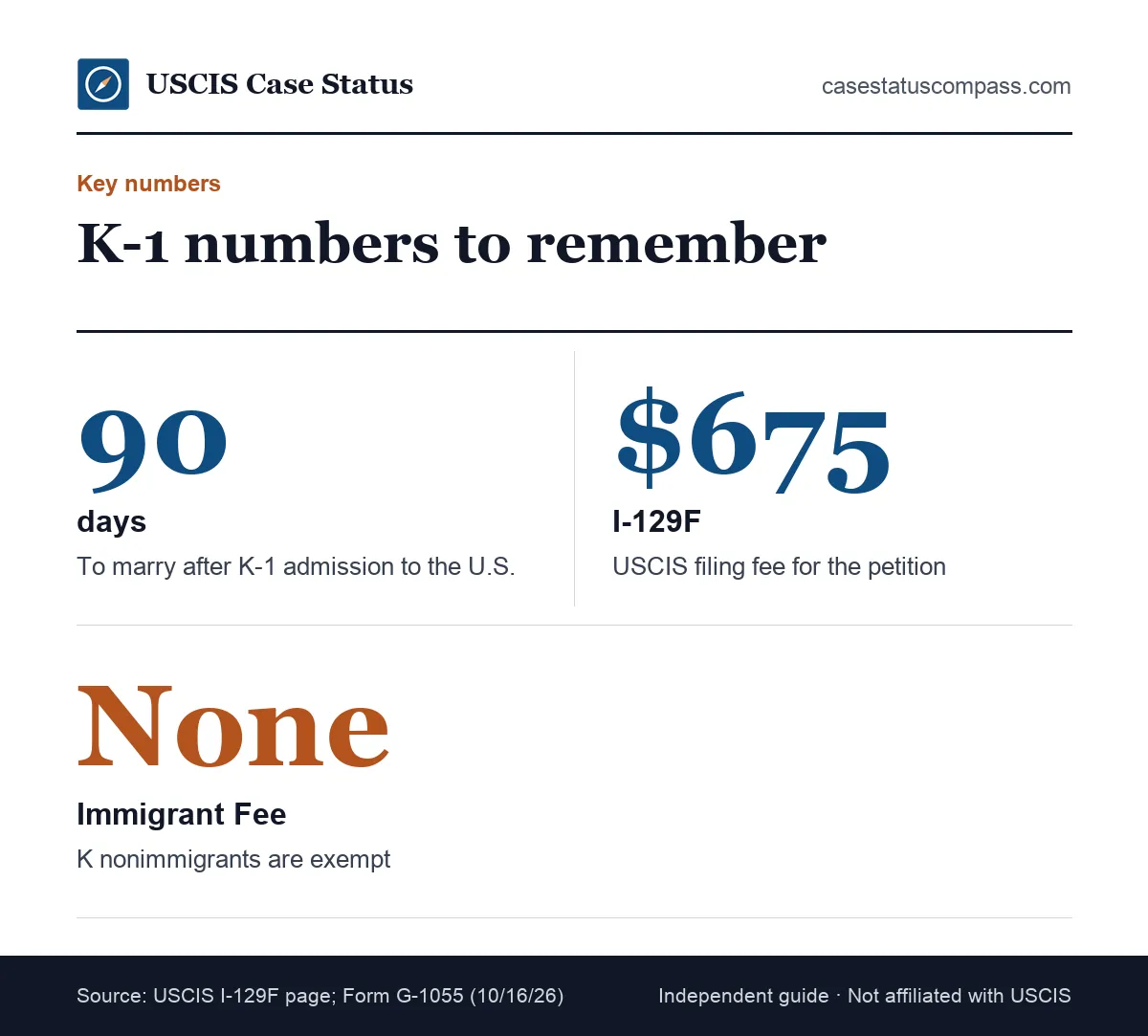
The 90-day marriage rule means the K-1 fiancé(e) must marry the U.S. citizen petitioner within 90 days of admission. USCIS states the rule as K-1: marry within 90 days of entering the U.S.. K-1 status cannot be extended, so plan the wedding well before the deadline.
Counting the days
The clock starts on the admission date in your I-94, not the date the visa was issued. Mark day 90 on a calendar. Plan the wedding date early, before you travel.
Marriage license waiting periods
Some states have waiting periods for marriage licenses, so check your county's rules early. Book the license appointment soon after entry, since a county backlog does not extend the 90 days.
Proof of marriage
Get certified copies of the marriage certificate from the local office. You need one for Form I-485 and often more for name changes. Keep a copy with your K-1 papers.
What Happens If You Do Not Marry Within 90 Days?
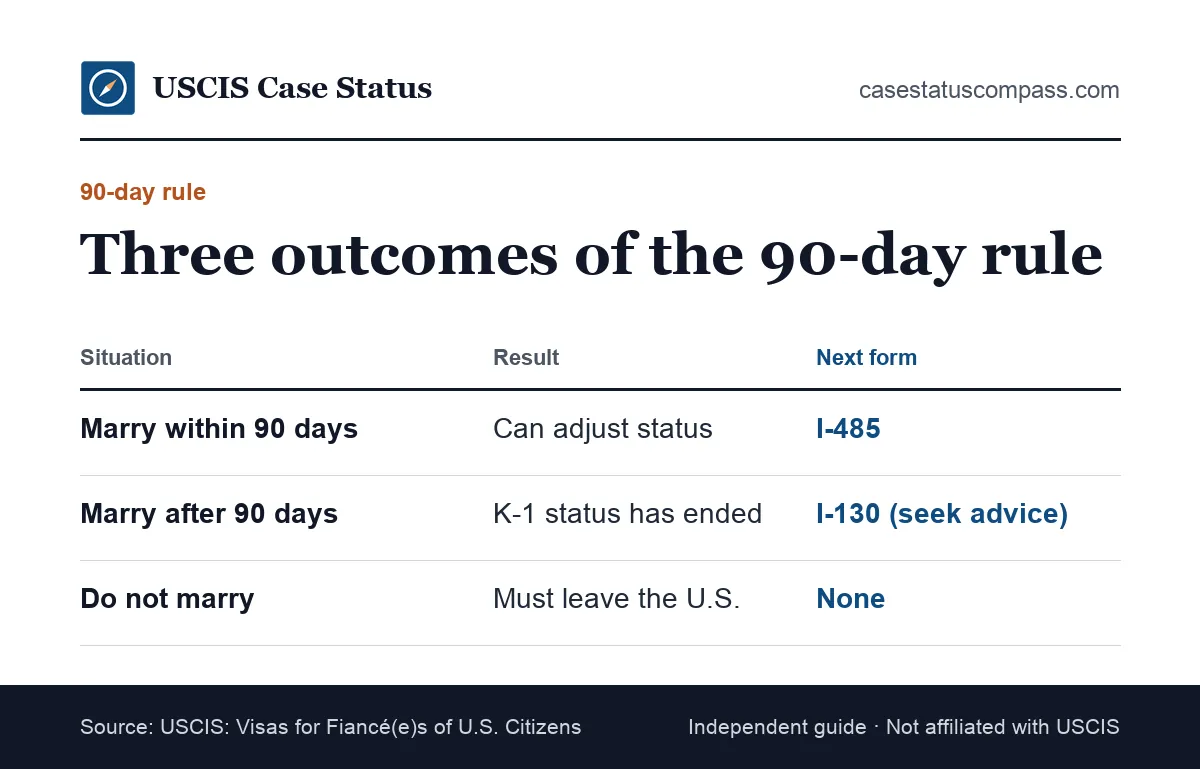
If you do not marry within 90 days, K-1 status ends and the fiancé(e) generally must leave the United States. Staying can lead to removal and harm future applications. If the couple marries late, the citizen may file Form I-130, but the path is harder and needs legal advice.
Status ends automatically
K-1 status cannot be extended, and K-2 status ends with it. USCIS says the fiancé(e) generally cannot get a green card on any basis other than marriage to the petitioner. Plan for departure if the wedding will not happen.
Marrying after the deadline
If you marry after day 90, USCIS says the citizen may file a Form I-130 petition. Whether the spouse can then adjust inside the U.S. depends on the facts. Get advice before filing anything.
Can a K-1 Holder Work in the US?
Yes, a K-1 holder can work in the United States after getting a work permit (EAD, Employment Authorization Document) through Form I-765. Most couples file Form I-765 with Form I-485 after the wedding. Tell a new employer when the card is expected.
Filing Form I-765 right after entry
USCIS says the K-1 fiancé(e) may file Form I-765 right after entry, but that permit lasts only for the 90-day K-1 period. Many couples skip it because it can expire soon after it arrives. See our Form I-765 work permit page for current rules.
Filing Form I-765 with Form I-485
Filing Form I-765 together with the I-485 gives a longer-lasting EAD that can be renewed while the green card case is pending. Current I-765 fees are on Form G-1055. Plan for a gap with no work permission between entry and approval.
Can a K-1 Holder Travel Abroad?
A K-1 holder should not travel abroad before marrying and filing for adjustment of status, because the K-1 visa allows a single entry. After filing Form I-485, travel usually requires advance parole on Form I-131 first. Leaving without it can end the green card case.
Before the wedding
Leaving the U.S. on a single-entry K-1 usually ends the K-1 status. Coming back would need a new visa. If a family emergency comes up, talk to an attorney before booking a flight.
After filing Form I-485
With Form I-485 pending, ask for advance parole on Form I-131 before any trip. Our Form I-131 travel document page explains the current fee and the H.R. 1 parole fee rules that apply.
After Arrival: Marriage and Adjustment of Status
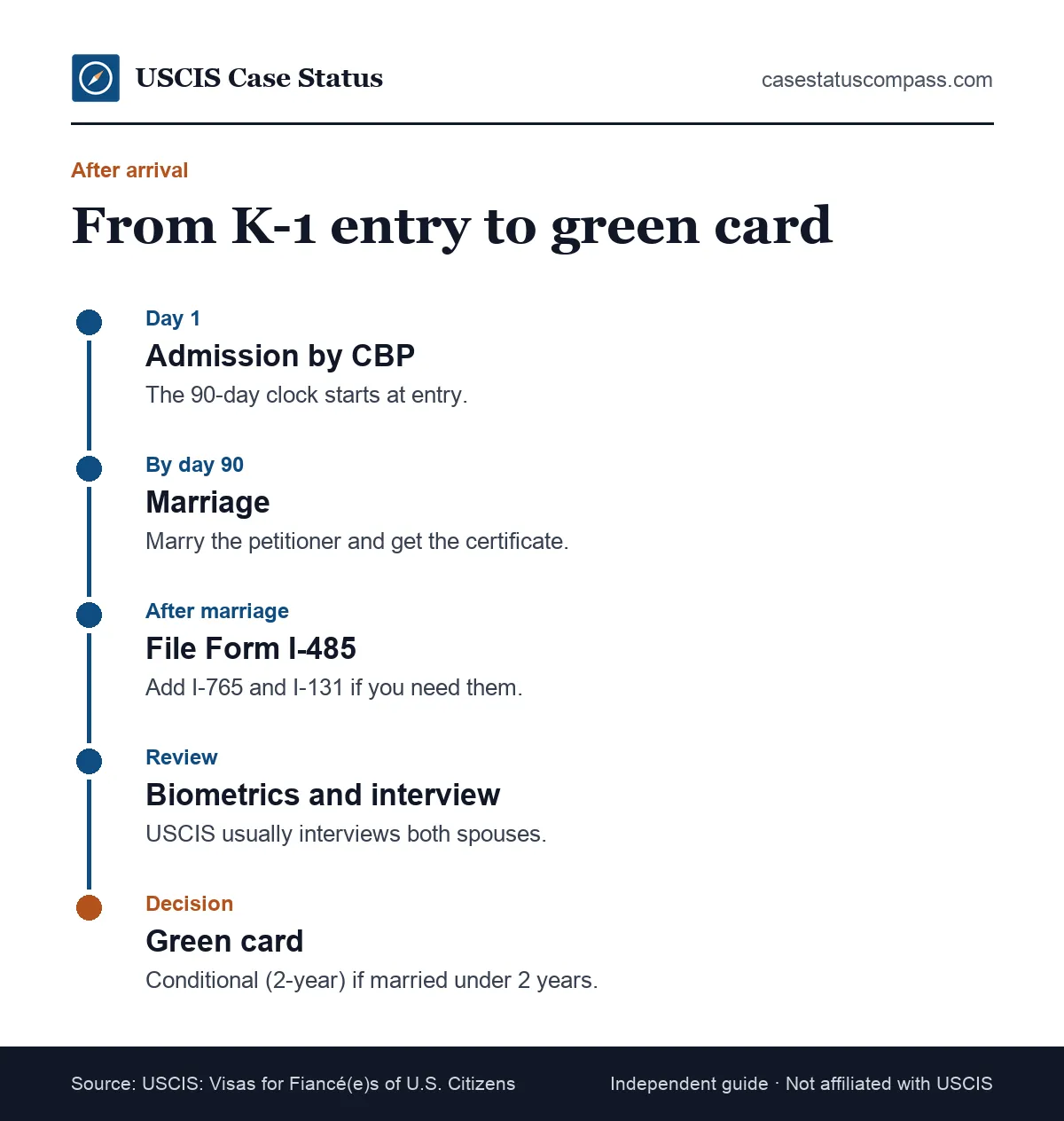
After arrival, the K-1 couple marries within 90 days and the spouse files Form I-485 to become a permanent resident. The petitioner adds Form I-864, the Affidavit of Support. Many couples file Forms I-765 and I-131 at the same time for work and travel permission.
The Form I-485 package
The I-485 requires edition 09/18/26 (01/20/25 and 09/04/26 editions rejected on/after Sept. 18, 2026; no grace period). Our i 485 adjustment of status guide covers the package in full. The fee is $1,440 paper / $1,390 online.
No new I-130 for a K-1 spouse
A K-1 spouse does not need a new I-130, because the I-129F approval supports the I-485. That shortcut works only when the marriage is to the petitioner within the 90 days.
The Affidavit of Support
The citizen spouse files Form I-864 to show they can support the immigrant. USCIS lists it at $0 at USCIS. Our Form I-864 guide explains income rules and joint sponsors.
Forms You File After the Wedding
After the wedding, a K-1 spouse usually files Form I-485, with Form I-864 from the petitioner, and often Forms I-765 and I-131. Each form gets its own receipt number to track. Keep each notice, since you will need the receipt numbers to check status and to answer any request for evidence.
Post-wedding forms table
The table lists the forms after the wedding and what each one does. Form I-485 is the core filing; check the instructions for which others your case needs.
| Form | Purpose | Required? | Tracking |
|---|---|---|---|
| I-485 | Green card application | Yes | Own receipt number |
| I-864 | Affidavit of Support from the petitioner | Yes, with I-485 | Filed with I-485 |
| I-765 | Work permit while pending | Optional | Own receipt number |
| I-131 | Advance parole for travel | Optional | Own receipt number |
| I-693 | Medical exam record | As instructions require | Filed with I-485 |
Medical exam and biometrics
USCIS may need a new or updated medical record; check the instructions and our immigration medical exam guide. Expect a biometrics appointment after filing, described in our biometrics appointment guide.
The Green Card Interview After a K-1
After a K-1 marriage, USCIS usually interviews both spouses before approving Form I-485. The officer checks that the marriage is genuine and reviews your documents, so bring originals and fresh proof of shared life. Bring the I-94 record and any EAD.
What to bring
- Interview notice and both passports.
- Marriage certificate and K-1 approval notice copy.
- Proof of shared life: lease, joint accounts, insurance.
- Recent tax records for the Form I-864 sponsor.
Add photos and records dated after the wedding.
How it differs from the consular interview
The consular interview tested the engagement; this one tests the marriage. Officers may ask about daily routines and family. Answer honestly and briefly, and ask for clarification if a question is unclear.
Conditional Green Card and Form I-751
If the K-1 couple has been married less than two years when the I-485 is approved, the spouse gets a conditional green card. Under USCIS rules, Most green cards are valid for 10 years; conditional green cards for 2 years. To keep status, the couple files Form I-751 to remove conditions near the end of that period.
When to file Form I-751
USCIS says: File in the 90 days before your 2-year card expires. The fee is $750 (paper) / $700 (online). Our Form I-751 guide covers evidence and the receipt-notice extension.
Later steps
After the 10-year card, spouses may file a green card renewal when needed, or a citizenship application once eligible. Keep every K-1 record, since later forms ask about past status.
K-1 Time and Cost Summary
K-1 time and cost depend on USCIS, the consulate and later green card steps. The USCIS I-129F fee is $675, with State Department and green card fees on top. Check the official tools before you budget. Budget for each stage.
Time in brief
USCIS posts I-129F times at egov.uscis.gov/processing-times; consular wait times vary by embassy. For how long each stage usually takes, use our K-1 processing time breakdown. For reference, I-129F: median 9.0 months (USCIS data, Apr.-June 2026).
Cost in brief
Besides the I-129F fee of $675, the State Department K visa fee is $265 under 22 CFR 22.1, paid to the State Department, not USCIS. The USCIS Immigrant Fee of $235 does not apply, because K nonimmigrants are exempt.
K-1 vs CR-1 Spousal Visa: Which Fits?
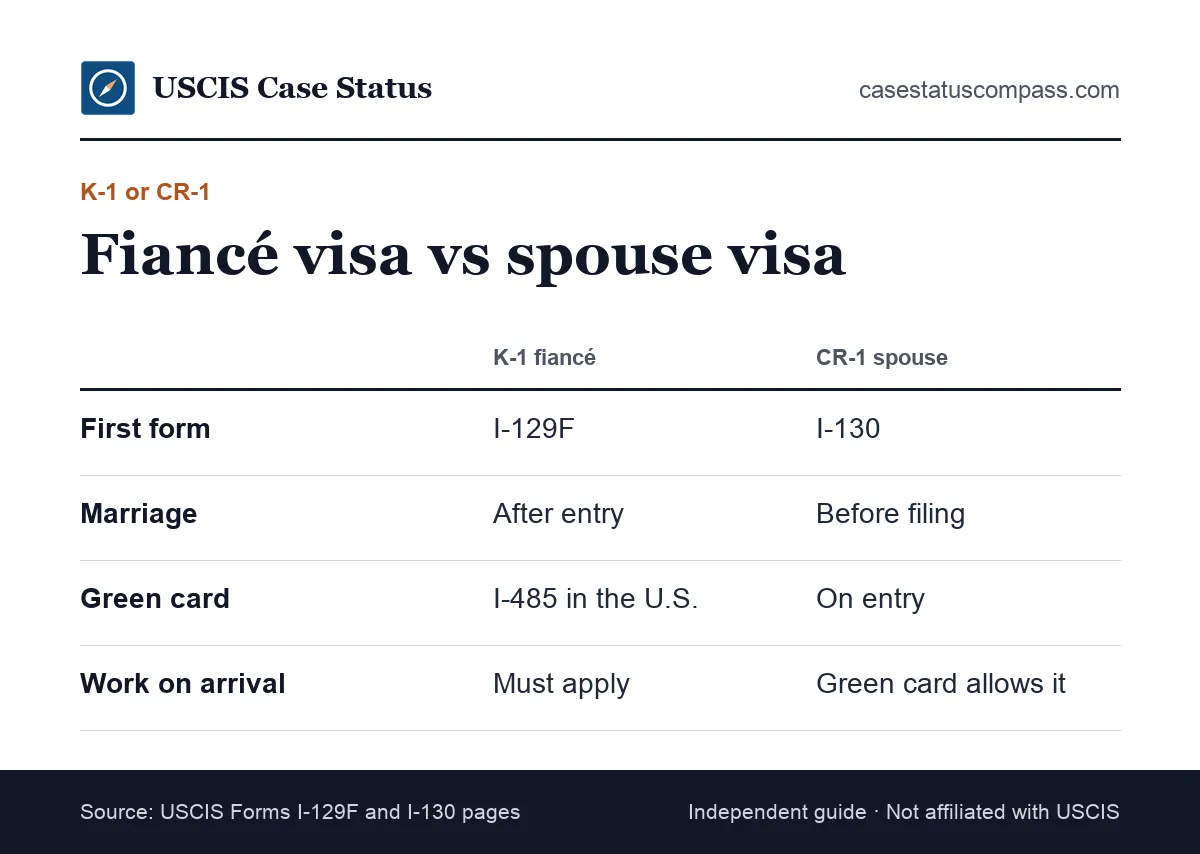
The K-1 fits couples who want to marry in the United States, while the CR-1 spouse visa fits couples who marry first. The K-1 starts with Form I-129F; the CR-1 starts with Form I-130 and gives a green card on arrival.
Side-by-side
The table compares the fiancé route with the spouse route. The main trade-off: a K-1 brings the couple together in the U.S. first, but a separate green card case follows the wedding.
| Point | K-1 fiancé visa | CR-1 spouse visa |
|---|---|---|
| Marriage | After entry, within 90 days | Before filing |
| First form | I-129F | I-130 |
| Green card | Separate I-485 in the U.S. | Issued after entry |
| Work on arrival | Needs an EAD | Allowed with the green card |
Where to read more
The spouse route is covered in our marriage green card guide. Compare total costs and travel needs before choosing, and ask an attorney if either partner has a complex history.
Why Is My K-1 Case Not Moving?
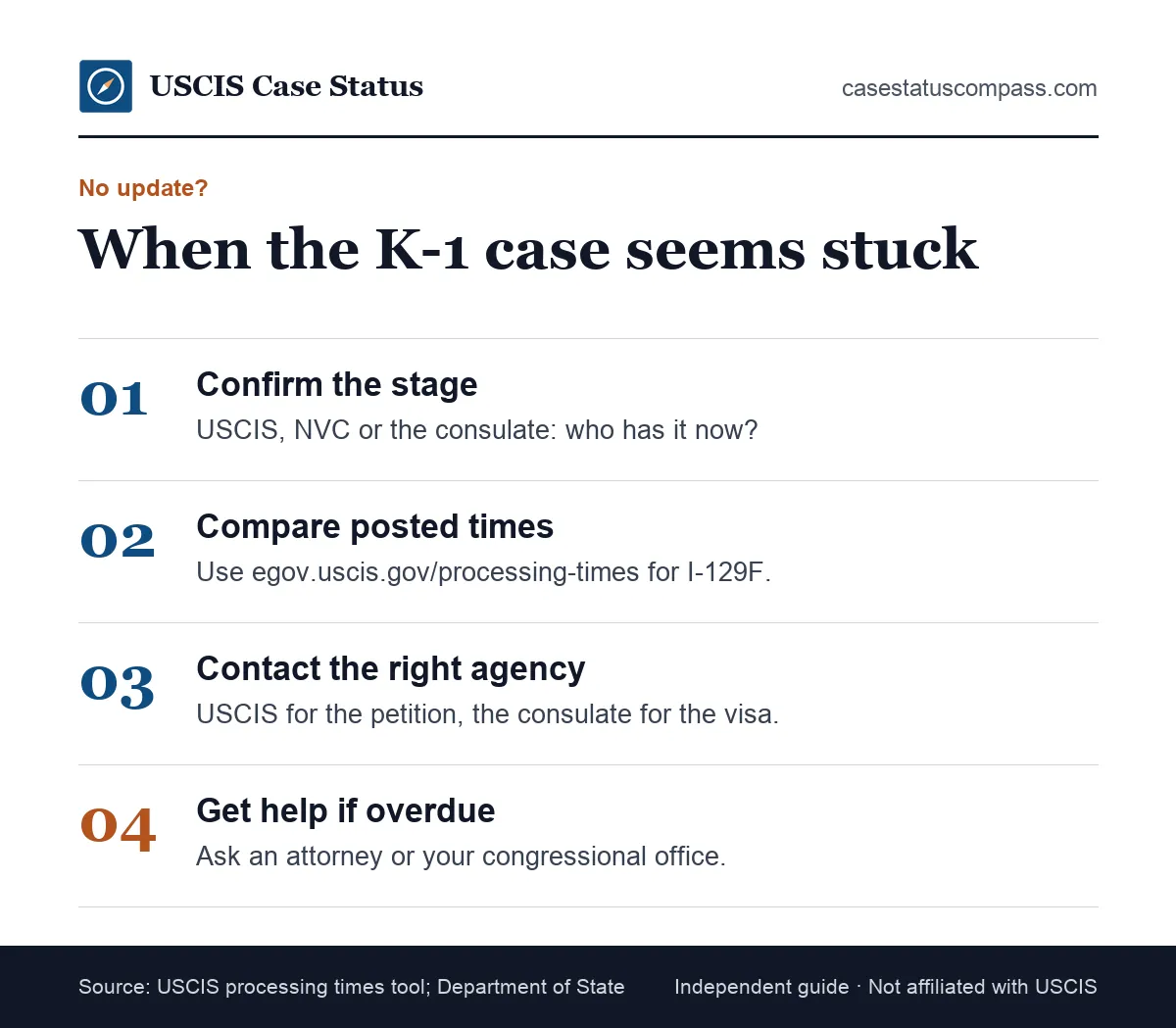
A K-1 case may not move because the I-129F is waiting in the USCIS queue, an RFE reply has not been logged, or the file is between agencies after approval. The gap between USCIS approval and the consulate is a common blind spot. First confirm which agency holds the case.
Common causes
- The petition is still within posted USCIS times.
- An RFE reply is in the mail or not yet scanned.
- The file is in transit from USCIS to NVC.
- The consulate needs more documents after the interview.
What to do
If the I-129F is outside posted times, contact USCIS; our USCIS contact guide lists options, including 800-375-5283. For a quiet status page, see our status not updating help. Note your inquiry date.
Common K-1 Application Mistakes
The most common K-1 application mistakes are using an old form edition, filing before a divorce is final, weak proof of meeting in person, and missing signatures. Each one can lead to rejection, an RFE or a denial. Check before filing.
Form mistakes
Old editions, unsigned forms and blank required fields lead to rejection. Answer every question, writing "None" where it applies. Make sure names match passports exactly across all pages. Check every page twice.
Meeting-proof mistakes
A single photo or a vague statement rarely proves the in-person meeting. Send dated travel records and a short sworn timeline, and check that the dates fall inside the window USCIS sets.
Evidence mistakes
Sending hundreds of chat screenshots instead of a few dated samples slows review. Forgetting a translation or a divorce decree triggers RFEs. Organize evidence by topic with clear labels.
Red Flags and Relationship Fraud Concerns
USCIS and consulates look for signs a K-1 relationship is not genuine, such as no shared language, very short contact, or money paid to arrange the match. Couples should also watch for scams aimed at them, such as fake "visa agents" promising guaranteed approvals.
Signs officers question
Large age gaps or cultural differences alone are not fraud, but they invite questions. Gaps in contact, inconsistent stories or paid introductions draw closer review. Strong, honest evidence answers most doubts.
Protecting yourself from scams
Only pay USCIS through official channels and the State Department through its listed methods. Ignore anyone claiming special access. Our USCIS scams guide lists common tricks. Report fake sites to the FTC.
K-1 Filing Checklist You Can Copy
This copyable K-1 checklist covers the steps from filing Form I-129F to the green card application. Paste it into a shared note so both partners can see progress. Work down it in order, ticking each step when the notice arrives. Add dates next to each line, because several later steps depend on when the earlier ones happened.
Before and during the petition
- Confirm eligibility and the in-person meeting proof.
- Download Form I-129F, edition 01/20/25.
- Gather citizenship proof, divorce records and translations.
- Pay the fee and mail or file as the I-129F page says.
- Save the receipt number and check status on a schedule.
After approval and arrival
- Get the NVC case number and track on CEAC.
- Complete the DS-160, medical exam and interview.
- Enter the U.S. and check the I-94 record.
- Marry before day 90 and order certified certificates.
- File Form I-485 with Form I-864, plus I-765 and I-131 if needed.
If-Then Guide for K-1 Situations
This if-then table matches common K-1 situations to the first action to take. Find the line that fits your case today. Complex cases still need an attorney. When two lines apply, act on the earliest deadline first, such as the 90-day marriage limit or a reply date.
Decision table
Each row gives one situation and the first step. Start with the row tied to a deadline, because missed deadlines are the hardest to fix.
| If this happens | Do this first |
|---|---|
| RFE on the I-129F | Send every listed item in one reply before the deadline |
| Approved, no NVC number yet | Wait a few weeks, then use the NVC public inquiry form |
| Consulate puts case on hold | Send requested documents the way the consulate asks |
| Petition returned to USCIS | Watch for USCIS notices; consider legal help |
| Wedding delayed near day 90 | Speak to an attorney before day 90 passes |
| Need to travel after I-485 | File Form I-131 and wait for advance parole |
When none of these fit
Unusual problems, such as a past visa overstay, a criminal record or a prior K-1 petition, need personal advice. Write down your dates and notice wording before your consultation.
When Should a K-1 Couple Get Legal Help?
A K-1 couple should get help from an immigration attorney or a DOJ-accredited representative if a petition is denied or returned, the 90-day deadline is at risk, either partner has a criminal or immigration history, or a meeting waiver is needed. This page is general information, not legal advice.
Red flags
- A past visa refusal, overstay or removal.
- More than one earlier fiancé(e) petition.
- A notice of intent to revoke or deny.
- Any doubt about meeting the 90-day deadline.
If one applies to you, get legal advice before you file or travel.
Choosing help
Use a licensed attorney or a DOJ-accredited representative, not a notario. This site is independent and not affiliated with USCIS or the State Department.
Frequently Asked Questions
How do I check my K-1 visa status?
Check the I-129F petition on USCIS Case Status Online with the 13-character receipt number from Form I-797C. After approval, get the NVC case number and follow the visa on the State Department's CEAC site.
Is a K-1 visa the same as a green card?
No. A K-1 visa is a temporary nonimmigrant visa that only lets the fiancé(e) enter to marry. After the wedding, the spouse files Form I-485 for a green card. Until USCIS approves it, the spouse is not a permanent resident.
Can the fiancé(e) visit the U.S. while Form I-129F is pending?
Sometimes, but a visitor visa requires showing you will return home, and a pending fiancé petition can make officers doubt that. Entry is never guaranteed. Talk to an attorney before planning a visit while the K-1 case is open.
Does a K-1 entrant pay the USCIS Immigrant Fee?
No. USCIS lists K nonimmigrants as exempt from the USCIS Immigrant Fee, so a K-1 entrant does not pay it. That fee applies to people entering on immigrant visas.
Can a K-1 holder change to another visa instead of marrying?
Generally no. USCIS says a K-1 fiancé(e) generally cannot get a green card on any basis other than marriage to the petitioner, and K-1 status cannot be extended. Anyone considering another route should speak to an immigration attorney first.
Can we marry abroad and still use the K-1 visa?
No. The K-1 visa is for couples who will marry in the United States after entry. If you marry first, the K-1 no longer fits, and a spouse petition on Form I-130 is the usual route. Tell USCIS or the consulate if your plans change.
Can a green card holder file for a K-1 visa?
No. Only U.S. citizens can file Form I-129F. A permanent resident who wants to bring a partner usually marries first and files Form I-130 for a spouse, which falls in a preference category with its own wait.
Do we need a wedding date to file for a K-1?
No fixed date is required. Both partners sign statements of intent to marry within 90 days of entry, and some couples add a venue booking or wedding plans as supporting evidence.
Does the K-1 fiancé(e) need police certificates?
Usually yes. The consulate asks for police certificates under State Department country rules, often from places where the fiancé(e) has lived. Check the embassy's checklist early, since some certificates take weeks to arrive.
Is there a USCIS interview for Form I-129F?
Rarely. USCIS usually decides the fiancé petition on paper. The visa interview happens at the consulate, and a second interview often follows at USCIS after the wedding, for the I-485.
Sources
- USCIS: Form I-129F, Petition for Alien Fiancé(e). www.uscis.gov/i-129f. Accessed Oct 27, 2026.
- USCIS: Visas for Fiancé(e)s of U.S. Citizens. www.uscis.gov/family/family-of-us-citizens/visas-for-fiancees-of-us-citizens. Accessed Oct 27, 2026.
- USCIS Form G-1055 Fee Schedule, Edition 10/16/26. www.uscis.gov/sites/default/files/document/forms/g-1055.pdf. Accessed Oct 27, 2026.
- USCIS: USCIS Immigrant Fee. www.uscis.gov/forms/filing-fees/uscis-immigrant-fee. Accessed Oct 27, 2026.
- USCIS: Case Status Online. egov.uscis.gov/. Accessed Oct 27, 2026.
- USCIS Check Case Processing Times. egov.uscis.gov/processing-times/. Accessed Oct 27, 2026.
- U.S. Department of State: Fees for Visa Services. travel.state.gov/content/travel/en/us-visas/visa-information-resources/fees/fees-visa-services.html. Accessed Oct 27, 2026.
- Form I-129F Instructions, Edition 01/20/25. www.uscis.gov/sites/default/files/document/forms/i-129finstr.pdf. Accessed Oct 27, 2026.
- USCIS Office of Legislative Affairs, Congressional Inquiries Refresher (PDF, 2021). www.uscis.gov/sites/default/files/document/guides/Congressional-Inquiries-Refresher.pdf. Accessed Oct 27, 2026.
- USCIS: Form I-797 Types and Functions (updated 01/24/2025). www.uscis.gov/forms/filing-guidance/form-i-797-types-and-functions. Accessed Oct 27, 2026.
- USCIS: Checking Your Case Status Online. www.uscis.gov/tools/checking-your-case-status-online. Accessed Oct 27, 2026.
- USCIS: Benefits of a USCIS Online Account. www.uscis.gov/file-online/benefits-of-a-uscis-online-account. Accessed Oct 27, 2026.
- 8 CFR 214.2(k)(5) (LII). www.law.cornell.edu/cfr/text/8/214.2. Accessed Oct 27, 2026.
- USCIS: Form I-485 page (updated 10/07/2026). www.uscis.gov/i-485. Accessed Oct 27, 2026.
- USCIS Glossary: Green Card. www.uscis.gov/tools/glossary. Accessed Oct 27, 2026.
- USCIS: Removing Conditions on Permanent Residence Based on Marriage. www.uscis.gov/green-card/after-we-grant-your-green-card/conditional-permanent-residence/removing-conditions-on-permanent-residence-based-on-marriage. Accessed Oct 27, 2026.
- USCIS Data Library: All USCIS Application and Petition Form Types, FY2026 Q3 (Apr. 1-June 30, 2026; queried 7/2026). www.uscis.gov/sites/default/files/document/data/quarterly_all_forms_fy2026_q3_v1.xlsx. Accessed Oct 27, 2026.
- 22 CFR 22.1 Schedule of Fees for Consular Services (govinfo, CFR 2025 edition). www.govinfo.gov/content/pkg/CFR-2025-title22-vol1/xml/CFR-2025-title22-vol1-sec22-1.xml. Accessed Oct 27, 2026.
- USCIS Contact Center (uscis.gov). www.uscis.gov/contactcenter. Accessed Oct 27, 2026.
casestatuscompass.com is an independent publication and is not affiliated with USCIS or any government agency. This page is general information, not legal advice. For denials, court or asylum matters, consult an immigration attorney or a DOJ-accredited representative.