Contents · 40 sections
- What Is a USCIS Fee Waiver?
- How Does the USCIS Fee Waiver Program Work?
- Who Qualifies for a USCIS Fee Waiver?
- What Counts as a Means-Tested Benefit?
- How Do You Prove a Means-Tested Benefit?
- How Is the 150% Poverty Guideline Test Applied?
- What Income Evidence Does USCIS Accept?
- Can You Get a Fee Waiver If You Do Not File Taxes?
- What Counts as Financial Hardship?
- How Do You Document Financial Hardship?
- Forms Eligible for a Fee Waiver
- Citizenship Application Fee Waiver: How It Works for N-400
- Naturalization Fee Waiver or Reduced Fee: Which Fits?
- Is Form I-942 Still Used for the Reduced Fee?
- Can You Get a Green Card Fee Waiver?
- Green Card Renewal Fee Waiver for Form I-90
- Which I-90 Filers Pay No Fee Without a Waiver?
- Can You Get a Fee Waiver for Form I-130?
- What Are Your Options If You Cannot Pay the I-130 Fee?
- Is There a Fee Waiver for a Work Permit (Form I-765)?
- Which Fees Can Never Be Waived?
- Why Can't H.R. 1 Fees Be Waived?
- Fee Waivers for Humanitarian and TPS Filers
- Fee Waiver vs Fee Exemption: What Is the Difference?
- How to Request a Fee Waiver
- How Do You Fill Out the Fee Waiver Form?
- Can You File a Fee Waiver Request Online?
- Can One Fee Waiver Request Cover Your Whole Family?
- What Happens After You Submit a Fee Waiver Request?
- What If You Hear Nothing After Mailing a Fee Waiver?
- What Happens If USCIS Denies Your Fee Waiver?
- Does a Fee Waiver Affect Public Charge or Your Case?
- Common Fee Waiver Mistakes
- Fee Waiver Checklist You Can Copy
- Fee Cost Worksheet: What a Waiver Saves You
- If-Then Guide: Should You Ask for a Fee Waiver?
- USCIS Fees Are Nonrefundable: Why the Waiver Choice Matters
- Do Fee Waivers Cover Other Agencies' Fees?
- When Should You Get Help With a Fee Waiver?
- Frequently Asked Questions
The short answer
A USCIS fee waiver lets you file certain immigration forms without paying the USCIS filing fee. You ask on Form I-912 (or in a signed letter) and qualify if you get a means-tested benefit, your household income is at or below 150% of the poverty guidelines, or you face financial hardship. It works only for forms on the official list.
At a glance
| Form to use | Form I-912, Request for Fee Waiver ($0 (no fee to request a fee waiver)) |
| Ways to qualify | Fee waiver: means-tested benefit, income at or below 150% of poverty guidelines, or financial hardship |
| Common waivable forms | N-400, I-90, I-751, I-765 (not DACA), N-565, N-600 |
| Never waived | H.R. 1 fees, premium processing and DACA filings |
| Who runs this site | An independent guide, not USCIS. We cannot decide or file your request. |
What Is a USCIS Fee Waiver?
A USCIS fee waiver is permission to file an eligible form without paying its USCIS filing fee. You request it with Form I-912 or a signed written statement in the same packet as the form.
It is one part of the wider system of USCIS filing fees.
Fee waiver meaning in plain terms
The fee waiver meaning is simple: the government agrees not to collect a fee it would normally charge. It never cancels fees set by Congress. Those statutory fees stay due even when the base fee is waived.
Waiver, reduced fee and exemption
- Fee waiver: you ask, prove need, and pay nothing if approved.
- Reduced fee: you pay a lower amount, such as the reduced N-400 fee.
- Fee exemption: the fee schedule already sets no fee for your category.
How Does the USCIS Fee Waiver Program Work?
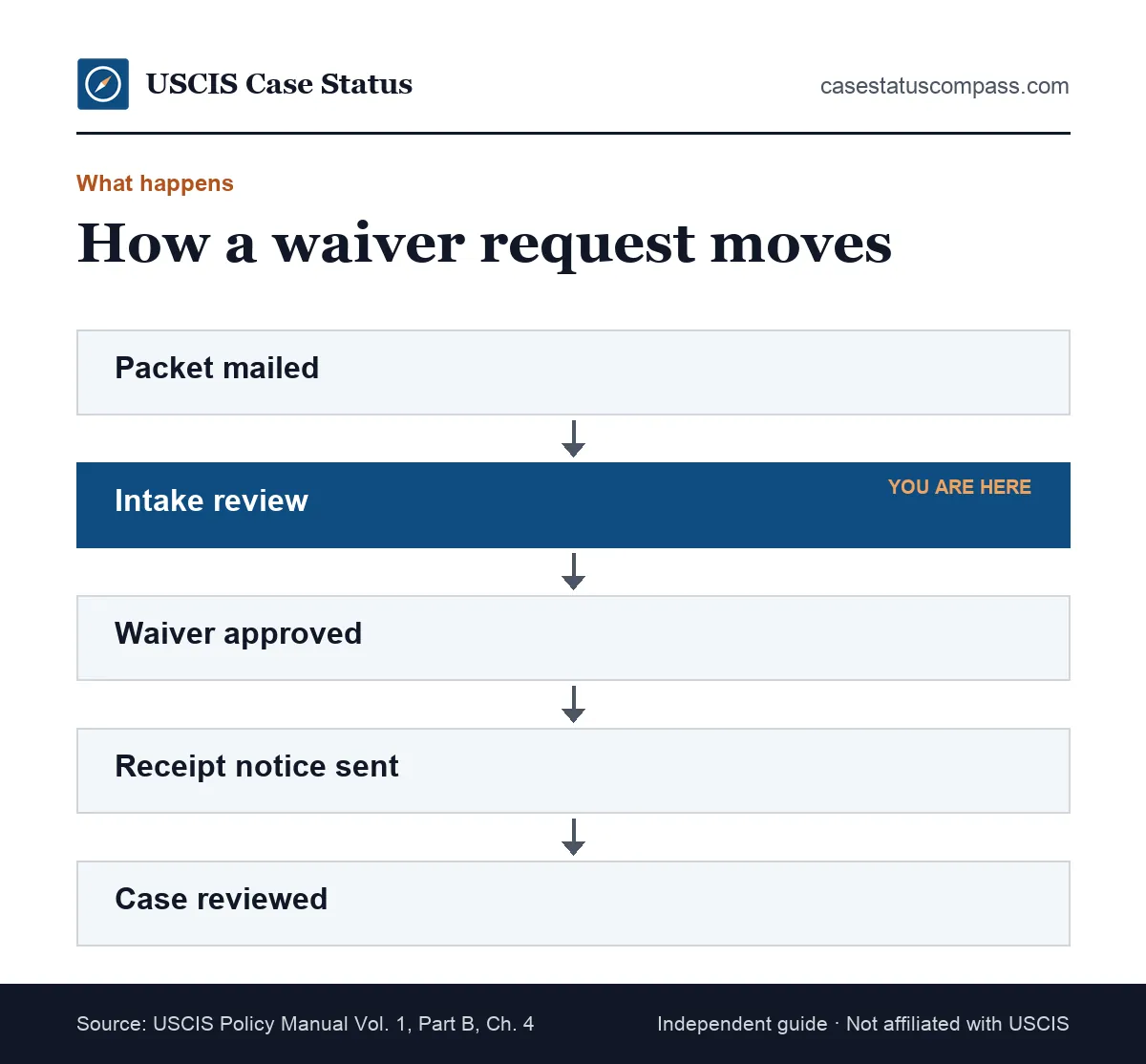
The USCIS fee waiver program works at intake. USCIS reviews your I-912 when the packet arrives. If the request meets the rules, the case is accepted; if not, the whole package is rejected and mailed back. There is no separate decision letter for the waiver.
The request travels with the application
USCIS says not to send Form I-912 by itself or after it has already received the application. The waiver request, the evidence and the form it covers go in one envelope.
There is no fee to ask
The current fee schedule lists Form I-912 at $0 (no fee to request a fee waiver). A weak request costs only time. But a rejected request returns the whole packet, which costs time.
Who Qualifies for a USCIS Fee Waiver?
You qualify for a USCIS fee waiver if you meet one of three bases in the Form I-912 instructions: Fee waiver: means-tested benefit, income at or below 150% of poverty guidelines, or financial hardship. One basis is enough, and the form must be on the eligible list.
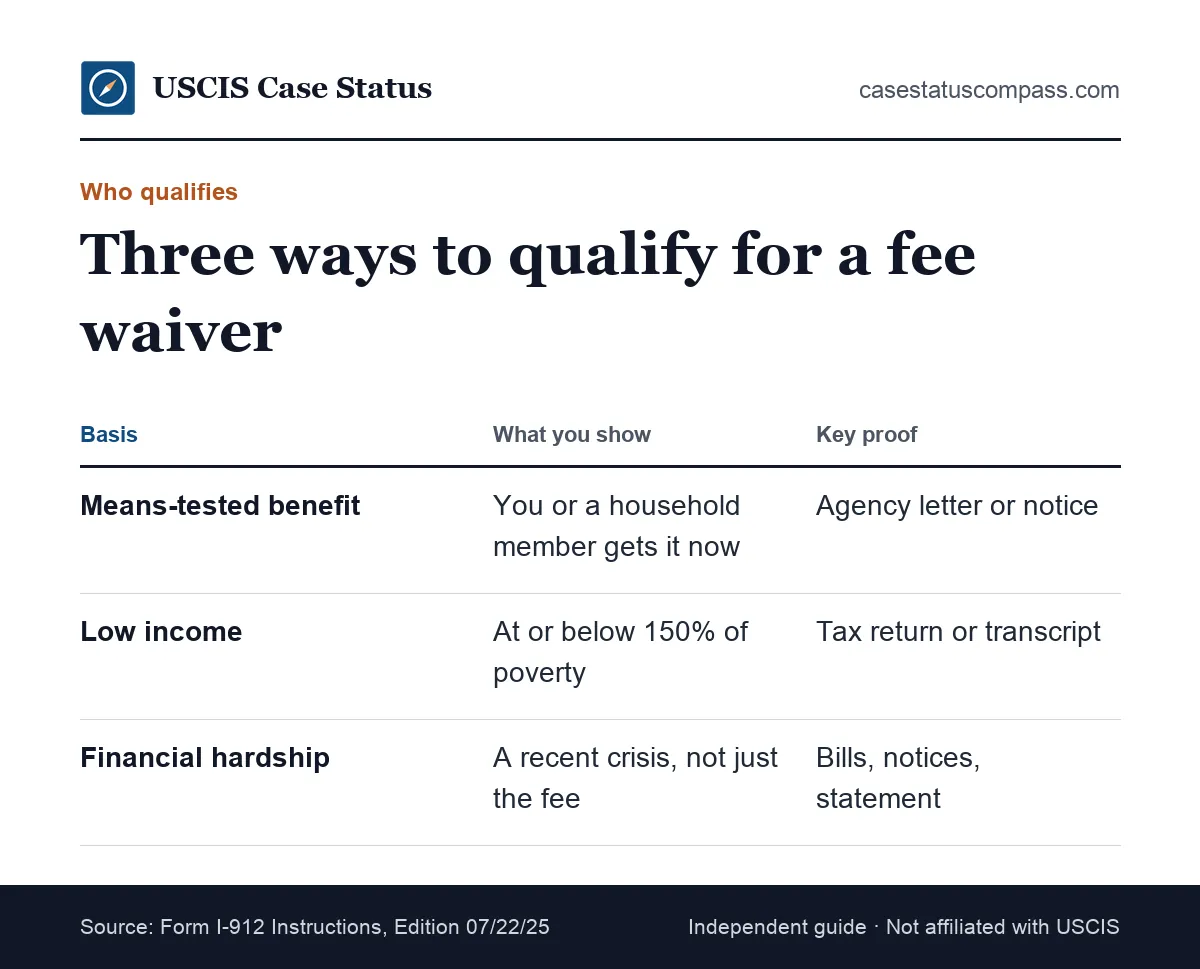
The three bases, in order of strength
- Means-tested benefit: the clearest route; one current agency letter can be enough.
- Income at or below 150% of the Federal Poverty Guidelines: needs tax or pay records.
- Financial hardship: needs the most explanation and documents.
Why you only need one
The bases are alternatives, not a checklist. If someone in your household gets a qualifying benefit, you do not also need to prove low income. Pick the basis with the strongest proof.
What Counts as a Means-Tested Benefit?
A means-tested benefit is a public benefit where income or resources decide whether you get it and how much. Medicaid, SNAP, TANF and SSI are common examples. The I-912 instructions say Medicare, unemployment and Social Security retirement do not count.
Benefits that usually count
The deciding feature is the income test. If the agency looked at your household money before approving you, the benefit is likely means-tested. Check the Form I-912 instructions for small local programs.
Benefits that do not count
Benefits earned through work or age generally do not qualify. Medicare, unemployment insurance and Social Security retirement fall in this group. Employer pensions do not count either, so use another basis.
How Do You Prove a Means-Tested Benefit?
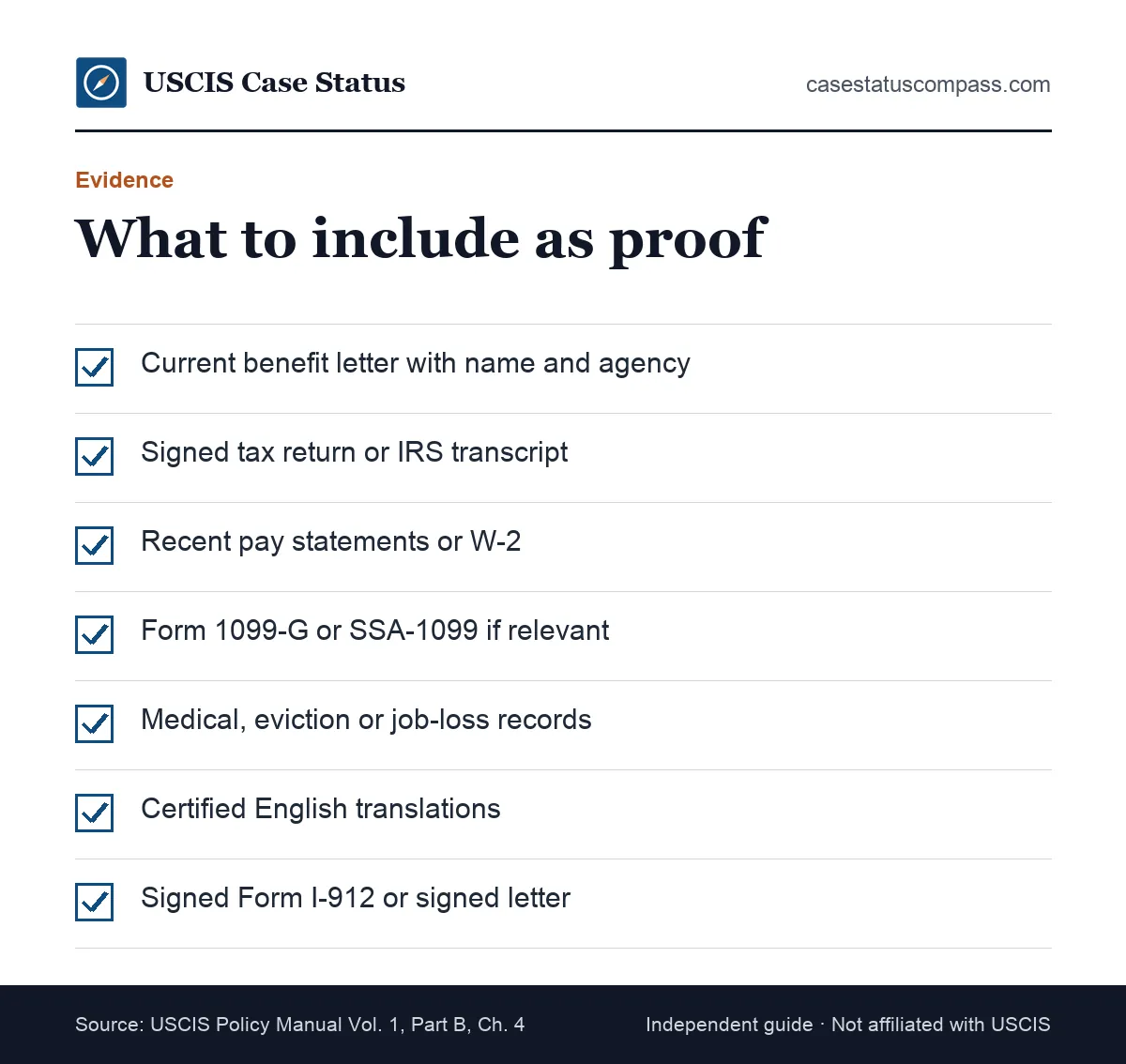
You prove a means-tested benefit with an agency document showing the recipient's name, the agency, the benefit type and that it is current. The letter must come from the agency itself. Ask the agency for a current award letter if you lack one.
Benefits received by a household member
USCIS accepts benefits received by you, your spouse, a parent (if you are under 21 or disabled), a sibling or a child living with you. Send proof that the person lives with you if the letter shows a different address.
What the benefit letter must show
Check your letter against each row below. If any item is missing, ask the agency for a new benefit letter before you mail.
| Item | Why USCIS needs it |
|---|---|
| Recipient's name | Links the benefit to you or your household |
| Agency name | Shows a real program issued it |
| Benefit type | Confirms it is means-tested |
| Current dates | Proves you receive it now |
Benefit letters older than 12 months
The Policy Manual says documents more than 12 months old need extra proof the benefit continues, such as a recent renewal notice or a dated portal printout. Request a fresh letter if you can.
How Is the 150% Poverty Guideline Test Applied?
The 150% test compares total household income with 150% of the Federal Poverty Guidelines for your household size. At or below that line, you qualify on income. USCIS publishes the current chart on Form I-912P. Alaska and Hawaii use higher figures.
Household size drives the number
The poverty line rises with each person in the household. Count your household the way the I-912 instructions define it. It generally includes you, your spouse and dependents living with you.
Use Form I-912P, not memory
The income chart changes each year. Open Form I-912P on uscis.gov the day you prepare the request. Find your household size, then read across to the 150% figure and compare it with your income.
If your income is just above 150%
You may still qualify on the hardship basis if a recent event left you unable to pay. N-400 filers can also look at the reduced fee, which reaches households at or below 400% of poverty.
What Income Evidence Does USCIS Accept?
USCIS accepts your most recent signed federal tax return or an IRS transcript as the main income proof. An unsigned return alone is not enough. Send proof for every person whose income you count, and add recent pay statements if your income changed.
Tax returns and transcripts
A free IRS transcript is often the cleanest proof. If you send a return, sign it. Include a return for every household member whose income you counted. Order transcripts from the IRS website.
Pay statements and benefit forms
The Policy Manual also lists Forms W-2, pay statements from the last three months, Form 1099-G and Form SSA-1099. These help when your income changed since the last tax year.
Can You Get a Fee Waiver If You Do Not File Taxes?
Yes. If your income is too low to require a return, explain that in writing and send what shows your real income:
- Recent pay stubs or an employer letter.
- Benefit statements, such as an SSA-1099.
- A signed note describing support from family.
What Counts as Financial Hardship?
Financial hardship means a recent setback that leaves you unable to pay, even if income is above 150% of the poverty line. The Policy Manual says it must be extreme, more than the burden of the fee itself, and usually within the 12 months before you file.
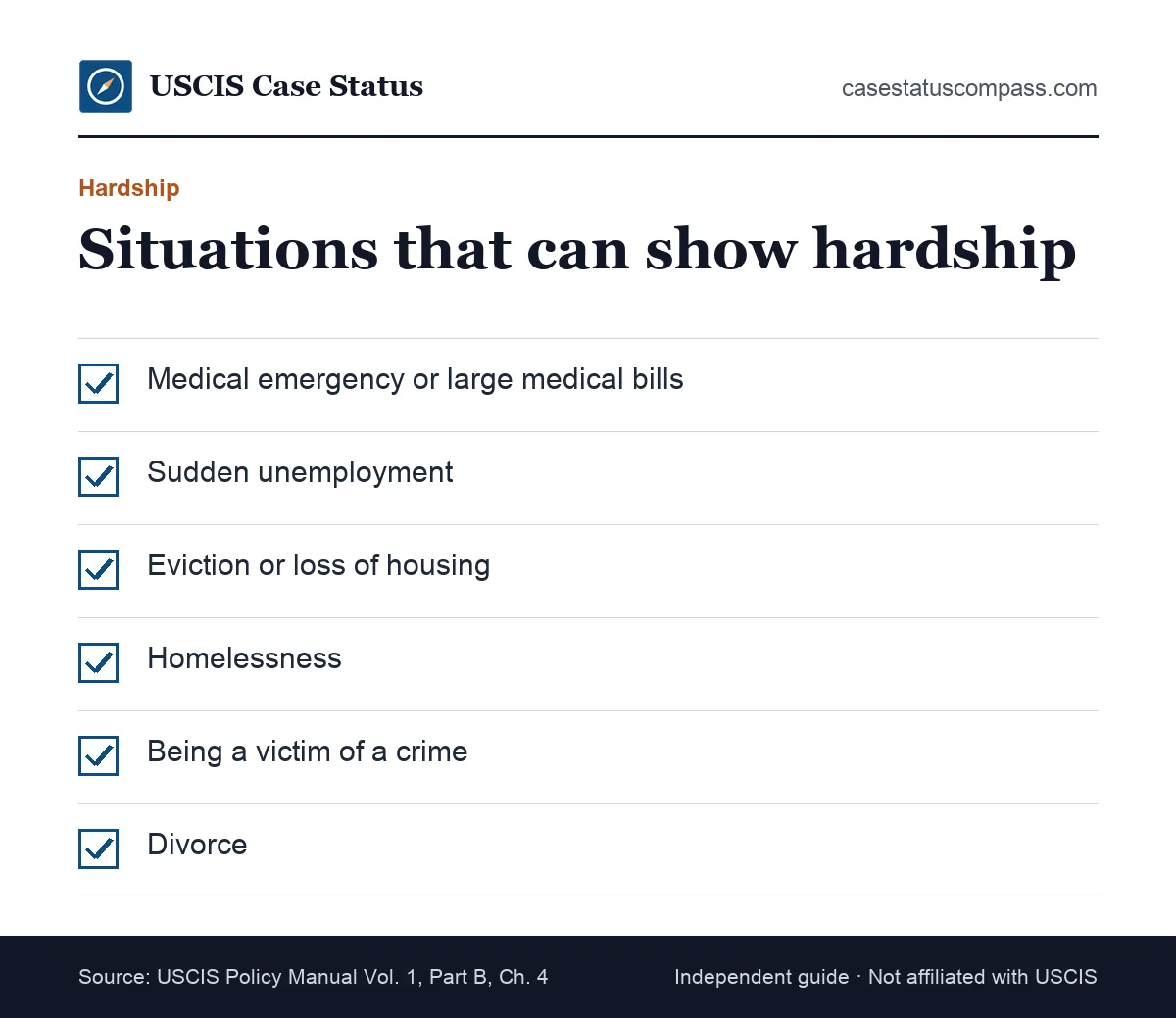
Examples USCIS recognizes
The Policy Manual names a medical emergency, unemployment, eviction and homelessness. Other events can qualify if you show their money impact. Back each one with dated records, such as a hospital bill or layoff letter.
Hardship is more than "the fee is high"
A request that only says the fee is expensive will fail. Show what you earned before, what happened, and what is left after rent, food and medical costs. Use dollar amounts from pay stubs, bills and bank statements, not estimates.
How Do You Document Financial Hardship?
You document financial hardship with records of the event plus a full picture of your income, assets and debts. Add a short signed statement. A statement without records rarely works, and records without a statement leave the officer guessing, so send both.
Records that carry weight
- Hospital bills or insurance denial letters.
- A termination letter or unemployment notice.
- An eviction notice or shelter letter.
- Bank statements showing low balances.
- Bills in collection or court judgments.
Send copies, not originals.
Writing the hardship statement
Keep it to one page: what happened, when, what it cost, and what you have left each month. Use the same figures as your records, then sign and date it.
Forms Eligible for a Fee Waiver
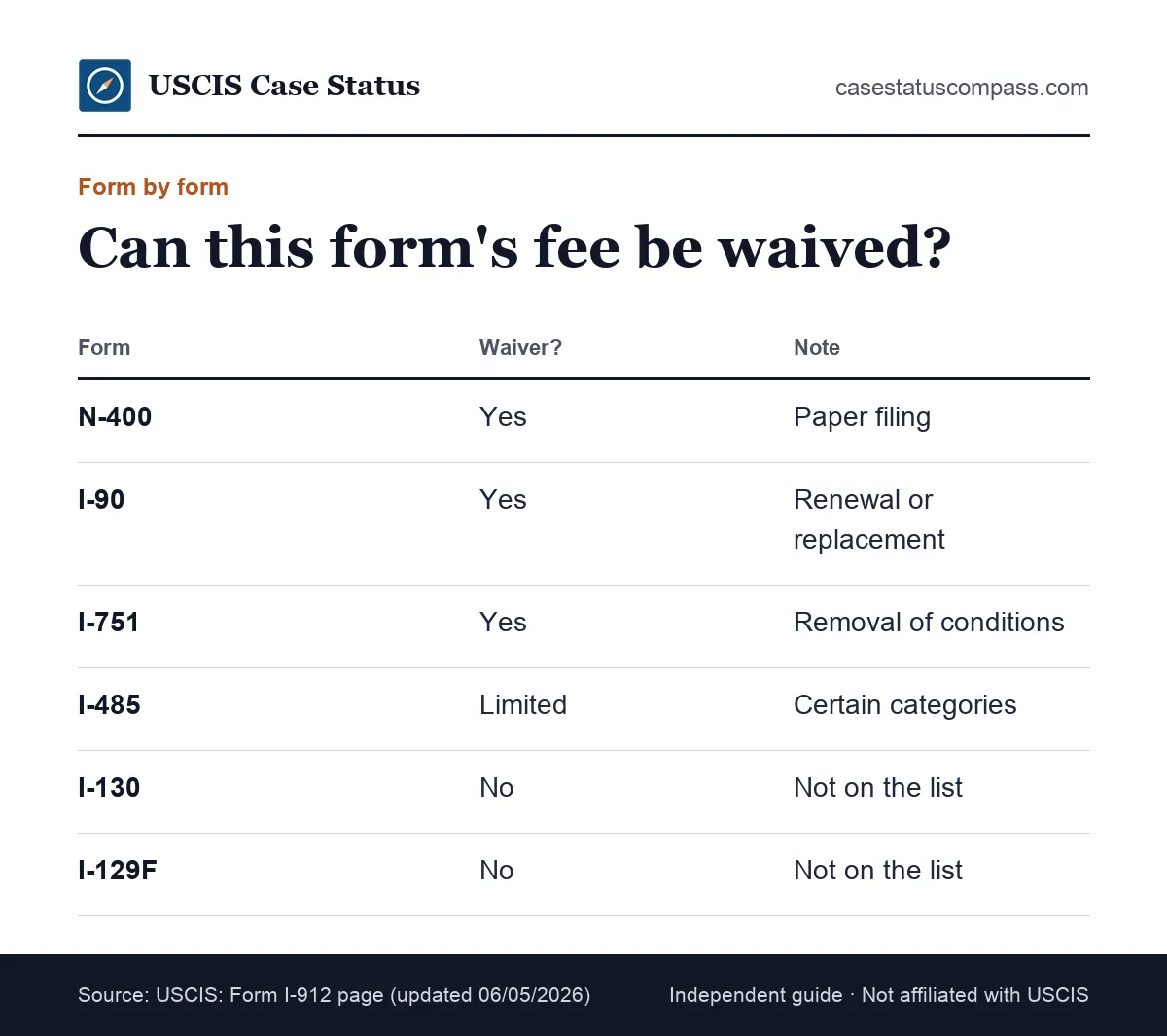
Only forms on the official list can be waived. As of October 2026, USCIS lists: Fee waivers are possible for forms like I-90, I-751, I-765 (not DACA), N-400, N-565 and N-600. If your form is not named, an I-912 sent with it is rejected along with the application.
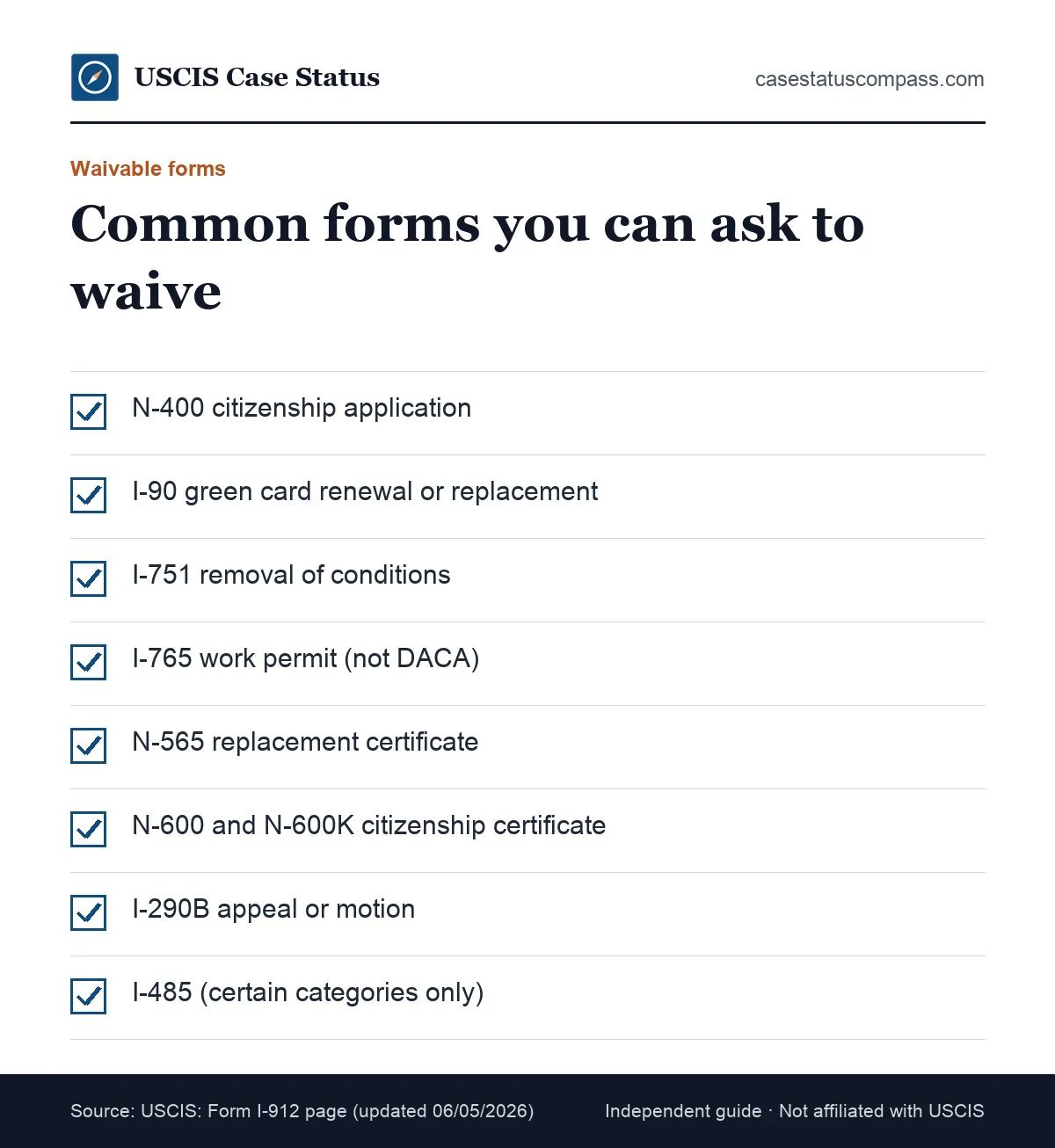
The eligible list, grouped
This table groups the eligible forms by purpose. Read the condition column, because some forms qualify only in certain categories.
| Group | Forms | Condition |
|---|---|---|
| Citizenship | N-400, N-470, N-600, N-600K, N-300, N-336, N-565 | Generally eligible |
| Green card and status | I-90, I-751, I-485, I-817 | I-485 for certain categories |
| Work and travel | I-765, I-131 | Not DACA; I-131 humanitarian parole |
| Waivers and appeals | I-290B, I-191, I-192, I-601, I-694, I-881 | Some need public-charge exemption |
| Special cases | I-129, I-539, I-821 | CNMI E-2; I-821 biometric fee only |
Citizenship fee waiver
A citizenship fee waiver covers Form N-400. USCIS lists the N-400 fee as $760 (paper) / $710 (online); reduced fee $380 (paper only) if household income is at or below 400% of the Federal Poverty Guidelines. For the full citizenship budget, see how much it costs to become a US citizen.
Green card renewal fee waiver
A green card renewal fee waiver covers Form I-90, used to renew or replace a permanent resident card. The I-90 fee is $465 (paper) / $415 (online). Our page on the green card renewal fee explains the no-fee cases.
Citizenship Application Fee Waiver: How It Works for N-400
A citizenship application fee waiver removes the full N-400 fee if you meet an I-912 basis. You must file the N-400 on paper to ask for it, because online filing does not take waiver requests. The N-400 and Form I-912 go in one envelope.
Filing on paper is required
The fee schedule notes say you must file on paper to ask for a reduced fee or fee waiver. Our citizenship application guide walks through the paper form. Mail it to the paper address.
A waiver covers the fee, not eligibility
You still need the required residence, presence and good moral character. Early filing follows its own rule: You can file the N-400 up to 90 days before you reach 5 years (or 3 years if married to a U.S. citizen) as a permanent resident.
Naturalization Fee Waiver or Reduced Fee: Which Fits?
Choose the naturalization fee waiver if household income is at or below 150% of poverty, you get a means-tested benefit, or you face hardship. Choose the reduced N-400 fee if income is above that but at or below 400%; as of October 2026 it is $380 on paper.
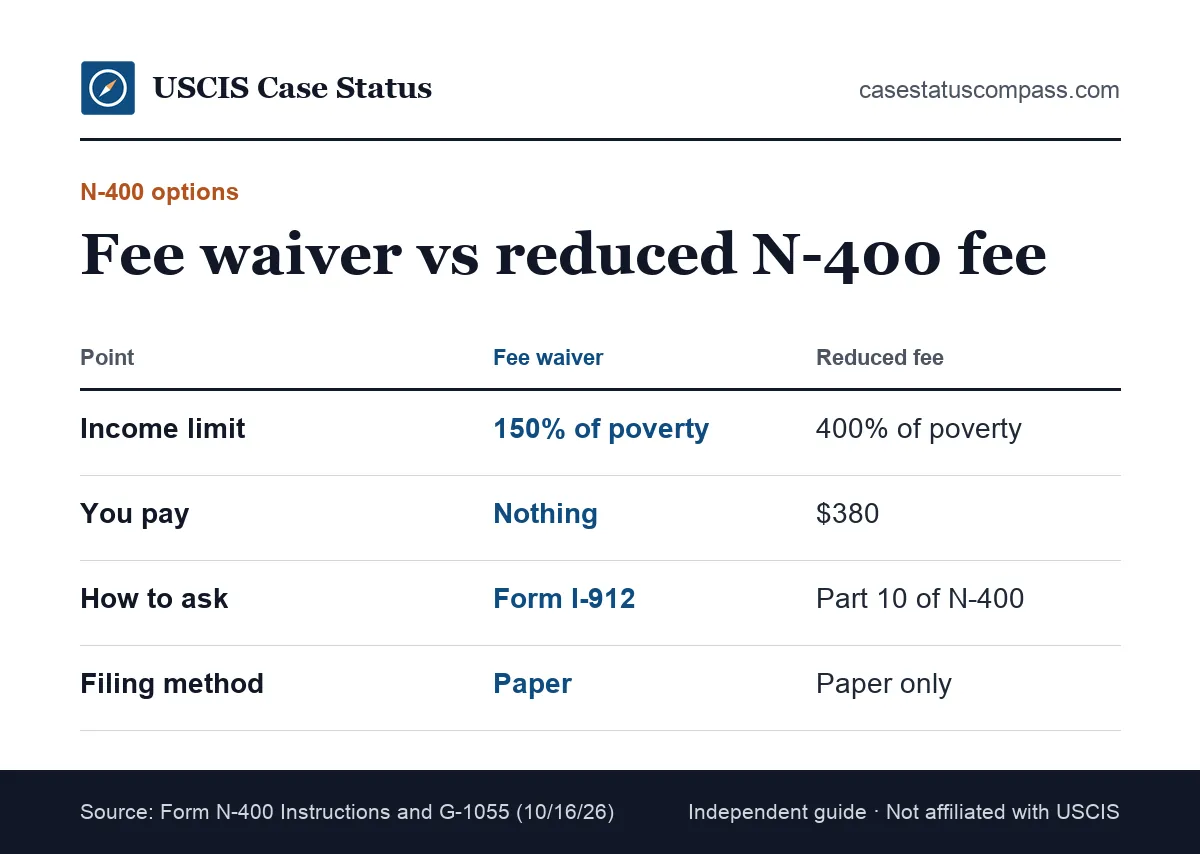
Side-by-side comparison
Use this table to see which N-400 option fits your income. Each row compares one feature of the two choices.
| Point | Full fee waiver | Reduced N-400 fee |
|---|---|---|
| Income limit | At or below 150% (or benefit/hardship) | At or below 400% of poverty |
| You pay | Nothing | $380 |
| How to ask | Form I-912 or signed letter | Part 10 of Form N-400 |
| Filing method | Paper | Paper only |
Is Form I-942 Still Used for the Reduced Fee?
No. Older guides point to Form I-942 for the reduced citizenship fee, but USCIS has archived that page, and the current schedule has no I-942 line. Today: Reduced N-400 fee: request it in Part 10 of the paper N-400 (income at or below 400% of poverty).
Can You Get a Green Card Fee Waiver?
A green card fee waiver is available only in limited cases. Form I-485 is on the list for certain categories, mainly applicants exempt from the public charge ground, such as many humanitarian filers. Most family and employment applicants cannot get one and should budget for the full fee.
Who may qualify for an I-485 waiver
The Policy Manual ties I-485 waivers to people exempt from the public charge ground. Asylees, refugees, T and U nonimmigrants, VAWA self-petitioners and special immigrant juveniles appear in that context.
What most applicants pay instead
USCIS lists the I-485 fee as $1,440 (paper) / $1,390 (online); $950 / $900 if under 14 and filing with a parent. For each path, see how much a green card costs, and our adjustment of status guide for the filing itself.
Green Card Renewal Fee Waiver for Form I-90
You can ask for a green card renewal fee waiver on Form I-90 if you meet an I-912 basis. Mail the paper I-90 with Form I-912 and your evidence. If the waiver is approved, the renewal moves forward with no fee charged.
When you need an I-90
USCIS lists these reasons: File I-90 if your card is lost, damaged, wrong, expiring within 6 months, or you turned 14. Our green card renewal guide explains which reason to select.
Filing the I-90 on paper with Form I-912
Online I-90 filing is cheaper for people who pay, but a waiver request normally travels on paper. Put the signed I-912 on top of the I-90, then the evidence. Use the current I-90 edition.
Which I-90 Filers Pay No Fee Without a Waiver?
The fee schedule shows no fee for some I-90 filers: a card with a USCIS error, a card never received, and certain renewals at age 14. They need no hardship proof and no Form I-912. They file under that reason instead.
Can You Get a Fee Waiver for Form I-130?
No. Form I-130, the family petition, is not on the I-912 list, so an I-130 fee waiver is not available. USCIS lists the I-130 fee as $675 (paper) / $625 (online). Do not send an I-912 with it; the whole petition will be returned.
Why the I-130 is left out
Waivers mainly cover forms for people who need status, documents or citizenship. A family petition starts a sponsorship, and sponsors later prove income on Form I-864. That is why i 130 fee waiver requests are rejected rather than reviewed.
What Are Your Options If You Cannot Pay the I-130 Fee?
Without a waiver, the choices are to lower the cost, wait, or find a different category. Our Form I-130 guide explains the petition itself. A relative can also pay, as long as the petitioner signs the forms. Filing online is the simplest way to lower that cost.
File the I-130 online for less
Online filing costs $625 instead of $675 on paper. You need a free USCIS online account. Online filing also avoids postage, and Pay.gov tells you at once if the charge fails.
Save first if there is no deadline
Most I-130s have no filing deadline, so waiting a few months to save can be safer than filing with a payment that may fail. Ask a lawyer if age-out is a risk.
Check whether VAWA fits
If you are a victim of abuse by a U.S. citizen or permanent resident relative, ask an accredited representative whether a VAWA self-petition fits instead. A VAWA self-petition on Form I-360 has no fee.
Is There a Fee Waiver for a Work Permit (Form I-765)?
Yes, for most categories. Form I-765 is on the waiver list except for DACA work permits. As of October 2026 the base fee is $520 paper / $470 online, and some categories carry H.R. 1 add-ons that cannot be waived.
Which I-765 filers it helps
A waiver can cover the regular fee for many humanitarian and pending-case categories; our work permit guide lists them. Mind the edition rule: 08/21/25 (the 09/15/26 edition is NOT accepted because of a Sept. 14, 2026 court order).
H.R. 1 add-ons on a waived I-765
If your I-765 category carries an H.R. 1 add-on, the waiver covers only the base fee. Pay the add-on separately in the same packet. Without it, the packet is rejected, even if the waiver itself is approved.
What it does not help
DACA work permits are excluded, so renewals pay in full; see the DACA renewal fee page. Employer-paid work visas are not waivable either; our guide to H-1B visa fees shows each line.
Which Fees Can Never Be Waived?
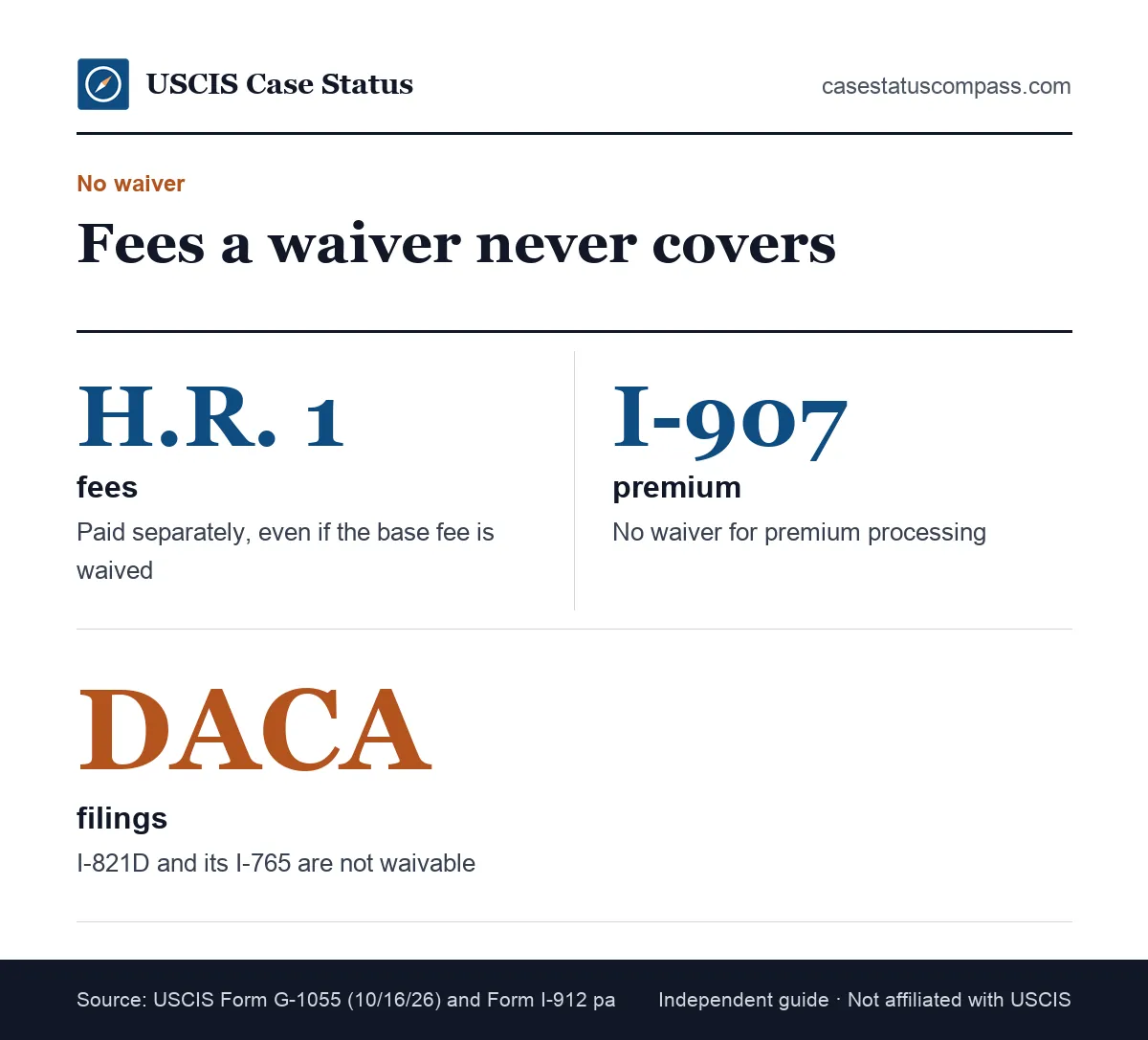
Three groups of fees can never be waived with Form I-912: fees set by H.R. 1 (Public Law 119-21), the premium processing fee on Form I-907, and DACA filings. Any form missing from the list, including Forms I-130 and I-129F, also cannot be waived.
Premium processing
USCIS states: You can't get a fee waiver for premium processing. The premium fee is $2,965 (I-129 most classes, I-140); $1,780 (H-2B/R, I-765 OPT); $2,075 (I-539 to F/J/M). See our premium processing guide.
DACA and non-listed forms
DACA requests on Form I-821D and the DACA work permit are excluded by name. Forms such as the K-1 fiancé petition, Form I-129F, are excluded by omission. See our K-1 visa cost breakdown.
Why Can't H.R. 1 Fees Be Waived?
H.R. 1 fees were set by Congress in Public Law 119-21, not by USCIS regulation, so USCIS has no power to waive them. The fee schedule states: H.R. 1 fees can't be waived and must be paid separately. Pay each H.R. 1 amount with the form, even when you ask for a USCIS fee waiver on the base fee.
Paying them when your base fee is waived
You may still ask USCIS to waive the regular fee on the same form, but the I-912 page says the H.R. 1 fee must then be paid separately, with the I-912 or in a separate written request. Examples include the asylum application fee and the TPS and parolee work permit add-ons listed in Form G-1055, Edition 10/16/26.
H.R. 1 amounts change every year
The add-ons are adjusted for inflation each fiscal year. The 10/16/26 schedule carries the FY2027 amounts, so check the current G-1055 before you pay. An amount from last year's guide may now be too low, and a short payment gets the packet rejected.
Fee Waivers for Humanitarian and TPS Filers
Many humanitarian filers pay no fee under the fee schedule or can request waivers on related forms. Temporary Protected Status (TPS) applicants can ask to waive only the biometric fee on a first-time Form I-821. Asylum H.R. 1 fees cannot be waived.
TPS biometric fee only
USCIS lists TPS fees as Initial: $520 + $30 biometrics; re-registration: $0 + $30 biometrics (the TPS EAD is a separate fee). The waiver reaches only the biometric fee for initial registration. Our TPS guide covers re-registration.
Asylum, VAWA, T and U filers
Asylum applicants pay $0 filing fee + $100 Asylum Application Fee (principal applicant); Annual Asylum Fee $105 (online, when USCIS sends a notice), and those amounts cannot be waived. VAWA, T and U filers often pay no fee on main forms. One court exemption applies: Ms. L. settlement class: exempt from H.R. 1 parole, parolee-EAD and asylum fees since Feb. 5, 2026.
Fee Waiver vs Fee Exemption: What Is the Difference?
A fee waiver is something you request and prove; a fee exemption is a zero fee already written into the fee schedule. Exempt filers do not need Form I-912. If your category shows no fee, send proof of your category and no I-912.
Quick comparison
This table sets the two side by side. The who decides row is the key difference.
| Point | Fee waiver | Fee exemption |
|---|---|---|
| Who decides | USCIS reviews your request | Set in Form G-1055 |
| Form needed | I-912 or signed letter | None |
| Evidence | Benefit, income or hardship | Proof of your category |
| Example | Low-income N-400 filer | Military N-400 under INA 328/329 |
Example: two N-400 filers
Maria, a fictional resident, receives a means-tested benefit and files Form I-912 with her paper N-400. James, a fictional service member, applies under the military provisions, where no fee applies by rule.
How to Request a Fee Waiver
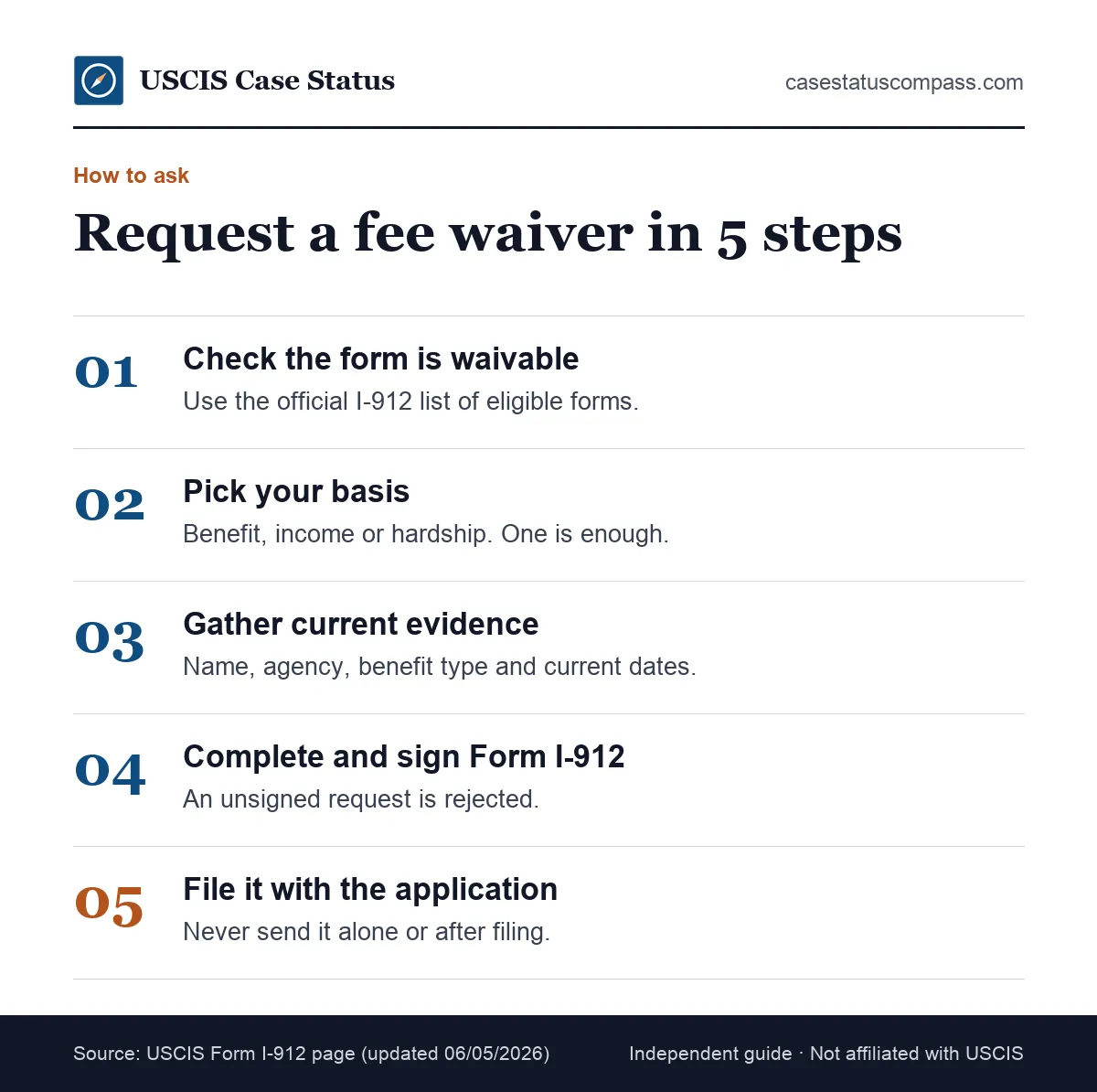
To request a USCIS fee waiver, confirm your form is on the list, choose one basis, gather current evidence, complete and sign Form I-912, and mail it with the application. Keep a full copy of everything you send, and use a tracked mailing service.
Step-by-step
- Check the I-912 page for your form and its conditions.
- Pick the basis with the best proof.
- Collect documents and English translations.
- Download Form I-912 (edition 07/22/25) from uscis.gov.
- Sign it; unsigned requests are rejected.
- Place it on top of the application and mail the packet.
Using a signed letter instead of Form I-912
USCIS also accepts a signed letter with the same details: names, the forms, your basis, household income and evidence. The form is safer because it prompts every item. Every requestor must sign it.
Where to send the packet
Use the filing address on your application's form page. Several addresses changed recently: New USCIS mailing addresses from Oct. 7, 2026; old addresses accepted if postmarked by Nov. 9, 2026.
How Do You Fill Out the Fee Waiver Form?
The fee waiver form, Form I-912, asks who is requesting, which forms you are filing, your basis and your household details. Match every number to your documents. Answer every question; write N/A or None instead of leaving a field blank, because blank fields can lead to a rejection.
Information to have ready
- Names, birth dates and A-Numbers for each requestor.
- The form numbers you want waived.
- Benefit details: agency, program and dates.
- Household members and each person's income.
- Expenses, assets and debts if you claim hardship.
Signatures and translations
Every requestor must sign. Each foreign-language document needs a full English translation with the translator's signed certification. A parent or legal guardian signs for a child under 14. Names must match the application exactly.
Can You File a Fee Waiver Request Online?
Mostly no. Fee waiver requests are usually mailed on paper with the application. The I-912 page says some eligible forms let you upload a completed PDF of Form I-912 through your USCIS online account. Check each form's online flow first.
When upload is allowed
If your form's online flow offers a fee waiver upload, attach the filled PDF and evidence there. If not, file on paper. Never pay online and plan to claim a waiver later: USCIS fees are nonrefundable, even if your case is denied or withdrawn.
Why paper is still the default
The N-400 waiver and reduced fee are paper-only, and many forms follow that pattern. Paper keeps the request for fee waiver with its evidence. Mail it to the address on the form page.
Can One Fee Waiver Request Cover Your Whole Family?
Yes, if family members file eligible family-related forms together. The Policy Manual says one request can cover all eligible family-related applications filed in the same packet. List each person and their form, with income proof for everyone counted. Each person signs their own application.
Filing together
Parents and children filing N-400s, or relatives filing I-90s at the same time, can list everyone on one I-912. Each adult requestor signs the I-912, and the evidence goes in the same envelope as all the applications.
Filing separately
If a relative files later, send a new I-912 with fresh evidence. USCIS will not pull proof from an earlier packet. Include a current benefit letter or tax record with the new request.
What Happens After You Submit a Fee Waiver Request?
USCIS decides the fee waiver at intake. If approved, the application is accepted and you receive a Form I-797C receipt notice. If not, the packet comes back. There is no separate approval letter for the waiver; paper filers get the notice by mail.
When it is approved
The receipt notice is your sign the waiver worked. Our I-797C notice of action guide explains it. Then track the form's own wait in the official tool: egov.uscis.gov/processing-times. Keep it with your copy of the I-912 as proof the fee was excused.
No separate wait for the waiver
There is no separate processing time for the waiver itself. Once accepted, the case waits in the form's normal line. An approved waiver neither speeds up nor slows the case.
What If You Hear Nothing After Mailing a Fee Waiver?
Count from the delivery date, not the mailing date. Do not mail a second identical packet. If several weeks pass with no receipt and no return, use the USCIS contact options with your tracking details. Check your mailbox for a returned packet too.
What Happens If USCIS Denies Your Fee Waiver?
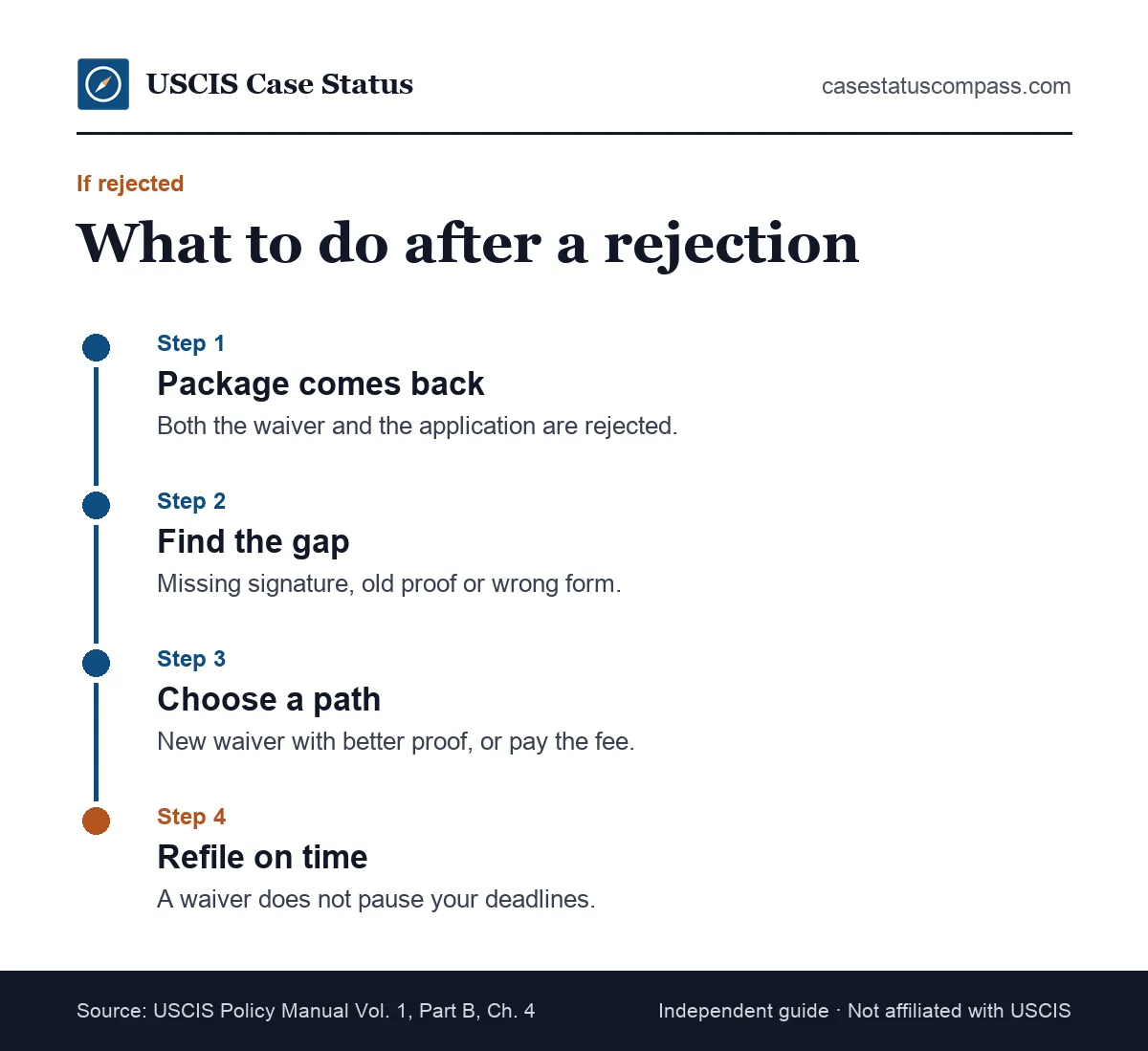
If USCIS finds you ineligible, it rejects both the fee waiver request and the application and returns them. There is no appeal; refile with better support or the full fee. The rejection notice usually says why; fix that point before refiling.
Why rejection is not denial
A rejection means the case was never accepted, so there is no receipt number and no decision on the merits. No filing date is protected. You can refile at once, with no waiting period.
Refiling with a stronger request
Fix the weak point the notice names, such as an old benefit letter, a missing tax return or an unsigned form. Then send a fresh I-912 with the complete application again.
Watch your deadlines
A waiver request does not pause other deadlines. If you must file an I-751 in its window (File in the 90 days before your 2-year card expires) or an appeal by a set date, refile fast.
Does a Fee Waiver Affect Public Charge or Your Case?
The Policy Manual states that receiving public benefits does not negatively affect the review of a fee waiver request. A waiver is a fee decision only. It does not decide your eligibility for the benefit itself. Green card applicants should still get advice on public charge.
What the waiver review looks at
The intake reviewer checks only your basis and whether the form is eligible. A means-tested benefit shown on the I-912 does not by itself make you ineligible. It does not judge your case.
When to get advice first
Public charge questions mainly arise for green card applicants who are not exempt, and they generally cannot get an I-485 waiver anyway. If unsure, ask an accredited representative first. Bring the benefit letters you plan to submit so the representative can review them.
Common Fee Waiver Mistakes
The most common fee waivers mistakes are filing for a form that is not on the list, sending old or incomplete proof, forgetting a signature, and leaving out household income. Each leads to a rejection. Most are caught with the checklist below.
Evidence mistakes
- Benefit letters older than 12 months with no update.
- Unsigned tax returns.
- Missing income proof for a household member.
- Foreign documents without certified translations.
- A hardship story with no numbers or records.
Form and filing mistakes
- Seeking a waiver for the I-130, I-129F or DACA.
- Filing the N-400 online and expecting a waiver.
- Mailing Form I-912 alone or after the application.
- Forgetting to pay an H.R. 1 fee separately.
- Using an outdated edition of the main form.
Fee Waiver Checklist You Can Copy
Use this fee waiver checklist before you seal the envelope. If any item is blank, fix it before you mail. Print it and tick each box as you prepare the packet. The lists cover planning, the envelope and the weeks after mailing.
Before you prepare the packet
- My form is on the I-912 eligible list.
- I picked one basis with the strongest proof.
- I checked this year's Form I-912P chart.
- I am filing on paper, or my form allows a PDF upload.
Inside the envelope
- Signed Form I-912 on top.
- The signed application, current edition.
- Current benefit, tax or hardship records.
- Certified English translations.
- Separate payment for any H.R. 1 fee.
Put them in this order, with the I-912 on top.
After you mail it
- Tracking number saved.
- Full copy of the packet kept.
- Reminder set to look for the I-797C receipt.
- Backup plan if a deadline is close.
If the packet comes back, read the notice first, then fix and refile.
Fee Cost Worksheet: What a Waiver Saves You
This worksheet shows what you would pay without a waiver. Add the forms you plan to file, then cross out the ones a waiver can cover. The crossed-out total is your saving if the waiver is approved. Any H.R. 1 fee on your forms stays due.
Pick your forms and add them up
Each row is a form you might file. The last column tells you whether a waiver can cover its fee.
| Form you plan to file | Fee without a waiver (Oct. 2026) | Waiver possible? |
|---|---|---|
| N-400 citizenship | $760 (paper) / $710 (online); reduced fee $380 (paper only) if household income is at or below 400% of the Federal Poverty Guidelines | Yes (paper) |
| I-90 card renewal | $465 (paper) / $415 (online) | Yes |
| I-751 remove conditions | $750 (paper) / $700 (online) | Yes |
| N-565 replacement certificate | $555 (paper) / $505 (online) | Yes |
| N-600 certificate of citizenship | $1,385 (paper) / $1,335 (online) | Yes |
| I-290B appeal or motion | $800 (some humanitarian categories $0; fee waiver possible) | Yes |
| I-130 family petition | $675 (paper) / $625 (online) | No |
Worked example
A mother files an I-90 and her son files an N-600, both on paper. Without a waiver they would pay $465 plus $1,385, or $1,850 (our sum of the paper fees). If both qualify through a household benefit, one I-912 can cover both.
If-Then Guide: Should You Ask for a Fee Waiver?
Use this guide to choose between a waiver, a reduced fee, an exemption or paying. If no row fits, ask an accredited representative before you file. Find the first row that matches you. If your form is not on the list, the answer is to pay.
Decision table
Read down the left column until a row matches you. The right column gives the next step.
| If… | Then… |
|---|---|
| Your form is not on the I-912 list | Pay the fee |
| You get a means-tested benefit now | Request a waiver with the benefit letter |
| Income is at or below 150% of poverty | Request a waiver with tax records |
| N-400 and income at or below 400% | Ask for the reduced fee in Part 10 |
| A recent crisis drained your savings | Request a waiver on hardship |
| Your category has no fee on G-1055 | No waiver needed |
| A deadline is days away | Consider paying to avoid a rejection delay |
When no row fits
Some cases mix categories, such as a TPS holder with a pending asylum case. Our Form G-1055 fee schedule guide helps you find each line. An accredited representative can help with mixed cases.
USCIS Fees Are Nonrefundable: Why the Waiver Choice Matters
USCIS fees are final once paid: USCIS fees are nonrefundable, even if your case is denied or withdrawn. If you think you qualify for a USCIS fee waiver, decide before filing. Paying first and asking later does not work.
Payment rules if you do pay
USCIS says to pay online through Pay.gov, or on paper with Form G-1450 (card) or Form G-1650 (bank account). For a paper payment, note that checks, money orders and cashier's checks are accepted only with an approved Form G-1651 exemption.
Do Fee Waivers Cover Other Agencies' Fees?
No. Form I-912 covers only USCIS fees. The State Department sets its own visa fees, and the immigration courts and the Department of Labor follow separate rules. Each agency sets its own rules for reduced fees, and a USCIS approval does not carry over.
State Department visa fees
Consular fees, such as the immigrant visa fee (Immigrant visa fee: $325 family; $345 employment; $205 other (per person)), are paid to the State Department, and USCIS cannot waive them.
Immigration court filings
In removal proceedings, court fees are handled by the Executive Office for Immigration Review (EOIR), not Form I-912. See our guide to immigration court case status. Ask the court about its rules.
Department of Labor filings
PERM labor certification costs belong to the employer under Department of Labor rules and are not USCIS fees. An I-912 has no effect on them. The worker should not pay them.
When Should You Get Help With a Fee Waiver?
Get help if your household is complex, your hardship is hard to document, a deadline is close, or H.R. 1 fees apply. A DOJ-accredited representative at a nonprofit or an immigration attorney can review the packet. Get help early, before you mail.
Free and low-cost help
Many nonprofit legal service providers help low-income filers with fee waivers at little or no cost. Be wary of anyone who promises a guaranteed waiver. Check that the person is an attorney or accredited representative.
Red flags that need a professional
- A past denial, arrest or removal case.
- An I-751 or appeal deadline coming up.
- Doubt about whether you are public-charge exempt.
- A household member living outside the U.S.
Frequently Asked Questions
Can I get a fee waiver for I-130?
No. Form I-130, the petition for an alien relative, is not on the USCIS fee waiver list, so the petitioner must pay the fee. Abuse victims can ask whether a VAWA self-petition fits instead.
How do I get an application fee waiver from USCIS?
File Form I-912 or a signed letter together with an eligible form. Show one basis: a current means-tested benefit, household income at or below 150% of the poverty guidelines, or financial hardship. Mail everything in one packet.
Is there a fee to file Form I-912?
No. USCIS charges nothing to request a fee waiver; the fee schedule lists Form I-912 at $0 (no fee to request a fee waiver). You must still pay any H.R. 1 fee on the same form separately.
Does a fee waiver hurt my naturalization case?
No. The USCIS Policy Manual says receiving public benefits does not negatively affect the review of a fee waiver request. The officer deciding your N-400 looks at citizenship eligibility, not at whether you paid.
Can I get a fee waiver for DACA?
No. DACA requests on Form I-821D and the DACA-based Form I-765 cannot be waived, so renewal applicants pay both fees in full. Ask a local immigrant legal service provider whether outside help with fees exists.
What happens if my fee waiver is rejected?
USCIS rejects both the waiver request and the application and returns them; there is no appeal. You can refile with stronger evidence or pay the fee. The rejection does not pause deadlines, so refile quickly.
Can I file my N-400 online with a fee waiver?
No. To ask for a fee waiver or the reduced fee on Form N-400, you must file on paper. Mail the paper N-400 with your signed Form I-912 and evidence together.
Is a fee waiver the same as the reduced citizenship fee?
No. A waiver removes the whole N-400 fee for people with a qualifying benefit, income at or below 150% of poverty, or hardship. The reduced fee lowers the N-400 fee to $380 for households at or below 400% of poverty.
Can I get a green card renewal fee waiver?
Yes. Form I-90 is on the I-912 list, so you can ask to waive the renewal fee on a paper I-90 if you meet one basis. Some I-90 filers, such as those whose card had a USCIS error, pay nothing without a waiver.
How long does a USCIS fee waiver take?
There is no separate wait. USCIS decides the waiver at intake, and an approved request shows up as a normal I-797C receipt notice.
Sources
- USCIS: Form I-912, Request for Fee Waiver. www.uscis.gov/i-912. Accessed Oct 27, 2026.
- USCIS: Form I-912 Instructions (Edition 07/22/25). www.uscis.gov/sites/default/files/document/forms/i-912instr.pdf. Accessed Oct 27, 2026.
- USCIS Policy Manual, Volume 1, Part B, Chapter 4: Fee Waivers and Fee Exemptions. www.uscis.gov/policy-manual/volume-1-part-b-chapter-4. Accessed Oct 27, 2026.
- USCIS Fee Schedule, Form G-1055 (Edition 10/16/26). www.uscis.gov/g-1055. Accessed Oct 27, 2026.
- USCIS: Filing Fees. www.uscis.gov/forms/filing-fees. Accessed Oct 27, 2026.
- USCIS: Form N-400 Instructions. www.uscis.gov/sites/default/files/document/forms/n-400instr.pdf. Accessed Oct 27, 2026.
- USCIS: How Do I Request Premium Processing?. www.uscis.gov/forms/all-forms/how-do-i-request-premium-processing. Accessed Oct 27, 2026.
- USCIS Form G-1055 Fee Schedule, Edition 10/16/26. www.uscis.gov/sites/default/files/document/forms/g-1055.pdf. Accessed Oct 27, 2026.
- USCIS: Form N-400 page. www.uscis.gov/n-400. Accessed Oct 27, 2026.
- Form I-90 Instructions, Edition 01/20/25. www.uscis.gov/sites/default/files/document/forms/i-90instr.pdf. Accessed Oct 27, 2026.
- USCIS: Form I-765 page (updated 10/07/2026). www.uscis.gov/i-765. Accessed Oct 27, 2026.
- USCIS: Filing Locations and Online Filing Options Updates. www.uscis.gov/forms/us-citizenship-and-immigration-services-filing-locations-and-online-filing-options-updates. Accessed Oct 27, 2026.
- USCIS Check Case Processing Times. egov.uscis.gov/processing-times/. Accessed Oct 27, 2026.
- USCIS: Removing Conditions on Permanent Residence Based on Marriage. www.uscis.gov/green-card/after-we-grant-your-green-card/conditional-permanent-residence/removing-conditions-on-permanent-residence-based-on-marriage. Accessed Oct 27, 2026.
- 22 CFR 22.1 Schedule of Fees for Consular Services (LII). www.law.cornell.edu/cfr/text/22/22.1. Accessed Oct 27, 2026.
casestatuscompass.com is an independent publication and is not affiliated with USCIS or any government agency. This page is general information, not legal advice. For denials, court or asylum matters, consult an immigration attorney or a DOJ-accredited representative.