Contents · 43 sections
- What Does "Case Is Being Actively Reviewed by USCIS" Mean?
- Why Didn't USCIS Mail a Notice When Active Review Began?
- Is Active Review a Good Sign?
- What Does an Officer Check During Active Review?
- Where Active Review Fits in the Status Path
- What Comes Next After "Actively Reviewed"?
- Case Is Being Actively Reviewed by USCIS After Biometrics
- What If You Never Had a Biometrics Appointment?
- How Long After Biometrics Does Active Review Last?
- Case Is Being Actively Reviewed by USCIS After an Interview
- Does Actively Reviewed After an Interview Mean Approval?
- After Biometrics vs After an Interview vs After an RFE Reply
- Actively Reviewed for Form I-485
- Case Is Being Actively Reviewed by USCIS for an I-130
- Actively Reviewed for Form I-765
- Will Your Work Permit Expire During Active Review?
- Actively Reviewed for N-400, I-751 and I-90
- Actively Reviewed for Employer Petitions
- How Does Active Review Work With Premium Processing?
- Form-by-Form Signal Table
- How Long Does "Case Is Being Actively Reviewed by USCIS" Last?
- New Date, Same "Actively Reviewed" Message: What Changed?
- Why Is My Case Being Actively Reviewed a Second Time?
- Does Active Review Mean Background Checks Are Done?
- Can You Speed Up Pending Background Checks?
- Can You Get an RFE After Active Review?
- What Should You Have Ready During Active Review?
- Should You Send More Evidence During Active Review?
- Should You Contact USCIS During Active Review?
- Is Active Review Different From "Still Being Processed"?
- Is It Safe to Travel During Active Review?
- Can a Job Change Affect an Employment Case Under Review?
- Active Review Examples From Common Cases
- What to Do Now: Active Review Decision Guide
- Mistakes to Avoid During Active Review
- What Happens If You Miss Mail During Active Review?
- How Often Does the Case Status Tool Update?
- Does Your Online Account Show More Than the Public Tool?
- How to Confirm the Message on Official Tools
- What Happens After Approval?
- When Should You Get Legal Help During Active Review?
- Key Points to Remember
- Frequently Asked Questions
The short answer
"Case is being actively reviewed by USCIS" means an officer or review team has your file open and is working toward a decision. It usually appears after biometrics or an interview. It is a sign of progress, not an approval: the next update can be an approval, a request for evidence, an interview notice or, less often, a denial.
At a glance
| Is it an approval? | No. The decision has not been made yet. |
| What it suggests | An officer is checking eligibility and evidence. |
| Common triggers | Biometrics done, interview held, RFE reply received. |
| Your action | Watch your mail and keep documents ready. |
| Official status tool | Case Status Online: egov.uscis.gov |
What Does "Case Is Being Actively Reviewed by USCIS" Mean?
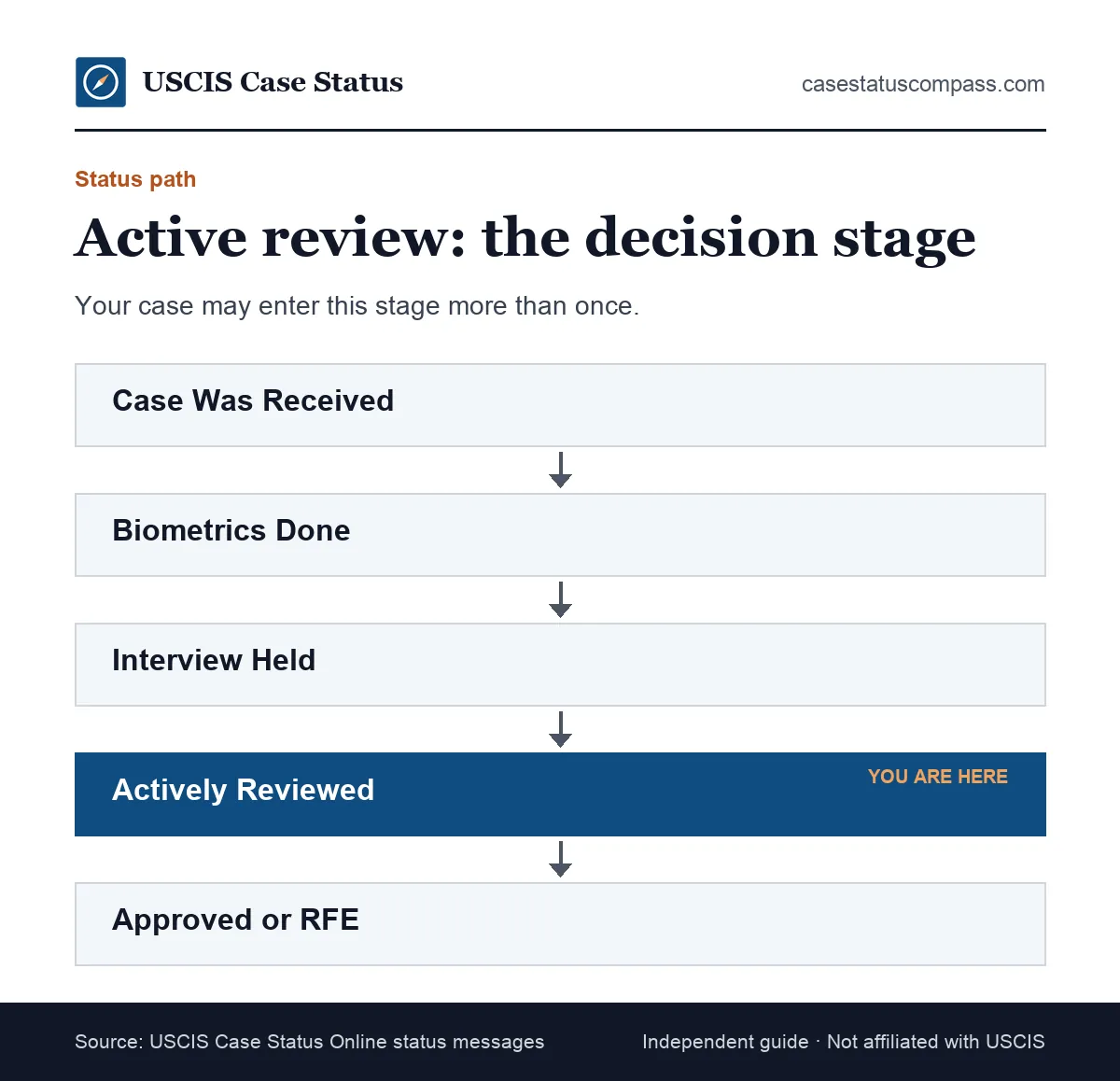
The actively reviewed meaning is simple: your case has moved from waiting to working. An officer or review team has opened it to check eligibility, evidence and security results. USCIS does not publish a formal definition, so read the message as progress with the outcome still open.
Who is likely handling the file
Depending on the form, the reviewer may be an adjudications officer at a service center, an officer at your local field office, or a team at the National Benefits Center preparing the file for an interview.
Why Didn't USCIS Mail a Notice When Active Review Began?
Active review is an internal stage, so USCIS usually mails nothing when it begins. A paper notice arrives only when the officer needs something from you or makes a decision. Your online account shows the same update next to your earlier notices.
Is Active Review a Good Sign?
Yes, in the sense that your case is moving. It is not a promise of approval. Officers still issue requests for evidence, interview notices and occasional denials after this stage.
Treat it as a signal to stay reachable and keep your documents together, so you can answer quickly if the next notice is a request rather than a decision.
What the message confirms
- USCIS accepted the filing and assigned it for substantive review.
- No final decision has been recorded yet.
- The file is active and, in many cases, close to a decision point.
What the message cannot promise
The status cannot tell you whether the officer has found a problem, whether checks are complete, or when the decision will be signed. Treating it as guaranteed approval can lead to risky plans.
What Does an Officer Check During Active Review?
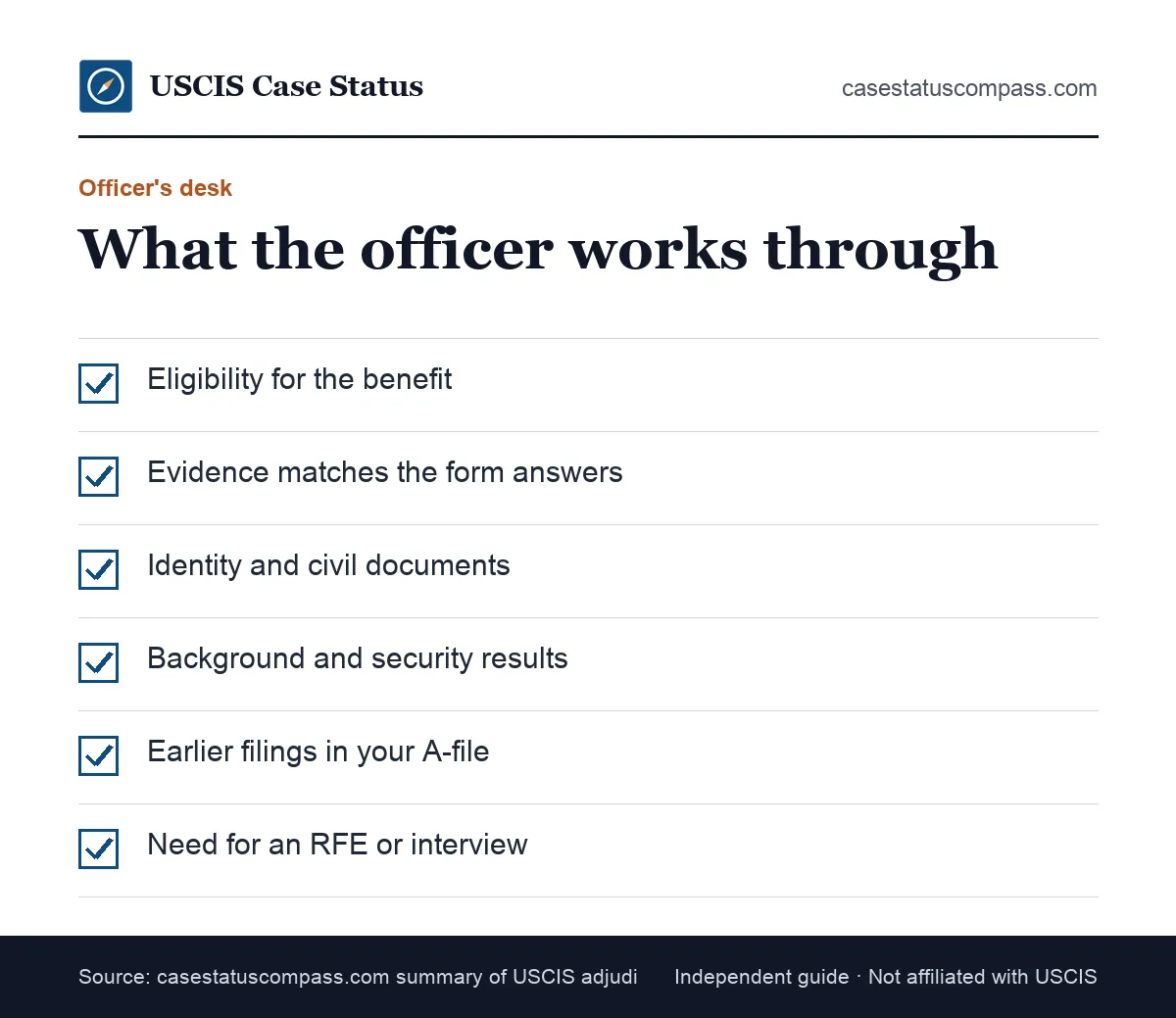
An officer confirms you qualify for the benefit, that your evidence matches your answers, that your identity and documents are genuine, and that background checks are clear. The officer also decides whether an interview or more evidence is needed.
Five checks behind every review
The table lists the five areas an officer works through and one practical way you can make each check easier.
| What the officer checks | What it involves | How you can help |
|---|---|---|
| Eligibility | Do you meet each legal requirement? | File complete forms |
| Evidence | Do documents support your answers? | Send clear copies and translations |
| Identity | Are civil documents genuine and consistent? | Use the same name spellings |
| Security results | Are fingerprint and name checks clear? | Attend biometrics on time |
| Prior filings | Do past records in your A-file match? | Answer history questions honestly |
Eligibility and evidence
For each benefit, the officer compares the law's requirements with your forms and documents. Gaps, such as a missing birth certificate or unclear financial evidence, are the most common reason an active review ends in an RFE instead of an approval.
Security results and your past filings
The officer also reviews fingerprint and name-check results and your A-file, the record of your earlier immigration filings. Differences between old and new answers can prompt an RFE or interview question.
Where Active Review Fits in the Status Path
Active review usually comes late in a case: after receipt, after biometrics and, for some forms, after an interview. Some cases enter it twice. It sits at the decision end of the path.
Knowing which step came right before it is the best clue to what comes next, so look at your last notice before reading anything into the message.
Common entry points
Common doors into active review are a completed biometrics appointment, a finished interview, and the arrival of your reply to a request for evidence.
A transfer to a new office can also open a fresh review once that office picks up the file. The date of the last notice usually tells you which door applies.
Common exits
Active review normally ends with a decision message, such as the Case Was Approved status, or with a request. Some cases first show a general update like a "We Have Taken an Action on Your Case notice."
What Comes Next After "Actively Reviewed"?
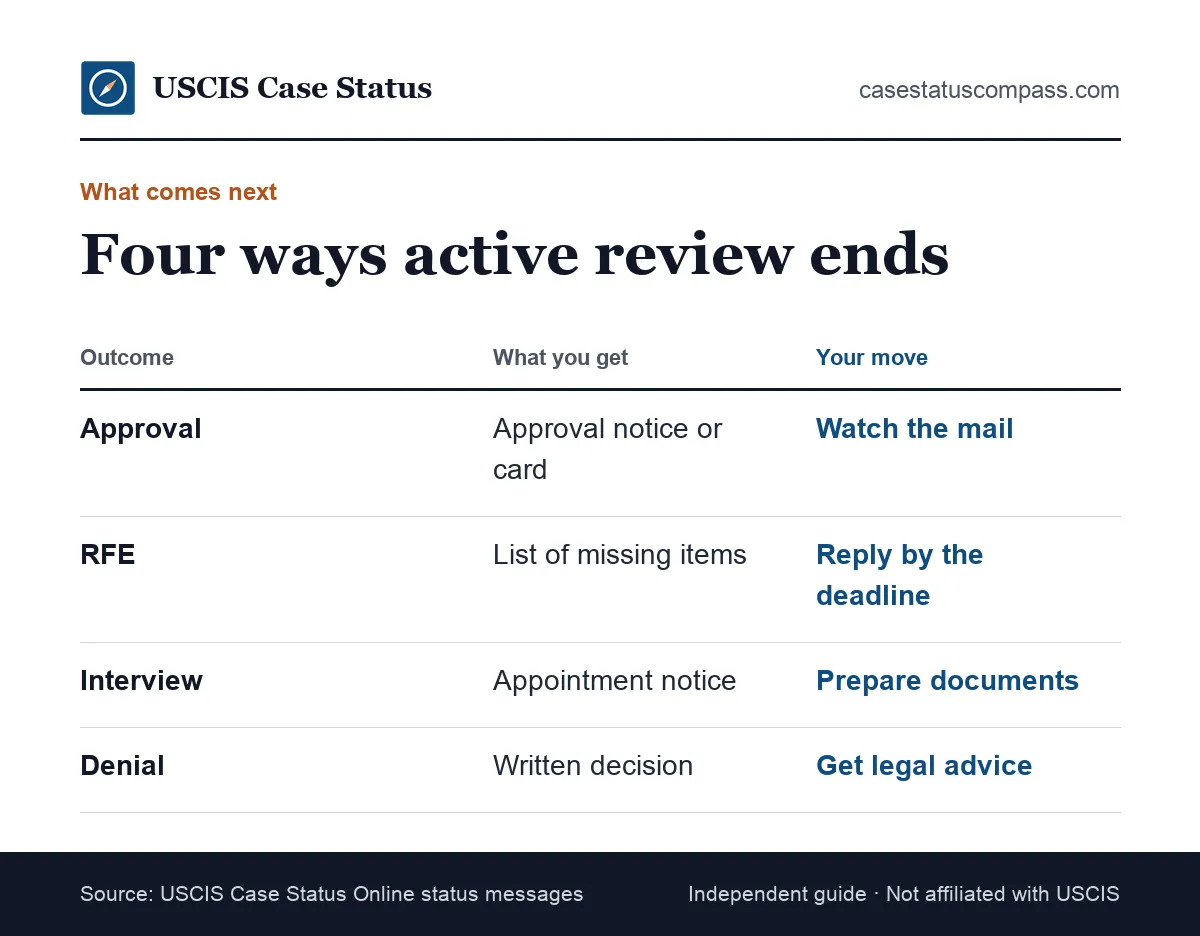
One of four things usually follows: an approval, a request for evidence (RFE), an interview notice, or a denial. Each comes with its own status message and a paper notice.
Approvals and requests for evidence are the most frequent outcomes; read whichever notice arrives in full before you act on it.
Next statuses and what each asks of you
Each row pairs a possible next message with what it means and the one action it asks of you.
| Next status | What it means | What to do |
|---|---|---|
| Case Was Approved | Officer granted the benefit | Watch for the notice or card |
| Request for Evidence Was Sent | Officer needs more proof | Reply fully before the deadline |
| Interview Was Scheduled | Officer wants to meet you | Prepare originals and attend |
| Notice of Intent to Deny | Officer plans to deny | Respond with evidence and get advice |
| Case Was Denied | Benefit refused | Read the decision; see a lawyer |
The approval path
For card-based benefits, approval is often followed by the New Card Is Being Produced update and then a mailing message. For petitions such as Form I-130 or Form I-140, an approval notice on Form I-797 arrives by mail.
The RFE path
An RFE lists missing items and a response deadline, and the case returns to review once your reply is logged. Our guide on how to answer an RFE explains what a strong reply includes.
The NOID path
A notice of intent to deny (NOID) is more serious and explains why the officer plans to deny. You get a chance to respond first; see our notice of intent to deny guide.
The interview path
If the officer wants to talk to you, the status changes to an Interview Was Scheduled status and a notice gives the date, time and office. Bring every original document the notice lists.
Case Is Being Actively Reviewed by USCIS After Biometrics
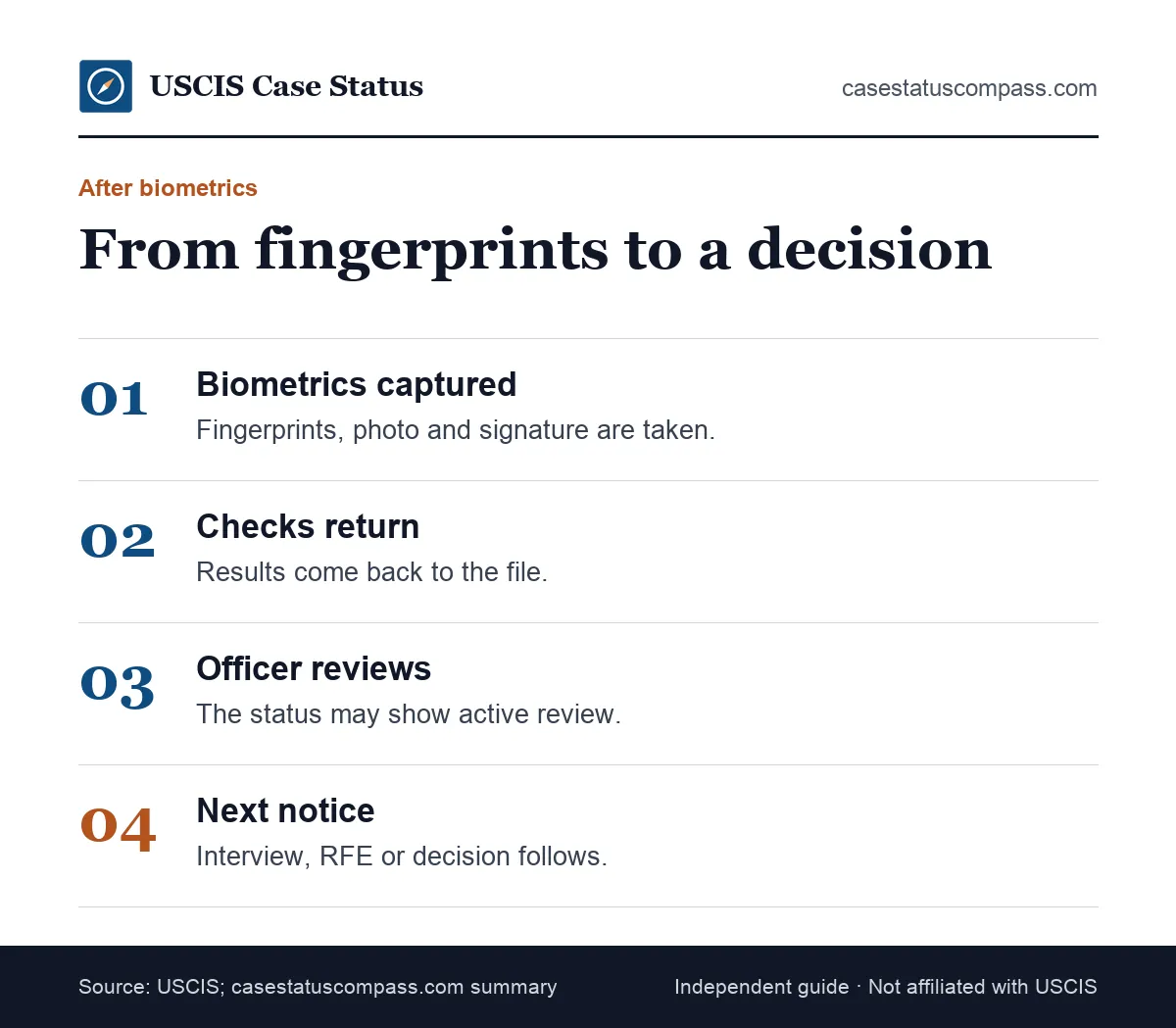
Seeing active review after biometrics usually means your fingerprint results reached the file and an officer can now move forward. For forms without interviews, a decision may come next. For green card and citizenship cases, the next step is often an interview.
What the fingerprints unlock
Biometrics feed FBI fingerprint checks and identity verification. When the status moves to active review soon after your USCIS biometrics appointment, that often means the results are in.
Without them, most cases cannot be decided at all.
What If You Never Had a Biometrics Appointment?
Some renewals reuse earlier biometrics, so you may skip the appointment. If your form normally needs fingerprints and you never got a notice, check your online account and mail history, and contact USCIS if nothing was sent. Most decisions wait on fingerprint results, so a missing appointment notice is worth chasing.
How Long After Biometrics Does Active Review Last?
For forms decided without an interview, the gap between biometrics review and a decision is often shorter than the earlier wait. For interview-based forms, active review after biometrics usually ends with an interview notice, not a decision.
USCIS publishes no figure for this gap.
Forms usually decided without an interview
Work permits, travel documents and green card renewals are often decided on paper. For these, active review after biometrics can be close to the final step.
The next update is often an approval or a card production message, though an RFE is still possible if the officer spots a gap in the evidence.
Forms that usually include an interview
Many Form I-485 and N-400 cases need an interview. Active review after biometrics often means the file is being prepared for interview scheduling, which depends on local office calendars.
Case Is Being Actively Reviewed by USCIS After an Interview
After an interview, active review usually means the officer is completing the decision: writing notes, reviewing anything you handed in, and waiting for any last check or supervisor sign-off.
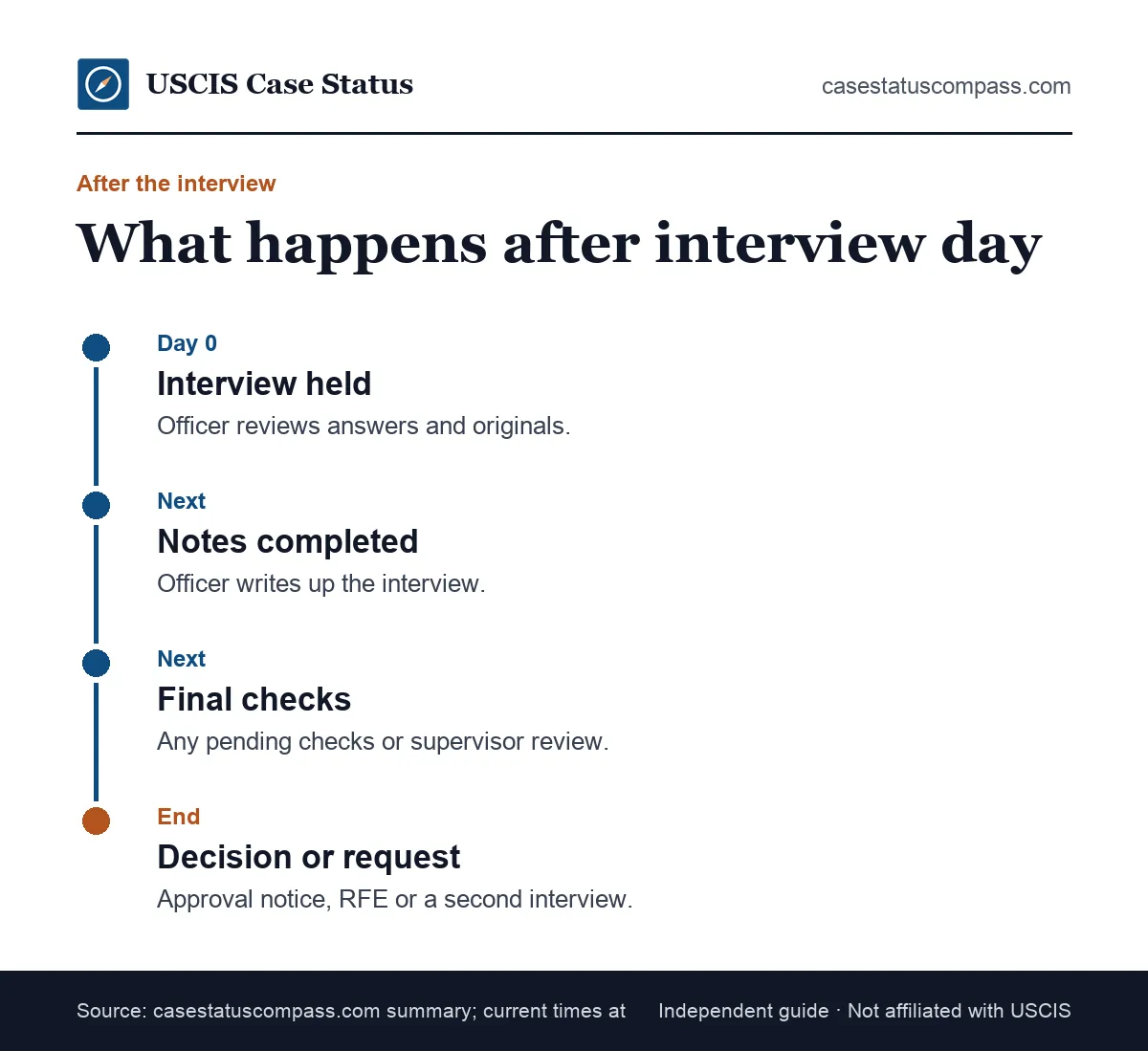
How long that takes depends on what the officer still needs, so the interview results sheet is your best guide to what comes next.
What the officer is finishing
The officer must record what happened at the interview, confirm your answers against the file, and log any new documents. Anything you handed over must be added first.
Any final check also has to clear.
When a check expires before the decision
If a security check expired or a question remains open, the officer may request an update before deciding. That can mean a new biometrics appointment or a short request for evidence.
Paper you may get on interview day
Many officers hand out an interview results sheet. It may say the case is approved, that a decision cannot yet be made, or that more evidence is needed. Keep it.
Does Actively Reviewed After an Interview Mean Approval?
Not by itself. If the officer told you at the interview that you would be approved, active review often precedes the approval message. If the officer asked for more documents, the review may end in a formal RFE.
Use the signs below as clues only.
Signs pointing toward approval
- The officer said the case looked approvable.
- You received no request for extra documents.
- Your background checks were already complete before the interview.
- The status moved soon after the interview.
Signs that more is needed
- Your results sheet listed documents to send.
- The officer mentioned a supervisor review.
- Your history includes an arrest, a prior denial or a status gap.
- Weeks pass with no change while similar cases close.
After Biometrics vs After an Interview vs After an RFE Reply
The same words mean slightly different things depending on what happened just before. Your trigger event tells you which next step to expect.
Check your online account history for the step that came just before the message, then find that step in the table below.
Trigger-by-trigger comparison
Find the event that happened just before your status changed; each row shows what the officer is probably doing and what tends to follow.
| Trigger before active review | What is usually happening | Likely next step |
|---|---|---|
| Biometrics completed | Fingerprint results reviewed | Interview notice or decision |
| Interview held | Officer finishing the decision | Approval or RFE |
| RFE reply received | Officer weighing new evidence | Approval, NOID or second RFE |
| File transferred in | New office opening the file | Interview or decision at new office |
Reading your trigger
USCIS uses this one message for several internal steps, so find the last milestone notice you received. That event, not the headline, tells you which row applies.
If no notice explains the change, check your online account history.
Actively Reviewed for Form I-485
For a Form I-485 green card application, active review means an officer is checking your adjustment eligibility, medical exam record, admission history and supporting petition. Approval may also depend on a visa number being available.
Officers also confirm the underlying petition is still valid.
What it signals for an I-485
Before an interview, it often means the file is being prepared for scheduling. After an interview, it usually means the officer is finishing the decision.
In both cases, keep your medical exam record, passport and civil documents ready, because the officer may ask for an update before signing.
An I-485 under review with no interview notice
An I485 actively reviewed status with no interview may mean the officer is considering an interview waiver. Do not count on one: an interview notice can still follow, so keep originals and your medical exam record ready.
Companion work and travel filings
Your work permit and advance parole cases have separate receipt numbers. Their statuses and approval dates can differ from the I-485. Check each case and keep each approval notice.
One may close weeks before the others.
Case Is Being Actively Reviewed by USCIS for an I-130
For an I-130 petition for alien relative, I-130 active review means an officer is checking the family relationship, the petitioner's status and the evidence. A spouse case may also be checked for a genuine marriage.
Many parent and child petitions are decided on paper.
Spouse, parent and child petitions
For immediate relatives, active review often leads straight to approval or an RFE. Spousal cases may be scheduled for an interview, especially when the I-130 is filed with an I-485.
Where an approved I-130 goes next
If the relative lives abroad, the approved petition moves to the National Visa Center. If the relative is in the United States and eligible, adjustment can follow. For preference relatives, the visa bulletin then controls timing.
Actively Reviewed for Form I-765
For a Form I-765 EAD application, active review means the officer is confirming your eligibility category and identity. Work permits are usually decided on paper, so this status is often close to approval and the card production step.
An officer who finds a gap can still send a request for evidence.
What the officer confirms on an EAD
The officer checks that your eligibility category is correct, that any underlying case is pending or approved, and that your photo and biometrics match. A wrong category code often triggers an RFE.
Will Your Work Permit Expire During Active Review?
As of October 2026, USCIS says: Ended: renewals filed on or after Oct. 30, 2025 no longer get the up-to-540-day automatic extension (exceptions: TPS by law/Federal Register notice; STEM OPT 180 days). If your card is near expiry, you may still need to plan for a short work gap until the new card arrives.
Actively Reviewed for N-400, I-751 and I-90
For citizenship, removal of conditions and card renewal cases, active review means an officer is close to a decision or to scheduling an interview.
What follows differs by form: an oath notice, a 10-year card or a replacement card. The sections below explain the signal for each form and the one document you should keep close while you wait.
Form N-400 citizenship
For a Form N-400 citizenship application, review after the naturalization interview often means the officer is finishing the decision. Before the interview, it may mean the file is being prepared for scheduling at your field office.
From N-400 approval to the oath ceremony
Approval usually leads to an oath ceremony notice. You are not a citizen until you take the Oath of Allegiance. Watch your mail for the ceremony date.
Bring your green card to the ceremony.
Form I-751 removal of conditions
For an I-751 petition to remove conditions, the officer reviews joint-life evidence and may waive or schedule an interview. Meanwhile, USCIS says: I-751 receipt notice extends conditional status and work authorization for 48 months.
Form I-90 card renewal
For an I-90 green card renewal application, active review usually means the card is close to production. USCIS says: I-90 receipt notice + expired card = proof of status for 36 months from the card's expiration date. Keep the receipt with your expired card.
Actively Reviewed for Employer Petitions
For an I-140 immigrant petition for a worker or a Form I-129 petition, active review means an officer is weighing the job offer, the employer's evidence and the worker's qualifications. The petitioner or its attorney gets the notices.
How Does Active Review Work With Premium Processing?
With USCIS premium processing service, active review usually means the officer is working within the guaranteed clock. An RFE pauses that clock until USCIS receives the reply, so a quick, complete answer matters. Workers should ask the petitioner or its attorney for updates.
Form-by-Form Signal Table
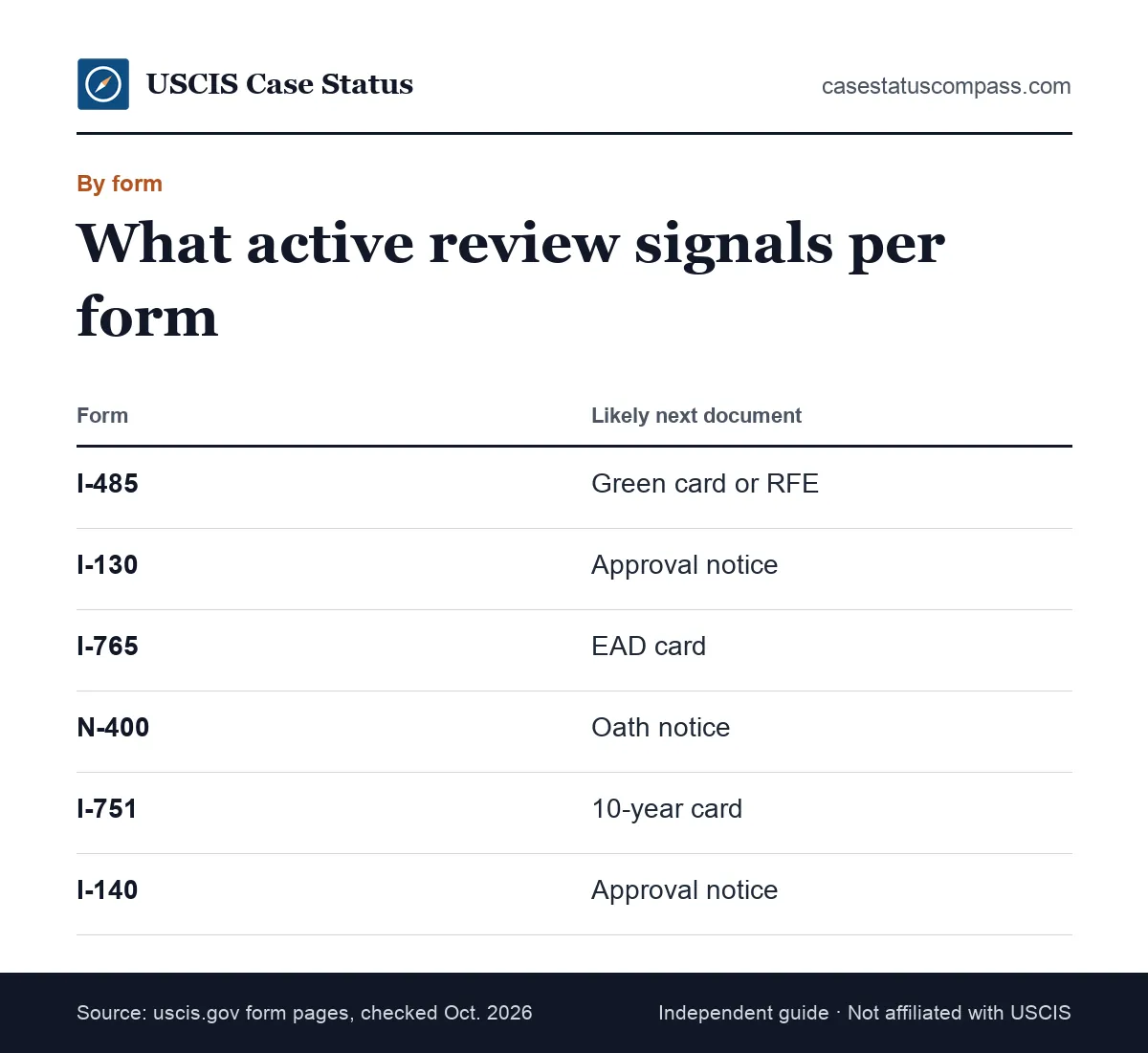
The table shows what active review usually signals by form and which document follows. The middle column is a typical pattern, not a rule.
Your own case can differ, especially if an interview, a transfer or an RFE is involved. Use the right column to know which document to watch for in the mail.
Signals for seven common forms
Find your form in the first column to see the usual meaning of the message and the document that tends to follow it.
| Form | What active review usually signals | Document you are waiting for |
|---|---|---|
| I-485 | Officer checking adjustment eligibility | Green card |
| I-130 | Relationship and petitioner check | I-797 approval notice |
| I-765 | Category and identity check | EAD card |
| N-400 | Decision before or after interview | Oath ceremony notice |
| I-751 | Joint-life evidence review | 10-year green card |
| I-90 | Card about to be produced | New green card |
| I-140 / I-129 | Job and qualification review | I-797 approval notice |
How Long Does "Case Is Being Actively Reviewed by USCIS" Last?
How long active review lasts varies from days to several months. USCIS does not publish a timer for this stage. Its official tool at egov.uscis.gov/processing-times shows the time for the whole case, from receipt to decision, not for active review alone.
Why USCIS gives no stage timer
Active review covers many internal steps: reading evidence, waiting for checks, supervisor review and scheduling. Each varies by office and case. That is why the posted processing time is the only official benchmark; see official USCIS processing times explained.
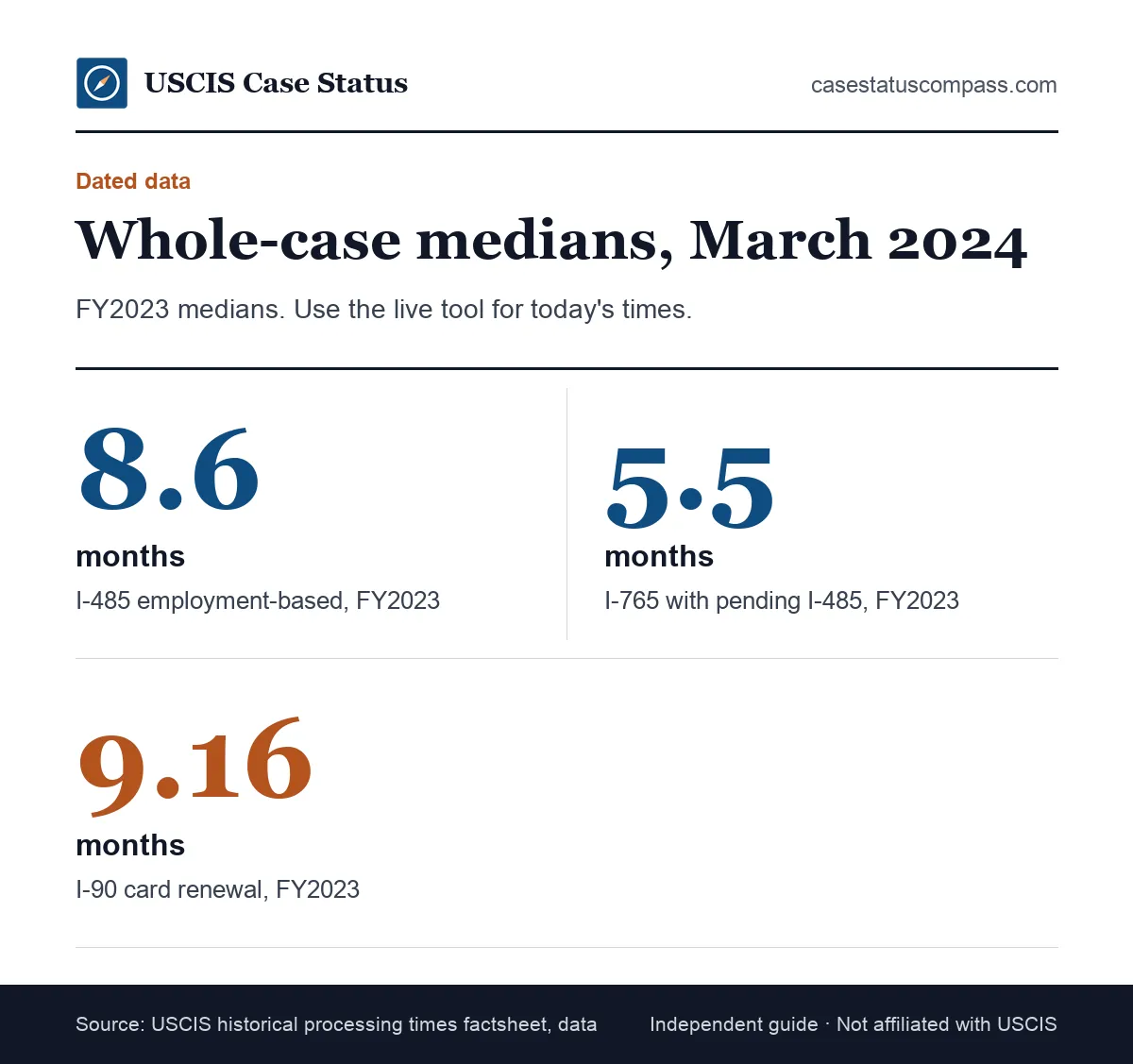
Dated historical medians for context
A USCIS factsheet with data as of March 5, 2024 listed older whole-case medians, some shown below. These cover the entire case and are not current. Use the live tool for today's numbers.
New Date, Same "Actively Reviewed" Message: What Changed?
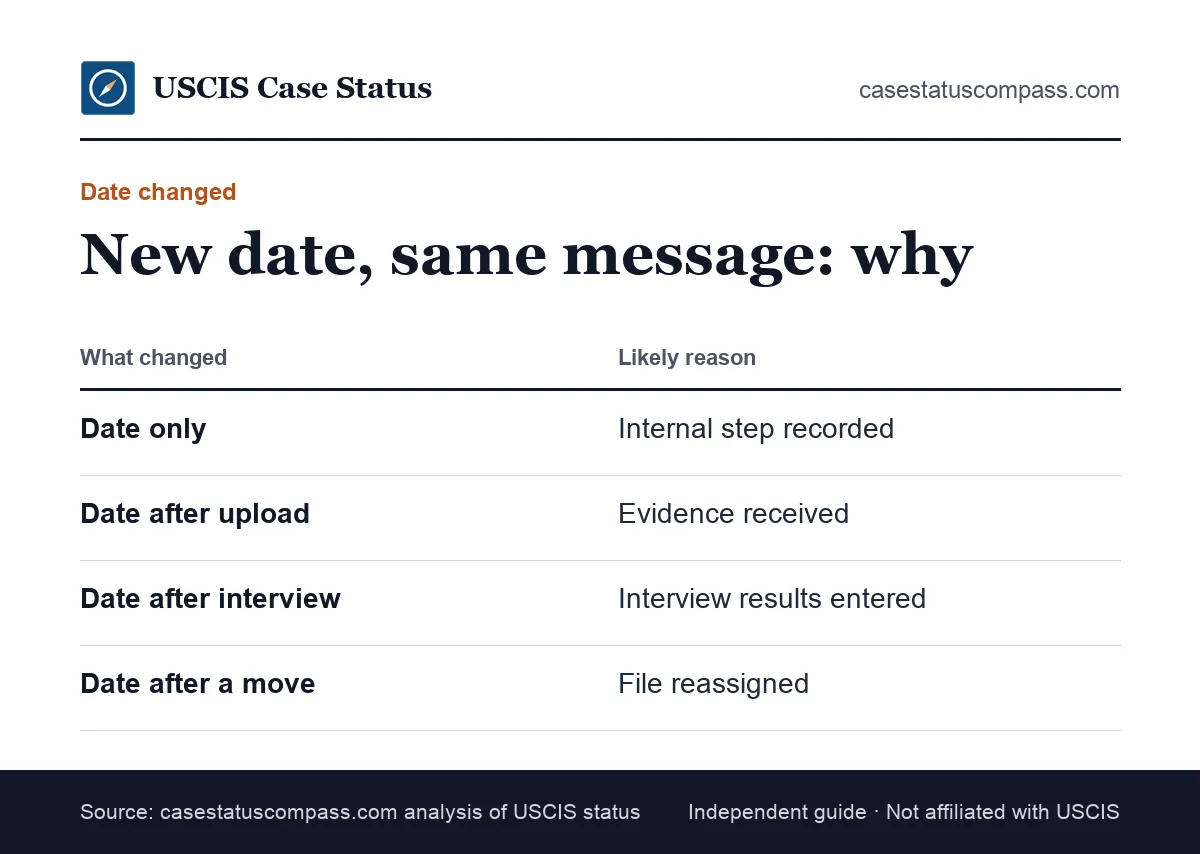
A new date with the same words usually means USCIS recorded an internal step, such as a reassignment, a check result or receipt of new evidence. It is not a new decision. The date shows when the record was last updated, not when an officer last read it.
Date changes and their likely causes
Use this table to match what you noticed with the most likely internal reason and whether you need to do anything.
| What you notice | Likely reason | What to do |
|---|---|---|
| Date changed, nothing else | Internal step logged | Keep watching |
| Date changed after an upload | Evidence received | Confirm it was the right case |
| Date changed after interview | Results entered | Wait for the decision notice |
| Date changed after a move | File reassigned | Check your address on file |
Internal touches and reassignment
Officers and support staff record actions such as case reassignment, a check result or a supervisor review. Each can refresh the date, even with no decision.
None of these needs a reply from you.
Review after a transfer to another office
If your case moved, the new office may log its own intake steps before an officer reads the file, so the date can change more than once. Read about file transfers between offices.
Evidence received after you sent it
If you uploaded or mailed documents, the date may change when they are logged. That is a good moment to confirm receipt in your online account and check the receipt number.
When the date stops changing for months
A frozen date is not proof of a problem, because many internal steps leave no trace online. If the date never changes for a long time, read about a status that stopped updating.
Why Is My Case Being Actively Reviewed a Second Time?
A second active review usually follows new information: an RFE reply, an interview, updated checks or a transfer. It is common and not a bad sign by itself. Each pass is a fresh look at the file with the new material in hand.
After new evidence arrives
When your RFE reply is logged, the officer must weigh it, so the case re-enters active review. A complete reply that answers every point gives the officer what is needed to decide without a second request.
After a supervisor or quality check
Some cases, especially those with complex histories, get a second-level review before approval. The online message may cycle back to active review while that happens.
This is routine for some files and does not mean a denial is coming. Keep watching for a notice rather than calling.
Does Active Review Mean Background Checks Are Done?
Not always. Many officers begin review while some checks are still pending, and checks can expire and be rerun. Active review after biometrics often means fingerprint results are back, but name checks or other screening may still be running.
The public tool does not say.
Checks that may still be pending
Name checks and other security screening run through outside agencies on their own schedules. The public tool never shows their progress. A case can stay in active review while an officer waits for a cleared result.
Can You Speed Up Pending Background Checks?
Very little, directly. Keep your address current, attend any new biometrics appointment, and use the inquiry route only if your case passes the official inquiry date. Calling repeatedly does not move outside screening faster. An attorney can advise on longer security delays.
Can You Get an RFE After Active Review?
Yes, it is one of the most common results of active review. It means the officer found something missing or unclear and wants proof before deciding. An RFE is not a denial; a complete, on-time reply often leads to approval.
Document and medical exam gaps
Missing or expired medical exam record (Form I-693) for adjustment cases
Missing translations or unclear civil documents
A missing birth certificate, or one without the parents' names, where the form requires it
Passport pages or entry records that do not match the answers on the form
Financial and relationship gaps
Weak financial evidence for an affidavit of support
Thin proof of a genuine relationship
Missing tax transcripts or a joint sponsor's documents
Evidence that does not cover the full period the form asks about
Read the RFE closely; it names each gap the officer found.
How to reply well
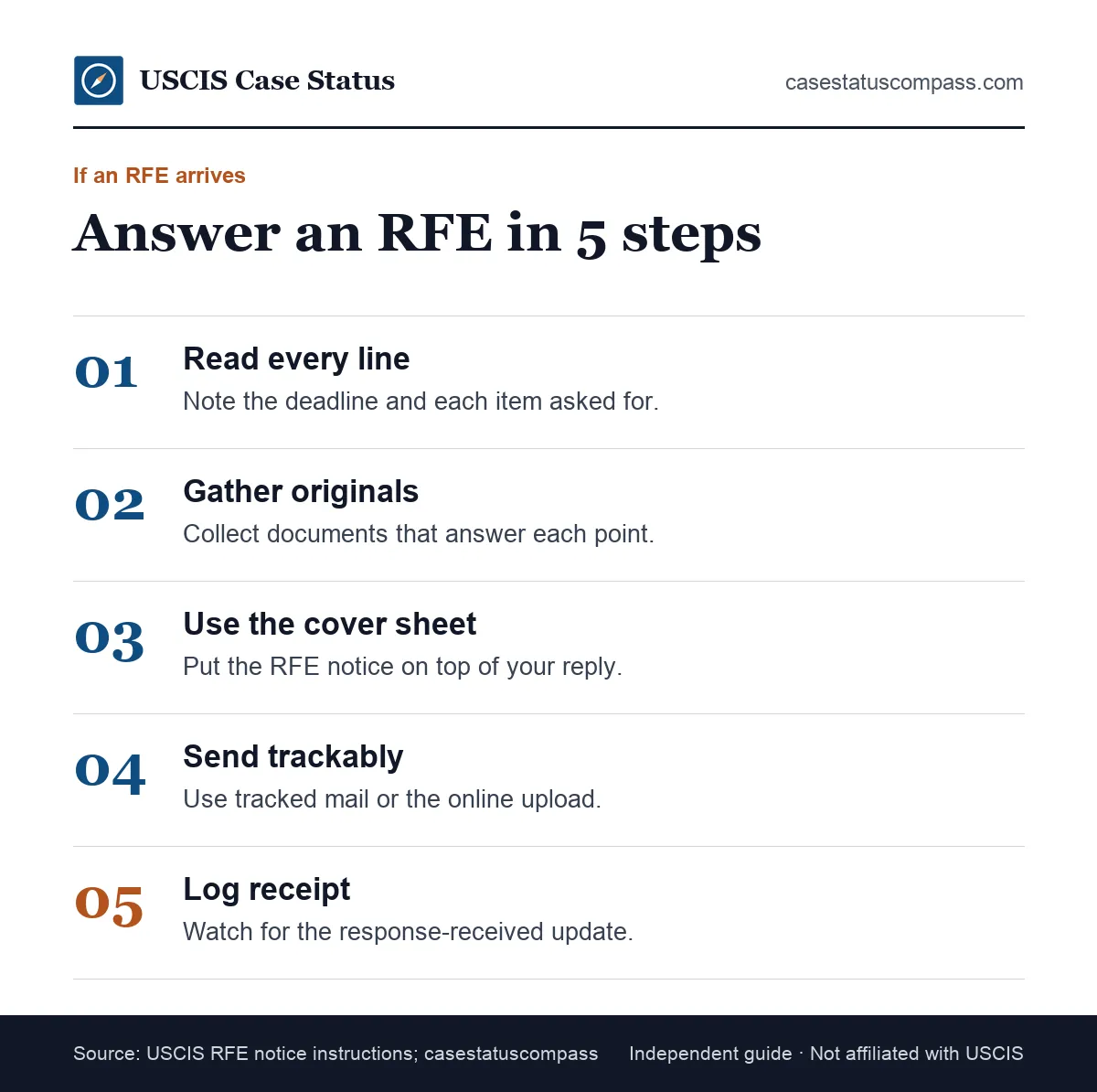
Answer every item in order, put the notice on top, and send by the deadline using a trackable method or the online upload. Keep a full copy of what you sent and watch for the response-received update.
What Should You Have Ready During Active Review?
Keep copies of your filing, your original civil documents and recent financial or job records within reach. If an RFE or second interview arrives, you can answer in days instead of weeks.
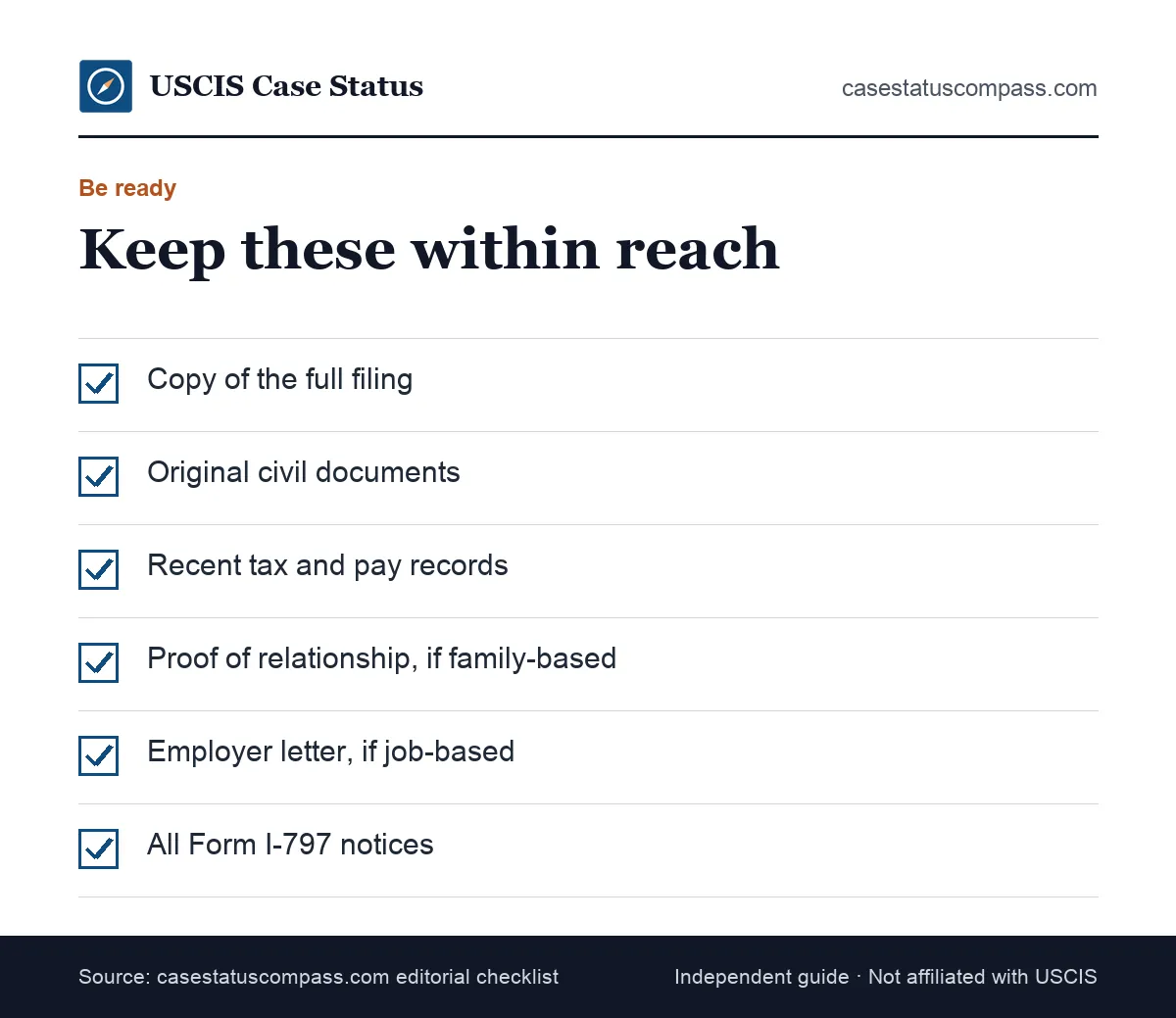
Store copies in one folder, paper or digital, labeled by form.
Documents to keep close
Full copy of the filing and every Form I-797
Birth, marriage and divorce certificates
Passport and travel records
Any court or police records, with certified dispositions
Your medical exam record if you filed an I-485
Keep originals in a safe place and copies ready to send.
Financial and relationship records
Recent tax returns, pay stubs or an employer letter
Relationship evidence for family cases, such as joint bank statements or a lease
Proof of any job change since you filed
Update these every few months so they stay current.
Contact details USCIS uses
Make sure your mailing address, email and phone are current. If you move during review, update your USCIS mailing address right away, because RFEs have strict deadlines that start from the notice date.
Should You Send More Evidence During Active Review?
Usually no, unless USCIS asks or something important changed. Unrequested documents can arrive late, land in the wrong file or confuse the record. Wait for an RFE or interview request, which tells you exactly what to send.
The main exception is a material change.
When an update is appropriate
Some changes are worth reporting, such as a new address, a new child, or a material change like a divorce or a new arrest. Ask an attorney how to report them.
When to hold back
Do not send extra photos, letters or repeat copies just to "help." Officers work from what the law requires. Duplicate packets slow file handling without strengthening your case.
If more is needed, USCIS will ask in writing.
Should You Contact USCIS During Active Review?
Only for a reason USCIS can act on: a case past the official inquiry date, a missing notice, an address problem or a documented emergency. Calls to ask "is it approved yet?" rarely help, because agents usually see the same public status you see.
When contact helps
Have your receipt number ready and name the exact problem in one sentence. An urgent, documented problem may support an expedite request.
Write down the date, the agent's answer and any reference number so you can cite it later if you need to escalate.
Reaching USCIS during review
Call the Contact Center at 800-375-5283, or use your online account. Our page on USCIS phone and contact options explains menu paths and appointment requests.
Have the receipt number ready before you call.
Is Active Review Different From "Still Being Processed"?
Yes, slightly. Both mean the case is open. Active review suggests an officer is working on the file now, while the other message usually means the file is waiting in a queue or between steps. Neither predicts the outcome.
Neither one asks you to reply.
Short comparison
| Point | Actively reviewed | Still being processed |
|---|---|---|
| Where the file is | On an officer's desk | In a queue |
| Usual timing | Closer to a decision | Earlier or between steps |
| Best response | Prepare for a request | Compare with the official time |
For the waiting message, read what it means when your case is still being processed by USCIS.
Is It Safe to Travel During Active Review?
Be careful. Active review often comes right before an interview or decision, so a trip can cause a missed appointment. Some pending cases also need permission to travel. Before booking, confirm no notice is pending and that someone can open your mail.
Travel with a pending I-485
Leaving the country with a pending I-485 without an approved advance parole document can put the case at serious risk. Even with one, a missed interview notice while abroad can delay or derail the case. Ask an attorney first.
Can a Job Change Affect an Employment Case Under Review?
If your case depends on a job offer, a change during active review can affect eligibility. Talk to the employer's attorney or your own before you change employers, because the rules depend on your form and timing. Get that advice in writing before you resign.
Active Review Examples From Common Cases
These invented examples show active review in different files. Each shows the right reaction to a specific trigger.
The names are fictional, and real timing varies by office and case. Focus on what each applicant did, not on how many weeks each step took.
Example: post-interview adjustment case
Hana's I-485 officer said the case looked approvable; active review followed two days later. The approval notice came first, then the card update.
She kept her results sheet and did nothing else.
Example: parent petition with no interview
Samir's I-130 for his mother abroad moved to active review. Weeks later he received an approval notice, and the case moved to the National Visa Center.
He kept his mother's documents current for the NVC stage.
Example: employer petition with an RFE
Bilal's premium-processed I-140 review ended in an RFE asking for more wage evidence. The attorney replied within days, and the case returned to active review before approval.
Bilal only had to keep his status valid.
Example: work permit renewal near expiry
Lucia's EAD renewal moved to active review three weeks before her card expired. She checked her category's extension rules, warned her employer about a possible gap and kept her receipt notice handy.
Example: citizenship case after the interview
Daniel passed his N-400 interview, but the officer needed a supervisor's sign-off. Active review lasted several weeks with one date change before the oath ceremony notice arrived.
The date change did not signal a problem.
What to Do Now: Active Review Decision Guide
Match your situation to a row and take that step. Most people in active review need to do nothing but stay reachable, but a few situations call for action.
If none of the rows fits, the right move is usually to wait and check your mail and online account each week.
Situations and the step that fits each
Find the row that describes you; the right column gives the single most useful step to take today.
| Your situation | What to do now |
|---|---|
| Active review after interview, officer was positive | Watch mail; keep the results sheet |
| Active review after biometrics, interview form | Prepare originals for an interview |
| Active review for months, past inquiry date | Submit a case inquiry |
| RFE arrived during review | Reply fully before the deadline |
| Card near expiry while EAD is in review | Plan for a gap; consider an expedite |
Reading your row
If more than one row fits, handle deadlines first: an RFE reply or an address update before anything else.
Next come anything with a fixed date, such as a card expiry. An inquiry or an expedite request comes last.
Mistakes to Avoid During Active Review
The biggest mistakes come from overreading the message: treating it as approval, missing mail, or sending documents nobody asked for.
Others include booking travel before a decision, quitting a job that an employment case depends on, and paying an outside service that promises to speed up review. None of these helps the officer decide faster.
Reading forum timelines as promises
Forum posts list other people's dates, not yours. Use the official tool and your own notices as your real benchmarks, and treat online timelines as stories, not forecasts.
What Happens If You Miss Mail During Active Review?
RFEs and interview notices go to the address on file. A missed notice can lead to a denial for abandonment, because deadlines run from the notice date, not the day you read it. Update your address the day you move and ask the post office to forward mail.
How Often Does the Case Status Tool Update?
The public tool updates when USCIS records an action on your file, not on a fixed schedule we could confirm. Days or weeks can pass with no visible change while review continues.
Checking a few times a week is enough. Mailed notices remain the official record if the tool and your mail disagree.
Does Your Online Account Show More Than the Public Tool?
As of October 2026, USCIS describes the account this way: Free USCIS online account: case status updates, notices, link paper-filed cases. Its case history shows earlier steps that the public page replaces with each update. USCIS also described myProgress in 2023 as: myProgress: personalized estimates in your USCIS online account (I-130, I-485, I-765, I-131, I-821, N-400, I-90).
How to Confirm the Message on Official Tools
Check your receipt number yourself at Case Status Online: egov.uscis.gov or in your USCIS online account. Do not rely on screenshots, texts or apps.
If a message or caller claims your case is approved or denied, confirm it yourself on these tools before you act or pay anything.
The notice that backs up the status
USCIS describes Form I-797C this way: I-797C = Notice of Action (receipt, rejection, transfer, appointment, re-open); not proof of status by itself. Decision notices come on other I-797 forms.
Keep every notice with your file.
What Happens After Approval?
After approval, USCIS mails an approval notice or produces a card, depending on the form. Petitions such as Form I-130 end with an I-797 approval notice and may move to another agency.
Our page on the approval message explains the notices and next steps in detail.
Card-based benefits
For green cards and work permits, approval usually leads to card production, then mailing. Check that the mailing address is right. If the card does not arrive in a reasonable time, contact USCIS.
Petitions and non-card benefits
Approved petitions move to the next stage: the National Visa Center, an adjustment filing, or an employer's next step.
Which one depends on the form and where the beneficiary lives. Watch for a separate notice from that agency, and keep the I-797 approval with your records.
When Should You Get Legal Help During Active Review?
Get help from an immigration attorney or a DOJ-accredited representative if you receive a NOID, if active review follows an interview where the officer raised concerns, or if your history includes arrests, prior denials or immigration violations.
Early advice costs less than fixing a denial.
Notices and interviews that need advice
A notice of intent to deny or a complex RFE
An interview that ended with open questions
An RFE asking about a past arrest or immigration history
In each case, get advice before the response deadline.
History and plans that need advice
A criminal record or prior removal order
Plans to travel or change jobs during review
Any time spent out of status or a past visa overstay
A divorce or separation while a marriage-based case is pending
Where to find qualified help
Use your state bar referral service, the American Immigration Lawyers Association directory, or the Department of Justice list of recognized organizations. Avoid "notarios," who cannot give legal advice in the United States.
Key Points to Remember
Active review means an officer is working toward a decision. It is a positive step, not an approval. Watch your mail, keep documents ready and use the official processing time as your only benchmark. See all USCIS case status meanings for other messages.
If the case is in your name
Stay reachable, answer requests quickly, and keep every notice. A case in active review is usually closer to the end than the beginning.
If a notice arrives, read it the same day and note its deadline.
For petitioners and employers
You receive most notices, so share them with the beneficiary. Reply to RFEs fast, and keep an eye on the response deadline.
Frequently Asked Questions
Does "actively reviewed" mean approval is coming?
Not necessarily. Many cases are approved after this stage, but officers also issue requests for evidence, interview notices and, less often, denials. Wait for the decision notice before making firm plans.
How long does "actively reviewed" take?
USCIS does not publish a time for this stage. Some cases are decided within days; others take months. Use the official processing times tool for your form and office.
Why does my case keep showing "actively reviewed" with a new date?
A new date with the same message usually means USCIS recorded an internal step, such as a check result or new evidence. It is not a decision. If the case passes the official inquiry date, you can submit a case inquiry.
Can a case be denied after being actively reviewed?
Yes, though less often than approval or an RFE. USCIS often first sends a request for evidence or a notice of intent to deny, giving you a chance to respond. A denial notice explains the reasons and your options. Talk to an immigration attorney promptly.
What does "actively reviewed" mean for an I-130 with no interview?
It usually means an officer is checking the relationship evidence and the petitioner's status. Many I-130 petitions for parents and children are approved without an interview. The next update is often an approval notice.
What does a date change on "actively reviewed" mean after an interview?
It usually means the officer entered your interview results or logged documents you handed over, not that a decision was made. Keep your results sheet and watch for an approval notice or a request for anything missing.
Is "actively reviewed" the same for an I-485 and an I-130?
The checks differ. For an I-485 the officer reviews adjustment eligibility, the medical exam and admission history. For an I-130 the officer checks the family relationship and the petitioner's status.
Should I call USCIS when my case is being actively reviewed?
Usually no. Agents generally see the same status you see. Call only if your case is past the official inquiry date, you missed a notice, your address changed, or you have a documented emergency that may justify an expedite request.
What does it mean if my case went back to "actively reviewed" after an RFE?
It means USCIS logged your RFE reply and the officer is reviewing the new evidence. If something is still missing, the officer may send another request or a notice of intent to deny.
Sources
- USCIS: Checking Your Case Status Online. www.uscis.gov/tools/checking-your-case-status-online. Accessed Oct 27, 2026.
- USCIS Check Case Processing Times. egov.uscis.gov/processing-times/. Accessed Oct 27, 2026.
- USCIS: Benefits of a USCIS Online Account. www.uscis.gov/file-online/benefits-of-a-uscis-online-account. Accessed Oct 27, 2026.
- USCIS: Form I-797 Types and Functions. www.uscis.gov/forms/filing-guidance/form-i-797-types-and-functions. Accessed Oct 27, 2026.
- USCIS: Automatic EAD Extension. www.uscis.gov/working-in-the-united-states/information-for-employers-and-employees/automatic-employment-authorization-document-ead-extension. Accessed Oct 27, 2026.
- USCIS Historical Processing Times Trends FY2016-2024 factsheet (data as of Mar. 5, 2024). www.uscis.gov/sites/default/files/document/fact-sheets/historical_pt_factsheet_fy16_to_fy24.pdf. Accessed Oct 27, 2026.
- USCIS: Removing Conditions on Permanent Residence Based on Marriage (updated 12/12/2023). www.uscis.gov/green-card/after-we-grant-your-green-card/conditional-permanent-residence/removing-conditions-on-permanent-residence-based-on-marriage. Accessed Oct 27, 2026.
- USCIS: Replace Your Green Card (updated 09/12/2025). www.uscis.gov/green-card/after-we-grant-your-green-card/replace-your-green-card. Accessed Oct 27, 2026.
- USCIS Contact Center (uscis.gov). www.uscis.gov/contactcenter. Accessed Oct 27, 2026.
- USCIS alert: USCIS Expands myProgress to Form I-485 and Form I-821 (Nov. 21, 2023). www.uscis.gov/newsroom/alerts/uscis-expands-myprogress-to-form-i-485-and-form-i-821. Accessed Oct 27, 2026.
casestatuscompass.com is an independent publication and is not affiliated with USCIS or any government agency. This page is general information, not legal advice. For denials, court or asylum matters, consult an immigration attorney or a DOJ-accredited representative.