Contents · 40 sections
- What Does "Case Is Still Being Processed by USCIS" Mean?
- Is "Case Is Still Being Processed" Good or Bad?
- Where This Status Sits in the Case Timeline
- Why Does Your Case Stay in This Status for Months?
- Do Background Checks Keep a Case in Processing?
- Can a Visa Number Delay a Case Still Being Processed?
- Why Did Your Status Change Back to "Still Being Processed"?
- How Long Can a Case Stay in Processing?
- What Does the USCIS Processing Times Tool Measure?
- How Do You Tell Normal Waiting From an Overdue Case?
- Still Being Processed vs Actively Reviewed: The Short Version
- What It Means for Form I-485
- What It Means for Form I-130
- What It Means for Form I-765 Work Permits
- What It Means for Form N-400
- What Does the Status Mean After the N-400 Interview?
- What It Means for Form I-751 and Form I-90
- What It Means for Employment Petitions
- What Should You Do While Your Case Is Still Being Processed by USCIS?
- What Should You Avoid Doing During a Long Wait?
- When to Act: Outside Normal Processing Time
- How Do You Submit a Case Inquiry?
- Can You Request an Expedite for a Case Still Being Processed?
- Escalation Options Compared
- Should You Call the USCIS Contact Center?
- Can a Congressional Office or the Ombudsman Help?
- Can the CIS Ombudsman Help With a Stuck Case?
- What to Do Now: A Decision Table
- Four Waiting Stories, Four Different Next Steps
- How to Verify the Status Is Real
- What Records Should You Keep While You Wait?
- Does Your Online Account Show More Detail?
- When Nothing Changes for a Long Time
- Can You Travel While Your Case Is Still Being Processed?
- Does This Status Mean an RFE or Denial Is Coming?
- When Does a Long Wait Need a Lawyer?
- Status Messages That Look Similar
- A Weekly Routine for Checking Your Case
- Key Takeaways
- Frequently Asked Questions
The short answer
"Case is still being processed by USCIS" means your filing was received, is open and has no decision yet. In most cases it is a waiting-in-line status: your file sits in a queue for checks or officer time. It is neutral, not a warning. Act only if your wait passes the official processing time.
At a glance
| Is it an approval? | No. No decision has been made yet. |
| Is it bad news? | No. It is the normal holding status for open cases. |
| Do you need to act? | Usually not, unless your case is outside normal processing time. |
| Where to check time | egov.uscis.gov/processing-times |
| Official status tool | Case Status Online: egov.uscis.gov |
What Does "Case Is Still Being Processed by USCIS" Mean?
The message means USCIS has your application or petition, the case is active, and nothing final has happened. It does not say an officer is working on the file today. It is the holding status shown between milestones, such as receipt, fingerprints or an interview.
The exact wording you may see
The headline reads "Case Is Still Being Processed" or a variant such as "Case Is Being Processed." The paragraph below repeats your receipt number, form type and a date, and says USCIS will send a notice if it needs anything.
Gaps the waiting message leaves open
The status does not reveal which office holds the file, whether background checks are done, or how close you are to a decision. It does not predict the outcome either.
Is "Case Is Still Being Processed" Good or Bad?
It is neither. This is the most common neutral status for an open case. Approved cases pass through it, and so do cases that later get a request for evidence. What matters is your wait compared with the official processing time for your form and office.
Reasons it is a neutral sign
- Your case has a receipt number, so it was not rejected at intake.
- No request for evidence or denial has been issued.
- The record is active, so it is not closed or abandoned.
When it deserves a closer look
Look harder if your wait is past the official time, if you moved without updating your address, or if an expected notice never arrived.
In each case, fix what you control first, such as your address on file, then check the inquiry date.
Where This Status Sits in the Case Timeline
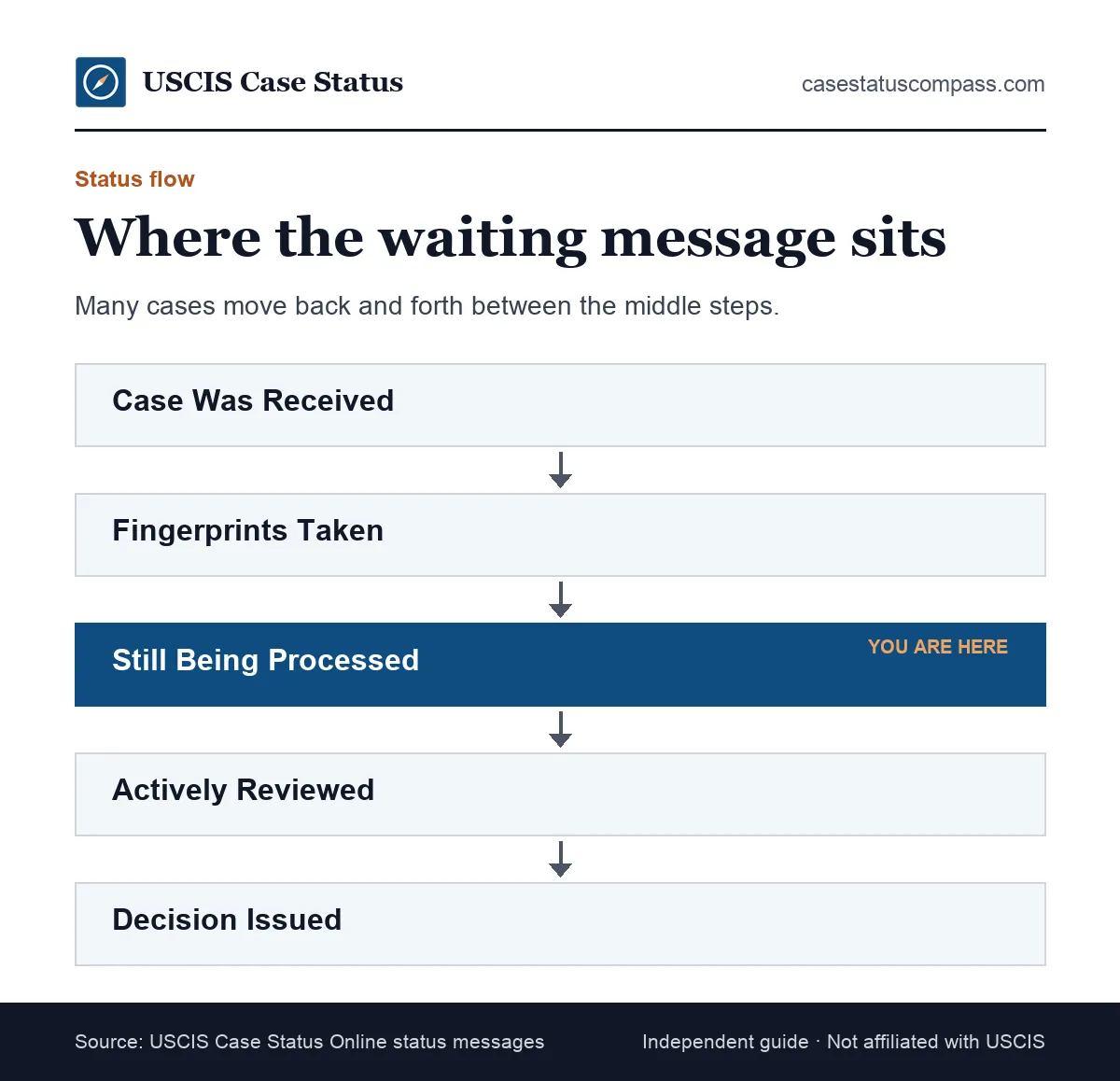
The waiting message usually appears after "Case Was Received" and before a decision. Typical steps sit on either side of it, with no fixed time between them, because timing depends on the form and the office handling the file.
Find your last milestone in the table.
Common steps on either side
The table places the waiting message between the milestone you last passed and the update that most often follows it.
| Before this status | This status | Common next status |
|---|---|---|
| Case Was Received | Still Being Processed | Fingerprints Were Taken |
| Fingerprints Were Taken | Still Being Processed | Interview Was Scheduled |
| Interview completed | Still Being Processed | Case Was Approved |
| Response to RFE received | Still Being Processed | Actively Reviewed or a decision |
| Case Was Transferred | Still Being Processed | Actively Reviewed |
Read it from your last milestone forward: the waiting message is a pause between steps, and the step after it depends on what came before.
Statuses that usually come before it
The most common earlier message is Case Was Received, then a biometrics update for forms that need fingerprints. A file that moved between offices may show a transfer first.
Statuses that usually come after it
The next visible step is often an interview notice, a request for evidence, an actively reviewed message or a decision. For card cases, approval may be followed soon by "new card is being produced."
Why Does Your Case Stay in This Status for Months?
Most long stays come from queue order, office workload and checks that run in the background. USCIS generally handles cases in the order received within each form type and office, so a case can sit unchanged while it waits its turn.
Queue order and office workload
Each field office and service center has its own backlog. Two people who filed the same form on the same day can wait very different lengths of time because their files went to different offices.
Do Background Checks Keep a Case in Processing?
They can. USCIS runs name checks, fingerprint checks and other screening on many applications. These background checks run through outside agencies and do not update your online status, so a slow check can hold a case long after biometrics.
Can a Visa Number Delay a Case Still Being Processed?
Yes, for some green card cases. Family and employment cases in limited categories cannot be approved until an immigrant visa number is available for the category and country, even when the file is complete. The State Department visa bulletin shows whether your date is current.
Why Did Your Status Change Back to "Still Being Processed"?
A step backward on screen is rarely a step backward in your case. USCIS systems often reset the headline to the waiting message after a milestone, such as an interview, an RFE response or a transfer.
Your place in line is not lost, and the earlier step still counts.
After an interview
Many applicants see the status return to the waiting message soon after the interview. That often means the officer is finishing notes, waiting on a supervisor's sign-off or running a final check.
After an RFE response
When USCIS receives your answer to a request for evidence (RFE), the status often shows the response was received, then returns to the waiting message. The officer must review the new evidence, and that review rejoins the queue.
How Long Can a Case Stay in Processing?
There is no single answer. A case can stay in this status for days or many months, depending on the form, category and office. USCIS publishes current figures at egov.uscis.gov/processing-times. Use that official tool, not forum posts, to judge your own wait.
What Does the USCIS Processing Times Tool Measure?
USCIS says the posted figure shows how long it took to complete 80% of decided cases over the past six months: a look back, not a promise. Our USCIS processing times guide explains each field on the tool.
In USCIS's words: The USCIS tool shows how long it took to finish 80% of cases in the past 6 months.
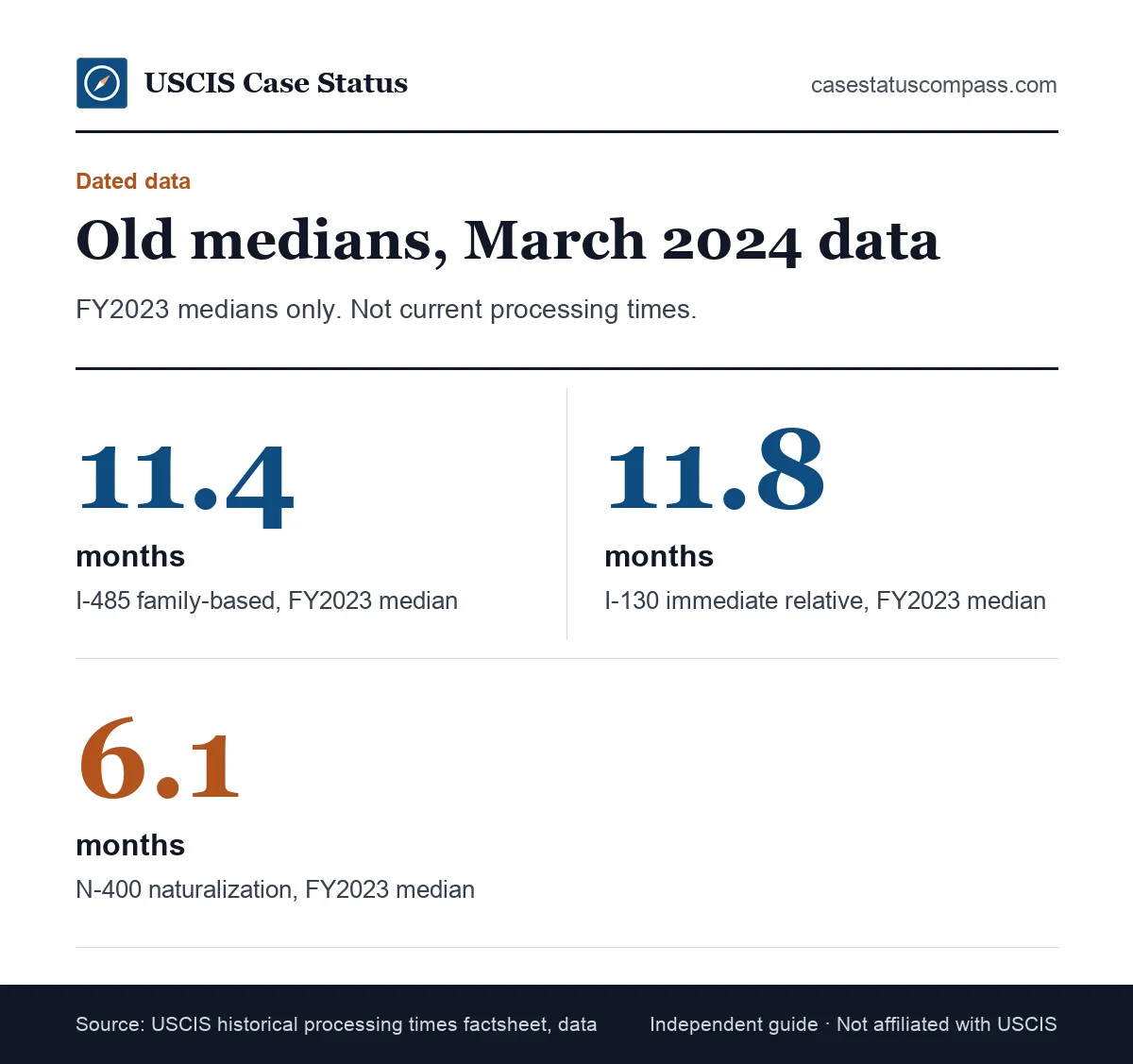
Older historical medians, labelled by date
For context only, a USCIS factsheet with data as of March 5, 2024 listed the older medians shown below. They are not today's times, and your office may be faster or slower.
How Do You Tell Normal Waiting From an Overdue Case?
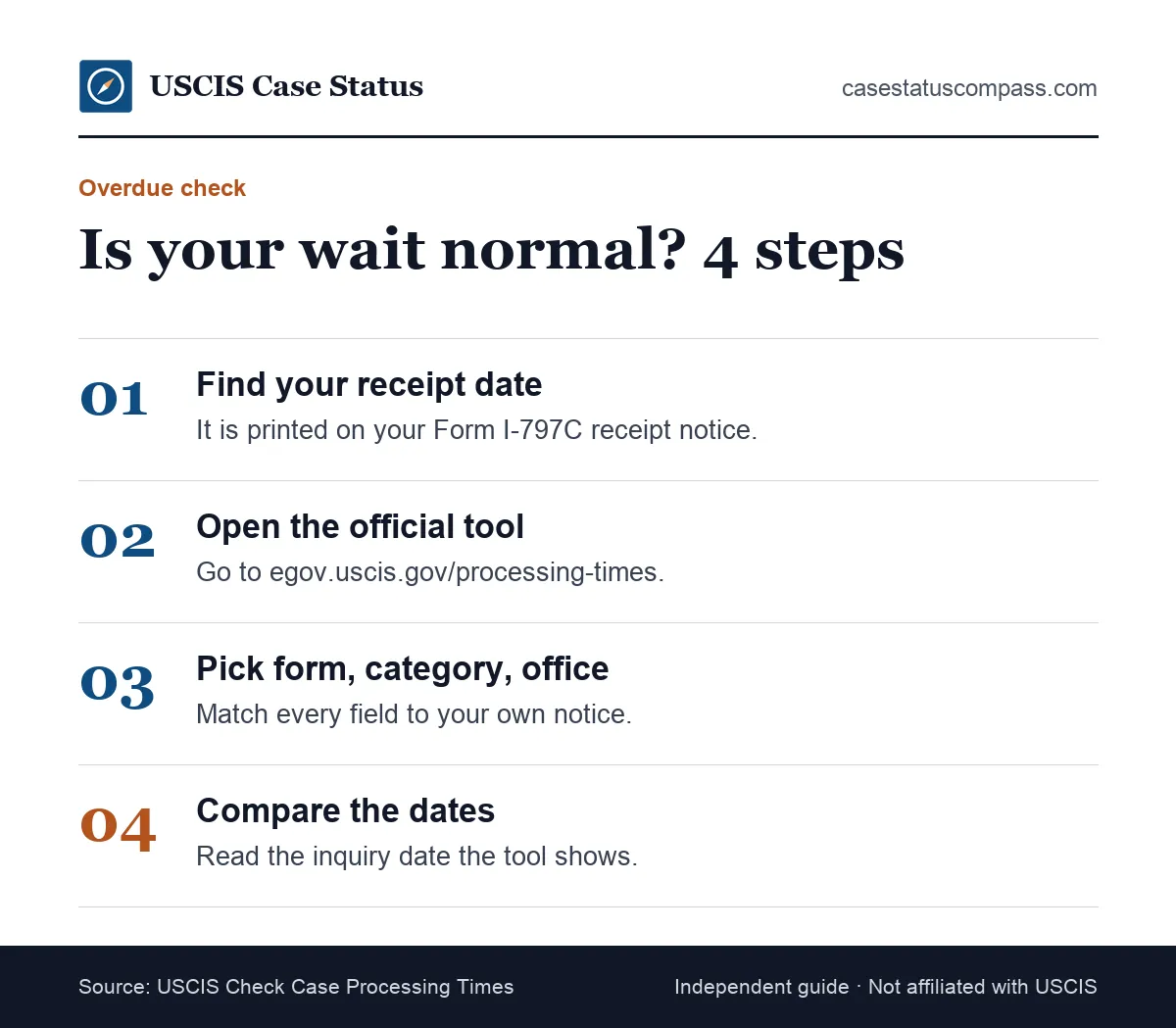
Compare your receipt date with the inquiry date on the official tool. If your receipt date is earlier, your case may be outside normal processing time and you can usually submit an inquiry. If it is later, waiting is still normal.
Step-by-step check using your receipt date
- Find the receipt date on your Form I-797C, not the last status date.
- Open the official processing times tool.
- Choose your form, category and office.
- Note the "receipt date for a case inquiry" the tool shows.
- If your receipt date is earlier, contact USCIS. If it is later, wait.
Reading the inquiry date on the tool
The inquiry date marks when a delay question becomes reasonable. It moves with the backlog, so check it monthly. We could not confirm current dates, because the tool blocks automated reading; check it yourself in a browser.
Still Being Processed vs Actively Reviewed: The Short Version
The two messages are close, and USCIS publishes no formal definition for either. In practice, "still being processed" reads as waiting in a queue, while "actively reviewed" suggests an officer has the file open. Neither guarantees an outcome.
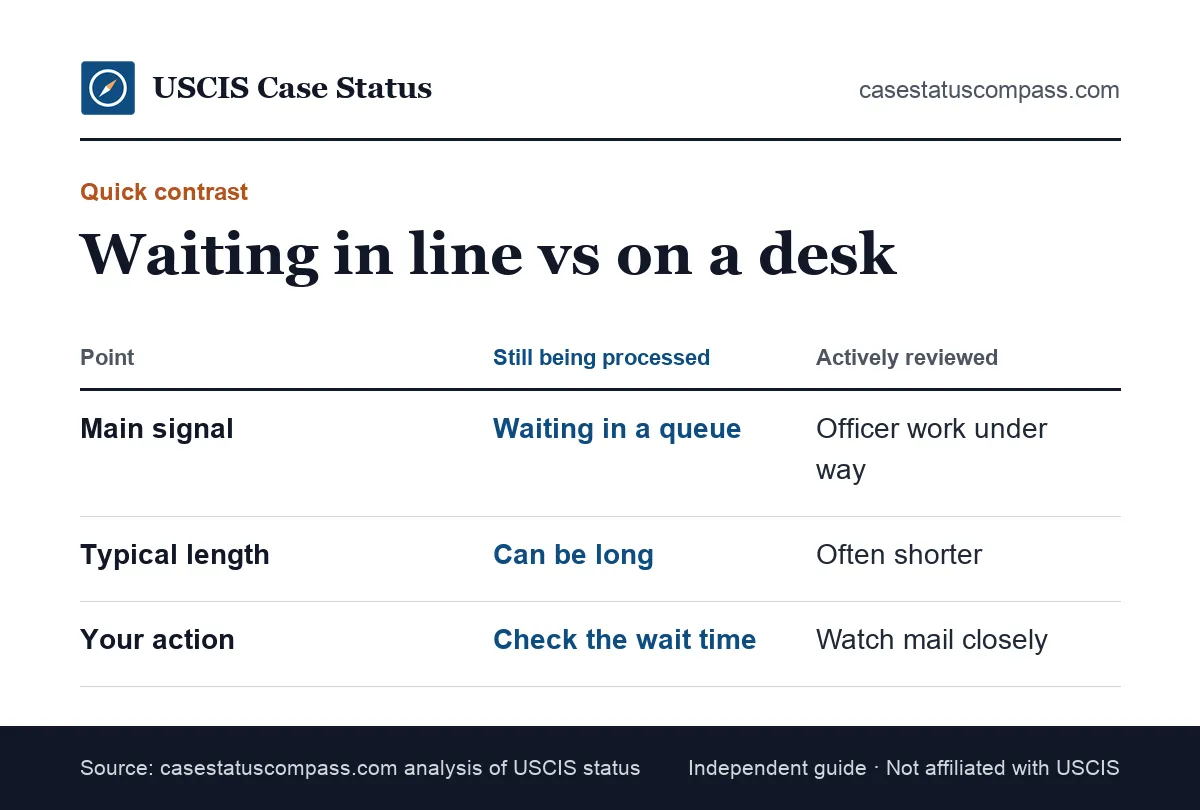
Both are normal for an open case.
Quick comparison
| Question | Still being processed | Actively reviewed |
|---|---|---|
| Is the case open? | Yes | Yes |
| Suggests officer attention now? | Not necessarily | Often |
| Common after a milestone? | Yes, as a reset | Yes, before a decision |
If your screen shows the other message, read what it means when a case is being actively reviewed by USCIS.
What It Means for Form I-485
For a green card applicant using Form I-485 adjustment of status, the message means the adjustment case is pending with no decision. The current I-485 edition is 09/18/26 (01/20/25 and 09/04/26 editions rejected on/after Sept. 18, 2026; no grace period), which matters only if you file again.
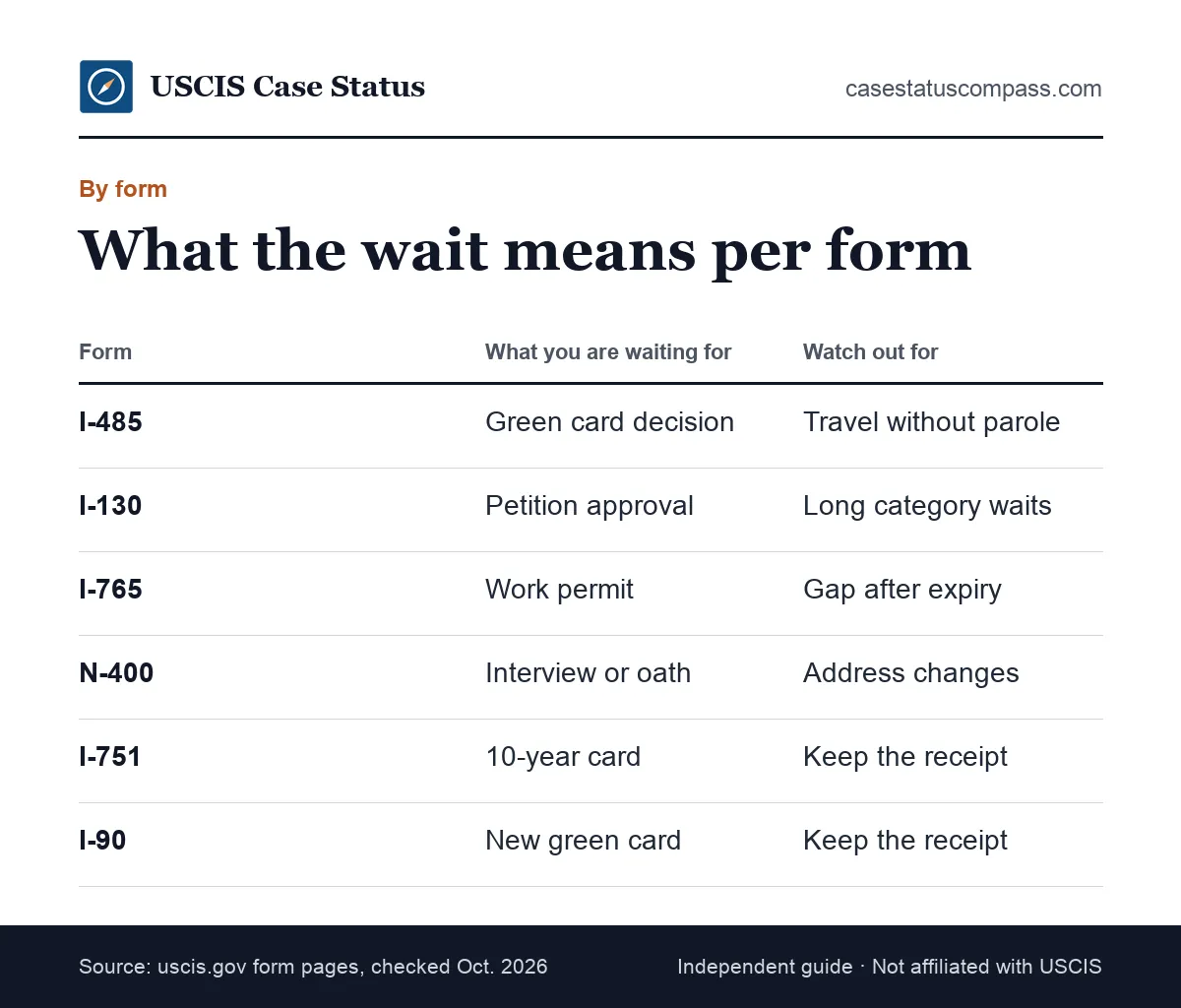
Pending adjustment and related documents
Many applicants also have separate work permit and advance parole cases, each with its own receipt number and status. One can move while another waits, so check every receipt number separately.
When the I-485 waits on something else
An I-485 can wait for the underlying I-130 or I-140 petition, or for a visa number. In that situation the waiting message reflects a dependency, not a problem with your own forms.
What It Means for Form I-130
On a Form I-130 family petition, the message means the petition is still under consideration. For preference relatives, approval alone may not end the wait, because a visa number may be needed. Immediate relatives of U.S. citizens face no annual limit.
Petitions that wait longer than others
Petitions for siblings, married children and other preference relatives often wait longer, because there is less urgency to decide them before a visa is available. Spousal petitions filed with an I-485 may move with it.
What follows an I-130 approval
If the relative lives abroad, the approved petition usually goes to the National Visa Center (NVC) for consular processing. If the relative is in the United States and eligible, adjustment of status may follow.
What It Means for Form I-765 Work Permits
For a work permit application on Form I-765, a long wait can create a gap in your right to work. That risk grew after a rule change, because a pending renewal no longer protects most workers automatically.
Check your card's end date today.
Renewal filers after October 30, 2025
As of October 2026, USCIS says: Ended: renewals filed on or after Oct. 30, 2025 no longer get the up-to-540-day automatic extension (exceptions: TPS by law/Federal Register notice; STEM OPT 180 days). Extensions granted before that date are not affected. If your old card expires while the renewal still waits, you may have to stop working.
Planning around a gap in work authorization
File renewals as early as USCIS allows, tell your employer in writing when your card expires, and keep your receipt notice. If losing work would cause serious harm, an expedite request may fit.
What It Means for Form N-400
For a naturalization application on Form N-400, the waiting message can appear before your interview, after it, or while you wait for an oath ceremony slot. The meaning depends on which milestone you last passed, so check your notices.
Read your most recent notice first.
Before the interview
Before an interview, the message usually means your file is queued at the local field office after biometrics. Use the time to review your N-400 answers, gather travel dates and report changes, such as a new address.
What Does the Status Mean After the N-400 Interview?
If the officer said you passed, the message often means USCIS is preparing the decision or an oath scheduling letter. If you got a form saying no decision could be made yet, the case may need more evidence or review first.
What It Means for Form I-751 and Form I-90
For removing conditions on residence and a green card renewal or replacement, a long wait is less risky because the receipt notice works as temporary proof with your card. Keep the original safe.
Check the dates printed on the notice before each trip or job start.
I-751: your receipt notice as proof
As of October 2026, USCIS says: I-751 receipt notice extends conditional status and work authorization for 48 months. Carry the receipt with your expired conditional card when you travel or start a job. If the extension runs out first, ask USCIS about an I-551 stamp.
I-90: expired card plus receipt
For Form I-90, USCIS says: I-90 receipt notice + expired card = proof of status for 36 months from the card's expiration date. Employers and border officers may still ask questions, so carry both documents together.
What It Means for Employment Petitions
For employer filings such as the immigrant worker petition (Form I-140) or a Form I-129 petition, the message has the same neutral meaning. The employer's attorney usually receives the notices, so the worker may see a status first.
Ask the attorney for each new notice.
Premium processing changes the clock
Some employment petitions can be upgraded with premium processing, which sets a guaranteed response time for a fee. A premium case still waiting after that clock has passed is worth raising with the attorney promptly.
Tracking the petition as the worker
Ask the employer or its attorney for a copy of the Form I-797C receipt so you can check the I-140 or I-129 yourself. Tell them about any change, since they handle every reply.
What Should You Do While Your Case Is Still Being Processed by USCIS?
Mostly, wait and stay reachable. Keep your address current, watch your mail and your online account, and prepare for the likely next step. There is no form to file just because this status appears.
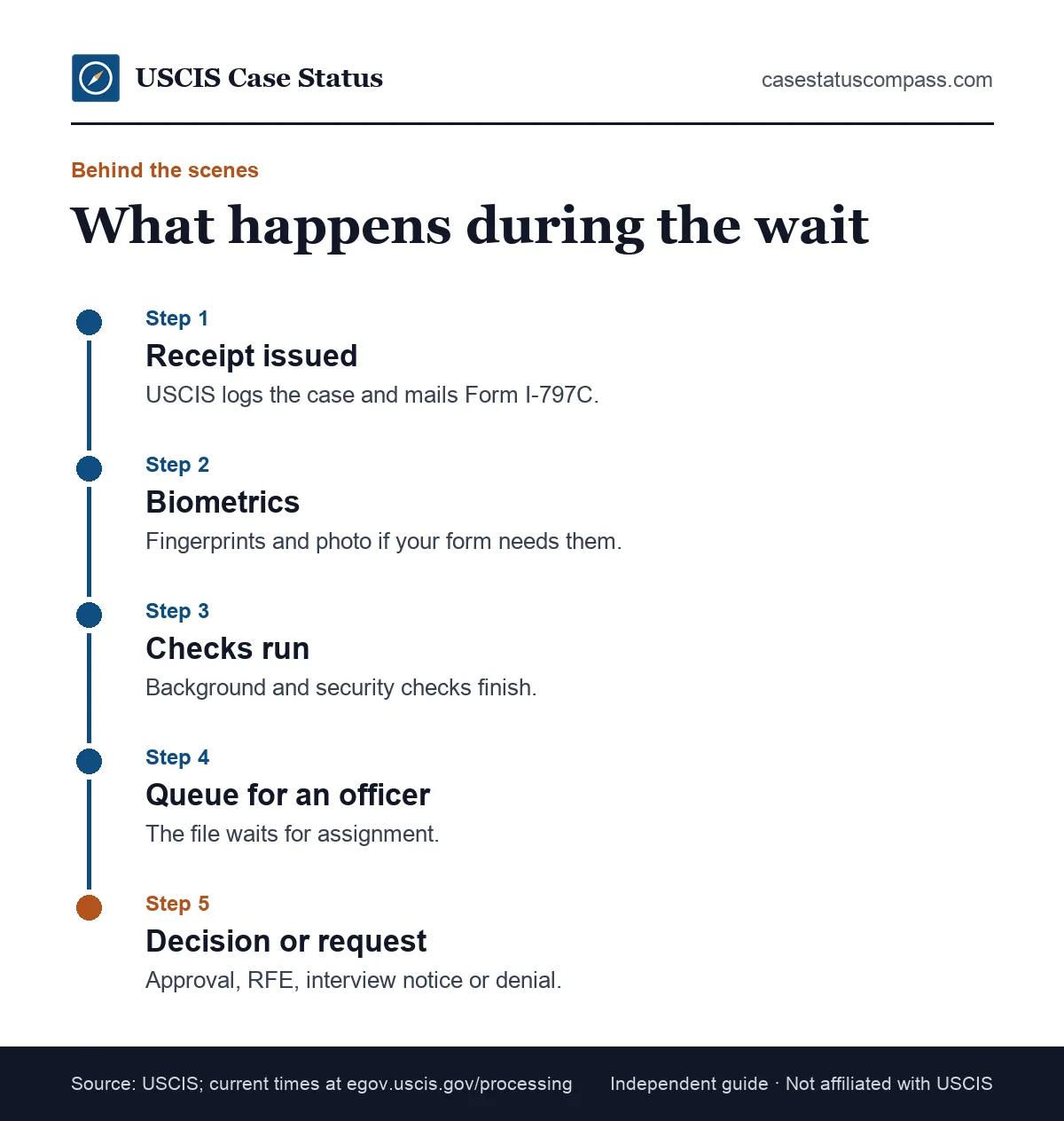
A short weekly check and a tidy file are enough to stay ready.
Keep your address current
USCIS mails interview notices, RFEs and cards to the address on file. If you move, change your address with USCIS right away; a missed notice can turn a quiet wait into a denial.
Watch for mail as well as the online status
Paper notices sometimes arrive before the online status changes, and some letters never appear online. Open every USCIS envelope promptly, note the date, and match the receipt number with your records.
Prepare for the likely next step
Use the quiet time to get ready for an interview or an RFE: gather originals, keep evidence such as tax returns current, and note life changes, like a new job, you may need to report.
What Should You Avoid Doing During a Long Wait?
Avoid refiling the same form, sending unrequested evidence, travelling without the right document, or paying anyone who promises faster results. None of these move a queued case, and some can harm it.
If you feel you must do something, check the inquiry date instead; it tells you whether action is due.
Refiling the same form
A second filing can create a duplicate case, a second fee and confusion about which file is current. It does not move you up the queue, and the extra fee is usually not refunded.
Sending evidence nobody asked for
Unrequested documents may never reach the officer, or may land in the file without being read. Send evidence only when USCIS asks in an RFE or notice, or when your attorney advises it.
Paying third parties for "faster status"
No private service can see inside your file or push it forward. Apps only read the same public status you can check free at Case Status Online: egov.uscis.gov. Never share your online account password.
When to Act: Outside Normal Processing Time
Act when your receipt date is earlier than the inquiry date on the official tool, or when an urgent need makes waiting harmful. Those are two routes: a case inquiry for delay, and an expedite request for urgency.
USCIS sets the timing rule: You can submit an 'outside normal processing time' request only after your case inquiry date.
Submitting a case inquiry
A case inquiry asks USCIS to look at a case past normal processing time. Submit it online through the e-Request tools linked from uscis.gov, or by phone through the Contact Center.
Requesting an expedite
An expedite asks USCIS to move a case ahead because of a serious, documented reason. USCIS lists its criteria on uscis.gov and decides case by case. Our USCIS expedite request guide walks through the process.
How Do You Submit a Case Inquiry?
Start online. Use the e-Request link on uscis.gov, choose the option for a case outside normal processing time, and enter your receipt number and details exactly as filed. A Contact Center agent can also open a service request.
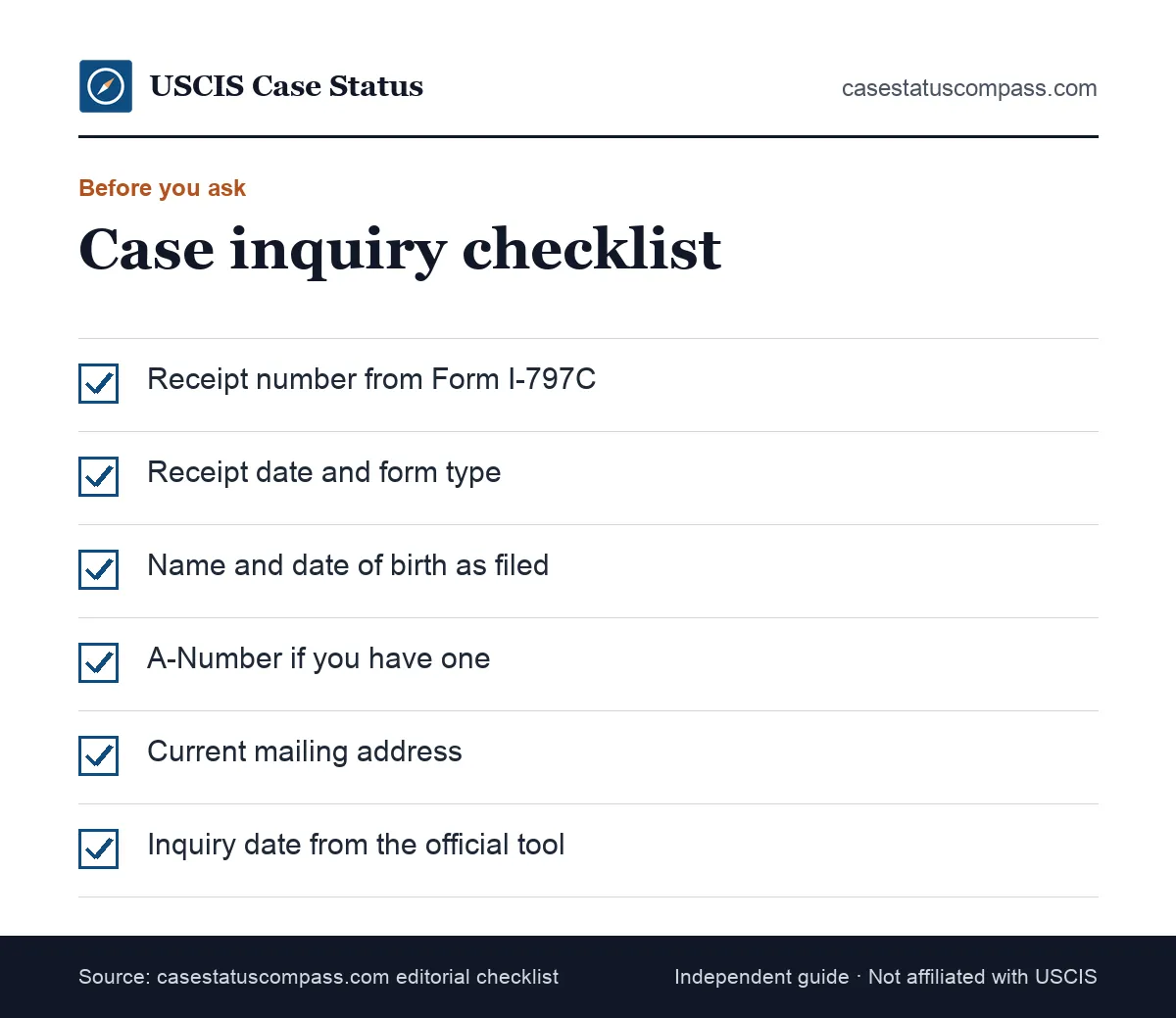
Save the confirmation it gives you.
Information to have ready
- Receipt number and receipt date
- Form type and category
- Full name and date of birth as filed
- Your A-Number, if you have one
- Current mailing address and email
Copy each item from your notice.
What happens after you submit
You should get a reference number. USCIS may reply by mail or email, sometimes only to say the case is pending. If nothing comes back in a reasonable time, call or escalate.
Can You Request an Expedite for a Case Still Being Processed?
Yes, but only for a strong reason; a long wait alone is not one. USCIS considers expedites for urgent, documented need and reviews each request on its own facts. A request without proof is unlikely to succeed.
As of October 2026, USCIS says: Ask for an expedite through the USCIS Contact Center or your online account.
What USCIS weighs
USCIS publishes its expedite criteria on uscis.gov. They focus on serious harm, urgent humanitarian needs and similar pressing reasons. We do not repeat the list because it can change; read the current version first.
Evidence to attach
Attach proof of the urgency: a doctor's letter, an employer letter about job loss, proof of a travel emergency, or similar records.
Dated, signed letters on letterhead carry more weight than a personal statement alone.
Escalation Options Compared
Different channels solve different problems. Use a case inquiry first for a plain delay, an expedite for urgency, and outside help only after USCIS has had a fair chance to respond to you.
Skipping steps usually slows things down, because each channel expects proof that you tried the one before it.
Channels side by side
The table lines up each escalation channel with the situation it fits and what you need before you use it.
| Channel | Use it when | What you need |
|---|---|---|
| Case inquiry (e-Request) | Past the tool's inquiry date | Receipt number and details |
| Expedite request | Urgent, documented need | Proof of urgency |
| Contact Center call | Questions or an appointment | Receipt number, ID details |
| Congressional office | Inquiries got no useful reply | Privacy release form |
| CIS Ombudsman | USCIS did not fix a problem | Prior inquiry history |
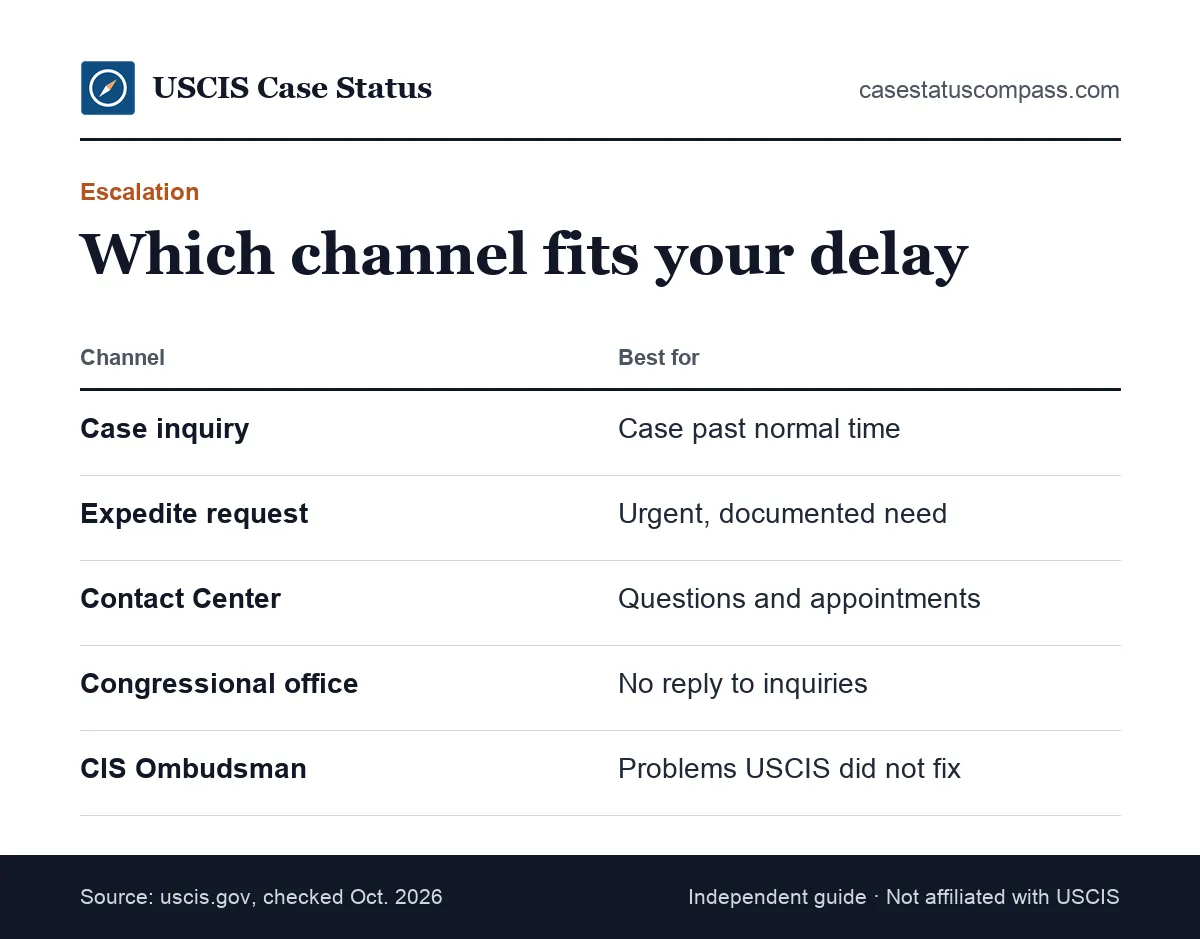
The rows run from the first channel to try down to the last, so most people stop at the case inquiry row.
Choosing the right channel
A delay alone fits an inquiry. A fixed deadline, such as a job start or a medical need, fits an expedite. A pattern of unanswered inquiries fits outside help, as our guide to CIS Ombudsman and congressional inquiries explains.
Order to try them
- Confirm your case is past the inquiry date.
- Submit a case inquiry and keep the reference.
- Call the Contact Center if there is no answer.
- Contact Congress or the Ombudsman after that.
Should You Call the USCIS Contact Center?
Call to open a service request, ask about a missing notice, or request an appointment. Calling about a case within normal time rarely helps. The Contact Center number is 800-375-5283 (TTY: 800-767-1833).
Automated phone line: 24 hours a day (live agents Mon-Fri 8am-8pm ET). Have your receipt number ready before you dial.
What first-line agents can see
First-line agents usually see the same status you see, plus basic record details. They can open a service request or pass a question to a higher tier, but cannot speed up a case.
Getting to a live agent
Live calls and chat: Monday to Friday, 8 a.m. to 8 p.m. Eastern. You can also start with Emma, USCIS's online virtual assistant (English and Spanish), on uscis.gov. Our guide on how to contact USCIS covers menu choices and what to say.
Can a Congressional Office or the Ombudsman Help?
Yes, after you try USCIS first. Your U.S. representative or senator can send a congressional inquiry for you. Caseworkers cannot force an approval, but a letter from a member of Congress usually gets a response from USCIS liaison staff.
Keep copies of your past inquiries.
Congressional caseworkers
Each member of Congress has caseworkers for federal agency problems. You sign a privacy release and share your receipt number and history; they contact USCIS liaison staff.
Find yours on house.gov or senate.gov.
Can the CIS Ombudsman Help With a Stuck Case?
Sometimes. The Office of the Citizenship and Immigration Services Ombudsman sits within the Department of Homeland Security but is separate from USCIS. It reviews cases stuck past normal time when you show you already tried to fix the problem.
As of October 2026, the rule is: Use the Ombudsman only after contacting USCIS within 90 days and waiting at least 60 days.
What to Do Now: A Decision Table
Use your situation, not the headline, to pick your next step. The table covers the most common situations behind a long waiting message, from a normal queue to an expiring work permit.
Most readers will land on the first row.
If this, do that
Find your situation in the left column; the right column gives the one step that fits it.
| If this is your situation | Do this |
|---|---|
| Within normal processing time | Wait; check weekly |
| Past the tool's inquiry date | Submit a case inquiry |
| Urgent need with proof | Request an expedite |
| Moved recently | Update your address now |
| Expected notice never came | Call the Contact Center |
| Several inquiries unanswered | Contact Congress or the Ombudsman |
| Work permit about to expire | Plan for a gap; consider an expedite |
Most rows call for patience or a single online step; only an expiring work permit or a real emergency calls for faster action.
Picking the right row
If two rows fit, handle the most urgent first. A recent move plus an overdue case: update your address, then send the inquiry so the reply reaches you. If an attorney filed your case, ask them first.
Four Waiting Stories, Four Different Next Steps
The same message can call for different steps. Names are invented, but the situations are common, and each ends with the practical step that fits.
Read the one that matches your form and last milestone. Notice that only two of the four people contacted USCIS at all; the others needed the right expectation, not an inquiry.
Scenario: a naturalization applicant after the interview
Rosa passed her N-400 interview, then saw the waiting message for weeks, well within normal time. She checked weekly and kept her address current. An oath notice arrived by mail before the status changed.
Scenario: a spouse petition for a husband abroad
Tomasz filed an I-130 for his husband abroad, and the status sat unchanged. When his receipt date passed the tool's inquiry date, he submitted a case inquiry and logged the reference number.
Scenario: a work permit renewal near expiration
Nadia renewed her EAD after October 30, 2025. With her card expiring and the case still waiting, she warned her employer, gathered a job-loss letter, and asked an attorney whether an expedite was worth sending.
Scenario: an adjustment case waiting on a visa number
Arjun had a complete I-485 in the waiting status. His attorney explained his category date was not current, so no officer could approve it yet. The right step was watching the visa bulletin, not an inquiry.
How to Verify the Status Is Real
Only trust status information from USCIS itself. Check your receipt number at Case Status Online: egov.uscis.gov or in your own account, and match every notice to it. Unofficial screenshots, texts or emails can be wrong or fake.
When in doubt, check it yourself.
Check the official site only
Type the address yourself rather than following links in messages. USCIS never charges to show your status and never asks for gift cards or wire transfers. A message that does either is a scam.
Matching notices to your receipt
Every Form I-797C notice for one case shows the same receipt number. USCIS describes it this way: I-797C = Notice of Action (receipt, rejection, transfer, appointment, re-open); not proof of status by itself. If numbers do not match, it is a different case.
What Records Should You Keep While You Wait?
Keep a full copy of what you filed, every USCIS notice, proof of mailing or online submission, and a dated log of checks and contacts. These records make an inquiry, expedite or attorney review fast.
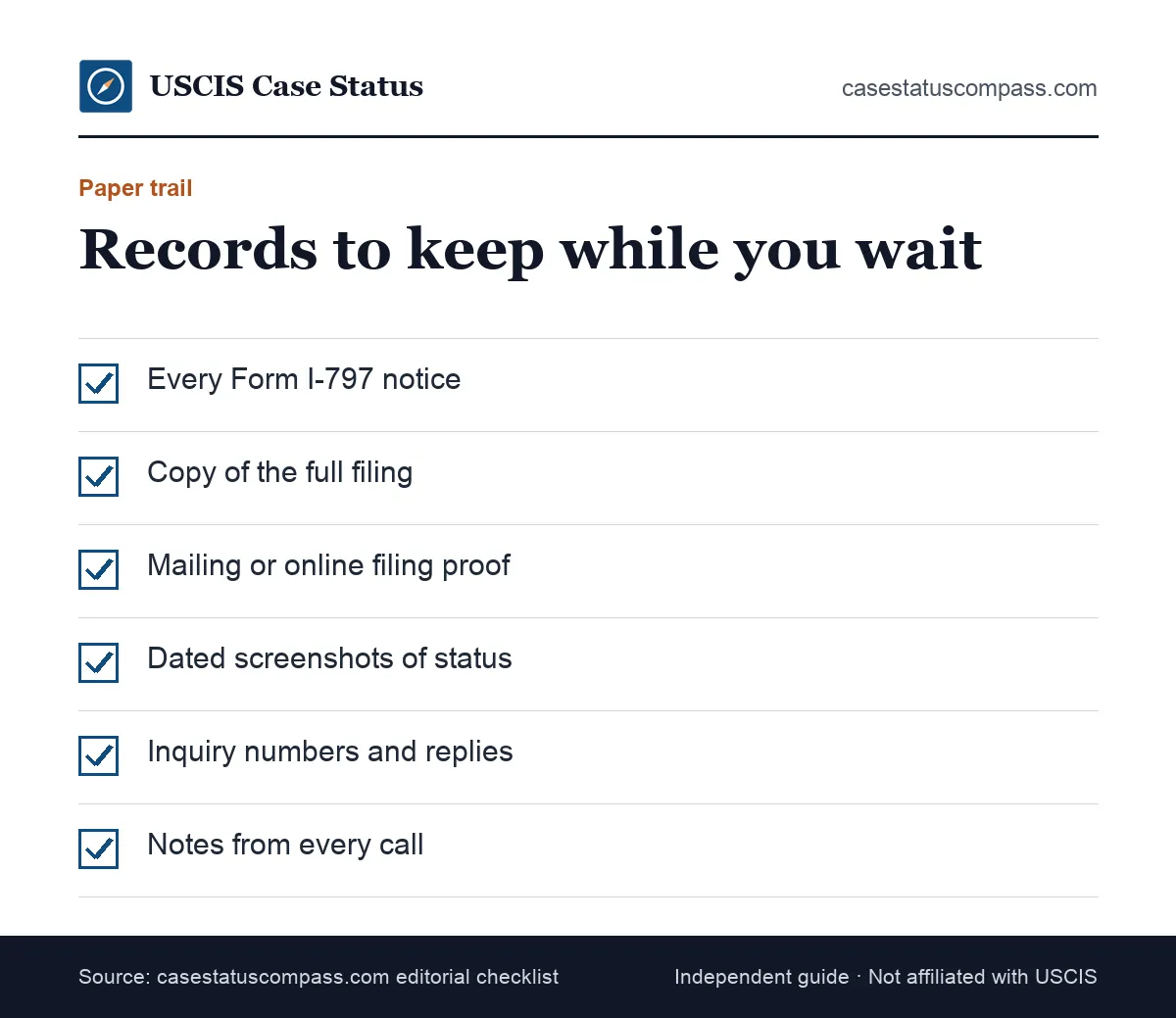
Store them in one folder by receipt number.
Documents to file away
- The full filing package as submitted
- Every Form I-797 notice, front and back
- Proof of delivery or online confirmation
- Copies of evidence sent later
- Any interview paperwork
Scan each one and keep the originals together.
A simple case log
Keep a one-page log with the date, the exact status wording and any action taken, plus inquiry numbers and agent names. It turns "it has been forever" into clear dates caseworkers can act on.
Does Your Online Account Show More Detail?
Often, yes. A free USCIS online account shows more history than the public tool. As of October 2026, USCIS describes it this way: Free USCIS online account: case status updates, notices, link paper-filed cases. Sign up at myaccount.uscis.gov/create-account.
Paper filers can link their cases.
Case history view
The account lists past updates in order, so you can see when the waiting message first appeared and what came before it. That case history places you on the timeline.
myProgress estimates
Some accounts also show an estimate tool. USCIS described it in 2023 as: myProgress: personalized estimates in your USCIS online account (I-130, I-485, I-765, I-131, I-821, N-400, I-90). Treat the estimate as a guide only; USCIS says it is not guaranteed.
When Nothing Changes for a Long Time
If your case is still being processed by USCIS with no change for months, that is common and usually normal. Weeks of real work can pass with no visible update, so compare the wait with the official time before you worry.
Distinguishing slow from stuck
A slow case is within the posted time; a stuck case is past it with no notices. Only the second needs action, starting with a case inquiry once your receipt date passes the inquiry date.
Technical glitches on the status page
An error message, a blank result or a status that will not load is a website problem, not a case problem. For those, see our guide to a USCIS case status not updating.
Can You Travel While Your Case Is Still Being Processed?
It depends on the form. Some pending cases require permission before leaving the United States, and leaving without the right document can end certain applications. Ask an attorney before any trip.
For a pending I-485, USCIS says: Traveling while your I-485 is pending abandons it unless you have advance parole (with H/L/V/K exceptions).
Pending I-485 and advance parole
If you have a pending I-485, leaving without an advance parole travel document can put the application at serious risk. Get the travel document approved first and confirm any conditions before you book.
Other pending cases
A pending N-400, I-751 or I-90 usually does not stop travel by itself, but long trips can affect naturalization eligibility, and you must attend any interview. Carry your receipt and card together.
Does This Status Mean an RFE or Denial Is Coming?
No. The waiting message does not hint at an RFE or a denial. Those outcomes arrive as their own status messages and paper notices. Many cases go straight from the waiting status to approval with no extra request.
If an RFE does come, the notice states the response deadline, so open every USCIS envelope the day it arrives.
How RFEs arrive
USCIS mails an RFE with a response deadline and usually updates the status. Read the whole notice and reply before the deadline; late or incomplete replies are a common cause of denials.
What a denial would look like
A denial shows as its own message with a written decision giving reasons and options. If that happens, our guide to options after a denial explains appeals, motions and refiling.
When Does a Long Wait Need a Lawyer?
Talk to an immigration attorney or a DOJ-accredited representative when your case is far past normal time, a deadline threatens your status or job, or your history includes arrests, prior denials or violations.
A single consultation can tell you whether an expedite or escalation is worth it.
Red flags worth a consultation
- Your work permit or status is about to expire.
- Several inquiries went unanswered.
- An interview form said more review is needed.
- You have a criminal record or past immigration problems.
Finding accredited help
Find licensed attorneys through your state bar or the American Immigration Lawyers Association, and accredited representatives through the Department of Justice list of recognized organizations. Avoid "notarios."
Check credentials before you pay.
Status Messages That Look Similar
Several USCIS messages sound alike but mean different things. Some show progress; others are holding messages like this one. Grouping them by what they signal makes your own status easier to place.
The table groups the most common ones, so you can place yours quickly.
Messages applicants confuse most
The table groups five look-alike messages by whether they show progress or simply a hold.
| Message | Group | What it signals |
|---|---|---|
| Case Is Being Actively Reviewed | Progress | An officer likely has the file |
| We Have Taken an Action on Your Case | Progress | Something happened; check your mail |
| Fingerprints Were Taken | Progress | Biometrics finished |
| Case Was Transferred | Holding | The file moved to another office |
| Case Is Still Being Processed | Holding | Waiting for the next step |
If your message is in the holding group, the next step is still ahead; a progress message usually means a notice is on the way.
Messages that signal progress
"We have taken an action on your case" often means a notice is in the mail. A biometrics update means a required step is done. The actively reviewed message suggests officer attention.
Messages that signal holding
A transfer means the file moved, which can reset your wait at a new office; see what it means when a case was transferred. The waiting message itself is the most common holding status.
A Weekly Routine for Checking Your Case
One check a week is enough for most cases. Look at the status, scan your mail, log any change, and recheck the official processing time about once a month. This catches real problems without daily stress.
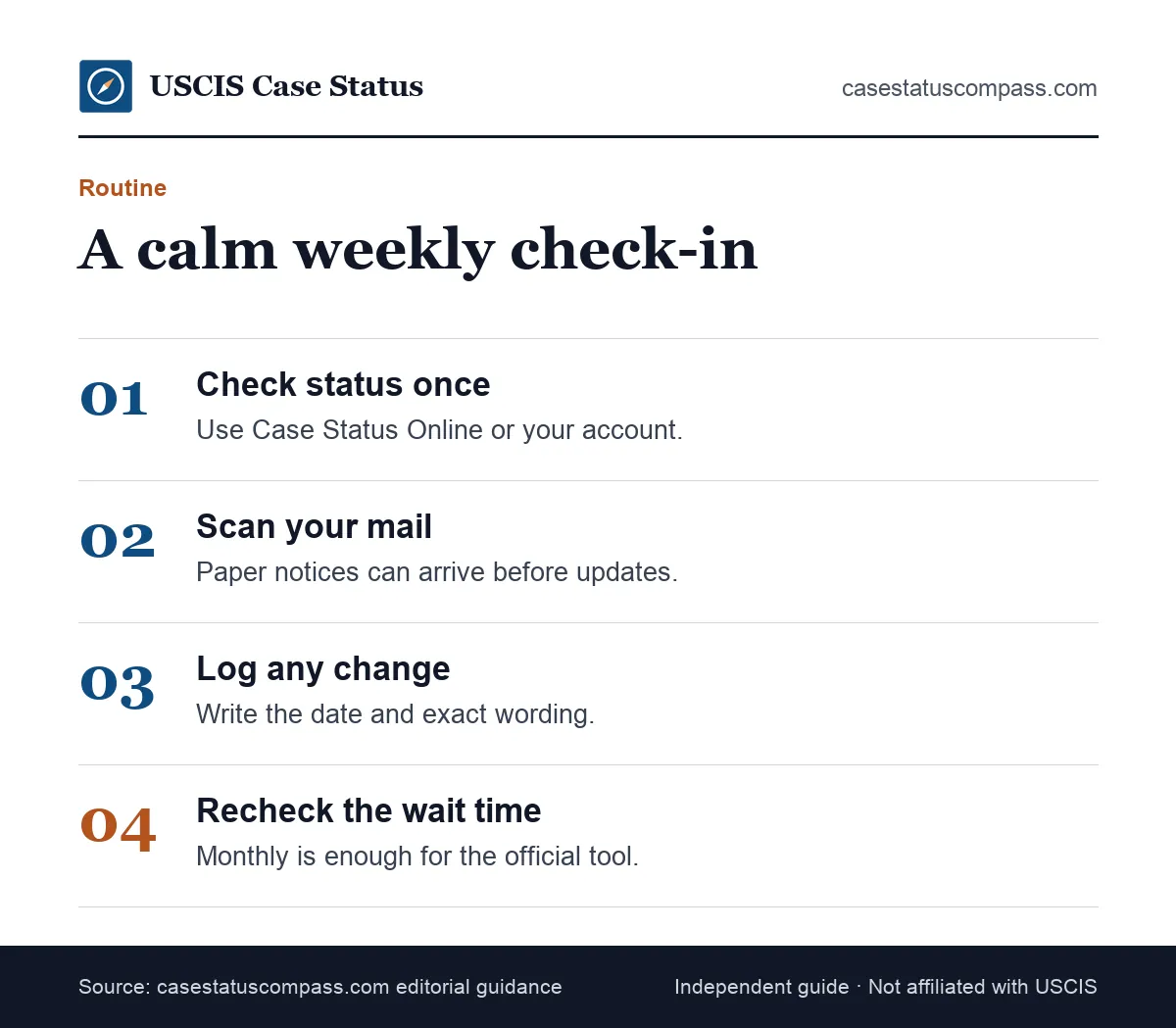
Pick one fixed day each week.
Steps for each check
- Check the status on the official tool or in your account.
- Look for new USCIS mail, including mail for family on the same case.
- Log the date and exact wording of any change.
- Monthly, compare your receipt date with the tool's inquiry date.
Key Takeaways
When a case is still being processed by USCIS, it is in the normal resting state for open cases, and the outcome is unknown. Your real guide is the official processing time for your form and office, plus the notices USCIS mails.
If you are the applicant waiting
Stay reachable, keep records, avoid travel or refiling mistakes, and act only when your case passes the inquiry date or a real emergency appears. Use all USCIS case status meanings to decode any new message.
For petitioners and sponsors
If you filed for a relative or worker, you control most official contacts: keep the receipt, check the official times, and send the inquiry when due.
Frequently Asked Questions
Is "case is still being processed" a good sign?
It is neutral. A case is still being processed by USCIS when the agency has accepted your filing and no decision or request for evidence has been issued. Judge your case by its wait against the official processing time, not by the message.
How long can a case stay in "still being processed"?
From a few days to many months, depending on the form, category, office and any pending checks or visa numbers. If your receipt date is earlier than the official tool's inquiry date, you can usually submit a case inquiry.
Does "still being processed" mean an officer is looking at my case?
Not necessarily. The message usually means your file is waiting in a queue or between milestones. Messages such as "actively reviewed" or an interview notice suggest more direct attention, but none predicts approval.
Why did my case go from "actively reviewed" back to "still being processed"?
It usually reflects a system reset after a step finished, such as a supervisory review, an interview, a transfer or new evidence arriving. It rarely means something went wrong.
Should I submit a case inquiry right away?
Only if your case is outside normal processing time, which you check by comparing your receipt date with the tool's inquiry date. An earlier inquiry usually gets a "within normal time" reply. Urgent situations call for an expedite request.
Can I check the status by phone?
Yes. The USCIS Contact Center gives automated case information and can connect you with an agent who can open a service request. Agents see roughly what you see online and cannot speed up a case.
Is "case is being processed" different from "still being processed"?
In practice they mean the same thing: the case is open with no decision. USCIS wording varies slightly across systems and forms, and neither variant signals a problem or a faster outcome.
Does "still being processed" mean my background checks are done?
No. The status does not show whether name or fingerprint checks have finished. Checks run through outside agencies, and their results show only indirectly, for example when an interview or decision follows.
Can a case inquiry slow down my case?
No. An inquiry does not send your file to the back of the line or count against you; it asks USCIS to look at a delay. Sent before the inquiry date, it will likely bring only a standard reply.
Is "still being processed" the same as pending?
Yes, in everyday terms. Pending means USCIS has not decided the case, and this message is one way the system shows that. Other pending messages, such as fingerprints taken, mark specific steps.
Sources
- USCIS: Checking Your Case Status Online. www.uscis.gov/tools/checking-your-case-status-online. Accessed Oct 27, 2026.
- USCIS Check Case Processing Times. egov.uscis.gov/processing-times/. Accessed Oct 27, 2026.
- USCIS: Benefits of a USCIS Online Account. www.uscis.gov/file-online/benefits-of-a-uscis-online-account. Accessed Oct 27, 2026.
- USCIS: Form I-797 Types and Functions. www.uscis.gov/forms/filing-guidance/form-i-797-types-and-functions. Accessed Oct 27, 2026.
- USCIS: Automatic EAD Extension. www.uscis.gov/working-in-the-united-states/information-for-employers-and-employees/automatic-employment-authorization-document-ead-extension. Accessed Oct 27, 2026.
- USCIS Contact Center. www.uscis.gov/contactcenter. Accessed Oct 27, 2026.
- USCIS Historical Processing Times Trends FY2016-2024 factsheet (data as of Mar. 5, 2024). www.uscis.gov/sites/default/files/document/fact-sheets/historical_pt_factsheet_fy16_to_fy24.pdf. Accessed Oct 27, 2026.
- USCIS alert: USCIS Expands myProgress to Form I-485 and Form I-821 (Nov. 2023). www.uscis.gov/newsroom/alerts/uscis-expands-myprogress-to-form-i-485-and-form-i-821. Accessed Oct 27, 2026.
- CIS Ombudsman tip sheet: Check Your USCIS Case Inquiry Date (Aug. 2024). dhs.gov/sites/default/files/2024-11/24_0823_cisomb_case-inquiry-date-tip-sheet.pdf. Accessed Oct 27, 2026.
- USCIS: Form I-485 page (updated 10/07/2026). www.uscis.gov/i-485. Accessed Oct 27, 2026.
- USCIS: Removing Conditions on Permanent Residence Based on Marriage (updated 12/12/2023). www.uscis.gov/green-card/after-we-grant-your-green-card/conditional-permanent-residence/removing-conditions-on-permanent-residence-based-on-marriage. Accessed Oct 27, 2026.
- USCIS: Replace Your Green Card (updated 09/12/2025). www.uscis.gov/green-card/after-we-grant-your-green-card/replace-your-green-card. Accessed Oct 27, 2026.
- USCIS: How to Make an Expedite Request (updated 09/08/2026). www.uscis.gov/forms/filing-guidance/how-to-make-an-expedite-request. Accessed Oct 27, 2026.
- DHS CIS Ombudsman: How to Submit a Case Assistance Request (updated 04/13/2026). www.dhs.gov/case-assistance. Accessed Oct 27, 2026.
- USCIS: Online Account and Technical Support. www.uscis.gov/tools/uscis-tools-and-resources/online-account-and-technical-support. Accessed Oct 27, 2026.
- Form I-485 Instructions, Edition 09/18/26. www.uscis.gov/sites/default/files/document/forms/i-485instr.pdf. Accessed Oct 27, 2026.
casestatuscompass.com is an independent publication and is not affiliated with USCIS or any government agency. This page is general information, not legal advice. For denials, court or asylum matters, consult an immigration attorney or a DOJ-accredited representative.