Contents · 44 sections
- What Does "Case Was Transferred" Mean?
- "Case Was Transferred and a New Office Has Jurisdiction": The Full Wording
- Is a Case Transfer a Good Sign?
- Why Does USCIS Transfer Cases?
- Workload Balancing Between Offices
- Transfers for Interviews at a Local Field Office
- Can a Transferred Case Be Approved Without an Interview?
- Transfers After You Move to a New Address
- Transfer to a Field Office vs Another Service Center
- What Is the National Benefits Center's Role?
- Does a Transfer Delay Your Case?
- How Long After a Transfer Will Your Case Move?
- How Do You Find Which Office Has Your Case?
- Reading the Transfer Notice (Form I-797C)
- Does Your Receipt Number Change After a Transfer?
- Why Does Your Receipt Prefix Not Match the New Office?
- Case Was Transferred on a Form I-485
- Case Was Transferred on a Form N-400
- Case Was Transferred on a Form I-751
- Case Was Transferred on a Form I-130 or I-129F
- Is a Transfer the Same as Moving to the NVC?
- Case Was Transferred on an Employment Petition
- How Does a Transfer Affect Premium Processing?
- Case Was Transferred on Form I-765, I-131 or I-90
- Status Flow Around a Transfer
- What Should You Do After a Transfer?
- Decision Table: Transfer Situations and Next Steps
- What If Your Case Was Transferred to the Wrong Office?
- Where Do You Send Documents After a Transfer?
- Pending RFE During a Transfer
- Interview Notices After a Transfer
- What If Your Case Is Transferred More Than Once?
- Transfer Back After an Interview
- Can You Request a Transfer to Another Office?
- Should You Move to Get a Faster USCIS Office?
- Processing Times at the New Office
- When Should You Contact USCIS About a Transfer?
- Escalation Options After a Long Transfer Wait
- Transfer vs Other Status Messages
- Mistakes to Avoid After a Case Transfer
- Documents to Keep After a Transfer
- When Does a Transfer Need Legal Help?
- Transfer Scenarios From Three Different Cases
- Frequently Asked Questions
The short answer
"Case was transferred" means USCIS moved your file to a different office, and that office now handles your case. It is a routine step, often to balance workloads or to send your case to a local field office for an interview. Your receipt number stays the same, and you usually do not need to do anything.
At a glance
| Is it a decision? | No. Only the office changes. |
| Does the receipt number change? | No. |
| Do you need to act? | Usually not. Save the notice. |
| Does it add time? | Sometimes, depending on the new office. |
| Who runs this site? | An independent guide, not USCIS. |
What Does "Case Was Transferred" Mean?
The status case was transferred means USCIS moved your application or petition from one office to another. The receiving office now has jurisdiction, so it will review, schedule and decide your case. The filing itself does not change. Our uscis case status meanings hub explains the other status titles.
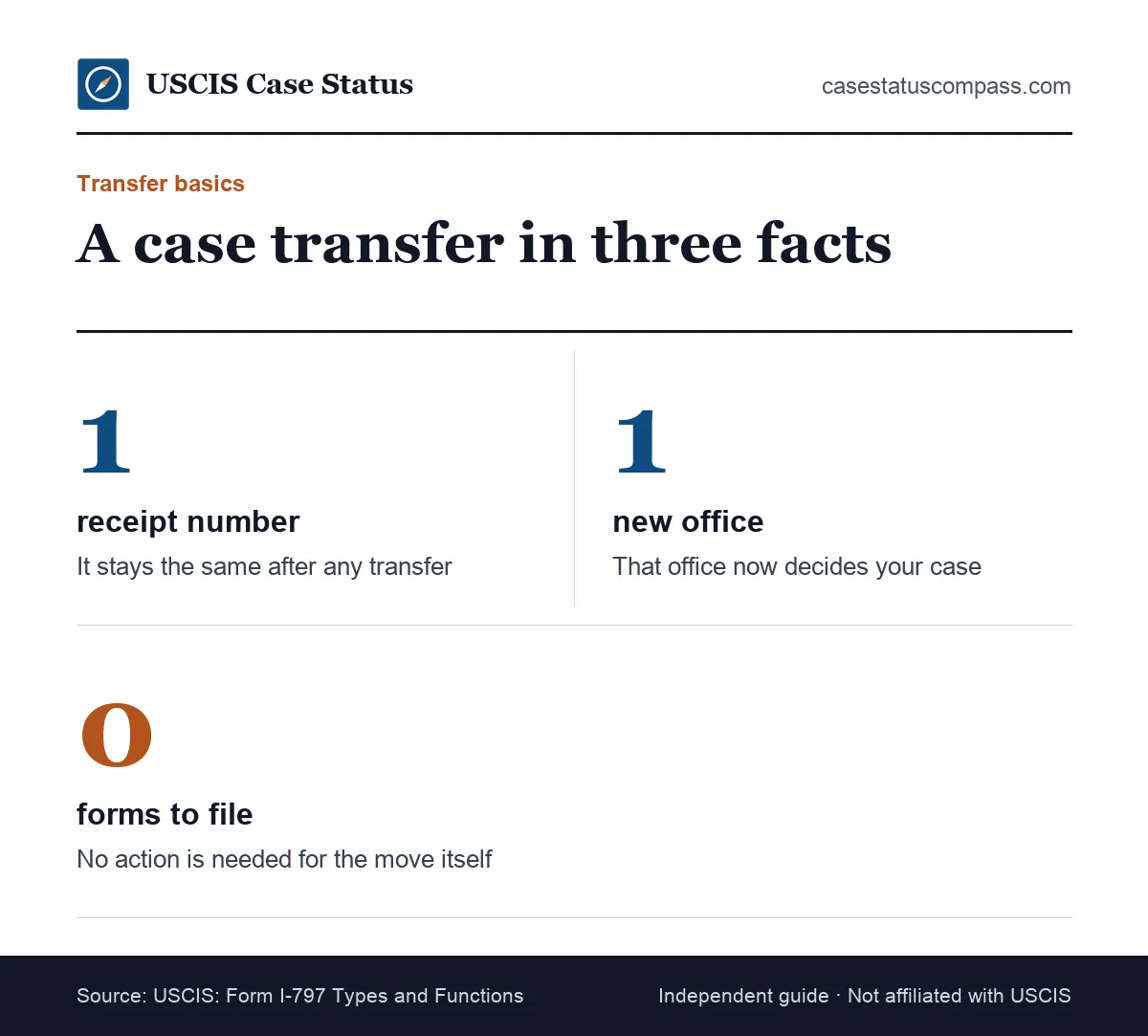
What changes and what stays
The table splits what a transfer touches from what it leaves alone, so you can see quickly that your filing itself is safe.
| Changes | Stays the same |
|---|---|
| The office that holds your file | Your receipt number and prefix |
| Where interviews may happen | Your filing date and priority date |
| The processing time that applies | Your evidence and fee payment |
| The address on future notices | The rules for your form |
In short, only the office and its posted time change; every date, number and document that defines your case carries over unchanged.
"Case Was Transferred and a New Office Has Jurisdiction": The Full Wording
The full status title is usually "Case Was Transferred And A New Office Has Jurisdiction." The body text gives the date and the form and says a notice explaining the move was mailed. Some applicants also see "Case Transferred To Another Office."
What "jurisdiction" means here
Jurisdiction here means authority to act. The new office can issue requests for evidence, schedule interviews and approve or deny, while the old office stops work. It is an administrative handoff, not a court action.
Is a Case Transfer a Good Sign?
A case transfer is neither good nor bad by itself. It is a routine workflow step and does not mean your case was denied or flagged. Often it means the case is moving toward an interview or a decision.
The destination office is the best clue.
When a transfer is a positive signal
A move from the National Benefits Center to a local field office often means pre-processing is done and the case is ready for interview scheduling. A move to a less busy center can also speed things up.
When a transfer may add a wait
A transfer to a busy office can add weeks or months, and a move after a change of address may restart the local queue. Neither signals a problem with your eligibility.
Why Does USCIS Transfer Cases?
USCIS transfers cases mainly to balance workloads between offices, to send cases to a field office for interviews, to follow an applicant's move, or to route a file to a specialized unit. You usually cannot choose or block it.
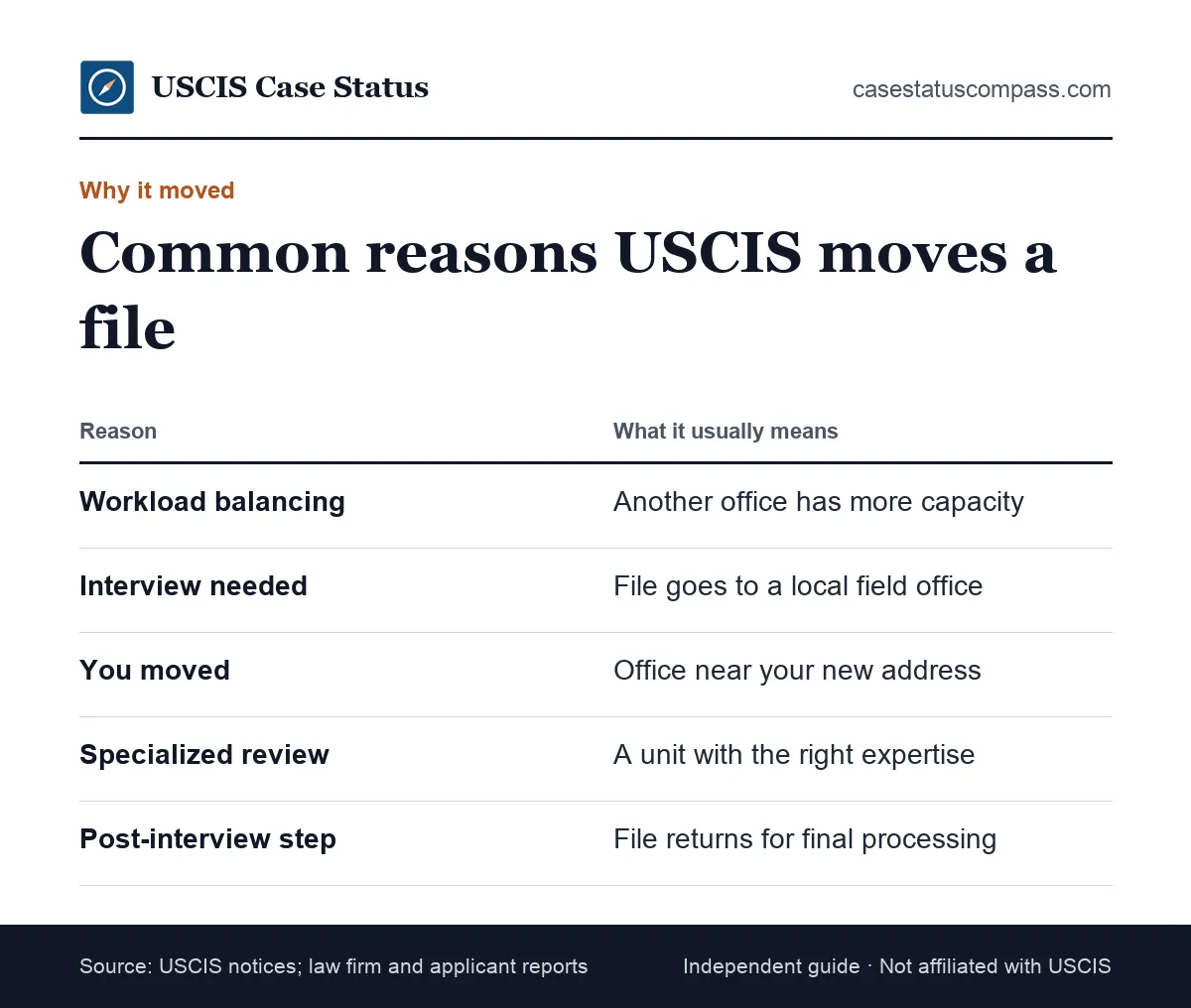
The four main reasons
- Workload balancing: one office has a backlog, another has capacity.
- Interview needs: the case goes to a field office near you.
- Address change: the case follows you to a new area.
- Specialized review: fraud, security or special program units.
Why USCIS rarely tells you which reason
The status and notice usually say only that the file moved. Use the destination as a clue: a field office suggests an interview, while another service center suggests workload sharing.
Workload Balancing Between Offices
Workload transfers move batches of cases from busy offices to offices with spare capacity. They are the most common reason for a center-to-center move and often affect many applicants at once, which is why forums fill with transfer posts on the same days.
Signs your transfer was a workload move
- The new office is another service center.
- Others with similar filings report transfers that week.
- No interview notice follows.
- Your form is usually decided on paper, like Form I-765 or I-140.
What it means for timing
A workload move aims to speed up processing overall, but for you it depends on how the new office handles the batch. Check the posted time for the new office, not the old one.
Transfers for Interviews at a Local Field Office
Cases that need an in-person interview, such as Form N-400 and many Form I-485 filings, are often transferred to the field office that serves your address so it can schedule and hold the interview. An interview notice usually follows.
What the field office does
A field office interviews applicants, reviews documents in person, decides many green card and citizenship cases and may hold oath ceremonies. Our green card interview guide explains what to bring if your I-485 heads there.
Can a Transferred Case Be Approved Without an Interview?
Yes. Some cases move to a field office and are approved without an interview, while others are interviewed. The transfer alone does not tell you which, so prepare your documents early and be ready for either outcome.
As of October 2026, USCIS says: USCIS can waive the green card interview case by case.
How a waived case shows online
If no interview is needed, the next update may jump straight from the transfer to an approval or card production status, with no interview notice in between.
Keep your documents ready either way.
Transfers After You Move to a New Address
If you move while your case is pending, USCIS may transfer your case to the office that serves your new address, which is common for interview-based forms. It can add time, because the file joins a new queue, but keeps your interview close to home.
Update your address first
Report your move through the official USCIS change of address process, or notices may go to the old address and you could miss an appointment. Our uscis change of address guide walks through each step.
Moving across state lines
An interstate move is the most likely to trigger a transfer, since the new address falls under a different field office. If you plan to move soon, ask an attorney whether to time it around your interview.
Transfer to a Field Office vs Another Service Center
A transfer to a field office usually means an interview or local review is next. A transfer to another service center usually means paper review continues somewhere less busy. The destination shapes your next notice and processing time.
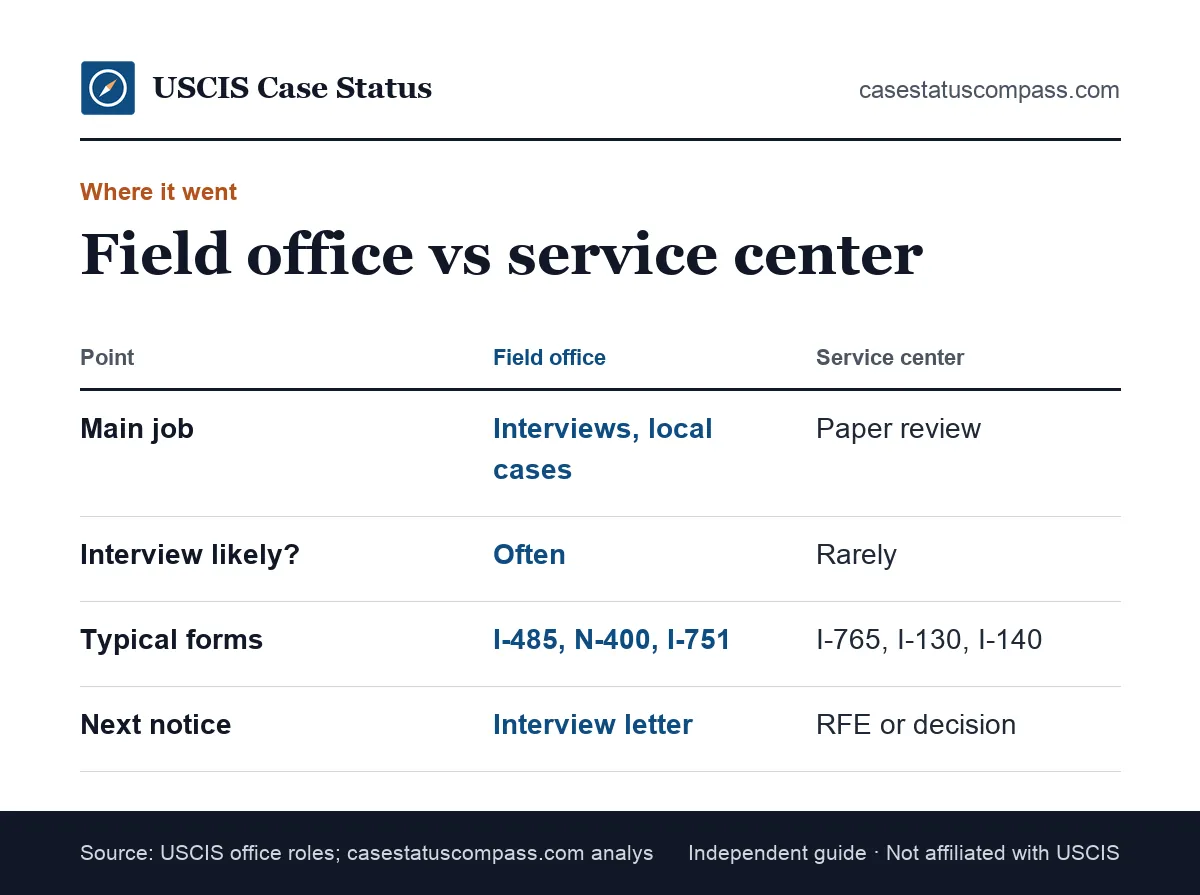
Check the notice to see which kind you got.
Field office transfers
Field offices handle in-person work, commonly Form I-485, Form N-400 and some Form I-751 cases. Expect an interview notice, a document request at the interview, or sometimes a decision without one.
Service center transfers
Service centers handle paper review at scale, commonly Form I-765, Form I-130, Form I-140 and Form I-129. Expect a decision or an RFE rather than an interview. Our overview of uscis service centers explains what each center does.
What Is the National Benefits Center's Role?
The National Benefits Center (NBC) does early processing for many cases that later need interviews, such as Form I-485 and Form N-400. It checks the file, then transfers it to a local field office, one of the most common transfers.
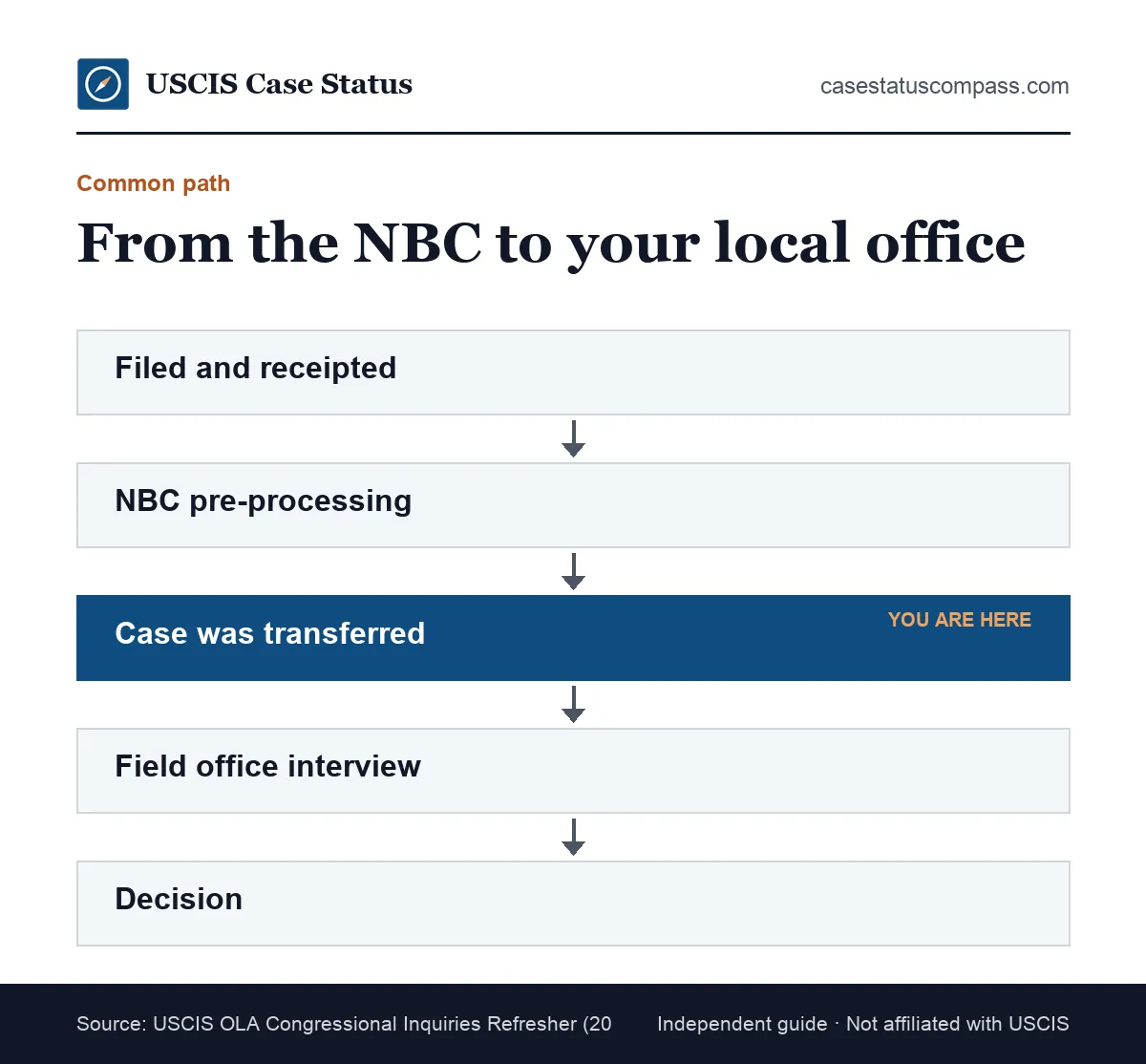
NBC and MSC receipt prefixes
Receipt prefixes show where USCIS first received a case, according to a 2021 USCIS guide: EAC = Vermont SC; WAC = California SC; LIN = Nebraska SC; SRC = Texas SC; NBC/MSC = National Benefits Center; YSC = Potomac SC; MCT = I-539 filings; IOE = online/electronic filing. An NBC or MSC prefix on an interview-based form often means a later field office transfer. The prefix itself never changes after the move.
What the NBC sends along
The NBC passes the file, including biometrics results and evidence, to the field office, which sets up interviews on its own calendar. Our page on the uscis receipt number explains each prefix in more detail.
Does a Transfer Delay Your Case?
A transfer can delay your case, but often it does not, or it speeds things up. The effect depends on the new office's workload and the reason for the move. USCIS publishes no standard transfer delay, so check the new office's processing time.
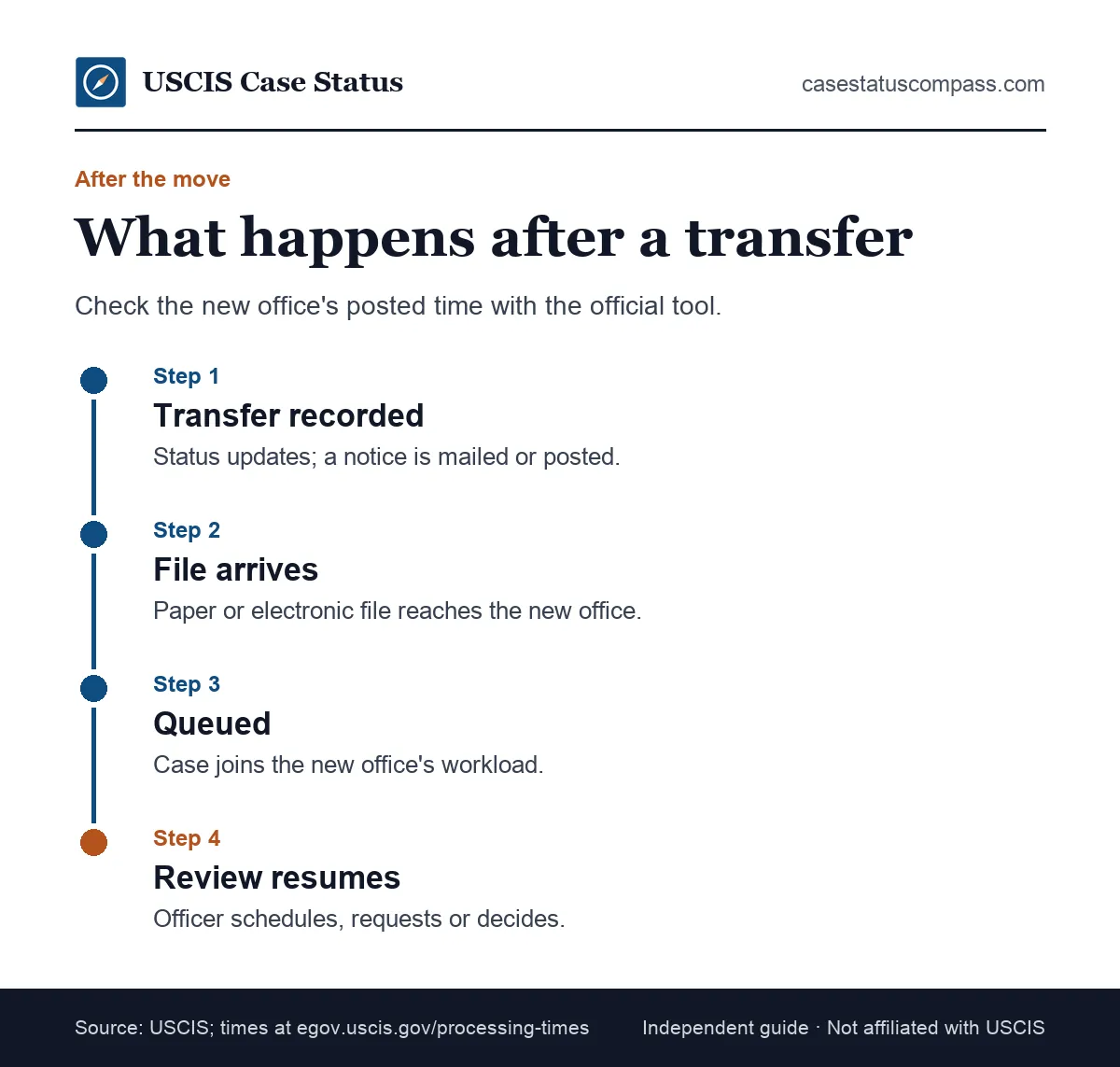
Factors that add time
- The paper file must be shipped.
- The new office has a longer posted time.
- The transfer followed your move.
- An RFE was pending when the file moved.
Several can apply at once, so recheck the posted time after each move.
Factors that save time
- The new office has more capacity.
- The file is electronic and moves instantly.
- The case is interview-ready.
- Your evidence is complete.
You control the last one: a complete, well-organized file is less likely to draw an RFE after the move.
How Long After a Transfer Will Your Case Move?
There is no official wait between a transfer and the next update; applicants report a few weeks to several months. The only official benchmark is the posted time for your form at the new office, at egov.uscis.gov/processing-times.
Note the date of the transfer in your log.
Measure from your filing date
The posted processing time usually counts from your receipt date, not the transfer date, and a transfer does not reset that clock for inquiries. Past the new office's posted time, you can submit an inquiry.
Signs the case is moving again
A new action email, an interview notice, a biometrics notice or an RFE all show the new office has started work. A quiet account for several weeks right after a move is common and not a warning sign.
How Do You Find Which Office Has Your Case?
To find which office has your case, read the transfer notice (Form I-797C), check the documents tab of your USCIS online account, or ask Emma or a Contact Center agent with your receipt number. The notice is usually the quickest source.
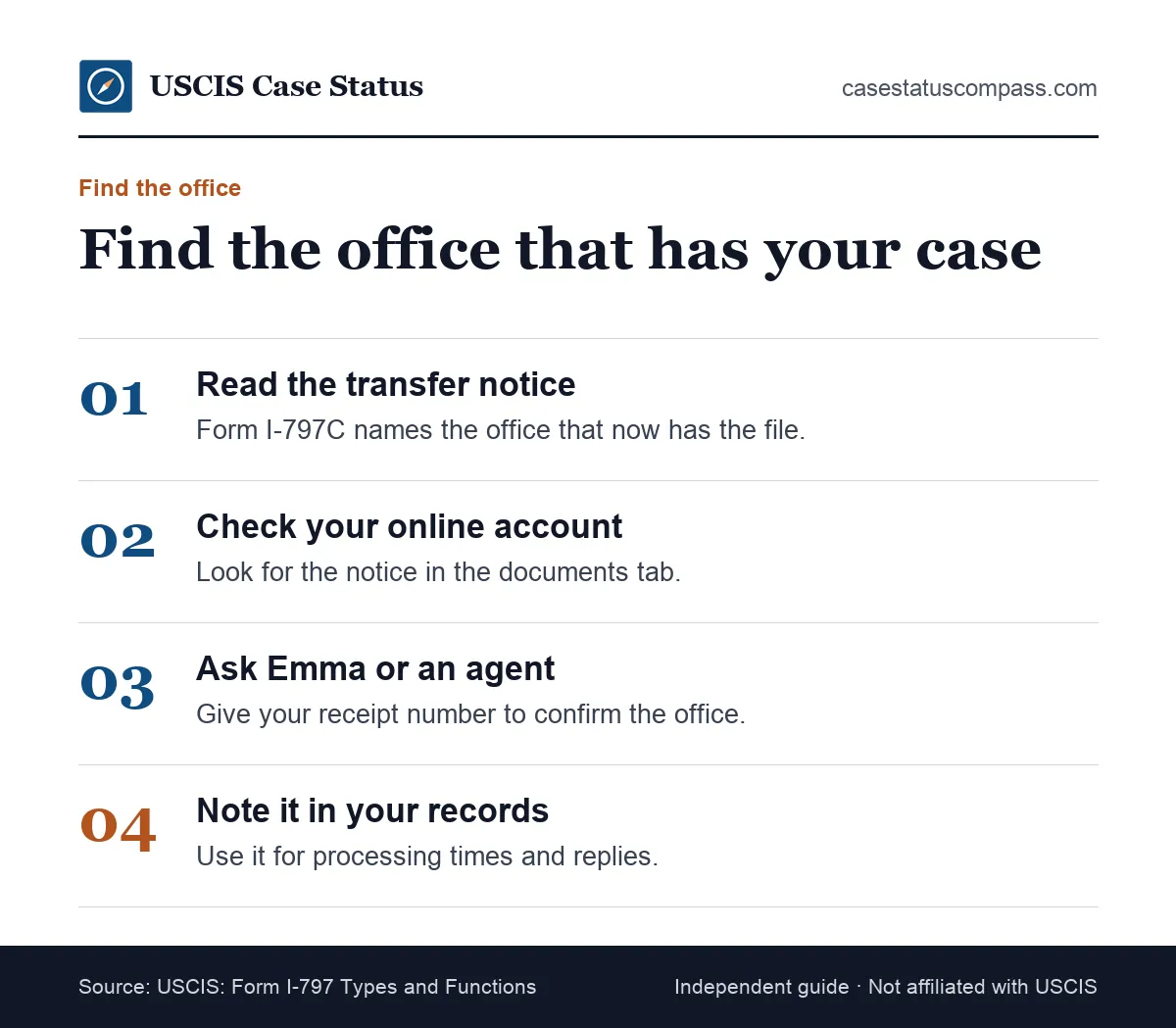
Using your online account
Linked cases show notices and history in the account. As of October 2026, USCIS describes it this way: Free USCIS online account: case status updates, notices, link paper-filed cases. Our guide to the uscis online account number explains access codes.
Asking USCIS directly
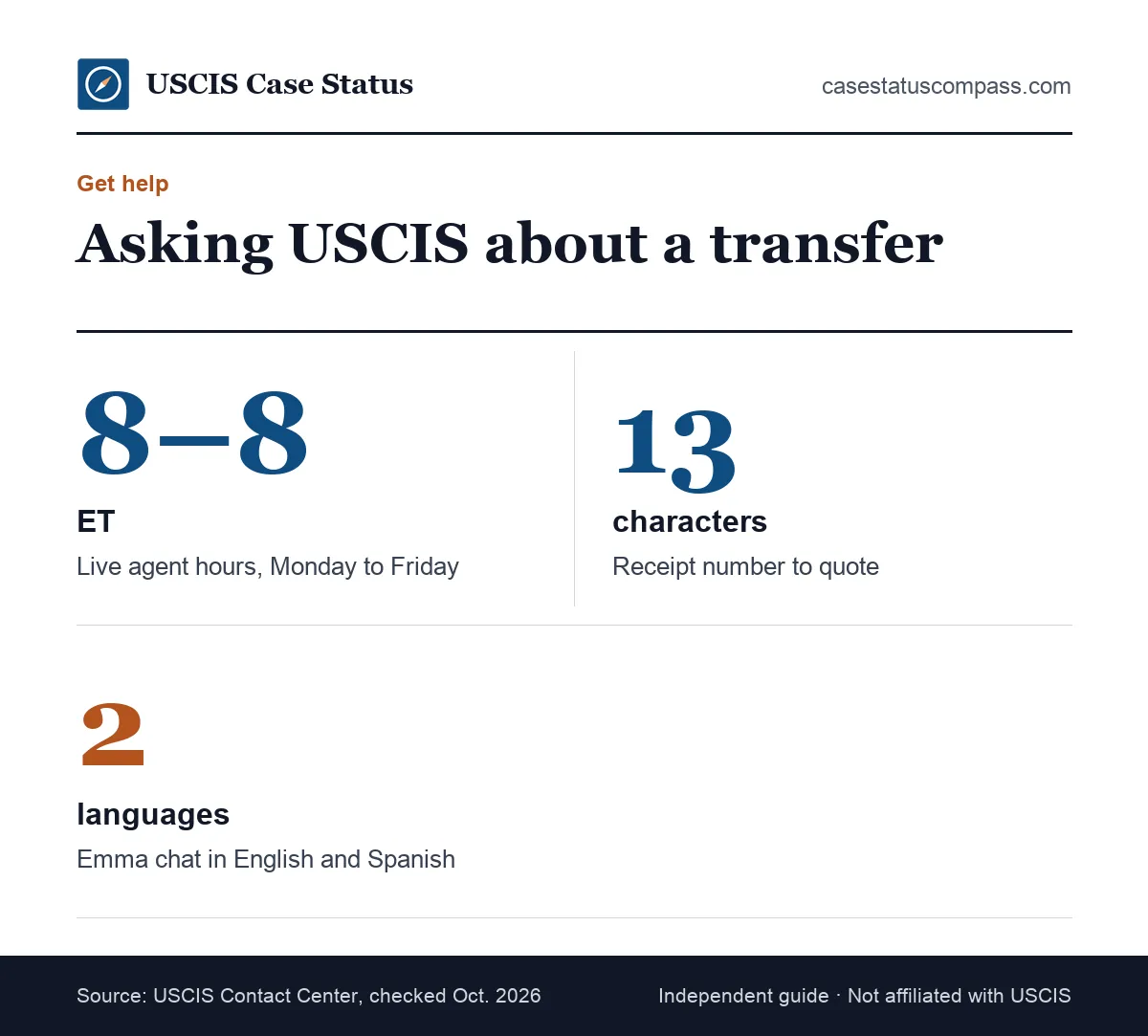
With no notice and nothing in the account, call 800-375-5283 or use Emma, USCIS's online virtual assistant (English and Spanish), on uscis.gov. Give your receipt number and ask which office now has jurisdiction.
Reading the Transfer Notice (Form I-797C)
The transfer notice is a Form I-797C, Notice of Action. USCIS describes the I-797C this way: I-797C = Notice of Action (receipt, rejection, transfer, appointment, re-open); not proof of status by itself. It confirms the move, lists your receipt number and usually names the new office.
Where to look on the notice
- Notice type: labeled as a transfer notice
- Receipt number: unchanged from your original receipt
- Office details: the office that now has the file
- Notice date: when the transfer was recorded
Keep it with your receipt
Store the transfer notice with your original receipt notice; together they show where the case started and where it is now. Our Form I-797C transfer notice guide explains every box on the page.
Does Your Receipt Number Change After a Transfer?
No. Your receipt number stays exactly the same after a transfer, including its three-letter prefix, which shows where the case was first received. Keep using the same number in Case Status Online and in any call with USCIS.
Only the office changes, so any inquiry, Emma chat or call uses the number you already have.
Using the same number everywhere
Enter the full number, prefix included, on Case Status Online, in Emma chats and in any case inquiry. Agents at the new office find your file by that number, not by office name.
Why Does Your Receipt Prefix Not Match the New Office?
The prefix records the original intake office only. If your receipt starts with LIN but the case is now at a field office, nothing is wrong. The transfer notice, not the prefix, tells you which office holds the file today.
Case Was Transferred on a Form I-485
For Form I-485, the green card application, a transfer usually means the file moved from the NBC or a service center to your local field office. An interview notice often follows, though some cases are approved without one.
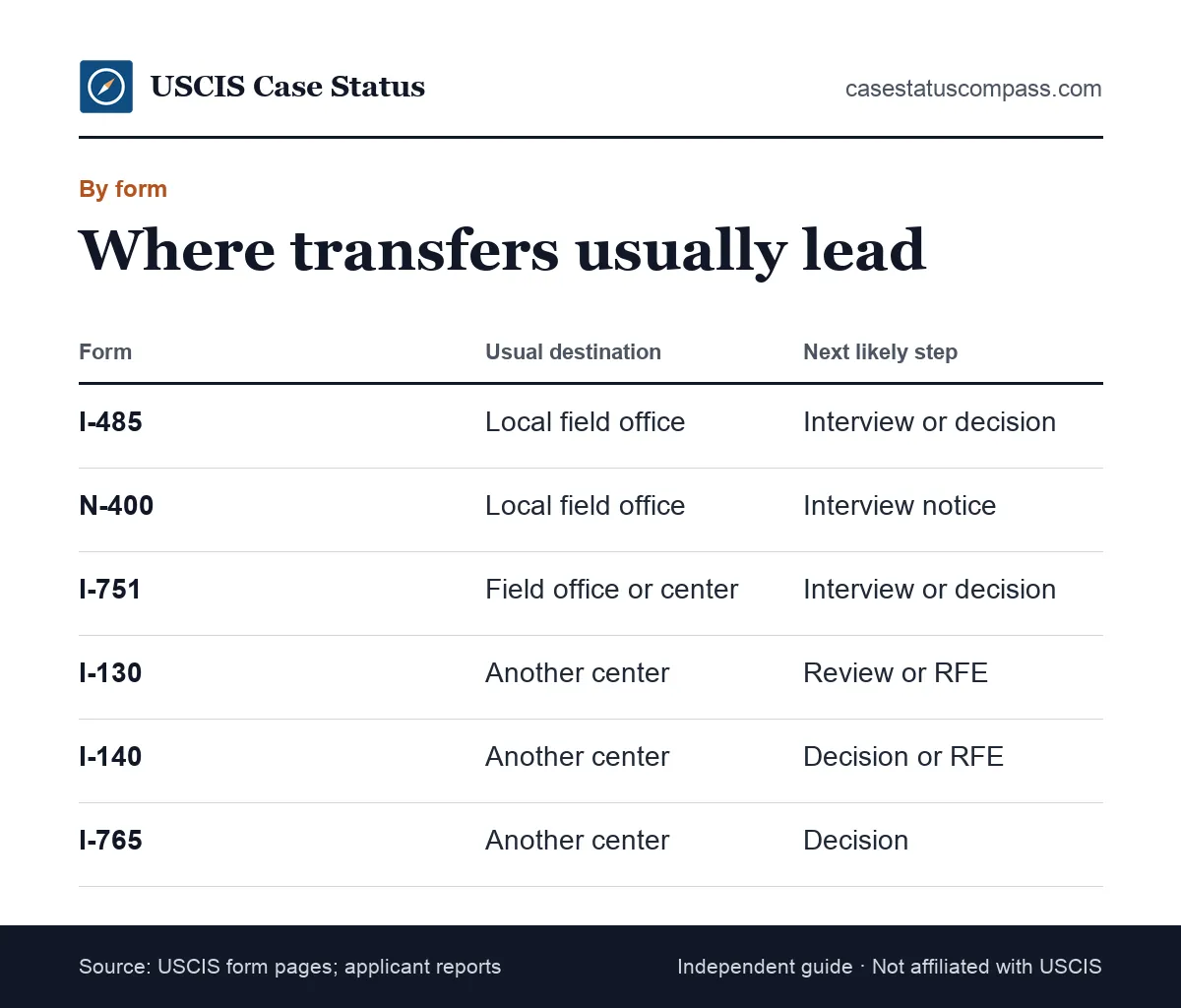
Prepare your originals while you wait.
Typical I-485 path after a transfer
- Transfer to a field office
- Interview notice, or review without one
- Interview and any follow-up requests
- Decision, then card production
Our i 485 green card application guide covers the full process from filing to card.
Linked I-765 and I-131 cases
Your work permit and travel document receipts may stay at a service center while the I-485 moves. Track each receipt number separately; one transfer does not mean all three moved.
Case Was Transferred on a Form N-400
For Form N-400, the naturalization application, a transfer usually sends the file to the field office that will hold your interview and test. Most N-400 applicants are interviewed, so an interview notice is the likely next update.
Watch your mail for the interview notice, which also tells you whether the test happens the same day.
Preparing while you wait
Use the time after a transfer to study for the English and civics tests and gather tax records and travel history. Our citizenship interview guide explains what officers ask.
Update any address or job changes too.
Transfers after the interview
Some N-400 cases move again after the interview, for example to schedule the oath ceremony at a different office. That second transfer is usually administrative. Our n-400 naturalization guide explains the steps around the oath.
Case Was Transferred on a Form I-751
For Form I-751, the petition to remove conditions on a green card, a transfer can go to a field office for an interview or to another center for paper review. Your receipt notice still protects your status while you wait.
Your status during a transfer
I-751 receipt notice extends conditional status and work authorization for 48 months. A transfer does not cut that short. Carry the receipt notice with your expired card for work and travel. Our Form I-751 guide explains joint petitions and waivers.
Interview or paper review for I-751
Some I-751 cases are decided on paper, while others go to a field office for an interview. The office named on the transfer notice is the best clue to which path your petition is on.
Case Was Transferred on a Form I-130 or I-129F
For Form I-130 (family petition) and Form I-129F (fiancé petition), a transfer is usually a service-center workload move. These petitions are rarely interviewed at USCIS unless filed with an I-485, so expect a decision or an RFE next.
Keep the notice with your receipt.
I-130 filed with an I-485
When filed together in the U.S., Form I-130 often moves to the field office with Form I-485 so both can be decided at the interview. Our Form I-130 guide explains concurrent filing.
Is a Transfer the Same as Moving to the NVC?
No. A transfer between USCIS offices keeps the case at USCIS. Sending an approved petition to the National Visa Center (NVC) moves it to the Department of State for visa processing, after approval and under its own case number. See our nvc case status page.
Case Was Transferred on an Employment Petition
For Form I-140 and Form I-129, a transfer is usually a service-center workload move, and interviews are rare. The employer or its attorney usually receives the transfer notice, so workers often learn about it secondhand.
Ask for a copy of each notice.
What the worker should do
Ask the employer's attorney for a copy of the transfer notice and the new office name; workers usually cannot get details from USCIS on an employer's petition. See our form i 140 guide for how the petition links to the green card case.
How Does a Transfer Affect Premium Processing?
If premium processing was requested, ask the employer's attorney how the transfer affects the premium clock and where any replies should go. The receipt number stays the same. Our premium processing guide explains how the service works.
As of October 2026, USCIS says: An RFE stops the premium clock; a new period starts when USCIS gets your response.
Case Was Transferred on Form I-765, I-131 or I-90
For Form I-765 (work permit), Form I-131 (travel document) and Form I-90 (green card renewal), transfers are usually workload moves between service centers. These forms are rarely interviewed, so the next update is often a decision or card production.
Check the new center's posted time.
Work permit timing after a transfer
If your EAD is near its end date, a transfer is stressful. Ended: renewals filed on or after Oct. 30, 2025 no longer get the up-to-540-day automatic extension (exceptions: TPS by law/Federal Register notice; STEM OPT 180 days). Check the new center's posted time and the expedite criteria.
I-90 renewals
I-90 receipt notice + expired card = proof of status for 36 months from the card's expiration date. A transfer does not change that period, so keep the receipt notice with your card.
Status Flow Around a Transfer
The case was transferred status usually appears during review, after biometrics and before an interview or decision, though it can also follow an interview. The table shows common before-and-after pairs.
Find the status you saw just before the move, and the row suggests what to expect next.
Before and after pairs
Each row pairs the status you saw before the move with the kind of transfer and the update that usually follows.
| Status before | Transfer type | Likely status after |
|---|---|---|
| Fingerprints taken | NBC to field office | Interview was scheduled |
| Actively reviewed | Center to center | Approval or RFE |
| Case was received | Intake to processing | Actively reviewed |
| Interview completed | Field office to another | Oath or decision |
| Address changed | Old to new office | Interview rescheduled |
The pattern to notice: transfers to a field office usually lead to an interview, while center-to-center moves lead to a decision or an RFE.
The review stage after a move
Many cases show active review again after the move. Our guide to case is being actively reviewed by uscis explains that stage. If an interview follows, see our interview was scheduled guide.
What Should You Do After a Transfer?
After a case transfer, save the transfer notice, write down the new office, keep your address current, and check the new office's processing time. You do not need to file anything for the move itself; track with the same receipt number.
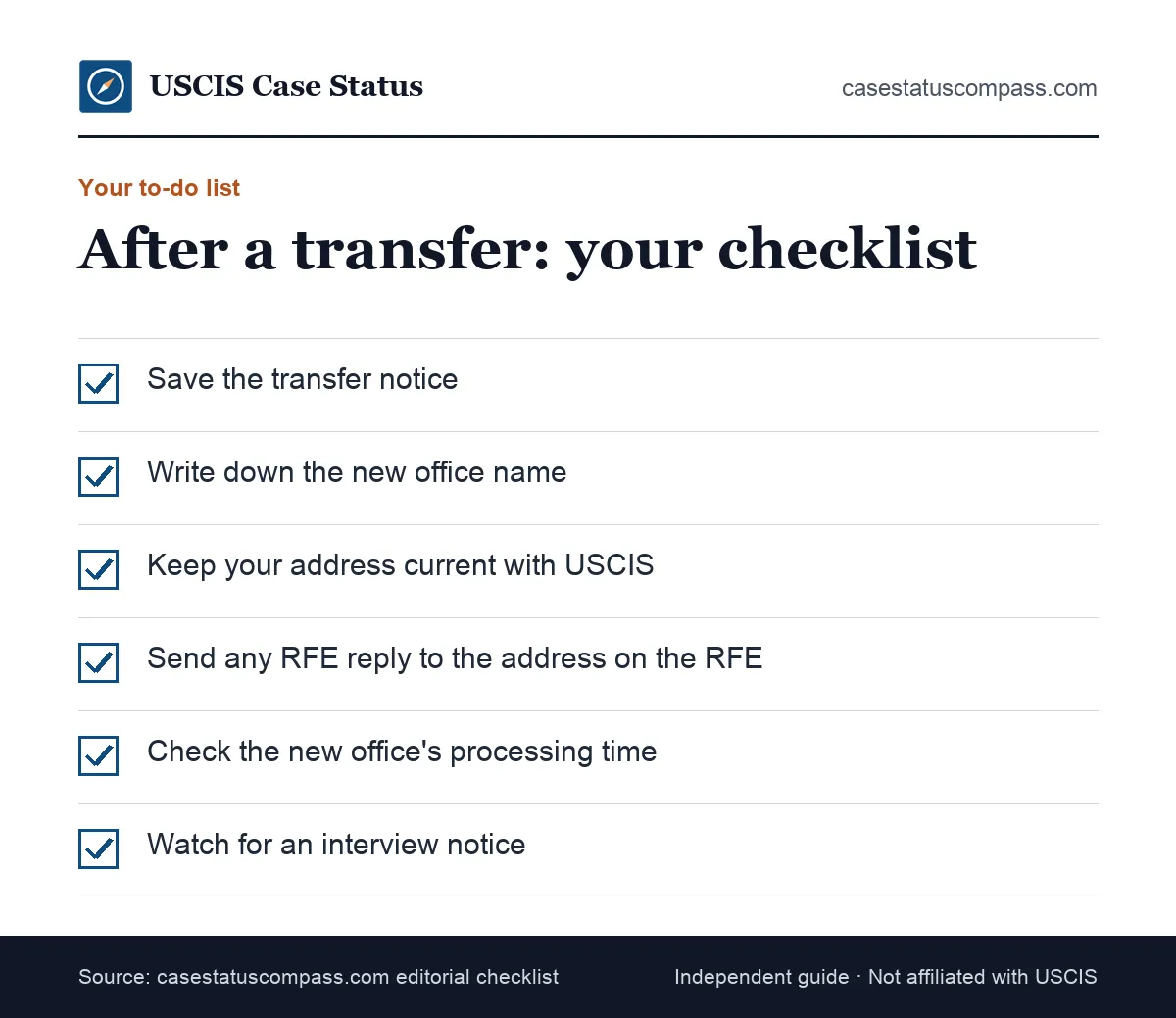
A first-week routine
- Save the transfer notice.
- Note the new office and the date.
- Look up that office's posted time.
- Confirm USCIS has your current address.
- Recheck your account weekly, not daily.
What you do not need to do
Do not refile the form, pay again or resend your evidence; a transfer cancels nothing you submitted. Duplicate packets can create correspondence steps that slow the new office down.
If the new office sends a request, answer only that request and place a copy of its notice on top of your reply.
Decision Table: Transfer Situations and Next Steps
The decision table below matches common transfer situations to a next step. Most rows need no action beyond tracking, but RFE and interview rows have firm deadlines, so act on those first.
Handle the high-urgency rows first, then check back on the others weekly.
Transfer decision table
Find your situation in the first column; the second gives the step and the third how quickly to take it.
| Your situation | Do this | How urgent |
|---|---|---|
| No notice yet | Wait for the I-797C; check account | Low |
| Moved to a field office | Prepare for an interview | Medium |
| RFE pending | Reply to the address on the RFE | High |
| Interview notice arrived | Confirm date and location | High |
| Past the posted time | Submit a case inquiry | Medium |
| You moved recently | Confirm your address update | High |
Three rows are marked high: an RFE, an interview notice and a recent move. Those carry deadlines or mail risks; the others can wait.
What If Your Case Was Transferred to the Wrong Office?
If the transfer looks wrong, such as a move to an office in a state you never lived in, contact USCIS with your receipt number and confirm your address on file. Mistaken transfers are uncommon but can be corrected, so raise it early.
Where Do You Send Documents After a Transfer?
Send documents to the address on the most recent notice that asked for them, such as the RFE or interview notice. If the RFE predates the transfer, follow it unless a newer notice says otherwise. When in doubt, ask USCIS first.
Replying to an RFE during a transfer
USCIS routes mail to the current file location, but delays happen, so keep proof of delivery and a full copy. Our guide to the rfe meaning and how to reply explains deadlines and formatting.
Unrequested documents
Do not mail unrequested documents just because the case moved. The new office receives the whole file, including everything you sent, and extra papers can slow review.
Send papers only when a notice asks.
Pending RFE During a Transfer
A pending RFE keeps its deadline even if the case transfers; the move does not pause or extend it. Reply on time, to the address in the RFE or any newer instruction, and keep proof of delivery.
RFE deadline: up to 12 weeks (the exact date is on your RFE); no extensions.
If the transfer happened right after you replied
Your reply should follow the file, and a correspondence update often appears once the new office logs it. If none shows within several weeks, contact USCIS with your tracking number and delivery date.
If you need more time
USCIS generally does not extend RFE deadlines. If you cannot meet one, talk to an immigration attorney at once about what to send and how to explain gaps.
USCIS also says to send every requested item in one response; a partial reply is treated as a request for a decision on the record.
Interview Notices After a Transfer
After a field office transfer, the next update is often an interview notice listing the date, time, office address and what to bring. Read it on arrival, because missing an interview without rescheduling can lead to a denial.
Check the documents list on it too.
Checking the new office address
The interview may be at a building you have never visited. Check the address on the notice, plan your travel time, and bring the notice, your ID and every original it lists.
Rescheduling at the new office
Follow the rescheduling instructions printed on the notice. Request an in-person appointment online at my.uscis.gov/en/appointment/v2 or call 800-375-5283. Request changes early and keep a record.
Ask for the new date in writing and keep the confirmation.
What If Your Case Is Transferred More Than Once?
Multiple transfers are not unusual. A case may move from intake to the NBC, then to a field office, then elsewhere after an interview or a move. Each is routine, though several in a row can add time.
Keep a record of each one: the date, the office it left and the office that received it.
Common multi-transfer patterns
- Service center, then NBC, then field office
- Field office to a new field office after you move
- Field office back to a center for final steps
- Center to center during backlog sharing
When to ask questions
If your case has moved three or more times with no other progress and is past the posted time, submit an inquiry. Ask the agent to confirm the current office and whether anything is needed.
Transfer Back After an Interview
Some cases are transferred again after an interview, for example to finish background checks, order a card, or schedule an oath elsewhere. A post-interview move usually means administrative work remains, not a problem.
Watch your mail for the next notice.
What usually follows
After a post-interview transfer, the next updates are often approval, card production, or an oath notice. Our guide to the approval case decision rendered status explains what happens after a decision.
Can You Request a Transfer to Another Office?
Generally, you cannot choose which USCIS office handles your case; USCIS assigns jurisdiction by workload and address. Moving and updating your address is the main way a case changes offices, and even that may not trigger a transfer.
Contact USCIS only if the office looks wrong.
Special circumstances
If you have a serious hardship, an expedite request is the proper route, not a transfer request. Our uscis expedite request guide lists the criteria USCIS considers.
Proof of the hardship is essential.
Should You Move to Get a Faster USCIS Office?
Usually not. Moving just to reach a faster office is risky: processing times change, the transfer itself takes time, and your case joins a new queue. Get legal advice before making housing decisions around a pending case.
A move can also delay a scheduled interview.
Processing Times at the New Office
After a transfer, the processing time that matters is the new office's. Look it up at egov.uscis.gov/processing-times by choosing your form, category and the office named on the transfer notice. USCIS says the posted time reflects how long it took to finish most recent cases.
Using the right office in the tool
Choose the office on the transfer notice, not the one your receipt prefix suggests: the field office for field office cases, the center for center cases. Our uscis processing times hub explains how to read the results.
Rechecking the time after a move
Posted times change. Note the figure and the date you checked it, then recheck monthly, and compare your receipt date with the current figure before you submit any inquiry.
Keep each figure in your log.
When Should You Contact USCIS About a Transfer?
Contact USCIS if no transfer notice arrives within a few weeks, the new office looks wrong, an RFE reply may have gone astray, or your case is past the new office's posted time. A transfer status alone needs no call.
How to reach USCIS
Call 800-375-5283 (TTY: 800-767-1833). Live calls and chat: Monday to Friday, 8 a.m. to 8 p.m. Eastern. Have the notice and receipt number ready. Our uscis contact number guide explains phone, chat and appointment options.
Making an inquiry count
State your form, receipt number, transfer date and new office. Ask a specific question, such as "Has the file arrived at the new office?" Note the date, the answer and any reference number.
Escalation Options After a Long Transfer Wait
If your case stalls past the posted time after a transfer, you can escalate: an outside normal processing time inquiry, an expedite request if you qualify, the CIS Ombudsman, or a congressional inquiry through your member of Congress.
Start with the USCIS inquiry, because the Ombudsman and congressional offices usually ask whether you already tried to resolve the delay with USCIS.
Comparing escalation routes
The table compares the four escalation routes by when each fits and what you must have ready.
| Route | Best for | What you need |
|---|---|---|
| Case inquiry | Past posted time | Receipt number, dates |
| Expedite request | Urgent hardship | Evidence of the urgency |
| CIS Ombudsman | Inquiries that failed | Prior inquiry details |
| Congressional office | Long stalls | Signed privacy release |
For the Ombudsman route, the rule as of October 2026 is: Use the Ombudsman only after contacting USCIS within 90 days and waiting at least 60 days.
Where to start
Start with a case inquiry and move up only if it fails. Our guide to the uscis ombudsman and congressional inquiry explains the later steps.
Keep the reference number from each inquiry; later routes ask for it.
Transfer vs Other Status Messages
"Case was transferred" is about where your file is; other messages describe what is happening to it. Mixing them up causes needless worry, so the table compares the updates people most often confuse.
Read your exact wording against it before deciding whether to act.
Side-by-side comparison
The table puts the transfer status next to four similar updates and says whether any of them needs action.
| Status | What it tells you | Action needed? |
|---|---|---|
| Case was transferred | A new office has the file | No, save the notice |
| Actively reviewed | An officer is working on it | No |
| Still being processed | In the queue | No, unless overdue |
| Action taken email | Something changed | Check your account |
| New card is being produced | Approved; card being made | No |
Only the action email asks you to look for something; the transfer and the others simply describe where your case stands.
Related guides
An action email often arrives the day of a transfer; see what we have taken an action on your case means. After an approval, our guide to new card is being produced explains the card step.
Mistakes to Avoid After a Case Transfer
The common transfer mistakes are refiling the form, mailing papers to the old office, ignoring the transfer notice, moving without updating your address, and comparing your wait against the old office's time. Each adds delay or confusion.
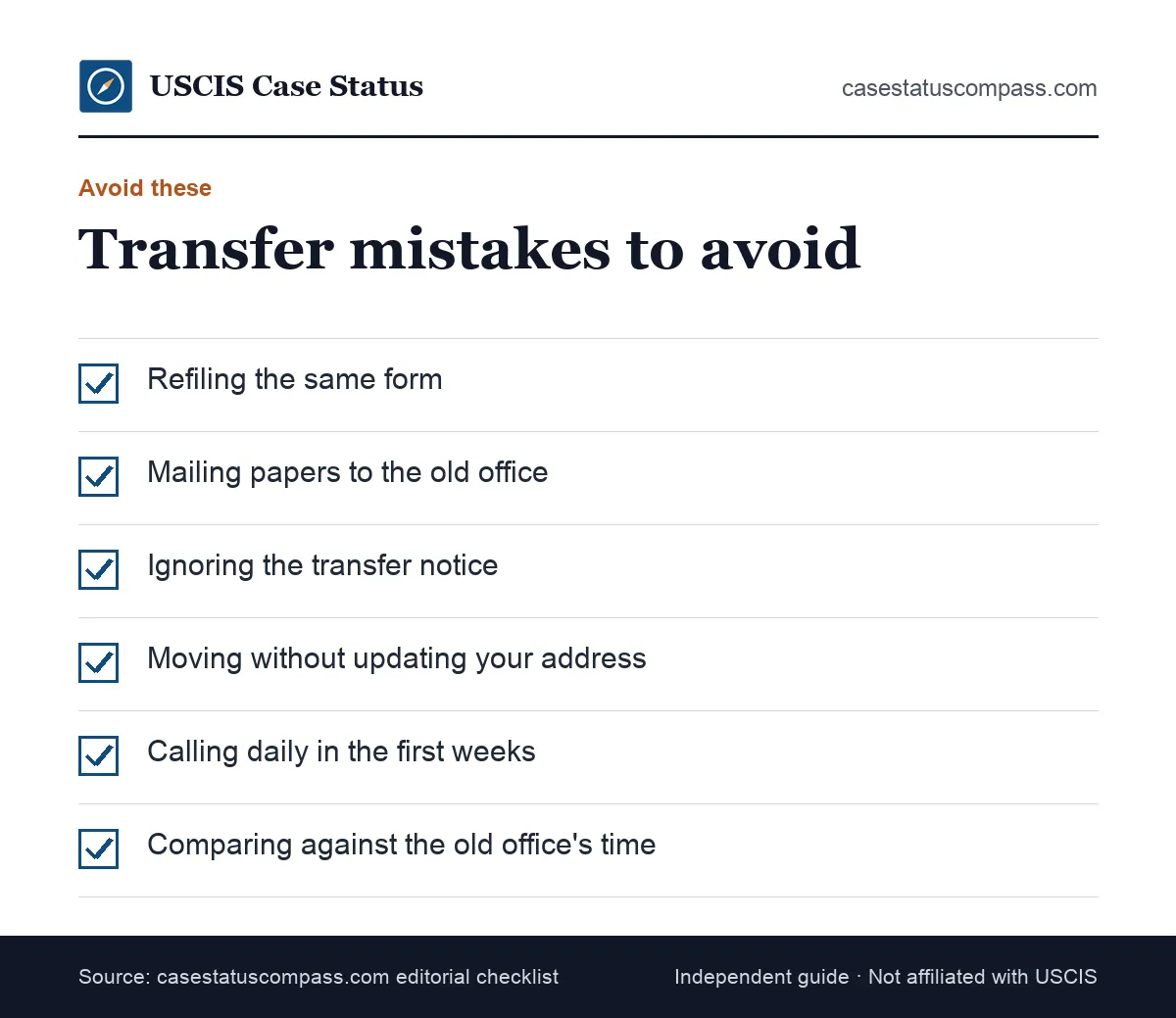
Most are easy to prevent with one habit: act only on the newest notice.
Why refiling backfires
Refiling creates a second case with a new fee and receipt number. USCIS may reject or deny the duplicate, and two files can confuse review. Let the original continue.
The fee is not refunded either.
Why address updates matter most
Notices from the new office go to the address on file. A missed interview notice is the most serious transfer-related problem, and an outdated address is the usual cause.
The law says: Report a new address to USCIS within 10 days of moving (INA 265).
Documents to Keep After a Transfer
Keep the transfer notice, your original receipt notice, every RFE and reply, proof of delivery for anything you mailed, and call notes. These records prove the case history if a file is delayed or a reply goes missing.
Keep them for years, because later filings, such as an N-400, may ask about your case history.
A transfer record sheet
Write one line per move: date, from office, to office, how you learned of it, and any next step. Add the new office's posted time and the date you checked it.
Digital copies of every notice
Scan or photograph each notice the day it arrives and save it in one dated folder. If a paper notice is lost in a move, the copy still shows the receipt number and the office.
When Does a Transfer Need Legal Help?
Most transfers need no legal help. Talk to an immigration attorney or DOJ-accredited representative if the transfer comes with an RFE or NOID you do not understand, a fraud or security unit is suggested, or the case sits far past the posted time after several transfers.
Signs to get advice
- An RFE or NOID arrives with the transfer
- The case stalls long past the new office's posted time
- You are in, or have been in, removal proceedings
- You plan to move during a pending case
Finding qualified help
Look for a licensed immigration attorney or a DOJ-accredited representative at a recognized nonprofit. Avoid notarios and anyone who promises to speed up a transfer for a fee.
Check the DOJ roster or your state bar first.
Transfer Scenarios From Three Different Cases
These scenarios show how transfers play out. They are composites of patterns applicants report, not real people; confirm your own case through notices and the official tools.
Each one shows a different kind of move: a field office transfer before an interview, a workload batch between centers, and a move that followed the applicant to a new state.
Scenario: green card to a field office
Priya's I-485 had an MSC receipt. After biometrics, the status changed to case was transferred, and a notice named her local field office. About two months later, an interview notice arrived.
Scenario: work permit between centers
Diego's I-765 moved between service centers in a workload batch. He checked the new center's posted time, which was shorter, and a decision came within that window.
He did not need to call, file anything or resend evidence.
Scenario: citizenship after a move
Sam moved to another state with an N-400 pending and updated his address online. The case transferred to the new field office; his interview came later, but notices reached the new address.
Frequently Asked Questions
Is a case transfer a sign of approval?
No. A transfer only changes which office holds your file; it is not an approval, denial or request. A move to a field office often means an interview is next. The approval comes later as its own status and notice.
How long after a transfer will my case move?
USCIS does not publish a standard wait; applicants report a few weeks to several months. Check the posted time for your form at the new office, measured from your original receipt date, not the transfer date.
Will I get a letter when my case is transferred?
Usually yes. USCIS normally mails a Form I-797C transfer notice, and linked cases may show it online. If none arrives within a few weeks, check your account and address on file, then contact USCIS.
Does a transfer mean I will have an interview?
Not always. A transfer to a field office makes an interview more likely, especially for Form N-400 and Form I-485, but some cases are approved without one. A move between service centers rarely leads to an interview.
Does a transfer reset my place in line?
USCIS does not say that a transfer resets your case. Your receipt date and priority date stay the same, but the case joins the new office's workload, so your wait depends on that office.
Can my case be transferred back to the original office?
Yes, for example after an interview or for final processing. Each move is recorded and usually comes with a notice. Back-and-forth transfers are uncommon but not a problem by themselves.
Is a transfer to the National Benefits Center normal?
Yes. The NBC handles early processing for many interview-based cases, such as Form I-485 and Form N-400, and later sends them to a local field office.
Can a transfer cause my RFE reply to get lost?
It is uncommon, because mail follows the file, but delays happen. Keep proof of delivery, and contact USCIS if no correspondence update appears within several weeks.
Does a transfer move my work permit and travel document cases too?
Not necessarily. Linked Form I-765 and Form I-131 cases often stay at a service center while the I-485 moves, so check each receipt number separately.
Do I need to tell my attorney about a transfer?
Yes, if your attorney did not already receive the notice. Attorneys usually get copies, but forward anything you receive. Your attorney may need to update where replies go or prepare you for an interview at the new office.
Sources
- USCIS: Form I-797 Types and Functions. www.uscis.gov/forms/filing-guidance/form-i-797-types-and-functions. Accessed Oct 27, 2026.
- USCIS: Checking Your Case Status Online. www.uscis.gov/tools/checking-your-case-status-online. Accessed Oct 27, 2026.
- USCIS Check Case Processing Times. egov.uscis.gov/processing-times/. Accessed Oct 27, 2026.
- USCIS: Benefits of a USCIS Online Account. www.uscis.gov/file-online/benefits-of-a-uscis-online-account. Accessed Oct 27, 2026.
- USCIS Contact Center. www.uscis.gov/contactcenter. Accessed Oct 27, 2026.
- USCIS Office of Legislative Affairs: Congressional Inquiries Refresher (2021). www.uscis.gov/sites/default/files/document/guides/Congressional-Inquiries-Refresher.pdf. Accessed Oct 27, 2026.
- USCIS Policy Manual Vol. 7, Part A, Ch. 5 (Interview Guidelines). www.uscis.gov/policy-manual/volume-7-part-a-chapter-5. Accessed Oct 27, 2026.
- USCIS: Removing Conditions on Permanent Residence Based on Marriage (updated 12/12/2023). www.uscis.gov/green-card/after-we-grant-your-green-card/conditional-permanent-residence/removing-conditions-on-permanent-residence-based-on-marriage. Accessed Oct 27, 2026.
- USCIS: How Do I Request Premium Processing? (updated 03/23/2026). www.uscis.gov/forms/all-forms/how-do-i-request-premium-processing. Accessed Oct 27, 2026.
- USCIS: Automatic EAD Extension (updated 10/29/2025). www.uscis.gov/working-in-the-united-states/information-for-employers-and-employees/automatic-employment-authorization-document-ead-extension. Accessed Oct 27, 2026.
- USCIS: Replace Your Green Card (updated 09/12/2025). www.uscis.gov/green-card/after-we-grant-your-green-card/replace-your-green-card. Accessed Oct 27, 2026.
- 8 CFR 103.2(b)(8)(iv) (LII). www.law.cornell.edu/cfr/text/8/103.2. Accessed Oct 27, 2026.
- USCIS Policy Manual Vol. 1, Part E, Ch. 6 (current as of Oct. 23, 2026). www.uscis.gov/policy-manual/volume-1-part-e-chapter-6. Accessed Oct 27, 2026.
- DHS CIS Ombudsman: How to Submit a Case Assistance Request (updated 04/13/2026). www.dhs.gov/case-assistance. Accessed Oct 27, 2026.
- USCIS: How to Change Your Address (updated 08/04/2026); 8 U.S.C. 1305(a) (LII). www.uscis.gov/addresschange. Accessed Oct 27, 2026.
casestatuscompass.com is an independent publication and is not affiliated with USCIS or any government agency. This page is general information, not legal advice. For denials, court or asylum matters, consult an immigration attorney or a DOJ-accredited representative.