Contents · 44 sections
- What Does Interview Was Scheduled Mean on Your USCIS Case?
- Is an Interview a Good Sign for Your Case?
- Where Does This Status Fit in the Timeline?
- Interview Was Scheduled vs Ready to Be Scheduled
- Interview Was Rescheduled: What Changed?
- What Does Interview Cancelled and Notice Ordered Mean?
- When Does Your Interview Notice Arrive?
- What Is on the Interview Appointment Notice?
- What If the Status Says Scheduled but No Notice Came?
- Can You Check Your Interview Date Online?
- How Do You Verify an Interview Notice Is Real?
- What If the Office Cannot Find Your Interview?
- Where Is the Interview Held and How Do You Get In?
- Which Cases Usually Get an Interview?
- Can USCIS Approve Your Case Without an Interview?
- Interview Scheduled for a Form I-485 Case
- Interview Scheduled for a Form N-400 Case
- What Happens After You Pass the Citizenship Interview?
- Interview Scheduled for a Form I-751 Case
- Interview Scheduled for an Asylum or Family Petition Case
- Do You Need a Lawyer for an Asylum Interview?
- How Long After Biometrics Does the Interview Happen?
- Is a Biometrics Appointment the Same as Your Interview?
- What Should You Do the Week the Status Changes?
- How Do You Prepare Without Overdoing It?
- What Should You Bring on Interview Day?
- Can You Reschedule a USCIS Interview?
- What Happens If You Miss the Interview?
- Can a Lawyer or Interpreter Come With You?
- How Do You Request a Disability Accommodation for the Interview?
- Can You Travel Before Your Interview?
- Can Green Card Holders Travel With a Pending N-400 Interview?
- What If You Moved After the Interview Was Scheduled?
- Will a Case Transfer Change Your Interview Date?
- Your Status Still Says Scheduled After the Interview
- What Happens After the Interview?
- Does an Interview Mean Background Checks Are Done?
- Three Interview Scheduling Scenarios
- Decision Table: What to Do Now
- What Mistakes Cause Problems at This Stage?
- What Interview Papers Belong in Your Case Folder?
- Why Do the Talk-to-a-Lawyer Warnings Matter?
- Key Takeaways About This Status
- Frequently Asked Questions
The short answer
Interview was scheduled means USCIS has set a date, time and place for you to meet an officer about your case, usually at a local field office. An appointment notice on Form I-797C follows by mail and often online. Find it, check who must attend and start preparing.
At a glance
| Is it good news? | It is progress; most green card and citizenship cases need it. |
| Is it an approval? | No. The officer decides at or after the interview. |
| What arrives next | A Form I-797C notice with date, time and office. |
| What to do today | Check your online account, confirm your address, tell your attorney. |
| Who runs this site | An independent guide, not USCIS. |
What Does Interview Was Scheduled Mean on Your USCIS Case?
The Interview Was Scheduled update means USCIS booked an in-person appointment for your case with an officer. The status names your form and receipt number and says a notice was sent. It is not a decision; your file is ready for the officer.
What the status message includes
The paragraph under the headline confirms the form, such as Form I-485 or Form N-400, and the receipt number, and says an appointment notice was mailed. Many versions also mention the date and office, but some do not.
What the update leaves out
The online message does not list the documents to bring, the people who must attend or the rescheduling rules. Those are on the appointment notice, so never plan the day from the status line alone.
Is an Interview a Good Sign for Your Case?
An interview is a normal, expected step, not a warning sign. For most family green card and naturalization cases, USCIS interviews as standard practice. It shows your file passed earlier checks; the outcome depends on your evidence and answers.
Why USCIS interviews applicants
The interview lets an officer confirm your identity, check the answers on your forms under oath and ask about anything unclear. In marriage cases it tests whether the relationship is genuine; for citizenship it includes the English and civics tests.
When an interview signals extra scrutiny
Some forms that usually skip interviews get one when the file raises questions, such as an evidence gap. If yours rarely gets interviewed, ask your attorney what may have triggered it.
Where Does This Status Fit in the Timeline?
The interview usually comes after the receipt notice, biometrics and initial review, and before the decision. Many cases show Case Is Ready to Be Scheduled for an Interview first. Afterward, expect a decision, an evidence request or more review.
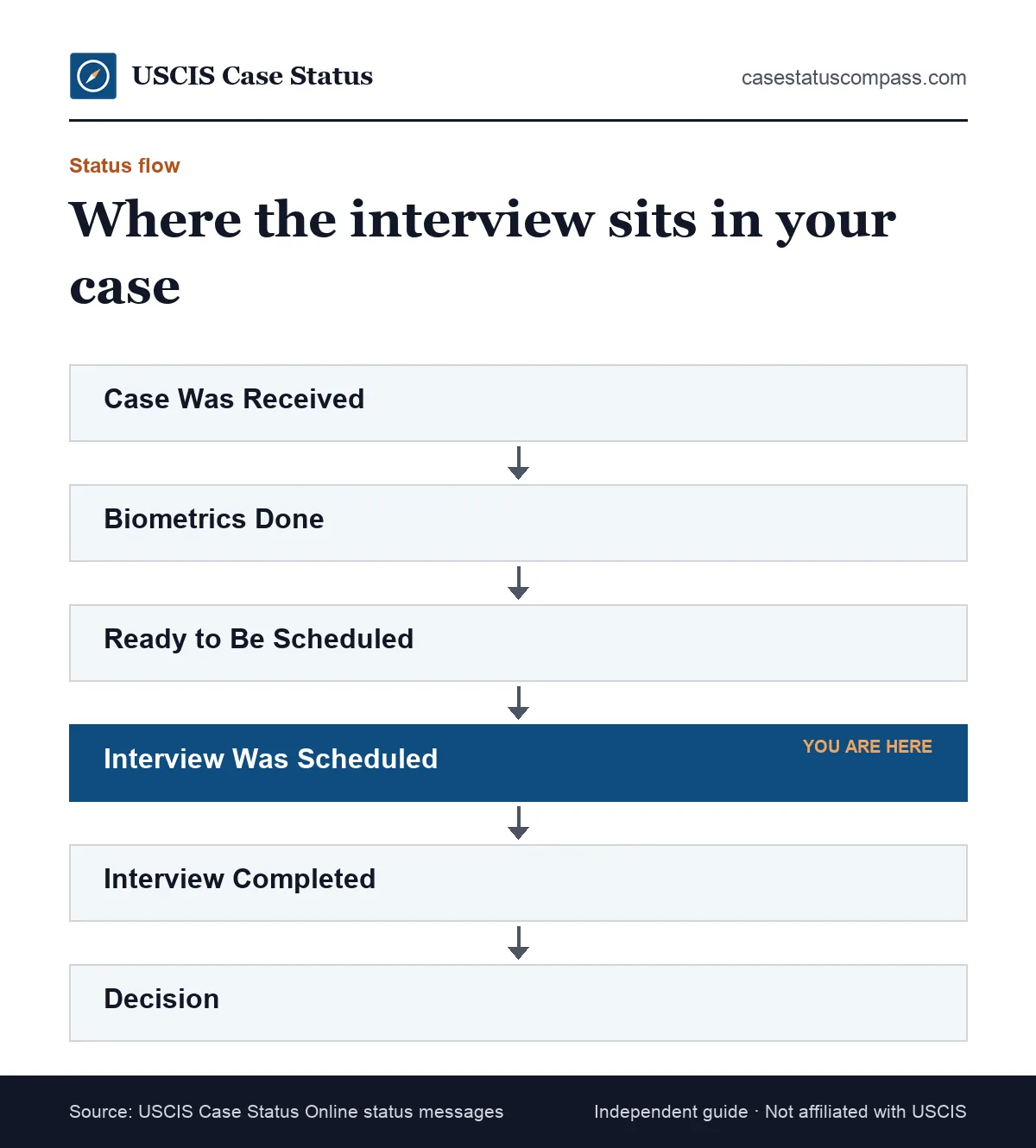
Seeing it means the slow part of the wait is usually behind you.
Status flow table
The table shows which updates usually lead into a scheduled interview and what controls when the next one appears.
| Status | Likely next update | What sets the timing |
|---|---|---|
| Case Was Received | Interview Was Scheduled | Office calendar |
| Fingerprints Were Taken | Interview Was Scheduled | Field office workload |
| Ready to Be Scheduled for an Interview | Interview Was Scheduled | Open interview slots |
| Interview Was Scheduled | Interview Was Rescheduled | Your request or an office change |
| Interview Was Scheduled | Approved, RFE or more review | Officer review after the meeting |
The takeaway: once the date exists, the next change depends on you attending and on the officer's review, not on the office calendar.
Why your history may skip steps
Not every case shows each step. Some go straight from biometrics to a scheduled interview; others show case is being actively reviewed by USCIS before or after. Skipped messages are normal.
Interview Was Scheduled vs Ready to Be Scheduled
Ready to Be Scheduled for an Interview means your file is waiting for a slot at the field office, with no date yet. Interview Was Scheduled means the date exists and a notice is coming. The gap depends on the office calendar.
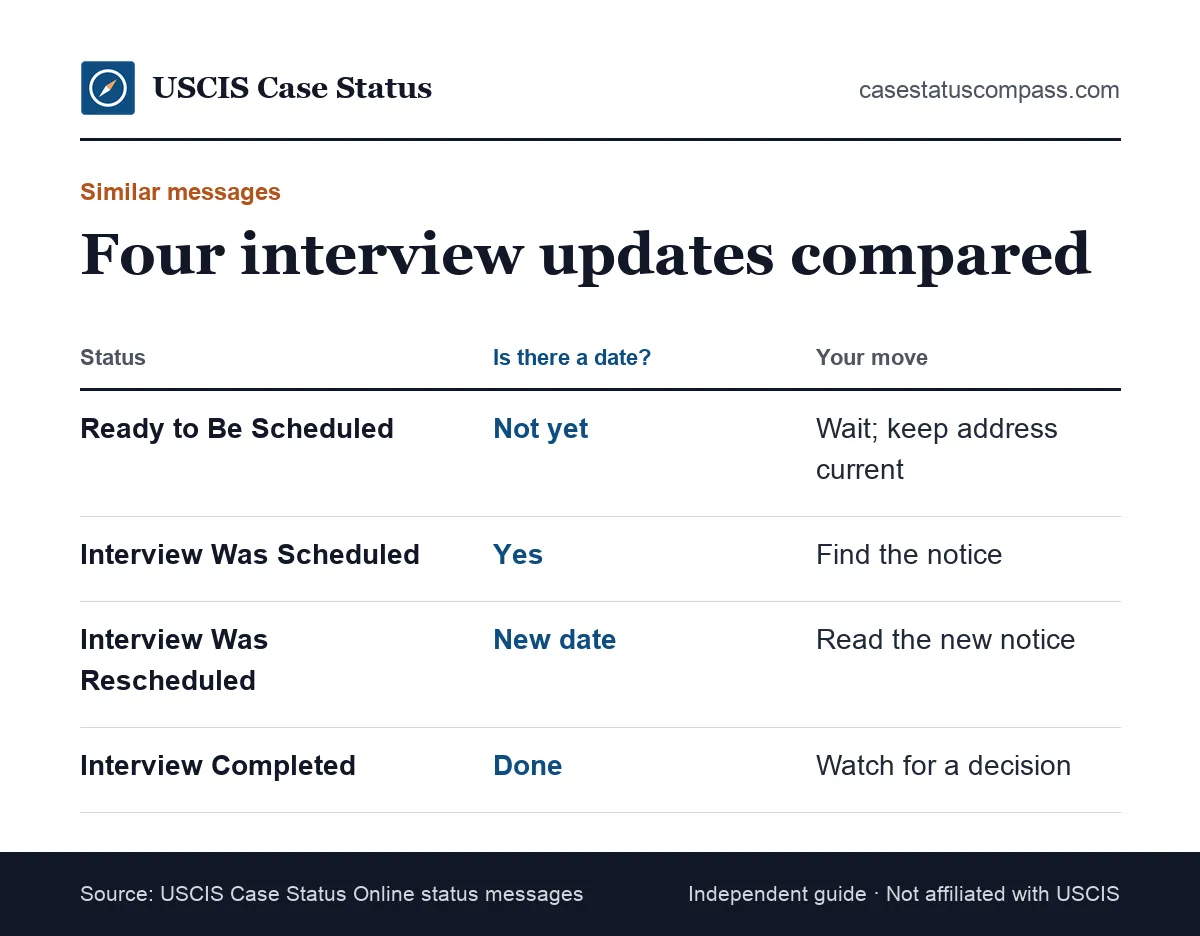
What to do while you wait for a date
Keep your mailing address current and avoid trips abroad without advice. Calling cannot speed up an office calendar, but a wait far past normal processing times may justify a case inquiry.
Other interview messages compared
Several interview messages look alike online. This table separates them by meaning and the one action each calls for.
| Status | Meaning | Action |
|---|---|---|
| Ready to Be Scheduled | Waiting for a slot | Keep address current |
| Interview Was Scheduled | Date booked, notice sent | Find and read the notice |
| Interview Was Rescheduled | Date moved | Use the newest notice only |
| Interview Cancelled | Appointment removed | Watch for a new notice |
| Interview Completed | Meeting held | Watch for a decision |
If two of these appear in a row, the most recent one controls, so act on the newest message and its matching notice.
Interview Was Rescheduled: What Changed?
Interview Was Rescheduled means USCIS moved your appointment to a new date or time, after your own request or an office decision such as staff shortages or closures. A new notice follows and replaces every earlier one.
Check that the office address did not change too.
Use only the newest notice
Throw nothing away, but plan only around the newest notice and mark older ones as replaced. If the new date clashes with work or travel, contact USCIS quickly.
Bring the newest notice on the day.
When the office moved the date
Office-driven changes are common and do not signal a problem with your case. If you did not ask for it, confirm who must attend and whether the documents list changed.
What Does Interview Cancelled and Notice Ordered Mean?
This update means USCIS removed your appointment and ordered a new notice. Sometimes a new date follows; sometimes the officer decides without an interview. Watch your account and mail, and do not go on the old date.
Keep your documents ready in the meantime.
What to do next
Screenshot the update, check your account for a new notice, and call the Contact Center if nothing arrives within a few weeks. Ask your attorney whether it could mean an interview waiver or a transfer.
Cancellation vs a missed interview
A cancellation comes from USCIS, so it does not count against you. A missed interview is your absence without notice, which can lead to abandonment. Keep the cancellation screenshot.
It proves the change came from USCIS.
When Does Your Interview Notice Arrive?
USCIS mails the interview appointment notice after the status changes, and it often posts in your online account too. We could not confirm an official delivery time. Check your account every few days and contact USCIS if nothing arrives within a few weeks.
The notice comes on Form I-797C
USCIS uses the Form I-797C Notice of Action for appointments. As of October 2026, USCIS describes it this way: I-797C = Notice of Action (receipt, rejection, transfer, appointment, re-open); not proof of status by itself. Our Form I-797C notice of action guide explains each box.
Checking your online account first
If your case is linked to a USCIS online account, the notice may appear there before paper mail. As of October 2026, USCIS lists these account features: Free USCIS online account: case status updates, notices, link paper-filed cases. Download and print the PDF.
What Is on the Interview Appointment Notice?
The appointment notice lists the date, time and field office address, who must appear, the documents to bring and how to reschedule. It also repeats your receipt number and A-Number. Bring the notice itself; guards often check it at the door.
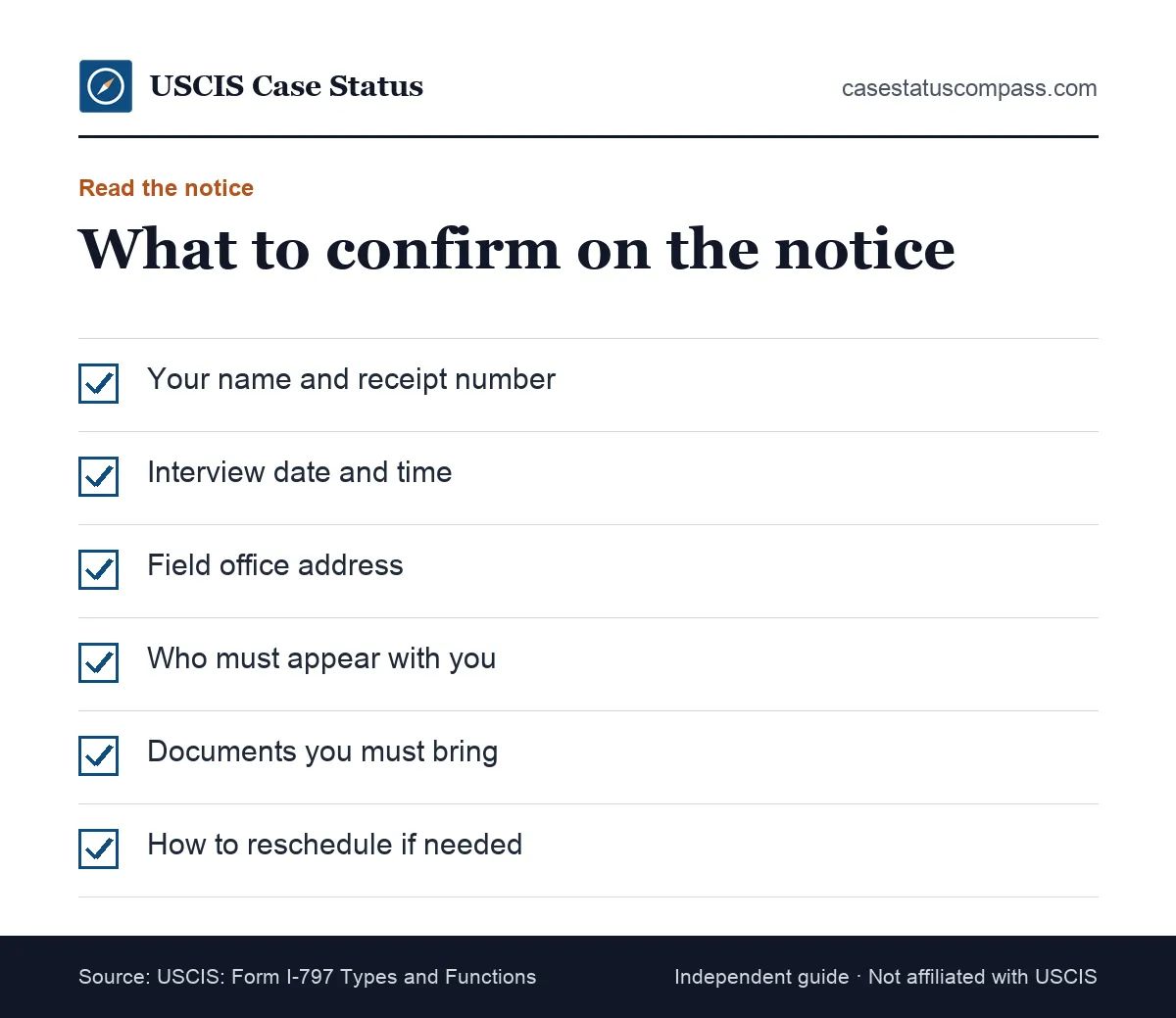
Who must attend
Read the notice for every name listed. In marriage-based green card cases, the petitioning spouse is often required too, and children may be listed separately. If someone named cannot attend, call before the date.
The documents list
The notice lists the originals to bring; treat it as the minimum. Our guides to green card interview questions and the citizenship interview cover what officers commonly ask and how people prepare.
What If the Status Says Scheduled but No Notice Came?
If the status says Interview Was Scheduled but no notice arrived, check your online account, your address on file and your attorney's mail. Then call the USCIS Contact Center to confirm the date and request a copy. Official delivery timing is not published.
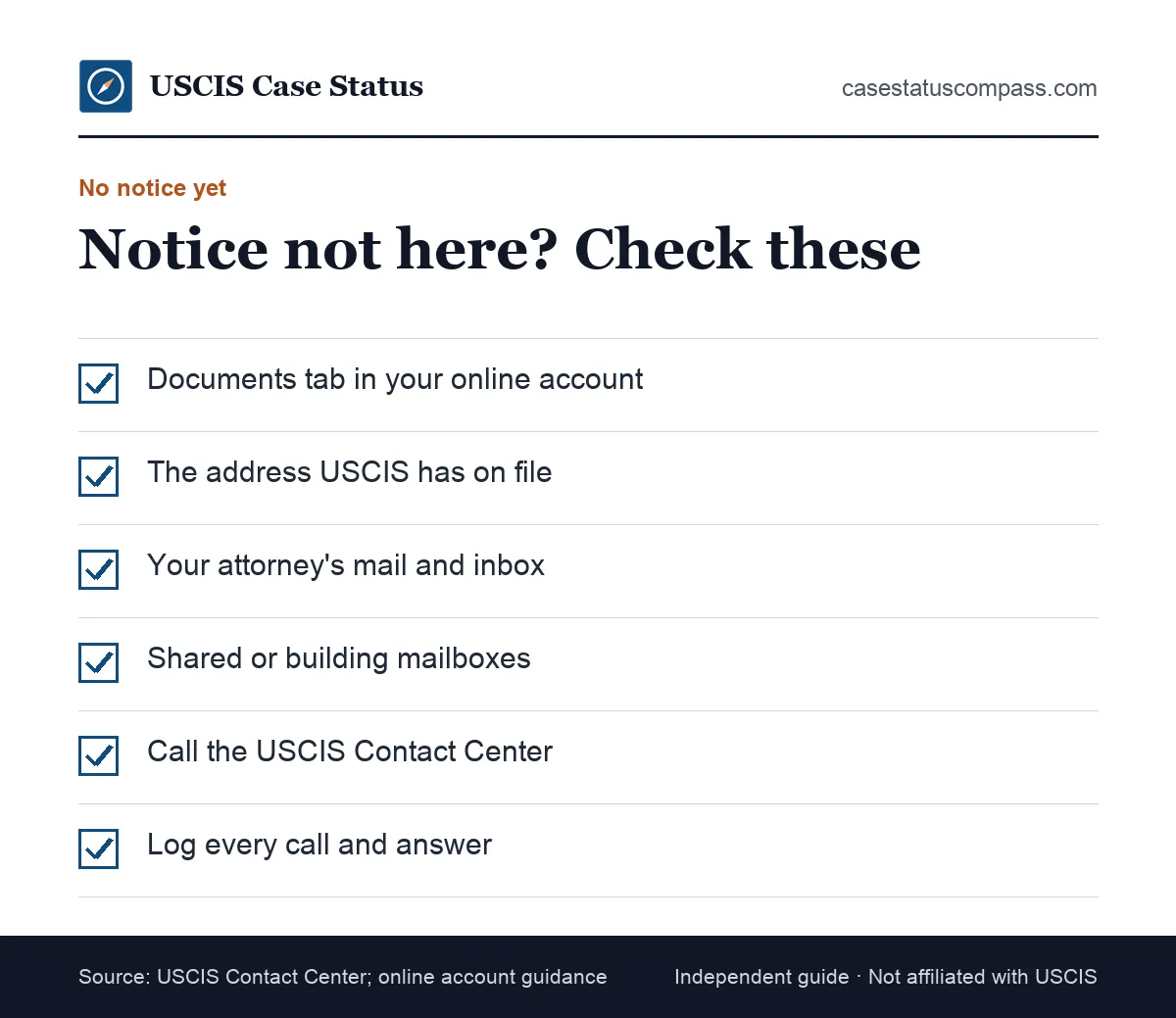
Call the Contact Center
Call 800-375-5283 (TTY: 800-767-1833). Live calls and chat: Monday to Friday, 8 a.m. to 8 p.m. Eastern. Have your receipt number ready, ask for the date, time and office, and note the agent's name. Our contact USCIS guide lists other channels.
Fix your address if it is wrong
A notice sent to an old address may never reach you. Update your address right away; our USCIS change of address guide explains how. Then ask whether the notice can be resent.
Can You Check Your Interview Date Online?
You can usually see the interview date in two places: the appointment notice in your online account and, sometimes, the public status text. The account is more reliable because it shows the notice itself, not a summary line.
If the two ever disagree, trust the notice.
Online account vs public status page
The public tool at Case Status Online: egov.uscis.gov shows only the latest action. The account shows case history and documents. Sign up free at myaccount.uscis.gov/create-account; our USCIS online account number guide explains how paper cases link.
When the status text shows no date
Some status messages say only that a notice was mailed. Then the date lives on the notice itself, so download it from your account or call the Contact Center rather than guessing.
How Do You Verify an Interview Notice Is Real?
A genuine interview notice names your receipt number, matches the official status page and lists a real USCIS field office. Check the receipt number on Case Status Online: egov.uscis.gov. USCIS does not ask for payment to attend an interview.
Any demand for a fee is a warning sign.
Quick checks before you travel
Look up the field office address on uscis.gov rather than trusting a printed phone number, and compare the date with your status page. Our guide to verify a USCIS notice and our page on USCIS scam warning signs cover the common tricks.
Fake interview calls and emails
Scammers sometimes call or email claiming you must pay to confirm or keep your interview slot. USCIS does not charge to attend an interview, so hang up and check the date in your own online account.
What If the Office Cannot Find Your Interview?
Occasionally a person arrives and staff cannot find the appointment. This is rare. Bring the printed appointment notice and a status screenshot, ask politely for a supervisor, and write down names.
Most mix-ups come from a rescheduled date or an office change that the applicant missed, so check your account for a newer notice before you leave home on the day.
Bring proof of the notice
The paper notice is your best proof; keep a PDF on your phone as a backup. If staff say the interview was cancelled, ask for that in writing or check your account for a cancellation notice.
Following up the same day
If you are turned away, call the Contact Center that day, describe what happened and ask for a service request. Keep your parking or transit receipts as proof that you came.
Where Is the Interview Held and How Do You Get In?
Most green card and citizenship interviews take place at the USCIS field office named on the notice; asylum interviews use an asylum office. Expect airport-style security at the entrance, so arrive early and bring only what you need.
Allow at least 30 minutes for the line.
Finding the right office
Use the address on your notice and confirm it with the office locator on uscis.gov, since some cities have more than one office. Plan parking or transit the week before, and check for closures on the day.
Security screening basics
Bring a government photo ID and the notice. Large bags, sharp items and some electronics may not be allowed. Rules vary by building, so read any instructions on the notice.
Which Cases Usually Get an Interview?
Interviews are standard for most Form I-485 adjustment and Form N-400 naturalization cases. They are common for affirmative asylum on Form I-589 and happen in some Form I-751 and Form I-130 cases. Forms such as I-765 are usually decided on paper.
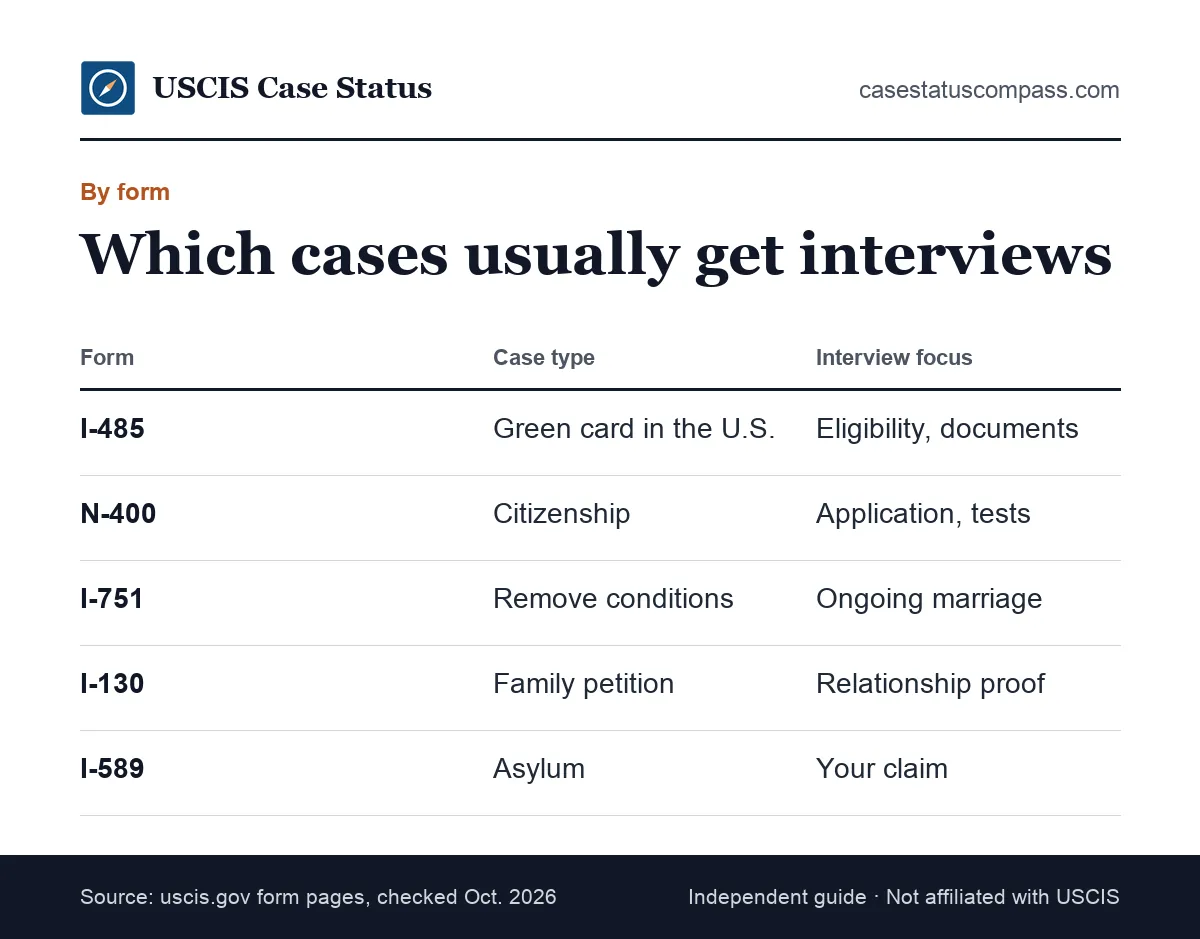
Interviews by form
This table shows, form by form, how likely an interview is and which kind of office usually holds it.
| Form | How often interviewed | Where |
|---|---|---|
| I-485 | Usually | Local field office |
| N-400 | Almost always | Local field office |
| I-751 | Sometimes | Local field office |
| I-130 | Sometimes (often with I-485) | Field office |
| I-589 | Usually | Asylum office |
| I-765, I-90 | Rarely | Usually no interview |
In short, an interview notice is routine for green card, citizenship and asylum cases, while a scheduled interview on a work permit or card renewal is unusual and worth asking about.
Can USCIS Approve Your Case Without an Interview?
Yes. USCIS sometimes decides a case without an interview, often called an interview waiver. USCIS makes that choice; you cannot request it through the status page. Our green card interview guide covers waivers in detail.
As of October 2026, USCIS says: USCIS can waive the green card interview case by case.
How a waived case shows up in your status
A waived case skips this update and usually moves from review straight to a decision or an RFE. If your form often gets an interview and none is scheduled, that alone is not a problem.
Interview Scheduled for a Form I-485 Case
For a Form I-485 green card case, the interview is where the officer confirms your eligibility to adjust status. Family cases usually include the petitioner. Officers often decide shortly after, but some cases go back for more review or an evidence request.
Medical exam and other paperwork
Some offices check that your Form I-693 medical exam is on file or ask you to bring it. Our guide on the immigration medical exam explains the form. Our Form I-485 guide covers the application itself.
Linked I-765 and I-131 filings
If you filed a work permit or travel document with your I-485, the interview does not usually change those cases, which have separate receipt numbers and decisions. Keep your EAD and advance parole documents valid while you wait.
Interview Scheduled for a Form N-400 Case
For a Form N-400 citizenship case, the interview is also where you take the English and civics tests. The officer reviews your application under oath. You may get results the same day in writing, or a later notice if more review is needed.
Where to prepare for the tests
Our citizenship test guide covers the civics questions, and the citizenship application guide explains eligibility. This page stays focused on what the status itself means.
If you fail a part, Two chances to pass; retest of the failed part 60-90 days after the interview.
Results on Form N-652
Many officers hand you Form N-652, Naturalization Interview Results, before you leave. It says whether you passed the tests and whether the case was granted, continued or denied. Keep it with your notice.
What Happens After You Pass the Citizenship Interview?
If the officer approves the N-400, the next step is the oath ceremony, which completes naturalization. Some offices hold same-day ceremonies; most schedule one later. Our oath ceremony guide explains the day.
As of October 2026, USCIS notes: You may be able to take the oath the same day as your interview. Until you take the oath, you are still a permanent resident, so keep your green card and follow its travel rules.
Interview Scheduled for a Form I-751 Case
A Form I-751 interview checks that your marriage is ongoing or was genuine when entered. Many I-751 cases are decided without one, so prepare carefully. Bring joint evidence created since your conditional green card was issued.
If your conditional green card has expired, carry the receipt notice.
Your status while you wait
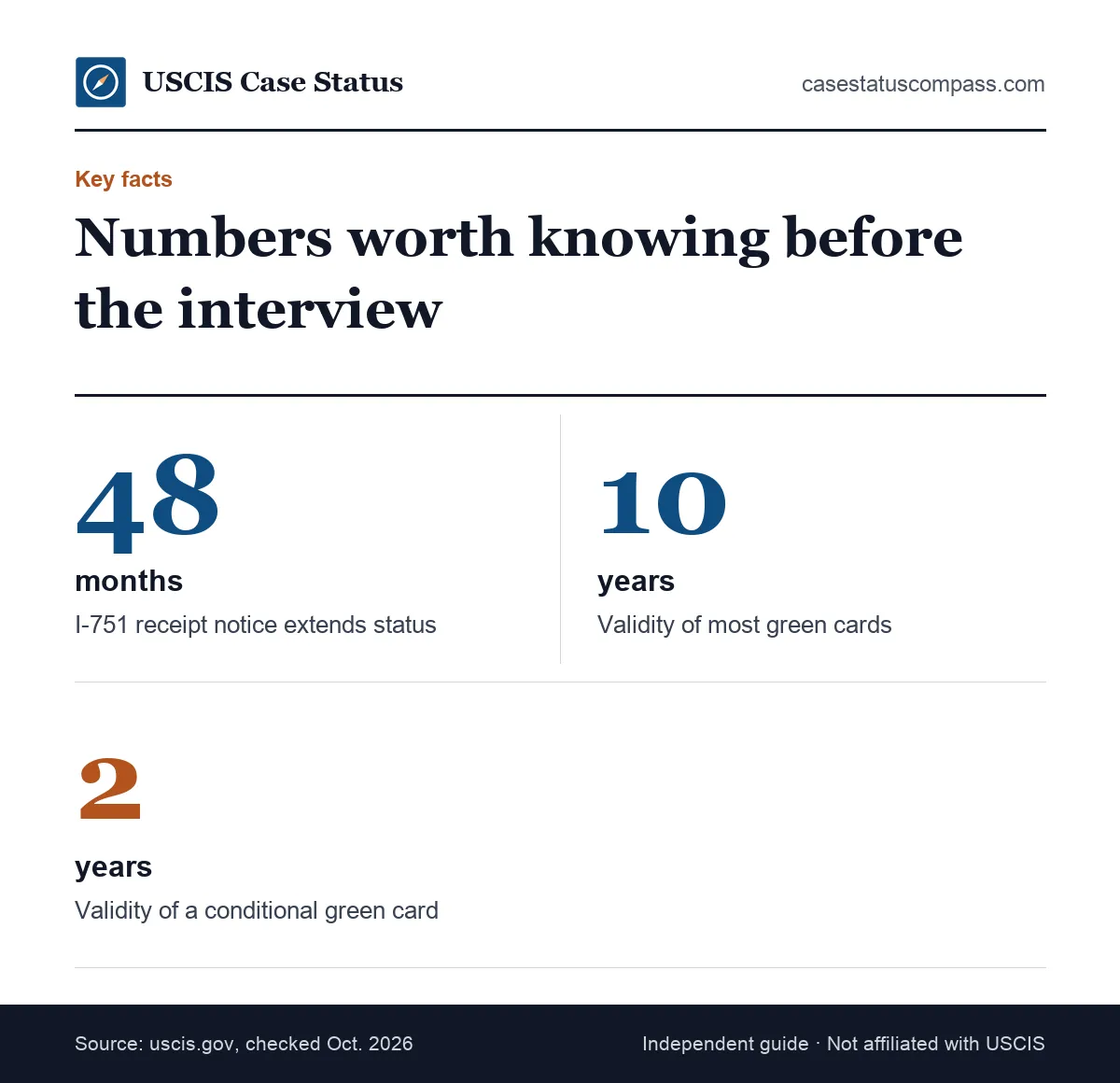
Your I-751 receipt notice protects your status during the wait. As of October 2026, USCIS says: I-751 receipt notice extends conditional status and work authorization for 48 months. Carry it with your expired card. Our Form I-751 guide covers the filing rules.
When divorce or separation changed things
If your marriage ended, the interview may focus on whether it was genuine when it began. Speak with an immigration attorney first, and bring evidence from the years you lived together.
Interview Scheduled for an Asylum or Family Petition Case
Affirmative asylum interviews take place at an asylum office, not a field office, and follow their own procedures, including interpreter rules. Family petition interviews on Form I-130 focus on the relationship. In both, the notice explains what to bring and who must appear.
I-130 relationship interviews
When an I-130 is interviewed, the officer focuses on proof of the relationship, such as a genuine marriage. Our Form I-130 guide explains what the petition needs and which documents help.
Do You Need a Lawyer for an Asylum Interview?
It is strongly advised. An asylum interview is a detailed review of your claim and can lead to a referral to immigration court. Do not attend unprepared. A nonprofit or attorney can help. Our asylum status guide explains the current process.
How Long After Biometrics Does the Interview Happen?
There is no fixed gap between biometrics and the interview; it depends on the form and the field office calendar. We could not confirm office-level timing on an official page. Our guide on how long after biometrics for interview explains what drives the wait.
Checking official processing times
USCIS publishes current times at egov.uscis.gov/processing-times. The tool shows times by form and office, not a biometrics-to-interview gap. For a personal estimate, myProgress may help: myProgress: personalized estimates in your USCIS online account (I-130, I-485, I-765, I-131, I-821, N-400, I-90).
Is a Biometrics Appointment the Same as Your Interview?
No. A biometrics appointment is a short visit to an Application Support Center for fingerprints and a photo. An interview is a meeting with an officer at a field office, under oath. The biometrics appointment guide covers that earlier step.
What Should You Do the Week the Status Changes?
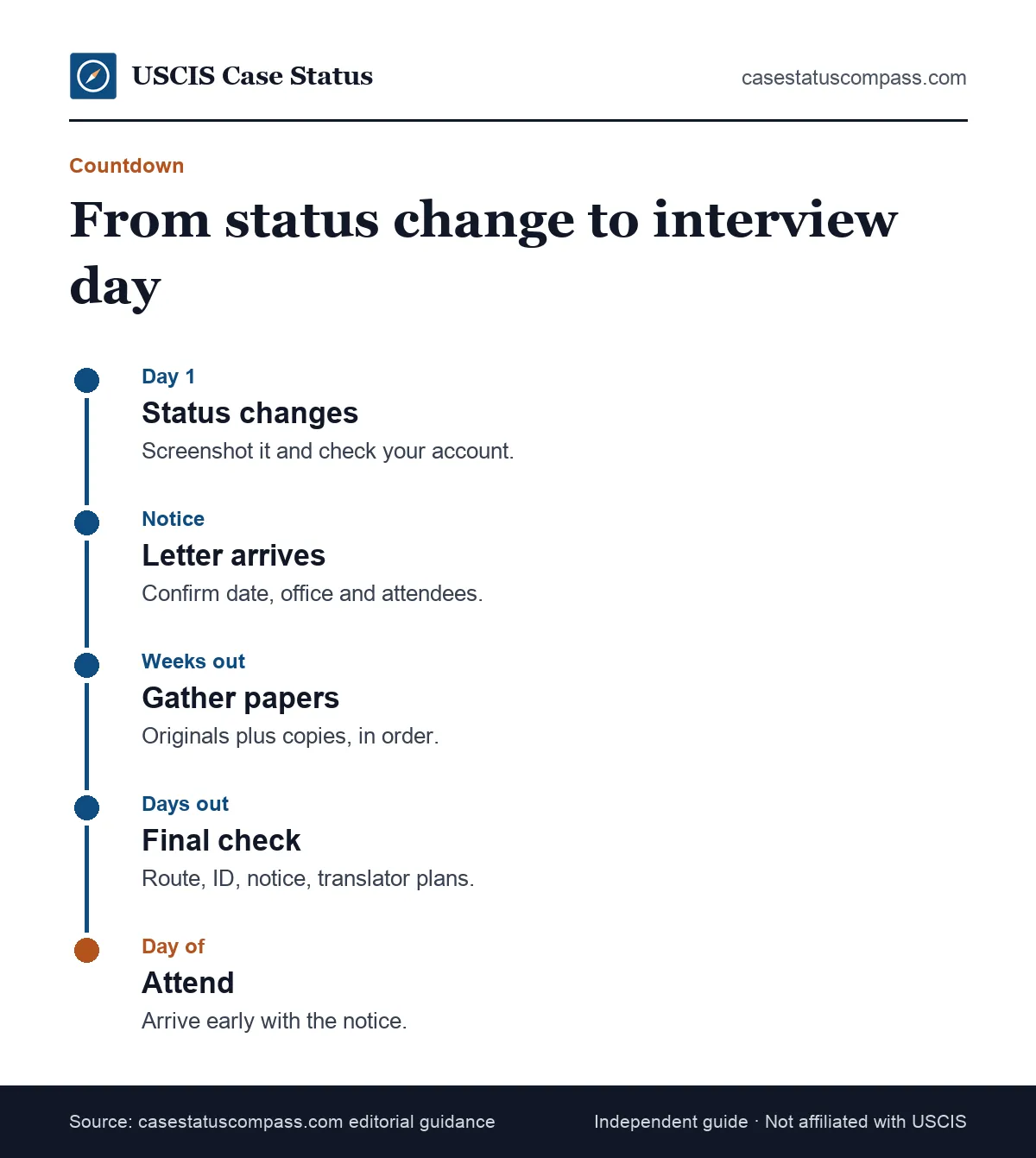
In the first week, find the notice, calendar the date, confirm who must attend and tell your attorney. Then plan time off, childcare and travel, and start gathering originals. Small logistics problems cause more missed interviews than legal ones.
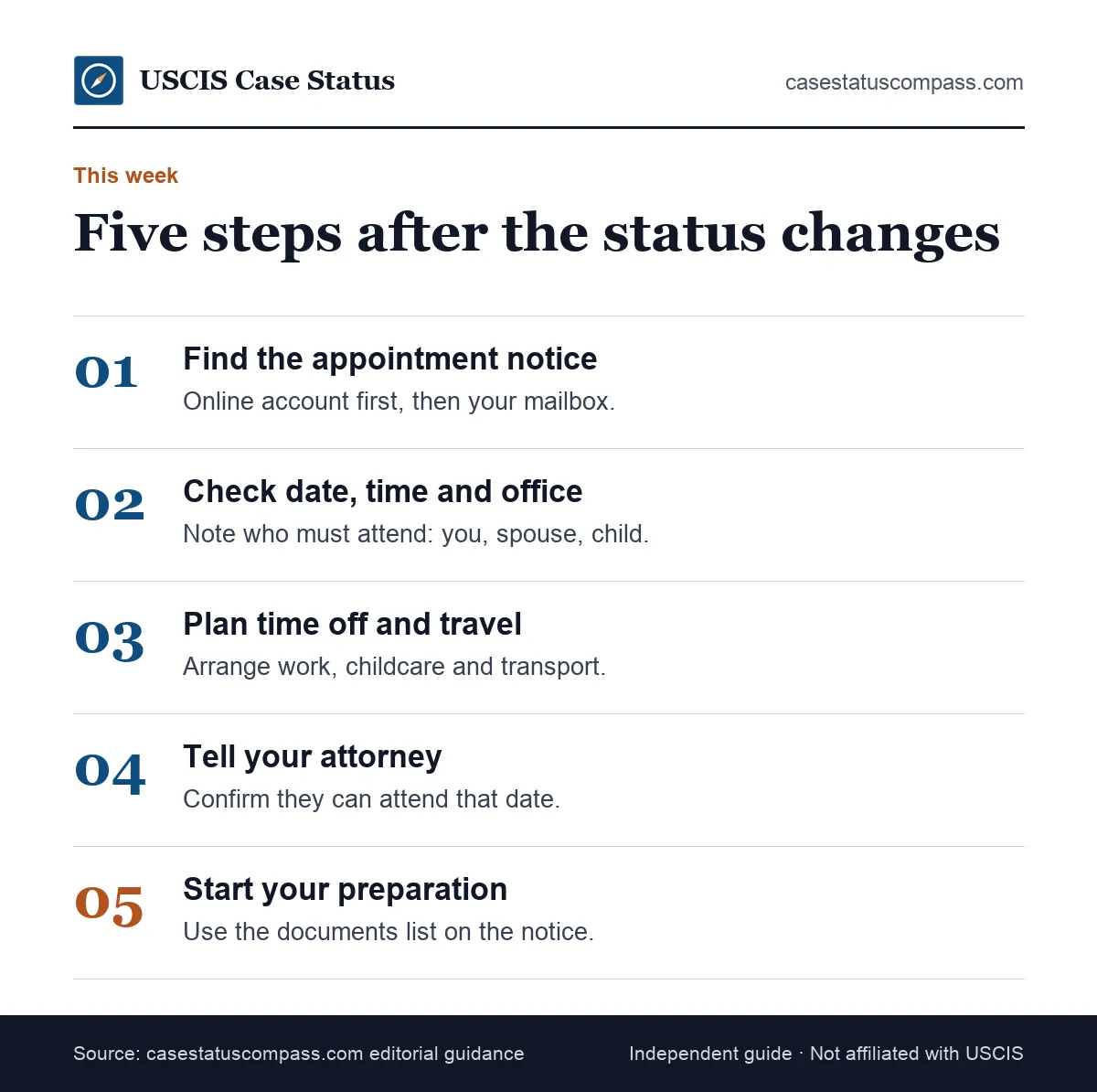
Start with the notice, since every other task depends on its date and its list of who must attend.
Save a record of the update
Take a dated screenshot of the status page. If a notice goes missing or the date changes, it shows what USCIS told you and when.
Save it as a PDF with the date in the file name.
Check your attorney's availability
If an attorney represents you, they normally receive a copy of the notice. Confirm they can attend; if not, ask whether they will request a new date or send a colleague.
How Do You Prepare Without Overdoing It?
Preparation means knowing your own forms, bringing the documents on the notice and planning the logistics. Read your filed application again, because the officer will ask about it. Question lists live in our dedicated interview guides.
Two focused evenings usually beat weeks of worry.
Re-read what you filed
The officer will compare your answers with your filed forms, so re-read every page. If a job, address, trip or family detail changed since you filed, be ready to explain.
Where to find full preparation guides
Use our green card interview guide for marriage and adjustment cases, the citizenship interview preparation guide for naturalization, and the USCIS interview hub for every appointment type.
Pick the one that matches your form, and skip generic question lists that ignore your case type.
What Should You Bring on Interview Day?
Bring the appointment notice, a government photo ID, your passport and every original listed on the notice, plus copies. That short list covers most interviews; detailed checklists by case type live in our interview guides.
When in doubt, bring the original.
The non-negotiables
- The interview notice itself
- Photo ID and passport
- Green card or EAD, if you have one
- Originals and copies from the notice list
- Certified English translations of foreign documents
Pack them in one folder the night before.
Proof of facts that changed since filing
If your job, address or family changed after filing, bring proof such as a new pay stub, lease or birth certificate. It can let the officer finish the case without a later request.
Can You Reschedule a USCIS Interview?
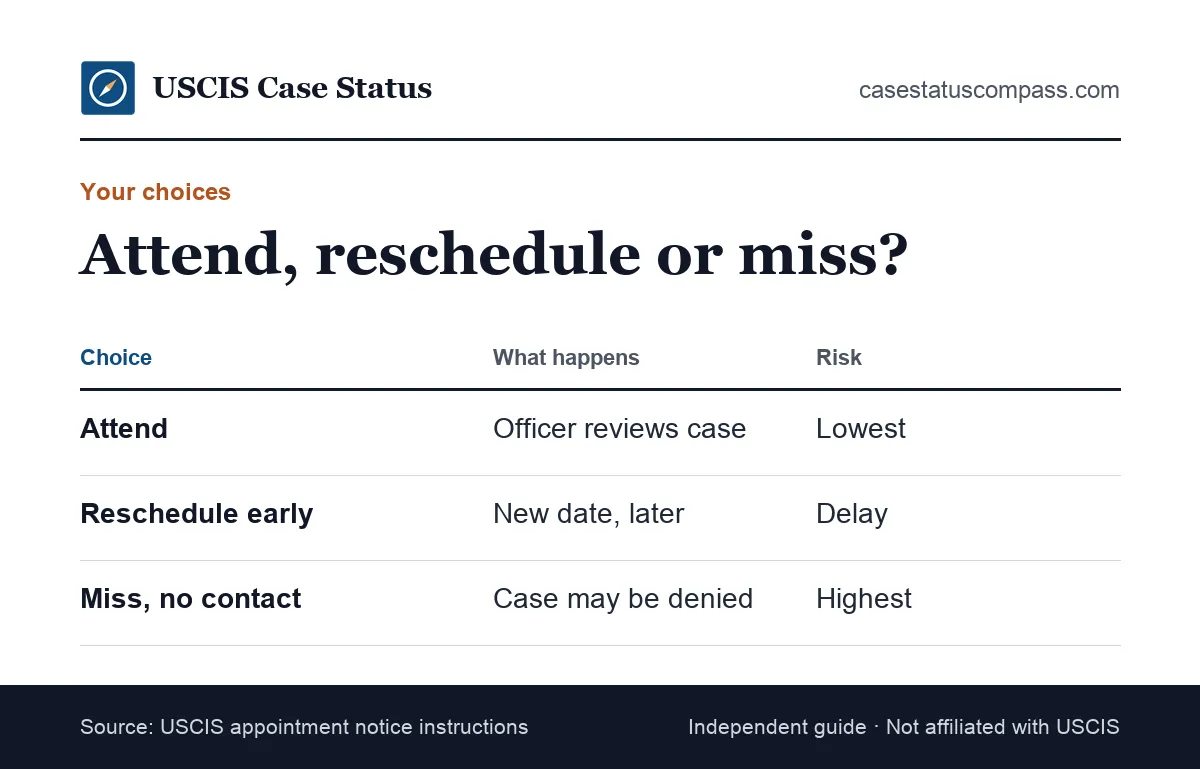
Yes, in most cases, but only for a good reason and as early as possible. Follow the rescheduling instructions on your notice, or contact USCIS. Rescheduling usually means a later date, sometimes much later. Never just skip the interview.
How to ask for a new date
Use the method on your notice, then confirm by calling 800-375-5283. You can also request an appointment: Request an in-person appointment online at my.uscis.gov/en/appointment/v2 or call 800-375-5283. Keep proof of every request. Asylum interview rules are stricter.
Good reasons and poor reasons
Illness, a medical emergency, a death in the family or a notice that arrived too late are common good reasons; convenience usually is not. Keep proof, such as a doctor's note.
What Happens If You Miss the Interview?
Missing a scheduled interview without contacting USCIS can lead the office to treat the case as abandoned and deny it. If you missed it, contact USCIS right away, explain why with proof and ask for a new date.
Do it the same day if you can; an explanation with proof sent quickly is easier to accept than one sent weeks later.
If the case was denied after a missed interview
A denial for a missed interview is serious but sometimes fixable with an attorney's help. Our page on what case was denied means explains the status and the first safe steps.
Proof that helps later
Keep the envelope, postmarks and any proof that the notice arrived late or at the wrong address, plus medical or travel records. These support a request for a new date or a later motion.
Can a Lawyer or Interpreter Come With You?
Your attorney or DOJ-accredited representative can usually attend with you, especially if they filed Form G-28 for your case. Interpreter rules vary by interview type, and your notice explains whether you must bring one.
Tell USCIS in advance if you will bring either.
When to bring an attorney
Bring an attorney if your case has a past denial, criminal history, immigration violation, a divorce or any complex fact. The attorney can object to improper questions and help clarify answers. Our immigration lawyer cost guide explains fee models.
Interpreter rules by interview type
Interpreter rules differ between field office and asylum interviews and have changed in recent years. Follow the instructions on your notice, and if you must bring an interpreter, choose someone fluent and neutral.
For green card interviews, USCIS guidance as of October 2026 reads: Need an interpreter? Bring one with government ID; they sign an oath (Form G-1256).
How Do You Request a Disability Accommodation for the Interview?
If you need a disability accommodation, such as a sign language interpreter or step-free access, request it as soon as you receive the notice. The USCIS Contact Center can take the request. Do not wait until the day.
As of October 2026, USCIS says you can request accommodations online or at 800-375-5283; asylum and NACARA 203 applicants must call. Keep a note of when you asked.
Can You Travel Before Your Interview?
Travel abroad before the interview can cause problems if your case depends on staying in the United States, such as a pending Form I-485. Leaving without valid advance parole can abandon the application. Domestic travel is fine.
Ask an attorney before booking any trip abroad.
Rules for pending I-485 applicants
Our guide on travel with a pending I-485 explains how advance parole works. As of October 2026, the I-131 advance parole fee is $630 (paper) / $580 (online); $0 if your I-485 was filed before Apr. 1, 2024 with the fee. H.R. 1 Immigration Parole Fee $1,050 when parole is granted (some exceptions).
Can Green Card Holders Travel With a Pending N-400 Interview?
Permanent residents with a pending N-400 can usually travel, but long trips can affect continuous residence, which the officer reviews at the interview. Our green card holder travel rules explain the limits. Never miss the interview because you are abroad.
What If You Moved After the Interview Was Scheduled?
If you move after the interview is scheduled, update your address with USCIS right away and ask whether your case should move to another office. Moving across the country may cause a transfer and a new date.
The law sets a short window: Report a new address to USCIS within 10 days of moving (INA 265).
Moving locally
A short move inside the same area usually keeps the same field office. Still update the address, because later notices and your card go there, and bring proof of the new address to the interview.
Will a Case Transfer Change Your Interview Date?
Usually, yes. If USCIS moves the file, your status may change to case was transferred, and a new interview notice should follow from the new office. Attend only the date on the newest notice.
Your receipt number stays the same.
Your Status Still Says Scheduled After the Interview
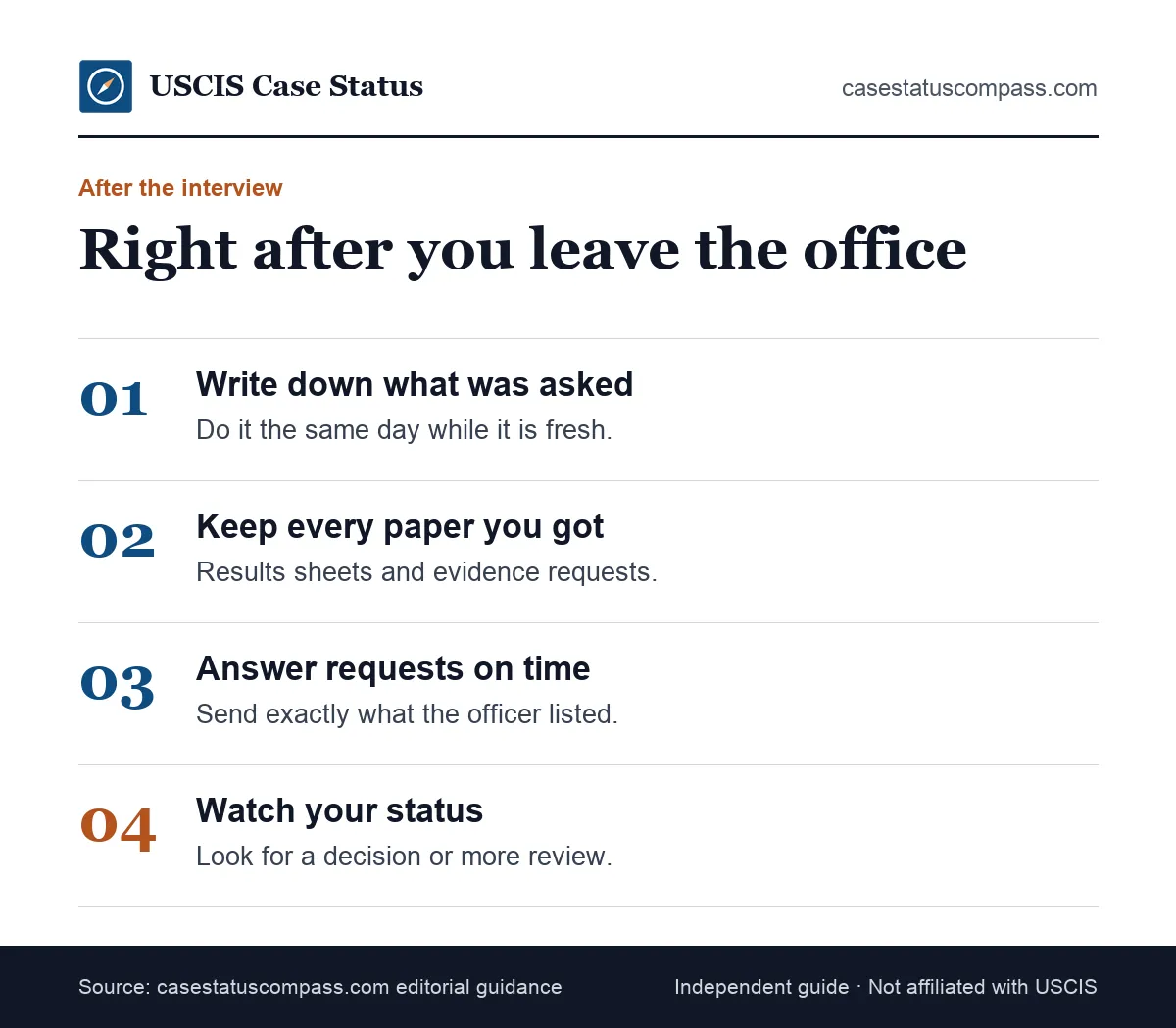
It is common for the status to stay on Interview Was Scheduled for days or weeks after you attended. It updates when the officer enters a result, not when you leave the building. Keep any paper the officer gave you.
When the next update usually comes
Next comes an approval, an RFE or a review status. Our page on approval case decision rendered explains the approval message, and our guide to a USCIS case status not updating explains when a frozen status is worth chasing.
Papers the officer may hand you
At the end of some interviews, the officer gives a written results sheet or a request for more documents. Read it before you leave; it says whether anything else is needed and by when.
What Happens After the Interview?
After the interview, the officer approves the case, asks for more evidence, continues review or, in some cases, denies it. Approved green card cases move to card production; citizenship cases move to the oath ceremony. The next update shows which path you took.
Possible outcomes compared
The table lists the four results that usually follow an interview and the next step each one starts.
| Outcome | What you may see | What comes next |
|---|---|---|
| Approved | Approval status | Card production or oath ceremony |
| More evidence needed | RFE status or paper at interview | Reply by the deadline |
| Further review | Actively reviewed status | Decision later |
| Denied | Case Was Denied | Read the notice; get advice |
Most outcomes keep the case moving; only a denial calls for urgent advice, and an RFE simply needs a complete reply on time.
If a card is coming
For an approved green card case, statuses such as new card is being produced follow. As of October 2026, USCIS says: Most green cards are valid for 10 years; conditional green cards for 2 years.
Does an Interview Mean Background Checks Are Done?
Not always. An interview is usually scheduled after initial checks, but some security checks can still be pending when you attend. That is one reason cases stay in review after a good interview, and it is not a problem by itself.
What may still happen after the meeting
The officer may need supervisor review, a check to clear, or a document you did not bring. Expect a review status or a written request; if months pass, check processing times before contacting USCIS.
Three Interview Scheduling Scenarios
These short examples show how the same Interview Was Scheduled update can lead to very different next steps. Each is based on common patterns, not a single case.
The names are fictional. Read the one closest to your situation and copy the order of steps, not the timing, because every field office runs its own calendar and notices can arrive at different speeds.
Scenario 1: Notice arrives with three weeks to spare
Maria sees the update, finds the notice in her account two days later and has three weeks. She books time off, tells her attorney and gathers originals: the typical, low-stress path.
Scenario 2: The notice went to an old address
David moved but updated USCIS late, so no letter came. He calls the Contact Center, gets the date, updates his address and downloads the notice from his account.
He keeps a note of the call.
Scenario 3: A surgery clashes with the date
Lin has surgery the same week. She follows the rescheduling steps on the notice, sends a doctor's letter and keeps proof. Her new date is later, but her case stays on track.
Decision Table: What to Do Now
Match your situation to a safe next step. This is a planning aid, not legal advice. When the stakes are high, such as a missed interview or a complex history, involve an immigration attorney or DOJ-accredited representative early.
If more than one row fits, handle the one with the nearest deadline first.
If X, then do Y
Find your situation in the left column, take the first step today and use the third column as the follow-up.
| Your situation | First step | Then |
|---|---|---|
| No notice yet | Check online account; confirm address | Call Contact Center |
| Notice arrived, date works | Calendar it; tell your attorney | Gather listed documents |
| Date does not work | Follow reschedule steps | Keep proof of the request |
| You missed the interview | Contact USCIS with proof | Ask an attorney |
| You moved | Update address now | Watch for a transfer |
| Interview done, status unchanged | Keep officer's papers | Check processing times |
Notice that almost every row starts with checking the notice or your address; those two habits prevent most missed interviews.
What Mistakes Cause Problems at This Stage?
The most common mistakes are trusting the status line instead of the notice, ignoring a changed address, arriving without required originals, bringing the wrong people and traveling abroad without advice. A simple checklist prevents each.
Run through that checklist a week before the date and again the night before.
Logistics mistakes
Arriving late or forgetting the notice and ID can cost you the slot. Plan the route the week before, and leave time for security checks.
Also check closures that morning.
Paperwork mistakes
Bring both originals and copies, and translate any foreign document into English with a translator's certification. Missing translations often trigger evidence requests.
Sort them in the order of the notice list.
Answer mistakes
Guessing, or giving an answer that differs from your filed forms without explaining why, causes more trouble than saying you do not remember. Ask the officer to repeat any question you did not understand.
What Interview Papers Belong in Your Case Folder?
Keep the appointment notice, your full filed application, every receipt notice, your status screenshots and any paper the officer gives you. These help if a notice goes missing, a decision is delayed or you must show what happened.
Bring the folder with you.
A simple case folder
Use one folder per receipt number, newest notice on top, plus a one-page list of key dates: filing, biometrics, interview and follow-up.
Add the officer's papers to it the same day, so nothing gets lost between the interview and the decision.
Digital backups
Scan the notice and key documents to a secure folder or phone. A digital copy helps if papers are lost on the way. Never share the scans publicly.
Use a password-protected folder.
Why Do the Talk-to-a-Lawyer Warnings Matter?
An interview is given under oath, and your answers become part of your record. If your case involves a criminal record, a past immigration problem, a prior denial or a changed marriage, an immigration attorney or DOJ-accredited representative can prepare you.
Signs you should get legal help first
- Any arrest or conviction, anywhere
- A past visa overstay or removal order
- A previous USCIS denial
- Divorce or separation after filing
- An asylum or humanitarian case
Any one of these is enough reason to book a consultation before the interview date.
Finding affordable help
Nonprofits with DOJ-accredited representatives often charge less than private firms. Confirm the person is listed on the Department of Justice roster before sharing documents or paying.
Ask about fees at the first call.
Key Takeaways About This Status
The status means a date was set, not that a decision was made. The written notice is the source of truth for the date, office and documents. Keep your address current and never skip without contacting USCIS.
If anything on the notice confuses you, ask your attorney or the Contact Center well before the date, not at the door.
Quick reference
Keep these verified contact details handy for the weeks before and after the interview, and confirm any number on uscis.gov.
| Item | Detail (Oct. 2026) |
|---|---|
| Official status tool | Case Status Online: egov.uscis.gov |
| Contact Center | 800-375-5283; 212-620-3418 (callers outside the U.S.) |
| Online account sign-up | myaccount.uscis.gov/create-account |
More status meanings
For other updates you may see before or after the interview, browse our hub of USCIS case status meanings, which explains each message.
Frequently Asked Questions
Does interview was scheduled mean my case will be approved?
No. It means the case is ready for an officer to meet you. Many interviewed cases are approved, but the outcome depends on your eligibility, evidence and answers.
Can I reschedule a USCIS interview?
Usually yes, if you have a good reason and ask before the date. Follow the instructions on your appointment notice or contact the USCIS Contact Center, and expect a later date. Never skip without contacting USCIS.
How far in advance does USCIS schedule interviews?
USCIS does not publish a standard notice period, and we could not confirm one on an official page. Many people get their notice several weeks before the date, so check your online account often.
Does my spouse have to attend the green card interview?
In many marriage-based cases, yes. The notice lists who must appear. If it names your spouse and they cannot attend, contact USCIS before the date.
Can I bring my children to the interview?
Children who are applicants are usually listed on the notice and must attend. Others can sometimes come, but rules vary by office, so check the notice or ask the Contact Center.
What if the date on the notice differs from my status page?
Use the date on the newest written notice, because status pages may lag. If two notices conflict, call the Contact Center to confirm, and keep both notices.
Why did my status go back to Interview Was Scheduled?
A status can return to this message after a reschedule, a transfer or a second interview. Look for a new notice with a new date; if none arrives, contact USCIS.
Will I get a decision at the end of the interview?
Sometimes. Some officers approve on the spot or hand you a results sheet; others need more review. Keep any paper the officer gives you and watch your status and mail afterward.
How long does a USCIS interview usually last?
USCIS does not publish a standard length, and it varies by case type. Plan for several hours at the office, counting security and waiting time.
Is the interview recorded or under oath?
You are placed under oath at most USCIS interviews, and the officer notes your answers in the record. Answer truthfully and ask for any unclear question to be repeated.
Sources
- USCIS: Form I-797 Types and Functions. www.uscis.gov/forms/filing-guidance/form-i-797-types-and-functions. Accessed Oct 27, 2026.
- USCIS Contact Center. www.uscis.gov/contactcenter. Accessed Oct 27, 2026.
- USCIS: Benefits of a USCIS Online Account. www.uscis.gov/file-online/benefits-of-a-uscis-online-account. Accessed Oct 27, 2026.
- USCIS: Checking Your Case Status Online. www.uscis.gov/tools/checking-your-case-status-online. Accessed Oct 27, 2026.
- USCIS: Establishing Good Cause for Rescheduling Affirmative Asylum Interviews. www.uscis.gov/humanitarian/refugees-and-asylum/asylum/establishing-good-cause-or-exceptional-circumstances-for-rescheduling-affirmative-asylum-interviews. Accessed Oct 27, 2026.
- USCIS: Form I-751 page. www.uscis.gov/i-751. Accessed Oct 27, 2026.
- USCIS: Online Account and Technical Support. www.uscis.gov/tools/uscis-tools-and-resources/online-account-and-technical-support. Accessed Oct 27, 2026.
- USCIS Policy Manual Vol. 7, Part A, Ch. 5 (Interview Guidelines). www.uscis.gov/policy-manual/volume-7-part-a-chapter-5. Accessed Oct 27, 2026.
- USCIS: The Naturalization Interview and Test (updated 10/31/2025). www.uscis.gov/citizenship/learn-about-citizenship/the-naturalization-interview-and-test. Accessed Oct 27, 2026.
- USCIS: Naturalization Ceremonies (updated 02/12/2026). www.uscis.gov/citizenship/learn-about-citizenship/naturalization-ceremonies. Accessed Oct 27, 2026.
- USCIS: Removing Conditions on Permanent Residence Based on Marriage (updated 12/12/2023). www.uscis.gov/green-card/after-we-grant-your-green-card/conditional-permanent-residence/removing-conditions-on-permanent-residence-based-on-marriage. Accessed Oct 27, 2026.
- USCIS Check Case Processing Times. egov.uscis.gov/processing-times/. Accessed Oct 27, 2026.
- USCIS alert: USCIS Expands myProgress to Form I-485 and Form I-821 (Nov. 21, 2023). www.uscis.gov/newsroom/alerts/uscis-expands-myprogress-to-form-i-485-and-form-i-821. Accessed Oct 27, 2026.
- USCIS: Preparing for Your Biometric Services Appointment (updated 04/30/2026). www.uscis.gov/forms/filing-guidance/preparing-for-your-biometric-services-appointment. Accessed Oct 27, 2026.
- USCIS Form G-1055 Fee Schedule, Edition 10/16/26 (Appendix B). www.uscis.gov/sites/default/files/document/forms/g-1055.pdf. Accessed Oct 27, 2026.
- USCIS: How to Change Your Address (updated 08/04/2026); 8 U.S.C. 1305(a) (LII). www.uscis.gov/addresschange. Accessed Oct 27, 2026.
- USCIS Glossary: Green Card. www.uscis.gov/tools/glossary. Accessed Oct 27, 2026.
casestatuscompass.com is an independent publication and is not affiliated with USCIS or any government agency. This page is general information, not legal advice. For denials, court or asylum matters, consult an immigration attorney or a DOJ-accredited representative.