Contents · 44 sections
- What Does "Card Was Returned to USCIS" Mean?
- Is a Returned Card Lost or Destroyed?
- Why Do Cards Get Returned to USCIS?
- How Does a Returned Card Fit Into the Card Timeline?
- How Long Does USCIS Keep a Returned Card?
- Does USCIS Search for a Newer Address Before Destroying the Card?
- What Should You Do First After a Card Was Returned to USCIS?
- How to Get Your Card Re-sent
- Which Address Will USCIS Use for a Second Mailing?
- Updating Your Address to Prevent It
- Does Form AR-11 Update Every Pending Case?
- Is There a Fee to Get a Returned Card Back?
- What If USCIS Already Destroyed the Card?
- Card Was Returned to USCIS on a Form I-485 Green Card Case
- What If Your Returned Card Is a Work Permit?
- Returned Cards After a Form I-90 Renewal
- What If Your Replacement Card Was Returned After Mail Theft?
- Returned 10-Year Cards After a Form I-751
- What If Both Spouses Moved During the I-751?
- Returned Cards in VAWA, SIJ and Other I-360 Cases
- How Is a Returned Card Different From a Returned Notice?
- What If an Approval or Appointment Notice Comes Back?
- What If a Travel Document Was Returned?
- How Can You Tell a Card Is Heading Back Before the Status Changes?
- Can You Stop a Return Before It Reaches USCIS?
- What Information Will USCIS Ask For?
- Your Situation and the Right Next Move
- What If the Status Says Returned but You Never Moved?
- What If the Carrier Marked a Valid Address Undeliverable?
- What If You Are Abroad When the Card Comes Back?
- Cards Returned From an Attorney's Office
- Mistakes That Lead to a Second Return
- Why Shouldn't You Ask for a Resend Too Early?
- How Long Does a Re-sent Card Take to Arrive?
- What If the Re-sent Card Is Returned Again?
- Should You Use a Different Address for the Third Mailing?
- Does a Returned Card Affect Your Immigration Status?
- When Should You Escalate a Returned Card?
- When Should You See an Immigration Attorney?
- What Records Should You Keep While the Card Is Held?
- Returned-Card Examples
- How Is "Returned" Different From "Mailed" or "Being Produced"?
- Following the Return in Your USCIS Online Account
- Frequently Asked Questions
The short answer
Card was returned to USCIS means USPS tried to deliver your green card or work permit and could not, so the envelope went back to USCIS. The card is being held, not cancelled. Fix your address with USCIS and contact USCIS quickly, because returned cards are kept only for a limited period.
At a glance
| Is your case still approved? | Yes. A failed delivery does not change the decision. |
| Where is the card? | Back at USCIS, waiting for a valid address |
| Main risk | USCIS destroys unclaimed returned cards after a holding period |
| What to do today | Update your address and ask USCIS to mail it again |
| Contact | e-Request or 800-375-5283 |
What Does "Card Was Returned to USCIS" Mean?
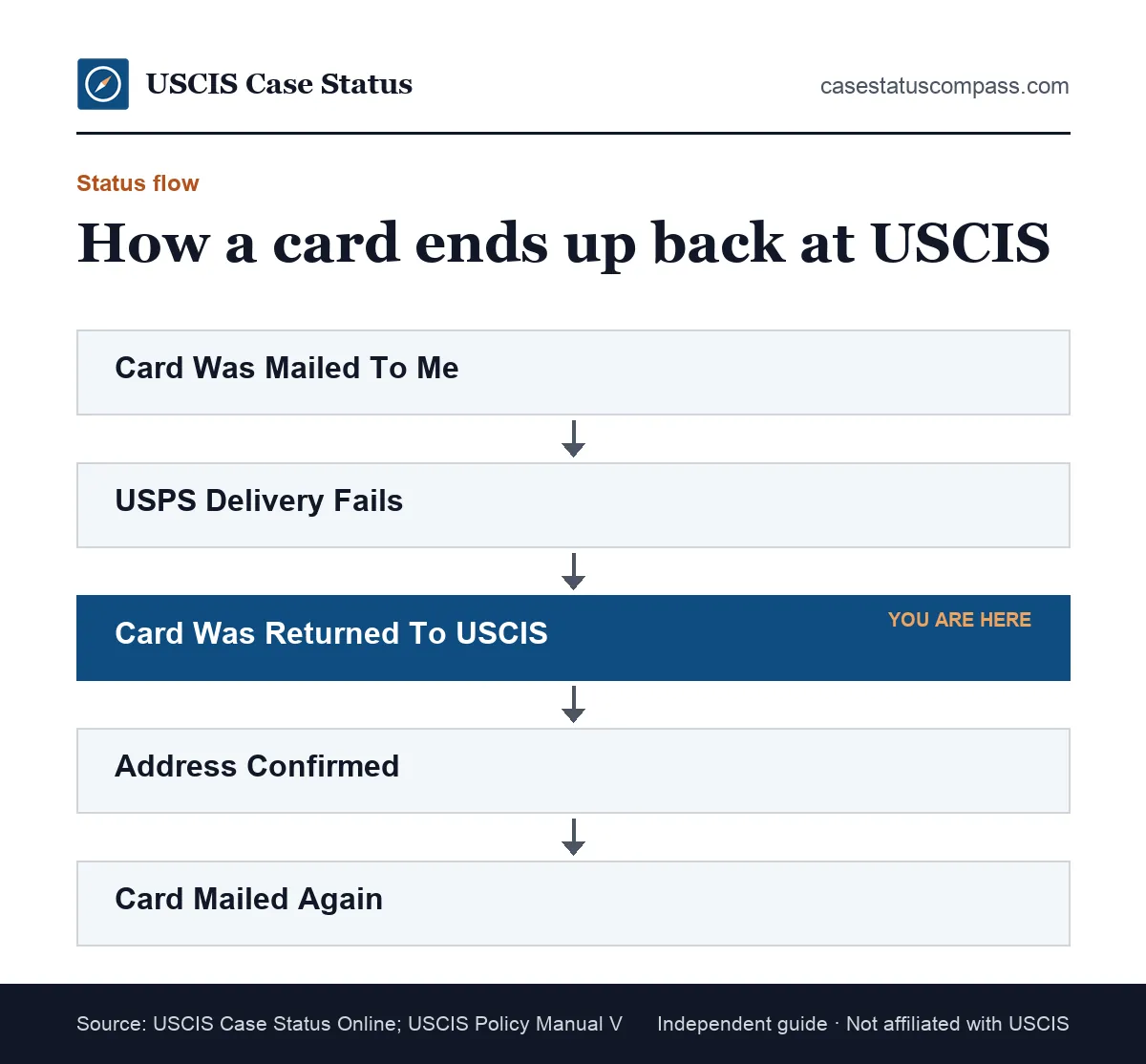
The "Card Was Returned To USCIS" update means the U.S. Postal Service (USPS) sent your card back to USCIS as undeliverable. Your approval stands. The card simply never reached you, and USCIS now holds it until you confirm where it should go.
The status wording
The title names the return, and the paragraph usually gives the date, your receipt number and a line asking you to update your address or contact USCIS. Read the full status text.
Is a Returned Card Lost or Destroyed?
Neither, at first. A returned card sits at USCIS. According to the USCIS Policy Manual, USCIS keeps such cards for a set holding period, then destroys any that remain unclaimed. Acting while the card still exists gives you the best chance of a free resend.
Why Do Cards Get Returned to USCIS?
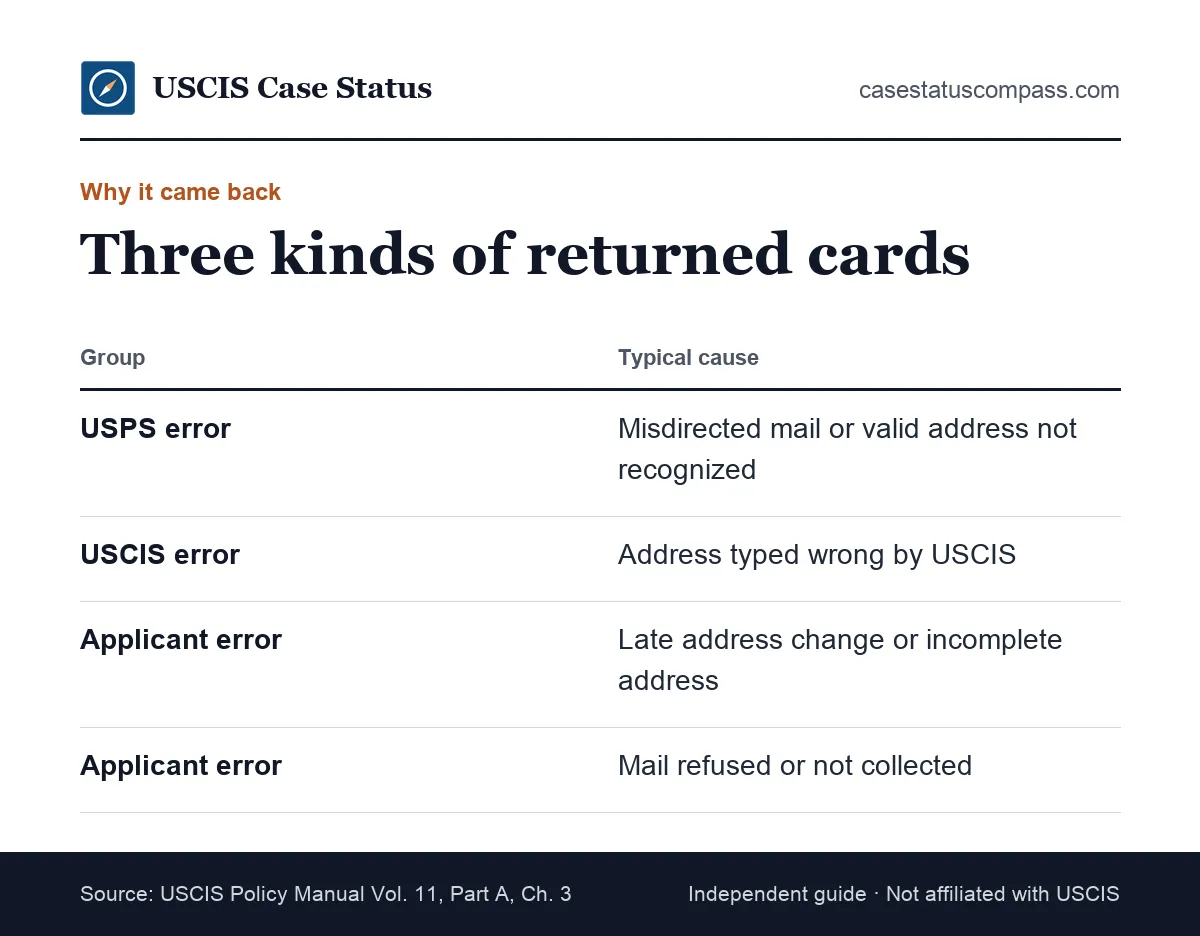
Cards come back for three broad reasons, which the USCIS Policy Manual lists: USPS errors, USCIS errors and requestor errors. The most common cause is an address problem, such as a missing unit number or a move that USCIS never heard about.
Cause groups from the Policy Manual
The cause matters because it decides who pays if the card must be replaced. The table groups the reasons as USCIS does.
| Cause group | Examples from USCIS guidance | Who is responsible |
|---|---|---|
| USPS error | Lost or misdirected mail; valid address not recognized; mail wrongly marked | USPS |
| USCIS error | Address entered wrong by USCIS; some system errors | USCIS |
| Requestor error | Late address change; incomplete, wrong or future address; mail refused | You |
Postal-side causes
Carriers sometimes miss a valid address, especially in new buildings, rural routes and multi-unit homes. Mail can also be marked with an expired forwarding label or routed to the wrong office.
Address-side causes
An unreported move is the classic cause. Others include a missing apartment number, a misspelled street and a name the carrier does not link to the mailbox.
Each of these counts as your error, which can mean a new fee.
USCIS-side causes
Occasionally USCIS itself enters the address wrong, for example by dropping a suite number from your form. Compare the address on your approval notice with what you wrote. If they differ, keep a copy of that form page.
How Does a Returned Card Fit Into the Card Timeline?
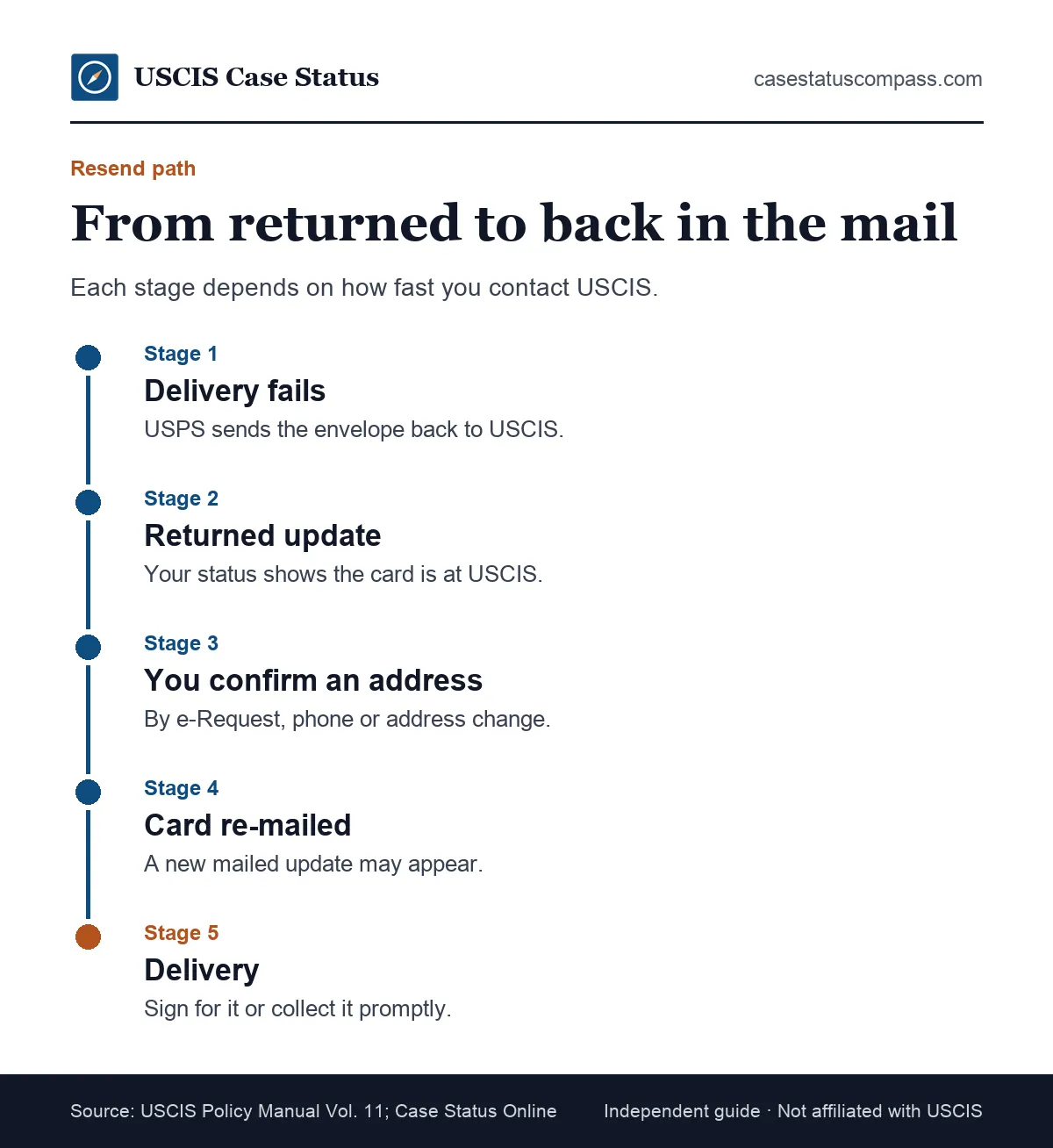
The return comes after Card Was Mailed To Me and replaces the expected delivery update. Next, USCIS either re-mails the card once it has a good address or, if no one responds, destroys it after the holding period. USCIS publishes no fixed time for each step.
Status flow after a failed delivery
This table shows the statuses usually seen before and after a return, and what decides how long each step lasts.
| Previous status | This status | Likely next status | Time between |
|---|---|---|---|
| Card Was Mailed To Me | Card Was Returned To USCIS | Card Was Mailed To Me (again) | Not published; depends on your response |
| Picked Up By USPS | Card Was Returned To USCIS | Address updated, then re-mail | Not published |
| Card Was Returned To USCIS | (no response from you) | Card destroyed, record updated | After USCIS's holding period |
What usually comes before
Most people see the mailed update, sometimes with a USPS tracking number. Tracking may show "return to sender" days before USCIS posts the return.
If you spot that scan, act right away instead of waiting for the USCIS update.
What usually comes after
If you supply a valid address, a new mailed update often appears, sometimes with a new tracking number. Our card was mailed to me guide explains the delivery stage.
Watch for it after your request.
How Long Does USCIS Keep a Returned Card?
USCIS keeps a returned card only for a limited holding period set out in the USCIS Policy Manual: Returned green cards are held 60 business days (about 12 weeks), then re-mailed or destroyed. Treat the return as urgent and contact USCIS the same week.
Does USCIS Search for a Newer Address Before Destroying the Card?
The Policy Manual says that before destroying a returned card, USCIS staff search its data systems for a newer address. If they find one, they re-mail the card. This is why updating your address with USCIS quickly can rescue the card even if you never call.
What happens after the holding period
If no new address turns up, USCIS destroys the card and updates its record. You then need to request a replacement. Depending on who caused the failed delivery, that can mean filing a new form and paying a fee.
What Should You Do First After a Card Was Returned to USCIS?
Start with your address. Confirm the address USCIS has, fix it for every pending case and then contact USCIS to ask for a second mailing. Do this within days, not weeks.
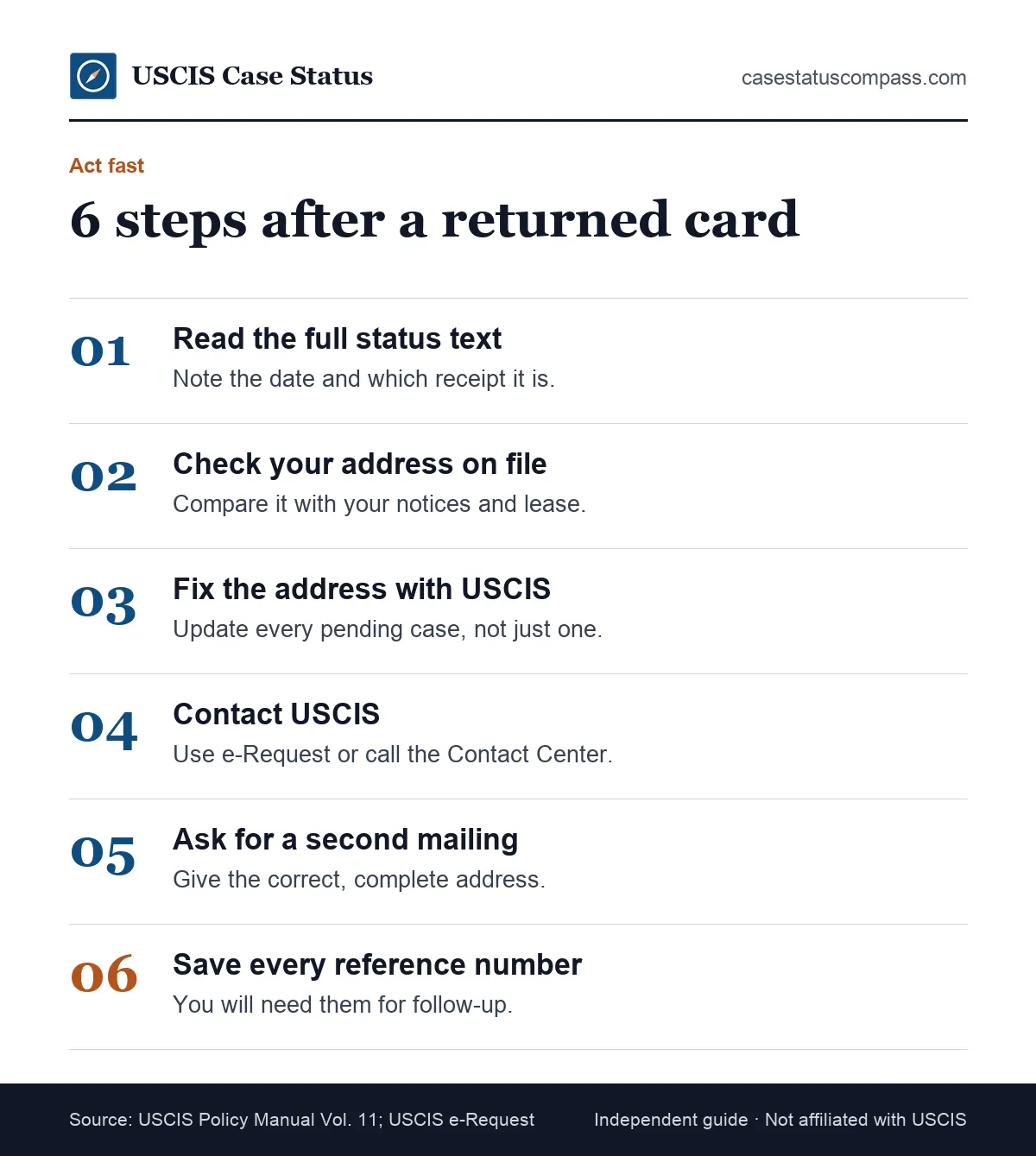
Then keep a written record of each step. The three tasks below follow that order, from checking the address to saving proof that you asked.
Hour one: confirm the address on file
Open your approval notice or online account and read the mailing address USCIS used, letter by letter. Look for a missing unit number, a wrong ZIP code or an old street.
Day one: tell USCIS
Update your address, then contact USCIS through e-Request or the Contact Center. Say that the card was returned and give the complete correct address, including any unit number.
Save any confirmation number you receive.
Recording the service request number
Ask the agent to note that you requested a resend, and write down the service request number. Add the date and the channel you used.
You will need that number if you follow up or escalate later, so keep it with your approval notice.
How to Get Your Card Re-sent
To get a returned card re-sent, give USCIS a valid address and ask it to mail the card again. You can do this through USCIS e-Request, by calling the Contact Center or by sending a secure message from your online account. The Policy Manual says USCIS may attempt a second delivery.
Asking through e-Request
e-Request has options for cards and notices that did not arrive. Choose the matching option, enter your receipt number and identity details, and give the address where you can receive mail now. Save the confirmation page.
Asking by phone
Call 800-375-5283 (TTY: 800-767-1833), or 212-620-3418 (callers outside the U.S.). Live calls and chat: Monday to Friday, 8 a.m. to 8 p.m. Eastern. Tell the agent the status says your card came back. See our guide to the USCIS phone number and live agents.
Asking through your online account
Account holders can send a secure message about the case. As of October 2026, USCIS lists these account features: Free USCIS online account: case status updates, notices, link paper-filed cases. A message leaves a dated, written record that you asked for a resend.
Which Address Will USCIS Use for a Second Mailing?
USCIS uses the address it has on file when it re-mails. If you corrected your address, that is the new one. The Policy Manual also says USCIS may try a second delivery to the original address when the address was right and USPS made the error.
Re-delivery to the same address
If the address was correct, ask USCIS to try again and tell your local post office to expect it.
Give the post office your receipt number and the expected sender so staff can watch for the envelope. Make sure your name is on the mailbox label, since carriers may return mail for names they do not see there.
Mailing to a new address
If you moved, the new address must be on file before USCIS re-mails. Changing it with USPS alone does not count. Include the unit.
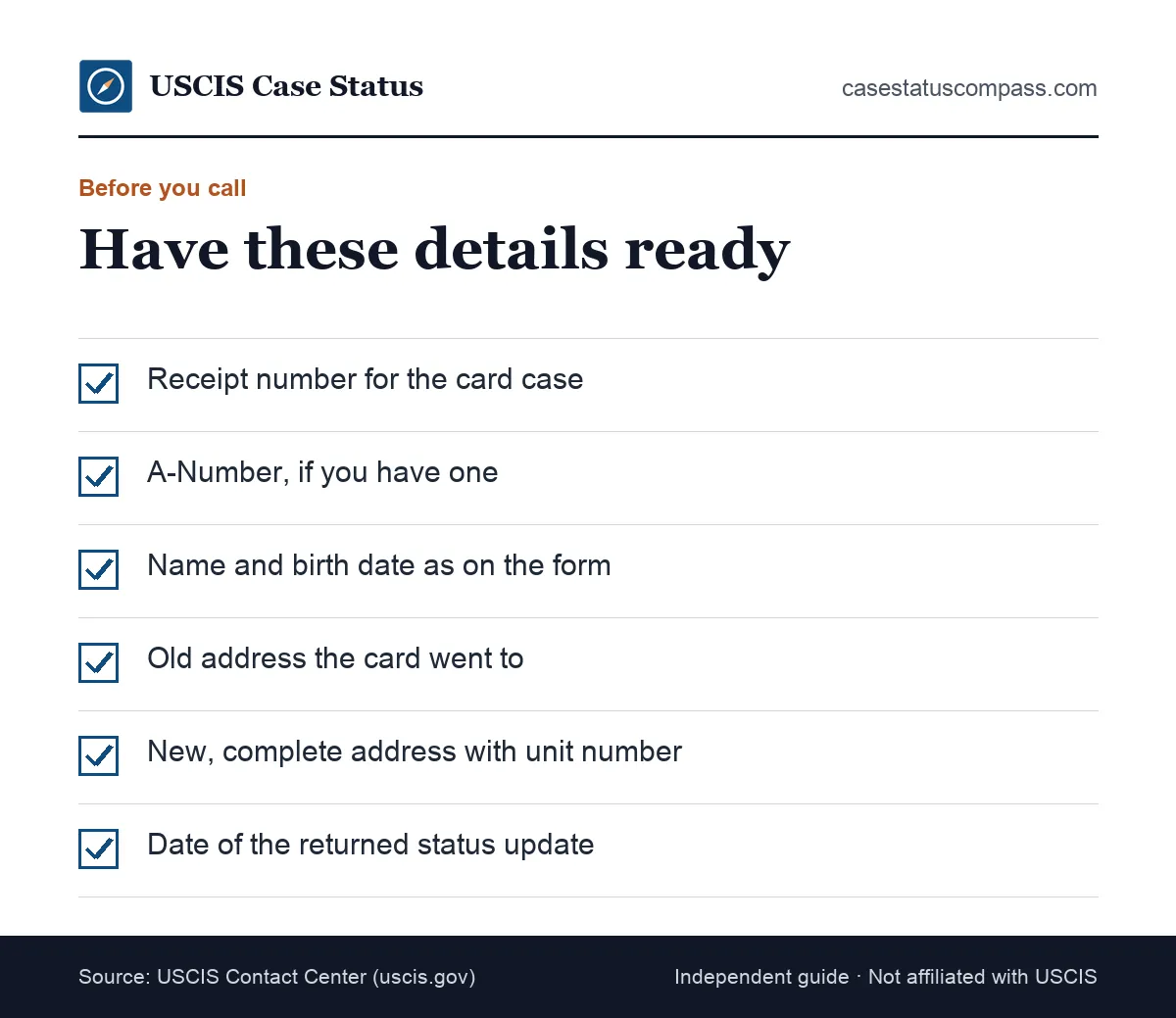
Check the record online before you ask for the resend, and include any suite or apartment number.
Updating Your Address to Prevent It
Most returns stop once USCIS has your current, complete address. Use the USCIS online change of address tool or Form AR-11, update every pending case and tell USPS as well. The law sets a deadline for reporting a move, so update right after you move.
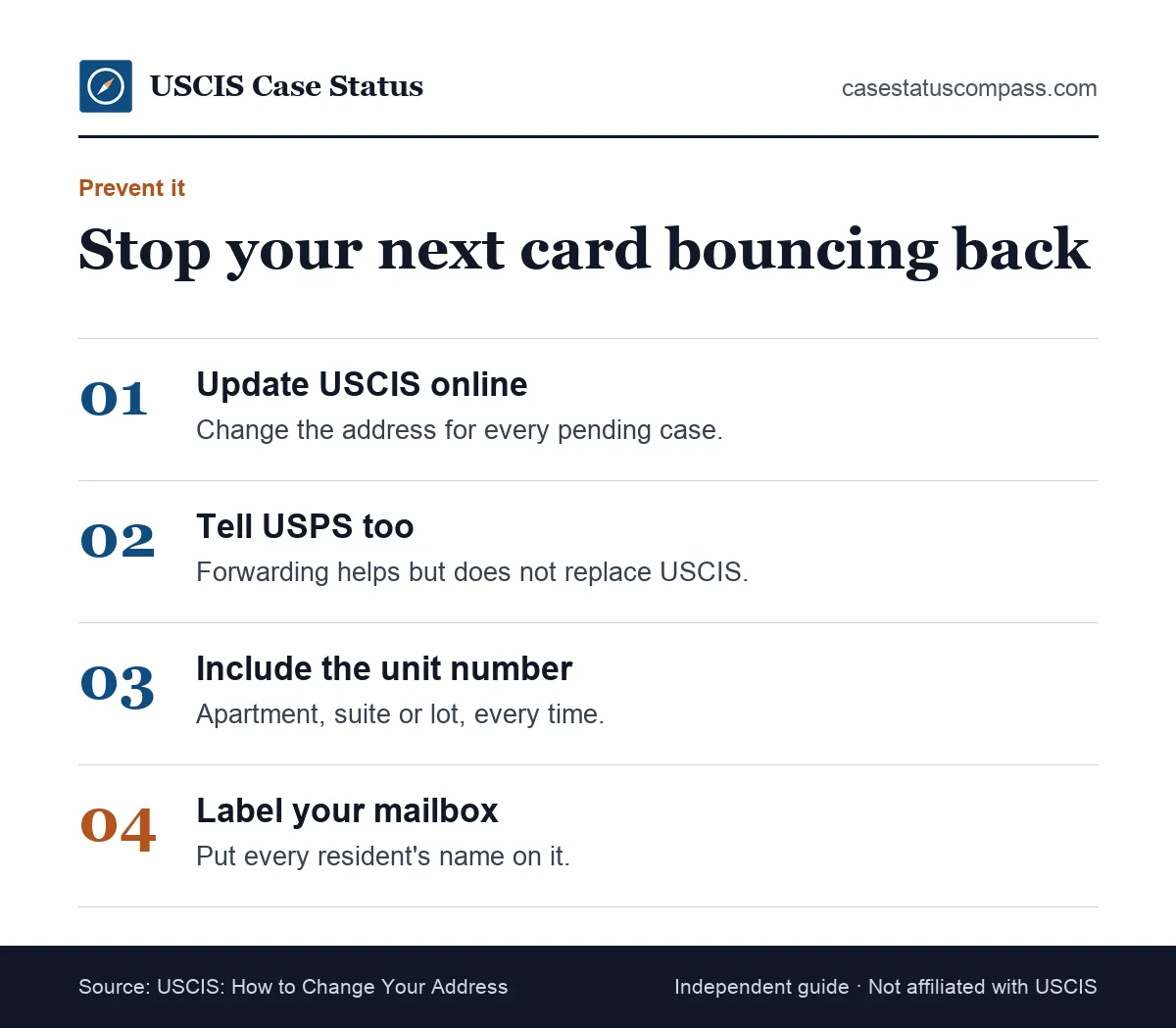
The online change of address tool
The USCIS online change of address tool updates your record and, for most cases, the address on pending filings. Our USCIS change of address guide walks through the screens.
Save the confirmation page it shows.
Does Form AR-11 Update Every Pending Case?
Form AR-11 reports your new address to USCIS. A separate AR-11 on paper may not update each pending case on its own, so the online tool is usually safer. Use it when you can, and keep proof of the date you reported the move.
Tell USPS as well
A USPS forwarding order helps catch stray mail but does not replace a USCIS update. Some government mail may not be forwarded. Set it up the same day you update USCIS.
Is There a Fee to Get a Returned Card Back?
Usually not when USPS or USCIS caused the problem. The USCIS Policy Manual says USCIS generally reissues without a new application or fee in those cases. If the failed delivery was your error, USCIS generally reissues only after a new application and fee, unless a waiver applies.
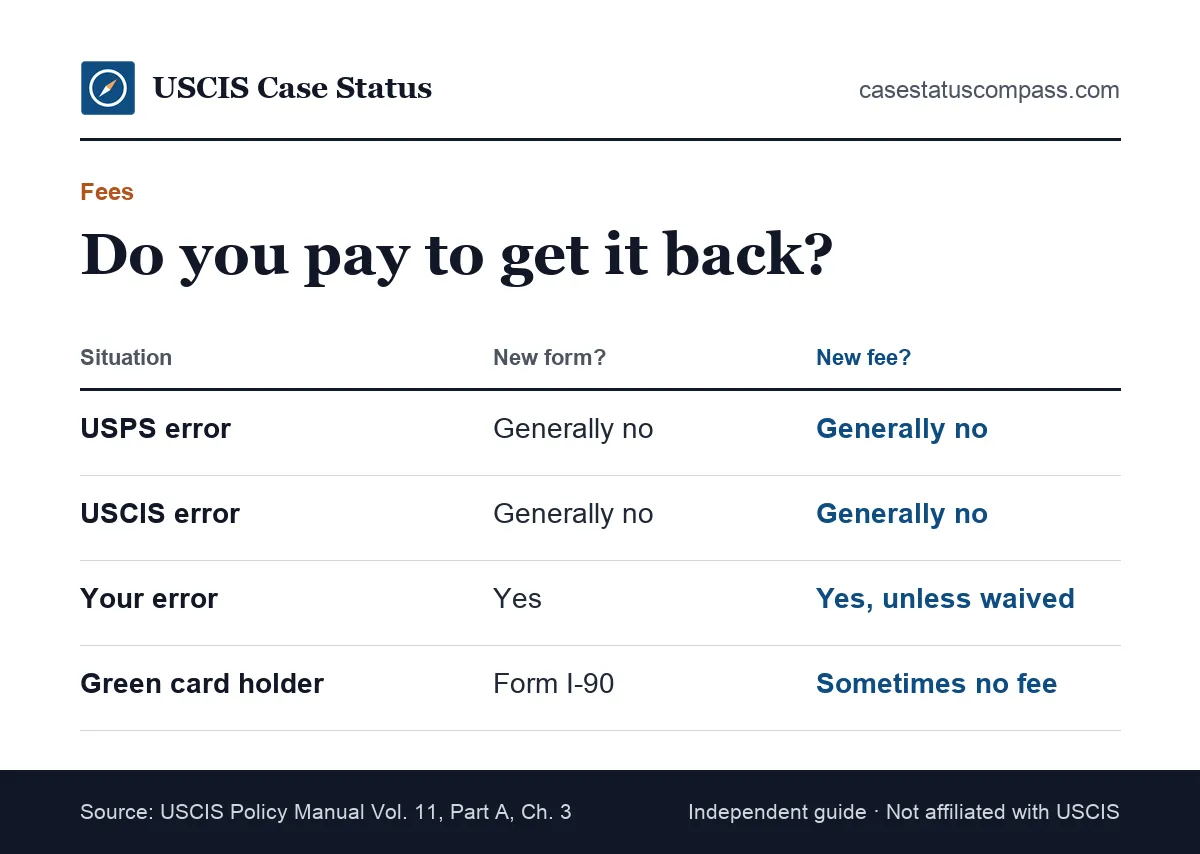
When the resend is free
If the card is still at USCIS, a valid address is often all it needs. When the card was already destroyed but the cause was USPS or USCIS, USCIS generally reissues it without charging you again.
When you pay again
Late address changes, incomplete addresses and refused mail count as requestor error. If the card was destroyed in that case, you file again. As of October 2026, Form G-1055 lists the I-90 fee as $465 (paper) / $415 (online). A fee waiver may apply to some applicants.
What If USCIS Already Destroyed the Card?
If the holding period passed and no address was found, USCIS destroys the card and you must request a replacement. Green card holders file Form I-90. Work permit holders inside the United States file a new Form I-765. Whether you pay depends on the cause of the return.
Green cards: Form I-90
The Policy Manual says permanent residents always file Form I-90 to replace a Permanent Resident Card, though in some cases no fee applies. Our Form I-90 replacement guide explains how to file, and our lost green card help covers related cases.
Work permits: a new Form I-765
For an EAD, the Policy Manual says you file Form I-765 inside the United States, with a fee if one is required. No replacement process exists from outside the U.S. Our Form I-765 work permit guide covers the current edition and fee rules.
Card Was Returned to USCIS on a Form I-485 Green Card Case
On a Form I-485 case, a returned card is your new green card. You became a permanent resident when USCIS approved the case, so the return does not undo that. You lack only the physical proof.
Act before the holding period ends.
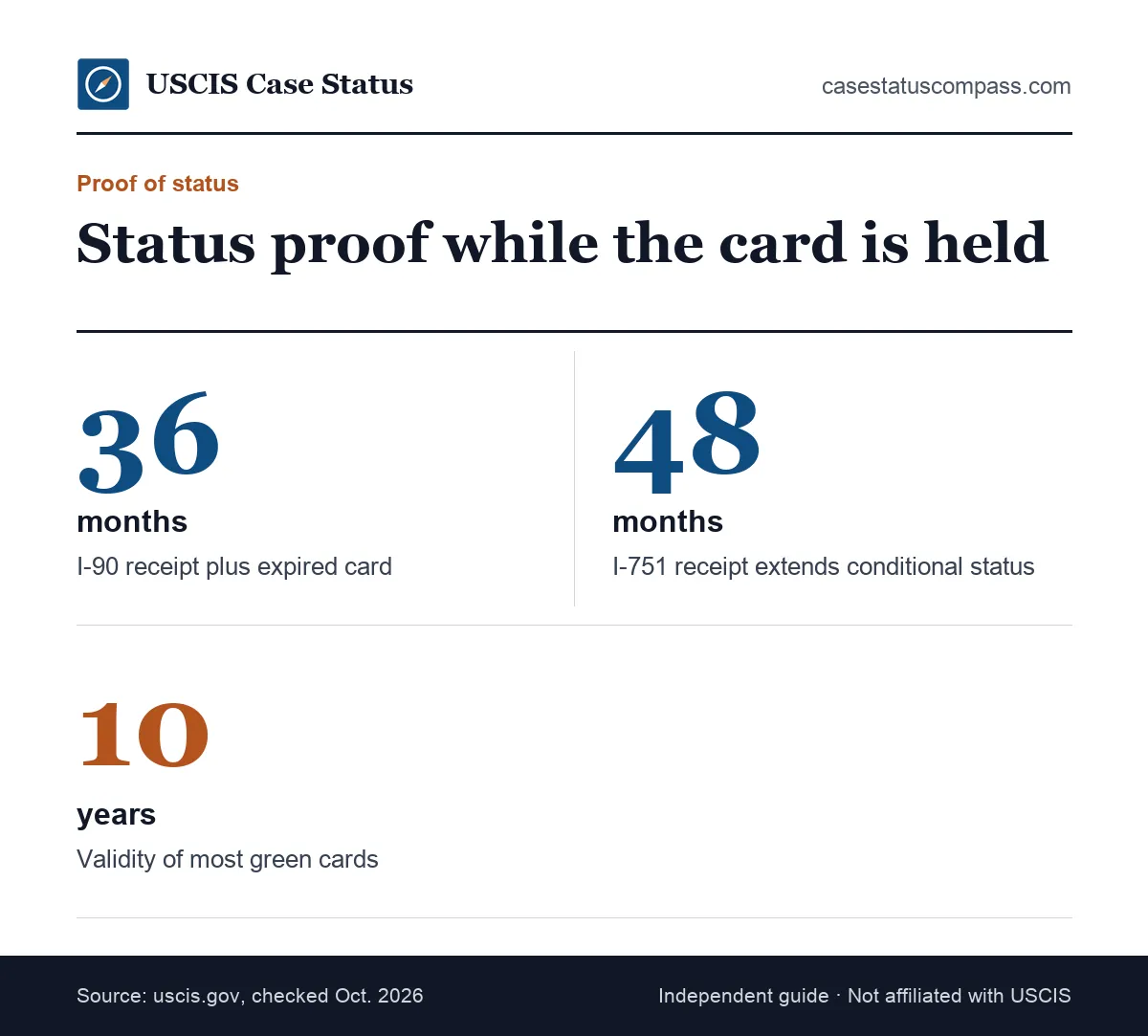
Proof of status while the card is held
You can ask for temporary proof. I-551/ADIT stamp: temporary proof of green card status; request through the USCIS Contact Center (800-375-5283). Our page on the temporary I-551 stamp explains when this makes sense. To book a visit: Request an in-person appointment online at my.uscis.gov/en/appointment/v2 or call 800-375-5283.
Linked EAD and travel cases
A green card approval can close a pending EAD or travel request filed with the I-485. If one of those cards was returned instead, check that receipt separately. Our I-485 application guide explains how these filings connect.
What If Your Returned Card Is a Work Permit?
A returned Employment Authorization Document (EAD) is held at USCIS like a green card. Until you have it, your employer may not accept the approval alone. Contact USCIS quickly, and ask HR what documents it can accept for Form I-9 in the meantime.
Working while the EAD is held
If your old EAD is still valid, keep using it. If it has expired, the rules depend on when you filed. Ended: renewals filed on or after Oct. 30, 2025 no longer get the up-to-540-day automatic extension (exceptions: TPS by law/Federal Register notice; STEM OPT 180 days).
Combo cards and advance parole
A combo card works as both an EAD and advance parole. If it came back, you also lack your travel permission. Do not travel abroad without a valid document.
Ask USCIS to resend it before any trip.
Returned Cards After a Form I-90 Renewal
On a Form I-90 case, a returned card is your renewed or replacement green card. Your receipt notice still helps prove status while USCIS holds it. I-90 receipt notice + expired card = proof of status for 36 months from the card's expiration date. Keep the receipt with your old card.
Moves during renewal
Renewal cases often run for months, and people move in between. If the card went to your old home, update your address before asking for the resend.
Your receipt notice still helps prove status meanwhile.
What If Your Replacement Card Was Returned After Mail Theft?
If you filed the I-90 because your card was stolen from your mailbox, a returned replacement is a warning sign. Ask USCIS to resend to a secure address, such as a locked box or an attorney's office, and keep a police report on file.
Returned 10-Year Cards After a Form I-751
On a Form I-751 case, a returned card is your 10-year green card. Your conditional status continues on the receipt notice while you sort out the address. I-751 receipt notice extends conditional status and work authorization for 48 months. Carry that notice with your expired 2-year card.
Waiver filers after separation
If you filed with a waiver after divorce or separation, make sure the card goes to an address only you control. Ask your attorney to help if safety is a concern.
What If Both Spouses Moved During the I-751?
Joint filers often move together during the long I-751 wait. Update the address for both spouses if both are on the case. The card goes to the address listed for the conditional resident, so that one must be exact. Use the online change of address tool for each person.
Returned Cards in VAWA, SIJ and Other I-360 Cases
For Form I-360 cases, such as VAWA self-petitions or Special Immigrant Juvenile petitions, a returned card usually belongs to a linked EAD or green card filing. Mail safety matters here, so check that the address on file is still safe before USCIS mails again.
Safe mailing addresses
VAWA petitioners can use a safe address that an abuser cannot see. If your safe address changed and the card bounced, update it through the channel your representative recommends.
Do not use a shared or old address.
Working with your representative
Your attorney or DOJ-accredited representative may receive mail for you. They can contact USCIS and help you choose a secure address for the second mailing.
Ask them to confirm the address USCIS has on file before the resend, and to tell you when the card arrives.
How Is a Returned Card Different From a Returned Notice?
A returned card is your physical proof of status; a returned notice is a letter, such as an approval or appointment notice. Both mean USPS could not deliver. A card can be destroyed after a holding period, while a missed notice can make you miss a deadline or appointment.
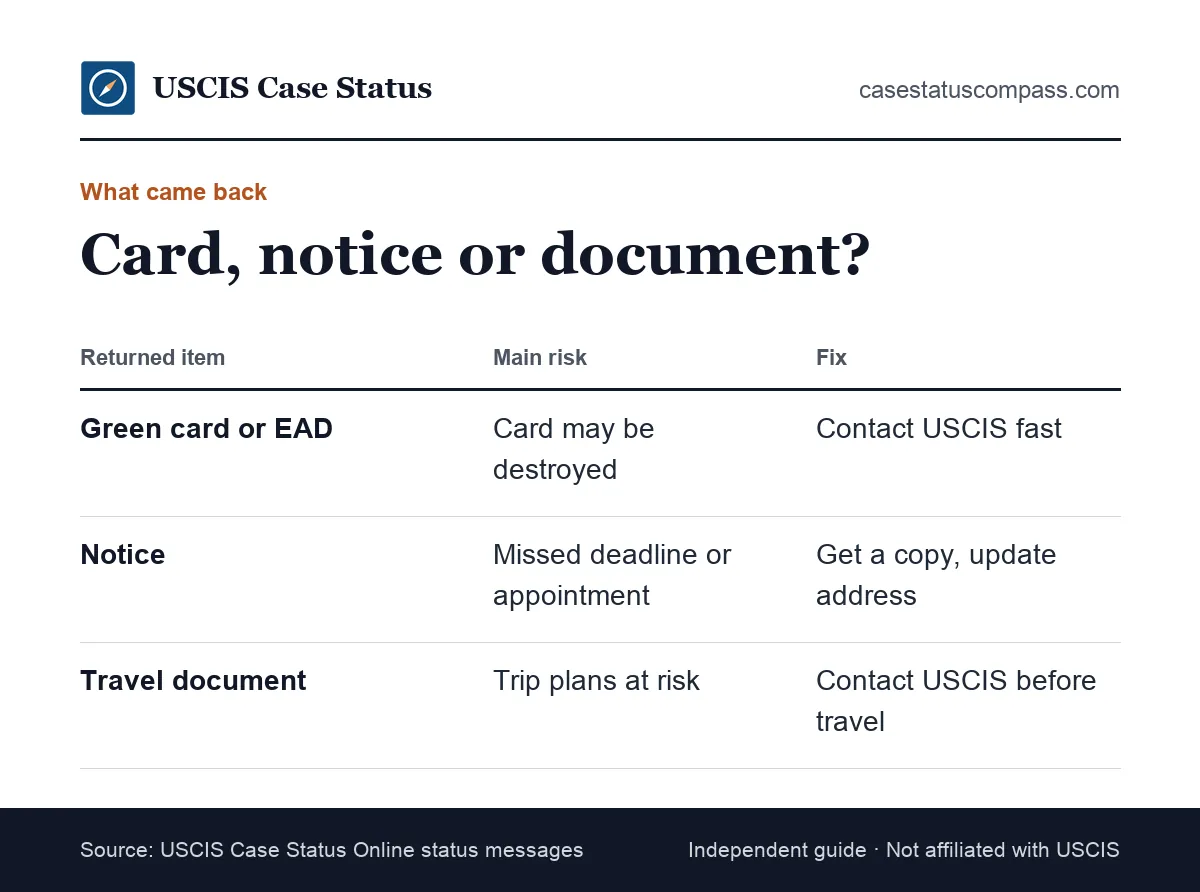
Card, notice and travel document compared
Different items can come back to USCIS. This table shows how each one appears and what to do first.
| Returned item | Status wording you may see | Most urgent action |
|---|---|---|
| Green card or EAD | Card Was Returned To USCIS | Fix address, ask for resend |
| Approval or appointment notice | Notice Was Returned To USCIS | Get a copy and check for deadlines |
| Travel document | Document returned as undeliverable | Contact USCIS before travel |
What If an Approval or Appointment Notice Comes Back?
A returned notice can hide an interview date, a biometrics appointment or a request for evidence. Check your online account for a digital copy. If you missed an appointment, contact USCIS and explain. Fix your address first so the next notice reaches you.
What If a Travel Document Was Returned?
A returned advance parole document or reentry permit works like a returned card: USPS could not deliver it, so it went back to USCIS. If a trip is planned, contact USCIS at once. Never leave the U.S. relying on a travel document you have not received.
How Can You Tell a Card Is Heading Back Before the Status Changes?
USPS tracking often shows the problem first. Watch for "return to sender", "unable to deliver" or "insufficient address" scans. The USCIS status may update days later, so act on the USPS scan as soon as you see it.
Save a screenshot of the scan with its date, since it shows when delivery failed.
Scans tied to the address
"Return to Sender" or "Returned to Sender"
"Insufficient Address" or "No Such Number"
"Vacant" or "No Mail Receptacle"
These point to a problem with the address itself. Check the street, unit and ZIP code on your notice, then visit the post office with the tracking number.
Scans tied to the recipient
"Addressee Unknown"
"Unclaimed" after a notice slip
"Refused" or "Not Deliverable as Addressed"
"Moved, Left No Address"
These point to the name or the person rather than the street. Make sure your name is on the mailbox and that you collect slips quickly.
Why the USCIS status lags
USCIS posts the return when the envelope is logged back at its facility. That can take days after the USPS scan.
Act on the USPS scan rather than waiting for the USCIS update.
Can You Stop a Return Before It Reaches USCIS?
Sometimes. If tracking shows a failed delivery but no return yet, call or visit your local post office with the tracking number. They may still hold the envelope for pickup. Once it is in transit back to USCIS, only USCIS can send it out again.
Going to the post office
Bring photo ID, the tracking number and any notice slip. Ask if the envelope is still at the station. If it is, you may be able to collect it or schedule redelivery, which avoids the return entirely.
When it is too late
If the station says the envelope already left, ask the date it was sent back. Give that date to USCIS when you call.
Then contact USCIS about the resend right away.
What Information Will USCIS Ask For?
USCIS needs enough detail to find your card and confirm who you are. Have your receipt number, A-Number, full name, date of birth, the old address and your complete current address ready. The date of the returned update also helps the agent search.
Identity details
Give your name exactly as it appears on your form. Have your A-Number handy. Your A-Number is the 'USCIS#' printed on the front of green cards issued after May 10, 2010.
Address details
Give the street, unit, city, state and ZIP code. Say whether you moved or whether the old address was simply wrong.
If you moved, give the date you moved and the date you told USCIS.
Your Situation and the Right Next Move
Your best next step depends on why the card came back and whether it still exists. The decision table below links each situation to one action.
Find the row closest to your case. If more than one fits, start with the address fix, because every other step depends on USCIS having a valid mailing address.
Situations and the next move for each
Each row pairs a common returned-card situation with the single most useful next step for you.
| Your situation | Best next move |
|---|---|
| You moved and USCIS has the old address | Update the address online, then request a resend |
| Address was right, USPS failed | Ask USCIS for a second delivery and alert your post office |
| USCIS typed your address wrong | Report the error and keep your form copy as proof |
| Tracking shows failed delivery, no return yet | Go to the post office with the tracking number |
| Card already destroyed, USPS or USCIS error | Ask USCIS about reissue without a new fee |
| Card already destroyed, your error | File Form I-90 or I-765 with any required fee |
Keep one request open at a time
File one request, wait for a reply within the time USCIS gives, then follow up on that same request number.
Several open requests can confuse the record and slow the reply.
What If the Status Says Returned but You Never Moved?
If you never moved, the return points to an address format problem or a postal error. Check the unit number, spelling and ZIP code on your notice. Then ask your carrier why the envelope failed, and ask USCIS for a second delivery once the cause is fixed.
Missing unit or mailbox name
In apartments and shared houses, a missing unit number or an unfamiliar name often triggers a return. Label your mailbox with every resident's full name.
Then make sure USCIS has the unit number too.
What If the Carrier Marked a Valid Address Undeliverable?
Sometimes the address is perfect and the carrier still marks it undeliverable. That counts as a USPS error under the Policy Manual. Ask the post office for a short note or record of the mistake, and mention it when you contact USCIS. Ask for a second delivery to the same address.
What If You Are Abroad When the Card Comes Back?
If you are outside the U.S., a trusted person at your U.S. address can watch the mail, but you must still handle the address and resend request with USCIS. Do not plan a return trip that depends on the card arriving first.
Getting help from someone in the U.S.
A family member can collect the re-mailed card at your address. They usually cannot change your USCIS address for you. You or your representative must submit the change and the resend request.
Coming back without the card
A permanent resident abroad without a card needs a valid document to board a flight. Contact USCIS or the nearest U.S. embassy or consulate about options.
Do this well before your planned trip.
Cards Returned From an Attorney's Office
If your card was mailed in care of your attorney and came back, the office address on your Form G-28 may be outdated or incomplete. Ask the office to update its address with USCIS and to request the resend for you.
Firm moves and suite numbers
Law firms move or change suites. A card sent to an old suite can bounce even if the building is right. Ask the firm to confirm the address USCIS has for its representative record.
Changing representatives
If you changed lawyers, the old firm may still be on file. Make sure your new representative files a new Form G-28 and that the mailing address reflects your current choice.
Mistakes That Lead to a Second Return
The biggest mistake is asking for a resend before USCIS has the correct address. Others are relying on USPS forwarding, leaving out the unit number and ignoring a notice slip on the second delivery. Each can send the card back again and use up the holding period.
Leaving out details
A missing "Apt", "Unit" or "#" is enough to fail delivery. Copy the address exactly as your lease, utility bill or bank uses it.
Include any building name as well.
Missing the second delivery
If a signature is needed and no one is home, a slip is left. Collect the envelope quickly. Ask your post office how long it will hold the item before it goes back.
Why Shouldn't You Ask for a Resend Too Early?
If USCIS re-mails to the same wrong address, the card returns again. Update the address first, then ask. Confirm the new address appears on the case, because a second trip to the old one wastes the holding period. Your online account shows the address on file for most cases.
How Long Does a Re-sent Card Take to Arrive?
USCIS publishes no fixed time for re-mailing a returned card. Once your address is fixed and you have asked for a resend, watch for a new mailed update and possibly a new tracking number. If nothing changes for several weeks, follow up on your request number.
Watching for the new mailed update
A resend usually shows as another mailed update with a new date. Compare it with the return date to confirm it is the second mailing. Our page on what the new card is being produced status means covers the case where USCIS prints a fresh card instead.
Following up without starting over
If the wait runs long, reference your original request instead of opening a new one. Give the date and number of your first contact.
Keep notes of each follow-up in your log.
What If the Re-sent Card Is Returned Again?
A second return usually means the address problem was not fully fixed. Check the address on file again, call your post office and talk to USCIS before asking for a third mailing. Consider a more reliable address, such as a secure mailbox or your attorney's office.
Finding the real cause
Ask the carrier what happened on each attempt. Compare both return dates with when you updated your address. If USCIS kept using an old address, note that, because it may change who is responsible.
Should You Use a Different Address for the Third Mailing?
If your building mail is unreliable, a trusted relative's address or a lawyer's office may work better. Update it with USCIS first, and tell the person to expect a government envelope in your name.
Ask them to hold it for you.
Does a Returned Card Affect Your Immigration Status?
No. A returned card does not change your immigration status. The return only affects the physical card. You do, however, need proof of status for work, travel and ID, so fixing the return quickly still matters.
Contact USCIS before that holding period ends, because an unclaimed card may be destroyed rather than re-mailed.
Status stays the same
USCIS made its decision before mailing. An undelivered envelope does not reverse it. Keep your approval notice; I-797C = Notice of Action (receipt, rejection, transfer, appointment, re-open); not proof of status by itself. The notice helps show approval, though employers and agencies often ask for the card.
When proof becomes urgent
If you start a new job, renew a license or need to travel, you may need proof before the card arrives. Ask USCIS about temporary proof. See the approval case decision rendered page for what an approval means.
When Should You Escalate a Returned Card?
Escalate if USCIS does not respond to your resend request within the time it gave you, if your card may soon be destroyed or if you face a hard job or travel deadline. Options include the CIS Ombudsman and your member of Congress.
Congressional and Ombudsman help
Your U.S. Representative or Senator can send a congressional inquiry. The CIS Ombudsman can help when normal channels fail. Our guide to the USCIS Ombudsman and congressional inquiries explains when each one fits.
When Should You See an Immigration Attorney?
See an immigration attorney or DOJ-accredited representative if USCIS says you must refile and you disagree, if a card shows the wrong status, or if you are a VAWA petitioner worried about mail safety. Avoid anyone who promises a faster resend for a fee.
What Records Should You Keep While the Card Is Held?
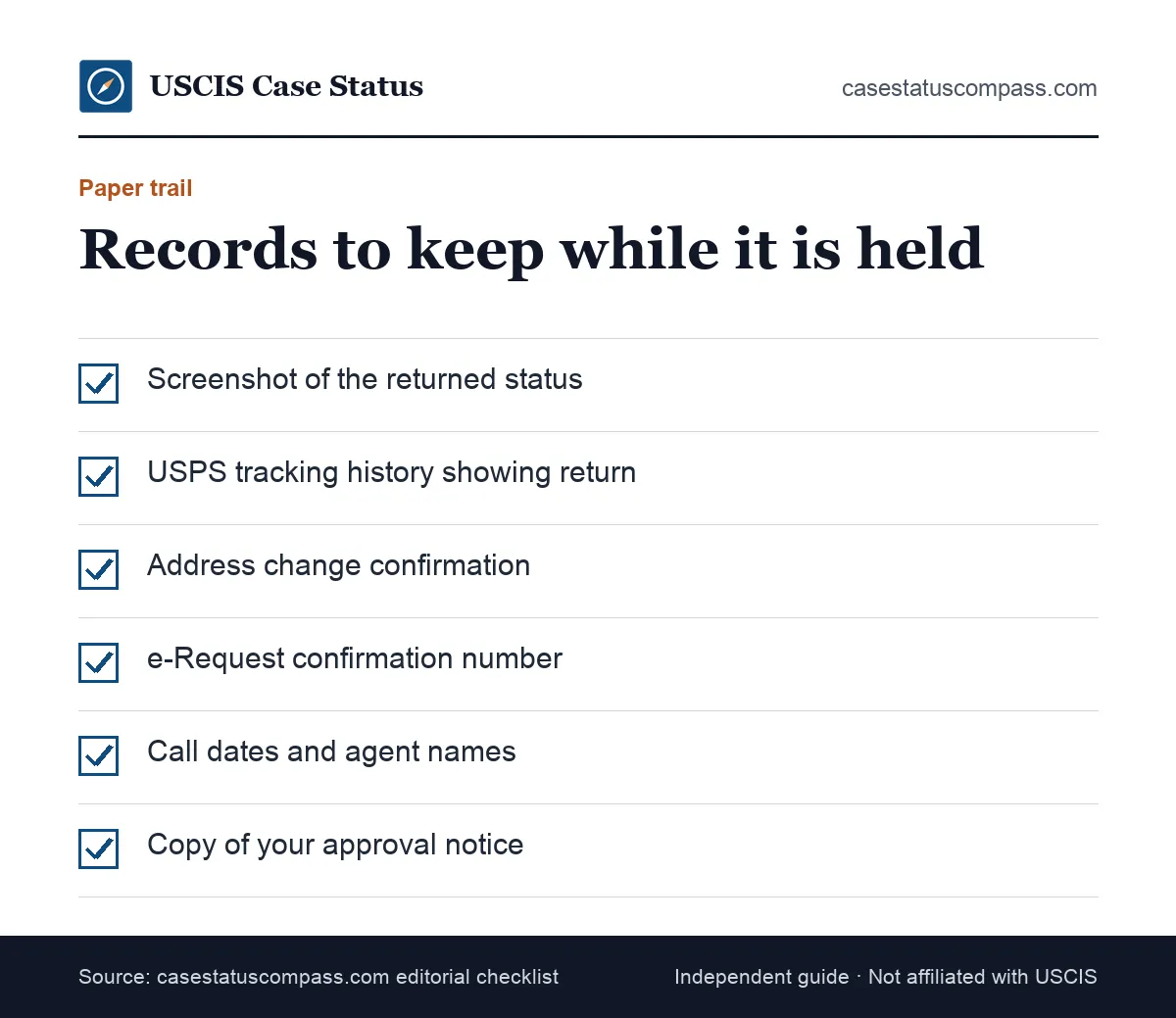
Keep a screenshot of the returned status, the USPS tracking history, your address change confirmation, e-Request confirmations, call notes and your approval notice. These records show you acted promptly, which matters if there is a dispute about who caused the return.
A simple log
Write the date, the channel (phone, e-Request, online message), the agent's name or ID and what was promised.
Add the request number and the result of each contact, so you can show the full history if USCIS asks.
Proof of your address change
The confirmation from the online change of address tool proves when you told USCIS. If USCIS later says the address was late, that date is your best evidence.
Keep a printed copy.
Returned-Card Examples
These short examples show how people fixed returns. Each one turns on a different cause, and each ends with the card back in the mail.
The names are fictional. Each example shows one cause and the fix that worked for it, so find the one closest to your case.
Lena: moved after filing
Lena moved before her I-485 approval and told only USPS. Her green card came back to USCIS. She updated her address online, filed an e-Request the same day and later saw a new mailed update.
Omar: carrier marked a valid address
Omar's EAD came back marked "no such number," though his house number was correct. His post office confirmed a substitute carrier's error. He reported the USPS error and asked for a second delivery.
Priya: missing apartment number
Priya's I-751 card returned because "Apt 4B" was missing from her form. She updated her address with the unit, then asked for a resend. Because the error was in her own form, she was ready to file if the card had been destroyed.
Ken: attorney's old suite number
Ken's green card was mailed in care of his lawyer, whose firm had moved suites. The card came back. The firm updated its address with USCIS, requested the resend and forwarded the card.
Sara: returned EAD near expiry
Sara's renewed EAD came back while her old card had weeks left. She updated her address, filed an e-Request and showed HR her valid old card and kept working.
How Is "Returned" Different From "Mailed" or "Being Produced"?
New Card Is Being Produced means printing is under way. Card Was Mailed To Me means USPS has it. "Card was returned to USCIS" means delivery failed and the card is back.
Each one calls for a different action from you.
Where the card is at each step
During production, the card is at USCIS and you can still fix the address before it ships. After a return, it is back at USCIS for a limited time, so speed matters most here.
Why these statuses are confused
Some people see the returned update and think the case was denied or the card was cancelled. Neither is true. Our hub of status meanings lists every label in order, and the case is being actively reviewed page covers the earlier review stage.
Following the Return in Your USCIS Online Account
Your USCIS online account shows the returned update and the history before it, and it lets you send a secure message. Sign up free at myaccount.uscis.gov/create-account if you have no account. The public tool at Case Status Online: egov.uscis.gov shows only the latest update.
What the account shows
The account lists each update with dates, so you can see when the card was mailed and when it came back. It also shows the mailing address on file for most cases, so you can catch an error.
Linking older paper cases
Paper filings can be linked with the online access code on your Account Access Notice. Once linked, you can follow the return and resend in one place.
Frequently Asked Questions
How long does USCIS keep a returned card?
Returned green cards are held 60 business days (about 12 weeks), then re-mailed or destroyed. Before destroying one, staff search for a newer address. Contact USCIS as soon as you see the returned update rather than waiting.
Will USCIS automatically re-send a returned card?
Sometimes. The Policy Manual says USCIS searches its systems for a newer address before destroying a card and re-mails it if it finds one. Update your address and ask for a resend through e-Request or the Contact Center, so a request is on record.
Do I have to pay to get my returned green card?
Not if the card is still at USCIS and you give a valid address, or if USPS or USCIS caused the return. If the card was destroyed and the failed delivery was your error, you generally file Form I-90 again with the fee, unless a fee waiver applies.
Can I pick up a returned card at a USCIS office?
USCIS generally re-mails returned cards rather than handing them out at field offices. If you have an urgent need for proof of status, ask the Contact Center about an appointment for a temporary I-551 stamp.
Does a returned card mean my case was denied?
No. A card is mailed only after approval, so a returned card means your case was approved but delivery failed. Fix your address and ask USCIS to mail the card again.
Should I file Form I-90 if my green card was returned?
Not while the card is still at USCIS. Ask for a resend first. File Form I-90 only after USCIS confirms the card was destroyed; whether you pay depends on who caused the return.
Can a family member ask USCIS to resend my card?
A family member can collect the re-mailed card at your address, but usually cannot change your USCIS address or request the resend for you. You or your attorney or accredited representative must contact USCIS.
What if my returned card was an EAD I need for work?
Contact USCIS right away to update your address and ask for a resend. Tell your employer the card was approved and returned in the mail. Ask HR which documents it can accept for Form I-9 meanwhile, and check whether your old EAD is still valid.
Sources
- USCIS Policy Manual, Volume 11, Part A, Chapter 3: Reissuance of Secure Identity Documents. www.uscis.gov/policy-manual/volume-11-part-a-chapter-3. Accessed Oct 27, 2026.
- USCIS: Case Status Online. egov.uscis.gov/. Accessed Oct 27, 2026.
- USCIS: e-Request Self-Service Tools. egov.uscis.gov/e-request/. Accessed Oct 27, 2026.
- USCIS: How to Change Your Address. www.uscis.gov/addresschange. Accessed Oct 27, 2026.
- USCIS Contact Center. www.uscis.gov/contactcenter. Accessed Oct 27, 2026.
- USCIS: Replace Your Green Card. www.uscis.gov/green-card/after-we-grant-your-green-card/replace-your-green-card. Accessed Oct 27, 2026.
- USCIS Form G-1055, Fee Schedule (Edition 10/16/26). www.uscis.gov/g-1055. Accessed Oct 27, 2026.
- USCIS: Benefits of a USCIS Online Account. www.uscis.gov/file-online/benefits-of-a-uscis-online-account. Accessed Oct 27, 2026.
- USCIS Form G-1055 Fee Schedule, Edition 10/16/26. www.uscis.gov/sites/default/files/document/forms/g-1055.pdf. Accessed Oct 27, 2026.
- USCIS alert: Additional Mail Delivery Process for Receiving ADIT Stamp (Mar. 16, 2023; archived). www.uscis.gov/newsroom/alerts/uscis-announces-additional-mail-delivery-process-for-receiving-adit-stamp. Accessed Oct 27, 2026.
- USCIS: Automatic EAD Extension (updated 10/29/2025). www.uscis.gov/working-in-the-united-states/information-for-employers-and-employees/automatic-employment-authorization-document-ead-extension. Accessed Oct 27, 2026.
- USCIS: Removing Conditions on Permanent Residence Based on Marriage (updated 12/12/2023). www.uscis.gov/green-card/after-we-grant-your-green-card/conditional-permanent-residence/removing-conditions-on-permanent-residence-based-on-marriage. Accessed Oct 27, 2026.
- USCIS Glossary: USCIS Number. www.uscis.gov/glossary-term/50674. Accessed Oct 27, 2026.
- USCIS: Form I-797 Types and Functions (updated 01/24/2025). www.uscis.gov/forms/filing-guidance/form-i-797-types-and-functions. Accessed Oct 27, 2026.
- USCIS: Online Account and Technical Support. www.uscis.gov/tools/uscis-tools-and-resources/online-account-and-technical-support. Accessed Oct 27, 2026.
- USCIS: Checking Your Case Status Online. www.uscis.gov/tools/checking-your-case-status-online. Accessed Oct 27, 2026.
casestatuscompass.com is an independent publication and is not affiliated with USCIS or any government agency. This page is general information, not legal advice. For denials, court or asylum matters, consult an immigration attorney or a DOJ-accredited representative.