Contents · 40 sections
- What Should You Do First If You Lost Your Green Card?
- Is Your Permanent Resident Status Gone When the Card Is Gone?
- Lost, Stolen, Destroyed or Never Received: Which Is Yours?
- Where Do Lost Green Cards Usually Turn Up?
- Should You File a Police Report for a Stolen Green Card?
- How Do You Protect Your Identity After Losing the Card?
- Which Numbers Should You Write Down Right Now?
- Build a Lost-Card Incident File You Can Copy
- Lost Green Card in the U.S. vs Abroad: Two Different Paths
- What If You Lost Your Green Card Outside the United States?
- Why Won't an Airline Board You Without a Green Card?
- What Is a Boarding Foil (Carrier Documentation)?
- Who Qualifies for Form I-131A?
- How Do You Apply for a Boarding Foil at a U.S. Embassy?
- How Long Is a Boarding Foil Valid?
- How Long Does an Embassy Take to Issue a Boarding Foil?
- How Much Does Form I-131A Cost?
- Can Someone Else Pay the I-131A Fee for You?
- When You Might Not Need Form I-131A
- What Is an SB-1 Returning Resident Visa?
- Boarding Foil vs SB-1 Visa vs Reentry Permit
- Lost Your Green Card Abroad After More Than a Year?
- Does Losing Your Green Card Abroad Mean You Abandoned Residence?
- What Happens at the U.S. Border Without Your Card?
- Can You Fly Within the U.S. Without a Green Card?
- Can You Work If You Lost Your Green Card?
- How Do You Prove Permanent Resident Status While You Wait?
- How Do You Request a Temporary I-551 Stamp?
- Replacing the Card: Form I-90 in Brief
- What Does It Cost to Replace a Missing Card?
- How Long Until the Replacement Card Arrives?
- What If Your Green Card Never Arrived in the Mail?
- Lost a Green Card With a Pending Case?
- Lost a 2-Year Conditional Green Card?
- Worked Examples: Four Lost-Card Scenarios
- What Are the Most Common Lost Green Card Mistakes?
- What If Your Lost Card Turns Up Later?
- Does a Lost Card Ever Need a Lawyer?
- Lost Green Card Recovery Timeline, From Day 1
- Frequently Asked Questions
The short answer
If you have a lost green card, your permanent resident status is not lost with it. Report a theft to the police, write down your A-Number, protect your identity, and file Form I-90 to replace the card. If you are abroad, you first need carrier documentation (a boarding foil) through Form I-131A to fly home.
At a glance
| Does status end? | No. The card is proof; your status continues. |
| Replacement form | Form I-90 (edition 01/20/25), filed from inside the U.S. |
| Fee | $465 (paper) / $415 (online) per G-1055 (10/16/26) |
| Card lost abroad | File Form I-131A in person at a U.S. embassy or consulate |
| Proof meanwhile | Temporary I-551 (ADIT) stamp through the USCIS Contact Center |
The application itself is explained on our Form I-90 green card renewal and replacement page.
What Should You Do First If You Lost Your Green Card?
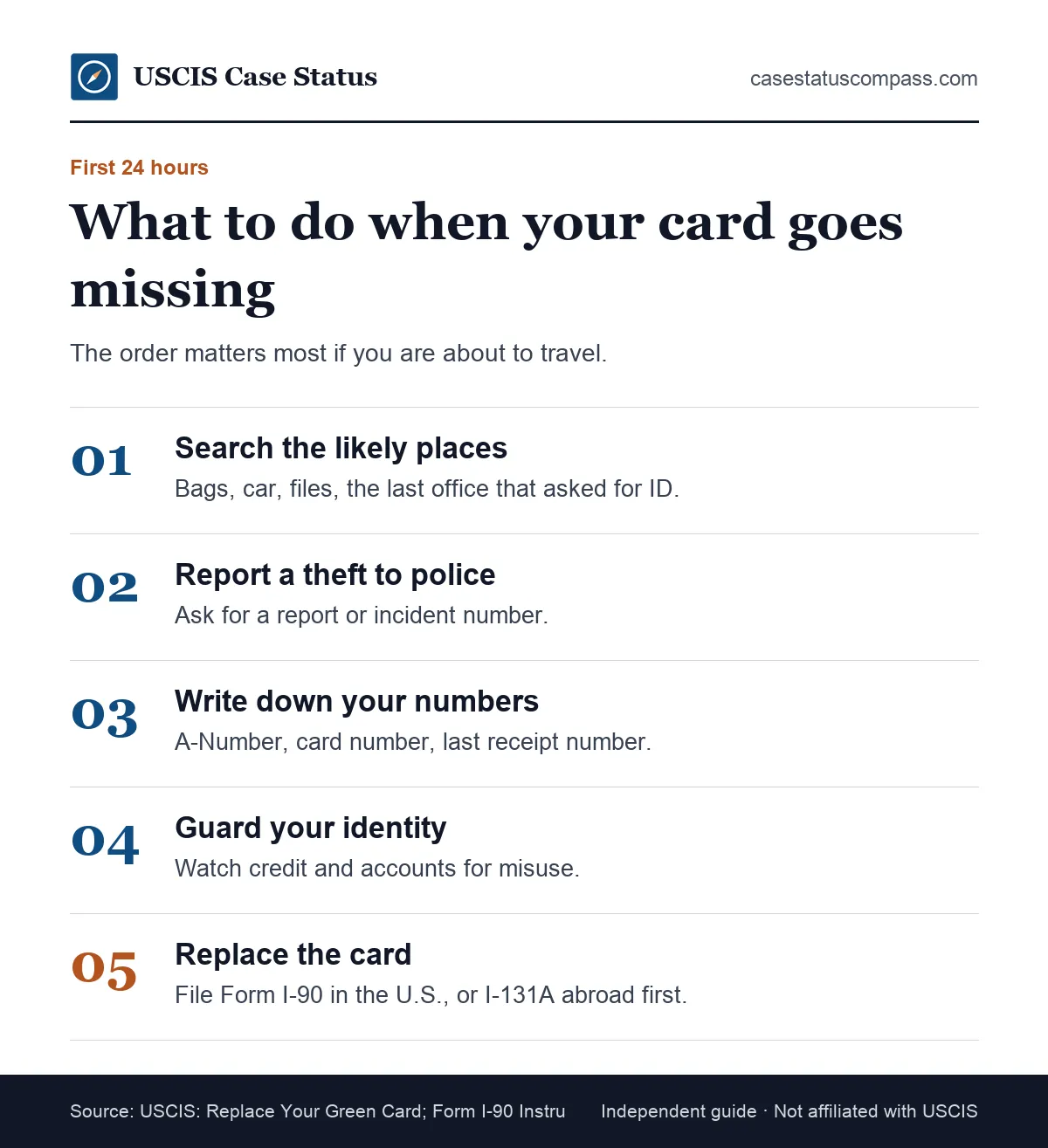
Search calmly first, then act in order: report a theft to police, record your A-Number and card details, guard your identity, and decide where you are. Inside the United States you file Form I-90. Abroad, you need travel documentation from a U.S. embassy first.
The first hour
Retrace the last time you used the card; most turn up in a wallet pocket, passport sleeve or appointment folder. If it was taken with a stolen bag, call local police the same day.
The first week
By the end of week one, aim for a police report number (if stolen), a note of your numbers, a credit alert and a filed replacement. A missing green card becomes urgent the day you need to fly or start a job.
Is Your Permanent Resident Status Gone When the Card Is Gone?
No. Your lawful permanent resident status comes from the approval recorded in your USCIS file, not the plastic card. The card, Form I-551, is only evidence; our permanent resident basics page explains the difference.
Replacing the card is still required, because U.S. law expects you to carry proof of status.
Card versus status
USCIS keeps your record under your A-Number, so a replacement is new evidence, not a new application for residence. Green card holders can live and work permanently in the U.S. and are protected by U.S. law.
When status really is at risk
Status can be in danger for reasons unrelated to the card, such as long stays abroad, some criminal issues, or a finding that you gave up residence. Long trips abroad can risk your green card; over 1 year is the general warning line. If any of these apply, get legal advice first.
Lost, Stolen, Destroyed or Never Received: Which Is Yours?
How the card went missing changes three things: whether you need a police report, which reason you pick on Form I-90, and whether you pay. A card USCIS mailed that never reached you is treated differently from one you held and then lost.
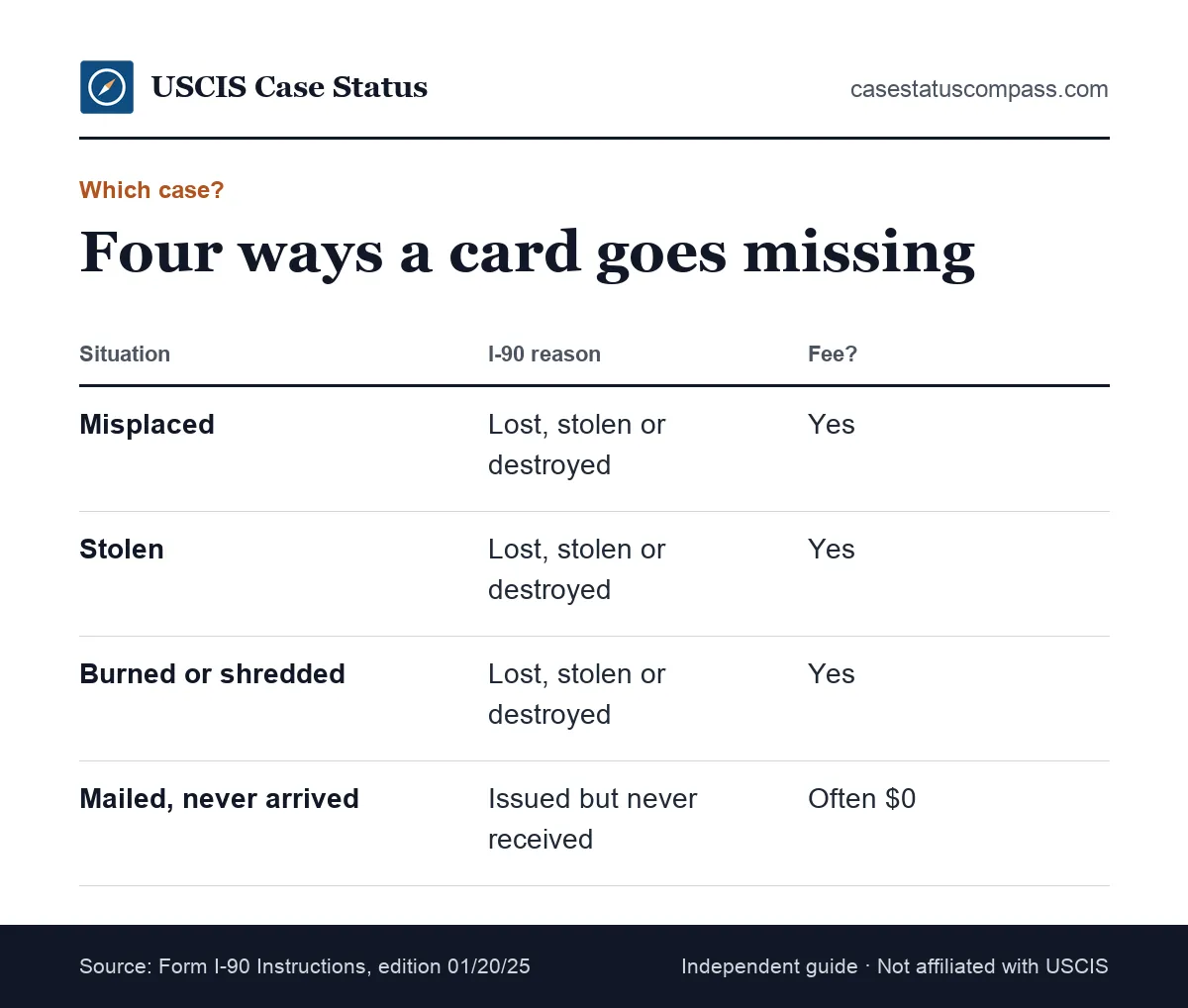
Missing-card situations and first steps
| Situation | Police report? | Extra step |
|---|---|---|
| Misplaced at home or work | Not needed | Search records for your card number |
| Stolen with a wallet or bag | Strongly advised | Credit freeze and alerts |
| Destroyed by fire, flood or laundry | Not needed | Keep any pieces and photos |
| Mailed by USCIS, never delivered | Not needed | Check address history and tracking |
| Lost on a trip abroad | Advised | Form I-131A at an embassy first |
Find the row that matches how your card went missing. The extra step column is what to do before filing Form I-90.
Misplaced or destroyed cards
A misplaced green card needs no police report; give yourself a firm deadline, such as three days, then treat it as lost. A badly damaged card still in your hands is the "mutilated" reason instead, and you send it with Form I-90.
Stolen or never-received cards
A stolen green card is also an identity risk, since it shows your name, photo, birth date and A-Number. A card that never arrived is not your loss at all and often qualifies for a $0 replacement.
Where Do Lost Green Cards Usually Turn Up?
Before you report a loss, check where cards usually hide: a passport sleeve, the bag from your last flight, folders from a DMV or job visit, and the car.
Also ask the last office that photocopied it, such as an employer, bank or clinic. Set a short deadline for the search, then move on to reporting and filing.
A search checklist
The passport cover you used on your last trip
Coat pockets and the bag from your last appointment
Your safe or "important papers" drawer
The glove box and car seat pockets
Envelopes from recent USCIS or DMV mail
If you find it after filing
Once reported lost, the old card may be flagged, so do not assume it still works. Call the USCIS Contact Center at 800-375-5283 and ask how to handle the found card and your pending case.
Should You File a Police Report for a Stolen Green Card?
Yes, if it was stolen. Form I-90 does not list a police report as required evidence, but the report creates a dated, official record of the theft. That helps if someone misuses your identity, and an embassy may ask for it abroad.
What to tell the officer
Say the item is a U.S. Permanent Resident Card (Form I-551), and give the date, place and anything else taken. Ask for the report number and save a copy.
Mention any identity documents taken with it.
If police will not take a report
Some departments refuse reports for lost items. Ask for an incident number or use your city's online form, and write your own dated statement.
Note the officer's name and the date.
How Do You Protect Your Identity After Losing the Card?
Treat a stolen permanent resident card like a stolen driver's license. Place a credit freeze or fraud alert, turn on bank alerts, and check your credit reports. If you find misuse, report it at IdentityTheft.gov, the FTC's recovery site.
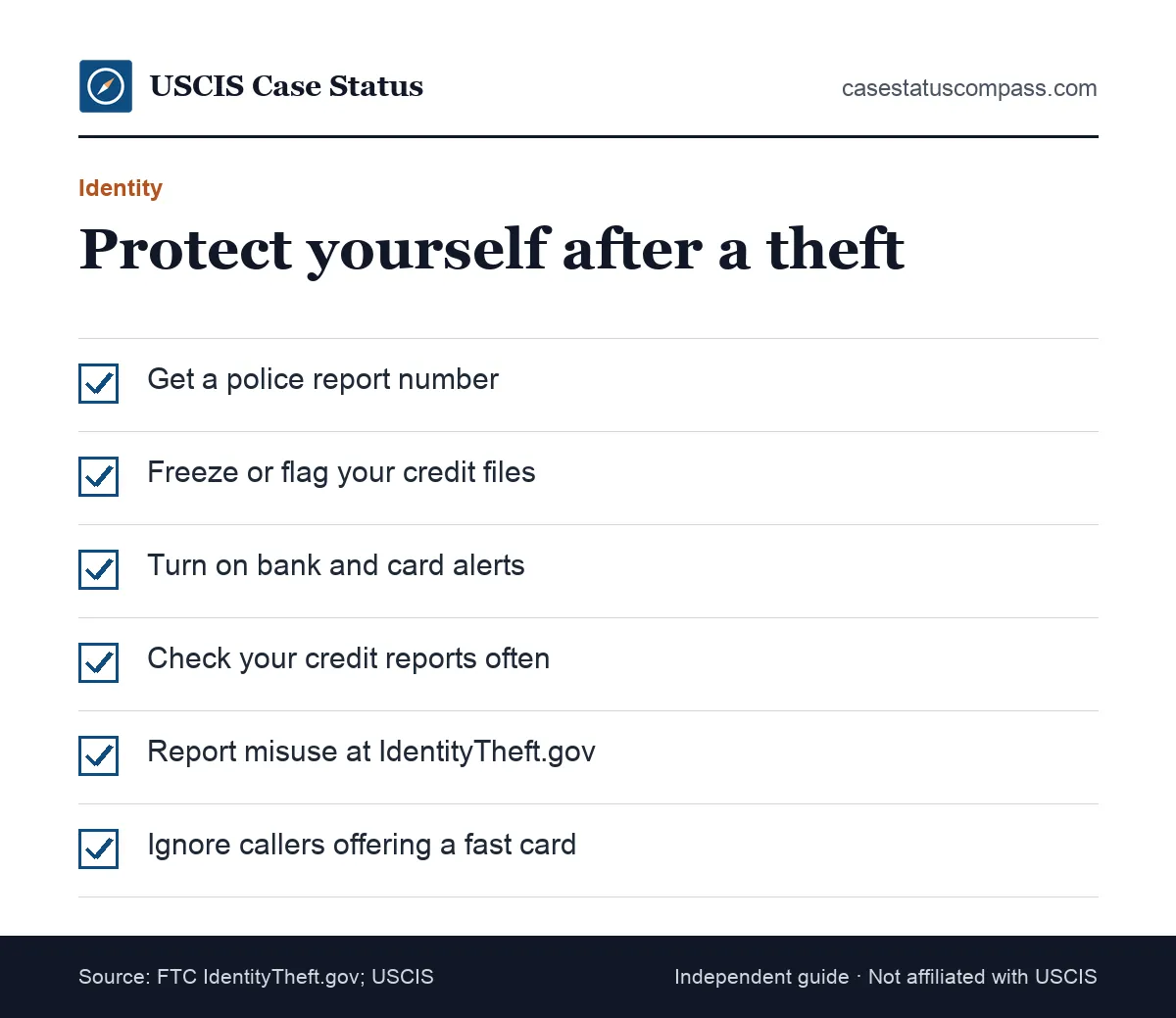
Protection steps in order
- Change your USCIS online account password and turn on two-step verification.
- Freeze your credit with the three national bureaus; it is free.
- Set alerts on bank, card and payroll accounts.
- Keep the police report number with your immigration file.
Watch for replacement scams
USCIS does not call to sell a faster card, and no one can "unlock" a replacement for a gift-card payment. Our guide to USCIS scams lists the warning signs.
Pay fees only to USCIS itself, never to a caller or "agent".
Which Numbers Should You Write Down Right Now?
Record your A-Number, the card number, the card's expiration date and the receipt number of your last USCIS case. These let USCIS, an embassy or an employer find your file, and your USCIS online account may hold copies.
Your A-Number and card number
Your A-Number is the 'USCIS#' printed on the front of green cards issued after May 10, 2010. It never changes, so old notices and your immigrant visa show it too; see our alien registration number guide. The card number changes with each card, as our green card number page explains.
Where to look without the card
| Record | What it may show | Where to look |
|---|---|---|
| Approval or welcome notice (I-797) | A-Number, receipt number | Home files, attorney copies |
| Immigrant visa in an old passport | A-Number, admission stamp | Expired passports |
| USCIS online account | Linked cases, notices | myaccount.uscis.gov/create-account |
The table lists records that often show your numbers. Check them before you call USCIS, so you have your A-Number ready.
Build a Lost-Card Incident File You Can Copy
Keep one folder, paper or digital, for the whole episode: the police report, a call log, your filing receipt and every notice. One incident file gives an attorney or embassy officer everything at once.
Start the file the day you notice a lost green card.
What goes into the file
A photo or copy of the old card, if you have one
The police or incident report number
Your Form I-90 confirmation and receipt notice
Notes from each call: date, agent and outcome
Copies of your credit freeze confirmations
Example incident log (fictional)
This example uses a fictional resident, Lena Ortiz. Adapt it to your facts.
| Date | Action | Reference |
|---|---|---|
| Mar. 3 | Wallet stolen on a train; reported to transit police | Report #T-0000 (example) |
| Mar. 3 | Credit freeze placed; bank alerts on | Confirmations saved |
| Mar. 5 | Filed Form I-90 online, reason "stolen" | Receipt in online account |
A dated record like this answers the questions police or USCIS may ask months later about when and where the card went missing.
Lost Green Card in the U.S. vs Abroad: Two Different Paths
Your location decides the path. Inside the United States, you go straight to Form I-90 and, if needed, an I-551 stamp. Abroad, you first ask a U.S. embassy or consulate for carrier documentation.
Mixing up the two paths wastes a fee.
Replacement path by location
| Question | Inside the U.S. | Outside the U.S. |
|---|---|---|
| First form | Form I-90 | Form I-131A |
| Where you file | Online or by mail with USCIS | In person at an embassy or consulate |
| What you get first | Receipt notice, then a card | Boarding foil or letter |
| New card | Mailed after approval | Still needs I-90 after return |
The table compares the two paths side by side. If you are abroad, the I-131A comes first and Form I-90 follows after you return.
Why embassies cannot fix it with a card
Embassies cannot print green cards, and an I-90 card is mailed to a U.S. address. If the card goes missing before a trip, postpone it or get an I-551 stamp first.
What If You Lost Your Green Card Outside the United States?
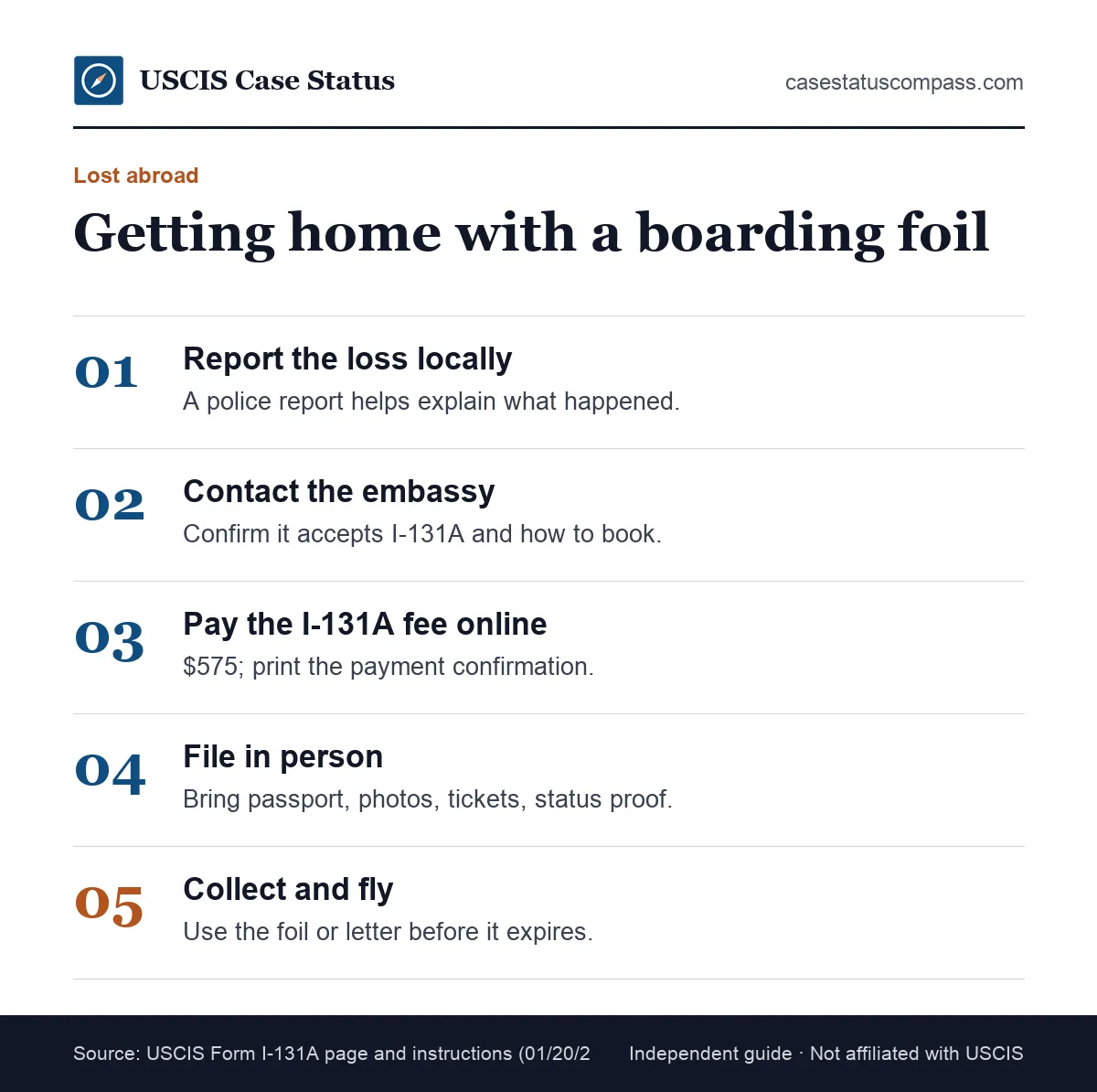
With a lost green card abroad, contact the nearest U.S. embassy or consulate and ask about Form I-131A, the Application for Carrier Documentation. Report the loss locally, read the embassy's own instructions before paying, and do not head to the airport hoping to explain.
Why Won't an Airline Board You Without a Green Card?
Airlines can be penalized for flying passengers without entry documents, so they usually refuse a permanent resident with no valid proof. Per the I-131A instructions, carrier documentation lets an airline board you without that penalty, though a CBP officer still decides entry.
What Is a Boarding Foil (Carrier Documentation)?
A boarding foil is a sticker placed in your passport, or a boarding letter, telling an airline you may travel to the United States as a permanent resident. USCIS calls it carrier documentation and issues it through Form I-131A.
The foil only lets you board a flight home; it is not a replacement card, so you still need Form I-90 after you return.
Foil versus transportation letter
The instructions say carrier documentation "may be a foil placed in your passport or a boarding letter." Older guides call the letter a transportation letter; both do the same job.
What the foil does not do
The foil is not a green card. The instructions state that it "does not take the place of obtaining a new Permanent Resident Card," so you still file Form I-90 after you land. It also does not promise admission.
Who Qualifies for Form I-131A?
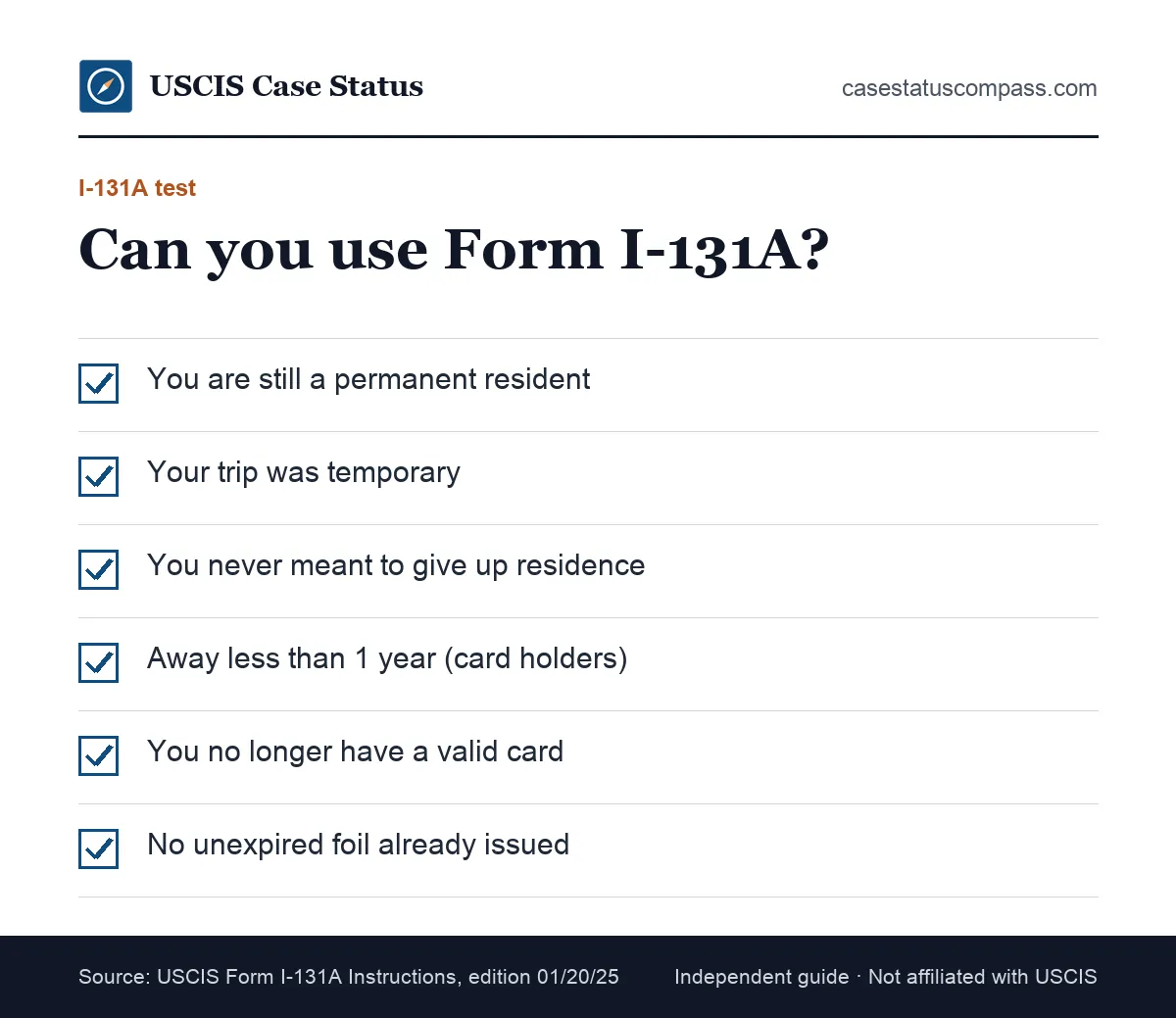
According to the Form I-131A instructions (edition 01/20/25), you qualify if you are still a permanent resident, traveled abroad temporarily without meaning to give up residence, and are returning after less than 1 year with a card that is now lost, stolen or destroyed.
The conditions in plain English
- You still hold permanent or conditional resident status.
- You did not abandon that status and were not removed.
- Your trip was temporary.
- You are under 1 year away with a card, or under 2 years with a reentry permit.
- You no longer have a valid card or permit.
How USCIS counts your time abroad
USCIS measures the absence from the day you left to the day you pay the fee, not the day of your appointment. A trip nearing the 1-year mark can cross it while you wait, so pay promptly.
Who should not file
Do not file if you gave up residence, your status was ended, or you already hold valid carrier documentation. Past the limit, ask about an SB-1 visa.
An attorney can confirm which applies.
How Do You Apply for a Boarding Foil at a U.S. Embassy?
Pay the Form I-131A fee online through USCIS first, then file the form in person at the consular section of a U.S. embassy or consulate with proof of payment. USCIS advises contacting the post first to confirm it can process the form.
Paying the I-131A fee online first
Enter your name, birth date and A-Number exactly as in USCIS records; USCIS says they appear on your foil. Keep the payment confirmation, because the post needs proof of payment.
Documents to bring to the embassy
The I-131A instructions list:
- A copy of every passport page, plus the original passport
- Evidence of resident status, if available (card copy, immigrant visa or CBP admission stamp)
- Tickets or an itinerary showing your departure and planned return
- Two identical recent color passport-style photos
Bring your police report too.
Interview and decision
The embassy may interview you and take biometrics to confirm identity. The form counts as filed only once the post accepts it, and that post tells you the decision.
Bring your fee receipt to the visit.
How Long Is a Boarding Foil Valid?
The Form I-131A instructions say carrier documentation (a boarding foil or transportation letter) is generally valid for 30 days from issuance. Plan to fly within that window, because missing it can mean a new application and fee.
Book a flight that fits the window.
At check-in
Show the foil and passport at check-in, and keep your police report and fee receipt in hand luggage. Arrive early, because some agents rarely see foils.
If an agent hesitates, ask for a supervisor.
How Long Does an Embassy Take to Issue a Boarding Foil?
No official page we could read gives embassy processing times for Form I-131A. Third-party sites mention a few days, but we did not verify that, so ask the specific post and leave room in your plans.
Ask the post for an estimated date in writing.
How Much Does Form I-131A Cost?
As of October 2026, Form G-1055 lists the Form I-131A fee at $575, paid online before you file at the embassy. Refugees, people paroled as refugees and residents who got status as refugees pay $0. Everyone else pays the full fee.
Fee rules that matter
USCIS's I-131A page says no fee waiver is available. USCIS fees are nonrefundable, even if your case is denied or withdrawn. Card payments cannot be disputed later, so pay only after the embassy confirms it can take your case.
Can Someone Else Pay the I-131A Fee for You?
Yes. USCIS says anyone can pay the Form I-131A fee from anywhere, which helps if a relative in the United States covers it. The name, birth date and A-Number entered must match your USCIS record exactly.
Keep the payment receipt for the embassy.
When You Might Not Need Form I-131A
Some residents abroad already hold documents an airline accepts. The Form I-131A instructions name an expired conditional or 10-year card plus a valid I-797 receipt showing a timely Form I-751 or I-829 filing. A valid reentry permit is another option. Ask your airline first.
Expired card plus an I-751 or I-829 receipt
If you filed to remove conditions on time, the receipt and expired card together may be enough to board. I-751 receipt notice extends conditional status and work authorization for 48 months. The instructions say to confirm with the carrier and file I-131A if it refuses.
A valid reentry permit
A reentry permit is a travel document obtained before a long trip. If you still have it, you may board without your card. If the permit was lost instead, the I-131A limit is 2 years of absence.
What Is an SB-1 Returning Resident Visa?
An SB-1 returning resident visa is a State Department immigrant visa for permanent residents who stayed abroad beyond what their documents allow, for reasons beyond their control. The I-131A instructions list it as an alternative; with an SB-1, you do not need Form I-131A.
When an SB-1 fits
It is meant for residents kept abroad by events such as serious illness. The State Department fee for Form DS-117 is $180; get the current requirements from the embassy.
Ask the embassy about SB-1 eligibility first.
Why it is a harder route
You must show U.S. ties and that the long stay was not your choice, in a full immigrant visa process. SB-1 holders are exempt from the USCIS Immigrant Fee of $235.
Boarding Foil vs SB-1 Visa vs Reentry Permit
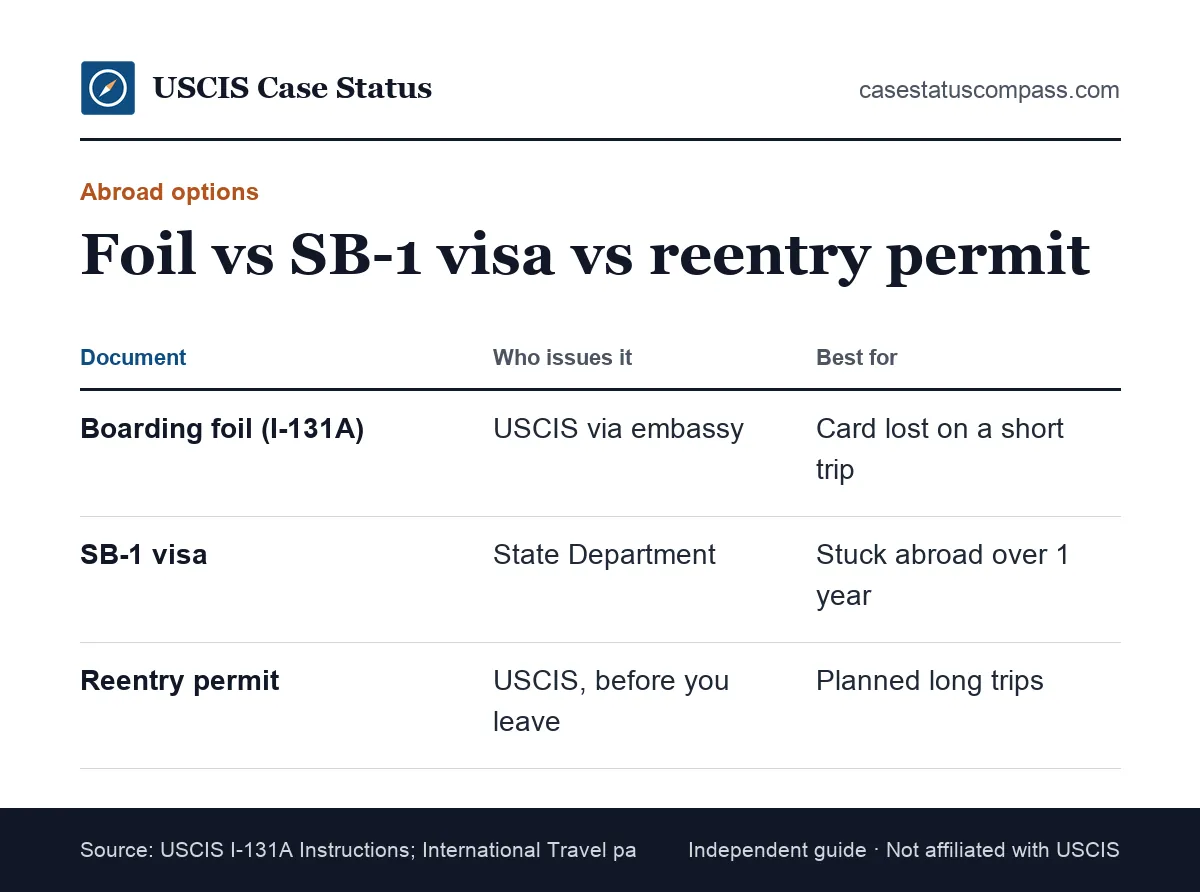
A boarding foil fixes a lost card on a short trip. An SB-1 visa helps a resident stranded abroad too long. A reentry permit is planned before a long trip and is the only one requested from inside the United States.
Three travel documents side by side
| Feature | Boarding foil (I-131A) | SB-1 visa | Reentry permit (I-131) |
|---|---|---|---|
| When you apply | Abroad, after the loss | Abroad, after a long stay | Before you leave |
| Where | Embassy or consulate | Embassy or consulate | USCIS, inside the U.S. |
| Absence covered | Under 1 year with a card | Beyond your document's limit | Generally 2 years |
| Replaces the card? | No | No | No |
The table compares when and where you apply for each document. None of the three replaces the green card itself.
Planning ahead
Reentry permit: generally valid 2 years (1 year if abroad more than 4 of the last 5 years). Our Form I-131 travel document guide explains how to apply before you travel.
Lost Your Green Card Abroad After More Than a Year?
If you lost the card after a year or more abroad, Form I-131A for a card no longer fits. You may need an SB-1 visa and may face questions about abandonment of residence. Speak with an immigration attorney before you approach the embassy.
Getting the right help
An attorney or DOJ-accredited representative can review your travel history first. Our green card holder travel rules guide explains how long absences affect residence.
Do this before you pay any embassy fee.
Does Losing Your Green Card Abroad Mean You Abandoned Residence?
No, not by itself. Abandonment turns on intent and ties, not on the lost card or just the calendar; even trips under a year can raise it. A U.S. home, job, tax returns and family show you meant to return, so bring proof of them to the embassy.
What Happens at the U.S. Border Without Your Card?
On arrival, a U.S. Customs and Border Protection (CBP) officer checks your identity and status in government systems. A boarding foil gets you to inspection, but the officer decides admission.
Answer questions about your trip honestly, and carry proof of your U.S. ties in case the officer asks.
What to carry for inspection
Your passport with the foil or boarding letter
The police report from where you lost the card
Any card copy and your A-Number written down
Proof of your U.S. home, job or taxes
After you are admitted
Admission does not give you a card. File Form I-90 once you are home, and ask about an ADIT stamp if you need proof right away.
Keep your admission record with your incident file.
Can You Fly Within the U.S. Without a Green Card?
Generally yes, with another acceptable ID. A valid foreign passport or a REAL ID-compliant driver's license or state ID usually works for domestic flights. Check the TSA identification list before you travel.
Carry that ID on every domestic trip.
Choosing the right ID
A passport is the safest choice, since it carries your photo and is widely accepted at checkpoints across the country.
Check that it has not expired, and carry the same ID you used to book the ticket.
When proof of status still helps
Domestic flights do not check immigration status, but trips near the border can bring questions. An I-551 stamp removes doubt.
Carry a copy of your I-90 receipt as backup.
Can You Work If You Lost Your Green Card?
Yes. Your right to work comes with resident status, not the card. The practical issue is Form I-9, the employment eligibility form. A new employer needs acceptable documents, while a current employer usually does not need to see your card again.
Starting a new job
A new hire can show an unexpired I-551 stamp in a foreign passport for Form I-9. The M-274 handbook has rules on receipts for lost documents; ask HR to check it.
Already employed
Your employer recorded your card at hiring, and a lost card does not restart that. If HR asks, share your I-90 receipt. Our I-551 stamp guide covers employer questions.
Keep your own copy of that receipt too, so you can produce it again if a later records check comes up.
How Do You Prove Permanent Resident Status While You Wait?
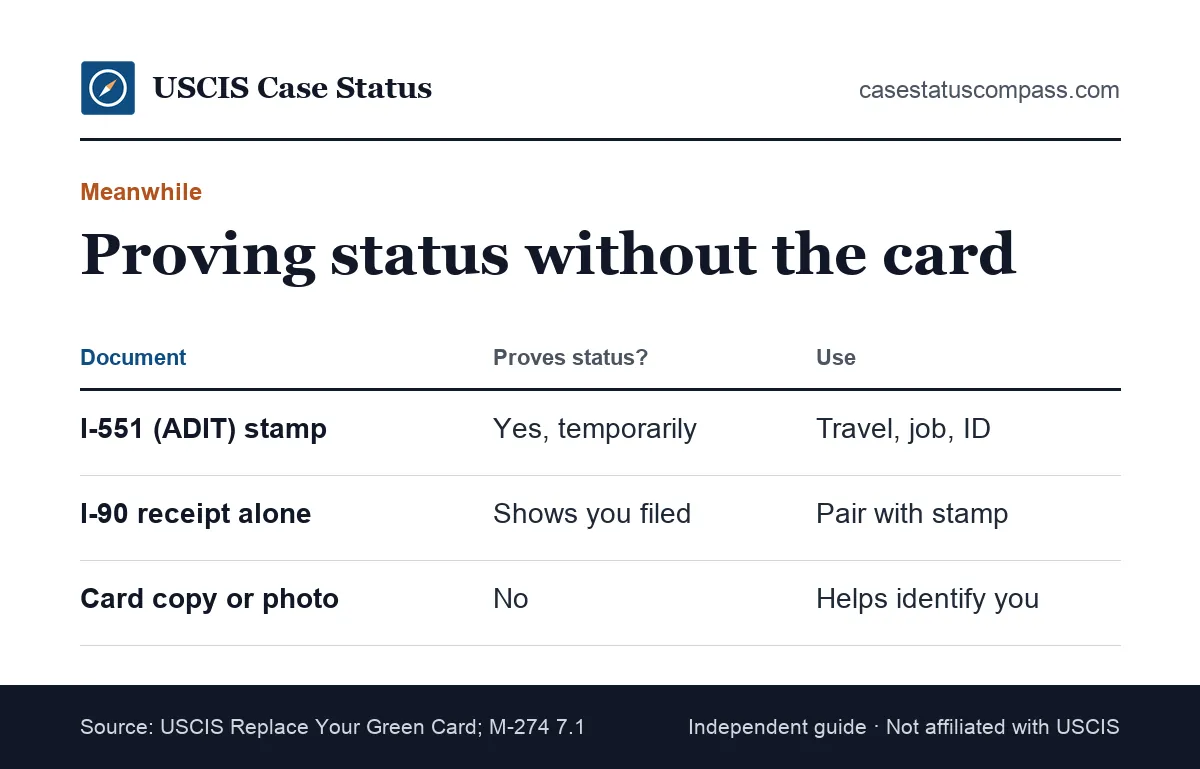
The strongest temporary proof is an I-551 stamp, also called an ADIT stamp, placed in your passport or on Form I-94. USCIS says it may issue one after you file Form I-90 if you no longer have your card. A receipt notice alone does not replace the card.
Why the receipt is not enough here
The I-90 receipt notice extension is built for expired cards: I-90 receipt notice + expired card = proof of status for 36 months from the card's expiration date. With a lost green card there is nothing to pair it with, so most residents ask for the stamp.
Proof options compared
| Document | Stand-alone proof? | Good for | Notes |
|---|---|---|---|
| I-551 (ADIT) stamp | Yes, temporary | Travel, Form I-9, DMV | Temporary I-551 stamp: valid until its expiration date, or 1 year if no date is printed |
| I-90 receipt notice | No, for a lost card | Showing you applied | Proof only with an expired card |
The table compares two kinds of temporary proof. Only the I-551 stamp works as stand-alone proof when the card is lost.
How Do You Request a Temporary I-551 Stamp?
Call the USCIS Contact Center to ask for the stamp. I-551/ADIT stamp: temporary proof of green card status; request through the USCIS Contact Center (800-375-5283). Explain why you need proof quickly, such as an urgent trip or job start. Agents may book a field office visit or, in some cases, arrange a stamped Form I-94 by mail.
What to have ready
Have your A-Number, name, I-90 receipt number and passport details. The number is 800-375-5283 (TTY: 800-767-1833). Live calls and chat: Monday to Friday, 8 a.m. to 8 p.m. Eastern. Our contact USCIS guide explains how to reach an agent.
At the appointment
Bring your passport, the appointment notice and your I-90 receipt. Our Form I-551 stamp page covers what happens there and how long the stamp lasts.
Check the stamp's date and details before leaving.
Replacing the Card: Form I-90 in Brief
Inside the United States, you replace a lost green card with Form I-90, the Application to Replace Permanent Resident Card. Choose "lost, stolen or destroyed" in most cases, file online or by mail, and attend biometrics if asked.
Store the receipt notice with your passport, because it carries the receipt number you need to track the replacement card.
The reason and what to send
File I-90 if your card is lost, damaged, wrong, expiring within 6 months, or you turned 14. Pick "issued but never received" only if USCIS mailed a card you never got. Since the card is gone, send a copy of a government photo ID, plus any old photocopy of the card.
Online or paper filing
Online filing through a USCIS account is cheaper and lets you upload your ID. The section-by-section walkthrough is on our I-90 filing guide.
Paper filers mail the form with the fee and an ID copy.
What Does It Cost to Replace a Missing Card?
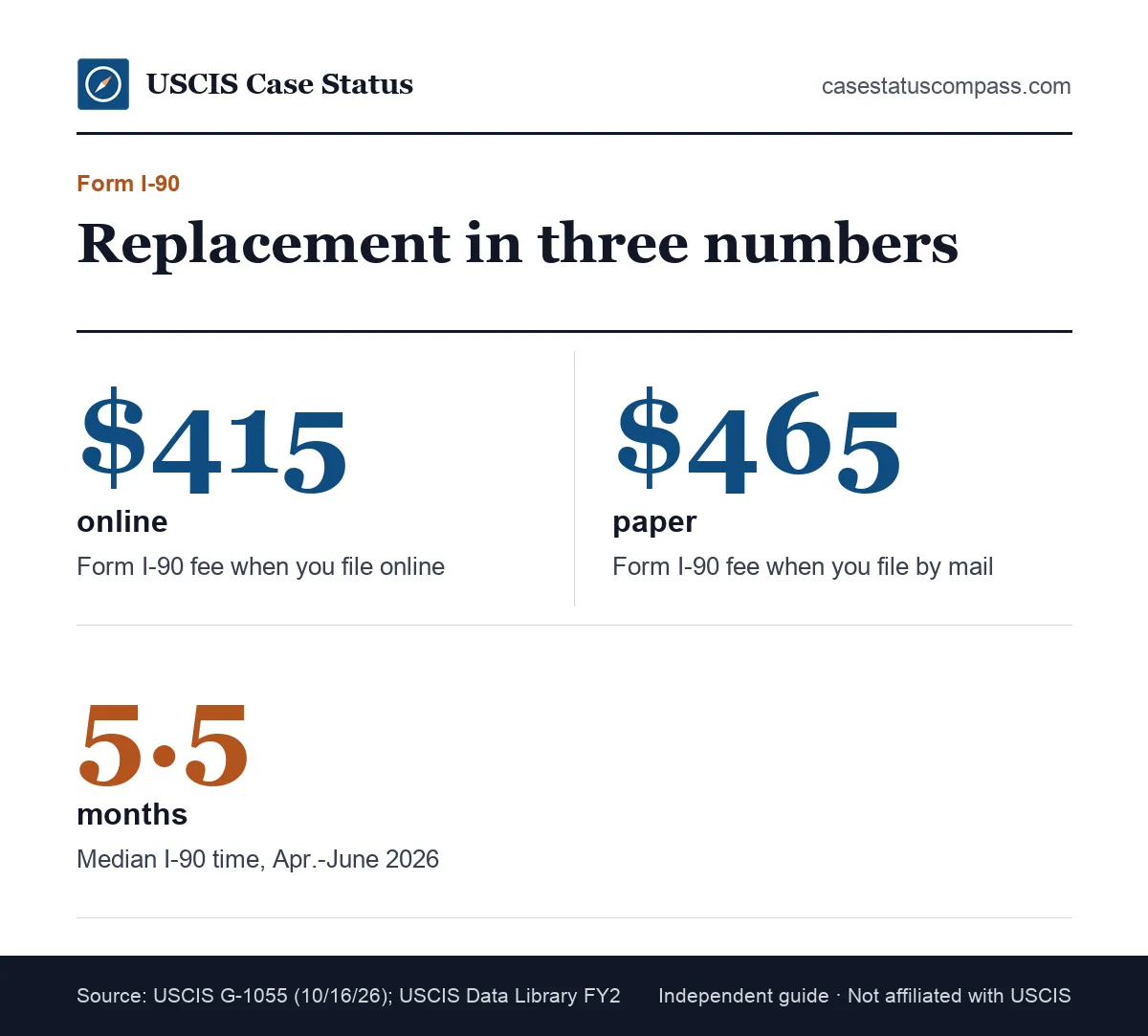
The Form I-90 fee, per G-1055 (edition 10/16/26), is $465 (paper) / $415 (online). Online filing costs less, and a fee waiver may be possible with Form I-912. Our green card replacement fee page covers every case, including the $0 situations.
When there is no fee
A card USCIS mailed that never arrived, or one with a USCIS error, may be replaced for $0. A lost or stolen card needs the full fee or an approved fee waiver. Asking costs nothing: $0 (no fee to request a fee waiver).
Costs people forget
Lose the card abroad and you pay the I-131A fee there, then the I-90 fee later, plus photos and travel to a field office.
Budget for each before you file.
How Long Until the Replacement Card Arrives?
For cases completed April to June 2026, USCIS reported this median: I-90: median 5.5 months (USCIS data, Apr.-June 2026). A median is not a promise. Right now, replacement cases take 6 months (USCIS data retrieved Oct 27, 2026). Our green card replacement time page explains what affects the wait.
The stages you will see
Expect a case was received update, then a biometrics appointment unless prints are reused, then approval.
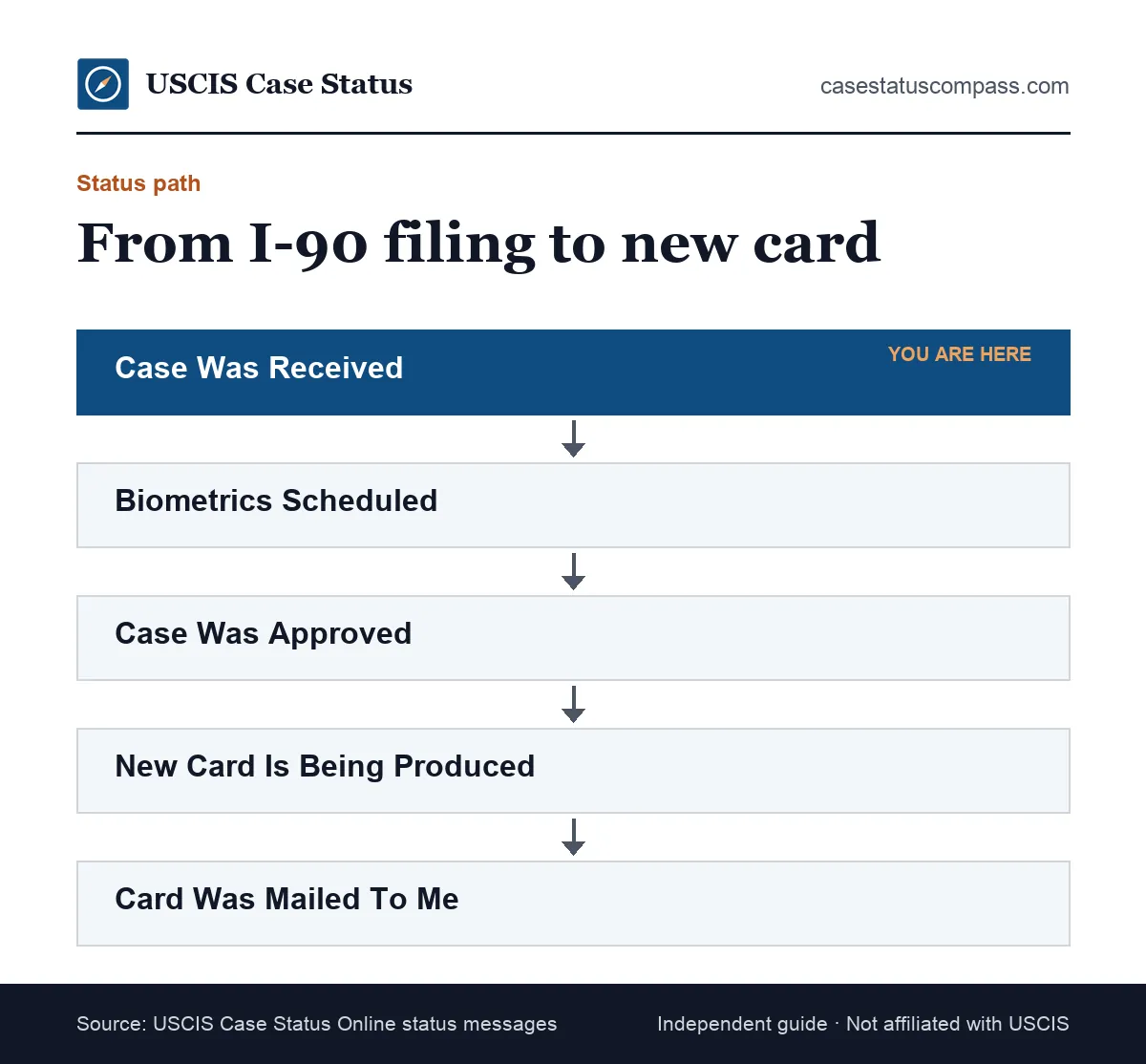
After approval, the card is produced and mailed to your address on file. Watch for a "card was mailed" update.
If you need the card sooner
You can ask for an expedite if you meet USCIS criteria; see our USCIS expedite request guide. Most residents use the I-551 stamp instead.
Explain your reason when you call.
What If Your Green Card Never Arrived in the Mail?
If USCIS says it mailed your card and nothing came, check tracking and your address history first. Undeliverable cards return to USCIS, which holds them for a set time before re-mailing or destroying them. A card never received may qualify for Form I-90 at no fee.
Cards returned to USCIS
Returned green cards are held 60 business days (about 12 weeks), then re-mailed or destroyed. See our card was returned to USCIS page, and update your address quickly.
Then ask how to have it re-mailed.
Cards marked as mailed
If tracking shows delivery but you have nothing, ask the post office and neighbors; our card was mailed to me guide explains follow-up. A late address update can mean a new fee. Report a new address to USCIS within 10 days of moving (INA 265), which you can do through our USCIS change of address guide.
Lost a Green Card With a Pending Case?
A lost green card can affect other pending cases. In a naturalization case, USCIS expects your card back at the oath ceremony. If you are a conditional resident with Form I-751 pending, the receipt works only alongside the card, so a lost card still needs action.
Pending N-400 citizenship case
Hand in your green card when you check in for the oath ceremony. Tell the officer at your interview that the card is lost and how you looked for it. See our oath ceremony guide.
Pending I-751 to remove conditions
Without the 2-year card, ask the Contact Center about an I-551 stamp. Our Form I-751 page explains why you should not file I-90 for a card near its end date.
Lost a 2-Year Conditional Green Card?
A conditional resident can use Form I-90 for a lost 2-year card only in limited cases. If the card expires within 90 days, file Form I-751 (or I-829) instead. A replacement conditional card keeps the same end date, so it does not extend your status.
When I-90 still applies
Most green cards are valid for 10 years; conditional green cards for 2 years. If the loss happens long before you can remove conditions, Form I-90 replaces the card with the same expiration date.
When to skip I-90
File in the 90 days before your 2-year card expires. If you are in or near that window, file to remove conditions instead; the receipt and an I-551 stamp cover you meanwhile.
Worked Examples: Four Lost-Card Scenarios
These fictional scenarios show how one problem leads to different steps. They are examples, not legal advice; your facts may change the answer.
Each scenario covers a different situation: a theft at home, a loss on a short trip, a loss after a long stay abroad, and a card that never arrived.
Example 1: Stolen at home
Priya, a fictional Ohio resident, had her wallet stolen. She reported it that day, froze her credit and filed Form I-90 online as "stolen," then booked an I-551 stamp appointment before a new job.
Example 2: Lost on a three-week trip
Daniel, a fictional resident visiting Lisbon, lost his card in a taxi. He got a police report, paid the I-131A fee online, filed at the U.S. Embassy, flew home on the foil, then filed Form I-90.
Example 3: Lost after 14 months abroad
Mei, a fictional resident caring for a sick parent, lost her card after 14 months away. Form I-131A did not fit, so she asked an attorney about an SB-1 visa.
Example 4: A card that never came
Ana, a fictional new resident, saw "card was mailed" online but nothing arrived at her correct address. She checked with the post office, then filed Form I-90 as "issued but never received," a reason that may carry no fee.
What Are the Most Common Lost Green Card Mistakes?
The usual mistakes are waiting too long, traveling abroad without proof, expecting Form I-90 to fix travel from abroad, paying scammers for a "fast" card, and forgetting an address update.
Each one can cost a fee, a missed flight or a delay.
Mistakes in the first days
Waiting months to see if the card shows up
Skipping the police report after a theft
Leaving the country without an I-551 stamp
Not writing down your A-Number and card number
Mistakes when the card is lost abroad
Going to the airport without carrier documentation
Filing Form I-90 instead of Form I-131A
Paying the I-131A fee before the post confirms it can help
Letting the 1-year limit pass while waiting
Mistakes after filing
Using a found old card after reporting it lost
Skipping biometrics (Missing biometrics can lead to denial for abandonment)
Paying anyone other than USCIS
Missing USCIS mail after a move
What If Your Lost Card Turns Up Later?
If you find the old card after reporting it lost, do not start using it without checking with USCIS. After a lost-card I-90 filing, the old card may be invalidated in government systems.
Keep the found card and your notes in your incident file.
What to do with a found card
Call the Contact Center, say you found the card, and ask how to proceed with your pending I-90. Note the call in your incident file.
Keep it safe until USCIS answers.
If you have not filed yet
A valid card found before you file can be used as normal; tell police if you reported a theft.
Keep it in a safer place, and photocopy both sides so you have your card number if it goes missing again.
Does a Lost Card Ever Need a Lawyer?
Most lost-card cases are routine. Get legal help if you were abroad for long periods, have a criminal record, are in removal proceedings, were denied before, or an embassy refuses carrier documentation.
A short paid consultation can confirm your next step.
Warning signs
A year or more abroad without a reentry permit
Any arrest or conviction since you got your card
An embassy that questions your residence
A past removal order or denied application
Finding trustworthy help
Use a licensed immigration attorney or a DOJ-accredited representative. Avoid notarios who promise guaranteed results.
Check the lawyer's state bar license, or find the representative on the Justice Department's roster.
Lost Green Card Recovery Timeline, From Day 1
Most of your effort falls in the first week: search, report, protect your identity and file. After that, USCIS works the case while you track status and use temporary proof.
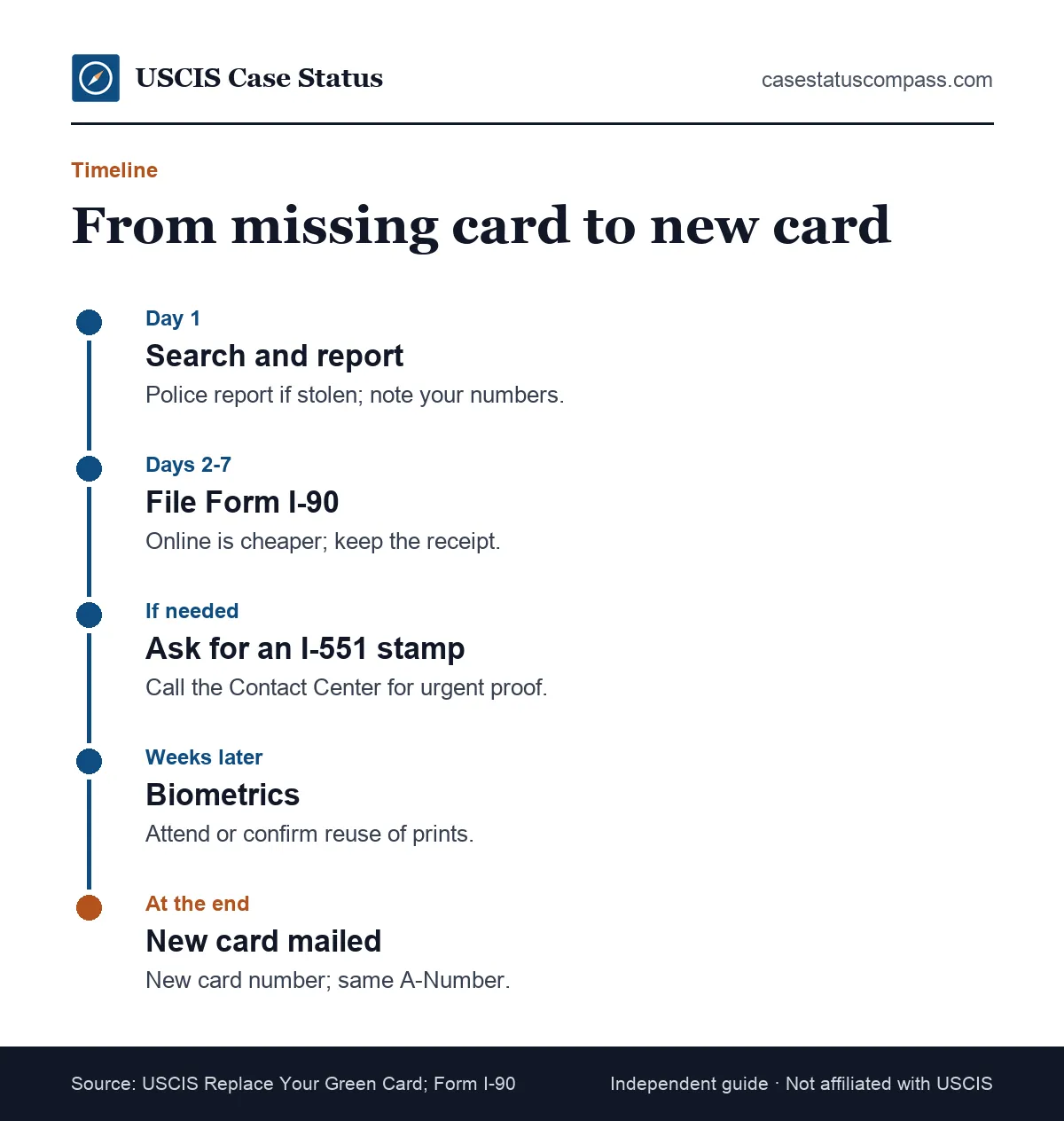
Keep your lost green card incident file updated as each notice arrives, and check your case status every few weeks.
Your part versus USCIS's part
Your part is the first week. USCIS's part is the receipt, biometrics, review and mailing. If a notice or call about your case looks odd, use our guide to verify a USCIS notice.
Frequently Asked Questions
Do I lose my permanent residence if I lose my green card?
No. Permanent resident status is recorded in your USCIS file and does not depend on the card, which is only evidence. You still need Form I-90, because without a card you may struggle to travel or start a job.
Can I re-enter the United States without my green card?
Usually only with substitute documents. After a short trip, apply for a boarding foil through Form I-131A at a U.S. embassy. A valid reentry permit, an SB-1 visa, or an expired card with a timely I-751 receipt may also work.
Is a police report required to replace a lost green card?
Form I-90 does not list a police report as required evidence. File one anyway if the card was stolen, because it documents the theft. Embassies handling Form I-131A may also ask to see it.
Will my new green card have a different number?
Yes. A replacement gets a new card number, while your A-Number stays the same. Employers or agencies that recorded the old number may ask for the new one.
Can I file Form I-90 while I am outside the United States?
Form I-90 replaces the card; it does not help you travel. Abroad, file Form I-131A at an embassy for carrier documentation, then file Form I-90 after you return.
Can I apply for citizenship if my green card is lost?
Yes. Citizenship application eligibility depends on your status and residence time, not the card. You normally hand in your card at the oath ceremony, but USCIS can waive that if you showed it was lost.
Who should I call about a lost green card?
Call the USCIS Contact Center at 800-375-5283 for an I-551 stamp or replacement questions; callers abroad can use 212-620-3418 (callers outside the U.S.). For a card lost on a trip, contact the nearest U.S. embassy or consulate.
Can I renew my driver's license without my green card?
Often only with other proof of status. Many state DMVs accept an unexpired I-551 stamp in your passport or on Form I-94, so request the stamp before your license appointment and bring your I-90 receipt.
Does a lost green card show up in my case status online?
Your I-90 case does. Once you file, track the receipt number in your USCIS online account or Case Status Online for biometrics, approval and mailing updates.
How do I get a stolen green card replaced?
File Form I-90 and choose the "lost, stolen or destroyed" reason. Report the theft to police first and keep the report number, and ask the Contact Center for an I-551 stamp if you need proof before the new card arrives.
Sources
- USCIS: Replace Your Green Card. www.uscis.gov/green-card/after-we-grant-your-green-card/replace-your-green-card. Accessed Oct 27, 2026.
- USCIS: Form I-90, Application to Replace Permanent Resident Card. www.uscis.gov/i-90. Accessed Oct 27, 2026.
- USCIS: Form I-131A, Application for Carrier Documentation (updated 06/03/2026). www.uscis.gov/i-131a. Accessed Oct 27, 2026.
- USCIS: Form I-131A Instructions, edition 01/20/25. www.uscis.gov/sites/default/files/document/forms/i-131ainstr.pdf. Accessed Oct 27, 2026.
- USCIS: International Travel as a Permanent Resident. www.uscis.gov/green-card/after-we-grant-your-green-card/international-travel-as-a-permanent-resident. Accessed Oct 27, 2026.
- USCIS alert: Additional Mail Delivery Process for Receiving ADIT Stamp (2023). www.uscis.gov/newsroom/alerts/uscis-announces-additional-mail-delivery-process-for-receiving-adit-stamp. Accessed Oct 27, 2026.
- USCIS M-274 Handbook for Employers, 7.1 Lawful Permanent Residents. www.uscis.gov/i-9-central/form-i-9-resources/handbook-for-employers-m-274/70-evidence-of-employment-authorization-for-certain-categories/71-lawful-permanent-residents-lpr. Accessed Oct 27, 2026.
- USCIS Form G-1055 Fee Schedule, edition 10/16/26. www.uscis.gov/g-1055. Accessed Oct 27, 2026.
- USCIS Policy Manual Vol. 11, Part A, Ch. 3 (undeliverable cards). www.uscis.gov/policy-manual/volume-11-part-a-chapter-3. Accessed Oct 27, 2026.
- USCIS Contact Center. www.uscis.gov/contactcenter. Accessed Oct 27, 2026.
- FTC: IdentityTheft.gov. www.identitytheft.gov/. Accessed Oct 27, 2026.
- USCIS processing times. egov.uscis.gov/processing-times/. Accessed Oct 27, 2026.
- USCIS Form G-1055 Fee Schedule, Edition 10/16/26. www.uscis.gov/sites/default/files/document/forms/g-1055.pdf. Accessed Oct 27, 2026.
- USCIS: Rights and Responsibilities of a Green Card Holder (updated 09/12/2025). www.uscis.gov/green-card/after-we-grant-your-green-card/rights-and-responsibilities-of-a-green-card-holder-permanent-resident. Accessed Oct 27, 2026.
- USCIS Glossary: USCIS Number. www.uscis.gov/glossary-term/50674. Accessed Oct 27, 2026.
- USCIS: Online Account and Technical Support. www.uscis.gov/tools/uscis-tools-and-resources/online-account-and-technical-support. Accessed Oct 27, 2026.
- USCIS: Filing Fees (updated 02/12/2026). www.uscis.gov/forms/filing-fees. Accessed Oct 27, 2026.
- USCIS: Removing Conditions on Permanent Residence Based on Marriage (updated 12/12/2023). www.uscis.gov/green-card/after-we-grant-your-green-card/conditional-permanent-residence/removing-conditions-on-permanent-residence-based-on-marriage. Accessed Oct 27, 2026.
- State Department: Fees for Visa Services. travel.state.gov/content/travel/en/us-visas/visa-information-resources/fees/fees-visa-services.html. Accessed Oct 27, 2026.
- Form I-131 Instructions, Edition 01/20/25; 8 CFR 223.3(a)(1). www.uscis.gov/sites/default/files/document/forms/i-131instr.pdf. Accessed Oct 27, 2026.
- Form I-90 Instructions, Edition 01/20/25. www.uscis.gov/sites/default/files/document/forms/i-90instr.pdf. Accessed Oct 27, 2026.
- USCIS Data Library: All USCIS Application and Petition Form Types, FY2026 Q3 (Apr. 1-June 30, 2026; queried 7/2026). www.uscis.gov/sites/default/files/document/data/quarterly_all_forms_fy2026_q3_v1.xlsx. Accessed Oct 27, 2026.
- USCIS: How to Change Your Address (updated 08/04/2026); 8 U.S.C. 1305(a) (LII). www.uscis.gov/addresschange. Accessed Oct 27, 2026.
- USCIS: Naturalization Ceremonies (updated 02/12/2026). www.uscis.gov/citizenship/learn-about-citizenship/naturalization-ceremonies. Accessed Oct 27, 2026.
- USCIS Glossary: Green Card. www.uscis.gov/tools/glossary. Accessed Oct 27, 2026.
- USCIS: Preparing for Your Biometric Services Appointment (updated 04/30/2026). www.uscis.gov/forms/filing-guidance/preparing-for-your-biometric-services-appointment. Accessed Oct 27, 2026.
casestatuscompass.com is an independent publication and is not affiliated with USCIS or any government agency. This page is general information, not legal advice. For denials, court or asylum matters, consult an immigration attorney or a DOJ-accredited representative.