Contents · 39 sections
- What Is an Alien Number?
- Where Is the A-Number on a Green Card?
- Where Is the Alien Number on Older Green Cards?
- How Many Digits Does an A-Number Have?
- Is the USCIS Number the Same as the A-Number?
- Where Else Can You Find Your A-Number?
- Which USCIS Notices Show the A-Number?
- Where Is the A-Number on an Immigrant Visa?
- Do You Need Your A-Number to Pay the USCIS Immigrant Fee?
- How Does the A-Number Appear on a Work Permit?
- A-Number vs Green Card Number vs Receipt Number
- Is the A-Number the Same as the USCIS Online Account Number?
- Where Do You Get an Alien Registration Number?
- Who Has an A-Number and Who Does Not?
- What If You Do Not Have an A-Number?
- Do H-1B Workers Have an Alien Number?
- Do DACA Recipients Have an A-Number?
- Do Asylum Seekers and Refugees Have A-Numbers?
- Do TPS Applicants Have an A-Number?
- Can Your A-Number Change?
- What If DHS Gave You Two A-Numbers?
- How Do You Find a Lost A-Number?
- Is There an Alien Number Lookup Online?
- Can You Check Immigration Status by Alien Number?
- How Do You Check an Immigration Court Case by A-Number?
- Where Do You Enter Your A-Number on USCIS Forms?
- How Is the A-Number Used on Form I-9?
- How Is the A-Number Used When You Apply for Citizenship?
- Is There a U.S. Citizenship Number?
- What Is an A-File?
- Common A-Number Mistakes to Avoid
- How Can You Protect Your A-Number?
- What If Your A-Number Is Wrong on a Card or Notice?
- Do Children and Family Members Have Their Own A-Numbers?
- Which Document Should You Check First?
- Does the Alien Number Appear on the Back of the Green Card?
- Which Terms Mean the Same as A-Number?
- When Should You Get Help With an A-Number Problem?
- Frequently Asked Questions
The short answer
Your alien number, or A-Number, is the Alien Registration Number that the Department of Homeland Security gives you when your U.S. immigration record starts. On green cards issued after May 10, 2010, it is the number after the USCIS# label on the front. It stays the same for life.
At a glance
| Official name | Alien Registration Number (A-Number), also shown as USCIS# |
| On a green card | Your A-Number is the 'USCIS#' printed on the front of green cards issued after May 10, 2010 |
| Length | 7 to 9 digits, written after the letter A |
| Changes? | No. One A-Number per person, reused on every filing |
| Not the same as | Your green card number, receipt number or online account number |
What Is an Alien Number?
An alien number is the permanent ID that U.S. immigration agencies use to track one person's records. USCIS, CBP, ICE and the immigration courts all file your history under it. The number identifies you, not a single case or card, so it never changes.
The official name: Alien Registration Number
Forms call it the Alien Registration Number. Cards and notices shorten it to A-Number, A#, or USCIS#. All of these labels point to the same number.
Treat them as one ID when filling forms.
What the I-90 instructions say about it
The Form I-90 instructions say USCIS uses it "to identify your immigration records" and that it begins with an "A". That wording is the clearest official definition a cardholder will find.
Why one number follows you everywhere
Your immigration file, called the A-file, holds petitions, interview notes and decisions. Because the A-Number is the file's label, officers can pull your full history even when you file a new form years later.
Where Is the A-Number on a Green Card?
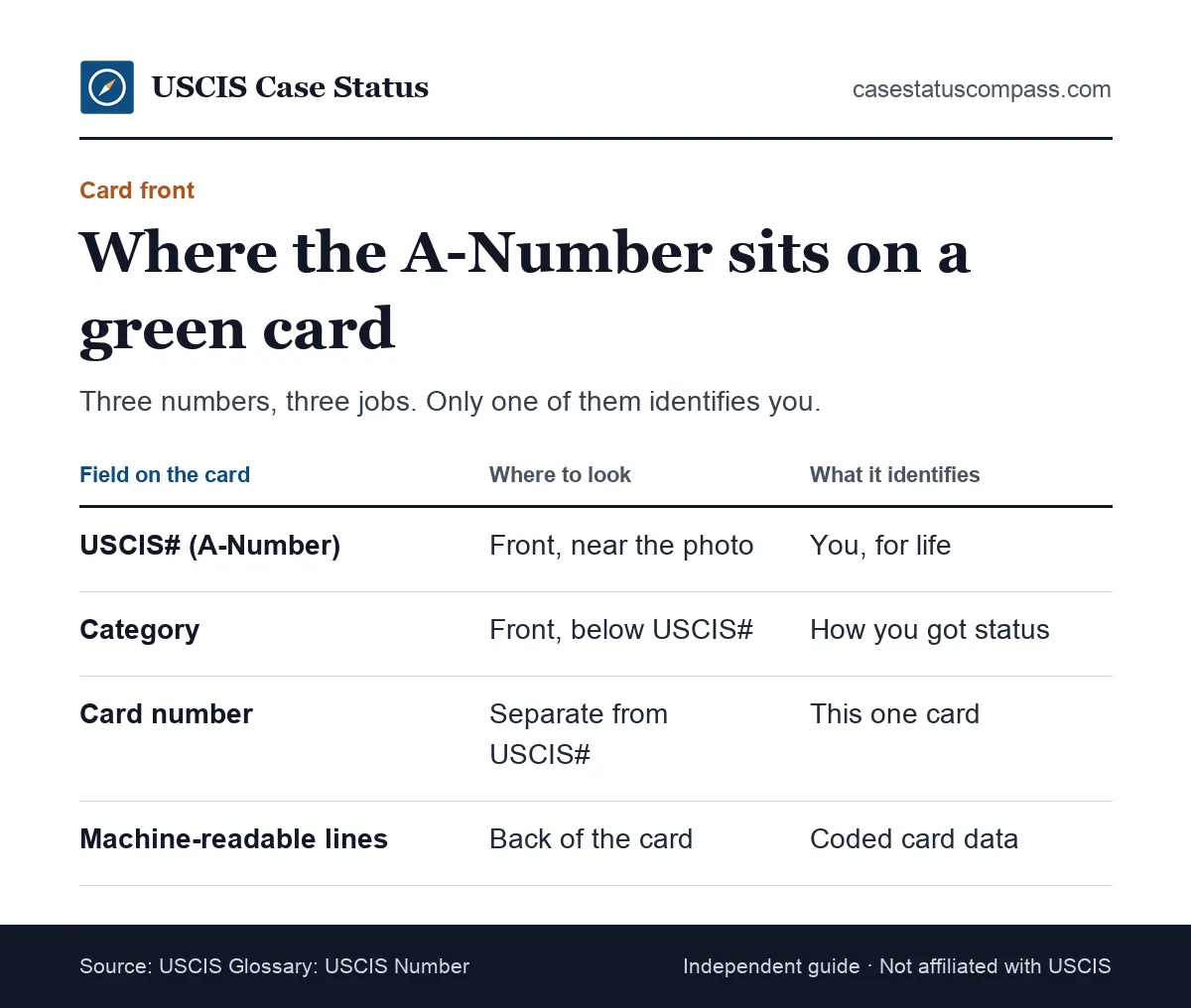
On current green cards, the A-Number is on the front, after the label USCIS#. As of October 2026, the USCIS glossary confirms this: Your A-Number is the 'USCIS#' printed on the front of green cards issued after May 10, 2010.
A-number location on the card (image description)
The labelled diagram below shows a green card front. The USCIS# line holds the alien number on a green card. The card number is a different code, and the machine-readable lines on the back contain coded data.
How the number is printed
The USCIS# is often printed in groups of three digits separated by dashes, such as 012-345-678. Forms usually want the digits without dashes. Copy the digits in order and keep any leading zeros, because a zero in front is part of your number.
Where Is the Alien Number on Older Green Cards?
Older green cards may print the alien number under a different label, such as A# or "Alien Registration No.", instead of USCIS#. The number is the same; only the label changed. Some very old cards have no expiration date and an older layout.
Cards labelled A# or Alien Registration
If your card says A# followed by digits, that is your A-Number. USCIS redesigns the card every few years, so read each label rather than looking in one fixed corner.
When the card shows no clear number
Very old cards, such as the obsolete Form I-151, are no longer valid proof and should be replaced with Form I-90. If your card is damaged or faded, check your EAD, visa or notices instead. The green card basics guide explains card types.
How Many Digits Does an A-Number Have?
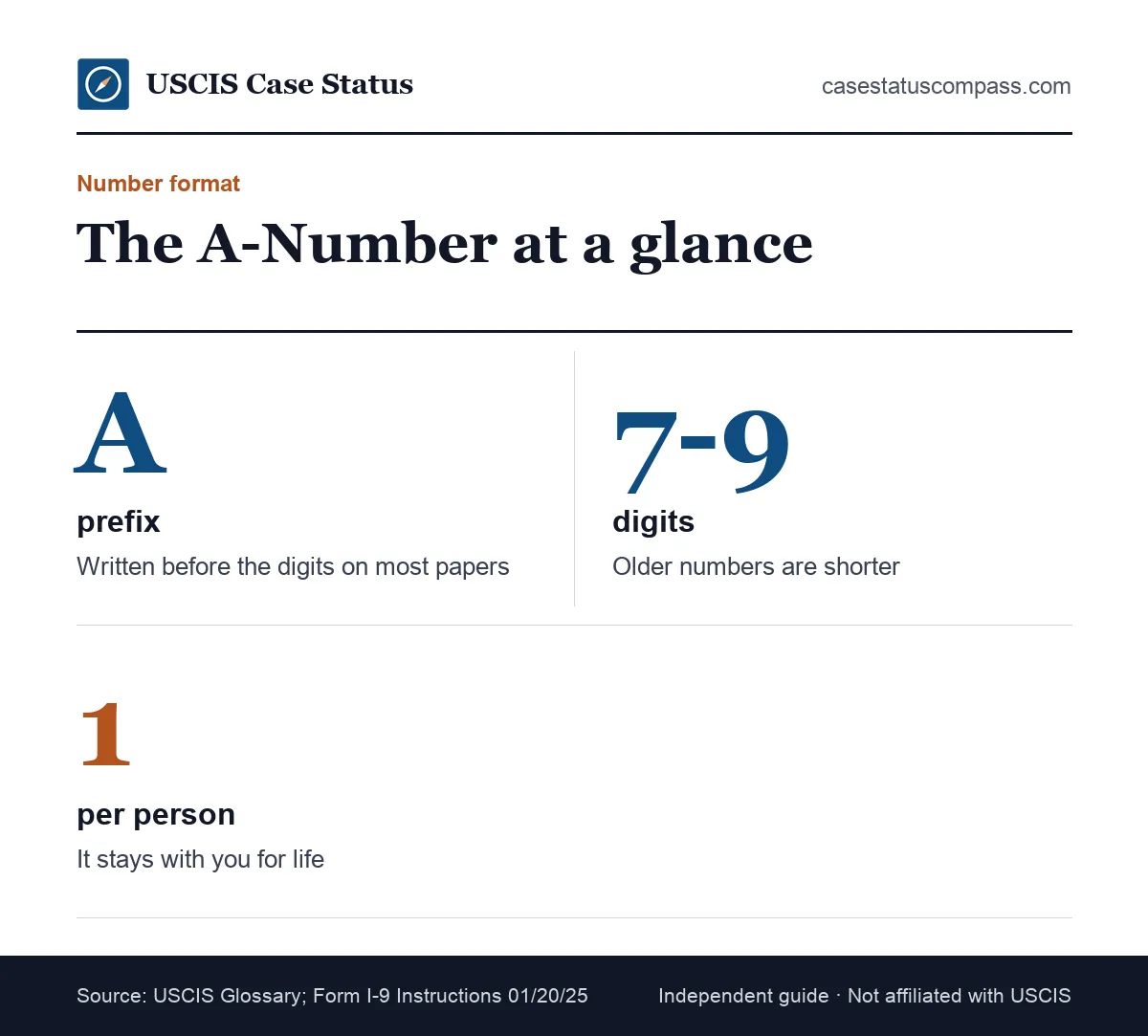
An A-Number has 7 to 9 digits after the letter A. The Form I-9 instructions (edition 01/20/25) describe it as the "7- to 9-digit USCIS Number (A-Number)".
Copy the digits exactly as printed, and do not add zeros to reach nine unless the form's instructions tell you to.
Seven, eight or nine digits
A shorter number is not an error. It only means DHS created your record earlier.
- A1234567: seven digits, an older record
- A12345678: eight digits, still valid
- A123456789: nine digits, typical of newer records
Matching the boxes on a form
Many paper and online forms print a fixed row of boxes for the A-Number. Before you write a shorter number, read that form's own instructions, because the filling method can differ between applications and editions.
Is the USCIS Number the Same as the A-Number?
Yes. The USCIS Number printed on green cards and work permits is your A-Number. The USCIS glossary describes the 9-digit USCIS Number on cards issued after May 10, 2010, and points to the A-Number entry. Two labels, one number.
Why the label changed
USCIS moved to the USCIS# label on newer cards, but the underlying record did not change. Digits on papers with either label should match exactly, apart from the letter A and any dashes the printer added.
When the digits do not match
If your card and a notice show different digits, check for a missing leading zero first, then for dashes or a dropped letter A.
Most mismatches end there, because the underlying number is the same.
Asking USCIS to review a mismatch
If they still differ, you may have two records. Ask USCIS to review it through the Contact Center at 800-375-5283, and keep copies of both papers.
Do not file new forms until it is resolved.
Where Else Can You Find Your A-Number?
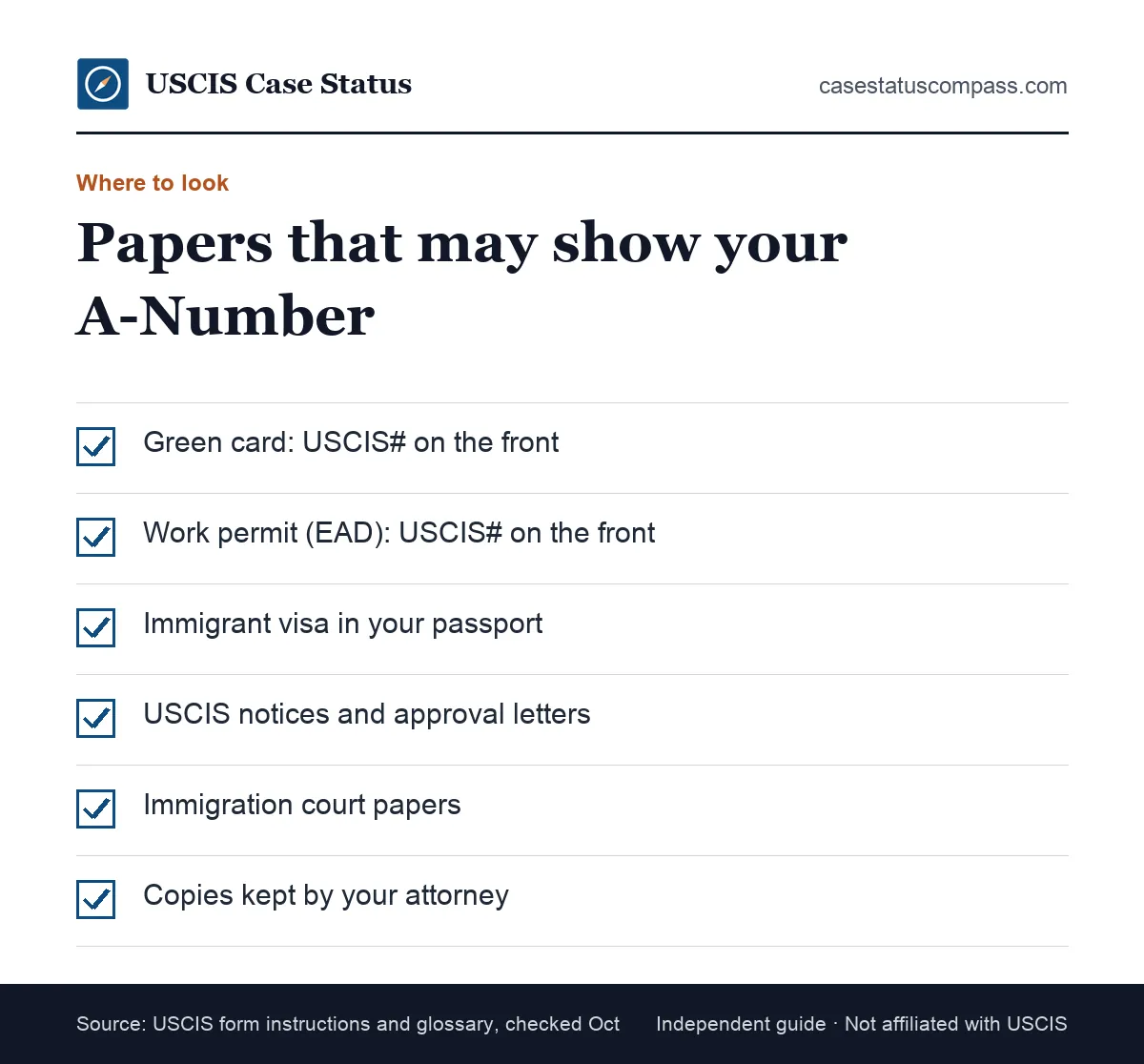
Beyond the green card, your A-Number appears on your work permit (EAD), many USCIS notices, the immigrant visa in your passport, and immigration court papers.
Check whichever of these you still have; the digits should match on all of them. The sections below show where to look on each one.
EAD card
The Employment Authorization Document shows the A-Number after USCIS# on the front, just like a green card. Our work permit guide explains the EAD itself.
Expired EADs still show the correct number.
USCIS notices
Many USCIS letters print the A-Number in the header, next to the receipt number and your name. Good places to look:
- Approval notices
- Biometrics and interview letters
- Requests for evidence
Immigrant visa
If you entered the U.S. with an immigrant visa, the visa foil in your passport lists a Registration Number. That is your A-Number.
It stays valid as a reference after entry.
Which USCIS Notices Show the A-Number?
USCIS notices that often show the A-Number include receipt, appointment and approval notices on the Form I-797 family. The number usually sits in the header area. The receipt number on the same notice is a different code that tracks only that one filing.
Receipt and appointment notices
A Form I-797C, Notice of Action, may show your A-Number beside the receipt number. As of October 2026, USCIS describes the I-797C this way: I-797C = Notice of Action (receipt, rejection, transfer, appointment, re-open); not proof of status by itself. For a full walkthrough, read what an I-797C notice is.
Approval notices and other letters
Approval notices (Form I-797), interview letters and biometrics notices often repeat your A-Number in the header. Requests for evidence and final decisions usually show it too, so an old letter from years ago can still recover the number.
Where Is the A-Number on an Immigrant Visa?
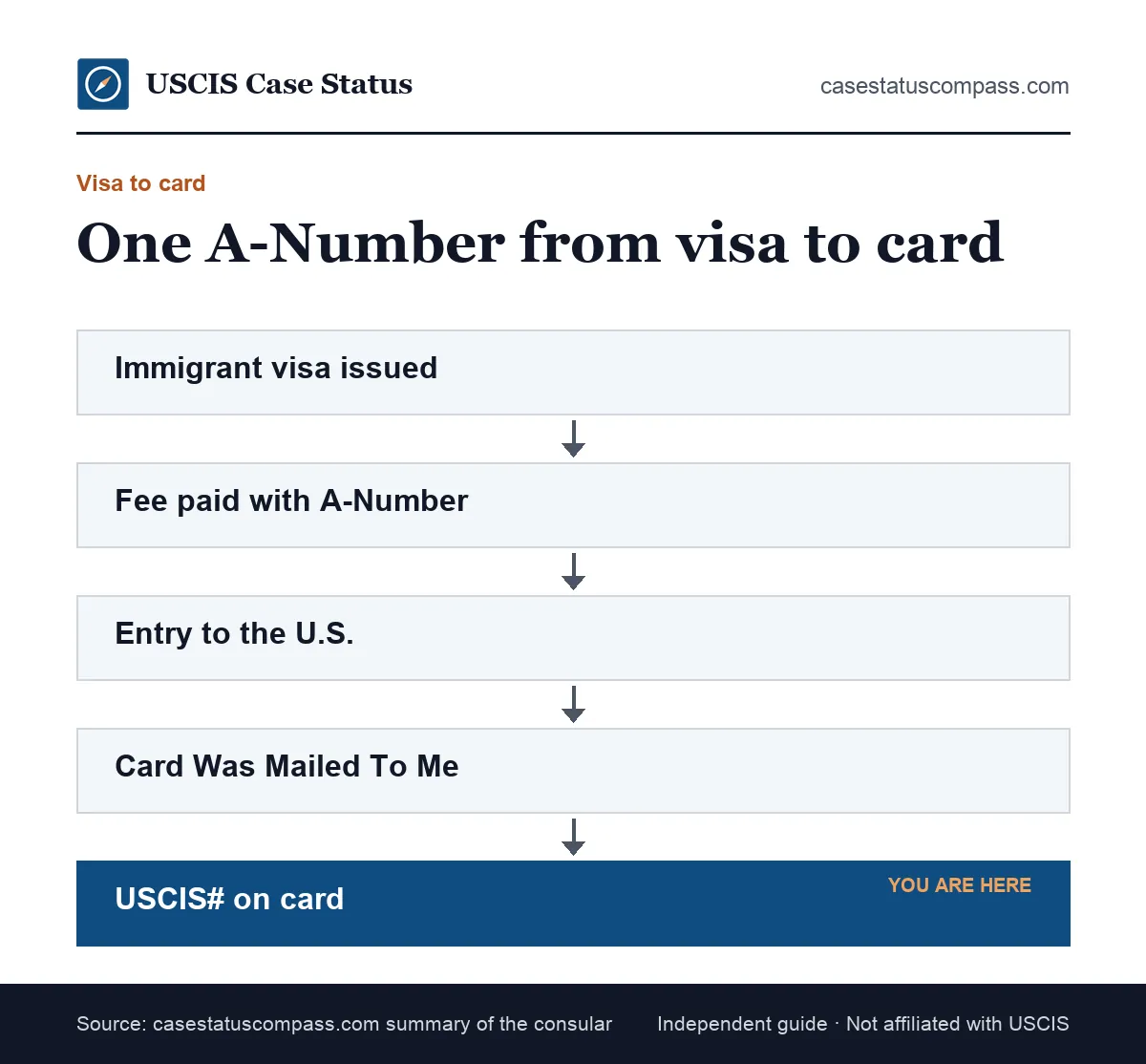
On an immigrant visa, the A-Number appears as the Registration Number on the visa page in your passport. Consular officers print it before you travel. Once you enter the U.S., the same number later appears on your green card after the USCIS# label.
The visa foil
Open your passport to the immigrant visa and find the field labelled Registration Number. It starts with an A or shows digits that match your future card.
Photograph it before travel, in case the passport is lost.
Do You Need Your A-Number to Pay the USCIS Immigrant Fee?
Yes. New immigrants pay the USCIS Immigrant Fee online after getting the visa, and the payment uses your A-Number. As of October 2026, the fee is $235 under Form G-1055, Edition 10/16/26. Your green card is produced only after that fee is paid.
Why consulates print it in the visa package
That is why consulates print the A-Number on handouts in the visa package. Keep that sheet with your passport until the fee is paid and the payment receipt is saved.
How Does the A-Number Appear on a Work Permit?
On a work permit, the A-Number is printed after USCIS# on the front of the card. Each new EAD gets its own card number, but your A-Number stays fixed.
Compare an old and a new EAD: the USCIS# line should match exactly.
Reading the EAD front
The EAD front shows your photo, name, category code, card expiration and USCIS#. The category code, such as C09 or C08, tells employers why you can work. It is not part of your A-Number.
When the EAD is your first A-Number document
Many people who adjust status inside the U.S., or who apply for asylum, receive an A-Number with their first EAD. If your first card is an EAD, copy the USCIS# into your records right away.
A-Number vs Green Card Number vs Receipt Number
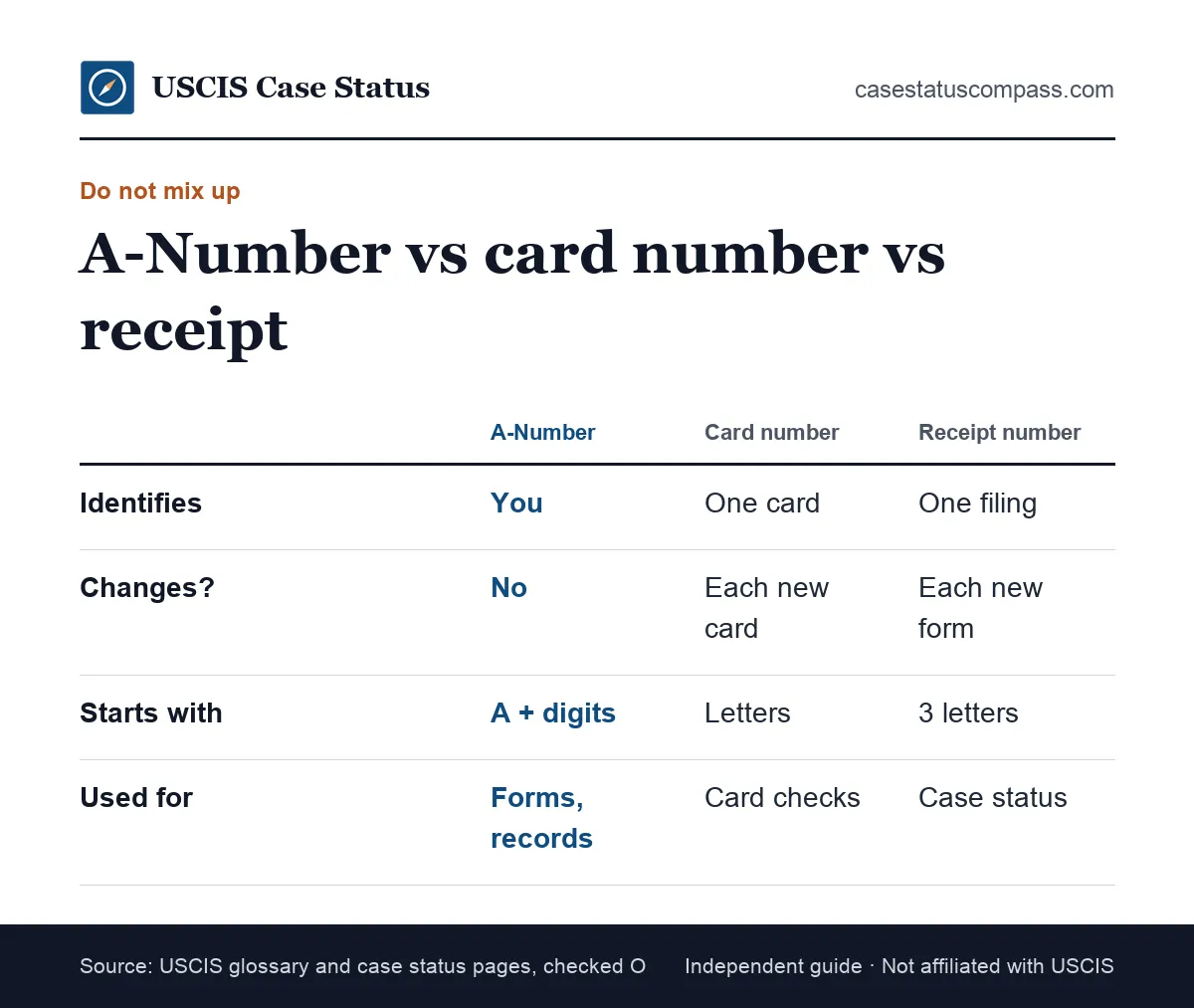
Your green card number and alien number are not the same. The A-Number identifies you. The green card number identifies one physical card. Your receipt number identifies one filing. They look different and do different jobs, and mixing them up is the most common reason a form or status search fails.
Side-by-side comparison
The table puts the three numbers next to each other, showing what each one identifies and where it is printed.
| Number | What it identifies | Where you find it | Changes over time? |
|---|---|---|---|
| A-Number (USCIS#) | You, as a person | Front of green card or EAD; immigrant visa; many notices | No, it is yours for life |
| Green card number | One physical card | Printed separately from the USCIS# on the card | Yes, each new card has its own |
| USCIS receipt number | One application or petition | Top of your Form I-797 notices | Yes, each filing gets one |
Where to read more about each number
Our page on the green card number explains the card's own document number in detail. The uscis receipt number guide covers the 13-character receipt format: 3 letters + 10 digits (13 characters), e.g. EAC2512345678; leave out dashes.
Is the A-Number the Same as the USCIS Online Account Number?
No. The USCIS Online Account Number (OAN) is a separate code linked to your online account. The Form I-90 instructions state plainly that "the OAN is not the same as an A-Number."
Enter each in its own box on a form.
What the OAN is
As of October 2026, USCIS explains: USCIS Online Account Number (OAN): only if you have an IOE receipt; shown in your account profile or at the top of the Account Access Notice.
If you never filed online
If you never filed online and never got an IOE receipt, you do not have an OAN. Our page on the uscis online account number explains how to find it.
IOE receipts and your A-Number
An IOE receipt shows you filed online. Your A-Number stays the same whether you file online or on paper. Learn how online-filed cases are tracked in our IOE case status guide.
Where Do You Get an Alien Registration Number?
You do not apply for an Alien Registration Number. DHS assigns it when your immigration record starts, such as when you receive an immigrant visa, file certain benefit requests, or enter removal proceedings.
Your first notice after that step usually shows it.
No application exists
There is no "A-Number application" on uscis.gov and no fee to get one. Sites that charge to "register" an A-Number are selling nothing real. The number simply appears on your papers once an agency opens your file.
Common triggers
- An immigrant visa issued by a U.S. consulate
- A first Form I-485 green card application
- A first work permit request in many categories
After any of these, check your first notice for the A-Number and record it.
Humanitarian and court triggers
Humanitarian and court cases open a file too:
- An asylum application or a removal case in immigration court
- Certain humanitarian programs, such as DACA or TPS
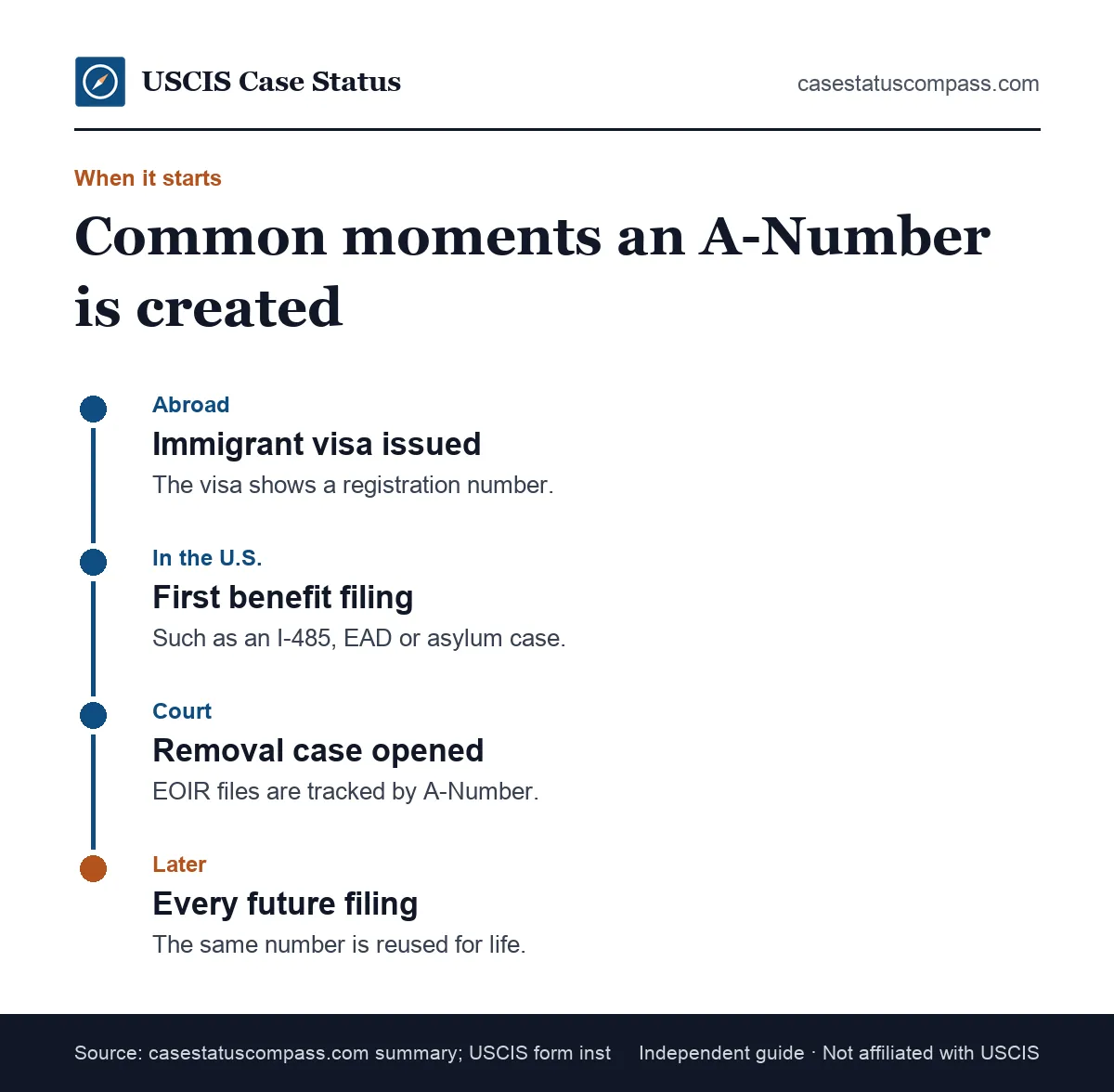
Each of these prints the number on the first notice or court paper you receive.
Who Has an A-Number and Who Does Not?
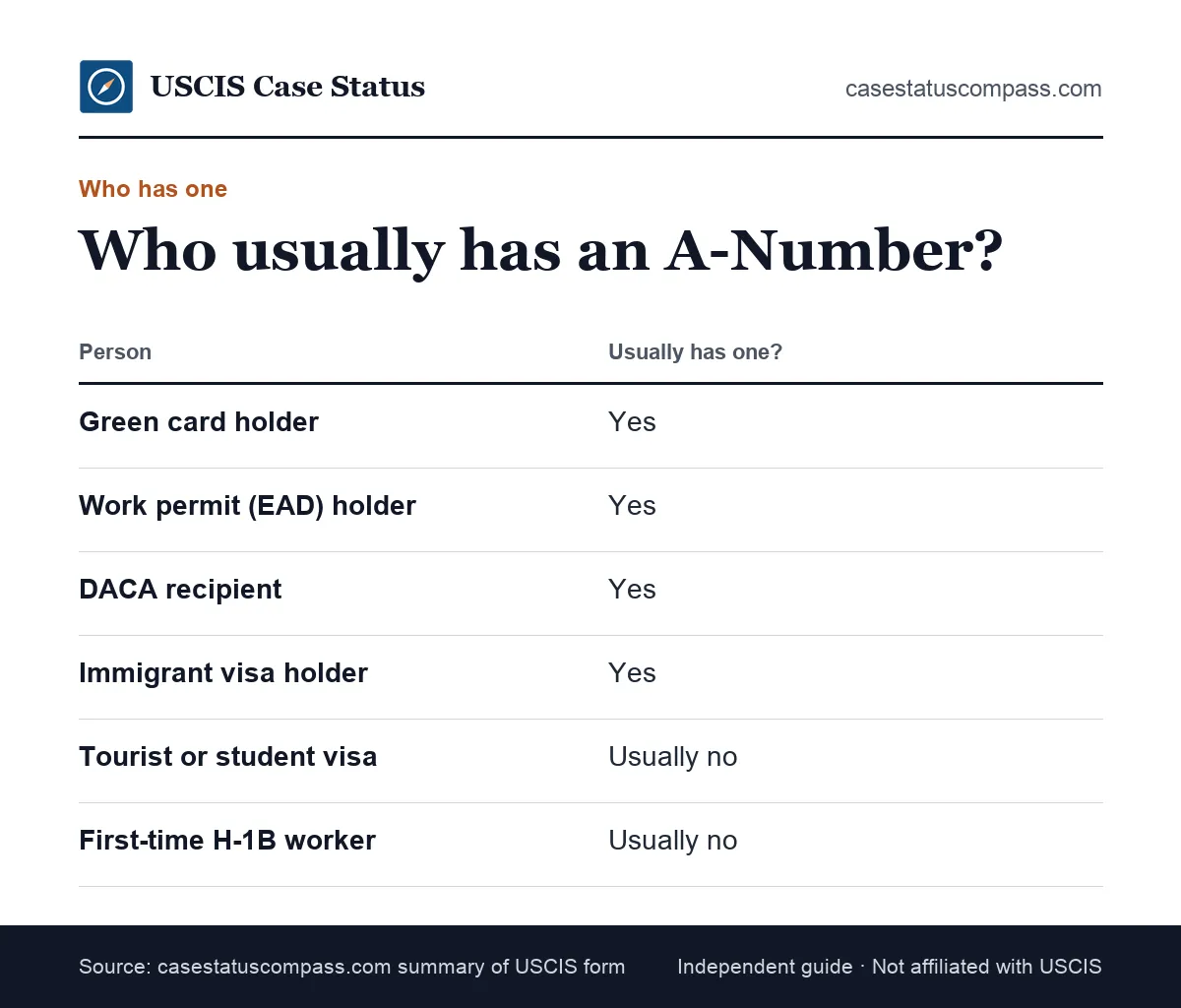
Most permanent residents, EAD holders, DACA recipients and immigrant visa holders have an A-Number. Most visitors, students and first-time temporary workers do not. The difference is whether DHS has opened a permanent immigration file for you.
Check your papers to confirm which group you are in.
People who usually have one
- Green card holders, including conditional residents
- Work permit (EAD) holders
- DACA recipients
- Most asylum applicants and all refugees
- Immigrant visa holders
If you are in one of these groups, look for the number on your most recent card or notice.
People who usually do not
These groups usually rely on the I-94 admission number and a passport instead:
- Tourists on B visas
- F-1 and M-1 students
- Many first-time H-1B, L-1 or O-1 workers
- Travelers under the Visa Waiver Program
What If You Do Not Have an A-Number?
If you do not have an A-Number, write N/A in the A-Number box unless the form says otherwise. The Form I-90 instructions say: "If you do not have an A-Number, type or print 'N/A.'" USCIS will create one if your case needs it.
Writing N/A the right way
Leaving the box blank can get a paper form rejected, because many forms treat blank answers as incomplete. Write N/A clearly. Never borrow a spouse's or parent's A-Number, even on a family filing; each person's number is unique.
Double-check before you write N/A
People who once had a work permit, a past green card case or a court case often forget they have an A-Number. Filing under a new number can split your records into two files.
Do H-1B Workers Have an Alien Number?
Most first-time H-1B workers do not have an alien number. An H-1B petition alone usually does not create one. An H-1B worker gets an A-Number later if they file for a green card, request certain EADs, or had an earlier immigration case.
The typical H-1B case
An H-1B worker's records usually rely on the passport, visa and I-94. On Form I-9, an employee who selects "an alien authorized to work" may enter an A-Number, an I-94 number, or a foreign passport number, according to the I-9 instructions.
When an H-1B worker gets an A-Number
The A-Number usually appears once the employer's green card process reaches the I-485 stage, or when a spouse files for an EAD. Read our H-1B visa status guide for the work visa process itself.
Do DACA Recipients Have an A-Number?
Yes. DACA recipients have an A-Number, and it appears on the DACA approval notice and on the front of the DACA work permit after USCIS#. The same number goes on every DACA renewal request and every later immigration filing.
Where to find it as a DACA recipient
Look at your current or past EAD first. Then check your Form I-797 approval notice for Form I-821D. A "DACA number" is not a separate ID; people usually mean the A-Number or the receipt number of their latest request.
Current DACA program status
As of October 2026, USCIS reports: DACA: renewals processed; initial requests accepted but not processed. Program rules are still under court review and may change, so check the DACA status guide before you plan a renewal.
Do Asylum Seekers and Refugees Have A-Numbers?
Asylum applicants and refugees usually receive an A-Number when their humanitarian case starts. The number appears on their receipt notices, their work permit and, for court cases, on immigration court papers.
Keep it with your court and USCIS papers, since both agencies use it.
Asylum and refugee cases
An affirmative asylum filing with USCIS and a defensive case in court both use your A-Number. If you have a court case, every court notice prints it. See our asylum status guide for the steps of the asylum process.
Do TPS Applicants Have an A-Number?
Often, yes. Temporary Protected Status applicants list their A-Number on Form I-821 if they have one. First-time applicants without one write N/A, and USCIS assigns a number, which then appears on the TPS work permit. Our TPS status guide lists the current designated countries.
Can Your A-Number Change?
Your A-Number does not change. It stays with you through visas, green cards, renewals and naturalization. New cards and new filings get new card numbers and receipt numbers, but they all link back to the same A-Number and the same A-file.
One number for life
Renewing a 10-year card, replacing a lost card, or removing conditions does not create a new A-Number. As of October 2026, USCIS states: Most green cards are valid for 10 years; conditional green cards for 2 years. Each new card repeats your existing USCIS#.
What If DHS Gave You Two A-Numbers?
Sometimes DHS creates a second A-Number by accident, for example when names are spelled differently. Two files can hold different parts of your history, so an officer reviewing one may not see the other. Fix it before your next big filing.
Listing both numbers on your forms
List both numbers on your next form where allowed; the N-400, for example, lets you list another A-Number. Ask an attorney about getting the files combined.
Keep copies of papers that show each number.
How Do You Find a Lost A-Number?
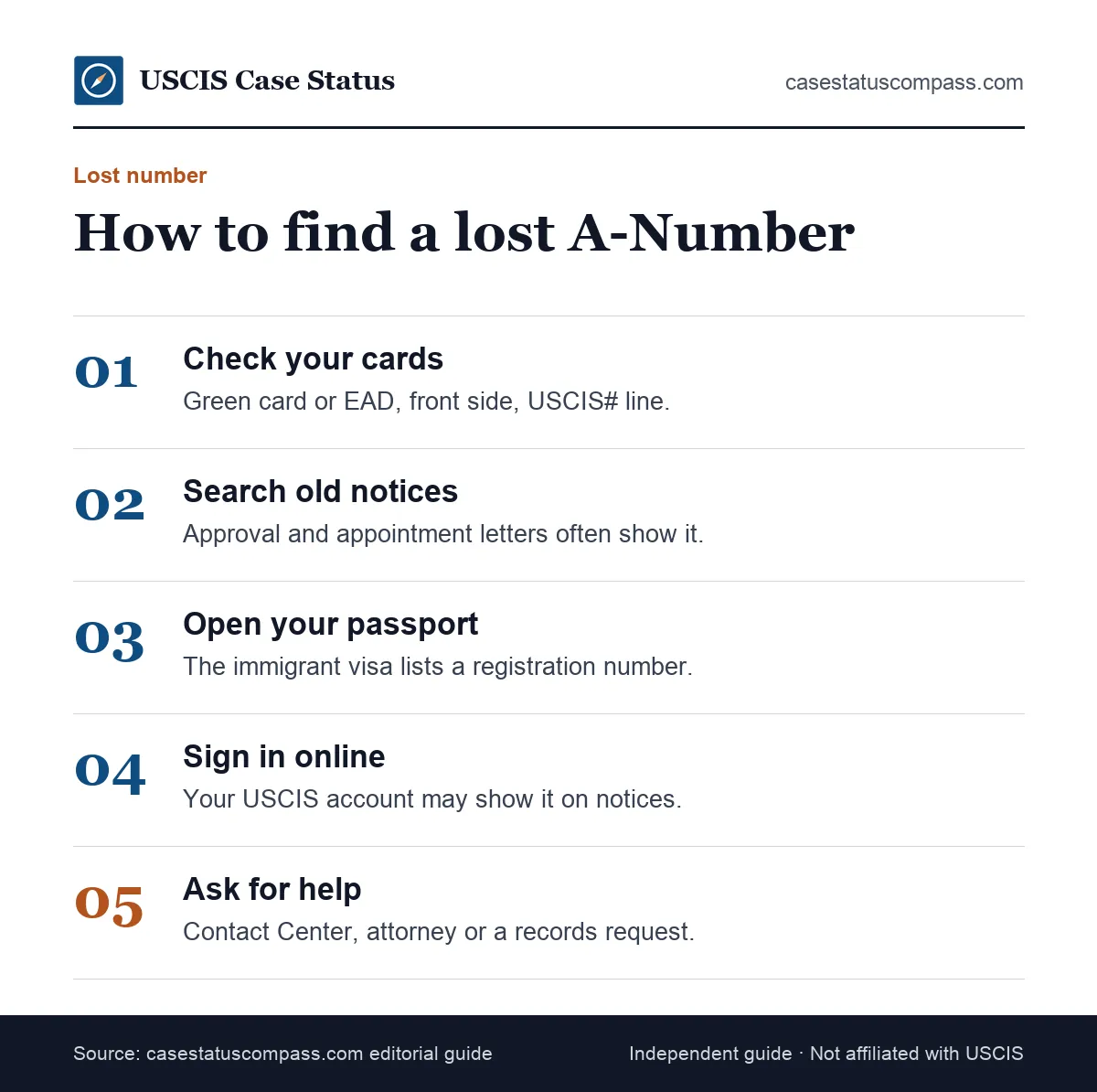
To find a lost A-Number, check your cards, old notices and visa page first, then copies others kept. If none of these work, ask USCIS or request a copy of your immigration file.
Start with the papers listed below, in that order.
Search your own papers
- Front of any current or expired green card or EAD
- Form I-797 notices, including old ones
- The immigrant visa page in your passport
Expired cards and old notices still show the correct digits, because the A-Number never changes.
Copies kept by courts, employers and attorneys
Papers you handed to others can also help:
- Court notices, if you ever had an immigration court case
- Tax or job files where you gave a copy of your card
- Copies your attorney or employer kept
Ask for help when papers are gone
Call the USCIS Contact Center at 800-375-5283 (TTY: 800-767-1833). Our contact USCIS guide lists the options.
Have your full name, date of birth and any old receipt number ready, so the agent can find your record. Never pay a private site for this.
Requesting your A-file
An attorney or accredited representative can also request your A-file through a records request, which often shows the number on page one. You can file that request yourself too.
USCIS does not charge for most records requests.
Is There an Alien Number Lookup Online?
There is no public alien number lookup online. USCIS does not let anyone type in a name and get an A-Number, because the number links to private records. Sites that promise a "resident alien number lookup" cannot reach real USCIS data.
Why no public lookup exists
An A-Number opens a person's full immigration file, including addresses, family details and decisions. A public lookup would expose that data to strangers, so only you, your representative and authorized agencies can see it.
Watch out for paid lookup sites
Sites that charge for an "A-Number search" may collect your personal data or sell useless reports, and some reuse your details for later scams.
Never pay anyone to find your own number.
Checking for a real uscis.gov address
Before entering anything, check the web address. A real USCIS page always ends in uscis.gov, and USCIS never charges to show your own records.
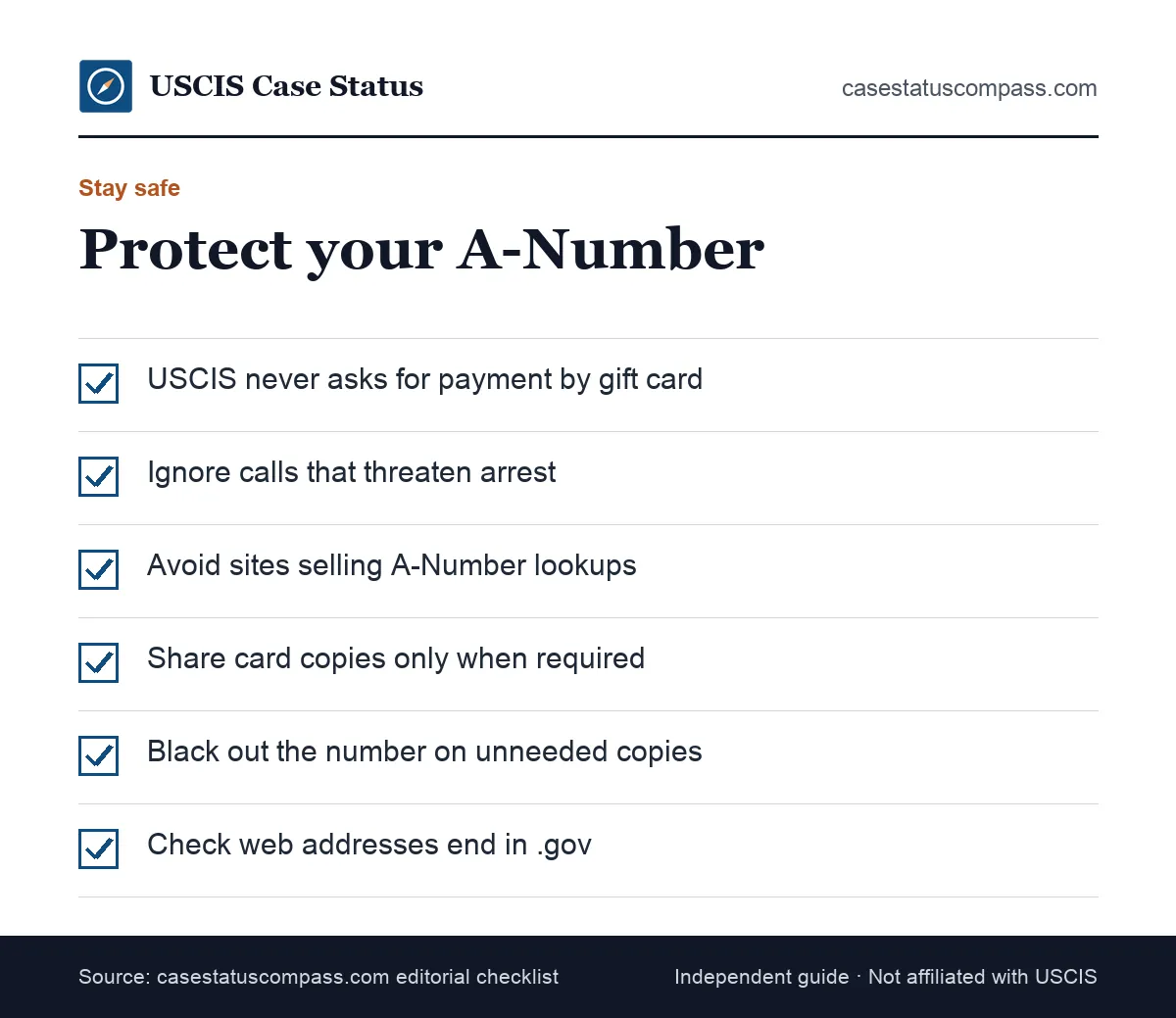
Look closely at the spelling of the address.
Can You Check Immigration Status by Alien Number?
USCIS Case Status Online does not search by A-Number. It needs the 13-character receipt number from your notice. So the right number depends on which agency has your case.
If your case is in immigration court instead, the A-Number is what you use, as the next section shows.
USCIS case status uses the receipt number
Go to Case Status Online: egov.uscis.gov and enter your receipt number, not your A-Number. The tool shows the latest action on that one filing. If you have several cases, check each receipt number separately.
How Do You Check an Immigration Court Case by A-Number?
The Executive Office for Immigration Review (EOIR) tracks removal cases by A-Number, so every hearing notice prints it. To check immigration status by alien number, use EOIR's system, not the USCIS tool, which needs a receipt number.
Keep that notice handy for each check.
Finding your next hearing date
If you have a court date, use our immigration court case status guide to look up the next hearing. Have the A-Number from your latest hearing notice ready.
Missing a hearing can lead to a removal order issued in your absence.
Where Do You Enter Your A-Number on USCIS Forms?
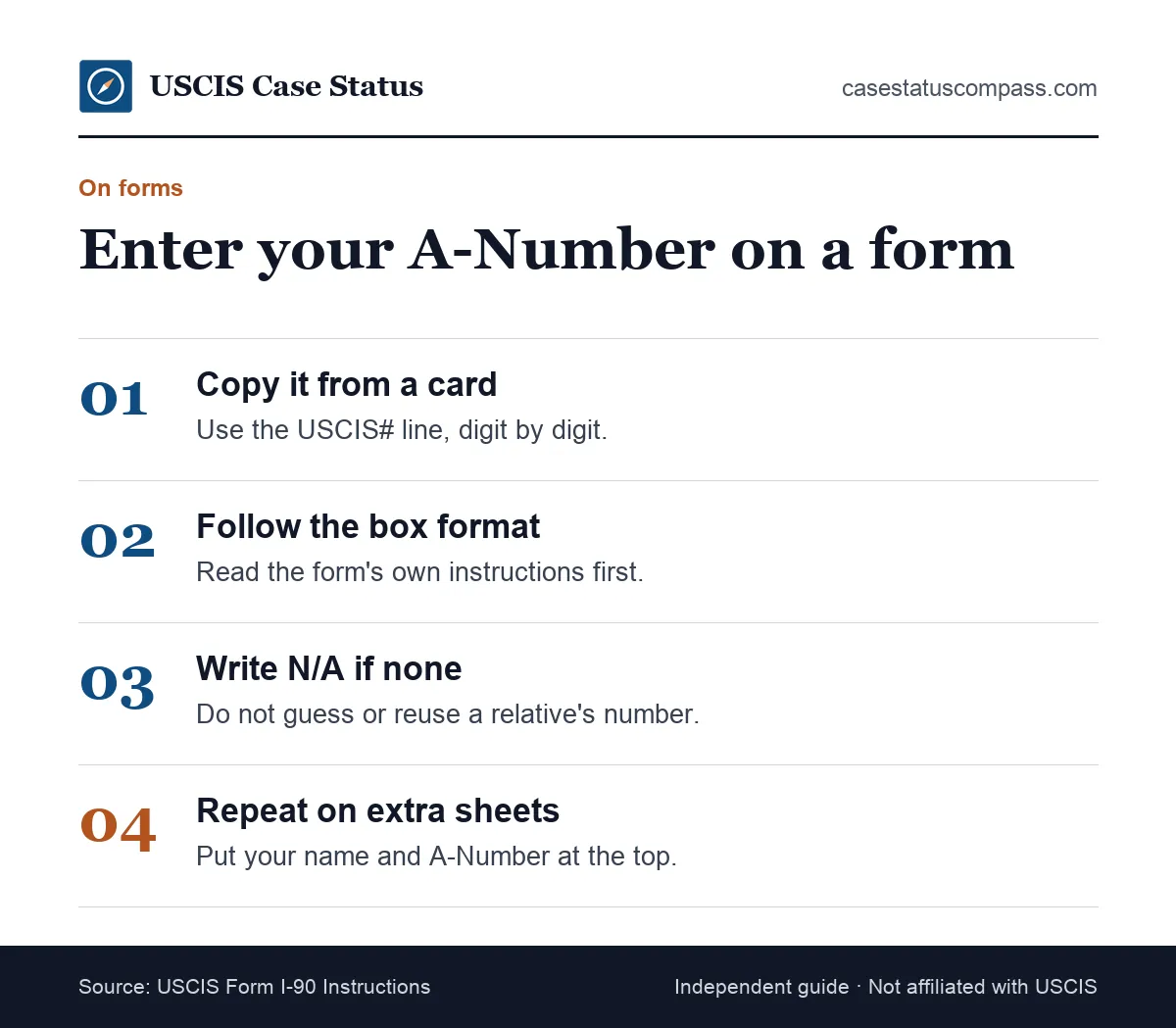
Most USCIS forms ask for the A-Number in Part 1, the section about you, and often in a box at the top of every page. If you add extra sheets, the I-90 instructions say to print your name and A-Number at the top of each sheet.
Part 1 and the page header
Look for the label "Alien Registration Number (A-Number) (if any)". Then:
- Copy the digits from your card.
- Repeat them in every page header that asks.
- Check that no page drops a leading zero.
How Is the A-Number Used on Form I-9?
On Form I-9, a lawful permanent resident enters their USCIS Number (A-Number) in Section 1. The employer then records card details separately in Section 2.
Employers cannot demand a specific document, so you choose which acceptable card or papers to show.
Section 1 for permanent residents
Choose "lawful permanent resident" and copy the USCIS# from your card. According to the instructions, conditional residents choose the same status.
Copy the digits with the leading A or as the form shows, and check them twice.
Asylees and refugees on Form I-9
Asylees and refugees choose "an alien authorized to work" instead, even if they hold an A-Number. That status still lets them enter the A-Number in Section 1.
They then add an expiration date.
Section 2 is a different number
In Section 2, your employer records the document's own number and expiration date. For a green card, that is the card's document number, not your A-Number. The green card number page shows the difference on the card.
How Is the A-Number Used When You Apply for Citizenship?
When you file Form N-400, you list your A-Number in Part 1. USCIS uses it to pull your green card file and check your eligibility. After you become a citizen, your naturalization certificate also links back to the same A-Number in USCIS records.
On the N-400 itself
Copy the USCIS# from your green card, including any leading zeros. If you once had more than one A-Number, the form lets you list the other one too. See our citizenship application guide for the full filing steps.
After naturalization
A new U.S. citizen no longer needs a green card. The naturalization certificate carries its own certificate number. USCIS keeps the old A-file, so later requests, such as a replacement certificate, still use your A-Number.
Is There a U.S. Citizenship Number?
There is no single "citizenship number" in the United States. People who search for a United States citizenship number usually mean the naturalization certificate number, the A-Number they used before becoming citizens, or a U.S. passport number. Each is a different document number.
What people usually mean
Use the table to match what you were asked for with the right document and where to find its number.
| If you mean | The number you need | Where it is |
|---|---|---|
| Proof you naturalized | Certificate number | Your Certificate of Naturalization |
| Your immigration file | A-Number | Old green card, N-400 notices |
| Proof of citizenship for travel | Passport number | Your U.S. passport |
| Citizenship through a parent | Certificate of Citizenship number | The certificate itself |
Replacing a certificate
A lost, stolen or damaged certificate is replaced with Form N-565, not with a new N-400. As of October 2026, the fee is $555 (paper) / $505 (online). Our naturalization certificate guide explains how to get or replace one.
What Is an A-File?
An A-file is your Alien File, the official record of your immigration history, labelled with your A-Number. It holds applications, photos, interview notes, decisions and court papers. When an officer reviews a new filing, they often review your A-file too.
What the A-file contains
- Copies of forms you or your sponsors filed
- Biometrics, photos and identity papers
- Interview notes and officer decisions
- Records from CBP entries and any court case
Officers often review it at interviews.
Getting a copy
You can request your own immigration records through a Freedom of Information Act (FOIA) request. Giving your A-Number, full name and date of birth helps the agency find the right file faster and avoids mix-ups with people who share your name.
Common A-Number Mistakes to Avoid
The most common A-Number mistakes are copying the green card number instead, dropping a leading zero, mixing up a relative's number, and entering the receipt number. Each one can delay a case or cause a mismatch with your immigration file.
Copying the wrong number
These three errors put the wrong ID on a form; each row shows what goes wrong and the fix.
| Mistake | What goes wrong | Fix |
|---|---|---|
| Using the card number | The form points to a card, not you | Copy only the USCIS# line |
| Using a spouse's number | Records get mixed between people | Use only your own number |
| Typing the receipt number | It tracks a case, not a person | Keep receipts for status checks |
Formatting and blank-box errors
These two errors come from how the digits are written, not which number you chose.
| Mistake | What goes wrong | Fix |
|---|---|---|
| Dropping a leading zero | Digits no longer match your file | Copy every digit as printed |
| Leaving the box blank | Paper form may be rejected | Write N/A if you truly have none |
How Can You Protect Your A-Number?
Treat your A-Number like a bank account number. Share it only with USCIS, other government agencies, your employer for Form I-9, and your attorney. Scammers use A-Numbers to sound official, so a caller who reads yours back to you is not proof they are USCIS.
Who may ask for it
- USCIS and other federal agencies, on forms and at interviews
- Your employer, when you complete Form I-9
- Your attorney or DOJ-accredited representative
Anyone else should explain why they need it before you share it.
Banks, landlords and card copies
Banks or landlords may see your A-Number on a copy of your card. Ask whether they really need the copy before you hand it over.
Black out the number on copies when possible.
Signs of a scam
Watch for these warning signs:
- A caller demands payment or threatens arrest
- A text asks you to "verify your A-Number" through a link
- Someone offers to "speed up" your file for cash
What If Your A-Number Is Wrong on a Card or Notice?
If your A-Number is wrong on a green card, you may need to file Form I-90 to correct it. If a notice shows the wrong number, contact USCIS. Check first whether the "error" is only a missing leading zero or dashes, which are not real errors.
A typo on your green card
A card with wrong data must be corrected. As of October 2026, Form I-90 costs $465 (paper) / $415 (online).
Attach evidence that shows the correct number, such as an old notice.
When USCIS made the error
There is no fee when the error was made by USCIS. Our green card renewal guide explains the I-90 steps.
Include proof that the error was USCIS's, such as notices showing the correct number.
A wrong number on a notice
Call the Contact Center at 800-375-5283 and explain the mismatch, with both papers in front of you. If an attorney filed for you, ask them to check what they entered on the form, since many notice errors start there.
Do Children and Family Members Have Their Own A-Numbers?
Yes. Every person in an immigration case gets their own A-Number, including children. A family that immigrates together has a different A-Number for each member. Parents, spouses and children never share a number, even on a joint filing.
When you fill in a form for a child, copy the A-Number from that child's own notice or card, never from a parent's.
Children of green card holders
A child who gets a green card through a parent receives a separate card with their own USCIS#. Check the name on the card before copying a number onto any form.
Children who become citizens
Children who become U.S. citizens automatically through a citizen parent may later apply for a Certificate of Citizenship with Form N-600. Their old A-Number helps USCIS match the request to their green card file. The N-600 guide covers that process.
Which Document Should You Check First?
The fastest place to find your A-Number depends on your situation. Green card holders check the card front. Work permit holders check the EAD. New immigrants check the visa page. People with only paper notices check the header of their Form I-797.
If you still have a card in hand
If you can still hold a card, start with the row that matches it below.
| If this is your situation | Check this first | Then try |
|---|---|---|
| You hold a green card | USCIS# on card front | Approval notice |
| You have only an EAD | USCIS# on EAD front | I-765 approval notice |
If you have no card to check
Without a card, use the row below that matches your situation to find another source.
| If this is your situation | Check this first | Then try |
|---|---|---|
| You just arrived on an immigrant visa | Visa page in passport | Fee payment receipt |
| You lost every card | Old notices or USCIS account | Contact Center or records request |
When to call USCIS
Call when your papers are lost and your online account shows nothing. Live calls and chat: Monday to Friday, 8 a.m. to 8 p.m. Eastern. You can also chat with Emma, USCIS's online virtual assistant (English and Spanish), on uscis.gov for basic questions.
Does the Alien Number Appear on the Back of the Green Card?
The back of a current green card has machine-readable lines of letters, digits and symbols. Independent guides say the alien number is coded inside those lines, but it is hard to read there. The clearly labelled place is the USCIS# line on the front.
The machine-readable zone
The three lines on the back are meant for scanners at ports of entry. We could not confirm the exact layout of these lines on an official USCIS page.
Use the front label instead.
Which Terms Mean the Same as A-Number?
Several labels mean the same A-Number, listed below. People also say "immigration number" or "resident alien number", but forms always use one of the official labels.
Treat them all as one number, and copy the same digits wherever any of these labels appears.
Labels you may see
- Alien Registration Number: on most USCIS forms
- USCIS# or USCIS Number: on green cards and EADs
- A#: on older cards and some letters
- Registration Number: on immigrant visas
All four lead to one record.
Labels that mean something else
These are not your A-Number:
- Receipt number
- Card number
- Case number
- Online Account Number
Each of these tracks a filing, a card, a court case or an online login, not you as a person, so never copy one into an A-Number box.
Permanent resident alien number
A permanent resident alien number, or resident alien number on a green card, is just the holder's A-Number, not a separate ID. Copy it from the USCIS# line like any other A-Number.
When Should You Get Help With an A-Number Problem?
Get help from an immigration attorney or a DOJ-accredited representative if you have two A-Numbers, a court case, an old deportation order, or records under a different name. These problems affect your whole file, so a simple form fix may not be enough.
Signs you need professional help
- Two different A-Numbers on your papers
- A past removal order or court case
- Old records under a different name or birth date
- A form rejected because the A-Number did not match
Where to start
Find a licensed attorney through a state bar referral service, or a DOJ-accredited representative at a recognized nonprofit. This page is general information, not legal advice. Our immigration help hub lists more support options.
Frequently Asked Questions
Is the alien number the same as the USCIS number?
Yes. The USCIS Number printed after "USCIS#" on green cards issued after May 10, 2010, and on work permits, is your Alien Registration Number. The two labels point to the same digits.
Does everyone have an A-Number?
No. Only people with a permanent immigration file have one, such as green card holders, EAD holders, DACA recipients and people with immigration court cases. Most tourists, students and first-time temporary workers do not.
Can I find my A-Number on my I-94?
No. The I-94 shows your admission number, which identifies one entry record kept by U.S. Customs and Border Protection (CBP). If you entered on an immigrant visa, check the visa page in your passport for the Registration Number instead.
What if my A-Number has only eight digits?
An eight-digit A-Number is valid. Older numbers are shorter, and the Form I-9 instructions describe A-Numbers as 7 to 9 digits.
Can someone use my A-Number to steal my identity?
An A-Number alone is not enough to take over your immigration case, but scammers use it to look official and gain trust. Share it only on real forms and with people who need it.
Where do you find the A-Number if you only have a DACA approval notice?
Check the header of the Form I-797 approval notice for Form I-821D, near your name. The same digits appear after USCIS# on your DACA work permit.
Does my A-Number change when I become a citizen?
No. Your A-Number stays in USCIS records after naturalization. USCIS still links your old file to your A-Number for future requests, such as replacing a certificate.
Sources
- USCIS Glossary: USCIS Number. www.uscis.gov/glossary-term/50674. Accessed Oct 27, 2026.
- USCIS: Form I-90 Instructions (Alien Registration Number item). www.uscis.gov/sites/default/files/document/forms/i-90instr.pdf. Accessed Oct 27, 2026.
- USCIS: Form I-9 Instructions, edition 01/20/25. www.uscis.gov/sites/default/files/document/forms/i-9instr.pdf. Accessed Oct 27, 2026.
- USCIS: Form N-400 Instructions (Online Account Number). www.uscis.gov/sites/default/files/document/forms/n-400instr.pdf. Accessed Oct 27, 2026.
- USCIS: Form I-9 Acceptable Documents. www.uscis.gov/i-9-central/form-i-9-acceptable-documents. Accessed Oct 27, 2026.
- USCIS: Checking Your Case Status Online. www.uscis.gov/tools/checking-your-case-status-online. Accessed Oct 27, 2026.
- USCIS: Form I-797 Types and Functions. www.uscis.gov/forms/filing-guidance/form-i-797-types-and-functions. Accessed Oct 27, 2026.
- USCIS Form G-1055 Fee Schedule, Edition 10/16/26. www.uscis.gov/sites/default/files/document/forms/g-1055.pdf. Accessed Oct 27, 2026.
- USCIS Contact Center. www.uscis.gov/contactcenter. Accessed Oct 27, 2026.
- USCIS Fee Schedule (Form G-1055). www.uscis.gov/g-1055. Accessed Oct 27, 2026.
- USCIS: Form I-821D page (updated 06/01/2026) and uscis.gov/DACA (updated 01/24/2025). www.uscis.gov/i-821d. Accessed Oct 27, 2026.
- USCIS Glossary: Green Card. www.uscis.gov/tools/glossary. Accessed Oct 27, 2026.
casestatuscompass.com is an independent publication and is not affiliated with USCIS or any government agency. This page is general information, not legal advice. For denials, court or asylum matters, consult an immigration attorney or a DOJ-accredited representative.