Contents · 39 sections
- What Is the N-600 Form?
- Who Should File the N-600 Form?
- Who Cannot Use Form N-600?
- Citizenship at Birth vs Citizenship After Birth
- N-600 Requirements for Derived Citizenship
- Which Law Applies to Your N-600 Application?
- What Does Legal and Physical Custody Mean for an N-600?
- What Proof of Your Parent's Citizenship Does USCIS Need?
- What Physical Presence Evidence Does a Parent Need for an N-600?
- N-600 vs N-400 vs N-600K: Which Form Fits?
- Is an N-600 Certificate the Same as a Naturalization Certificate?
- Do You Need an N-600 If You Have a U.S. Passport?
- Where Do You Get the Form N-600 PDF?
- Should You File the N-600 Online or on Paper?
- N-600 Instructions: A Part-by-Part Walkthrough
- N-600 Documents Checklist You Can Copy
- How Do You File the N-600 Application Step by Step?
- Common N-600 Mistakes That Cause Rejection
- N-600 Fee: What It Costs (Summary)
- What Happens After You File the N-600 Form?
- N-600 Status Sequence: From Receipt to Certificate
- Is There an Interview for the N-600?
- What Questions Are Asked at an N-600 Interview?
- Do You Take an Oath for an N-600 Certificate?
- How Long Does the N-600 Take? (Summary)
- How Do You Check Your N-600 Case Status?
- What If USCIS Sends an RFE on Your N-600?
- What If Your N-600 Is Denied?
- N-600 for Adopted Children
- N-600 for Children of Military Members and Government Employees
- Filing an N-600 as an Adult
- Should You Keep Renewing Your Green Card Before N-600 Approval?
- Real-World N-600 Scenarios
- If X, Do Y: N-600 Decision Table
- How Is the N-600 Different From the I-130 and I-864?
- What Should You Keep After N-600 Approval?
- What If Your Certificate of Citizenship Is Lost or Wrong?
- When Should You Talk to an Immigration Attorney About the N-600?
- Frequently Asked Questions
The short answer
The N-600 form is the USCIS application for a Certificate of Citizenship. You file it if you are already a U.S. citizen through a citizen parent, either at birth abroad or automatically before age 18, and want official proof. Filing does not make you a citizen. It documents citizenship you already have.
At a glance
| Official name | Form N-600, Application for Certificate of Citizenship |
| Current edition | 01/20/25 (USCIS N-600 page, checked October 2026) |
| Who files | People who acquired or derived U.S. citizenship through a parent |
| Fee (summary) | $1,385 (paper) / $1,335 (online); details on our citizenship fee page |
| What you receive | A Certificate of Citizenship, valid for life |
What Is the N-600 Form?
The N-600 form asks U.S. Citizenship and Immigration Services (USCIS) to issue a Certificate of Citizenship to someone who became a citizen through a parent. USCIS confirms the law already made you a citizen and gives you proof. Its full title is Form N-600, Application for Certificate of Citizenship, and it goes to USCIS, not the State Department.
What the certificate proves
The certificate shows your name, date of birth and the date you became a citizen. USCIS calls it evidence of U.S. citizenship. Unlike a passport, it never expires. Passport agencies accept it as primary evidence of citizenship when you apply for your first U.S. passport.
Citizenship comes first, the paper second
The N-600 form does not grant citizenship. If you qualify, you were a citizen from the date the legal conditions were met, even if you never filed anything. The certificate then records that earlier date, not the day you mailed or submitted the form.
Who Should File the N-600 Form?
File the N-600 form if you were born abroad to a U.S. citizen parent, or became a citizen automatically as a child after a parent naturalized. A parent or legal guardian may file for a minor, and adults who qualified as children may file at any age.
Adults who derived citizenship as children
Many applicants are adults who learned late that a parent's naturalization made them citizens. Think of a 30-year-old green card holder whose mother naturalized when the child was 12 and living with her.
Parents filing for a minor child
A U.S. citizen parent or legal guardian can file for a child under 18. USCIS says the parent signs for a child under 14. The parent usually attends any interview with a minor applicant, unless USCIS waives that.
People born abroad to a citizen parent
A child born outside the country to a U.S. citizen may have acquired citizenship at birth. The parent's citizenship and, often, the parent's earlier physical presence in the United States decide the outcome.
Who Cannot Use Form N-600?
The N-600 form is not for people born in the United States, adult green card holders who must naturalize, or children abroad who are not yet citizens. Filing the wrong form wastes the fee and months of waiting. Check which group you fall into before you pay $1,385 (paper) / $1,335 (online).
People born in the United States
USCIS does not issue Certificates of Citizenship to people born on U.S. soil. Their birth certificate is primary proof, and a U.S. passport is the usual travel document. They never need the N-600 application.
Green card holders who must naturalize
If your parent naturalized after your 18th birthday, or you had no green card while under 18 and in that parent's custody, you did not derive citizenship. You become a citizen through your own citizenship application on Form N-400.
Children who live abroad: Form N-600K
A child who regularly lives outside the United States usually cannot derive citizenship automatically. Form N-600K serves certain children under 18 who visit the United States temporarily in lawful status.
Citizenship at Birth vs Citizenship After Birth
N-600 cases fall into two legal groups. Acquisition means you were a citizen at birth because of a parent. Derivation means you became a citizen later, before age 18, when certain conditions came together. Your evidence depends on the group.
Acquisition vs derivation side by side
The table sets the two paths next to each other, so you can see which evidence your N-600 form package should lead with.
| Point | Acquisition at birth abroad | Derivation after birth |
|---|---|---|
| Citizenship began | On your birth date | When the last condition was met |
| Main law | Law in force on your birth date | Usually INA 320 |
| Key evidence | Parent's citizenship and presence | Green card, custody, parent's naturalization |
| Green card needed? | No | Yes, before 18 |
Acquisition at birth abroad
The question is whether your citizen parent met the transmission rules when you were born. Those rules changed several times and depend on the parents' citizenship, marriage and U.S. residence.
Derivation after birth
The question is whether all conditions overlapped before your 18th birthday: a green card, a citizen parent, U.S. residence and that parent's custody. If one piece is missing, there is no overlap: a green card issued the week after your 18th birthday arrives too late.
N-600 Requirements for Derived Citizenship
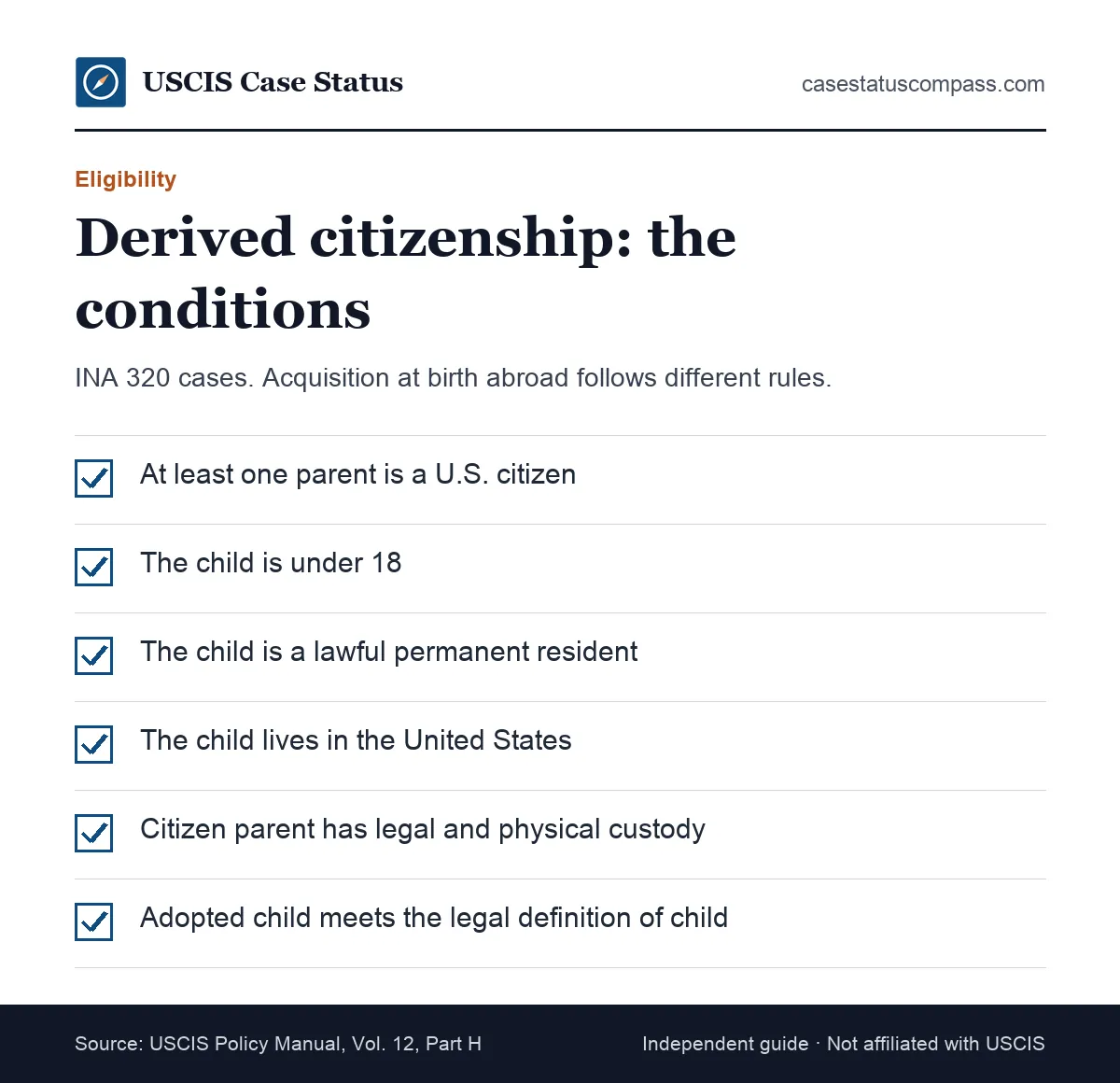
The core N-600 requirements under INA 320 are a U.S. citizen parent, age under 18, lawful permanent resident status, residence in the United States, and the citizen parent's legal and physical custody. All must exist at the same time.
The conditions, one by one
- Citizen parent: by birth or naturalization.
- Age: under 18 when the other conditions met.
- Green card: admitted as a lawful permanent resident.
- Residence: living in the United States.
- Custody: the citizen parent had legal and physical custody.
Why the timing must overlap
Say your father naturalized when you were 10, but your green card came at 17. You became a citizen at 17, when the last condition was met. If the card came at 19, you did not derive citizenship.
Testing your own dates against the N-600 requirements
Line up the dates of your green card, the parent's naturalization and any custody order on one timeline to test your n600 form requirements. Every condition must be true on the same day before your 18th birthday.
Which Law Applies to Your N-600 Application?
The law for your N-600 application is generally the law in force when the last condition was met, or on your birth date for acquisition cases. Two siblings can fall under different rules. Settle which date controls before you gather evidence, because it decides whether INA 320 or an older provision governs the case.
The Child Citizenship Act of 2000
The Child Citizenship Act created today's INA 320 rules. It took effect on February 27, 2001, for children under 18 on that date or born later. It dropped an older rule that often required both parents to naturalize.
If you were 18 before February 27, 2001
The older former INA 321 rules apply. They often required both parents to naturalize, or the custodial parent after a legal separation. Have an immigration attorney check your dates against USCIS's charts.
What Does Legal and Physical Custody Mean for an N-600?
Legal and physical custody means your citizen parent had the legal right to care for you and you actually lived with that parent. USCIS looks hardest at custody when parents were divorced, separated or never married. A child living with both married biological parents is generally presumed to be in their legal custody.
Physical custody
Physical custody means you actually lived with the citizen parent. School and medical records, leases and tax returns listing you as a dependent at the parent's address all help.
Legal custody after divorce
A court custody order usually shows who had legal custody. USCIS also accepts joint custody in many cases. With no order, the law where you lived may give the parent you lived with custody by default.
Records that prove custody
These papers carry the most weight when the parents divorced, separated or never married:
- Divorce decree and any custody order
- Parenting plan or child-support order
- School forms naming the parent
- The parent's tax returns listing you
What Proof of Your Parent's Citizenship Does USCIS Need?
USCIS needs official proof that your parent was a U.S. citizen at the relevant time, such as a U.S. birth certificate, naturalization certificate, Certificate of Citizenship or U.S. passport. Birth-abroad cases also need proof of the parent's earlier time in the United States.
Documents that prove the parent's citizenship
- U.S. birth certificate for a parent born in the country
- Certificate of Naturalization, which shows the date
- Certificate of Citizenship if the parent also derived it
- A valid or expired U.S. passport
What Physical Presence Evidence Does a Parent Need for an N-600?
Acquisition cases often turn on how long the parent lived in the United States before your birth, so USCIS wants records placing the parent here year by year. Gaps here are a common reason for extra evidence requests. The number of years required depends on the law in force on your birth date.
Records that show a parent's U.S. presence
School transcripts, tax transcripts, military records and Social Security earnings statements all help. Combine several types so each year before your birth is covered by at least one record. Old passport stamps help with travel dates but do not by themselves show how long the parent stayed.
N-600 vs N-400 vs N-600K: Which Form Fits?
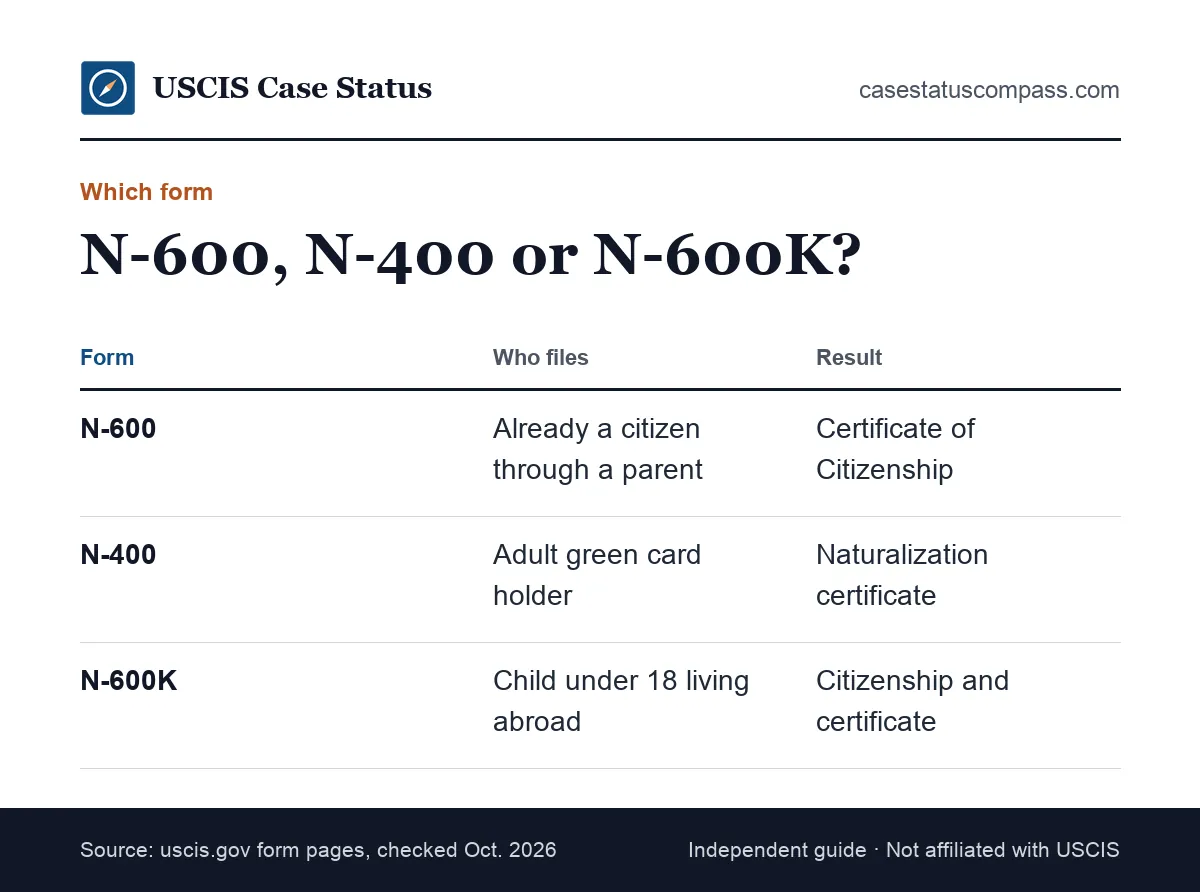
The N-600 form fits people who are already citizens through a parent. Form N-400 fits adult green card holders who want to naturalize. Form N-600K fits certain children under 18 who live abroad. The table and chart below show the differences.
N-600, N-400 and N-600K at a glance
The comparison answers the four questions that usually settle the choice: current status, typical applicant, testing and the document you receive.
| Question | N-600 | N-400 | N-600K |
|---|---|---|---|
| Already a citizen? | Yes | No | No |
| Usual applicant | Child of a citizen parent | Adult permanent resident | Child living abroad |
| Civics and English test | No | Yes, in most cases | No |
| Document issued | Certificate of Citizenship | Certificate of Naturalization | Certificate of Citizenship |
When the N-400 is right
If you missed the age-18 cutoff, you must naturalize yourself. Our N-400 naturalization guide covers eligibility, the test and the interview. Filing an N-600 first in that situation usually ends in denial.
When the N-600K is right
The N-600K helps citizen parents abroad, including many military and expatriate families. The child must be under 18 and in the United States temporarily in lawful status for the interview and oath.
Is an N-600 Certificate the Same as a Naturalization Certificate?
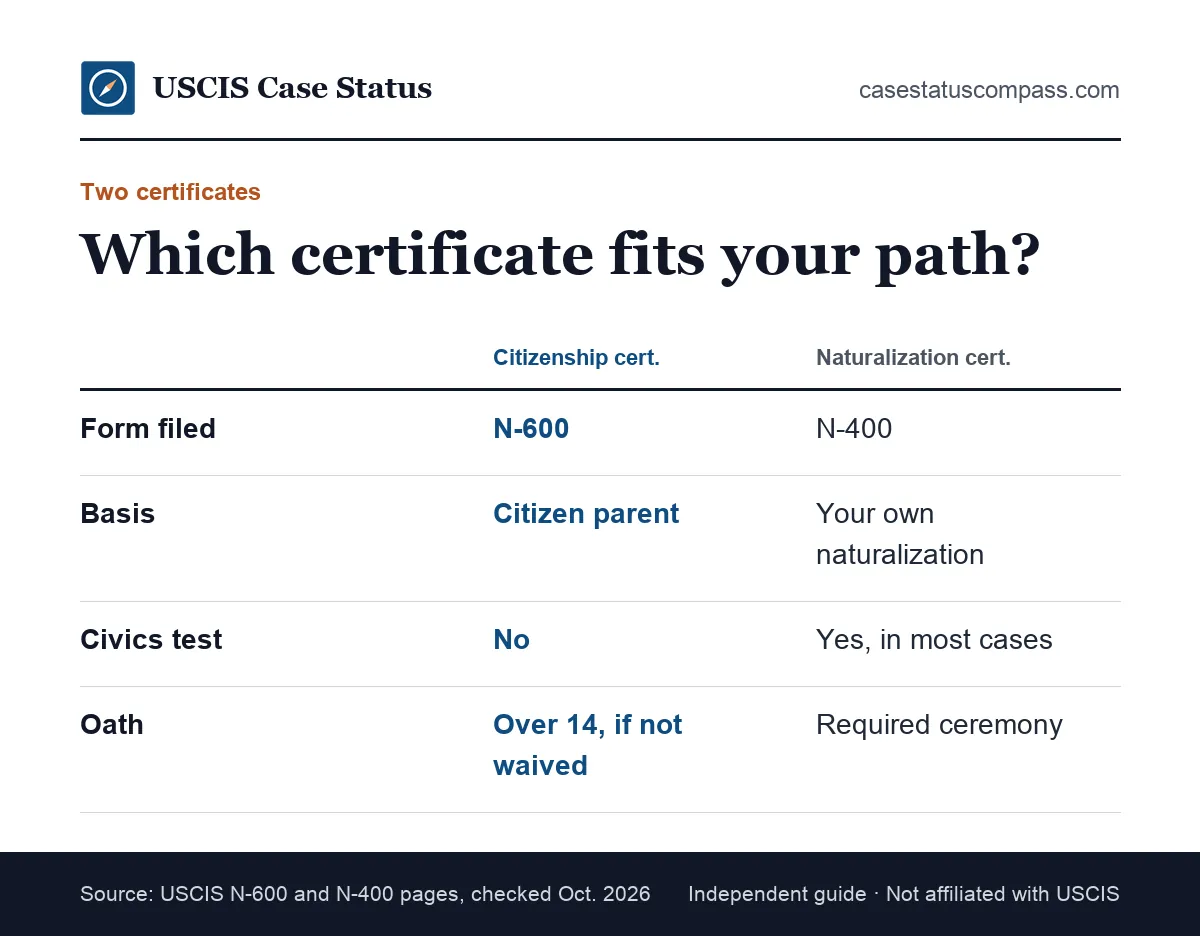
No. The N-600 certificate, called a Certificate of Citizenship, comes from the N-600 form and proves citizenship through a parent. A Certificate of Naturalization comes from Form N-400 and proves you naturalized yourself. Both are valid proof of citizenship. Which one you hold depends only on how you became a citizen.
How the two documents differ
The N-600 certificate lists the date you became a citizen, which may be your birth date. A naturalization certificate lists your oath date. Passport offices, employers and benefit agencies accept both.
If you naturalized yourself
People who took the oath after an N-400 already hold a naturalization certificate. If it is lost or never arrived, see how to get a naturalization certificate replaced or corrected.
Do You Need an N-600 If You Have a U.S. Passport?
No. USCIS says a validly issued U.S. passport generally serves as evidence of citizenship while it is valid, so the N-600 is optional. Many families still file because a certificate never expires and stands on its own. An adult passport must be renewed every 10 years; the certificate needs no renewal.
Why some passport holders still file
- A certificate is permanent proof with no renewal.
- Some employers, schools and state agencies ask for it.
- It records your exact citizenship date.
- It helps your own children born abroad prove you were a citizen.
Where Do You Get the Form N-600 PDF?
Get the Form N-600 PDF and instructions only from the uscis.gov N-600 page, where they are free. As of October 2026, USCIS lists edition 01/20/25. Every page must show the same edition date, or USCIS may reject the package. The N-600 instructions are a separate PDF on the same page.
Checking the edition date
The edition date sits at the bottom of every page. USCIS warns that mixed editions can lead to rejection. Download a fresh copy before you start. If you began filling in an older copy, move your answers onto the current edition instead of mixing pages.
Sites that sell the free form
Some sites charge for "N-600 packages." USCIS never charges for blank forms. Our guide to common USCIS scams shows how to spot paid look-alikes. Paying a document preparer does not speed up USCIS review, and the filing fee is still owed to USCIS separately.
Should You File the N-600 Online or on Paper?
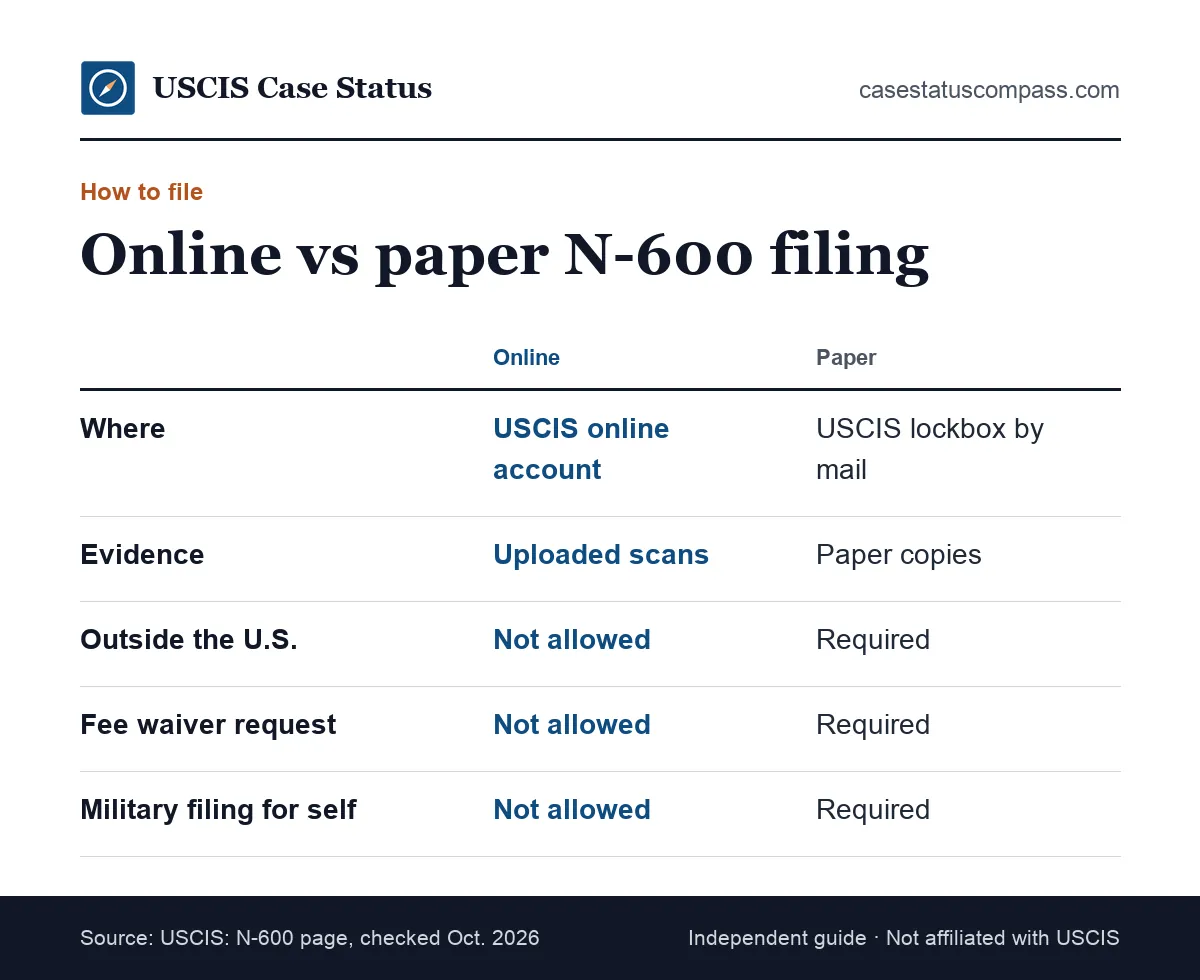
Most people inside the United States can file the N-600 application online through a free USCIS account. You must file on paper if you live abroad, request a fee waiver, or are a current or former service member filing for yourself.
Filing online
Create an account at myaccount.uscis.gov/create-account and choose the N-600 form. The system flags missing required fields before you submit, which cuts rejections for blank answers. Online filers pay the lower $1,335 fee and upload scanned evidence instead of mailing copies.
Who must mail a paper form
Paper filing is required in three situations; everyone else may choose either method. The table shows each case:
| Situation | Online allowed? |
|---|---|
| Living in the U.S. and paying the fee | Yes |
| Living outside the U.S. | No |
| Requesting a fee waiver | No |
| Military or veteran filing for yourself | No |
N-600 Instructions: A Part-by-Part Walkthrough
The N-600 instructions explain each part and list the evidence USCIS expects. Read them fully first. The trouble spots are Part 1, Part 2 and the parent sections. Keep the instructions open beside the N-600 form, because they also say which documents support each answer and where a paper package goes.
Part 1: Your eligibility basis
Part 1 asks why you are applying, such as for yourself or as a parent for a child. USCIS says to check only one box in Question 1 and only one in Question 2.
Part 2: Information about you
Part 2 covers your name, birth date, mailing address and immigration history. Missing family name, date of birth or mailing address causes rejection. Use your name exactly as it appears on your birth certificate or green card.
The parent sections
The form asks how and when your U.S. citizen father, mother or both became citizens. Dates that clash with your documents often trigger an evidence request. Copy each parent's naturalization date and place exactly as printed on the certificate, and type N/A rather than leaving a question that does not apply blank.
Signature and preparer parts
An unsigned form is rejected. A parent signs for an applicant under 14. Anyone who prepared the N-600 form for you completes the preparer section, and an interpreter completes a separate one.
N-600 Documents Checklist You Can Copy
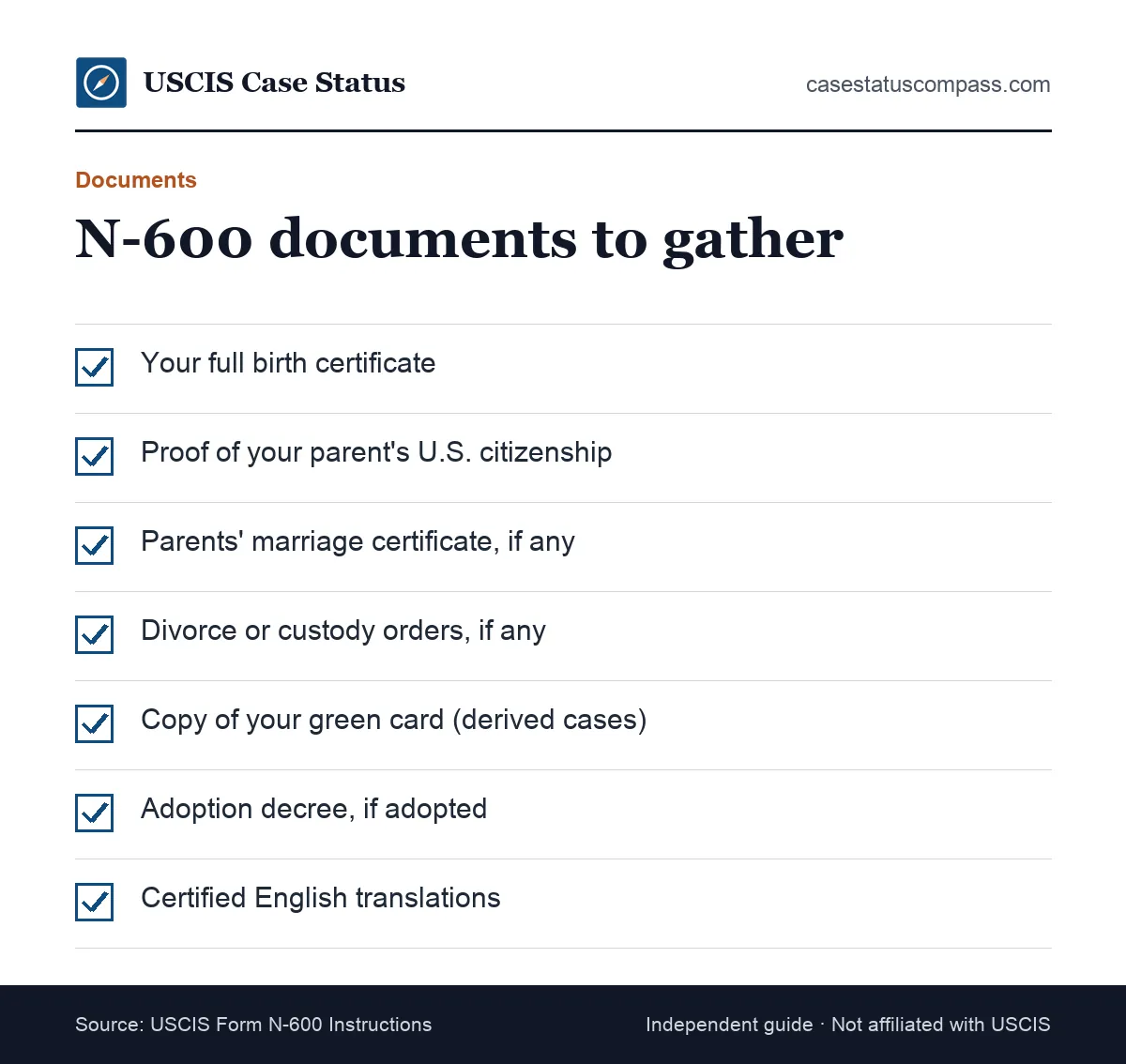
The core N-600 documents are your birth certificate, proof of your parent's citizenship, and records linking you to that parent. Derivation cases add your green card and custody papers; acquisition cases add the parent's physical presence evidence. Copy the lists below and tick items off as you gather them.
Core documents for every case
- Your birth certificate naming both parents
- Proof of your parent's U.S. citizenship
- Parents' marriage certificate, if married
- Proof of legal name changes
- Copy of your green card, both sides, for derivation
Documents for specific situations
- Divorce decrees and custody orders
- Adoption decree with custody and residence proof
- Parent's physical presence records
- Paternity evidence for unmarried parents
- Form G-28 if a lawyer files for you
Copies, originals and translations
Send copies unless USCIS asks for originals, and bring originals to any interview. Each foreign-language record needs a full English translation with the translator's certification of competence and accuracy.
How Do You File the N-600 Application Step by Step?
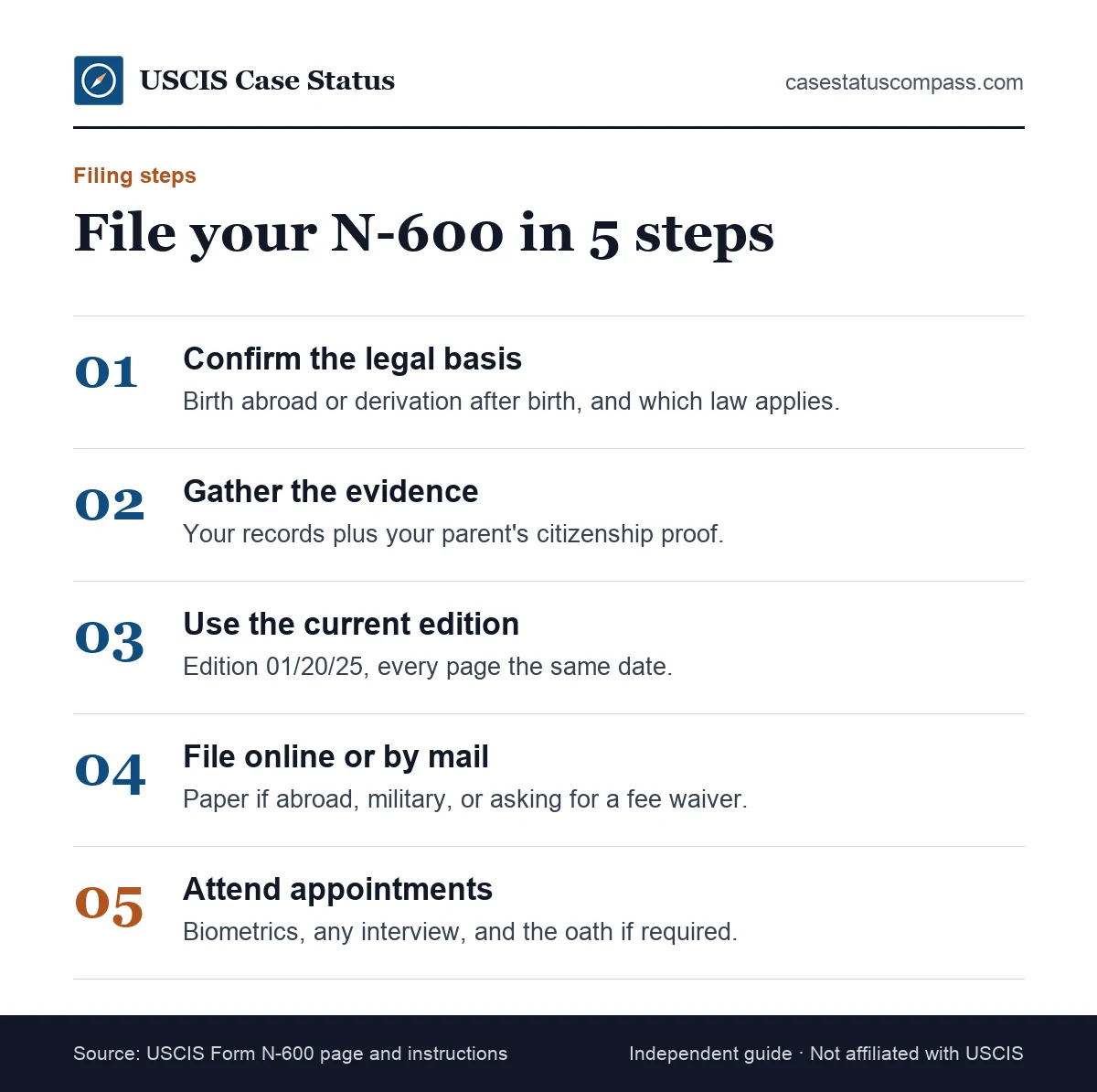
You file the N-600 application by confirming your legal basis, gathering evidence, completing the current edition, and submitting online or to the right lockbox. Then you attend the biometrics, interview and oath appointments USCIS schedules. Keep a full copy of everything you submit, because later notices refer back to it.
The five filing steps
- Confirm your basis and which law applies.
- Gather evidence from the checklist above.
- Complete edition 01/20/25 with every question answered.
- Submit online, or mail to the Phoenix or Elgin lockbox listed for your state on the uscis.gov N-600 page.
- Attend appointments and answer notices on time.
Common N-600 Mistakes That Cause Rejection
The most common N-600 mistakes are a missing signature, blank required fields, more than one box checked in Part 1, mixed edition pages and the wrong fee. USCIS rejects those packages unread. A rejected package comes back with the fee, and you must fix the problem and file again, which restarts the wait.
Rejection triggers USCIS lists
- Form not signed
- Blank family name, birth date or mailing address
- Multiple boxes in Part 1, Question 1 or 2
- Pages from different editions
- Missing or wrong fee
Check each item against the final package before you seal the envelope or press submit.
N-600 Fee: What It Costs (Summary)
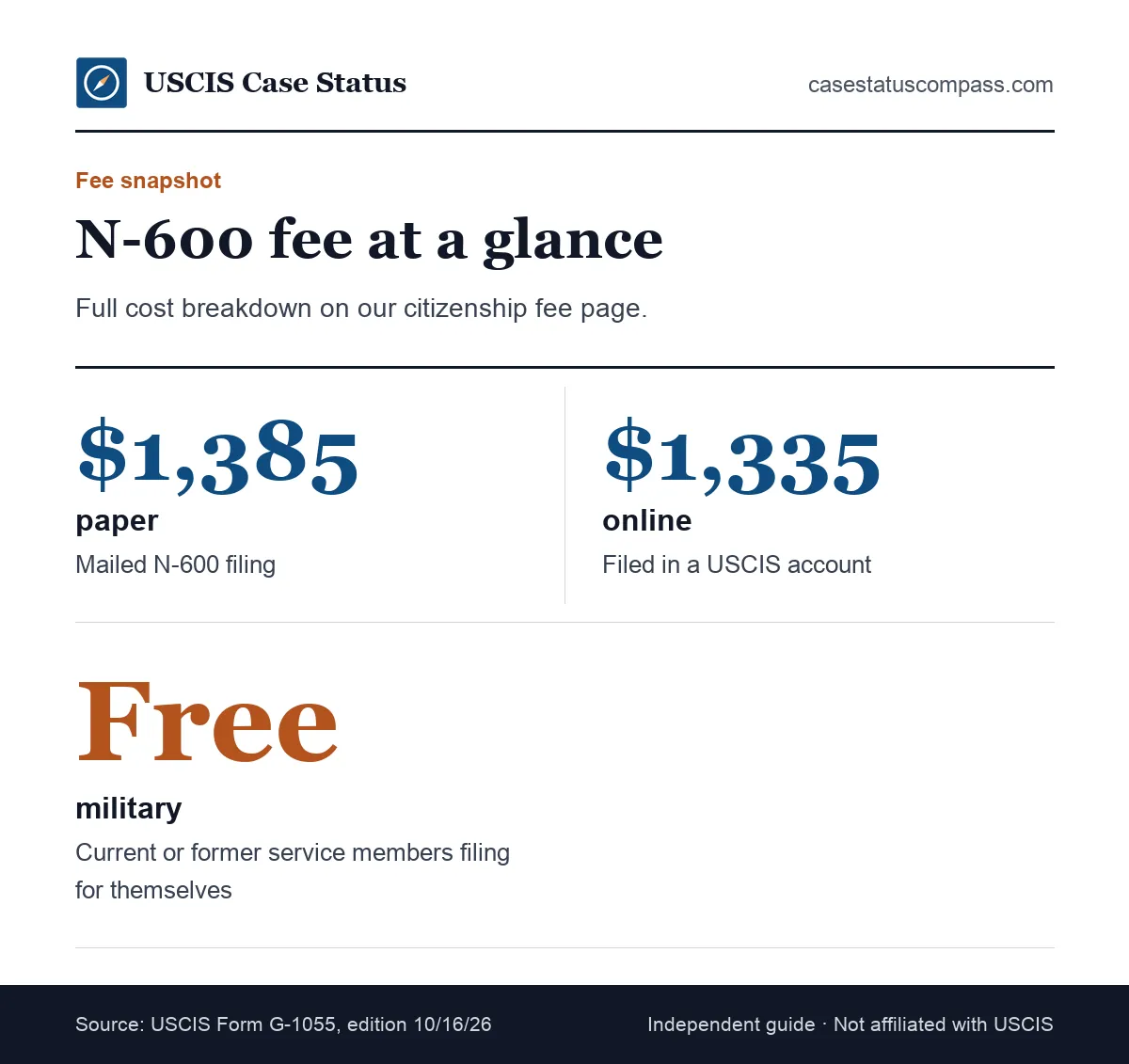
As of October 2026, the N-600 fee on Form G-1055 is $1,385 (paper) / $1,335 (online). Current or former U.S. armed forces members filing for themselves pay nothing. For the full picture, see how much does it cost to become a US citizen.
Before you pay
The fee comes from Form G-1055, Edition 10/16/26, and a wrong amount means rejection. Fee waiver requests go on paper; our USCIS fee waiver guide explains who may qualify.
What Happens After You File the N-600 Form?
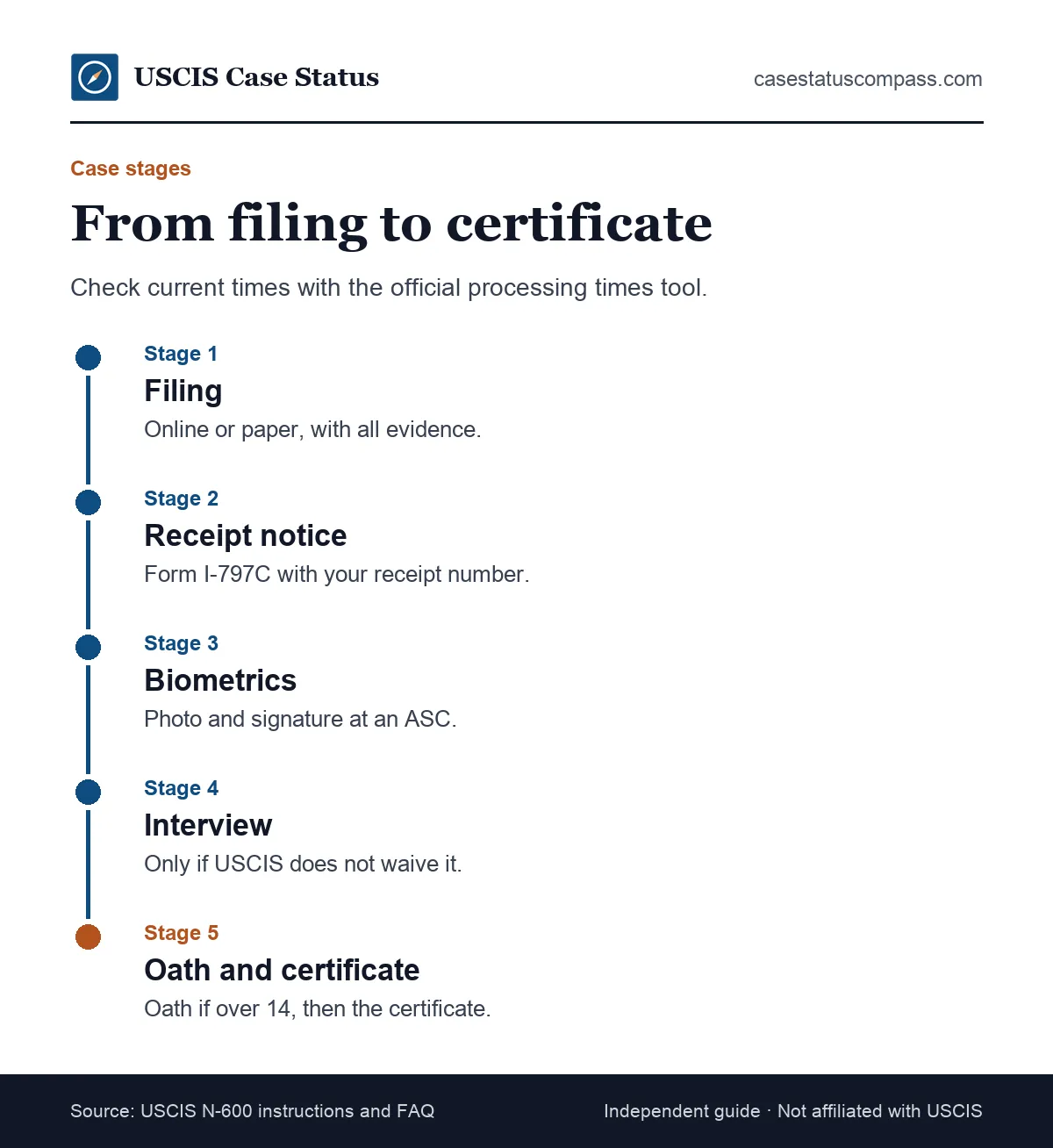
After you file the N-600 form, USCIS sends a receipt notice, schedules biometrics, reviews the evidence and may set an interview. If approved, an applicant over 14 usually takes the Oath of Allegiance, and then the Certificate of Citizenship is issued.
The receipt notice
Your first notice is a Form I-797C. I-797C = Notice of Action (receipt, rejection, transfer, appointment, re-open); not proof of status by itself. It carries the receipt number you will track the case with. See our I-797C notice of action page.
Biometrics appointment
Applicants in the United States go to an Application Support Center for a photo and signature, so USCIS says photos are generally not mailed. Our biometrics appointment guide covers what to bring. Paper filers also get an Account Acceptance Notice for linking the case online.
N-600 Status Sequence: From Receipt to Certificate
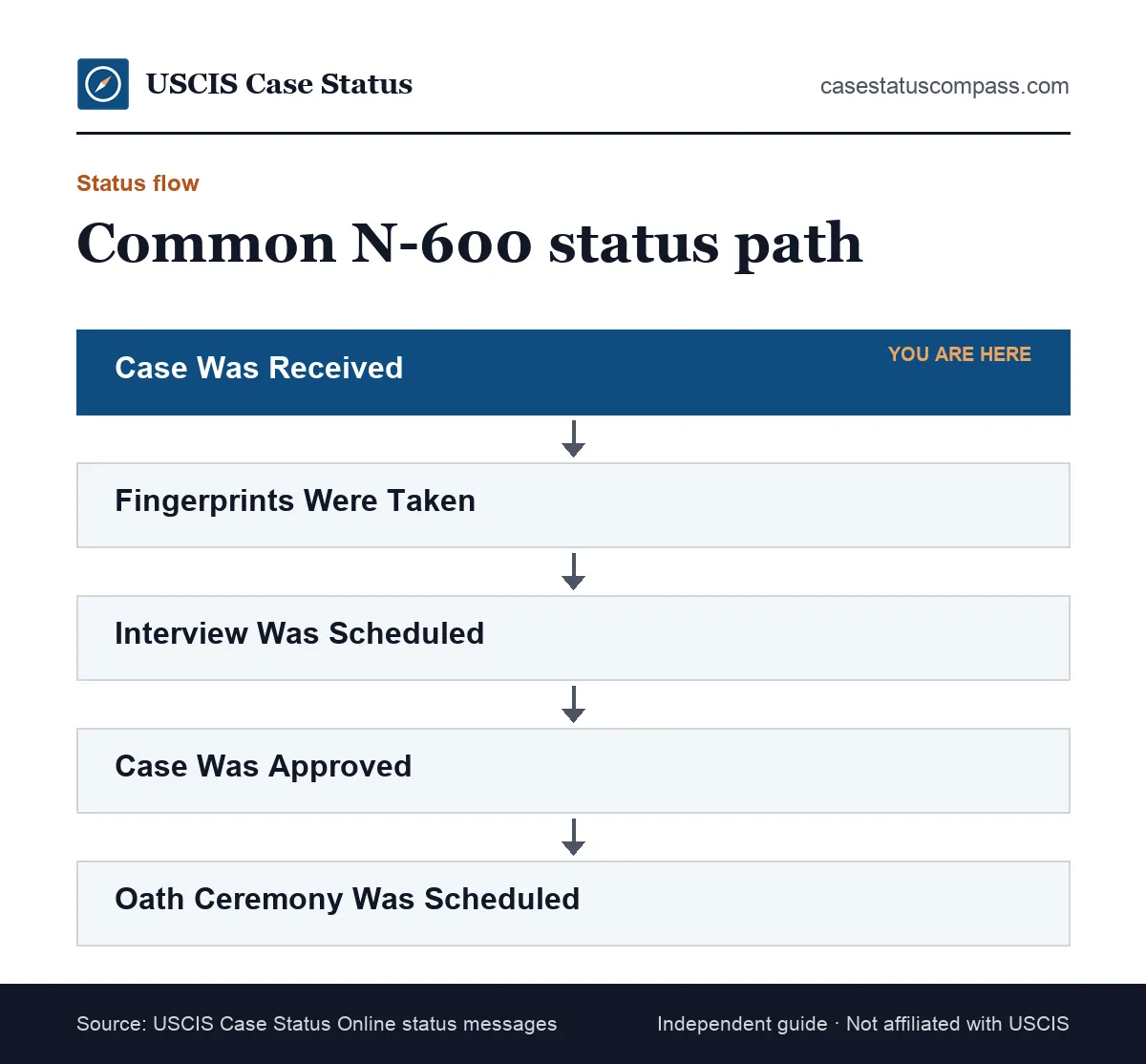
A typical N-600 status sequence starts with Case Was Received, moves through biometrics and review, may add an interview and oath, and ends with approval and the certificate. Not every case shows every status: many skip the interview, and children under 14 usually skip the oath.
Early N-600 statuses: receipt to evidence request
These are the first messages most filers see, with the single action each one calls for:
| Status you may see | What it means | What you do |
|---|---|---|
| Case Was Received | Filing and fee accepted | Save the I-797C |
| Fingerprints Were Taken | Biometrics done | Keep your address current |
| Case Is Being Actively Reviewed | An officer has the file | Watch for notices |
| Request for Evidence Was Sent | More proof needed | Respond by the deadline |
Later N-600 statuses: interview to approval
Later messages depend on whether the officer wants to meet you and whether an oath is required:
| Status you may see | What it means | What you do |
|---|---|---|
| Interview Was Scheduled | Officer wants to meet you | Bring originals and the parent |
| Oath Ceremony Was Scheduled | Oath required | Attend with your notice |
| Case Was Approved | Citizenship confirmed | Watch for the certificate |
Statuses off the usual path
Case Was Transferred may appear if a closer field office takes over. A denial status means the officer found you did not prove citizenship. For the approval message itself, see the Case Was Approved status.
Is There an Interview for the N-600?
Not always. USCIS decides from your evidence whether an N-600 interview is needed. Unclear custody or a parent's U.S. residence history usually brings an interview notice, while clear documents may lead to approval without one. The interview notice gives the field office, date and time.
Who attends with a minor
USCIS says applicants under 18 must attend with their citizen parent unless USCIS waives it. Applicants 18 or older may go alone. If the parent has died or cannot attend, contact USCIS before the date.
What to bring
- The interview notice and photo ID
- Originals of every copy you sent
- Certified translations
- New evidence for open questions
Our page on the Interview Was Scheduled status explains the notice.
What Questions Are Asked at an N-600 Interview?
N-600 interview questions cover your identity, your link to the citizen parent, the parent's citizenship and, for derivation, your residence and custody before 18. There is no civics or English test, because you are not naturalizing. Expect questions tied to the documents you sent with the N-600 form.
Topics officers usually cover
- Your name, birth date and birthplace
- How each parent became a citizen
- When you got your green card
- Where and with whom you lived before 18
- Family name changes, marriages or divorces
How it differs from the N-400 interview
The N-400 interview includes English and civics tests and questions on your own moral character. The N-600 interview reviews facts about your parents and childhood, so a parent who remembers dates helps more than practice tests.
Do You Take an Oath for an N-600 Certificate?
Often, yes. USCIS says applicants over 14 are scheduled to take the Oath of Allegiance at a USCIS office if it is not done at the interview. Children under 14 are generally exempt, and the certificate follows once the oath is done or waived.
The age-14 rule
A child under 14 is usually excused from the oath. A child who turns 14 while the case is pending may then need to take it, so follow your notice rather than assuming.
How the oath is scheduled
The oath may happen at the interview or at a later appointment. Our citizenship oath ceremony guide describes the larger N-400 ceremonies, which differ from small N-600 oaths. If the date conflicts, follow the rescheduling instructions on the notice before the appointment.
How Long Does the N-600 Take? (Summary)
N-600 processing time depends on the USCIS field office handling your case, Right now, the tool shows 7.5 to 11.5 months, depending on category and office (USCIS data retrieved Oct 27, 2026) at the offices we checked. Check the current estimate for the N-600 form and your office at egov.uscis.gov/processing-times.
Reading the USCIS median for the N-600
USCIS's quarterly data show N-600/N-600K: median 6.9 months (USCIS data, Apr.-June 2026), a median rather than a promise. Our USCIS processing times hub explains how to read that tool.
How Do You Check Your N-600 Case Status?
Check your N-600 case status by entering the receipt number from your I-797C in Case Status Online, or by signing in to your USCIS online account. The account also shows full history and notices. Paper and online filers use the same kind of receipt number.
Using the receipt number
Enter the 13-character number at Case Status Online: egov.uscis.gov without dashes. If it fails, our USCIS receipt number guide covers format errors. Online filings usually get a receipt that starts with IOE.
Using your online account
Online filers see the case automatically. Paper filers link it with the code on their notice. Our guide to the USCIS online account number explains how it differs from a receipt number.
What If USCIS Sends an RFE on Your N-600?
A request for evidence (RFE) on an N-600 means USCIS needs more proof before it decides. It is not a denial, but a missed deadline usually means one. The notice lists each missing item and gives a response date, which USCIS does not extend.
Typical N-600 RFE topics
Most N-600 RFEs ask for proof tied to the parent or to the custody period, such as:
- Proof of legal custody after a divorce
- A parent's physical presence records
- A long-form birth certificate
- Paternity proof for unmarried parents
- Name change records
Responding well
Send everything in one package with the RFE notice on top, and explain gaps in a short cover letter. A partial reply is treated as a request to decide on the record, so wait until you have every item. Our request for evidence guide covers deadlines and uploads.
What If Your N-600 Is Denied?
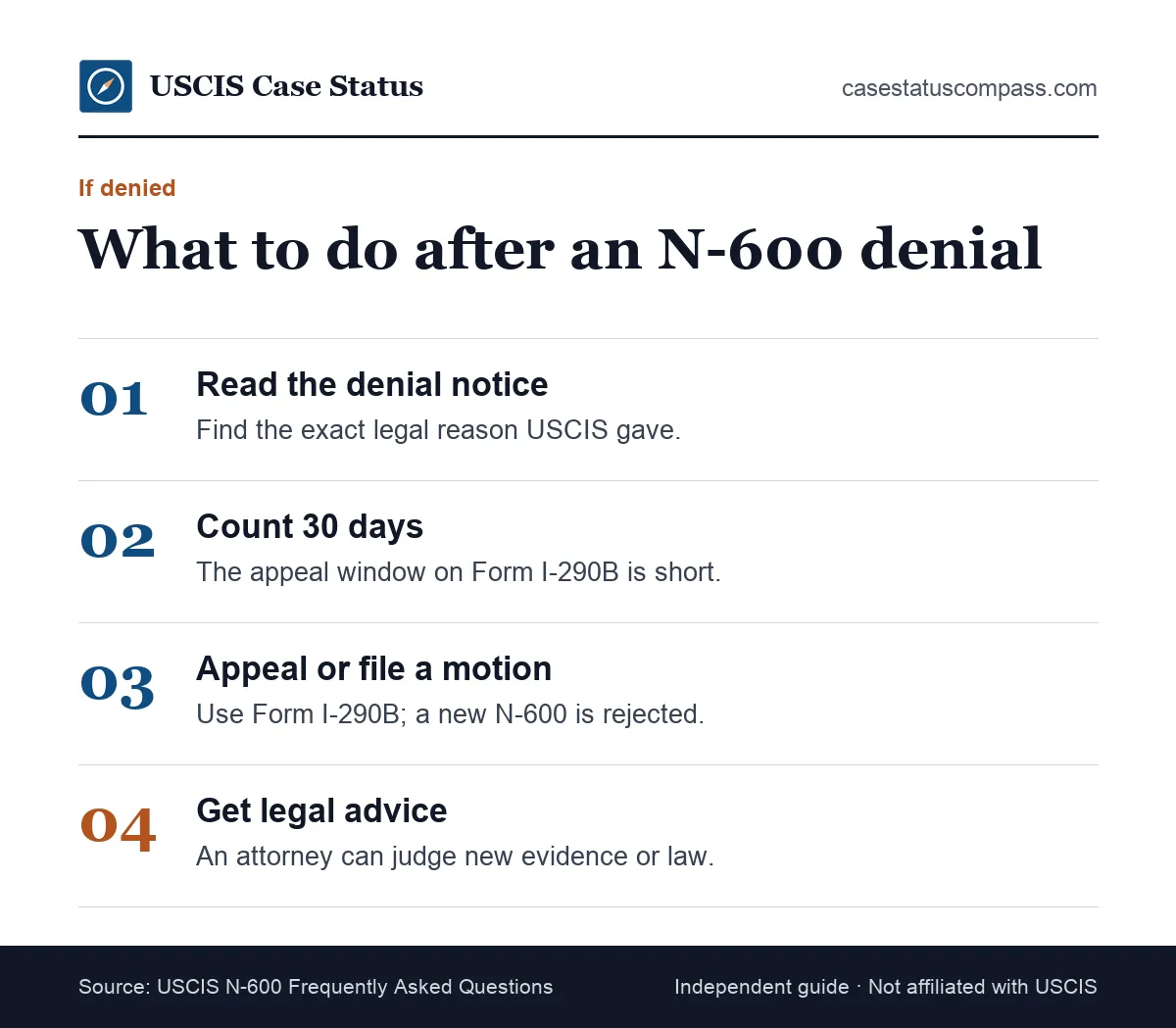
If your N-600 is denied, you can appeal on Form I-290B within 30 days, according to USCIS's N-600 FAQ. USCIS rejects a new N-600 filed after a denial; once the window closes, you file a motion to reopen or reconsider instead.
Appeal or motion
An appeal asks a higher office to review. A motion to reopen adds new facts, and a motion to reconsider argues the law was misapplied. Our motion to reopen and appeal guide helps you choose.
If you truly do not qualify
Some denials are correct, such as a green card that came after 18. You are then a permanent resident, not a citizen, and may naturalize later. The Case Was Denied status page explains the message.
N-600 for Adopted Children
An adopted child can derive citizenship and use the N-600 form if the child meets the immigration law definition of "child" and the other INA 320 conditions. That generally means an adoption finalized before age 16, plus legal custody and residence with the adoptive parent.
Children who entered on IR-3 visas
USCIS's adoption pages say children admitted on IR-3 or IH-3 visas usually become citizens on admission and receive a certificate without an N-600. If none arrived, contact USCIS before paying for an application.
Children who entered on IR-4 visas
IR-4 or IH-4 children often need the adoption finalized or re-done in the United States. Once it is final and the other conditions are met, the parent files an N-600 with the final adoption decree.
N-600 for Children of Military Members and Government Employees
Children of U.S. military members and government employees stationed abroad have special rules. A 2020 law lets certain children living abroad with such a parent derive citizenship as if they lived in the United States. Service members filing for themselves pay no N-600 fee.
The 2020 residence exception
The Citizenship for Children of Military Members and Civil Servants Act covers eligible children under 18 on March 26, 2020. The child must be a permanent resident in the custody of a citizen parent stationed abroad on official orders.
Filing from overseas
Families abroad must file on paper, and applicants abroad send two passport-style photos, according to the USCIS N-600 page. Military legal assistance offices can often review the package.
Filing an N-600 as an Adult
You can file an N-600 as an adult; there is no upper age limit. What matters is whether you met the conditions as a child. Adults often need extra time, because evidence sits in parents' files, old school records and closed court cases.
Rebuilding old records
Ask your parent for a copy of their naturalization certificate, request old transcripts from school districts, and get custody orders from the court clerk. A records request to USCIS may recover parts of a parent's file.
Should You Keep Renewing Your Green Card Before N-600 Approval?
Adults who derived citizenship sometimes keep renewing a green card for years. Keep the current card valid until the N-600 is approved. Our guide to green card renewal on Form I-90 explains renewal if your card is expiring. Letting it lapse while the case is pending can complicate travel and job checks.
Real-World N-600 Scenarios
These three scenarios show how the same N-600 rules lead to different answers. They are examples, not legal advice; compare the dates with your own and see an attorney if your facts fall between them. Each shows the single date that decided the case.
Ana: a teen whose mother naturalized
Ana arrived at 9 with a green card and lived with her mother, who naturalized when Ana was 15. Everything overlapped at 15, so Ana derived citizenship that day. Her mother files with her naturalization certificate, Ana's green card and school records.
Ben: an adult born abroad to a citizen father
Ben was born in Kenya to a U.S. citizen father who had lived in Ohio for years before the birth. Ben may have acquired citizenship at birth. His case depends on proving his father's earlier presence with school, tax and work records.
Chen: a parent who naturalized too late
Chen's father naturalized when Chen was 19. Even with a green card and shared home, the citizen-parent condition came after 18, so Chen did not derive citizenship. He files his own N-400 when eligible.
If X, Do Y: N-600 Decision Table
Use this decision table to match your situation to a next step. It covers the common forks: passport holders, people past the age cutoff, families abroad and denied applicants. When two rows seem to apply, choose the more cautious path.
Eligibility and age situations
Start with these rows if your question is whether you qualify at all or which age rules apply:
| If this is your situation | Then do this |
|---|---|
| Valid U.S. passport, need only travel proof | N-600 optional |
| All INA 320 conditions overlapped before 18 | File with green card and custody evidence |
| Parent naturalized after you turned 18 | Not a citizen that way; consider N-400 |
| You turned 18 before Feb. 27, 2001 | Have an attorney check the former rules |
Living abroad, denial and adoption situations
These rows cover families living outside the country, applicants who were denied, and adopted children who entered on IR-3 visas:
| If this is your situation | Then do this |
|---|---|
| You live abroad and are under 18 | Look at Form N-600K |
| N-600 denied | File Form I-290B within 30 days |
| IR-3 entry, no certificate received | Ask USCIS about the automatic certificate |
When the table does not fit
Mixed cases are common: a parent who naturalized after a divorce, a child adopted at 16, or a stepparent who never adopted. Stepchildren generally do not derive citizenship without a legal adoption.
How Is the N-600 Different From the I-130 and I-864?
The N-600 confirms citizenship, while the I-130 and I-864 belong to the green card process. Old filings from a parent's case can still serve as evidence. If a parent is about to file an I-130 for a child who may already be a citizen, check citizenship first, because a green card petition cannot be approved for someone who is already a U.S. citizen.
How a child's earlier green card case connects
A citizen parent bringing a child to the United States first files an I-130 petition, and a sponsor signs the affidavit of support on Form I-864. Neither is part of the N-600, but copies of them can help prove the child's residence and relationship.
What Should You Keep After N-600 Approval?
After approval, store the Certificate of Citizenship somewhere safe and dry, keep a scan, and keep your approval notice and key evidence. You will need the certificate for passports, benefits and your children's claims, so never laminate it. Make sure a trusted family member knows where it is kept.
Protecting the certificate
A few habits keep the original usable for decades:
- Store it flat in a fireproof folder.
- Keep a scan for reference; copies are not proof.
- Do not laminate it.
- Get a U.S. passport as a second proof.
Records to keep with the certificate
Keep the approval notice, the I-797C receipt, and copies of your parent's citizenship proof and custody records. Your own children born abroad may need them later to show they acquired citizenship through you.
What If Your Certificate of Citizenship Is Lost or Wrong?
A lost, damaged or incorrect certificate is replaced with Form N-565, not a new N-600. Check the details on arrival. As of October 2026 the N-565 fee is $555 (paper) / $505 (online), with no fee when the error was USCIS's. While a case is open, keep your address current using our change of address guide.
When Should You Talk to an Immigration Attorney About the N-600?
Talk to an immigration attorney or DOJ-accredited representative before filing if you turned 18 before February 27, 2001, your parents split without clear custody orders, you were born abroad to unmarried parents, or you have any criminal or removal history.
Red flags that need legal review
- Turned 18 before February 27, 2001
- No custody order after a separation
- Birth abroad to unmarried parents
- Parent's U.S. residence hard to prove
- Any arrest, conviction or removal case
Low-cost legal help and notice checks
Nonprofits with DOJ-accredited representatives often give low-cost advice. Avoid notarios who cannot legally give immigration advice, and learn how to verify a USCIS notice before acting on any letter. Our Forms hub lists related applications.
Frequently Asked Questions
Do I need an N-600 if I have a U.S. passport?
No. USCIS says a valid U.S. passport generally proves citizenship while it is valid, so the N-600 is optional. Many people still file because the certificate never expires and records the exact date you became a citizen.
Can I file Form N-600 if I am over 18?
Yes. There is no age limit for filing. The question is whether you met the legal conditions as a child, such as holding a green card and living in your citizen parent's custody before your 18th birthday.
Does filing an N-600 make me a U.S. citizen?
No. If you qualify, you already became a citizen at birth or on the date the last legal condition was met before age 18. The Certificate of Citizenship confirms that existing status in writing.
Who can file an N-600 for a minor child?
A U.S. citizen parent or a legal guardian files for a child under 18 and signs if the child is under 14. Adults who qualified as children file for themselves at any age.
Does a Certificate of Citizenship expire?
No. Unlike a passport, a Certificate of Citizenship never expires and needs no renewal. You only file Form N-565 if it is lost, damaged or contains an error.
Can I travel while my N-600 is pending?
Usually yes, if you hold valid travel documents such as a U.S. passport or a valid green card. Do not miss a biometrics, interview or oath appointment while abroad.
Is the N-600 the same as Form N-600K?
No. The N-600 confirms citizenship you already have. Form N-600K is a naturalization application for certain children under 18 who live abroad with a U.S. citizen parent and visit the United States for the process. Both end with a Certificate of Citizenship.
What if my name changed after I filed?
Tell USCIS before the decision, with a copy of the court order or marriage certificate, so the certificate shows the right name. If the certificate is already issued with an old or wrong name, you request the correction on Form N-565 rather than filing a new N-600.
Sources
- USCIS: N-600, Application for Certificate of Citizenship. www.uscis.gov/n-600. Accessed Oct 27, 2026.
- USCIS: Form N-600 Instructions (PDF). www.uscis.gov/sites/default/files/document/forms/n-600instr.pdf. Accessed Oct 27, 2026.
- USCIS: N-600 Frequently Asked Questions. www.uscis.gov/forms/all-forms/n-600-application-for-certificate-of-citizenship-frequently-asked-questions. Accessed Oct 27, 2026.
- USCIS Policy Manual, Volume 12, Part H: Children of U.S. Citizens. www.uscis.gov/policy-manual/volume-12-part-h. Accessed Oct 27, 2026.
- USCIS: U.S. Citizenship for an Adopted Child. www.uscis.gov/adoption/bringing-your-internationally-adopted-child-united-states/us-citizenship-adopted-child. Accessed Oct 27, 2026.
- USCIS Fee Schedule (Form G-1055). www.uscis.gov/g-1055. Accessed Oct 27, 2026.
- USCIS Check Case Processing Times. egov.uscis.gov/processing-times/. Accessed Oct 27, 2026.
- USCIS Form G-1055 Fee Schedule, Edition 10/16/26. www.uscis.gov/sites/default/files/document/forms/g-1055.pdf. Accessed Oct 27, 2026.
- USCIS: Online Account and Technical Support. www.uscis.gov/tools/uscis-tools-and-resources/online-account-and-technical-support. Accessed Oct 27, 2026.
- USCIS: Form I-797 Types and Functions (updated 01/24/2025). www.uscis.gov/forms/filing-guidance/form-i-797-types-and-functions. Accessed Oct 27, 2026.
- USCIS Data Library: All USCIS Application and Petition Form Types, FY2026 Q3 (Apr. 1-June 30, 2026; queried 7/2026). www.uscis.gov/sites/default/files/document/data/quarterly_all_forms_fy2026_q3_v1.xlsx. Accessed Oct 27, 2026.
- USCIS: Checking Your Case Status Online. www.uscis.gov/tools/checking-your-case-status-online. Accessed Oct 27, 2026.
casestatuscompass.com is an independent publication and is not affiliated with USCIS or any government agency. This page is general information, not legal advice. For denials, court or asylum matters, consult an immigration attorney or a DOJ-accredited representative.