Contents · 42 sections
- What Does It Mean to Travel With Pending I-485 Status?
- What Changed for Advance Parole Travel on August 13, 2026?
- Does Delcarmen-Lara Apply to Trips Taken Before August 13, 2026?
- Who Is Most Exposed Under Matter of Delcarmen-Lara?
- How Is Unlawful Presence Counted for the 3- and 10-Year Bars?
- What Time Does Not Count Toward the Unlawful Presence Bars?
- Should You Talk to an Attorney Before Any Trip?
- Can You Leave the U.S. Without Advance Parole?
- What Happens If USCIS Treats Your I-485 as Abandoned?
- Which Visa Holders Can Travel Without Advance Parole?
- Which Advance Parole Document Will You Carry?
- What Do You Pay for Travel Permission in October 2026?
- Does the $1,050 Immigration Parole Fee Apply to Adjustment Applicants?
- When Should You File for Advance Parole?
- How Should You Time a Trip Around the Advance Parole Wait?
- What If You Need to Travel Urgently?
- How Do You Get Emergency Advance Parole at a Field Office?
- Domestic Travel With Pending I-485: Do You Need Papers?
- Is Travel to Puerto Rico or Guam a Departure?
- Does a Trip to Canada or Mexico Count as Leaving the U.S.?
- Pre-Trip Checklist for Travel With Pending I-485 Cases
- What Happens at the Airport and the Border?
- What Should You Check After You Return?
- What If USCIS Schedules Biometrics While You Are Abroad?
- What If Your Green Card Interview Falls During the Trip?
- Can USCIS Decide Your I-485 While You Are Abroad?
- What If an RFE or Denial Arrives While You Are Abroad?
- How Do Work Permits and Travel Fit Together?
- Do Spouses and Children Each Need Their Own Advance Parole?
- How Do Asylum, TPS and DACA Change the Travel Picture?
- Can You Travel With a Pending Asylum Case and an I-485?
- How Long Is an Advance Parole Document Valid?
- What If Something Goes Wrong Abroad?
- What Are the Most Common Travel Mistakes With a Pending Green Card Case?
- Travel Risk Decision Table: If This, Then That
- Worked Examples: Two Travelers in 2026
- What Changes When Your I-485 Is Approved?
- How Do You Keep Your Case Moving While You Travel?
- Where Should You Check the Rules Before You Book?
- How Does Travel Fit Into the Rest of Your Green Card Case?
- Is a Trip Ever Worth the Risk?
- Frequently Asked Questions
The short answer
You can usually travel with pending I-485 paperwork only after USCIS approves advance parole, unless you hold valid H, L, K or V status. Since August 13, 2026, a trip on advance parole counts as a departure: if you have over 180 days of unlawful presence, you may be barred on return. Get legal advice before booking.
At a glance
| Main rule | Leaving without advance parole generally abandons Form I-485 |
| Biggest 2026 change | Matter of Delcarmen-Lara (Aug. 13, 2026): parole travel is a "departure" for the 3- and 10-year bars |
| Who must get legal advice | Anyone with more than 180 days of unlawful presence, any removal order or any past violation |
| Filing fee | Form I-131: $630 paper / $580 online (Oct. 2026) |
| Parole fee | $1,050 H.R. 1 fee when parole is granted; the law lists an exception for adjustment applicants returning from temporary travel |
What Does It Mean to Travel With Pending I-485 Status?
To travel with pending I-485 status means leaving the United States after you filed Form I-485 but before USCIS decides it. Our Form I-131 advance parole guide covers the application itself; here we focus on the trip: permission, risk, cost and timing.
Who this guide is for
It is written for adjustment of status applicants: spouses of U.S. citizens, workers with an approved I-140, relatives in family categories and others who filed from inside the country. If your green card is already approved, different rules apply, covered later.
The three documents that matter
Three papers decide whether a trip is possible. The I-485 receipt notice proves your case is pending. The advance parole document, usually Form I-512L or an EAD combo card, lets you ask to return. Your passport must stay valid for the whole trip.
What Changed for Advance Parole Travel on August 13, 2026?
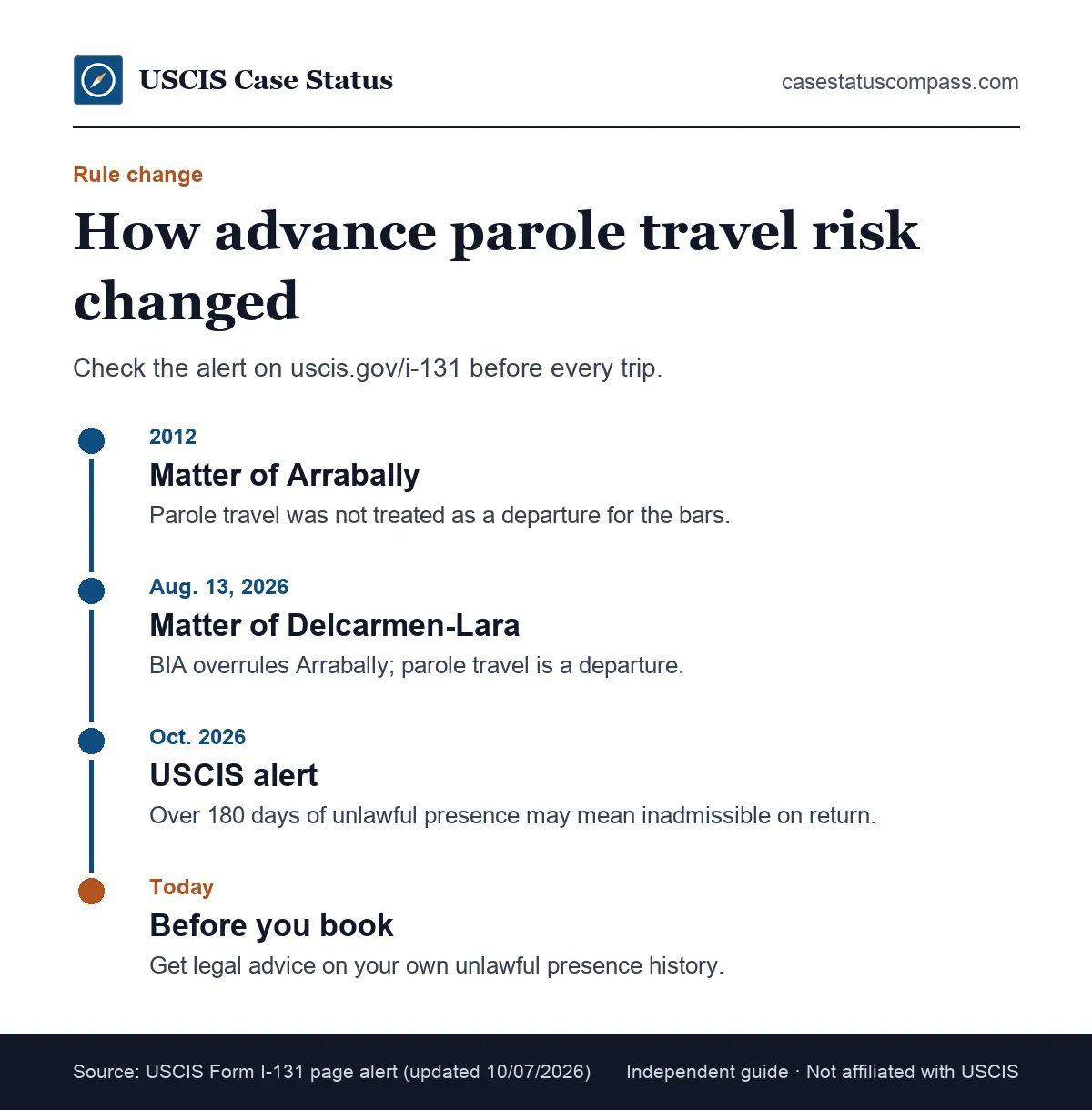
On August 13, 2026, the Board of Immigration Appeals (BIA) decided Matter of Delcarmen-Lara and overruled Matter of Arrabally and Yerrabelly. USCIS now warns that leaving on an advance parole document is a departure for the unlawful presence bars.
Advice given before that date may be out of date.
The USCIS alert in plain words
As of October 2026, the Form I-131 page states: Since Aug. 13, 2026, travel on advance parole counts as a departure: over 180 days of unlawful presence can trigger the 3/10-year bar. In USCIS's words, people "considering a departure with an Advance Parole Document should be aware that they may be inadmissible" on return if they have more than 180 days of unlawful presence.
Does Delcarmen-Lara Apply to Trips Taken Before August 13, 2026?
Practice advisories read the BIA decision as prospective, meaning it was not meant to reach trips completed before August 13, 2026. USCIS's alert does not discuss past trips. If you traveled on parole earlier and have unlawful presence, ask an attorney how it may affect your interview.
Who Is Most Exposed Under Matter of Delcarmen-Lara?
The people most exposed are adjustment applicants who built up more than 180 days of unlawful presence before they filed, such as someone who overstayed a visa for a year and then married a U.S. citizen.
For them, a short family visit abroad could trigger a 3- or 10-year bar on return, even with an approved parole document.
Profiles that need a legal review first
- You overstayed an I-94 date by more than six months at any point
- You stayed after a status ended, for example after a denied extension
- You lived in the U.S. without status before a parole or visa entry
- You were ever in removal proceedings or received an order
Why "lower risk" still means "check"
Someone who has always held lawful status, such as an H-1B worker who never fell out of status, has little or no unlawful presence. That person faces less risk from this decision.
How Is Unlawful Presence Counted for the 3- and 10-Year Bars?
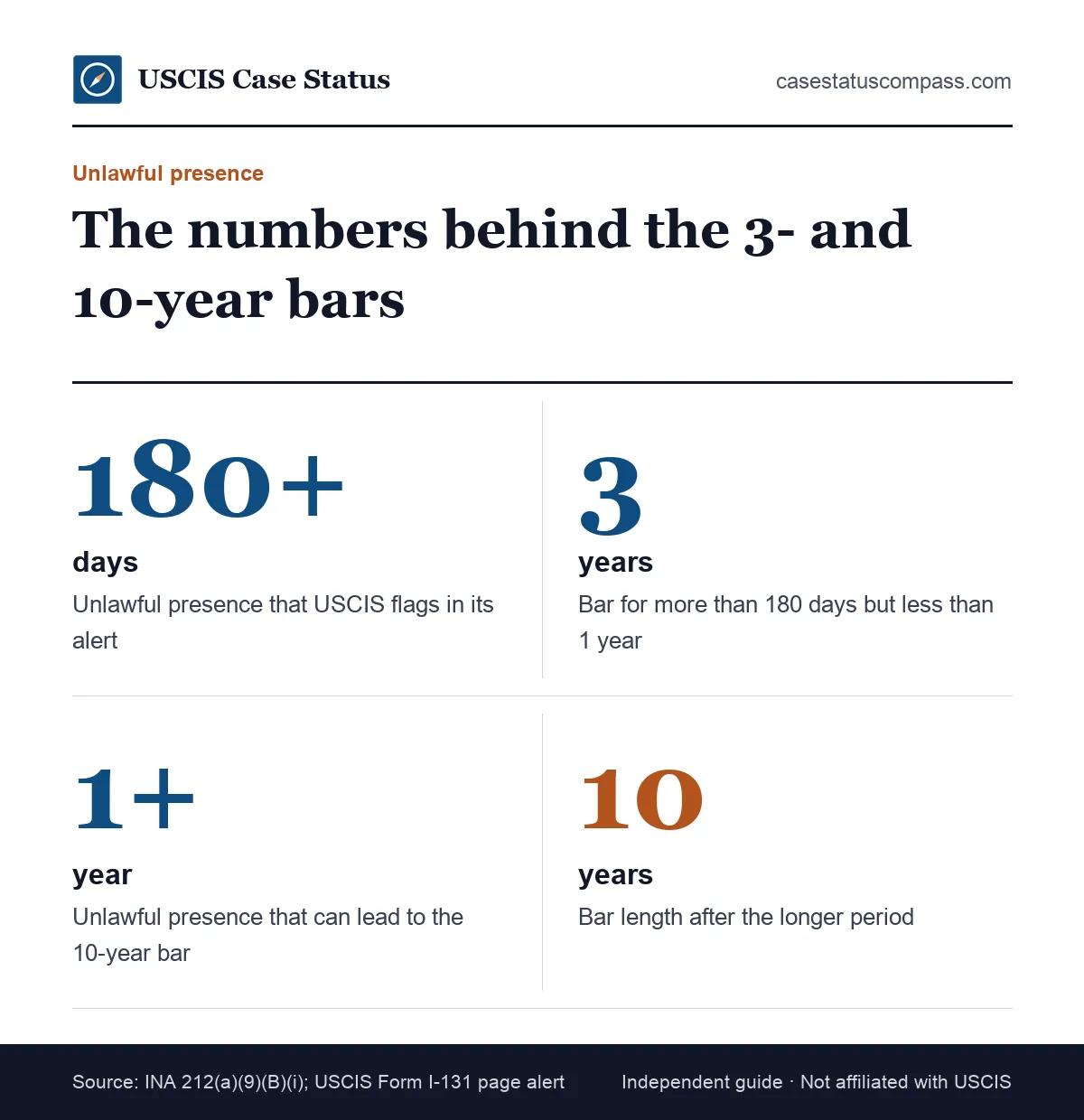
Unlawful presence is time you spend in the U.S. after an authorized stay expires, or without ever being admitted or paroled. Under INA 212(a)(9)(B)(i), more than 180 days but under a year can lead to a 3-year bar after departure; one year or more can lead to a 10-year bar.
What Time Does Not Count Toward the Unlawful Presence Bars?
The statute lists exceptions. Time under age 18 does not count, and USCIS policy treats time while a properly filed adjustment application is pending as not counting toward these bars. A bona fide pending asylum claim can also stop the count, so the date you filed each application matters.
Why your own count needs a professional
Old I-94 dates, gaps between extensions and "duration of status" entries make the math hard. An immigration attorney can rebuild your timeline and tell you whether any waiver exists for your facts.
Should You Talk to an Attorney Before Any Trip?
Yes, if you have any unlawful presence, any arrest, a past visa denial, a prior removal order or a pending asylum claim. Speak with a licensed immigration attorney or a DOJ-accredited representative before buying tickets, not after.
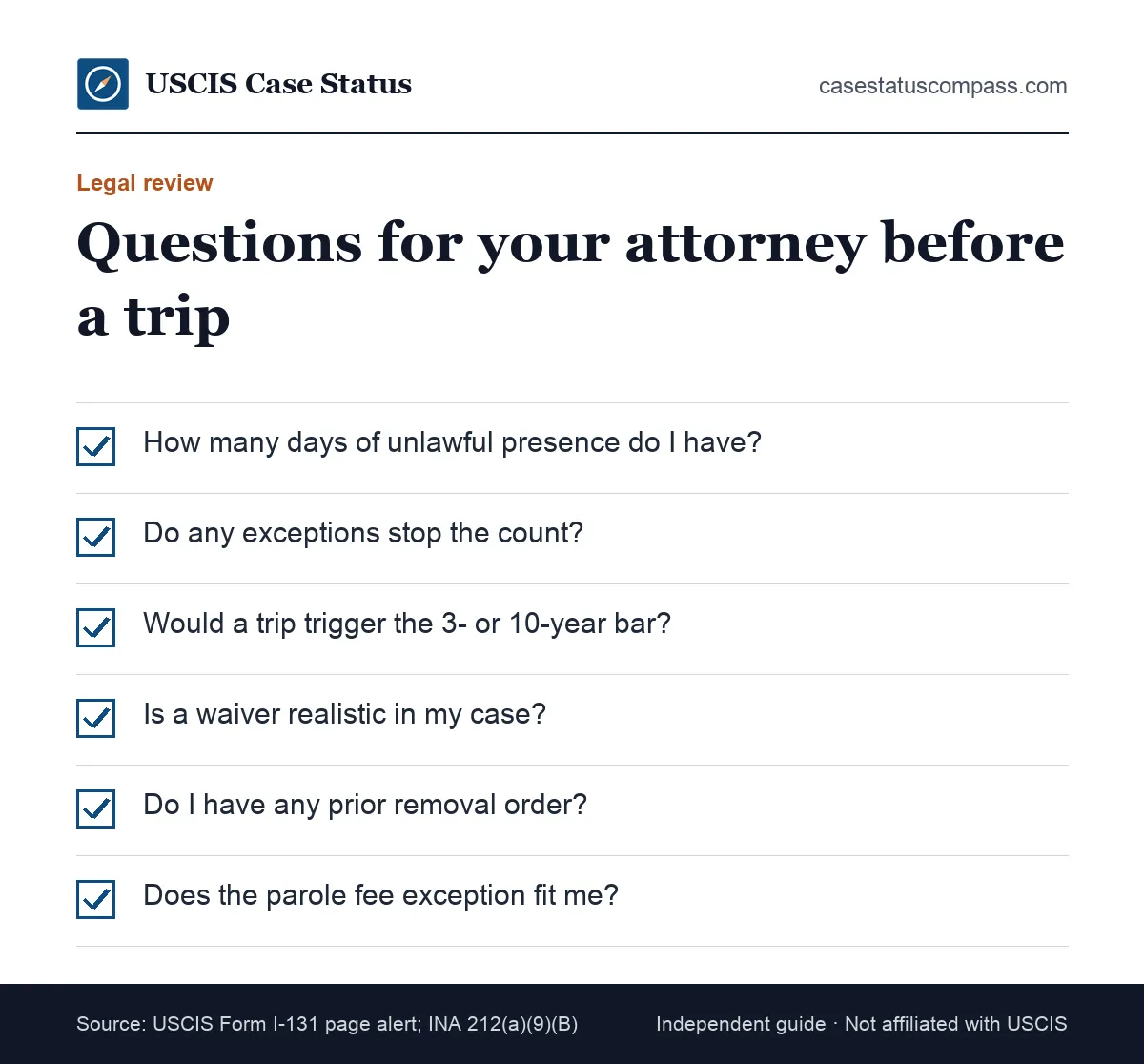
Ask for the advice in writing.
What to bring to the consultation
Bring every I-94 record, passport stamp, visa, USCIS notice and court paper, plus a written list of entries and exits with dates. The more complete your history, the more precise the advice.
Where to find qualified help
Use a state-licensed attorney or a representative at a DOJ-recognized organization. Avoid "notarios" and consultants who promise a safe trip; they cannot give legal advice.
Check the person on the state bar website or the DOJ roster before you share your file.
Can You Leave the U.S. Without Advance Parole?
For most applicants, no. The I-485 instructions say that leaving without first getting an Advance Parole Document generally means USCIS will treat your application as abandoned. As of October 2026 the rule reads: Traveling while your I-485 is pending abandons it unless you have advance parole (with H/L/V/K exceptions).
The receipt notice is not a travel pass
A Form I-797C receipt for your I-131 only proves USCIS received the request. You need the approved, original document before you leave. Airlines and CBP will not accept a receipt as permission to return.
What Happens If USCIS Treats Your I-485 as Abandoned?
An abandoned I-485 is usually denied, and fees are not refunded. Our I-485 denied guide covers the options. You may then have to start over through a U.S. consulate abroad, which can trigger the very bars at issue.
Do not leave on a receipt notice alone.
Which Visa Holders Can Travel Without Advance Parole?
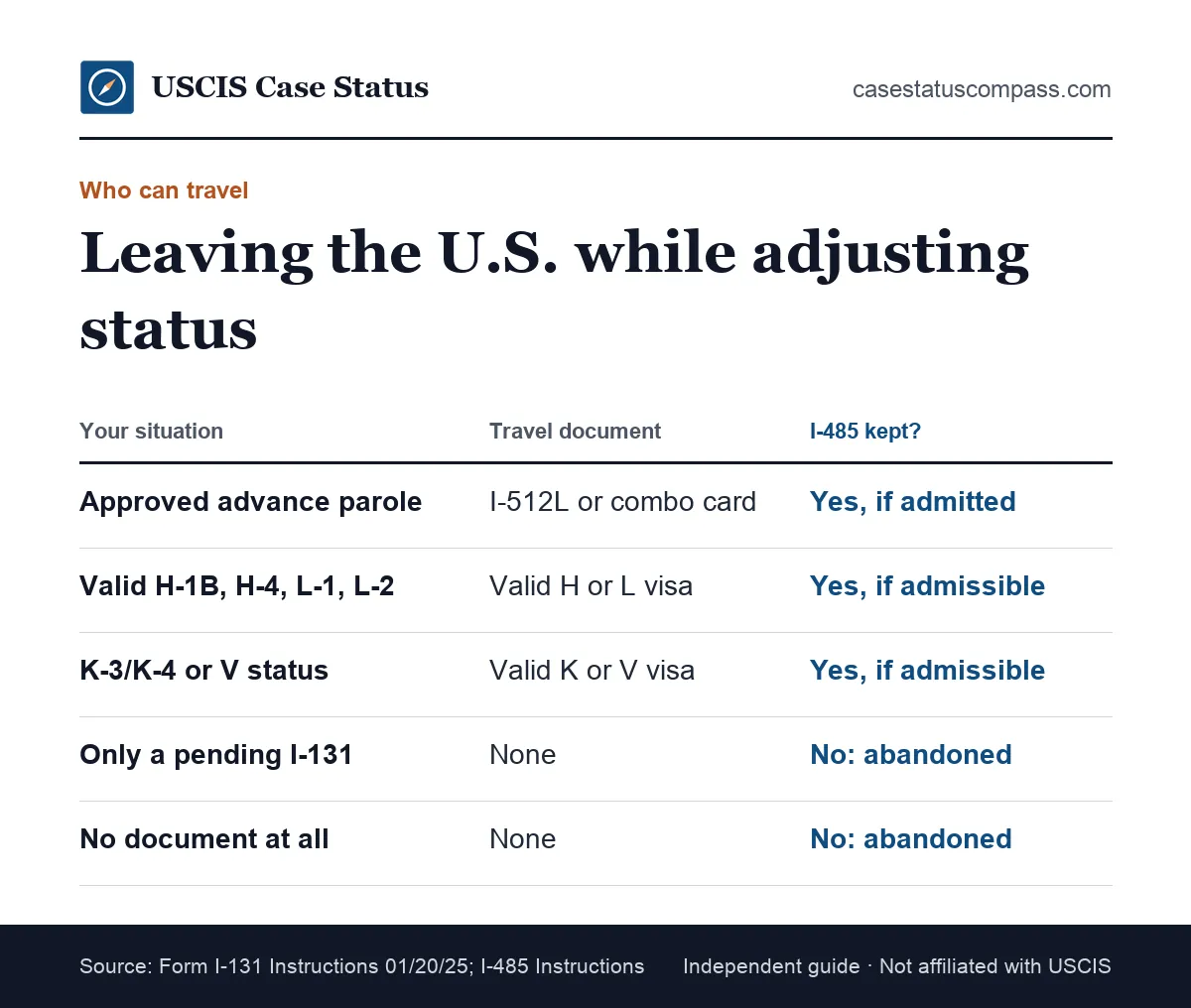
The Form I-131 instructions list four groups who generally keep their I-485 when they travel on a valid visa instead of parole: H-1B and H-4, L-1 and L-2, K-3 and K-4, and V-1, V-2 and V-3. They must return with a valid visa in that category and still be admissible.
H-1B, H-4, L-1 and L-2 holders
You must still be maintaining that status and working for the sponsoring employer, or be the spouse or child of someone who is. If your visa stamp has expired, you need a new one from a U.S. consulate to return this way.
K-3, K-4 and V holders
Spouses and children of U.S. citizens in K-3/K-4 status, and families of permanent residents in V status, are covered too. The same condition applies: return on a valid, unexpired visa in your category.
Comparison: who needs advance parole to return
The table sorts common situations into those that can leave on a visa and those that need an approved parole document first.
| Situation | Can travel without parole? | What you show on return |
|---|---|---|
| H-1B or H-4, status maintained | Yes | Valid H visa and passport |
| L-1 or L-2, status maintained | Yes | Valid L visa and passport |
| K-3 or K-4 | Yes | Valid K visa and passport |
| V-1, V-2 or V-3 | Yes | Valid V visa and passport |
| F-1, B-2, expired status or no status | No | Approved advance parole document |
| Pending asylum plus I-485 | No | Parole document or refugee travel document if eligible |
If your row says no, plan to travel with pending I-485 papers only once the approved document is in your hands; a visa you once held does not replace it.
Which Advance Parole Document Will You Carry?
Adjustment applicants usually receive one of two documents. The Form I-512L is a paper parole document. The combo card is an EAD that says "Serves as I-512 Advance Parole." Both work for travel while valid; our I-131 guide compares them.
Using an I-512L
The I-512L is printed on secure paper and shows a validity period. Keep the original; airlines and CBP will not accept a photocopy.
Check the name, dates and number of entries the day it arrives.
Using a combo card
The combo card shows both work and travel permission. When the card expires, both permissions end, so a trip must finish before that date.
Check the printed end date before you book any return flight.
What Do You Pay for Travel Permission in October 2026?
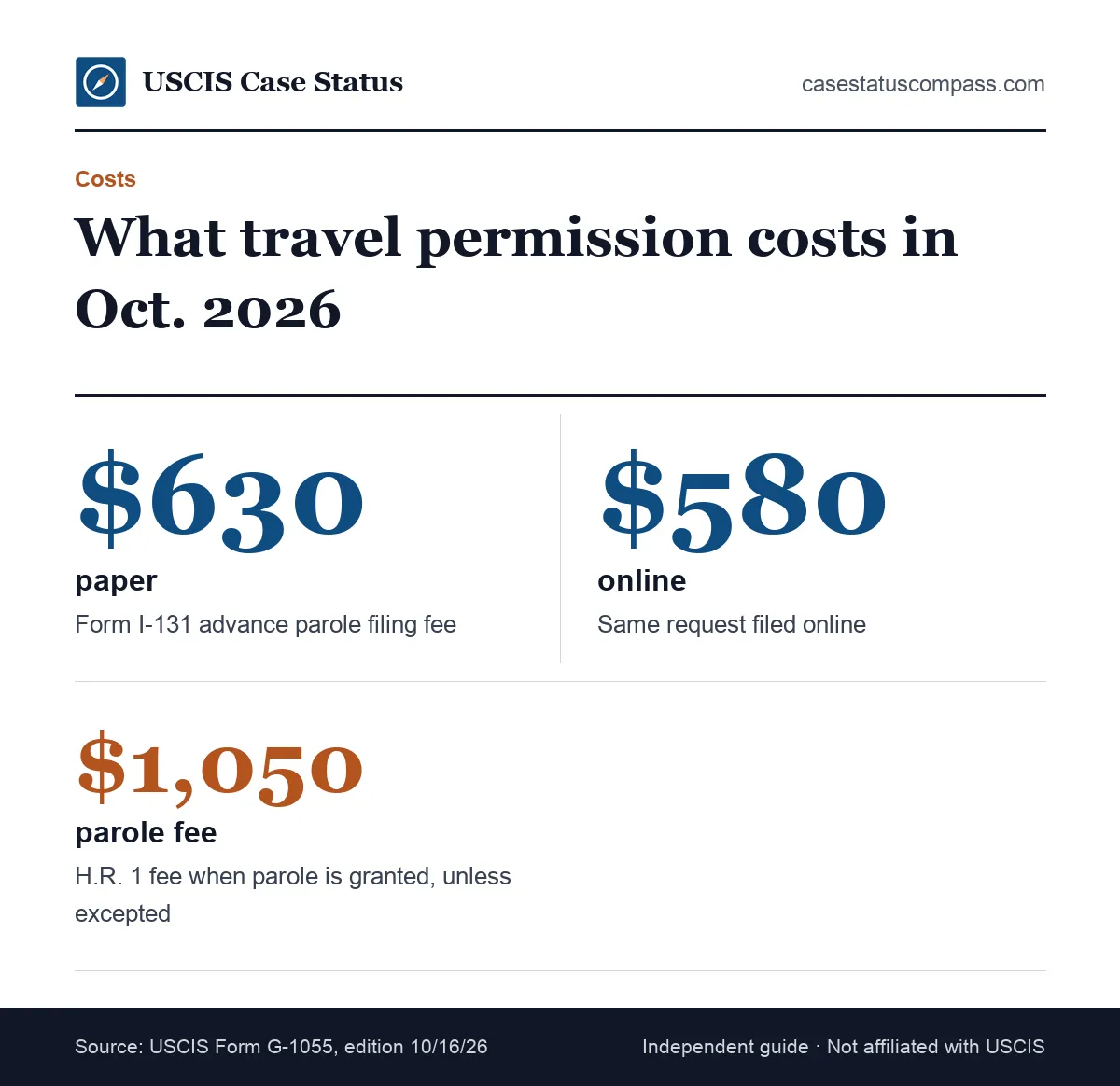
As of October 2026, G-1055 (edition 10/16/26) lists the advance parole request as $630 (paper) / $580 (online); $0 if your I-485 was filed before Apr. 1, 2024 with the fee. H.R. 1 Immigration Parole Fee $1,050 when parole is granted (some exceptions). Our USCIS fee guide explains every Form I-131 fee category.
When the I-131 costs nothing
If you filed your I-485 between July 30, 2007 and March 31, 2024 and paid the full fee, G-1055 shows a $0 fee for advance parole while that I-485 is pending. Applicants who filed after April 1, 2024 pay the I-131 fee separately.
Fees that never come back
USCIS states that USCIS fees are nonrefundable, even if your case is denied or withdrawn. If you file for advance parole and then cancel the trip, the fee is gone. As of October 2026 the current I-131 edition is 01/20/25.
Does the $1,050 Immigration Parole Fee Apply to Adjustment Applicants?
H.R. 1 created an Immigration Parole Fee, listed at $1,050 for FY2027, that applies when DHS actually grants parole. The law lists ten exceptions. Exception 7 covers a "lawful applicant for adjustment of status under section 245" who is "returning to the United States after temporary travel abroad."
What the Federal Register notice says
DHS's notice on the fee (FR Doc. 2025-19564) states the fee is not charged if DHS finds, in its discretion, that you are paroled under one of the ten exceptions. CBP collects the fee at the port of entry when it grants parole and you do not show an exception.
How to prepare for the fee question
Carry your I-485 receipt notice and parole document, which show that you are an adjustment applicant on a temporary trip. The decision is still CBP's.
USCIS's summary as of October 2026: the parole fee does not apply to an INA 245 adjustment applicant returning from temporary travel abroad, if CBP agrees at the port of entry.
Waivers and the Ms. L. exemption
The H.R. 1 fee follows its own rules: H.R. 1 fees can't be waived and must be paid separately. Ms. L. class members have a separate exemption: Ms. L. settlement class: exempt from H.R. 1 parole, parolee-EAD and asylum fees since Feb. 5, 2026.
Travel cost table for adjustment applicants
The table lists every cost a trip can involve for an adjustment applicant, who collects it and when it is due.
| Fee | Amount (Oct. 2026) | Who collects | When |
|---|---|---|---|
| Form I-131 advance parole | $630 paper / $580 online | USCIS | At filing |
| I-131 with older paid I-485 | $0 | USCIS | At filing |
| Immigration Parole Fee | $1,050 | CBP at the port of entry | When parole is granted, unless an exception applies |
| Adjustment exception (H.R. 1 exception 7) | $0 if accepted | CBP decides | On return from temporary travel |
The takeaway: the I-131 fee is paid up front to USCIS, while the parole fee question is settled by CBP at the border on your return.
When Should You File for Advance Parole?
You can file Form I-131 together with your I-485 or at any time while it is pending. Filing early gives you the longest runway.
Processing takes months, so a request filed after a trip is planned often arrives too late. If you expect any travel in the next year, filing with the I-485 package is the simplest choice.
Filing with the I-485 package
Many applicants file the I-131 in one packet with the I-485 and I-765, which often leads to a combo card and one biometrics visit for all three forms. The I-485 must use edition 09/18/26 (01/20/25 and 09/04/26 editions rejected on/after Sept. 18, 2026; no grace period) as of October 2026.
Filing later on its own
A standalone request is fine if you did not file at first. Check the USCIS filing address rules, since many addresses changed on October 7, 2026.
As of October 2026, USCIS notes that advance parole and TPS travel can often be filed online, but reentry permits and refugee travel documents are paper-only.
How Should You Time a Trip Around the Advance Parole Wait?
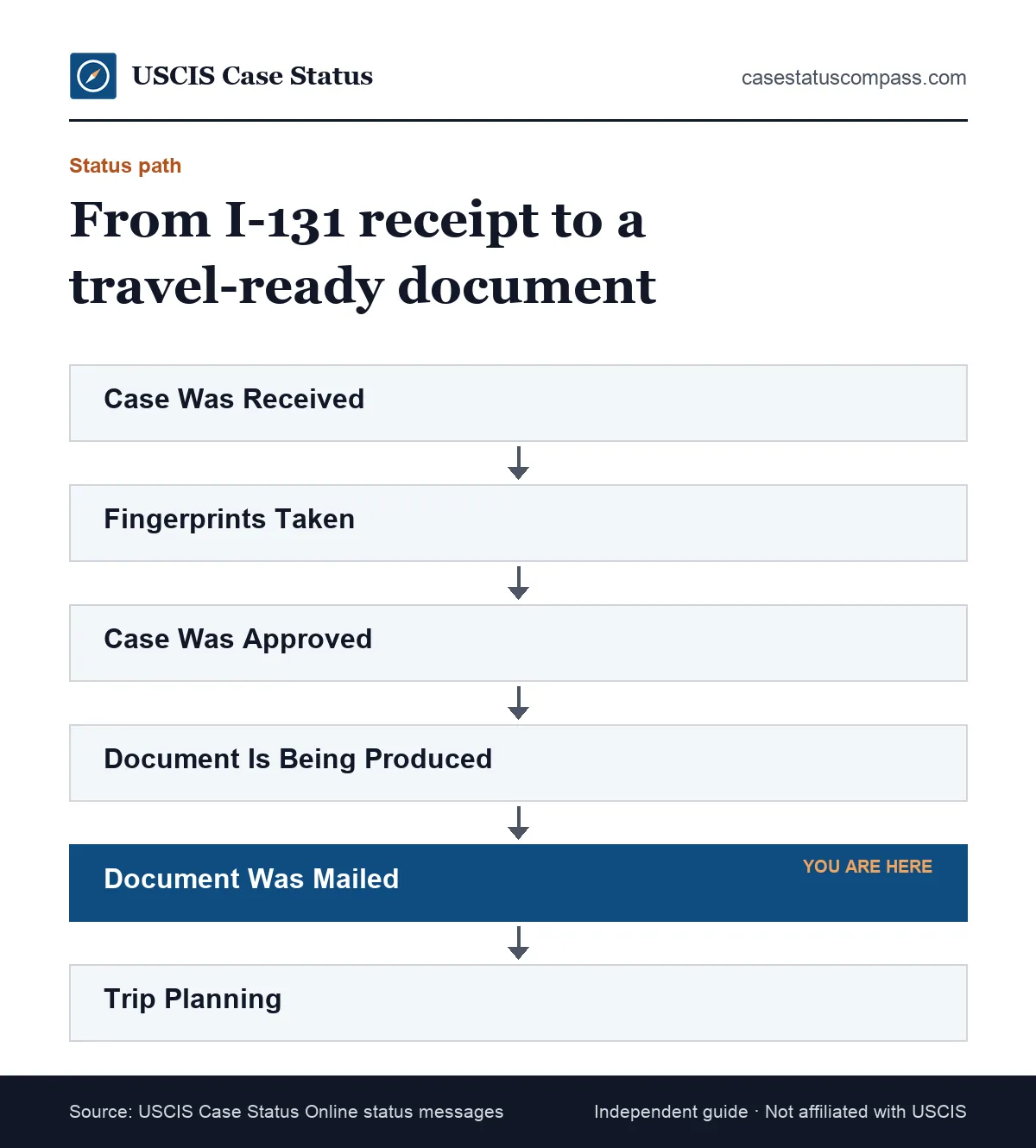
Build the trip around the document, never the other way around. USCIS data show I-131 advance parole (inside the U.S.): median 5.8 months (USCIS data, Apr.-June 2026). That figure is a median for April to June 2026, so half of cases took longer. Our I-131 processing time page explains how to read the live tool.
Booking flexible tickets
If you must plan, book refundable fares and set your departure only after the document arrives. Fixing a wedding date first and hoping USCIS keeps pace is how people end up with a lost ticket or an abandoned case.
Leaving a safety margin at the end
Plan to be back well before the parole document expires. Flight cancellations, illness and strikes happen.
A buffer of a few weeks before the end date gives you room to rebook. Never plan a return for the last valid day, because a missed connection could leave you abroad with an expired document.
What If You Need to Travel Urgently?
There are two official routes. You can ask USCIS to expedite a pending I-131, or, in a true emergency, request an in-person appointment at a local field office for emergency advance parole.
Both routes need proof of the emergency.
Asking for an expedite
USCIS lists these criteria: Expedite criteria: severe financial loss, emergency/humanitarian, nonprofit, government interest, clear USCIS error. A parent's serious illness or a funeral may fit "emergencies or urgent humanitarian situations." Our expedite request guide explains how to ask and what evidence helps.
How Do You Get Emergency Advance Parole at a Field Office?
For travel within days, call the Contact Center and ask for an emergency travel appointment. Bring a completed I-131, the fee, photos, your passport and proof such as a doctor's letter. The Delcarmen-Lara risk applies to emergency trips too, so call an attorney the same day.
Domestic Travel With Pending I-485: Do You Need Papers?
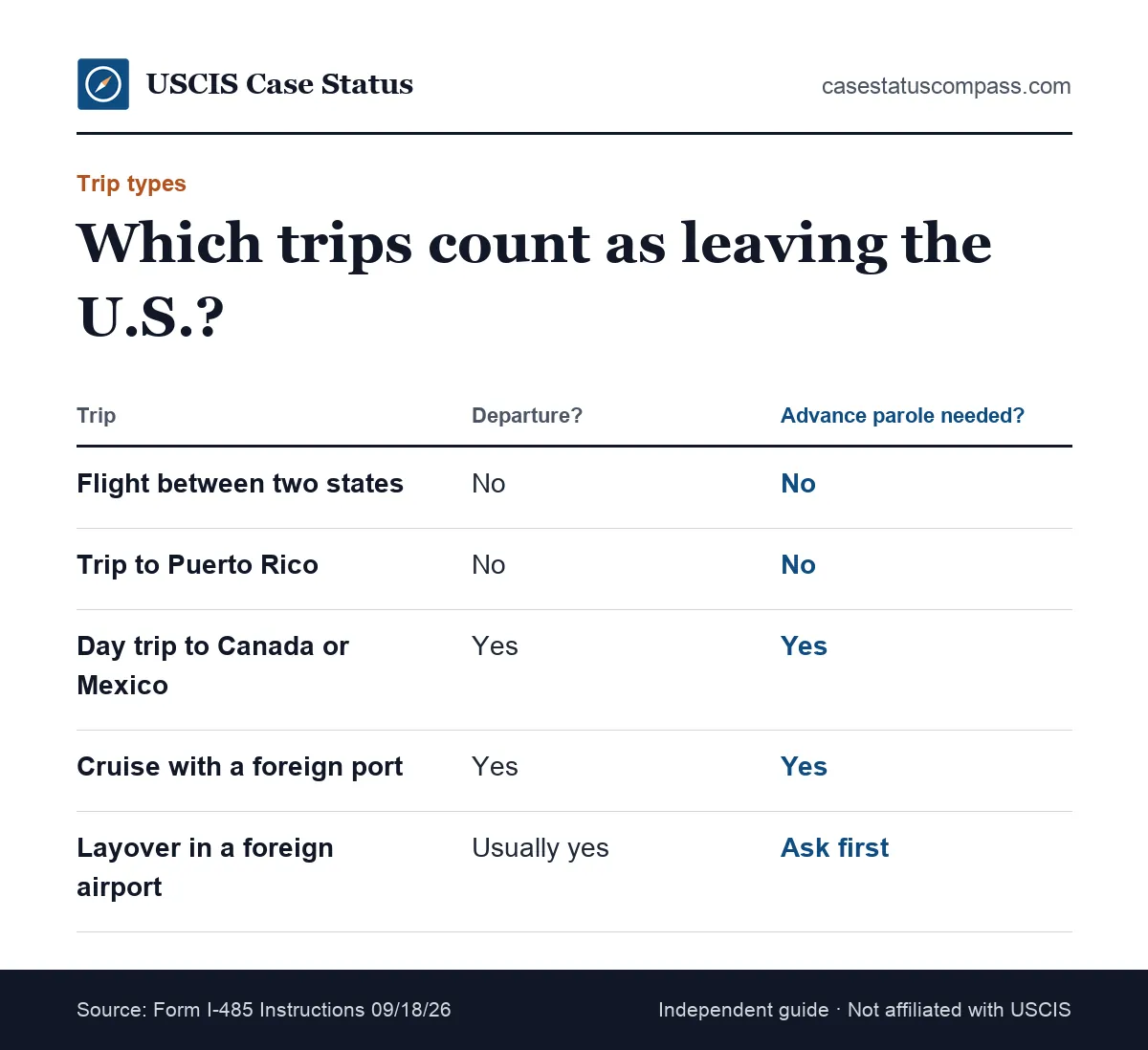
No travel document is needed for domestic travel with pending I-485 cases, because a trip between states is not a departure. Still, carry your passport, I-94 and receipt notices, since airport and identity checks can ask for proof of your situation.
Flights within the 50 states
Use an accepted ID at the airport, such as a passport or a REAL ID-compliant license. Keep copies of your I-485 receipt and any EAD with you.
No border inspection applies to these flights.
Is Travel to Puerto Rico or Guam a Departure?
Puerto Rico, Guam, the U.S. Virgin Islands and the Northern Mariana Islands are part of the United States under immigration law, so direct flights there are not departures. A routing that stops in a foreign country is, so check the itinerary.
Does a Trip to Canada or Mexico Count as Leaving the U.S.?
Yes. Any trip across the border to Canada or Mexico is a departure, even for an afternoon; there is no short-trip exception. Without advance parole or a qualifying visa, a day of shopping across the border can abandon your I-485.
Land crossings and border towns
Families in border areas sometimes cross without thinking. Once you pass the U.S. exit point, you have left. Coming back means asking CBP for entry, which requires a valid document.
Cruises with foreign ports
A cruise that stops in the Bahamas, Mexico or Canada is foreign travel. Treat cruises like any other international trip and get a review before booking.
Even a single foreign port stop counts.
Pre-Trip Checklist for Travel With Pending I-485 Cases
Use this checklist at least a month before departure. It covers legal review, documents and case timing, the three places where trips go wrong.
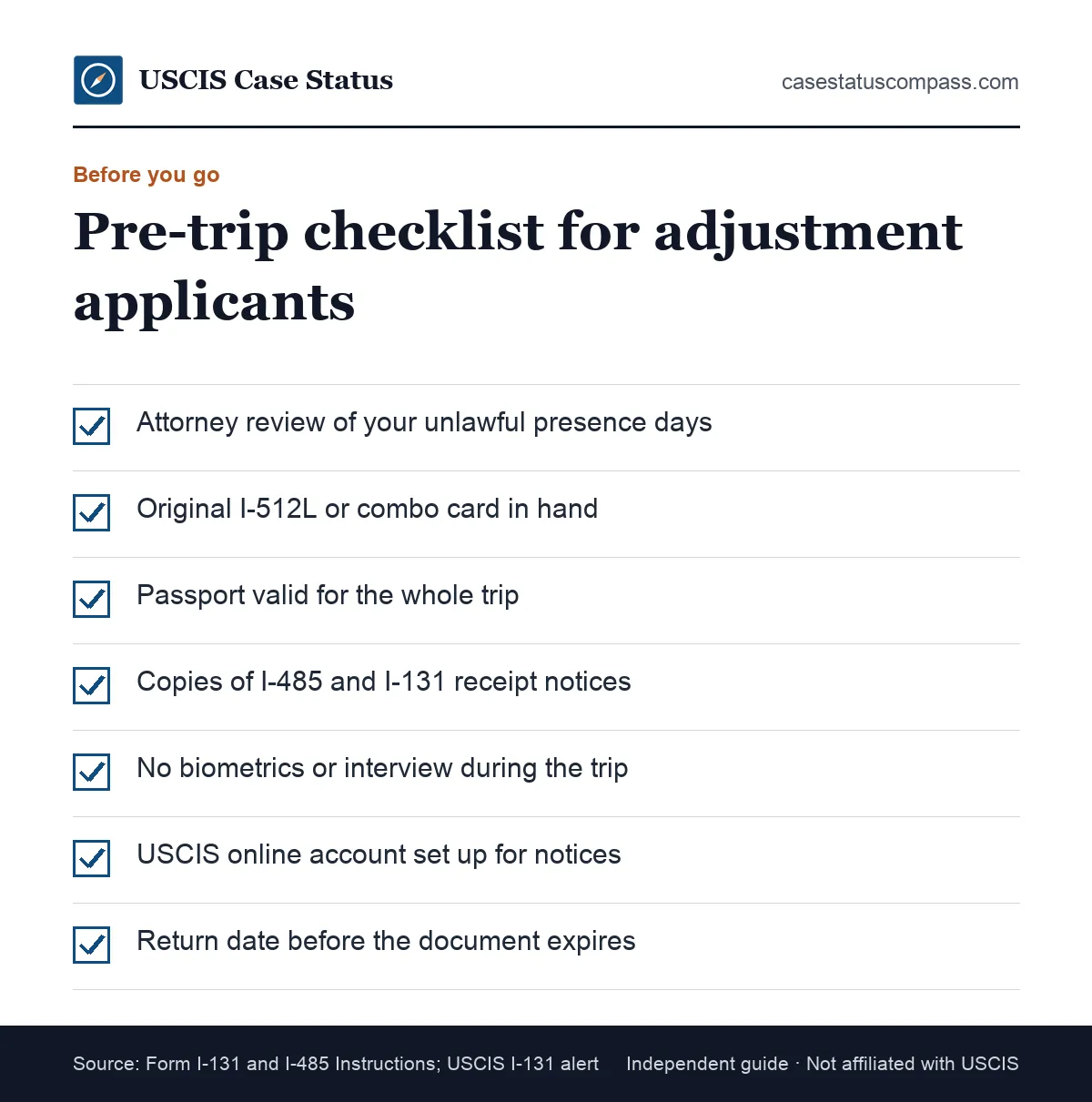
Work through it in order: confirm your legal risk, then your documents, then your case calendar. If any item fails, delay the trip rather than hoping it works out at the airport.
Documents to carry
- Passport valid for the full trip
- Original I-512L or combo card
- Copies of the I-485, I-130 or I-140, and I-131 receipt notices
- Any approval notices you have received
- A copy of your latest EAD, if you have one
- Your attorney's contact details and written advice
Case checks the week before
Log in to your USCIS online account and confirm no new notices. Check that no biometrics or interview falls during the trip, and confirm the document's expiration date. If anything new appears, delay the trip.
What Happens at the Airport and the Border?
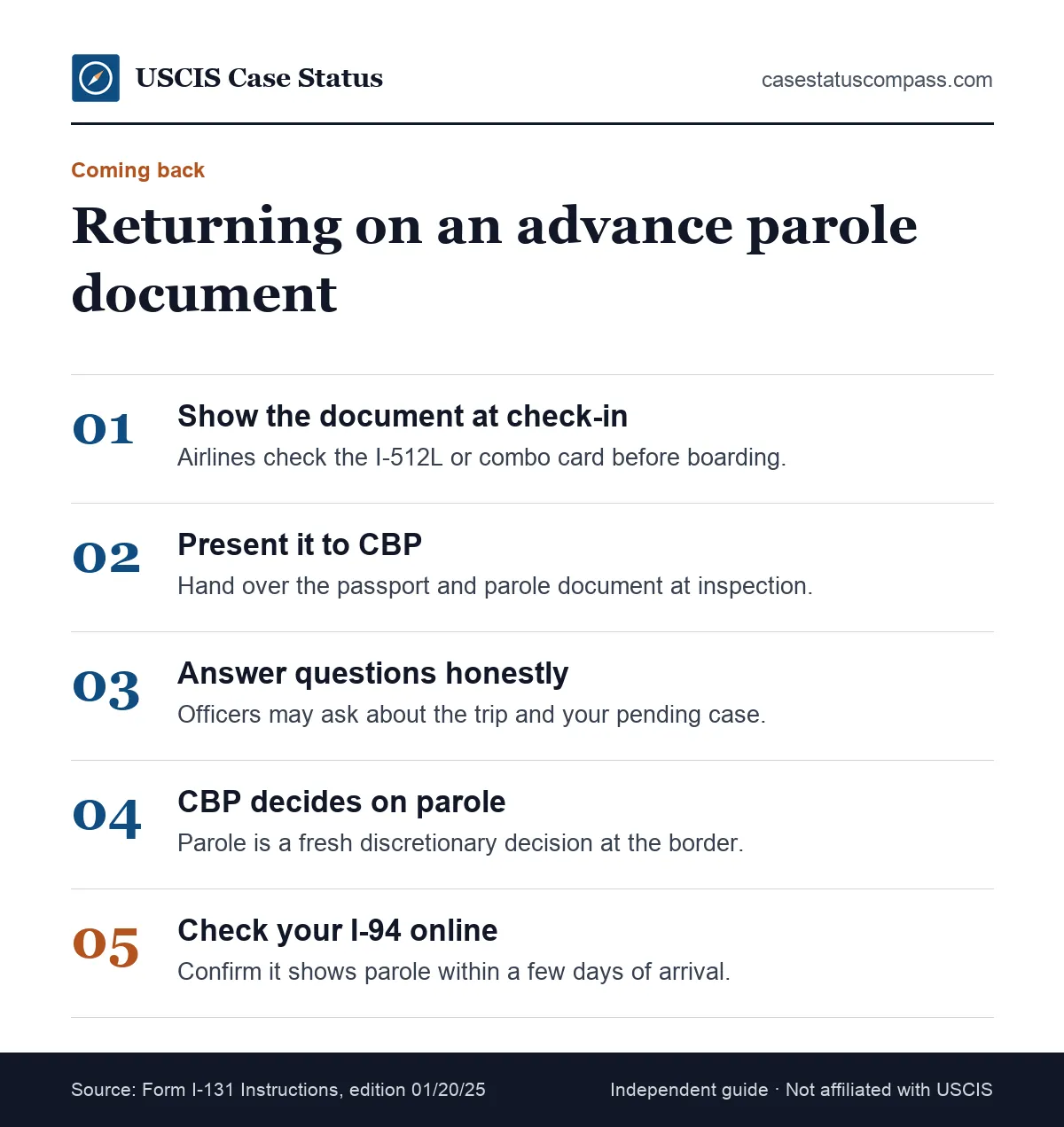
Two checks happen. The airline checks your travel document before the return flight. At the port of entry, a CBP officer inspects you and decides whether to parole you in. An approved document lets you ask for parole; it does not promise it.
At check-in abroad
Show your passport and the parole document together. Some airline agents are unfamiliar with the I-512L. Arrive early, since document checks can take longer than usual.
Keep your receipt notices in your carry-on, not checked bags.
CBP inspection and secondary
The officer may send you to secondary inspection for more questions. This happens often and is not a decision. Answer truthfully, keep your receipts ready and do not guess about dates.
What Should You Check After You Return?
Check your electronic I-94 record on the CBP website within a few days. It should show parole and your return date. Also confirm the parole document was endorsed. Fix problems early, before your interview.
Keep copies with your case file.
Reading the I-94
The class of admission should reflect parole. If the record is missing or wrong, contact a CBP deferred inspection office or ask an attorney.
Download a copy and keep it with your parole document.
Keeping your travel records
Save boarding passes, the stamped document and a list of trip dates. USCIS may ask about travel at the interview, and the N-400 later asks for trips abroad.
Store them with your case file.
What If USCIS Schedules Biometrics While You Are Abroad?
If a biometrics appointment notice arrives while you are away, request a new date before the appointment. Missing biometrics without rescheduling can lead USCIS to treat the case as abandoned. Short trips and online monitoring are the best defense.
Have a trusted person check your mail.
Rescheduling from abroad
You can usually ask to reschedule through your online account or by calling the Contact Center before the date. Note the confirmation.
As of October 2026, USCIS says to Reschedule biometrics online at least 12 hours before, with good cause, or call the Contact Center.
Preventing the clash
File the I-131 early so biometrics are done before you leave. If you filed the I-485 and I-131 together, one appointment often covers both. Travel after that visit to lower the chance of a conflict.
What If Your Green Card Interview Falls During the Trip?
An interview scheduled notice can come with only a few weeks' warning. If it lands during your trip, ask to reschedule right away and explain why. Missing the interview without notice can lead to a denial for abandonment.
A new date may be months away.
Asking for a new date
Follow the rescheduling instructions on the notice. Send the request before the interview date and keep proof.
Explain the reason briefly and attach proof, such as a medical letter or the travel emergency that took you abroad. Rescheduling usually means a later date, so weigh whether to return early instead.
Preparing before you leave
If your case is close to interview stage, consider waiting. Our green card interview guide explains what the officer may cover, including questions about entries and exits.
Pack copies of your filing in case you must return early.
Can USCIS Decide Your I-485 While You Are Abroad?
Yes. USCIS keeps working while you travel, so the case can be approved, sent an RFE or denied during your trip. Approval is good news, but a denial can leave your parole document without the pending case it depended on.
If the case is approved during the trip
You return as a parolee using your document; the card follows by mail. Watch your account for a new card is being produced update.
Keep the approval notice with your passport.
What If an RFE or Denial Arrives While You Are Abroad?
A Request for Evidence has a deadline that keeps running while you travel. A denial can mean CBP refuses parole. Before you return, check status online. If you see a denial, speak with an attorney before boarding.
An RFE reply can be mailed by someone at home.
How Do Work Permits and Travel Fit Together?
Many adjustment applicants hold an EAD and a parole document at the same time. A combo card covers both, but when it expires you lose work and travel permission together.
A separate I-512L, by contrast, has its own dates, so check both documents before any trip.
Renewal timing and trips
As of October 2026: Ended: renewals filed on or after Oct. 30, 2025 no longer get the up-to-540-day automatic extension (exceptions: TPS by law/Federal Register notice; STEM OPT 180 days). If your combo card expires during a planned trip, you may lose your way back. Read our EAD automatic extension guide and renew well ahead.
Your work permit status page
Renewal details, categories and fees are in our work permit guide. The key point here: never plan a return after your combo card's printed expiration.
Track its renewal receipt too.
Do Spouses and Children Each Need Their Own Advance Parole?
Yes. Each person with a pending I-485 needs their own parole document. A parent's document does not cover a child, and one spouse's does not cover the other. Each files a separate Form I-131 and pays the fee that applies.
Children and unlawful presence
Time spent in the U.S. under age 18 does not count as unlawful presence for the 3- and 10-year bars. Teenagers who are close to 18, or who turned 18 while out of status, should still have their days reviewed.
Traveling as a family
Carry each person's documents in their own folder. Check every card's expiry date, since family members' documents are often approved weeks apart.
Make sure each child's passport is valid for the whole trip.
How Do Asylum, TPS and DACA Change the Travel Picture?
People with a pending asylum case, TPS or DACA who also have a pending I-485 face extra layers. Each program has its own travel rules, and some carry special risks. The Delcarmen-Lara alert applies to anyone who plans to travel with pending I-485 papers on an advance parole document.
TPS and DACA recipients
TPS holders use TPS travel authorization, and DACA recipients use advance parole for limited purposes. See our TPS status guide and DACA status page. Many DACA recipients may have unlawful presence from before the grant, so a review is essential.
Can You Travel With a Pending Asylum Case and an I-485?
Leaving the U.S. while an asylum claim is pending without parole is generally treated as abandoning the claim. A trip to the country you fled can suggest you no longer fear harm, which can damage an asylum or refugee-based case. Read our asylum status guide and talk to counsel first.
How Long Is an Advance Parole Document Valid?
The I-131 instructions say advance parole approval "generally will not exceed six months" for some categories, while adjustment-based documents are often issued for longer. The real answer is on your own document. It may be single entry or multiple entry.
Reading your document
Look for the validity dates and the number of entries. A single-entry document is used up after one return. A multiple-entry document can be used for several trips until it expires.
Renewing before it expires
If you need to keep traveling, file a new I-131 months before the old one expires. Do not plan a trip that ends close to the expiration date.
An EAD renewal and a new I-131 can be filed together.
What If Something Goes Wrong Abroad?
If your parole document is lost, stolen or about to expire while you are abroad, contact the nearest U.S. embassy or consulate and an immigration attorney right away. Copies and early returns are far easier than recovery.
Keep scans in your email.
Lost or stolen documents
Report the loss to local police and keep the report. Bring copies of the document and receipts to the embassy. Ask your attorney whether any boarding foil or other option is available for your situation.
Delays past the expiration date
If illness or a disaster keeps you abroad past the document's end date, collect proof. Contact the embassy and your attorney before the date passes.
Medical records and airline notices help explain the delay.
What Are the Most Common Travel Mistakes With a Pending Green Card Case?
The most common mistakes are leaving on a receipt notice alone, relying on old advice about unlawful presence, missing a USCIS notice during the trip, and returning on an expired document. A checklist and early legal review prevent most.
Each is listed below, split into paperwork and timing slips.
Paperwork mistakes
- Packing a copy instead of the original document
- Traveling on a combo card that expires mid-trip
- Not carrying the I-485 receipt notice
- Assuming a family member's document covers you
Timing mistakes
- Booking before the document arrives
- Ignoring biometrics or interview notices
- Taking a long trip when the case is near decision
- Relying on pre-August 2026 advice about the bars
Each one can be avoided by waiting.
Travel Risk Decision Table: If This, Then That
Use this table to see your next step. It does not replace legal advice. The point is to stop and check before buying tickets, not to approve a trip, and to know which facts an attorney will need.
Start at the top row; for anyone planning to travel with pending I-485 paperwork, the first two rows matter most.
If-then table for common travel situations
Find the first row that is true for you; the right column gives the safest step before any booking.
| If this is true | Do this |
|---|---|
| You have more than 180 days of unlawful presence | Do not travel until an attorney reviews your case |
| You have any removal order | Do not travel; get legal advice first |
| You hold valid H-1B, H-4, L-1 or L-2 status | Confirm your visa is valid and you are admissible |
| You only have an I-131 receipt notice | Wait for the approved document |
| An interview or biometrics date falls during the trip | Reschedule the trip, not the appointment |
| Your combo card expires within the trip | Renew first or shorten the trip |
| Your case is based on asylum | Get advice before any travel |
Notice that the first two rows stop the trip entirely until an attorney reviews it; those are the cases where a single trip can cost years.
When to stop and ask
Any "unsure" answer is a reason to pause. If you cannot say how many days of unlawful presence you have, you do not have enough information to travel safely after August 2026.
When to call USCIS
Call the USCIS contact center to reschedule appointments or ask about a missing document. Do not ask Contact Center agents whether a trip is legally safe; they cannot give legal advice.
Worked Examples: Two Travelers in 2026
These fictional examples show how the same trip can carry very different risk. Your situation may differ, so use them only to understand the questions an attorney will ask.
The difference between them is not the trip but the history: one has unlawful presence and one does not. That single fact changes the advice.
Example A: Maria, a spouse who overstayed
Maria entered on a tourist visa, stayed 14 months past her I-94 date, then married a U.S. citizen and filed a marriage-based green card case. Before August 2026, many advisers would have called parole travel safe. Now her 14 months of unlawful presence could trigger the 10-year bar, so her attorney advises her not to travel.
Example B: Arjun, an H-1B worker
Arjun has held H-1B status for six years with no gaps. He has a valid H-1B visa and a combo card. He can travel on his visa or his parole document. With no unlawful presence, the Delcarmen-Lara risk is low, but he still checks his case for notices first.
What Changes When Your I-485 Is Approved?
Once your green card is approved, you no longer need advance parole. You travel as a permanent resident with your green card. Different rules then apply, including limits on long absences. Our green card holder travel rules guide covers them.
Before the card arrives
If you are approved but the card has not arrived, do not travel without proof of status. Ask USCIS about temporary evidence if you must travel. Never use an old parole document after approval unless an attorney says it is fine.
Long trips after approval
Long absences can raise questions about whether you gave up residence. A reentry permit, filed before you leave, can help.
As of October 2026, USCIS says: Reentry permit: generally valid 2 years (1 year if abroad more than 4 of the last 5 years).
How Do You Keep Your Case Moving While You Travel?
Your case keeps moving while you are away, so you need a way to see notices. Use a USCIS online account, keep your mailing address current and ask a trusted person to check your mail.
Check the account weekly while away.
Online account and notices
Link your paper-filed cases to your account using the account access notice. Our USCIS online account guide explains how. Turn on notifications so new notices reach you abroad.
Save each notice as a PDF.
Address rules
USCIS states: Report a new address to USCIS within 10 days of moving (INA 265). If you move just before or after a trip, update it. Our change of address guide explains how.
Where Should You Check the Rules Before You Book?
Check the official Form I-131 page and its alerts, the I-485 instructions and your own notices. Rules on travel changed in 2026 and can change again.
Read them in the week you book, not months earlier. If anything on those pages differs from this guide or from older advice, follow the official page and ask your attorney about the change.
Official pages to bookmark
- uscis.gov/i-131 for the Delcarmen-Lara alert
- uscis.gov/i-485 for the current edition and instructions
- uscis.gov/g-1055 for fees
- CBP's I-94 website for your arrival record
Type each address yourself rather than following links in emails.
Dates on this page
This guide was reviewed in October 2026. Fees follow the G-1055 fee schedule (edition 10/16/26). If you read it later, check the official pages for updates.
Rules for travel with pending I-485 cases can change at any time, as the August 2026 decision showed.
How Does Travel Fit Into the Rest of Your Green Card Case?
Travel is one part of an adjustment case. The I-485 is the core application; the I-131 and I-765 add travel and work permission.
Every trip should fit around the core case: plan travel for gaps after biometrics and away from a likely interview, and never let a trip put the I-485 at risk. The decision on the I-485 matters more than any single visit.
Forms in the adjustment package
Our Form I-485 guide explains every form in the package. If your case relies on INA 245(i), read our INA 245(i) explainer, since those cases often involve unlawful presence.
Watching your case status
Track all receipts together on the USCIS case status checker, since an update on one form can signal a step on another. If a receipt stops moving for months, see our case status not updating guide.
Is a Trip Ever Worth the Risk?
Sometimes, such as a parent's final illness, but only after you understand your risk. With significant unlawful presence, the cost can be a 10-year bar; with a clean history, a well-planned trip on valid documents is often routine. Decide with an attorney.
Weighing the reason
Ask whether the trip can wait until your green card is approved. Our green card processing time page shows how long adjustment usually takes. A delayed visit may be better than a decade apart.
Alternatives to travel
Relatives may be able to visit you in the U.S. on visitor visas. Video calls can cover family events.
Frequently Asked Questions
Can I travel with a pending I-485 if I have an H-1B visa?
Usually yes, if you keep maintaining H-1B status and return on a valid H-1B visa. The Form I-131 instructions list H-1B and H-4 holders among those whose I-485 is not treated as abandoned when they travel. You must still be admissible.
Does Matter of Delcarmen-Lara affect everyone with advance parole?
It matters most for people with more than 180 days of unlawful presence. Since August 13, 2026, USCIS warns that departing on an advance parole document is a departure for the 3- and 10-year bars. Anyone else should still check other grounds with an attorney.
Can I leave while my advance parole application is pending?
Not safely. A pending I-131 does not give permission to travel. If you leave before the document is approved and in your hands, USCIS generally treats your I-485 as abandoned. If the trip is urgent, ask about an expedite or an emergency appointment.
Will I pay the $1,050 parole fee when I return?
H.R. 1 lists an exception for lawful adjustment applicants returning after temporary travel abroad. CBP collects the parole fee at the port of entry and decides, in its discretion, whether an exception applies. Carry your I-485 receipt notice and parole document.
Can I travel to Canada or Mexico without advance parole?
No, unless you hold valid H, L, K or V status and a valid visa. Any trip across the border is a departure, even for a few hours. Without approved advance parole, the trip can abandon your Form I-485.
Is domestic travel safe with a pending green card application?
Domestic travel is not a departure, so it does not abandon your I-485. Carry a valid ID, your receipt notices and any EAD. Flights to Puerto Rico or Guam are domestic if they do not stop in a foreign country.
Do I need advance parole after my green card is approved?
No. After approval you travel as a permanent resident using your green card. Different rules apply to long absences, and a reentry permit may help. Do not use an old parole document after approval unless an attorney advises it.
Can I travel while my I-485 interview is pending?
Only with an approved parole document or qualifying visa, and only if the trip ends well before any interview or biometrics date. Missing either can lead to a denial, so many applicants close to interview stage choose to wait.
Can a family member's advance parole cover my child?
No. Every person with a pending I-485 needs their own parole document, including children. Each person files a separate Form I-131. Check each expiry date before you travel with pending I-485 papers as a family.
Sources
- USCIS: Form I-131 page and alert on Matter of Delcarmen-Lara (updated 10/07/2026). www.uscis.gov/i-131. Accessed Oct 27, 2026.
- USCIS: Form I-131 Instructions, edition 01/20/25. www.uscis.gov/sites/default/files/document/forms/i-131instr.pdf. Accessed Oct 27, 2026.
- USCIS: Form I-485 Instructions, edition 09/18/26. www.uscis.gov/sites/default/files/document/forms/i-485instr.pdf. Accessed Oct 27, 2026.
- USCIS Form G-1055 Fee Schedule, edition 10/16/26. www.uscis.gov/sites/default/files/document/forms/g-1055.pdf. Accessed Oct 27, 2026.
- DHS Federal Register notice: Immigration Parole Fee Required by HR-1 (FR Doc. 2025-19564). public-inspection.federalregister.gov/2025-19564.pdf. Accessed Oct 27, 2026.
- USCIS: Fee Schedule page (Ms. L. settlement class exemption). www.uscis.gov/g-1055. Accessed Oct 27, 2026.
- USCIS: Unlawful Presence and Inadmissibility. www.uscis.gov/laws-and-policy/other-resources/unlawful-presence-and-inadmissibility. Accessed Oct 27, 2026.
- USCIS Data Library: All Forms, FY2026 Q3. www.uscis.gov/sites/default/files/document/data/quarterly_all_forms_fy2026_q3_v1.xlsx. Accessed Oct 27, 2026.
- USCIS: How to Make an Expedite Request. www.uscis.gov/forms/filing-guidance/how-to-make-an-expedite-request. Accessed Oct 27, 2026.
- USCIS: How to Change Your Address. www.uscis.gov/addresschange. Accessed Oct 27, 2026.
- USCIS: Filing Fees (updated 02/12/2026). www.uscis.gov/forms/filing-fees. Accessed Oct 27, 2026.
- DHS notice 'Immigration Parole Fee Required by HR-1 Reconciliation Bill', FR Doc. 2025-19564, 90 FR (Oct. 16, 2025); also G-1055 10/16/26 Appendix B. www.govinfo.gov/content/pkg/FR-2025-10-16/pdf/2025-19564.pdf. Accessed Oct 27, 2026.
- USCIS: Form I-485 page (updated 10/07/2026). www.uscis.gov/i-485. Accessed Oct 27, 2026.
- USCIS: Preparing for Your Biometric Services Appointment (updated 04/30/2026). www.uscis.gov/forms/filing-guidance/preparing-for-your-biometric-services-appointment. Accessed Oct 27, 2026.
- USCIS: Automatic EAD Extension (updated 10/29/2025). www.uscis.gov/working-in-the-united-states/information-for-employers-and-employees/automatic-employment-authorization-document-ead-extension. Accessed Oct 27, 2026.
casestatuscompass.com is an independent publication and is not affiliated with USCIS or any government agency. This page is general information, not legal advice. For denials, court or asylum matters, consult an immigration attorney or a DOJ-accredited representative.