Contents · 36 sections
- What Was the EAD Automatic Extension?
- Did the EAD Automatic Extension End in 2025?
- What Did the October 2026 Final Rule Change?
- How Did the Extension Rules Change Over Ten Years?
- Who Still Gets an Automatic Extension in 2026?
- How Does the STEM OPT 180-Day Rule Work?
- How Do TPS Work Permit Extensions Work Now?
- Which EAD Categories Lost the Automatic Extension?
- Old Rules vs New Rules: A Side-by-Side View
- How Do You Know If Your Pending Renewal Still Has an Extension?
- How Long Does an Older 540-Day Extension Last?
- What Proof Can You Show an Employer for Form I-9?
- How Should Employers Handle Form I-9 Now?
- What Happens If Your EAD Expires Before the New Card Arrives?
- What Else Can a Lapsed Work Permit Affect?
- Can You Keep Working Without an EAD?
- Do E and L Spouses Still Need an EAD?
- Why Do H-4 Spouses Face the Biggest Gap Risk?
- Who Is Most Affected by the End of the EAD Automatic Extension?
- How Are Pending Green Card Applicants Affected?
- How Are Asylum Applicants Affected?
- When Should You File Your EAD Renewal?
- How Long Do EAD Renewals Take Now?
- Renewal Gap Calculator: Three Worked Examples
- How Can You Avoid a Work Gap?
- Can You Expedite an EAD Renewal?
- Does Premium Processing Help With EAD Renewals?
- What Does an EAD Renewal Cost in October 2026?
- Which Form I-765 Edition Should You File?
- What If Your Renewal Is Rejected or Denied?
- Is There a Court Challenge to the Rule?
- What Are the Most Common EAD Extension Mistakes?
- If X, Do Y: EAD Extension Decision Table
- What Should Workers Do Seven Months Before Expiry?
- Where Should You Check for Updates?
- Frequently Asked Questions
The short answer
The EAD automatic extension ended for most work permit renewals filed on or after October 30, 2025, and a final rule kept it that way on October 14, 2026. Renewals filed earlier keep up to 540 days. TPS extensions by law or Federal Register notice and the STEM OPT 180-day rule still apply.
At a glance
| What ended | The up-to-540-day automatic extension for renewal EADs |
| Cutoff | Renewals filed on or after Oct. 30, 2025 get no automatic extension |
| Made final | DHS final rule, 91 FR 65306, effective Oct. 14, 2026 |
| Still extended | Renewals filed before the cutoff; TPS by law or Federal Register notice; STEM OPT (180 days) |
| Best defense | File your renewal up to 180 days before the card expires |
What Was the EAD Automatic Extension?
The EAD automatic extension let many workers keep working after their Employment Authorization Document (EAD) expired, as long as they had filed a timely renewal. It lasted up to 540 days in recent years. Our work permit guide covers Form I-765 itself.
How the extension worked
You filed Form I-765 to renew before your card's "Card Expires" date. USCIS sent a Form I-797C receipt. That receipt, shown with the expired card, proved the card was still valid for up to 540 days or until USCIS decided the renewal, whichever came first.
Why it mattered to workers
Renewals often take months. The EAD automatic extension covered that wait, so people with a pending green card case, H-4 spouses and asylum applicants did not lose pay. Employers could keep them on payroll without breaking Form I-9 rules.
Did the EAD Automatic Extension End in 2025?
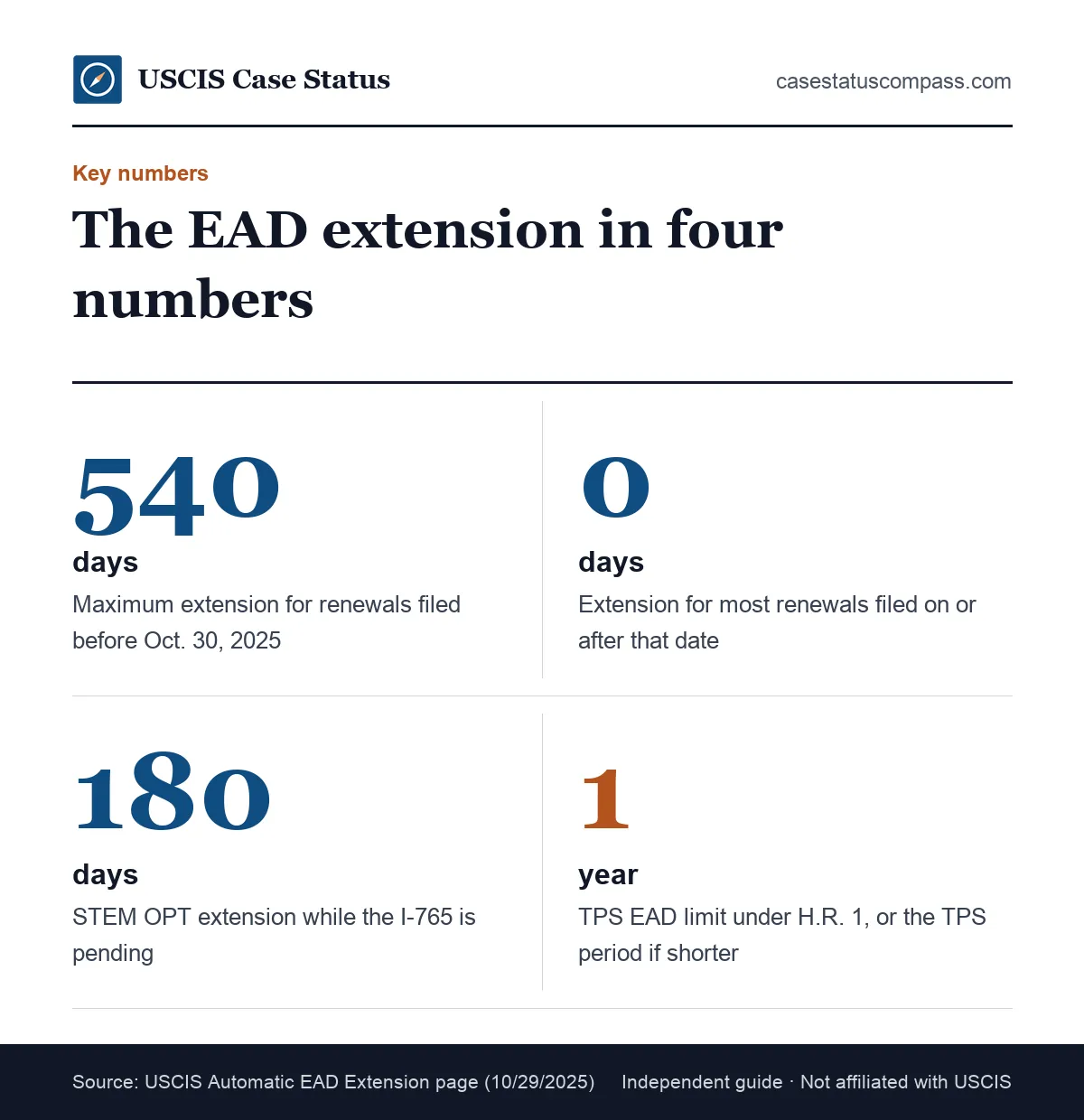
Yes. A DHS interim final rule published October 30, 2025 (90 FR 48799) ended the EAD automatic extension for most renewals. As of October 2026, USCIS states: Ended: renewals filed on or after Oct. 30, 2025 no longer get the up-to-540-day automatic extension (exceptions: TPS by law/Federal Register notice; STEM OPT 180 days). The rule applies to the date you filed the renewal.
The October 30, 2025 cutoff
USCIS's news release said people who file to renew "on or after Oct. 30, 2025, will no longer receive an automatic extension." A renewal received on October 29, 2025 follows the old rules. One received on October 30 does not, even if both cards expire on the same day.
What Did the October 2026 Final Rule Change?
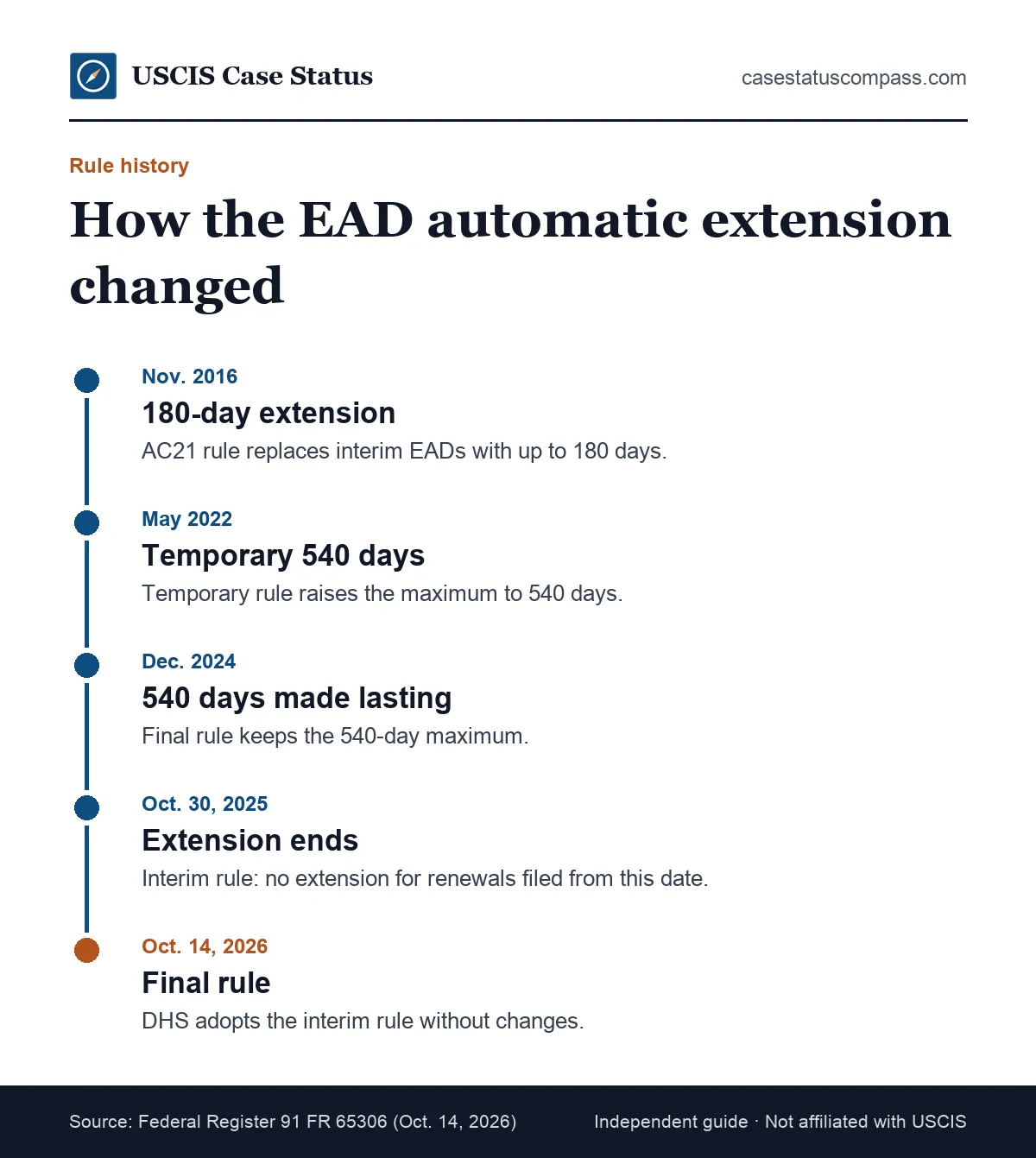
On October 14, 2026, DHS published a final rule titled "Removal of Automatic Extensions for Certain Employment Authorization Documents" (91 FR 65306). It took effect that day and "adopts the IFR as final, without any changes." For workers, the cutoff is no longer temporary: it now sits in permanent regulations, with no grace period for slow decisions.
How Did the Extension Rules Change Over Ten Years?
The extension started at 180 days in a rule published November 18, 2016. Temporary rules in May 2022 and April 2024 raised it to 540 days, and a December 2024 rule kept 540 days. Then the October 2025 interim rule ended it, and the 2026 final rule confirmed that.
Why the 540-day period existed
The 2026 final rule explains that DHS raised the period because processing delays were causing large numbers of workers to lose their jobs. The 2022 and 2024 rules cited USCIS funding problems, the COVID-19 emergency and a surge in filings.
Why DHS ended it
DHS says ending the extension supports "the proper vetting and screening of aliens" before a new period of work permission is granted. In other words, the agency wants each renewal reviewed before work permission continues, instead of letting a receipt carry the old card forward while the case waits in line.
Who Still Gets an Automatic Extension in 2026?
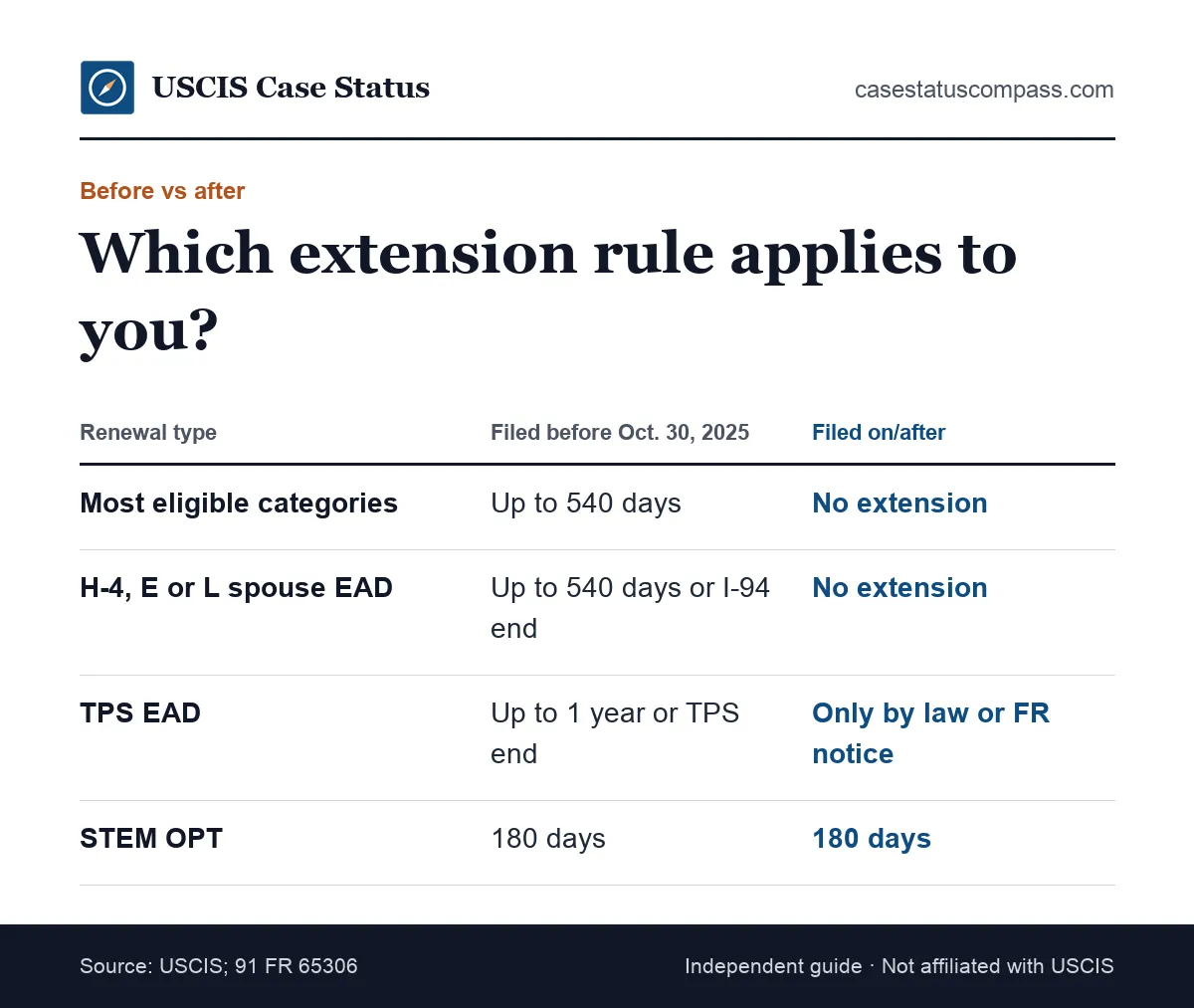
Three groups still have one. People who filed a timely renewal before October 30, 2025 keep the old extension. TPS holders get extensions only when the law or a Federal Register notice provides one. STEM OPT students who file on time get 180 days.
Renewals filed before the cutoff
The final rule says it "does not affect the validity of EADs that were automatically extended prior to the IFR." If your renewal was received before October 30, 2025, in an eligible category, the EAD automatic extension still runs until USCIS decides or 540 days pass.
Extensions by law or Federal Register notice
The new regulation, 8 CFR 274a.13(e), keeps extensions "provided by law, or through a Federal Register notice" for TPS-related documents. Read the notice for your TPS country rather than assuming your card is extended.
How Does the STEM OPT 180-Day Rule Work?
F-1 students who file a timely STEM OPT extension on Form I-765 can keep working for up to 180 days after their OPT card expires. USCIS says this extension "ends when USCIS decides" the application. STEM OPT was never part of the 540-day rule.
What "timely" means for STEM OPT
The application must be filed before the current OPT EAD expires and meet the program's other rules. Your school's designated school official (DSO) updates your record first.
Using the 180 days at work
Show your employer the expired OPT EAD, the I-797C receipt for the STEM OPT filing and your updated Form I-20. Keep working only for an employer listed on your training plan.
When the 180-day STEM OPT bridge ends
If the 180 days run out before a decision, you must stop working. The bridge also ends as soon as USCIS decides, so tell your DSO and employer about any decision notice the day it arrives.
How Do TPS Work Permit Extensions Work Now?
TPS EADs follow special rules. Since July 22, 2025, USCIS limits TPS-based automatic extensions to up to one year or the TPS period, whichever is shorter. A Federal Register notice for your country may also extend cards. No extension can pass the "TPS Designated Through" date.
The one-year limit under H.R. 1
H.R. 1 caps TPS work permission at one year or the length of the TPS designation, whichever is shorter. As of October 2026, USCIS lists these TPS countries: El Salvador, Lebanon, Sudan, Ukraine.
Checking your country's notice
Each TPS designation or extension notice says whether existing EADs are extended and until when. Our TPS status guide explains how to find the current notice. Print the relevant page for your employer.
Which EAD Categories Lost the Automatic Extension?
The categories that used to qualify are the ones that lost it. USCIS's list includes refugees and asylees, TPS, pending adjustment of status (c)(9), pending asylum (c)(8), H-4 spouses (c)(26), E and L spouses (A17, A18) and several smaller groups. Renewals in these categories filed after the cutoff get no extension.
Formerly eligible categories
The codes match the Category field printed on your card.
| Code | Category | Status after Oct. 30, 2025 filings |
|---|---|---|
| A03, A05 | Refugee, asylee | No automatic extension |
| A07, A08, A10 | N-8/N-9, Compact citizens, withholding | No automatic extension |
| A12, C19 | TPS | Only by law or Federal Register notice |
| A17, A18 | Spouse of E or L worker | No extension; many work incident to status |
| C08 | Asylum application pending | No automatic extension |
| C09 | Adjustment of status pending | No automatic extension |
| C10, C16, C20, C22, C24 | Cancellation/NACARA, registry, legalization | No automatic extension |
| C26 | Spouse of certain H-1B workers | No automatic extension |
| C31 | VAWA self-petitioner | No automatic extension |
If your code appears here and USCIS received your renewal on or after October 30, 2025, plan for no bridge at all unless a TPS notice for your country says otherwise.
Categories that never had it
Some codes were never on the list, so nothing changed for them. DACA (c)(33) and initial work permits never received an automatic extension. For DACA, USCIS advises filing the renewal 120 to 150 days before expiry.
Old Rules vs New Rules: A Side-by-Side View
The simplest test is the Received Date on your renewal receipt. Before October 30, 2025 means the old rules. On or after that date means no extension unless you are TPS (by notice) or STEM OPT. Your card's expiry date does not change the answer; only the receipt's date does.
What stayed the same
USCIS says the change does not affect whether DHS renews work permission; it removes only the automatic bridge. Fees, forms and evidence rules for the renewal itself did not change because of this rule.
What is different in practice
Before, a renewal filed a week before expiry rarely caused a gap. Now, if USCIS takes months to decide, every one of those months after your old card expires is a period when you cannot work in that category.
How Do You Know If Your Pending Renewal Still Has an Extension?
Look at the I-797C receipt for your renewal. If the Received Date is before October 30, 2025, before your card's expiry, on or after May 4, 2022, and in a matching eligible category, the old extension likely applies. Our I-797C notice guide shows where each date is printed.

Reading the Received Date
The Received Date is when USCIS accepted the filing, not the date you mailed it. It is printed near the top of the I-797C, beside the Notice Date, and it is the date that decides which rule applies.
Example: mailed before the cutoff, received after
A package mailed October 25 but received October 31, 2025 falls after the cutoff. If your receipt is close to the line, check it carefully and keep the courier tracking record with your I-9 papers.
Matching the category
The code on your current card must match the code on the receipt. USCIS allowed some exceptions, such as TPS codes A12 and C19 being treated as matching. If the codes differ, ask HR or an attorney before relying on an extension.
How Long Does an Older 540-Day Extension Last?
For renewals filed before the cutoff, the EAD automatic extension runs up to 540 days from the card's expiration date, or until USCIS decides the renewal, whichever comes first. For H-4, E and L spouses, it also ends when the I-94 expires, if that is sooner.
Worked example: counting the days
Lena (fictional) had a (c)(9) card that expired on December 1, 2025. She filed her renewal on September 15, 2025. Her extension can run until May 25, 2027, which is 540 days after December 1, 2025, unless USCIS decides first.
Extensions capped by an I-94 date
For codes A17, A18 and C26, compare 540 days after the card expired with your I-94 end date. Work in that category must stop on whichever comes first, even without a decision.
When the extension ends early
The EAD automatic extension ends as soon as USCIS approves or denies the renewal. A denial ends it at once, so your employer must stop your work in that category. Watch for any case was approved update or a denial notice.
What Proof Can You Show an Employer for Form I-9?
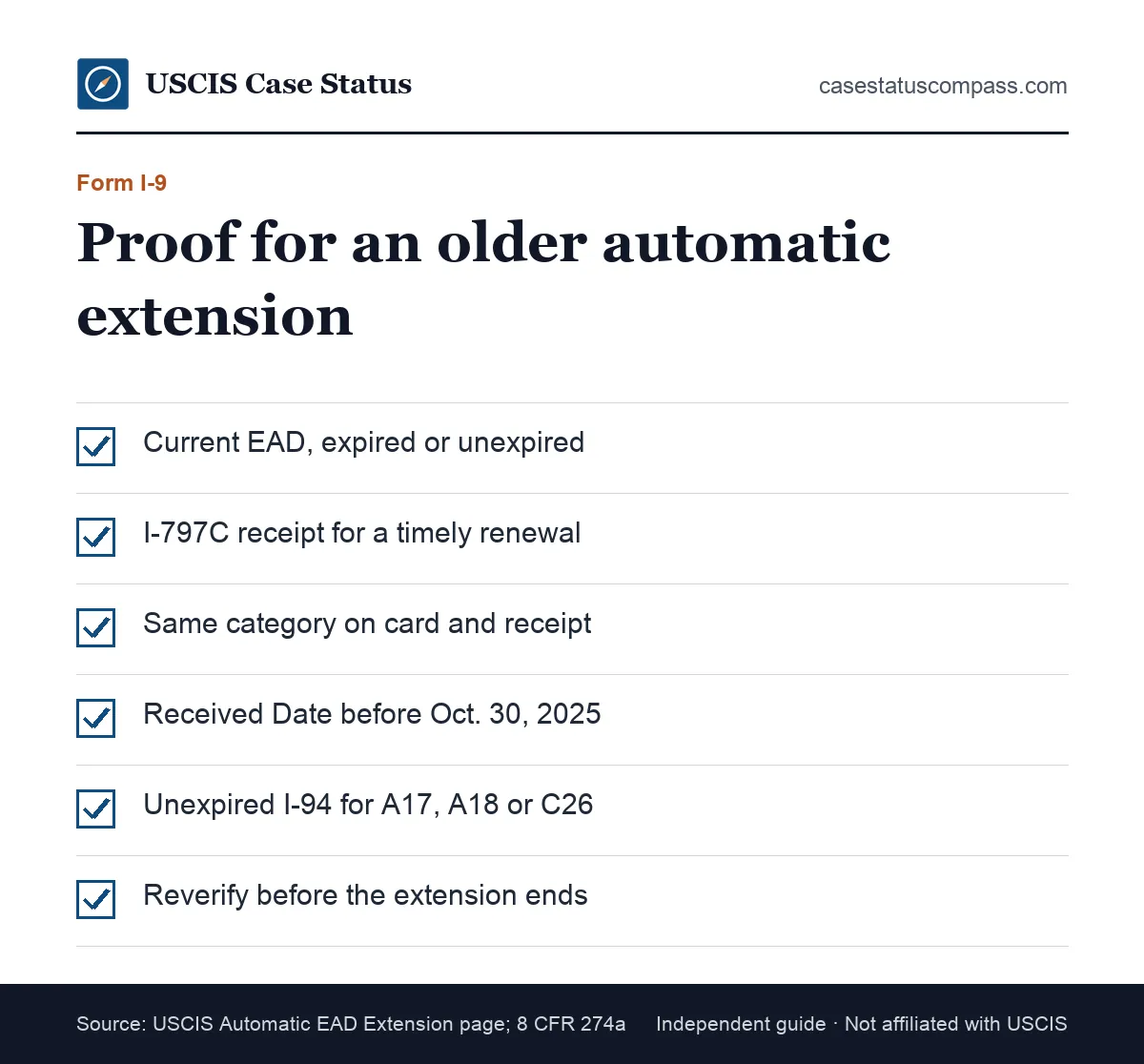
For a renewal filed before the cutoff, show your current EAD (expired or not) together with the I-797C receipt for a timely renewal in the same category. USCIS says this combination is acceptable proof under 8 CFR 274a.13(d). After the cutoff, a receipt plus an expired card is not enough.
Proof for spouses of E, L and H-1B workers
Codes A17, A18 and C26 also need an unexpired Form I-94. The extension ends on the I-94 date if that comes first. Bring both documents to HR together so the file is complete.
What does not work as proof
A receipt for a renewal filed on or after October 30, 2025 does not extend an expired card. A case status screenshot, an online account page or a letter from an attorney is not a List A or List C document either.
How Should Employers Handle Form I-9 Now?
Employers should reverify employment authorization on or before the date an EAD expires. For older renewals with a valid extension, they record the new end date. For newer renewals, they cannot keep the worker on payroll in that category after the card expires, unless the worker shows other valid proof.
Recording an older 540-day extension
When a worker shows an expired EAD with a qualifying pre-cutoff I-797C in the same category, HR records the extended end date and sets a reverification reminder for 540 days after card expiry.
Reverification steps
Track every EAD expiration in your I-9 system. When a card expires, accept any acceptable List A or List C document the worker chooses to present, and do not demand a specific document.
Where employers can get help
USCIS points employers to Chapter 5 of the Handbook for Employers (M-274) and I-9 Central. The Form I-9 Contact Center lines are 888-464-4218 for employers and 888-897-7781 for employees. HR teams should also ask their own immigration counsel when a worker's category codes or dates look unusual, before deciding to suspend anyone.
What Happens If Your EAD Expires Before the New Card Arrives?
If you filed after the cutoff and your card expires before the new one arrives, you must stop working in that category from the day after expiry. Work can start again only when you have a new EAD or another valid basis to work.
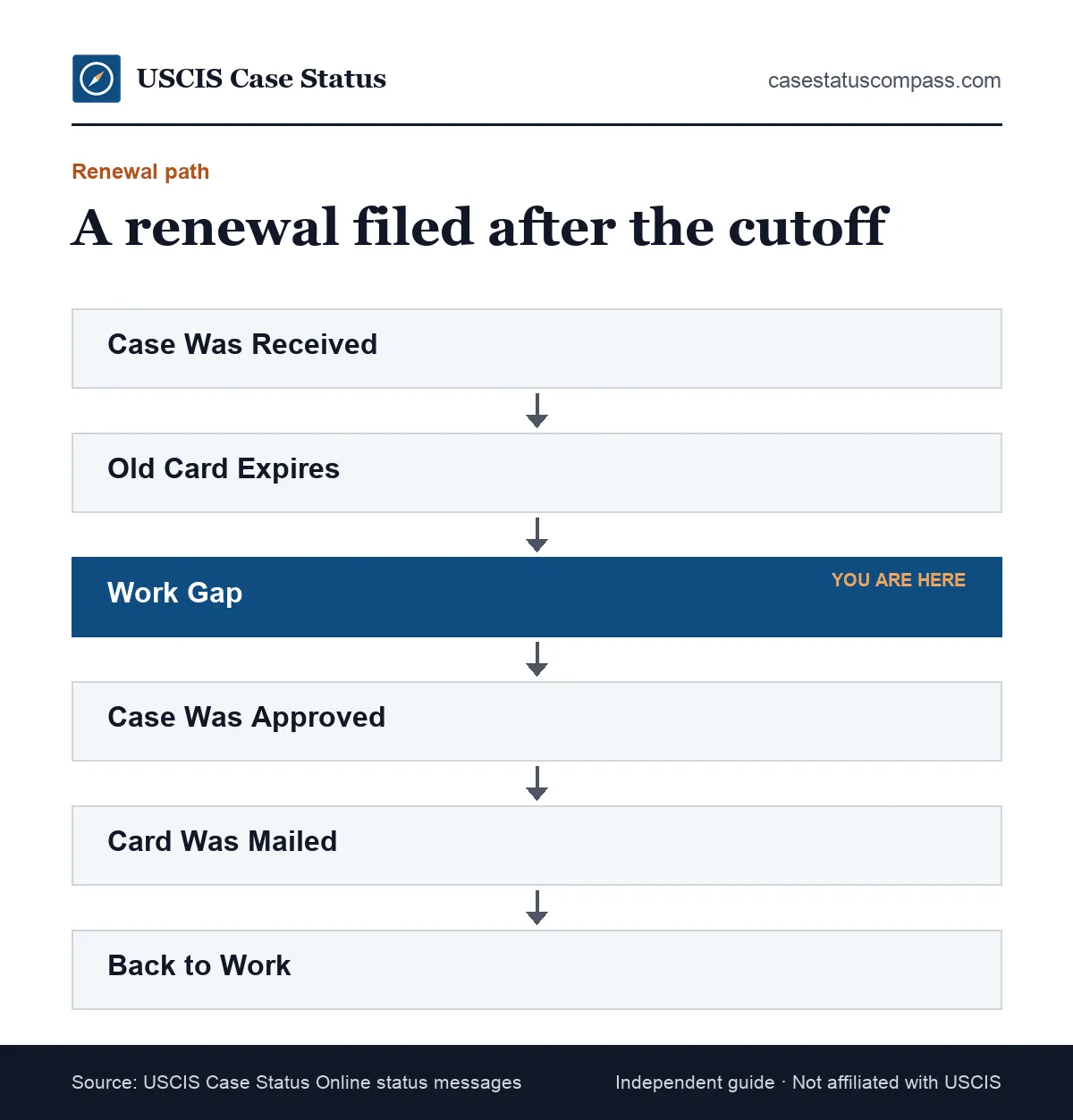
What you keep during a gap
A lapse in work permission does not by itself cancel a pending Form I-485 or asylum claim. Keep your address current, since the new card will be mailed to the address USCIS has on file.
What you may lose
A gap can mean lost wages, lost health coverage and, for some employers, a lost job. Talk with HR about unpaid leave instead of termination. Ask in writing whether your health plan continues during leave and whether the job will be held until the new card arrives.
What Else Can a Lapsed Work Permit Affect?
Your EAD card is often used as identity proof, and some state agencies tie licenses or IDs to its dates. Payroll, benefits and background checks may also stop until a new card arrives. Make a short list now of every account, license and employer record that uses your card's expiry date, so nothing lapses by surprise.
State IDs and driver's licenses
Some states issue licenses that expire with your work permit, so a gap in the card can mean a gap in your license. Check your state motor vehicle agency's rules before your card expires, and keep your passport as backup ID.
Payroll, benefits and new jobs
Employers usually pause pay and some benefits during a work gap. A new employer cannot complete Form I-9 with an expired card unless an extension applies. If you plan to change jobs, time the move after the new card arrives.
Can You Keep Working Without an EAD?
Some people can, because their status itself allows work. An H-1B worker can work for the sponsoring employer on that status. Certain E and L spouses are work-authorized incident to status. Most (c)(9), (c)(8) and H-4 workers have no such backup.
Status-based work permission
If you hold H-1B, L-1 or O-1 status and also have a pending green card case, you may be able to keep working on that status during an EAD gap. Our H-1B status guide explains how H-1B status works.
Confirming status-based work with HR
Before your card expires, ask HR to confirm in writing which document it will accept at reverification, such as a foreign passport with an unexpired Form I-94. This avoids a payroll hold when the EAD lapses.
What is not a backup
A pending I-485 alone does not authorize work. An approved I-140 or I-130 petition does not either. H-4 spouses need their own EAD, so the end of the extension hits them directly.
Do E and L Spouses Still Need an EAD?
Many do not. Under the USCIS Policy Manual, certain E-1, E-2, E-3 and L-2 spouses are employment authorized incident to status. An unexpired Form I-94 marked E-1S, E-2S, E-3S or L-2S is an acceptable List C document for Form I-9.
How the I-94 codes work
CBP and USCIS began issuing these codes on January 30, 2022. If your I-94 shows the "S" code and is unexpired, you can work without an EAD. Check your I-94 online after each entry.
When an EAD still helps
Some spouses still file Form I-765 for a card they can use as ID or for older I-94s without the code. Children of E and L workers are not covered by this rule.
Why Do H-4 Spouses Face the Biggest Gap Risk?
H-4 spouses with a (c)(26) EAD have no status-based work permission. Their EAD often depends on a pending Form I-539 extension of H-4 status as well. Without the automatic extension, a slow I-539 or I-765 decision can leave them unable to work for months.
Planning around the H-1B timeline
File the H-4 extension and EAD renewal as early as allowed, often together with the H-1B extension. Our work permit processing time page explains H-4 timing in detail. Ask the employer's attorney whether the spouse's I-539 and I-765 can go in the same package as the H-1B extension, so all three move together.
Talking with your employer
Give HR your expiry date at least six months ahead. Some employers can move a start date or offer unpaid leave. Share the I-797C receipt as soon as it arrives and agree in advance on what happens if the new card is late, such as unpaid leave or a later return date.
Who Is Most Affected by the End of the EAD Automatic Extension?
The end of the EAD automatic extension hits hardest where renewals are slow and there is no other basis to work: pending green card applicants, H-4 spouses and asylum applicants. TPS holders depend on country notices, and STEM OPT students keep a 180-day cushion.
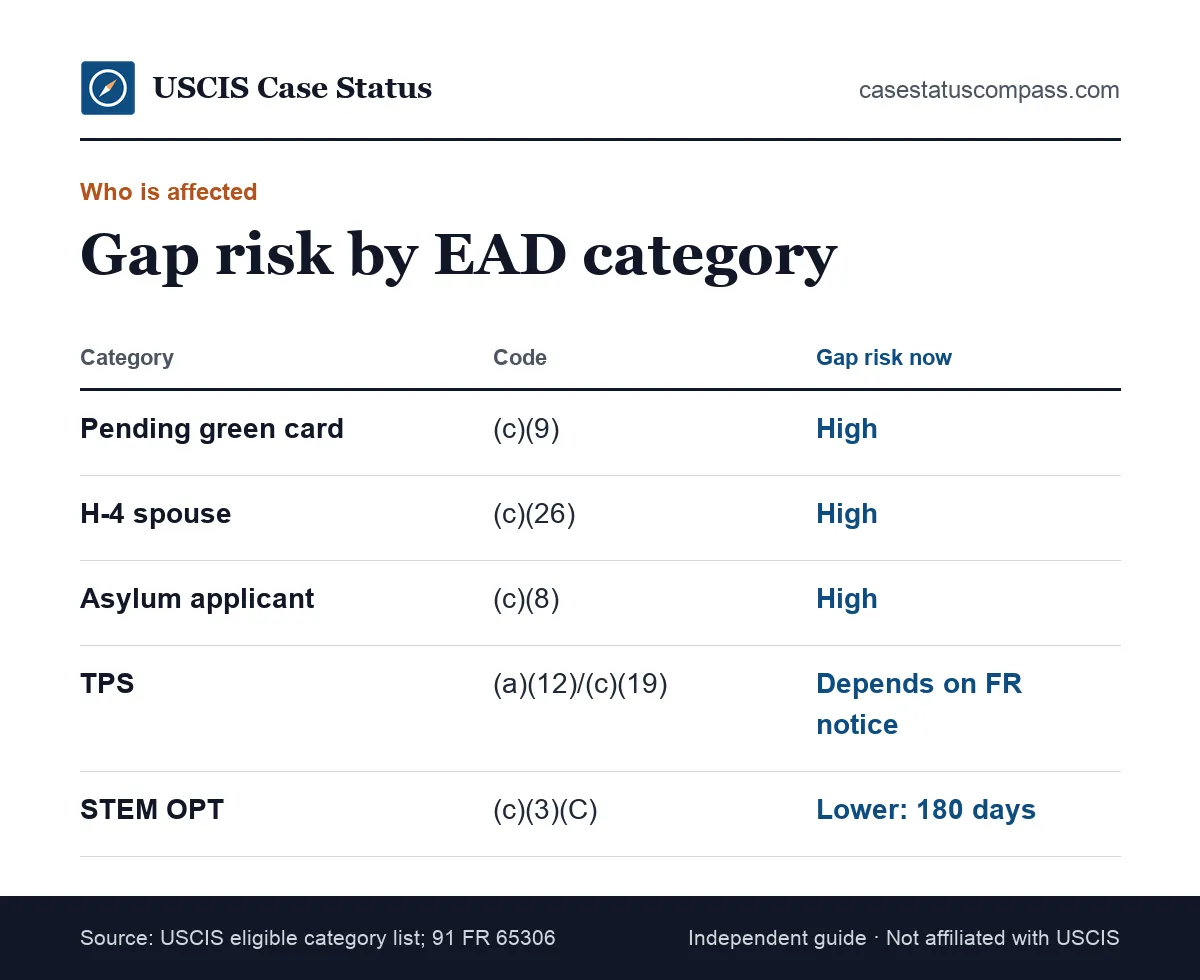
The three high-risk groups
Workers in categories (c)(9), (c)(26) and (c)(8) usually have no status that allows work on its own. When the card expires, the paycheck stops. Their only bridge is a decision from USCIS before the expiry date, which is why filing on day one of the 180-day window matters most for them.
Groups with a cushion
STEM OPT students keep their 180-day bridge, and some E and L spouses can work on an S-coded I-94. H-1B workers may lean on their H-1B status. TPS holders sit in between: their cards are covered only when a notice for their country says so.
How Are Pending Green Card Applicants Affected?
Adjustment applicants with a (c)(9) EAD relied on the EAD automatic extension heavily. USCIS data show I-765 (based on pending I-485): median 6.4 months (USCIS data, Apr.-June 2026), so a late renewal can mean a long gap. Because a pending I-485 does not authorize work by itself, the card's expiry date is usually the day pay stops.
The reduced renewal fee
Adjustment applicants get a lower I-765 price than the standard paper or online fee. Applicants with a pending I-485 filed on or after April 1, 2024 pay the reduced amount, and the cost section below lists every G-1055 figure. See our Form I-485 guide for the full adjustment package.
Combo cards and travel
Many (c)(9) applicants hold a combo card that also serves as advance parole. When it expires, travel permission ends too. Our guide on travel with a pending green card case explains the risks.
How Are Asylum Applicants Affected?
Asylum applicants with a (c)(8) EAD lost the automatic extension too, and they now face H.R. 1 fees on top. USCIS data show I-765 (asylum applicant): median 0.8 months (USCIS data, Apr.-June 2026). That figure covers all asylum-applicant work permit requests, so a renewal may take longer; file as early as the 180-day window allows.
H.R. 1 fees for asylum-based EADs
Renewal (c)(8) EADs carry an extra H.R. 1 fee that cannot be waived and must be paid separately. As of October 2026, G-1055 lists the renewal (c)(8) add-on as $275 on top of the base fee. Our asylum status guide covers the asylum case itself.
Keeping the asylum case on track
Missing an asylum interview or biometrics can harm both the asylum claim and the EAD. Keep every appointment and report address changes quickly. If your case is also in immigration court, tell the immigration court or BIA within five working days on Form EOIR-33, or online through Respondent Access.
When Should You File Your EAD Renewal?
USCIS recommends "properly filing a renewal application up to 180 days before their EAD expires." With no automatic extension, filing on the first allowed day gives you the most time. Waiting until the last month almost guarantees a gap. The 180-day window is the limit USCIS sets, so mark that exact day.
Building your renewal calendar
Find your "Card Expires" date. Count back 180 days and mark that date. Prepare your evidence two weeks earlier, so you can file on day one of the window. Add reminders to check your online account weekly for the receipt and any biometrics notice.
If you are already inside the window
File now. Each week of delay pushes the new card later. Check the USCIS filing addresses before mailing, since many changed on October 7, 2026. If you file online, the receipt appears in your account right away; on paper, keep the courier tracking number.
How Long Do EAD Renewals Take Now?
USCIS data for April to June 2026 show I-765 (all other categories): median 3.3 months (USCIS data, Apr.-June 2026), and I-765 (based on pending I-485): median 6.4 months (USCIS data, Apr.-June 2026). These are medians, so half of cases took longer. Our EAD processing time guide has more detail.
Why the median matters more now
Before October 30, 2025, a slow decision rarely cost a paycheck. Now the gap equals the time between your card's expiry and the new card's arrival. If you file 180 days early and USCIS takes six months, you may just avoid a gap.
Live times in the official tool
Right now, the USCIS tool shows 1 to 18.5 months, depending on category and office (USCIS data retrieved Oct 27, 2026). That figure measures how long 80% of recent cases took, which is a different measure from the medians above.
Renewal Gap Calculator: Three Worked Examples
These fictional examples use a 6.4-month median, the April to June 2026 figure for adjustment-based EADs, to show how filing dates drive the gap. Real cases can be faster or slower. We use the median because USCIS publishes it; the live tool's 80% figure is longer, so treat these as best-case estimates.
Gap examples for three fictional workers
| Worker | Card expires | Renewal filed | Old extension? | Likely result |
|---|---|---|---|---|
| Ana, (c)(9) | Dec. 1, 2025 | Sept. 15, 2025 | Yes, up to May 25, 2027 | Keeps working until decision |
| Ben, (c)(9) | June 30, 2026 | Jan. 5, 2026 (176 days early) | No | A short gap is possible if decided near the median |
| Chen, (c)(26) | June 30, 2026 | May 20, 2026 (41 days early) | No | Gap of months is likely |
The only thing that changes the outcome is how early each worker filed relative to the cutoff and to the card's expiry date.
Reading the examples
Ana filed before the cutoff and keeps the old extension. Ben filed early, so any gap should be short. Chen filed late and will likely stop working for a while.
Applying it to your case
Plug in your own dates. If your filing date plus the median lands after your card's expiry, plan for a gap now: talk to HR, save money and consider an expedite request if you qualify.
How Can You Avoid a Work Gap?
The best tools are early filing, a complete application and quick replies. File up to 180 days before expiry, use the correct edition, file online where your category allows, attend biometrics and answer any RFE fast. They remove the delays you control.
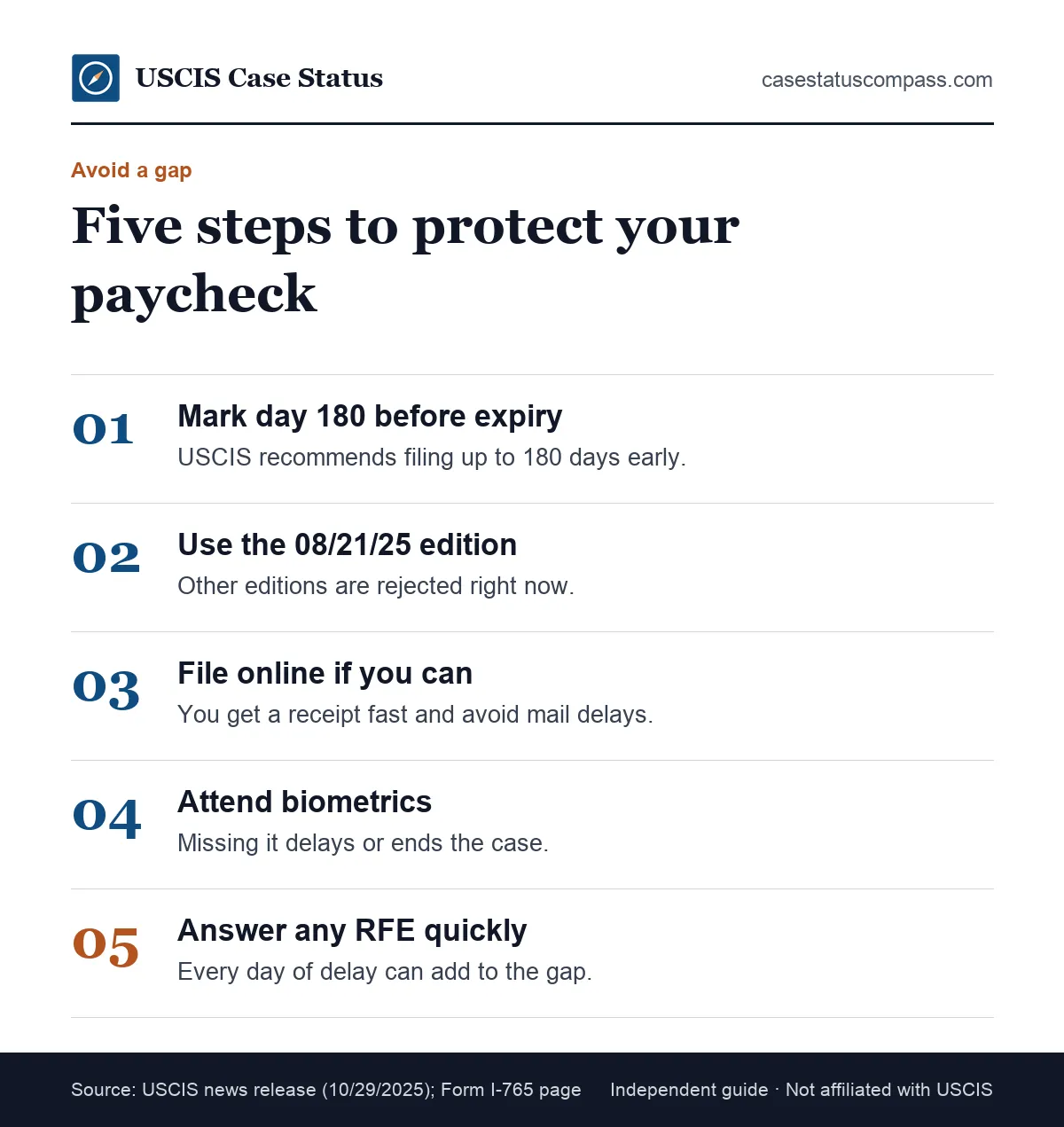
Filing online vs on paper
Online filing gives an instant receipt and avoids mail delays. Many I-765 categories can be filed online. Check the Form I-765 page for eligible categories. Paper filers must also wait for the mailed I-797C before they can show HR proof of a timely filing.
Keeping your address current
USCIS mails the biometrics notice and new card to the address on file. If you move while the renewal is pending: Report a new address to USCIS within 10 days of moving (INA 265). A card sent to an old address can lengthen a gap.
Avoiding an RFE
Include a clear copy of your current EAD, the correct category code, photos and proof of the underlying case. An RFE adds weeks. Our request for evidence guide explains how to respond quickly.
Can You Expedite an EAD Renewal?
You can ask. USCIS considers expedite requests on these grounds: Expedite criteria: severe financial loss, emergency/humanitarian, nonprofit, government interest, clear USCIS error. Losing a job may support "severe financial loss," but only if the delay is not caused by filing late. Our expedite request guide explains how to ask.
Evidence that helps
Include a letter from your employer showing the job is at risk, proof of your filing date and any documents showing financial harm. Explain in a short note that you filed early and when your card expires, so the officer can see the delay is not your doing.
When USCIS will likely say no
A request based only on the end of the EAD automatic extension, without a real emergency, is unlikely to succeed. USCIS expects people to file early. Requests are also weak when the renewal went in during the final weeks before expiry, because the loss then stems from the filing date.
Does Premium Processing Help With EAD Renewals?
For most categories, no. Premium processing covers only certain I-765 filings: Premium processing covers I-129 work visas, I-140 (EB-1/2/3), I-765 OPT/STEM OPT and I-539 to F/M/J. Adjustment, asylum and H-4 EADs are not eligible. See our premium processing guide for OPT details.
OPT and STEM OPT
Students filing for OPT or STEM OPT can use premium processing for a faster decision. As of October 2026, the Form I-907 fee for OPT filings is $1,780, and USCIS's premium clock for them is 30 business days.
Fast-track offers to avoid
No private service can speed up a USCIS decision. Avoid anyone selling "guaranteed" EAD processing. The only official speed-up routes are an expedite request and, for OPT, premium processing, and both go straight to USCIS. Treat any request for payment to a personal account or app as a scam.
What Does an EAD Renewal Cost in October 2026?
As of October 2026, the I-765 fee depends on your category. G-1055 (edition 10/16/26) lists $520 (paper) / $470 (online); $260 with a pending I-485 filed on or after Apr. 1, 2024. H.R. 1 add-ons: initial asylum-applicant (c)(8) EAD $0 + $570; initial TPS/parolee EAD base fee + $570; renewal TPS/parolee base fee + $280; renewal (c)(8) base fee + $275. Our USCIS fees guide has the full schedule.
H.R. 1 add-on fees
Some categories, such as TPS, parole-based and asylum-based EADs, pay an H.R. 1 add-on. USCIS states: H.R. 1 fees can't be waived and must be paid separately. Ms. L. class members do not pay the parolee EAD add-on.
Fees are not refunded
USCIS says USCIS fees are nonrefundable, even if your case is denied or withdrawn. A rejected filing usually means a new fee and a new wait. Double-check the category code, the fee amount and your signature before you file.
Which Form I-765 Edition Should You File?
As of October 2026, USCIS accepts only 08/21/25 (the 09/15/26 edition is NOT accepted because of a Sept. 14, 2026 court order). Using another edition will get your renewal rejected. Check the edition date at the bottom of every page before filing.
Where to find the right edition
Download the form directly from uscis.gov/i-765 the week you file. Saved or third-party copies may be out of date. The edition date appears in the footer of each page, and every page in your package must show the same accepted edition.
If you already filed the wrong edition
If USCIS rejects the filing, refile right away with the correct edition. The rejection does not hold your place in line. Use the new receipt's Received Date for planning, since that is the filing date USCIS will count.
What If Your Renewal Is Rejected or Denied?
A rejection means USCIS did not accept the filing, so you must refile with the right fee and form. A denial means USCIS decided against you. Either way, no automatic extension protects you. Our case denied guide explains the options after a denial.
After a rejection
Find the reason on the rejection notice, fix it and refile at once. Check the filing address again, since many addresses changed in October 2026. Because the new filing date is later, re-estimate your gap and tell HR.
After a denial
Read the notice for appeal or motion rights. Consider speaking with an immigration attorney about whether to refile or challenge the decision. Many EAD denials cannot be appealed, but a motion may be possible; the notice says which applies. Motion deadlines are short, so act within days.
Is There a Court Challenge to the Rule?
Law firms report lawsuits against the October 2025 rule, but we could not confirm any court order on an official government page. The USCIS automatic extension page, last updated October 29, 2025, mentions no court action, and the October 14, 2026 final rule is in effect.
Where to check
Watch the USCIS automatic EAD extension page and the USCIS newsroom. If a court blocks the rule, USCIS will usually post a notice there. The Federal Register is where any change to the regulation itself would appear.
Do not rely on news alone
Do not keep working on a news report. Only an official USCIS notice or advice from your attorney should guide your work decision. Court orders can be narrow, covering only certain plaintiffs or states, so wait for USCIS to explain who is covered.
What Are the Most Common EAD Extension Mistakes?
The biggest mistakes are assuming an extension still exists, filing late, using the wrong edition and showing an employer a receipt filed after the cutoff. Each one is avoidable with a calendar reminder and a quick look at the dates on your receipt. The lists below split them by who usually makes them.
Worker mistakes
- Relying on old advice about the 540-day extension
- Filing in the final weeks before expiry
- Not checking the category code on the receipt
- Mailing the package without tracking, so the Received Date is hard to prove
- Moving without updating the address before the card is mailed
Employer mistakes
- Accepting a post-cutoff receipt plus an expired card
- Forgetting to reverify on time
- Demanding a specific document from the worker
- Ending employment before the card's actual expiry date
- Treating a case status screenshot as proof of work authorization
If X, Do Y: EAD Extension Decision Table
Use this table to find your next step. The safest choice is always the one that avoids working without valid authorization. Find the row that matches you; if more than one applies, follow the stricter step. Bring the table to HR so both sides work from the same dates.
Next steps by EAD situation
| If this is true | Do this |
|---|---|
| Your renewal was received before Oct. 30, 2025 | Confirm the extension with HR and track the 540-day end date |
| Your renewal was filed on or after Oct. 30, 2025 | Plan for a gap if the card is not approved before expiry |
| You hold TPS | Check the Federal Register notice for your country |
| You are on STEM OPT | File before the OPT card expires to get 180 days |
| You are an E or L spouse with an S-coded I-94 | Show the I-94 for Form I-9 |
| Your card expires in under 180 days | File the renewal now |
If no row fits, treat the card's expiry date as your last day of work in that category until an attorney tells you otherwise.
When to get legal help
Talk to an immigration attorney if your category codes do not match, if you have a pending denial or if a gap could affect your status. A DOJ-accredited representative at a nonprofit can also review your dates at low cost.
What Should Workers Do Seven Months Before Expiry?
Seven months before your card expires is the right time to start. That gives you a month to prepare and lets you file on the first day of the 180-day window. The checklist below gathers the steps in one place, and the subsections walk through them in order.
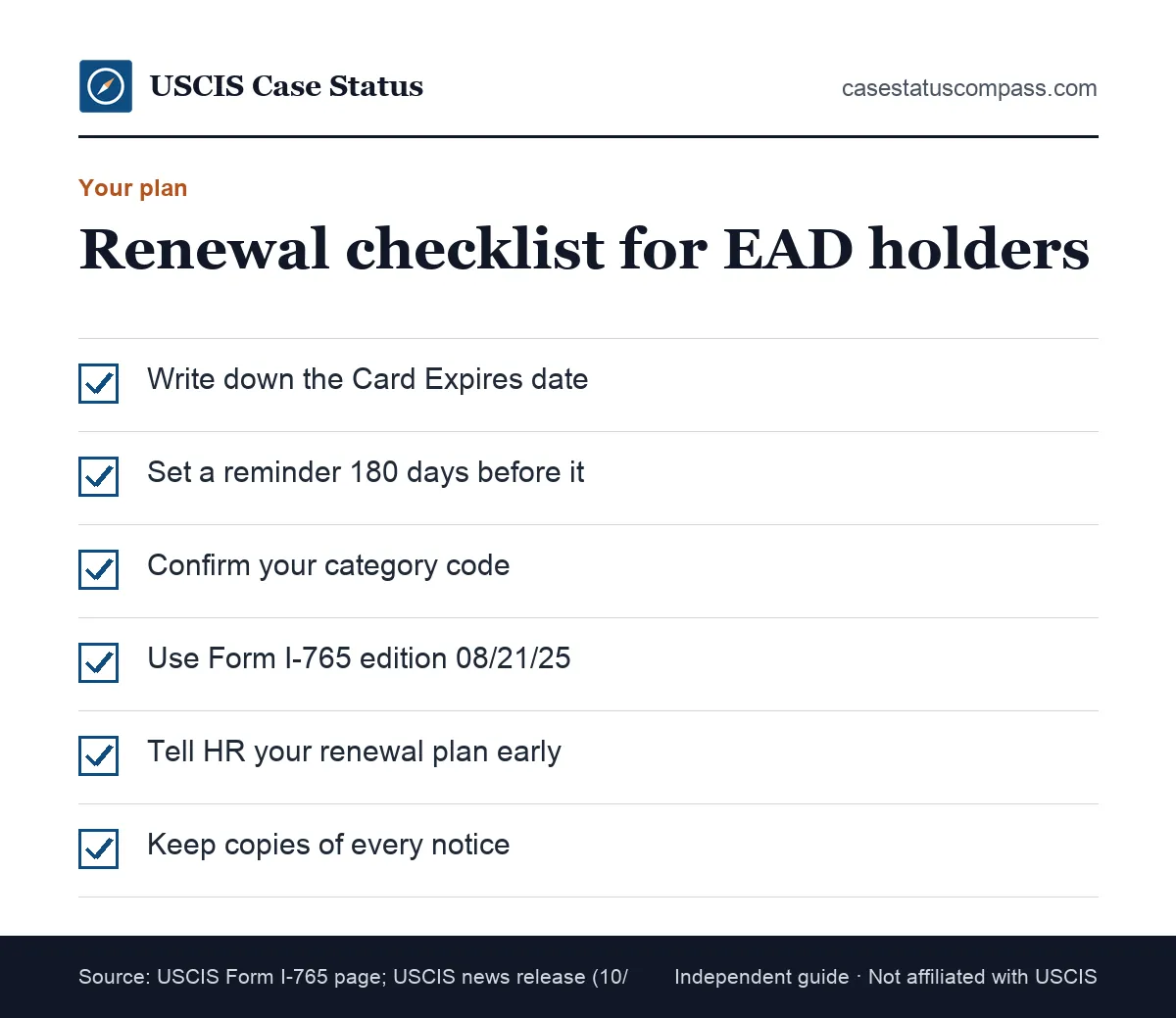
A month before the window opens
Gather your current EAD, passport photos and proof of the underlying case. Set up a USCIS online account if you do not have one. Our USCIS online account guide explains the setup.
On the day the window opens
File online if your category allows it, or mail the package to the correct lockbox. Give HR a copy of the I-797C receipt as soon as it arrives, so your employer can see you filed early.
After filing
Track the case. If it stops moving, our case status not updating guide explains what to do. Watch for a card was mailed update. Report any address change at once, and give HR the new card the day it arrives so reverification is complete.
Where Should You Check for Updates?
Check the USCIS automatic EAD extension page, the Form I-765 page and the Federal Register. Rules here changed twice in two years, so check before relying on any extension. Recheck each page the month before you file and again on filing day, because an edition or an address can change in between.
Official pages to bookmark
- USCIS Automatic EAD Extension page
- uscis.gov/i-765 for the current edition
- The Federal Register for TPS notices
- The USCIS filing addresses page for your category
- I-9 Central and the M-274 handbook for employer rules
- Your USCIS online account for notices about your own case
Dates on this page
This guide was reviewed in October 2026; check the official pages for later changes. Track all your cases on our USCIS case status checker.
Frequently Asked Questions
Is the EAD automatic extension still available in 2026?
Only in limited cases. Renewals filed before October 30, 2025 keep the old extension of up to 540 days. TPS cards may be extended by law or Federal Register notice. A timely STEM OPT filing lets an F-1 student keep working for up to 180 days while the case is pending.
Can I keep working if I filed my renewal after October 30, 2025?
Not after your card expires, unless you have another basis to work, such as H-1B status or an S-coded E or L spouse I-94. You must stop working in that category until the new EAD arrives.
Does the end of the extension affect extensions I already have?
No. DHS says the rule does not affect EADs that were automatically extended before October 30, 2025. Those extensions still run up to 540 days or until USCIS decides.
Is my I-797C receipt proof that I can work?
Only for renewals filed before October 30, 2025, and only together with your current EAD in the same category. For renewals filed on or after that date, the receipt does not extend an expired card.
Does the change apply to DACA work permits?
DACA (c)(33) EADs were never on the automatic extension list, so the change does not alter their rules. DACA recipients should still file renewals 120 to 150 days before expiry to avoid a gap.
Can I ask USCIS to speed up my renewal?
Yes. You can file an expedite request if you meet a criterion such as severe financial loss. USCIS does not grant expedites caused by late filing. Premium processing is only for certain OPT filings.
Are TPS work permits still automatically extended?
Only when the law or a Federal Register notice for your country provides one. Since July 22, 2025, TPS-based extensions last up to one year or the TPS period, whichever is shorter.
Does the change hit H-4 EAD (c)(26) holders?
Yes. A (c)(26) renewal filed on or after October 30, 2025 gets no automatic extension, and H-4 spouses have no status-based work permission. File the I-539 and I-765 as early as allowed.
What should an employer do when an EAD expires?
Reverify on or before the expiry date. An expired card plus a receipt works only for a timely pre-cutoff renewal in the same category. Otherwise, the worker chooses another acceptable List A or List C document.
Will the automatic extension come back?
There is no official sign of that. The October 14, 2026 final rule made the change permanent. Lawsuits have been reported, but we found no official notice of a court order. Check the USCIS page for updates.
Sources
- USCIS: Automatic Employment Authorization Document (EAD) Extension (updated 10/29/2025). www.uscis.gov/working-in-the-united-states/information-for-employers-and-employees/automatic-employment-authorization-document-ead-extension. Accessed Oct 27, 2026.
- USCIS news release: DHS Ends Automatic Extension of Employment Authorization (10/29/2025). www.uscis.gov/newsroom/news-releases/dhs-ends-automatic-extension-of-employment-authorization. Accessed Oct 27, 2026.
- Federal Register: Removal of Automatic Extensions for Certain Employment Authorization Documents, final rule, 91 FR 65306 (Oct. 14, 2026). www.govinfo.gov/content/pkg/FR-2026-10-14/pdf/2026-20955.pdf. Accessed Oct 27, 2026.
- Federal Register: interim final rule, 90 FR 48799 (Oct. 30, 2025). www.govinfo.gov/content/pkg/FR-2025-10-30/pdf/2025-19702.pdf. Accessed Oct 27, 2026.
- USCIS Policy Manual, Vol. 10, Part B, Chapter 2: Employment Authorization for Certain H-4, E and L Dependent Spouses. www.uscis.gov/policy-manual/volume-10-part-b-chapter-2. Accessed Oct 27, 2026.
- USCIS: Form I-765 page (updated 10/07/2026). www.uscis.gov/i-765. Accessed Oct 27, 2026.
- USCIS Form G-1055 Fee Schedule, edition 10/16/26. www.uscis.gov/sites/default/files/document/forms/g-1055.pdf. Accessed Oct 27, 2026.
- USCIS Data Library: All Forms, FY2026 Q3. www.uscis.gov/sites/default/files/document/data/quarterly_all_forms_fy2026_q3_v1.xlsx. Accessed Oct 27, 2026.
- USCIS: Temporary Protected Status. www.uscis.gov/humanitarian/temporary-protected-status. Accessed Oct 27, 2026.
- USCIS: How to Make an Expedite Request. www.uscis.gov/forms/filing-guidance/how-to-make-an-expedite-request. Accessed Oct 27, 2026.
- USCIS processing times. egov.uscis.gov/processing-times/. Accessed Oct 27, 2026.
- DOJ EOIR: Update Respondent or Alien Information (updated May 18, 2026). www.justice.gov/eoir/update-respondent-or-alien-information. Accessed Oct 27, 2026.
- USCIS: How to Change Your Address (updated 08/04/2026); 8 U.S.C. 1305(a) (LII). www.uscis.gov/addresschange. Accessed Oct 27, 2026.
- USCIS: How Do I Request Premium Processing? (updated 03/23/2026). www.uscis.gov/forms/all-forms/how-do-i-request-premium-processing. Accessed Oct 27, 2026.
- USCIS: Filing Fees (updated 02/12/2026). www.uscis.gov/forms/filing-fees. Accessed Oct 27, 2026.
casestatuscompass.com is an independent publication and is not affiliated with USCIS or any government agency. This page is general information, not legal advice. For denials, court or asylum matters, consult an immigration attorney or a DOJ-accredited representative.