Contents · 39 sections
- What Is the Current I-130 Processing Time?
- How Does USCIS Measure I-130 Processing Time?
- How Do You Read the Processing Times Tool for an I-130?
- I-130 Processing Time by Relationship
- How Long Does I-130 Take for a Spouse?
- What Is the CR1 Visa Processing Time?
- How Long Does a Marriage Visa Take?
- How Long Is the I-130 Processing Time for Parents?
- U.S. Citizen Filing for a Brother or Sister: Processing Time
- What Is the Siblings I-130 Wait Time per Country?
- How Long Is the I-130 Waiting Time for a Brother?
- How Long Does It Take to Process Form I-130 Step by Step?
- I-130 Timeline Estimator: Plan Your Milestones
- How Long After I-130 Approval to Interview?
- How Long Does Consular Processing Take After I-130 Approval?
- What Is the Visa Bulletin Wait and Who Has One?
- Which Visa Bulletin Chart Applies to Family Cases?
- Why Do Immediate Relative and Preference Medians Differ?
- Why Some I-130s Take Longer
- Do Background Checks Slow Down an I-130?
- How Many I-130 Petitions Are Pending?
- Does Filing Online Make the I-130 Faster?
- Can You Pay for Premium Processing on Form I-130?
- When Is an I-130 Outside Normal Processing Time?
- What to Do If Your I-130 Is Delayed
- Can You Expedite an I-130?
- How an RFE Changes the I-130 Approval Timeline
- Which USCIS Office Handles My I-130?
- Is the I-130 Wait Getting Longer?
- I-130 vs K-1: Which Fiancé or Spouse Route Is Faster?
- After the Green Card: Other Timelines to Plan For
- Mistakes That Add Months to an I-130
- Real-World I-130 Timeline Scenarios
- Decision Table: If Your I-130 Is Taking Too Long
- What Can the Petitioner Do While the I-130 Is Pending?
- How Accurate Are Online I-130 Timelines?
- When Should You Get Legal Help With an I-130 Delay?
- How This Page Fits With Other Processing Time Guides
- Frequently Asked Questions
At a glance
| Immediate relatives | I-130 (immediate relative): median 13.0 months (USCIS data, Apr.-June 2026) |
| Other relatives | I-130 (all other relatives): median 43.3 months (USCIS data, Apr.-June 2026) |
| Live estimate | egov.uscis.gov/processing-times (80% measure, by office) |
| Premium processing | Not available for Form I-130 |
| Filing fee | $675 (paper) / $625 (online) |
What Is the Current I-130 Processing Time?
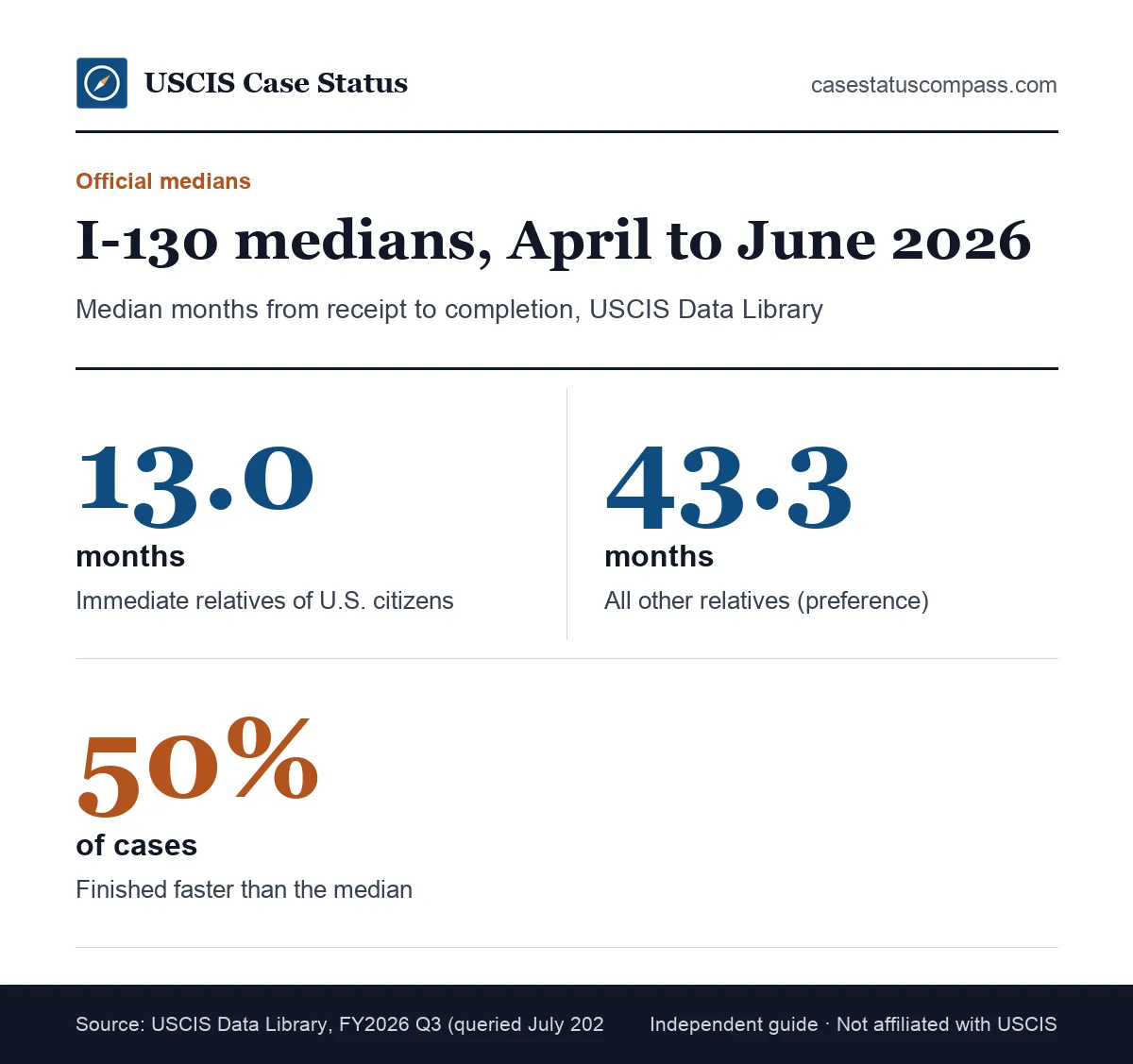
The latest official I-130 processing time figures come from the USCIS Data Library. For petitions completed between April 1 and June 30, 2026, the median was 13.0 months for immediate relatives and 43.3 months for other relatives. Your own office may run faster or slower.
Official I-130 medians by category
The table shows the two official medians and which relationships fall under each one.
| Category | Median, Apr.-June 2026 | Who it covers |
|---|---|---|
| Immediate relative | 13.0 months | Spouses, parents and unmarried children under 21 of U.S. citizens |
| All other relatives | 43.3 months | F1, F2A, F2B, F3 and F4 preference relatives |
Takeaway: a preference petition's middle case took more than three times as long as an immediate-relative one.
What the medians do and do not include
The medians run from the USCIS receipt date to a USCIS decision. They leave out the National Visa Center (NVC), the embassy interview and any visa bulletin wait. Add those separately.
How Does USCIS Measure I-130 Processing Time?
USCIS publishes two measures. The Data Library reports the median, the time to complete 50% of cases in a quarter. The official tool shows the time to finish 80% of cases over the past six months. Neither one predicts your own date.
Median versus the 80% figure
USCIS describes the tool this way (checked October 2026). The USCIS tool shows how long it took to finish 80% of cases in the past 6 months. Because it uses a higher percentile than the median, its figure is usually longer.
Why the quarterly data runs behind
The Data Library is published quarterly and runs about three to four months behind. Office speed changes since July 2026 show up first in the live tool. Check both before planning.
How Do You Read the Processing Times Tool for an I-130?
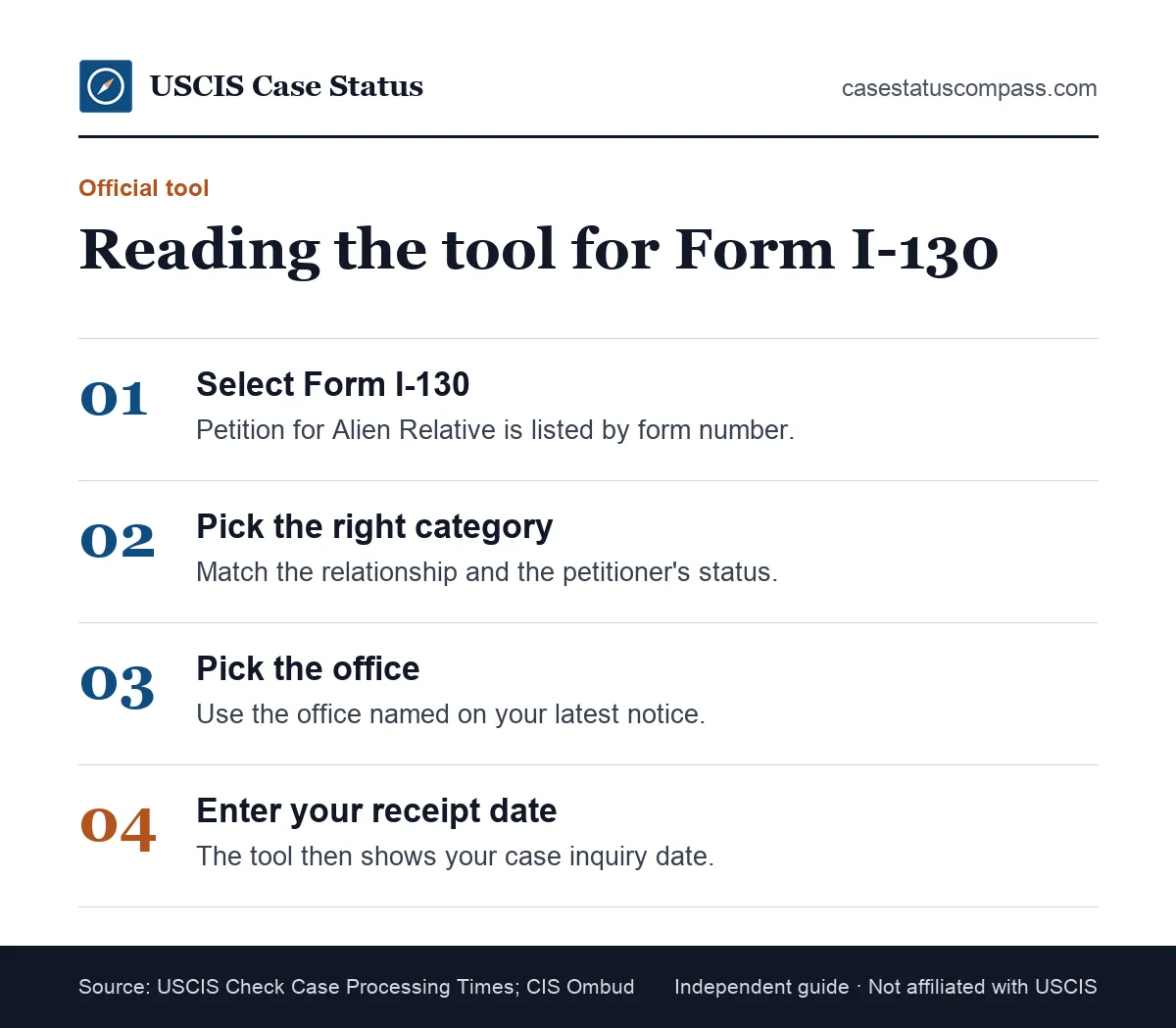
Open egov.uscis.gov/processing-times, select Form I-130, choose the category that matches your relationship, and pick the office on your latest notice. Adding your receipt date shows your case inquiry date. The receipt date is printed on Form I-797C. If you picked the wrong relationship line, the figure belongs to a different queue, so match the category to your petition before relying on the I-130 processing time shown.
Choosing the right category
The I-130 menu splits petitions by relationship and by the petitioner's status. A U.S. citizen sponsoring a spouse picks the immediate-relative line. A green card holder sponsoring a spouse, or a citizen sponsoring a sibling, picks a preference line.
Current figures for each category and office
| Category | Office | 80% of cases completed within |
|---|---|---|
| Permanent resident filing for a spouse or child under 21 | All Field Offices | 139 months |
| Permanent resident filing for a spouse or child under 21 | National Benefits Center | 52 months |
| Permanent resident for unmarried son or daughter 21 or older | All Field Offices | 188.5 months |
| Permanent resident for unmarried son or daughter 21 or older | National Benefits Center | 53.5 months |
| U.S. citizen filing for a brother or sister | All Field Offices | 286.5 months |
| U.S. citizen filing for a brother or sister | National Benefits Center | 57 months |
| U.S. citizen filing for a married son or daughter | All Field Offices | 110.5 months |
| U.S. citizen filing for a married son or daughter | National Benefits Center | 53.5 months |
| U.S. citizen filing for a spouse, parent, or child under 21 | All Field Offices | 83.5 months |
| U.S. citizen filing for a spouse, parent, or child under 21 | National Benefits Center | 53 months |
| U.S. citizen filing for unmarried son/daughter 21 or older | All Field Offices | 195 months |
| U.S. citizen filing for unmarried son/daughter 21 or older | National Benefits Center | 52.5 months |
Right now, Form I-130 petitions take 52 to 286.5 months, depending on category and office (USCIS data retrieved Oct 27, 2026). Always use the office on your newest notice, not your first one.
I-130 Processing Time by Relationship
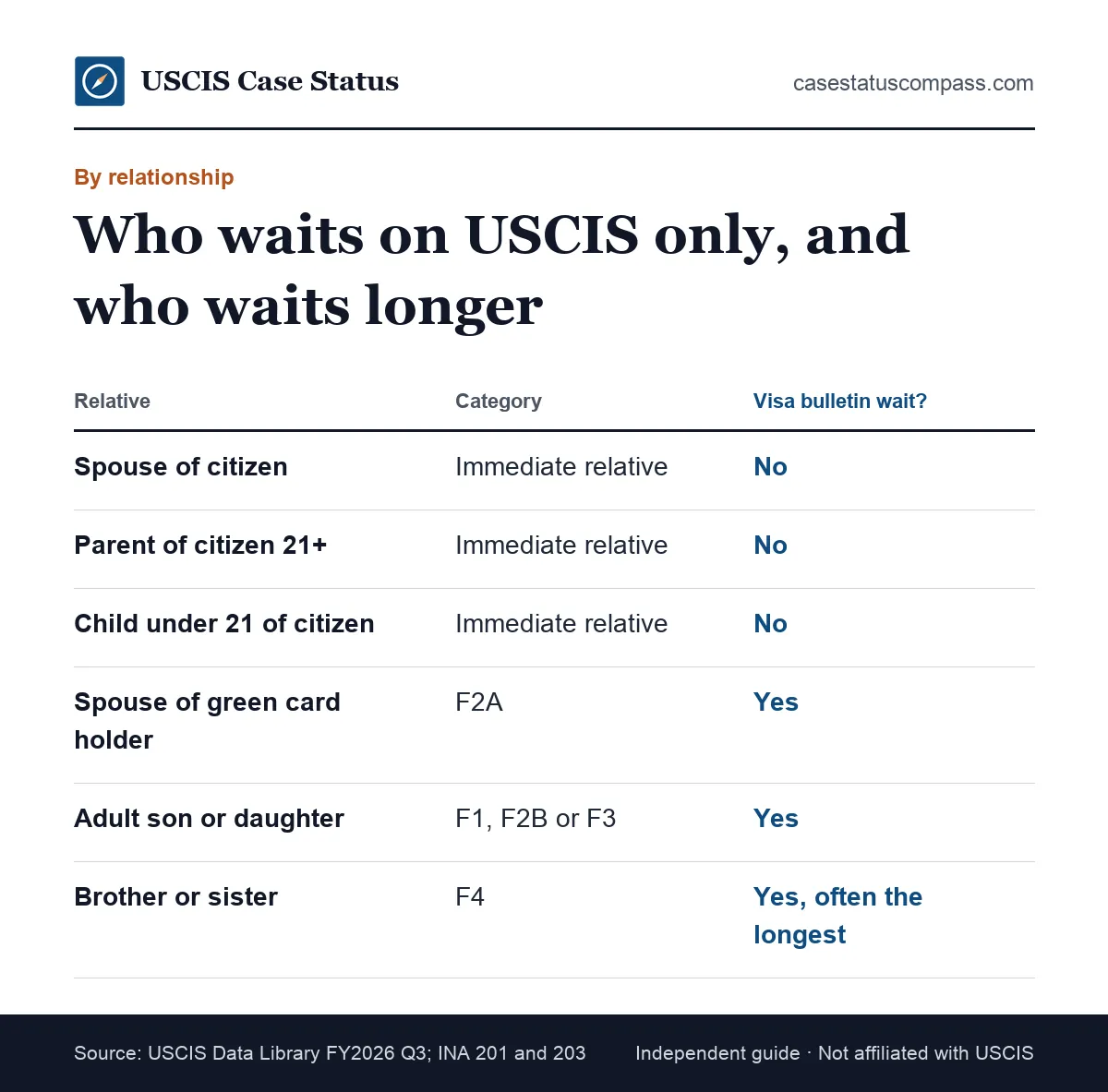
Immediate relatives of U.S. citizens wait only for USCIS, NVC and the consulate. Preference relatives also wait for a visa number under yearly limits. A parent petition and a sibling petition filed the same day can finish years apart. Relationship matters most.
Relationship-by-relationship wait table
Find the person you are sponsoring in the first column; the last column shows whether a visa bulletin wait follows.
| Relationship | Petitioner | Category | USCIS median | Visa bulletin wait |
|---|---|---|---|---|
| Spouse | U.S. citizen | Immediate relative | 13.0 months | None |
| Parent | Citizen age 21+ | Immediate relative | 13.0 months | None |
| Child under 21 | U.S. citizen | Immediate relative | 13.0 months | None |
| Spouse or child under 21 | Green card holder | F2A | 43.3 months* | Yes |
| Adult son or daughter | Citizen or LPR | F1, F2B or F3 | 43.3 months* | Yes |
| Brother or sister | Citizen age 21+ | F4 | 43.3 months* | Yes, often many years |
Only immediate relatives skip the bulletin, which is why their total wait is usually far shorter.
Spouse / CR1
A citizen's spouse is an immediate relative, so the USCIS stage follows the 13.0-month median. If the marriage is under two years old when the visa is issued, the spouse enters on a CR1 (conditional) visa.
Parents
Parents of U.S. citizens who are 21 or older are also immediate relatives, share the same median and face no annual cap. The citizen must be at least 21 when filing, and the parent's own visa or adjustment step comes after approval.
Siblings (F4)
Brothers and sisters fall in the F4 category. After approval, the sibling waits for a current priority date in the monthly Visa Bulletin, and that line moves at different speeds for some countries of birth.
How Long Does I-130 Take for a Spouse?
For a U.S. citizen's spouse, the USCIS stage had a median of 13.0 months in April to June 2026. A green card holder's spouse is a preference case (F2A), counted in the 43.3-month combined median, and may also wait on the visa bulletin.
Spouse of a U.S. citizen
The American spouse visa processing time at USCIS follows the immediate-relative median. A spouse in the U.S. who can adjust status may file Form I-485 at the same time. A spouse abroad moves to NVC after approval.
Spouse of a green card holder
If the permanent resident naturalizes while the F2A petition is pending, the case usually converts to immediate relative. That can cut the wait, so send USCIS or NVC proof of citizenship.
What Is the CR1 Visa Processing Time?
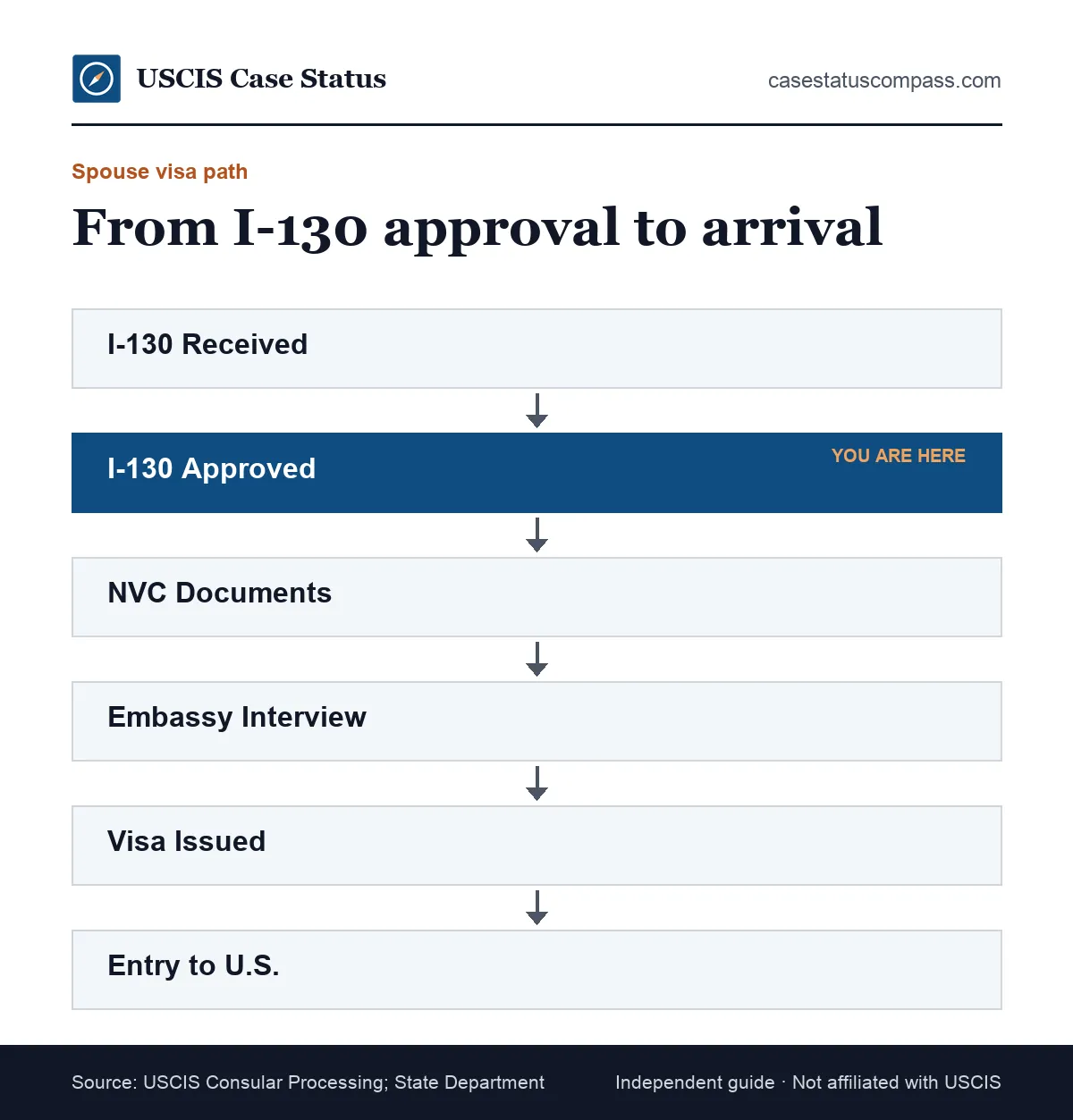
The CR1 visa processing time is the I-130 stage at USCIS plus the NVC document stage and the embassy interview. Only the first part has an official median: 13.0 months in April to June 2026. NVC and embassy timing depends on your paperwork speed and the consulate's calendar.
The three agencies in a spouse visa case
- USCIS decides the I-130 petition.
- NVC (State Department) collects fees and documents.
- The embassy or consulate interviews the spouse and issues the visa.
Our CR1 visa guide for spouses covers eligibility.
CR1 vs IR1: same petition, different card
CR1 and IR1 spouses use the same immediate-relative I-130 line, so the USCIS wait is identical. The only difference is the marriage's age when the visa is issued, which decides whether the card is conditional.
How Long Does a Marriage Visa Take?
A marriage visa for a citizen's spouse takes the I-130 median plus the NVC and embassy stages, which no USCIS source measures. For a green card holder's spouse, the F2A line can add more. This US spouse visa processing time is best planned in four blocks: petition, NVC, interview scheduling and visa printing.
How Long Is the I-130 Processing Time for Parents?
The I-130 processing time for parents of U.S. citizens follows the immediate-relative median of 13.0 months (April to June 2026). Parents never wait for a visa number, so after approval the case moves straight to NVC or to Form I-485.
Parents living abroad
A parent abroad goes through NVC and an embassy interview. Collecting the birth certificate, police certificates and passport early keeps that stage short. The citizen child also files an affidavit of support at NVC.
Parents already in the U.S.
A parent who entered lawfully and can adjust may file Form I-485 with the I-130, so both run side by side. Our green card processing time guide covers the I-485 side.
Parents and the age-21 rule
A citizen under 21 cannot file for a parent, so a younger citizen must wait for that birthday. Filing soon after the child turns 21 starts the parent's 13.0-month clock as early as possible.
U.S. Citizen Filing for a Brother or Sister: Processing Time
When a U.S. citizen files for a brother or sister, the wait has two parts: the USCIS review (43.3-month median for all other relatives in April to June 2026) and the F4 visa bulletin wait. The second part is usually much longer and varies by the sibling's country of birth.
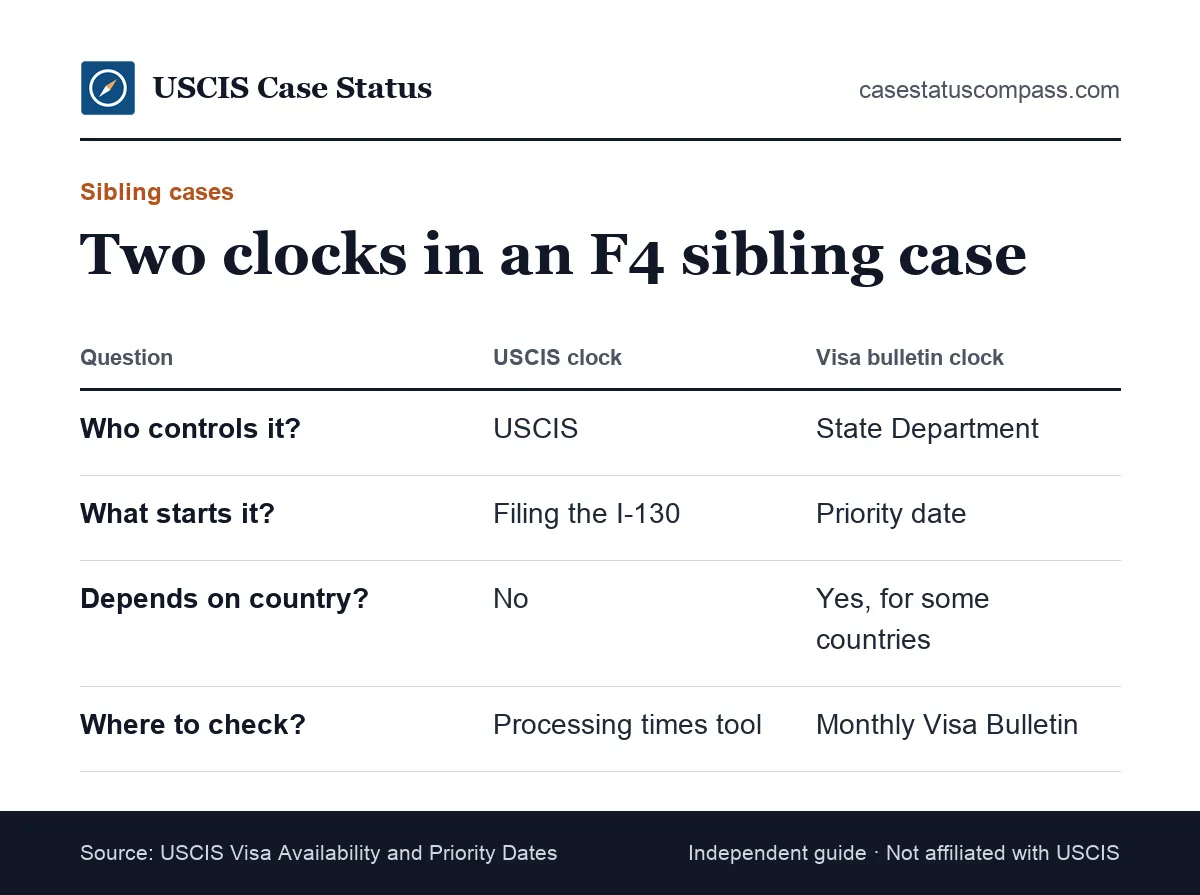
The two clocks in a sibling case
The USCIS clock starts at receipt. The bulletin clock depends on the priority date, which for family cases is the I-130 filing date. Both run at once, so a sibling may wait on the bulletin long after USCIS approval.
Filing early sets the sibling's place in line
Because the priority date is the I-130 filing date, filing sooner moves a sibling forward in the F4 line. Waiting to file cannot shorten the bulletin wait; it only starts it later.
What Is the Siblings I-130 Wait Time per Country?
The sibling wait per country is set by the Visa Bulletin, which lists F4 cutoff dates by chargeability area. On the November 2026 Final Action chart, F4 is Oct. 22, 2012 for most countries, Apr. 22, 2001 for Mexico and Dec. 15, 2006 for India. See our visa bulletin explainer.
How Long Is the I-130 Waiting Time for a Brother?
The I-130 waiting time for a brother is the same as for a sister: the USCIS stage (43.3-month combined median, April to June 2026), then the F4 line, which often adds years. Your brother's country of birth decides which column applies.
A worked sibling example
Say a citizen files for her brother on March 1, 2026. That becomes his priority date. USCIS may approve years later, but he still waits until the F4 date for his country passes March 1, 2026.
How Long Does It Take to Process Form I-130 Step by Step?
Processing Form I-130 runs through five steps: receipt, waiting in the queue, officer review, any request for evidence (RFE), and a decision. The whole USCIS part had medians of 13.0 or 43.3 months in April to June 2026, depending on category.
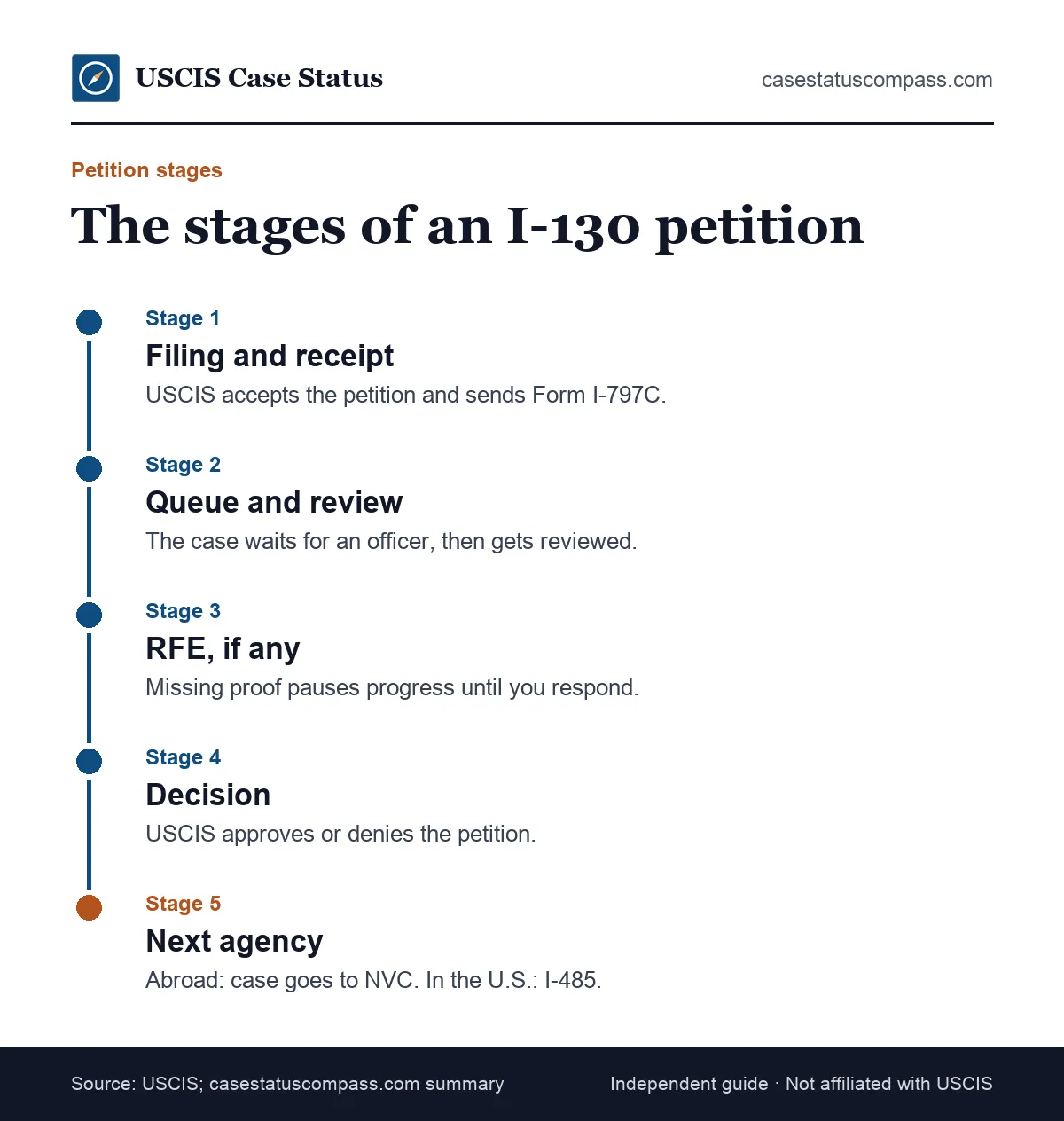
The receipt notice
USCIS sends Form I-797C after accepting the petition. Its receipt date starts the official clock and is the date you enter in the tool. See our case was received guide.
Queue and officer review
Most of the I-130 processing time passes before an officer opens the file. A status change to actively reviewed does not always mean a decision is close; an officer may still request evidence.
The RFE pause inside the median
If the officer needs more proof, USCIS issues an RFE and the file waits for your answer. That pause counts inside the median, so cases with an RFE usually finish later than the middle case.
Decision and handoff
After approval, USCIS sends a notice and moves the case on: to NVC for relatives abroad, or to the pending I-485 for relatives in the U.S. The case was approved page explains the notice.
I-130 Timeline Estimator: Plan Your Milestones
You can estimate your I-130 timeline by adding the official median to your receipt date, then checking the tool's case inquiry date. This gives a planning date, not a promise. Replace each estimate with real dates as notices arrive.
I-130 milestone worksheet
Fill in each row with your own dates as the notices arrive.
| Milestone | How to estimate it | Where to confirm it |
|---|---|---|
| Receipt date | Printed on Form I-797C | Notice or online account |
| Planning decision month | Receipt + 13.0 or + 43.3 months | USCIS Data Library, Apr.-June 2026 |
| Case inquiry date | Enter receipt date in the tool | Processing times tool |
| Priority date current | Bulletin date passes your filing date | Visa Bulletin |
| NVC and interview | After approval and a current date | NVC and embassy portals |
Real notice dates always replace the estimates, so update the worksheet each time USCIS writes to you.
How to use the estimator
Add your category's median to your receipt date for a rough decision month, then enter the same date in the tool. If its case inquiry date is later, plan around that date, because that is when USCIS takes questions.
A worked spouse example
A citizen files for his wife and receives a February 2, 2026 receipt date. Adding 13.0 months gives early March 2027 as a planning month. He checks his office in the tool, sets a reminder for the case inquiry date, and does not call USCIS before it.
How Long After I-130 Approval to Interview?
How long after I-130 approval to the interview depends on the path. For a relative abroad, NVC prepares the case and the embassy schedules an interview once documents are complete. For a relative in the U.S., the interview belongs to the green card application, which USCIS schedules itself.
Consular path through NVC
NVC opens a case, then asks for fees, the DS-260 and civil documents. Once the file is complete, it waits for an embassy slot. Track this stage with our NVC case status guide, since USCIS stops showing updates.
Adjustment path inside the U.S.
Adjustment cases follow the interview rule. Green card interviews are required unless waived; the family petitioner usually attends too. The interview can come before or after the I-130 decision. Our green card interview guide explains what to bring.
Interview timing for preference relatives
A preference relative abroad cannot be scheduled for an interview until the priority date is current, even with a complete NVC file. The approval holds the place in line; the bulletin decides when the interview stage opens.
How Long Does Consular Processing Take After I-130 Approval?
Consular processing after I-130 approval has no official median, but NVC posts weekly timeframes: As of Oct. 26, 2026, NVC was creating cases for petitions received from USCIS on Oct. 17, 2026. The rest depends on how fast you pay fees and submit documents at NVC and on the embassy's interview backlog.
Fees at the NVC stage
As of October 2026, the State Department lists the immigrant visa fee as Immigrant visa fee: $325 family; $345 employment; $205 other (per person). Paying late pushes every later step back.
The USCIS Immigrant Fee after the visa
After the visa is issued, the USCIS Immigrant Fee of $235 is due before the green card is mailed. Paying it promptly avoids a wait for the card after arrival.
Embassy scheduling
Each embassy sets its own interview calendar, and waits differ widely between posts. Check the embassy page for your relative's country, and do not book travel until the visa is printed in the passport.
What Is the Visa Bulletin Wait and Who Has One?
The visa bulletin wait is the time a preference relative waits for a visa number after USCIS approves the I-130. Immediate relatives have none. Spouses of green card holders, adult children and siblings do, because Congress caps family preference visas. Yearly limits: 226,000 family preference visas; 140,000 employment-based.
Priority dates in plain English
Your priority date is your place in line; in family cases, it is the date USCIS received the I-130. When the bulletin date for your category and country passes it, your relative moves forward.
Which Visa Bulletin Chart Applies to Family Cases?
The bulletin has two charts: Final Action Dates and Dates for Filing. USCIS picks one chart each month. November 2026: USCIS accepts I-485s using the Dates for Filing chart (family and employment). The family Final Action chart below changes monthly; confirm it on the State Department's Visa Bulletin or in our Visa Bulletin guide.
Current family Final Action chart
Find your relative's category in the left column, then read across to the country of birth that applies.
| Category | All areas | China (mainland-born) | India | Mexico | Philippines |
|---|---|---|---|---|---|
| F1 | Jan. 22, 2021 | Jan. 22, 2021 | Jan. 22, 2021 | Sept. 22, 2008 | Nov. 1, 2013 |
| F2A | Oct. 22, 2026 | Oct. 22, 2026 | Oct. 22, 2026 | Apr. 22, 2026 | Oct. 22, 2026 |
| F2B | Aug. 22, 2020 | Aug. 22, 2020 | Aug. 22, 2020 | May 15, 2010 | Oct. 1, 2013 |
| F3 | Oct. 22, 2015 | Oct. 22, 2015 | Oct. 22, 2015 | July 15, 2001 | July 22, 2006 |
| F4 | Oct. 22, 2012 | Oct. 22, 2012 | Dec. 15, 2006 | Apr. 22, 2001 | May 15, 2008 |
If the date shown is earlier than your priority date, your relative is still waiting; "C" means the category is current.
Why Do Immediate Relative and Preference Medians Differ?
The medians differ because the two groups lead to different outcomes. Immediate-relative petitions lead straight to a visa or green card. Preference petitions often cannot be used until a visa number is available, so they may wait longer in the queue before review.
Immediate relative and preference petitions side by side
The table compares the two groups point by point, from caps to what happens after approval.
| Point | Immediate relative | Preference relative |
|---|---|---|
| Who | Spouse, parent, child under 21 of a citizen | F1, F2A, F2B, F3, F4 |
| Annual limit | None | Yes, set by law |
| Category can change? | Rarely | Yes, e.g. petitioner naturalizes |
The key difference is the annual cap: it shapes both the queue and the wait after approval.
What "all other relatives" includes
USCIS reports one combined median for every preference category, mixing F2A spouses with F4 siblings. Your own category could move faster or slower than 43.3 months. No official split by preference category was published.
Category changes that shorten the wait
A green card holder who naturalizes turns an F2A spouse petition into an immediate-relative case. An F2B son or daughter becomes F1. Send proof of the change to USCIS or NVC so the file is moved to the new category, and keep a copy of what you sent.
Why Some I-130s Take Longer
Some I-130s take longer because of missing evidence, office workload, background checks, complex family histories or preference queues. Many delays come from the backlog, not from your file. You can fix evidence problems; queue delays you can only wait out until your case inquiry date passes.
Evidence gaps and RFEs
A missing marriage certificate, an untranslated birth record or thin proof of a real marriage can trigger an RFE. Each one adds your response time plus a second review. Complete filings avoid this.
Office workload and transfers
USCIS moves cases between offices to balance work, which can speed a case up or slow it down. After a transfer notice, check the new office's line. Our case was transferred guide explains it.
Do Background Checks Slow Down an I-130?
They can. Prior petitions, past violations, criminal records or earlier marriages may lead to extra review, and spouse petitions with little shared evidence may get a closer look. These checks do not show in your status, and USCIS publishes no separate timing for checked cases.
How Many I-130 Petitions Are Pending?
As of June 30, 2026, the USCIS Data Library listed 786,723 immediate-relative I-130 petitions pending, out of 12.8 million cases pending at USCIS (end of June 2026). That backlog is the main reason most petitions wait months before an officer opens them, even complete ones.
What the backlog means for you
A large queue means the receipt date matters more than anything you do after filing. Calls do not move a case forward before its case inquiry date. Filing early helps most.
Where the pending count comes from
The figure is from the USCIS Data Library's FY2026 Q3 report and counts petitions still undecided on June 30, 2026. Approved petitions already sent to NVC are not part of it.
Does Filing Online Make the I-130 Faster?
USCIS has not published a separate median for online I-130 filings, so we cannot say online filing is faster. It does cost less, gives an instant receipt and avoids mail problems. As of October 2026, the fee is $675 (paper) / $625 (online).
What online filing changes
Online filing changes how you send and receive paperwork, not the review itself:
- The receipt appears in your account right away.
- RFEs and notices arrive in your account too.
- You can answer some requests by upload.
What it does not change
Online and paper petitions wait in the same review queue. If you file on paper, use the current address on uscis.gov. New USCIS mailing addresses from Oct. 7, 2026; old addresses accepted if postmarked by Nov. 9, 2026.
Can You Pay for Premium Processing on Form I-130?
No. Premium processing is not available for Form I-130. USCIS lists the eligible forms (checked October 2026). Premium processing covers I-129 work visas, I-140 (EB-1/2/3), I-765 OPT/STEM OPT and I-539 to F/M/J. Family petitions are not on that list, so any service selling a paid "premium" I-130 is not offering a USCIS option.
Why family petitions are excluded
The family queue has no fee-based fast lane. Congress and USCIS have limited premium processing to certain employment and student forms. Our premium processing explainer lists the forms that qualify. Ignore anyone selling a "guaranteed" fast I-130.
What you can do instead
- File a complete petition with strong evidence.
- File online to avoid mail delays.
- Ask for an expedite only if you meet a listed criterion.
- Answer any RFE quickly and fully.
When Is an I-130 Outside Normal Processing Time?
An I-130 is outside normal processing time once today's date passes the case inquiry date the tool gives for your receipt date. Before that date, USCIS treats the case as normal, even if it feels slow. Recheck the date monthly.
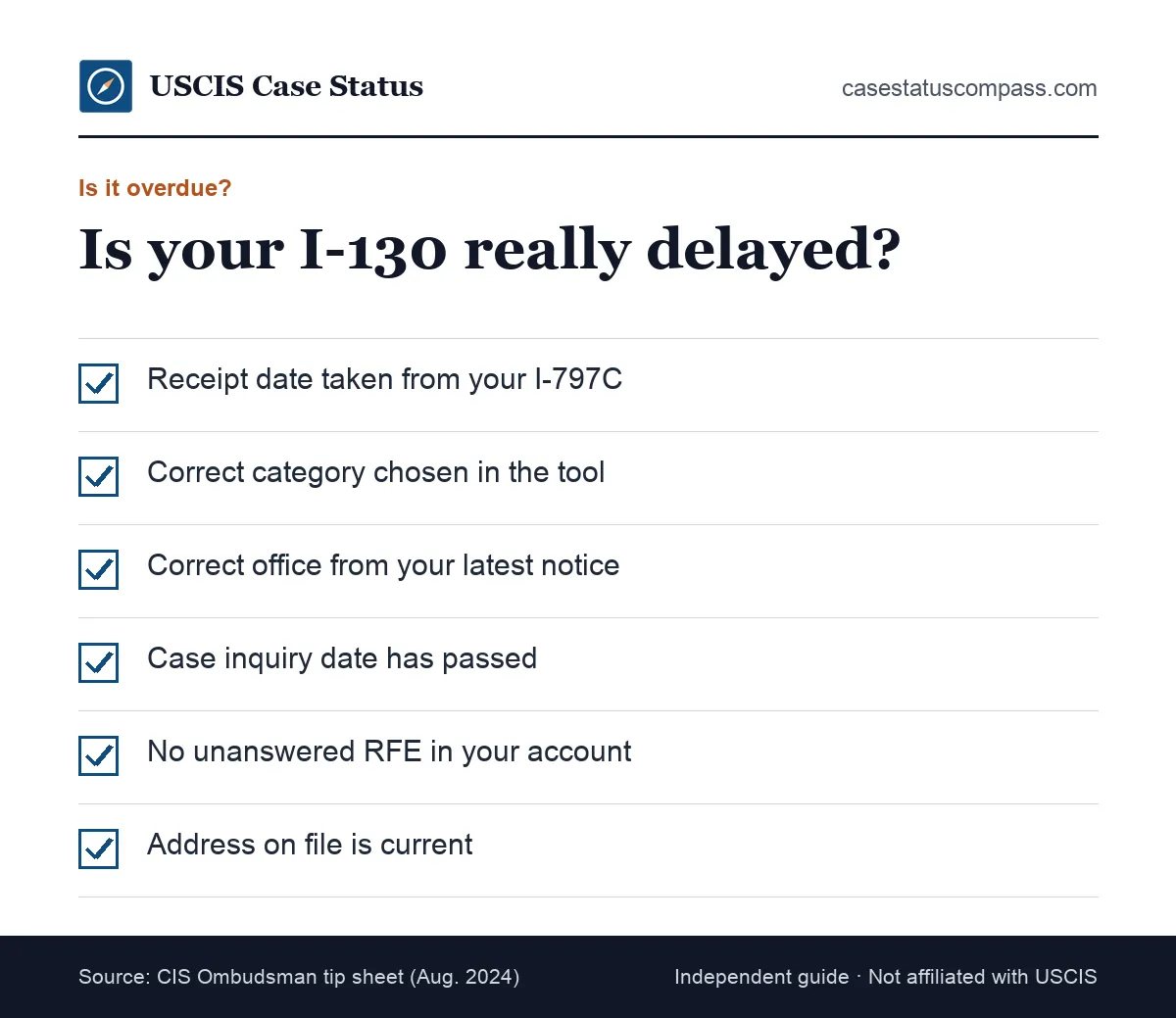
What the case inquiry date means
Case inquiry date: the earliest date USCIS will accept a question about your pending case; it can change. If your form or category is not listed in the tool, the CIS Ombudsman says you can ask once it has been pending more than six months.
Common reasons a case only looks late
- Picking the immediate-relative line for a preference case.
- Using the first office instead of the current one.
- Counting from the mailing date instead of the receipt date.
- Forgetting an RFE response that restarted review.
What to Do If Your I-130 Is Delayed
If your I-130 is past the case inquiry date, submit an outside-normal-processing request first. If that fails, consider an expedite (only for listed reasons), the CIS Ombudsman or your member of Congress. Keep the reference number from every contact, with its date.
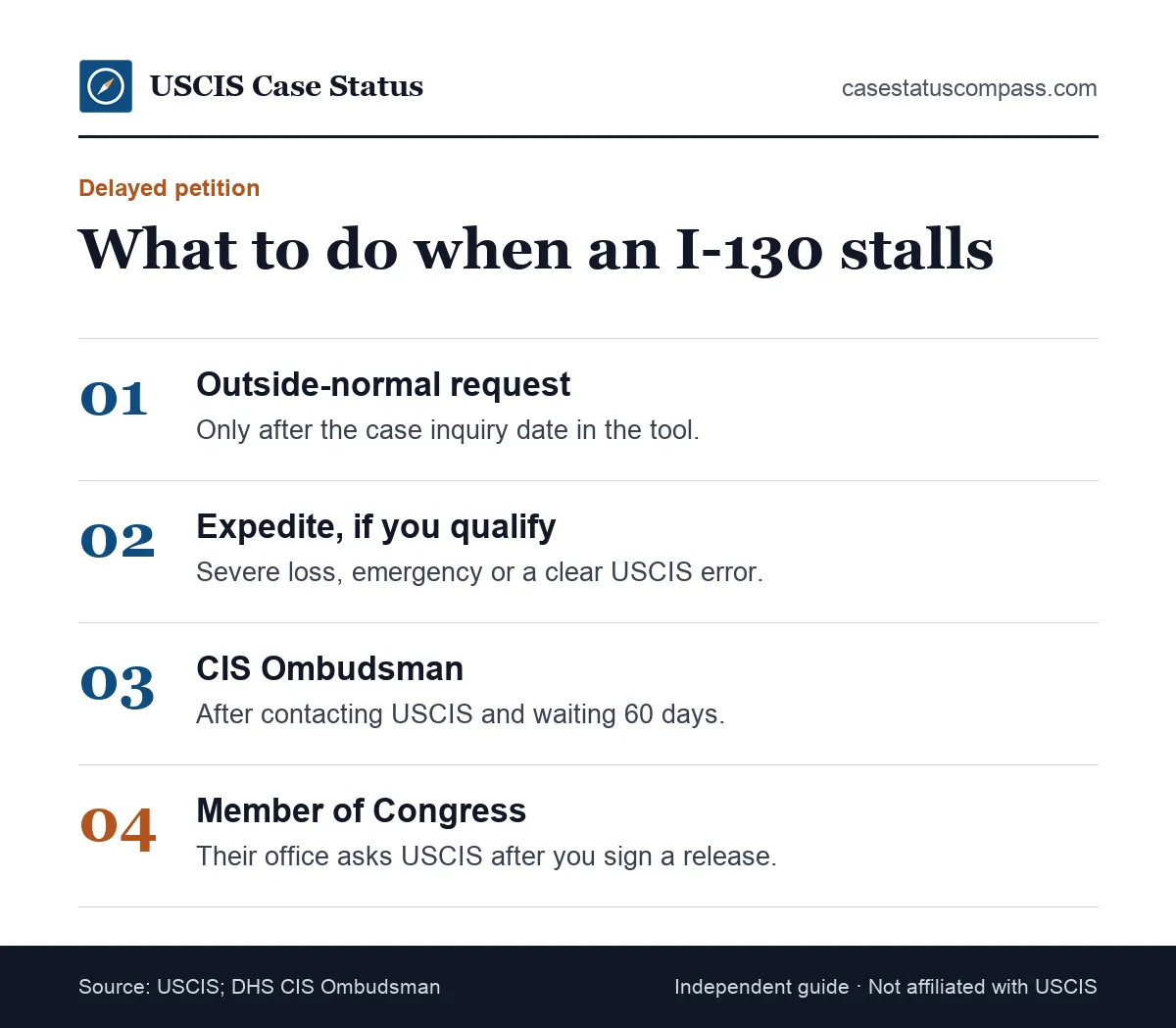
Outside-normal request
Use the inquiry link in the tool, or call the USCIS Contact Center at 800-375-5283 with your receipt number. Our case status not updating guide covers other fixes. Note the reply date.
CIS Ombudsman and Congress
Use the Ombudsman only after contacting USCIS within 90 days and waiting at least 60 days. A congressional inquiry needs a signed privacy release. Our ombudsman and congressional inquiry guide explains both.
Can You Expedite an I-130?
Yes, but only in limited cases. USCIS considers expedite requests for forms without premium processing, including Form I-130, when you meet a listed criterion. The criteria (checked October 2026): Expedite criteria: severe financial loss, emergency/humanitarian, nonprofit, government interest, clear USCIS error. Meeting one does not guarantee approval.
How to ask
Ask for an expedite through the USCIS Contact Center or your online account. Send proof, such as medical letters or military orders; requests without evidence are usually denied. Our I-130 expedite request guide explains strong evidence.
Expedite vs outside-normal request
An expedite asks USCIS to move a case ahead for an urgent reason. An outside-normal request only asks why a case is past its inquiry date, and needs no special reason.
How an RFE Changes the I-130 Approval Timeline
An RFE pauses progress until USCIS gets your answer; then the officer reviews the file again. The deadline is printed on the notice. RFE deadline: up to 12 weeks (the exact date is on your RFE); no extensions. (The 30-day cap applies to I-539 and I-601A requests, not to an I-130.) Answering early can save weeks, but a complete answer matters more than a fast one.
Response timing and mail days
If USCIS mailed the notice, add 3 days to the deadline. Count from the notice date and send all items together, because a partial response is treated as a request for a decision on the record.
After you respond
Your status should show that USCIS received the response, and review resumes when an officer reaches the file. Our request for evidence guide explains how to build a response. Keep your mailing proof.
Which USCIS Office Handles My I-130?
Your office appears on your receipt and later notices. The receipt prefix shows where USCIS first received the case, which may differ from where it is today. In the tool, choose the office on your newest notice. That line sets your inquiry date.
Reading the receipt prefix
The first three letters of the receipt number point to the receiving office or channel; IOE means online filing. Our receipt number guide decodes each prefix. The prefix never changes after a transfer.
When the office changes
USCIS can send a petition to a field office for an interview or to another center. Five USCIS service centers: California, Nebraska, Potomac, Texas and Vermont. A transfer notice names the new office.
Is the I-130 Wait Getting Longer?
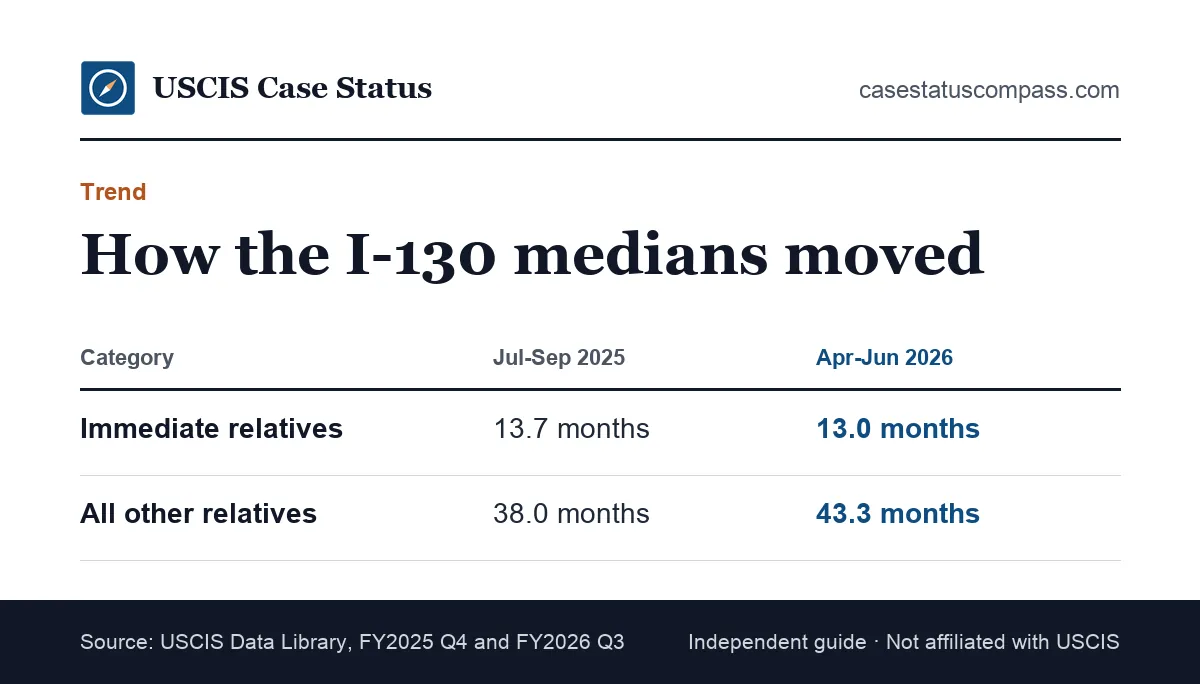
For immediate relatives, the median eased slightly, from 13.7 months in July to September 2025 to 13.0 months in April to June 2026. For all other relatives, it grew from 38.0 to 43.3 months over the same period. Preference cases bore the rise.
Longer history
An older USCIS factsheet (data as of March 5, 2024) put the FY2023 immediate-relative median at 11.8 months. Comparing it with the 13.0-month figure for April to June 2026 suggests the immediate-relative line is a little slower than in FY2023, though the two reports were built at different times.
What the trend means for planning
Plan a preference petition around the longer, rising median, and an immediate-relative petition around the steadier 13.0-month figure. Recheck each quarterly release before relying on either number. Trends can reverse.
I-130 vs K-1: Which Fiancé or Spouse Route Is Faster?
Unmarried couples use Form I-129F instead of Form I-130. For April to June 2026, USCIS listed I-129F: median 9.0 months (USCIS data, Apr.-June 2026), compared with 13.0 months for immediate-relative I-130s. The K-1 path then needs a green card application after arrival.
Trade-offs to weigh
The K-1 has a strict wedding deadline. K-1: marry within 90 days of entering the U.S., then file Form I-485. A CR1 or IR1 spouse gets a green card on arrival, so a faster petition does not always mean a faster green card.
Where to read more
Our K-1 visa processing time page covers the fiancé route, including the State Department stage. Compare both routes with an immigration attorney before you marry or file, because the choice decides which form starts your case.
After the Green Card: Other Timelines to Plan For
Spouses married under two years get a two-year card and must later file Form I-751. Many green card holders apply for citizenship after three or five years. Each step has its own queue, so mark the filing window for each one now and plan the full green card timeline, not only the petition.
Removing conditions
File in the 90 days before your 2-year card expires. USCIS listed I-751: median 22.6 months (USCIS data, Apr.-June 2026). Our I-751 processing time guide covers that wait. Mark the window early.
Citizenship later
Our guide on how long does naturalization take explains the N-400 timeline. Once you naturalize, pending preference petitions you filed may move into faster categories. Your earlier priority date stays.
Mistakes That Add Months to an I-130
The mistakes that add the most months are missing evidence, old form editions, unsigned forms, wrong fees and moving without telling USCIS. Each can cause a rejection, an RFE or a lost notice. A short checklist prevents most of them.
Form and edition mistakes
- Using an old edition (current edition: 04/01/24).
- Leaving out Form I-130A for a spouse petition.
- Skipping a signature, or signing in the wrong box.
- Leaving required questions blank instead of writing "None" or "N/A".
Translation and fee mistakes
- Sending foreign documents without certified translations.
- Paying the wrong fee, which gets a mailed filing rejected with no receipt date.
- Missing the translator's statement of competence on each translation.
Address mistakes
Report a new address to USCIS within 10 days of moving (INA 265). A missed RFE notice can lead to a denial. See our USCIS change of address guide for the steps.
Real-World I-130 Timeline Scenarios
These scenarios use fictional families and the April to June 2026 medians. Each is a planning example, not a prediction. Names are made up. Find the case closest to yours, then check your own category and office in the tool, because a real I-130 processing time can differ from the median.
A citizen sponsoring a spouse abroad
Maria files for her husband abroad. The USCIS stage follows the 13.0-month median. She pays NVC fees within a week of the request, which keeps that stage short; the embassy calendar decides the rest.
A green card holder sponsoring a spouse
Ana, a permanent resident, files for her husband under F2A, which uses the 43.3-month combined median and the bulletin. When Ana naturalizes, she sends proof and the case converts to immediate relative.
A citizen sponsoring a sister
David files for his sister. USCIS may take years, and the F4 bulletin may add many more depending on her country. He saves the receipt, checks the bulletin monthly and keeps his address current.
A citizen sponsoring a parent in the U.S.
Sam, 30, files for his mother, who entered lawfully. She files Form I-485 with the I-130, so both clocks run together under the 13.0-month immediate-relative median. She may also request a work permit.
A green card holder sponsoring an adult son
Leo, a permanent resident, files for his 24-year-old son under F2B, so the 43.3-month combined median and the bulletin both apply. If Leo naturalizes, the case becomes F1. He sends proof.
Decision Table: If Your I-130 Is Taking Too Long
Most I-130 delays only need patience until the case inquiry date. After that, the outside-normal request comes first, and stronger steps follow only if it fails. Expedites are a separate route for urgent, documented reasons, and legal help fits when status or a deadline is at risk.
I-130 delay situations and next steps
Match today's situation to a row and take the step beside it.
| If this is true | Then do this |
|---|---|
| Before your case inquiry date | Wait; recheck the tool monthly |
| Past the case inquiry date | Submit an outside-normal request |
| No fix 60 days after contacting USCIS | Consider a CIS Ombudsman request |
| Emergency or severe financial loss | Ask for an expedite with proof |
| You moved and may have missed a notice | Update your address and check your account |
| Preference case approved, no NVC contact | Check the Visa Bulletin for your date |
Most rows start with waiting or a request to USCIS, not outside help.
When the table does not fit
A petition approved in the wrong category or a beneficiary facing removal needs individual advice. An immigration attorney or a DOJ-accredited representative can review your notices. Bring every notice.
What Can the Petitioner Do While the I-130 Is Pending?
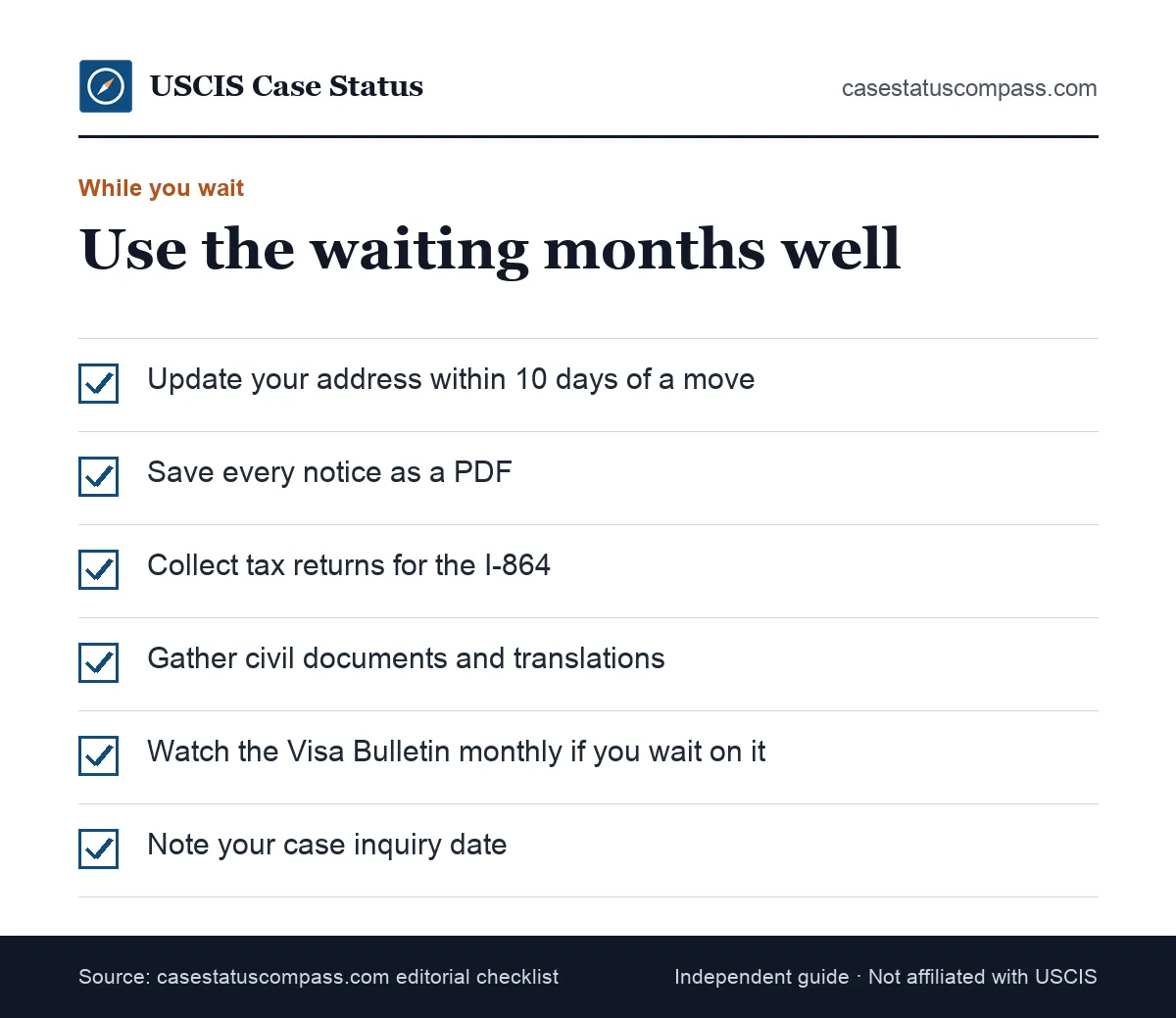
While the I-130 is pending, the petitioner can prepare for the next stages: save notices, keep the address current, collect tax records for the affidavit of support and gather civil documents. Good preparation shortens the NVC or I-485 stage after approval.
Preparing the affidavit of support
The petitioner later files Form I-864. Sponsors need income of at least 125% of the poverty guidelines (100% for active-duty military sponsoring spouse/child). Our Form I-864 guide explains the income test.
Keeping a date log
Save every notice as a PDF named with the receipt number. Keep a short log of filing, receipt, RFE, response and decision dates. That log makes any case inquiry faster.
How Accurate Are Online I-130 Timelines?
Forum and blog I-130 timelines are personal reports, not official data. They help show the order of events, but they often mix categories and offices. The only dated official figures are the USCIS medians and the live tool. Use them first.
Forum timelines and sampling bias
People with very fast or very slow cases post more often than average cases. Compare only with cases in your exact category and office, and treat them as anecdotes.
myProgress in your online account
myProgress: personalized estimates in your USCIS online account (I-130, I-485, I-765, I-131, I-821, N-400, I-90). These I-130 processing time estimates are not guaranteed and can shift as the queue moves. Rely on the case inquiry date for any action.
When Should You Get Legal Help With an I-130 Delay?
Talk to an immigration attorney or DOJ-accredited representative if your I-130 has an RFE you do not understand, a notice of intent to deny, a past immigration violation, a prior marriage-based petition or an age-out risk. A long wait alone usually does not need a lawyer.
Warning signs
- A child beneficiary is close to age 21.
- The beneficiary has a past removal or overstay.
- USCIS asks about an earlier marriage or petition.
- You received a notice of intent to deny or a denial.
Finding qualified help
Look for a licensed attorney in good standing or a representative at a DOJ-recognized organization. This site gives general information, not legal advice. Avoid notarios and "consultants" who cannot represent you.
How This Page Fits With Other Processing Time Guides
Start at our USCIS processing times hub to see every form. The petition itself, evidence and filing steps are in our Form I-130 petition guide. This page covers only timing. Use the hub to compare the I-130 wait with the next form in your path, such as the I-485 or N-400.
Employment-based timelines
If a relative may qualify through a job, the employer route starts with a Labor Department filing. Our PERM processing time page explains that separate wait.
Frequently Asked Questions
How long does I-130 approval take?
USCIS's April to June 2026 median was 13.0 months for immediate relatives of U.S. citizens and 43.3 months for all other relatives. The official tool shows your office's 80% figure.
How long does a spouse visa take?
It starts with an I-130 that had a 13.0-month median in April to June 2026 for a citizen's spouse. NVC and the embassy then add unmeasured time.
How long does it take to process Form I-130 for a sibling?
The USCIS stage uses the "all other relatives" median, 43.3 months in April to June 2026. After approval, the sibling waits for a current F4 priority date, which depends on country of birth.
Why is the processing times tool longer than the median?
The tool shows the time to finish 80% of cases over six months; the median shows the 50% point for one quarter. A higher percentile is usually longer.
Does the I-130 processing time start on the filing date?
No. The clock starts on the receipt date printed on Form I-797C. In family cases, that date is also your priority date for the Visa Bulletin.
What happens if my I-130 is approved but my priority date is not current?
USCIS sends the approved petition to NVC, where it waits until the priority date becomes current. Check the Visa Bulletin every month.
How long is the I-130 approval timeline for a child under 21?
A U.S. citizen's unmarried child under 21 is an immediate relative, so the 13.0-month median applies. A green card holder's child under 21 is F2A and also waits on the bulletin.
Is the I-130 waiting time for parents different from spouses?
No. Parents of adult U.S. citizens and citizens' spouses are both immediate relatives, so they share the 13.0-month median and never wait for a visa number.
Sources
- USCIS Check Case Processing Times. egov.uscis.gov/processing-times/. Accessed Oct 27, 2026.
- USCIS Data Library: All USCIS Application and Petition Form Types, FY2026 Q3 (XLSX). www.uscis.gov/sites/default/files/document/data/quarterly_all_forms_fy2026_q3_v1.xlsx. Accessed Oct 27, 2026.
- USCIS Data Library: All USCIS Application and Petition Form Types, FY2025 Q4 (XLSX). www.uscis.gov/sites/default/files/document/data/quarterly_all_forms_fy2025_q4_v1.xlsx. Accessed Oct 27, 2026.
- USCIS Historical Processing Times factsheet FY2016-2024 (PDF). www.uscis.gov/sites/default/files/document/fact-sheets/historical_pt_factsheet_fy16_to_fy24.pdf. Accessed Oct 27, 2026.
- CIS Ombudsman tip sheet: Check Your USCIS Case Inquiry Date (PDF). dhs.gov/sites/default/files/2024-11/24_0823_cisomb_case-inquiry-date-tip-sheet.pdf. Accessed Oct 27, 2026.
- USCIS: Visa Availability and Priority Dates. www.uscis.gov/green-card/green-card-processes-and-procedures/visa-availability-priority-dates. Accessed Oct 27, 2026.
- USCIS: Consular Processing. www.uscis.gov/green-card/green-card-processes-and-procedures/consular-processing. Accessed Oct 27, 2026.
- USCIS: How to Make an Expedite Request. www.uscis.gov/forms/filing-guidance/how-to-make-an-expedite-request. Accessed Oct 27, 2026.
- DHS CIS Ombudsman: How to Submit a Case Assistance Request. www.dhs.gov/case-assistance. Accessed Oct 27, 2026.
- USCIS: Form I-130 page. www.uscis.gov/i-130. Accessed Oct 27, 2026.
- USCIS Form G-1055 Fee Schedule (PDF). www.uscis.gov/sites/default/files/document/forms/g-1055.pdf. Accessed Oct 27, 2026.
- State Department Visa Bulletin for November 2026. travel.state.gov/content/travel/en/legal/visa-law0/visa-bulletin.html. Accessed Oct 27, 2026.
- USCIS Policy Manual Vol. 7, Part A, Ch. 5 (Interview Guidelines). www.uscis.gov/policy-manual/volume-7-part-a-chapter-5. Accessed Oct 27, 2026.
- State Department: NVC Timeframes (as of 26-Oct-26). travel.state.gov/content/travel/en/us-visas/immigrate/nvc-timeframes.html. Accessed Oct 27, 2026.
- 22 CFR 22.1 Schedule of Fees for Consular Services (LII). www.law.cornell.edu/cfr/text/22/22.1. Accessed Oct 27, 2026.
- USCIS: Adjustment of Status Filing Charts from the Visa Bulletin (updated 10/05/2026). www.uscis.gov/green-card/green-card-processes-and-procedures/visa-availability-priority-dates/adjustment-of-status-filing-charts-from-the-visa-bulletin. Accessed Oct 27, 2026.
- USCIS: Filing Locations and Online Filing Options Updates. www.uscis.gov/forms/us-citizenship-and-immigration-services-filing-locations-and-online-filing-options-updates. Accessed Oct 27, 2026.
- USCIS: How Do I Request Premium Processing? (updated 03/23/2026). www.uscis.gov/forms/all-forms/how-do-i-request-premium-processing. Accessed Oct 27, 2026.
- USCIS Contact Center (uscis.gov). www.uscis.gov/contactcenter. Accessed Oct 27, 2026.
- 8 CFR 103.2(b)(8)(iv) (LII). www.law.cornell.edu/cfr/text/8/103.2. Accessed Oct 27, 2026.
- 8 CFR 103.8(b) (LII). www.law.cornell.edu/cfr/text/8/103.8. Accessed Oct 27, 2026.
- USCIS Service Center Operations Directorate (updated 07/17/2026). www.uscis.gov/about-us/organization/directorates-and-program-offices/service-center-operations-directorate. Accessed Oct 27, 2026.
- USCIS: Form I-129F page. www.uscis.gov/i-129f. Accessed Oct 27, 2026.
- USCIS: Removing Conditions on Permanent Residence Based on Marriage. www.uscis.gov/green-card/after-we-grant-your-green-card/conditional-permanent-residence/removing-conditions-on-permanent-residence-based-on-marriage. Accessed Oct 27, 2026.
- USCIS: How to Change Your Address (updated 08/04/2026); 8 U.S.C. 1305(a) (LII). www.uscis.gov/addresschange. Accessed Oct 27, 2026.
- Form I-864 Instructions, Edition 08/24/26. www.uscis.gov/sites/default/files/document/forms/i-864instr.pdf. Accessed Oct 27, 2026.
- USCIS alert: USCIS Expands myProgress to Form I-485 and Form I-821 (Nov. 21, 2023). www.uscis.gov/newsroom/alerts/uscis-expands-myprogress-to-form-i-485-and-form-i-821. Accessed Oct 27, 2026.
casestatuscompass.com is an independent publication and is not affiliated with USCIS or any government agency. This page is general information, not legal advice. For denials, court or asylum matters, consult an immigration attorney or a DOJ-accredited representative.