Contents · 42 sections
- What Is the Current H-1B Processing Time?
- How Has the I-129 Median Changed Since 2025?
- How Do You Check H-1B Processing Times in the Official Tool?
- Median vs the 80% Figure for I-129 Petitions
- H-1B Approval Timeline
- What Are the Stages of the H-1B Process Timeline?
- What Is the H-1B Cap Season Timeline?
- Why Do H-1B Cap Cases Often Use Premium Processing?
- How Long Does an H-1B Petition Take After Lottery Selection?
- H-1B Regular vs Premium Processing
- How Long Does Premium H-1B Processing Take?
- What Does Premium Processing Cost for an H-1B?
- H-1B Extension and Amendment Timelines
- What Is the H-1B Extension Time Frame?
- What Is the H-1B Extension Processing Time in Texas?
- How Long Does an H-1B Amendment Take?
- H-4 Processing Time
- Why Can an H-4 Extension Take Longer Than the H-1B?
- Which Service Center Handles H-1B Petitions?
- What Happens If USCIS Transfers an H-1B to Another Center?
- Why Do Some H-1B Petitions Take Longer?
- How Does an RFE Change the H-1B Timeline?
- Is My H-1B Outside Normal Processing Time?
- What to Do If Your H-1B Is Delayed
- Is an H-1B Expedite Request Possible?
- Can You Upgrade a Pending H-1B to Premium?
- How Long After H-1B Approval Can You Start Work or Travel?
- How Long Does H-1B Visa Stamping Take?
- H-1B Timeline Estimator: Plan From the Filing Date
- Real-World H-1B Timeline Scenarios
- Does Filing Online Speed Up an H-1B?
- Did the October 2026 Address Change Affect H-1B Filings?
- Is the $100,000 Payment Slowing H-1B Petitions?
- Cap-Subject vs Cap-Exempt H-1B Timelines
- What Comes After the H-1B: PERM and Green Card Timelines
- How Accurate Are H-1B Tracker Timelines?
- Decision Table: If Your H-1B Is Taking Too Long
- Mistakes That Add Time to an H-1B Petition
- What Can the Worker Do While the H-1B Is Pending?
- When Should You Get Legal Help About an H-1B Delay?
- Where Else Should You Look for Related Timelines?
- Frequently Asked Questions
At a glance
| Regular (all I-129 classes) | I-129 (all classifications combined): median 9.5 months (USCIS data, Apr.-June 2026) |
| Premium processing | 15 business days for Form I-129 |
| Premium fee | $2,965 for H-1B (G-1055, edition 10/16/26) |
| H-4 extension (Form I-539) | I-539: median 5.7 months (USCIS data, Apr.-June 2026) |
| Live estimate | egov.uscis.gov/processing-times |
What Is the Current H-1B Processing Time?
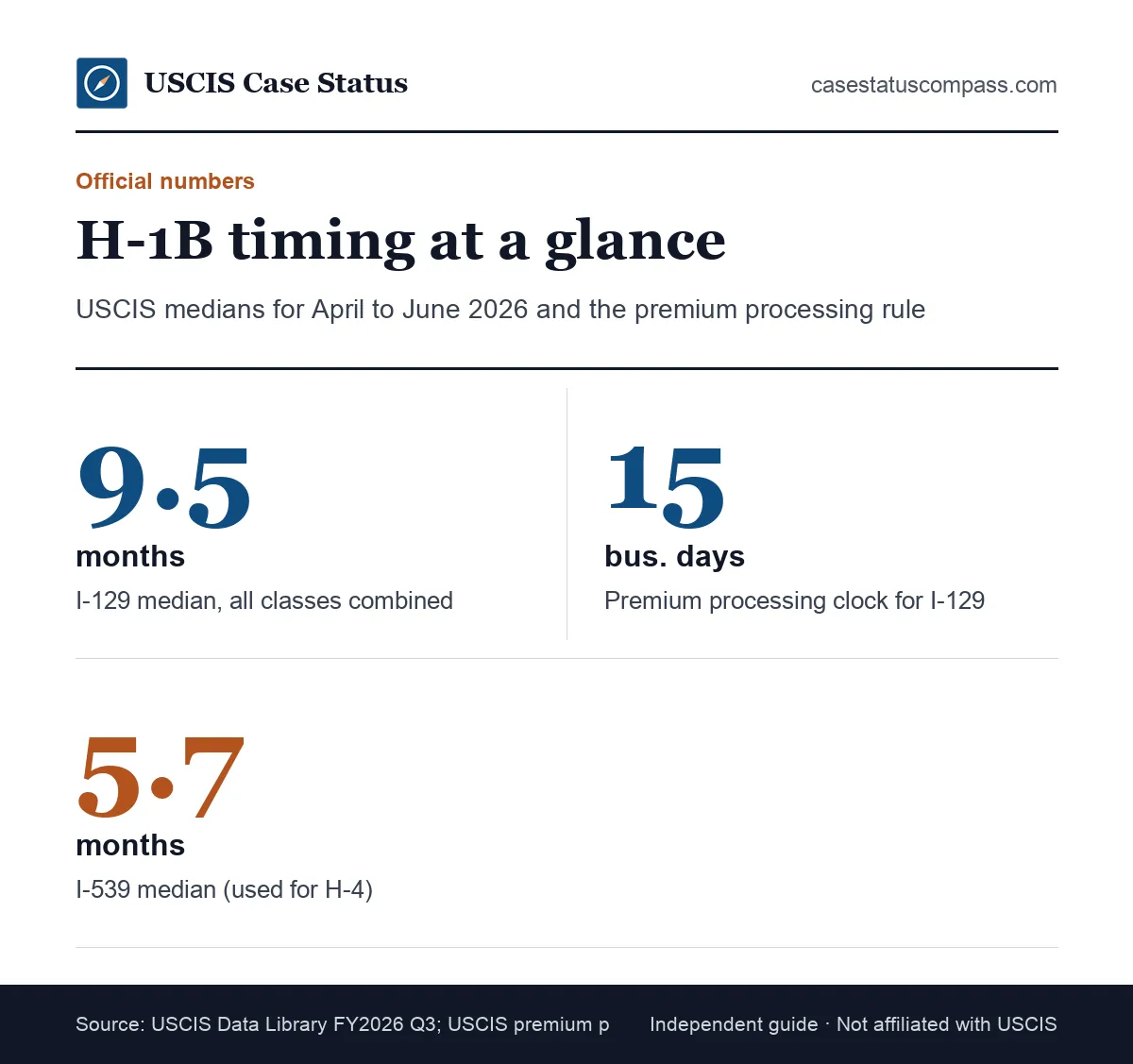
The current H-1B processing time can only be estimated from the Form I-129 median, since no H-1B-only median exists. For I-129 petitions completed between April 1 and June 30, 2026, the median for all classifications combined was 9.5 months. Premium cases are decided far faster.
Official H-1B timing figures for 2025 and 2026
The table sets the all-classes I-129 median for two quarters beside the premium clock and the I-539 median.
| Measure | Official figure | Covers |
|---|---|---|
| I-129 median, Apr.-June 2026 | 9.5 months | Every I-129 class combined (H-1B, L-1, O-1 and others) |
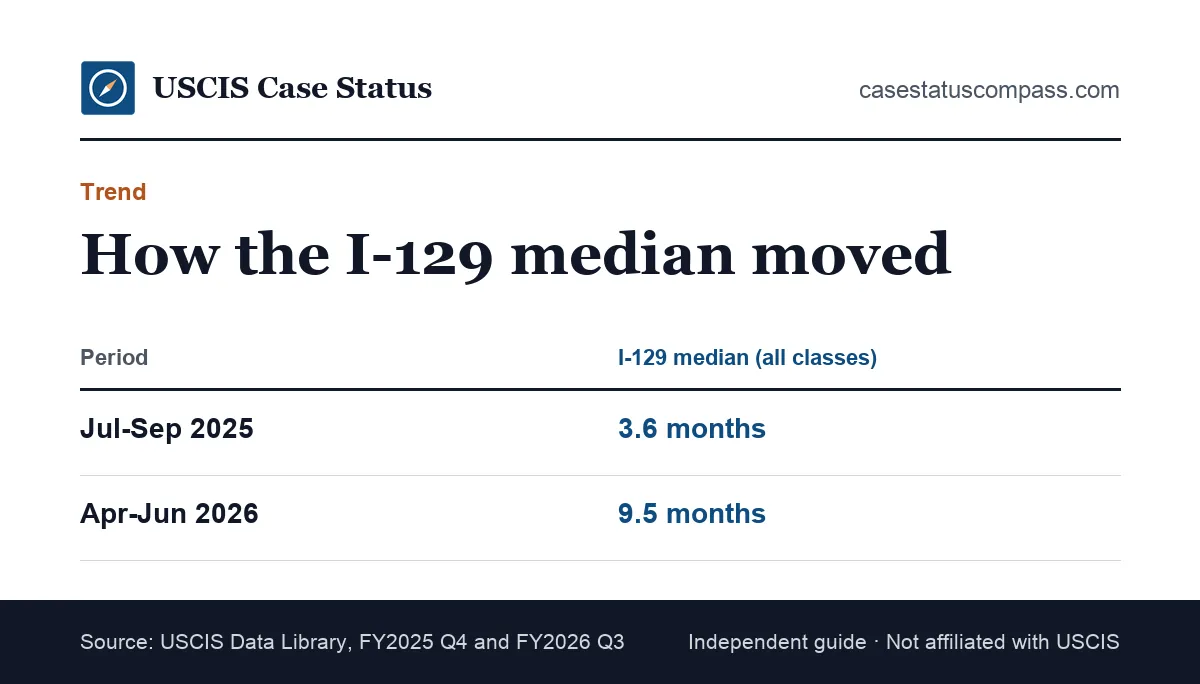
| I-129 median, July-Sept. 2025 | 3.6 months | Same, one year earlier |
| Premium processing | 15 business days | I-129 petitions with Form I-907 |
| I-539 median, Apr.-June 2026 | 5.7 months | All I-539 filings, including H-4 |
Takeaway: the regular median grew about 2.6 times in a year, while the premium window stayed at 15 business days.
Why there is no H-1B-only median
The USCIS Data Library groups every I-129 classification into one line, so an H-1B extension, an L-1 transfer and an O-1 petition share the same 9.5-month median. Your H-1B processing time could be faster or slower.
What the median measures
The median runs from the receipt date to a USCIS decision for cases completed in the quarter. Half of those cases took longer. It is a quarterly snapshot, so it lags the live tool by months.
How Has the I-129 Median Changed Since 2025?
The I-129 median rose sharply, from 3.6 months in July to September 2025 to 9.5 months in April to June 2026. So plan a regular H-1B case filed today with far more lead time than a year ago. That is a rise of almost six months.
What the jump means for employers
A start date that once fit inside a regular-processing window may now need premium processing. Teams that file extensions months ahead are less exposed. Build the new median into budget and hiring calendars, and into every regular H-1B processing time estimate.
How Do You Check H-1B Processing Times in the Official Tool?
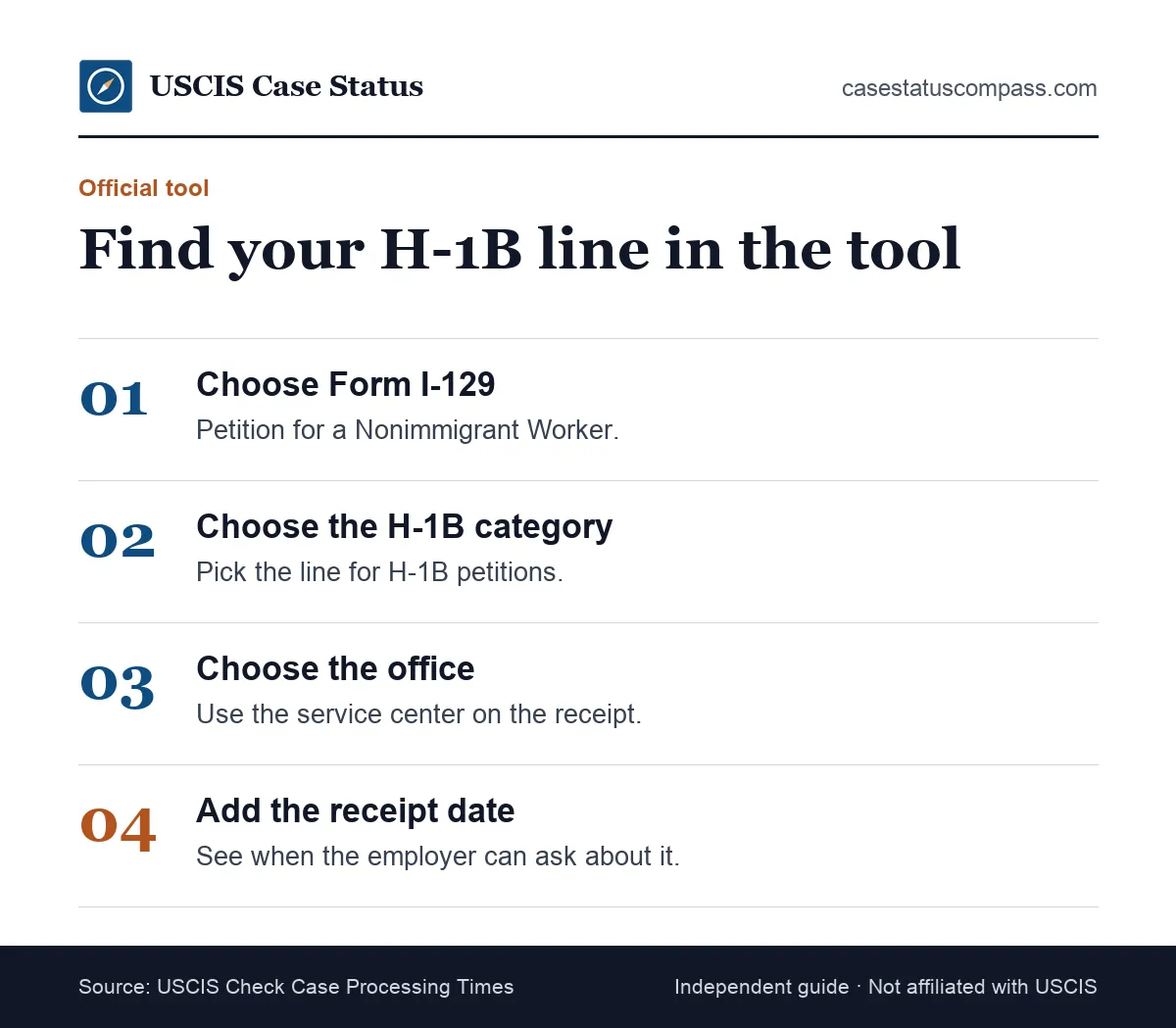
To check H-1B processing times, open egov.uscis.gov/processing-times, choose Form I-129, then the H-1B category and the service center on the receipt notice. The tool shows how long it took to finish 80% of those cases recently. Adding the receipt date shows the case inquiry date.
Current I-129 figures by category and office
| Category | Office | 80% of cases completed within |
|---|---|---|
| E - Treaty traders and investors | Service Center Operations (SCOPS) | 20 months |
| E3 - Specialty occupation workers from Australia | Service Center Operations (SCOPS) | 5 months |
| H-1B - Specialty occupation - Change of status in the U.S. | Service Center Operations (SCOPS) | 10 months |
| H-1B - Specialty occupation - Extension of stay in the U.S. | Service Center Operations (SCOPS) | 11.5 months |
| H-1B - Specialty occupation - Visa to be issued abroad | Service Center Operations (SCOPS) | 11 months |
| H-2A - Temporary agricultural workers - Named Beneficiary | Service Center Operations (SCOPS) | 15 days |
| H-2A - Temporary agricultural workers - Unnamed Beneficiary | Service Center Operations (SCOPS) | 15 days |
| H-2B - Temporary nonagricultural workers | Service Center Operations (SCOPS) | 4 months |
| H-3 - Temporary trainees | Service Center Operations (SCOPS) | 17 months |
| Intracompany transferees and blanket L | Service Center Operations (SCOPS) | 6.5 months |
| O - Extraordinary ability | Service Center Operations (SCOPS) | 14.5 months |
| P - Athletes, artists, and entertainers | Service Center Operations (SCOPS) | 13 months |
| Q - Cultural exchange visitors | Service Center Operations (SCOPS) | 7 months |
| R - Religious occupation | Service Center Operations (SCOPS) | 9.5 months |
| TN - United States-Mexico-Canada Agreement (USMCA, formerly NAFTA) professional | Service Center Operations (SCOPS) | 4.5 months |
Right now, regular H-1B petitions take 10 to 11.5 months, depending on category and office (USCIS data retrieved Oct 27, 2026).
Picking the right office
The office is printed on the I-797C receipt. If USCIS later transfers the petition, use the new office. Our USCIS service centers guide explains which center is which.
Median vs the 80% Figure for I-129 Petitions
USCIS publishes two numbers that bear on H-1B processing time. The quarterly median is the 50% point for cases completed in one quarter. The live tool's figure is the 80% point over the past six months. The 80% figure is usually longer, and neither is a promise for one petition.
Which number to use when
USCIS's explanation (checked October 2026): The USCIS tool shows how long it took to finish 80% of cases in the past 6 months. Use the tool's H-1B line for planning a specific case. Use the median for broad trends.
H-1B Approval Timeline
The H-1B approval timeline runs from filing the I-129 to a USCIS decision, then on to visa stamping or a status change. With premium processing, the USCIS step takes 15 business days unless there is an RFE. With regular processing, plan around the tool's H-1B line and the 9.5-month all-classes median.
What Are the Stages of the H-1B Process Timeline?
The H-1B process timeline has seven stages, from the labor condition application to visa stamping. Each stage has a different owner, so a hold-up can sit with the employer, the Department of Labor, USCIS or a U.S. embassy. Knowing who acts next tells you where to look.
H-1B process timeline by stage
Each row is one stage, listed in order, with the party that acts at that point.
| Stage | Who acts | Typical timing source |
|---|---|---|
| Labor condition application (LCA) | Employer, Department of Labor | Before the petition is filed |
| I-129 filed, receipt issued | Employer, USCIS | Form I-797C receipt notice |
| Review (regular) | USCIS | Tool's H-1B line; 9.5-month all-classes median |
| Review (premium) | USCIS | 15 business days from I-907 receipt |
| Request for evidence, if any | Employer | Deadline printed on the RFE |
| Approval notice | USCIS | Form I-797 approval |
| Visa stamping (if abroad) | State Department | Embassy appointment calendar |
Only three of the seven stages fall inside USCIS timing data.
The parts USCIS measures
Only filing, review and decision count in the USCIS figures. The LCA step happens before filing, and stamping happens after. So a slow LCA or a long consular wait never shows in the I-129 median.
The parts nobody measures officially
Each embassy sets its own calendar for visa stamping. Our US visa status guide explains how to track the consular step. Ask the embassy, not USCIS, when the stamping calendar is the hold-up.
What Is the H-1B Cap Season Timeline?
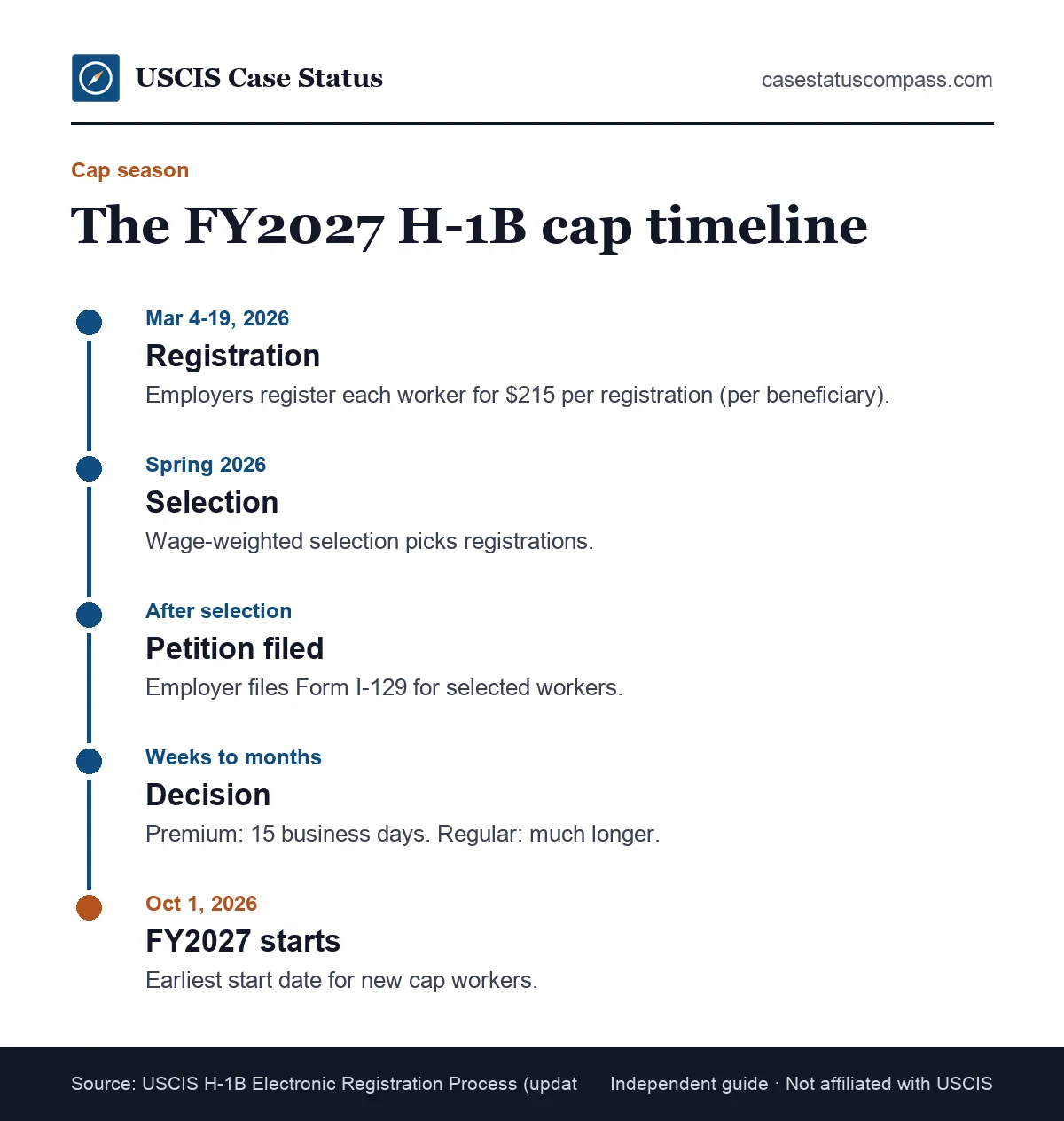
The cap season timeline follows the fiscal year. For FY2027, employers registered workers from March 4 to March 19, 2026, at $215 per registration (per beneficiary). Selected registrations could then be filed as I-129 petitions, with October 1, 2026 as the earliest start date for new cap workers.
Registration and selection
As of September 2026, USCIS says the FY2027 selection was wage-level weighted, not a pure random lottery, and that the FY2027 regular and master's caps have been reached. H-1B cap: 65,000 a year + 20,000 for U.S. master's degree or higher.
Why Do H-1B Cap Cases Often Use Premium Processing?
After selection, the employer files the petition within the filing period stated on the selection notice. Because the start date is fixed at the fiscal year, a regular case filed late in the window may still be pending on October 1. That is a common reason employers choose premium processing for cap cases.
How Long Does an H-1B Petition Take After Lottery Selection?
After lottery selection, the H-1B petition takes 15 business days with premium processing (unless USCIS sends an RFE), or as long as the regular queue for the office. For April to June 2026, the regular all-classes I-129 median was 9.5 months.
Regular processing after selection
The clock starts at the receipt date, not the selection date. If the employer files weeks after selection, the wait starts then. Ask the employer for the receipt date as soon as the I-797C arrives.
Premium processing after selection
With Form I-907, USCIS must take action within 15 business days of receiving it. Action can mean an approval, a denial or an RFE. It guarantees timely action, never approval.
H-1B Regular vs Premium Processing
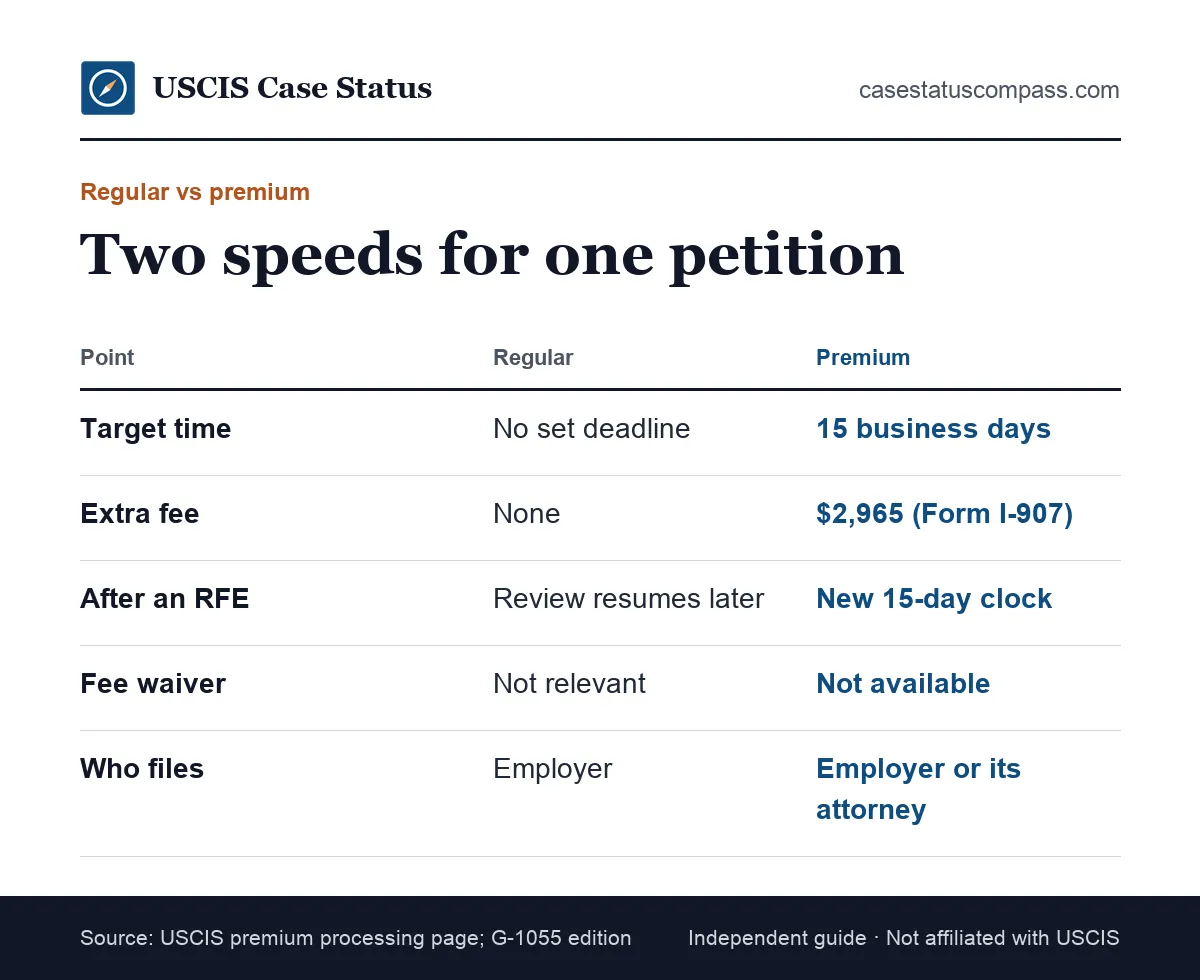
H-1B regular processing time has no deadline and follows the queue at the office. Premium processing costs an extra $2,965 for H-1B petitions and requires USCIS to act within 15 business days. Premium buys speed and certainty about timing, never a better chance of approval.
Regular and premium H-1B processing side by side
The rows set the two options against each other on cost, clock and what each one promises.
| Point | Regular processing | Premium processing |
|---|---|---|
| Time limit | None; follows the office queue | 15 business days to act |
| Extra fee (Oct. 2026) | None | $2,965 for H-1B |
| What "action" means | Decision or RFE, whenever reached | Approval, denial, RFE or NOID within the window |
| After an RFE | Review resumes after the response | A new 15-day period starts at the response |
| Fee waiver | Not relevant | Not available |
| Can upgrade later? | Yes, by filing Form I-907 | Already premium |
Premium changes only the timing; the evidence standard is the same either way.
When regular processing is enough
Regular processing can work for extensions filed early, when the current approval has many months left. Ask your attorney whether the worker can keep working on your exact dates if the case is still pending.
When premium usually makes sense
Premium fits job changes with a fixed start date, travel plans that need an approval notice, and cap cases that must finish before October 1. Our premium processing guide covers how to request it.
How Long Does Premium H-1B Processing Take?
Premium H-1B processing time is 15 business days from the date USCIS receives a properly completed Form I-907 at the correct address. Within that window, USCIS must approve, deny or issue an RFE or a notice of intent to deny. Business days exclude weekends and federal holidays.
Counting business days
Count from the I-907 receipt date, not the mailing date. Fifteen business days is usually about three calendar weeks. A federal holiday in the window pushes the deadline back by one day.
What happens after an RFE
The rule as of October 2026: An RFE stops the premium clock; a new period starts when USCIS gets your response. So one RFE can add several weeks. A complete first filing keeps premium fast.
What Does Premium Processing Cost for an H-1B?
As of October 2026, the premium processing fee for an H-1B petition is $2,965, set by Form G-1055 (edition 10/16/26). It is paid on top of the regular filing fees. You can't get a fee waiver for premium processing. Fees for other forms differ: $2,965 (I-129 most classes, I-140); $1,780 (H-2B/R, I-765 OPT); $2,075 (I-539 to F/J/M).
Who pays the premium fee
Only the petitioner (the employer) or its representative can file Form I-907; the worker cannot sign it. Full H-1B package fees are on our work visa and EAD fees page.
H-1B Extension and Amendment Timelines
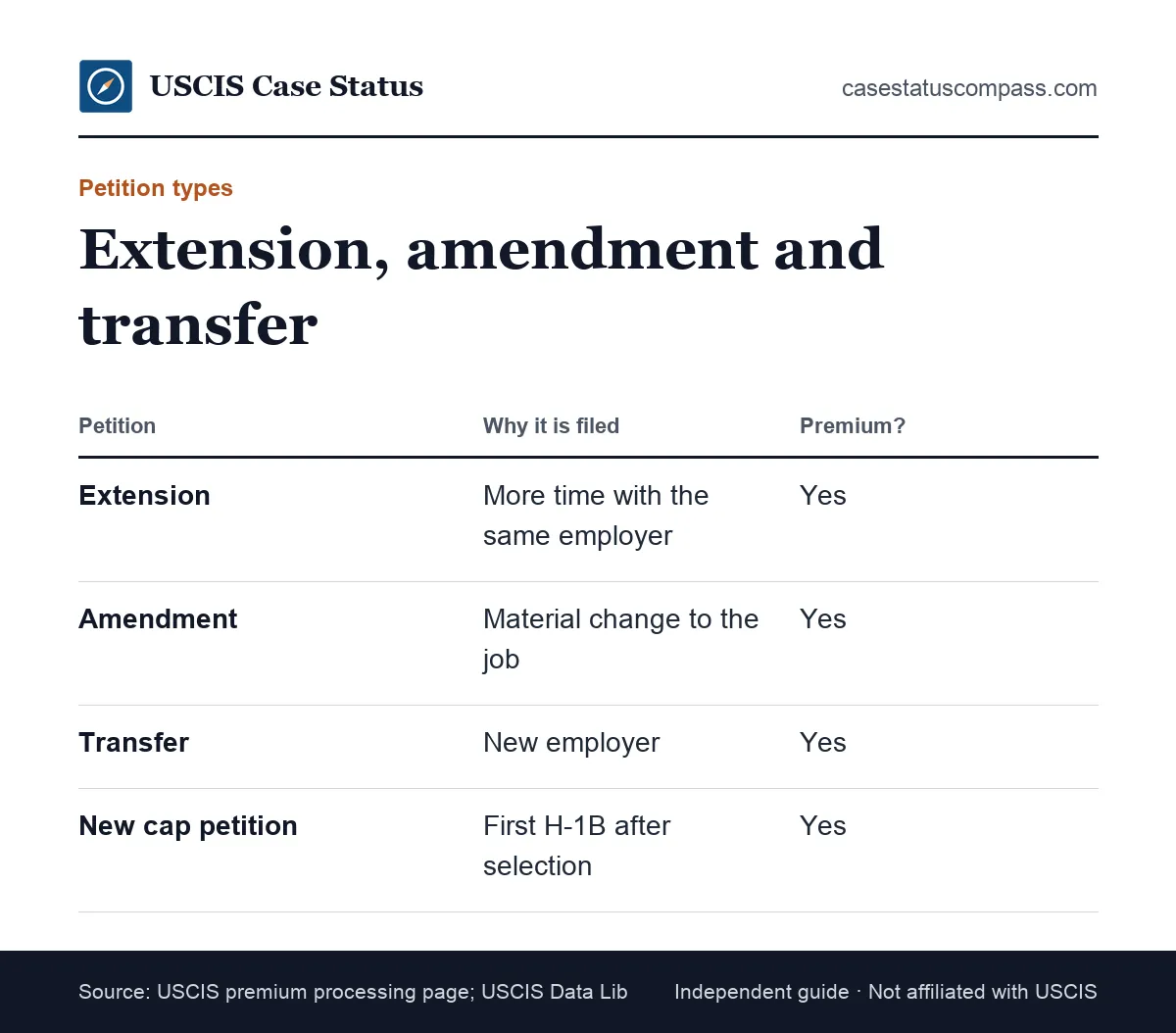
Extensions, amendments and transfers are all Form I-129 petitions, so they share the same timing tools: the tool's H-1B line, the all-classes median and the premium option. The difference is why the petition is filed, not how USCIS times it.
Extension, amendment, transfer and concurrent petitions compared
Each row is a different reason for filing the same Form I-129.
| Petition | Why it is filed | Premium available? | Timing source |
|---|---|---|---|
| Extension | More time with the same employer | Yes | Tool's H-1B line; I-129 median |
| Amendment | Material change to the job or worksite | Yes | Same |
| Transfer (change of employer) | Moving to a new employer | Yes | Same |
| Concurrent employment | A second H-1B job | Yes | Same |
All four share the regular queue and the premium option, so choose by purpose, not by speed.
H-1B extension timeline
An H-1B extension timeline starts at the receipt date and follows the same queue as other I-129 cases. Filing well before the current approval ends avoids a gap in status.
H-1B amendment timeline
The H-1B visa amendment processing time follows the same line. Our H-1B visa status guide explains when an amendment may be needed; this page covers only the wait. Plan it like an extension.
What Is the H-1B Extension Time Frame?
The H-1B extension time frame has two parts: the legal limit on total H-1B time and the processing wait. USCIS sets the limit (checked October 2026). H-1B: 3 years at first, up to 6 years in total. The processing wait follows the tool's H-1B line or 15 business days with premium.
Planning around the six-year limit
Workers near the six-year limit need careful timing, especially if a green card case is pending. Ask an immigration attorney to map extensions past six years. Bring the I-94 and every approval notice to that meeting.
What Is the H-1B Extension Processing Time in Texas?
People often search for the H-1B extension processing time in Texas because the Texas Service Center handles many cases. USCIS lists its centers (checked October 2026). Five USCIS service centers: California, Nebraska, Potomac, Texas and Vermont. The tool now lists H-1B petitions under Service Center Operations (SCOPS), not by center, so Texas cases share the national figure: extensions take 11.5 months (USCIS data retrieved Oct 27, 2026).
Finding the Texas Service Center line
In the official tool, choose Form I-129, then the H-1B category, then the Texas Service Center. Enter the receipt date from the I-797C to see that center's case inquiry date. Recheck it monthly, because center speeds shift.
How Long Does an H-1B Amendment Take?
An H-1B amendment takes as long as any other I-129 in the same office: the tool's H-1B line with regular processing, or 15 business days with premium. USCIS does not publish a separate amendment median. Plan around the same office line as an extension.
Timing the amendment with a job change
Employers usually file before the change takes effect. If the new worksite or role starts soon, premium processing may be the only way to get a decision first. Confirm the start date with the attorney.
H-4 Processing Time
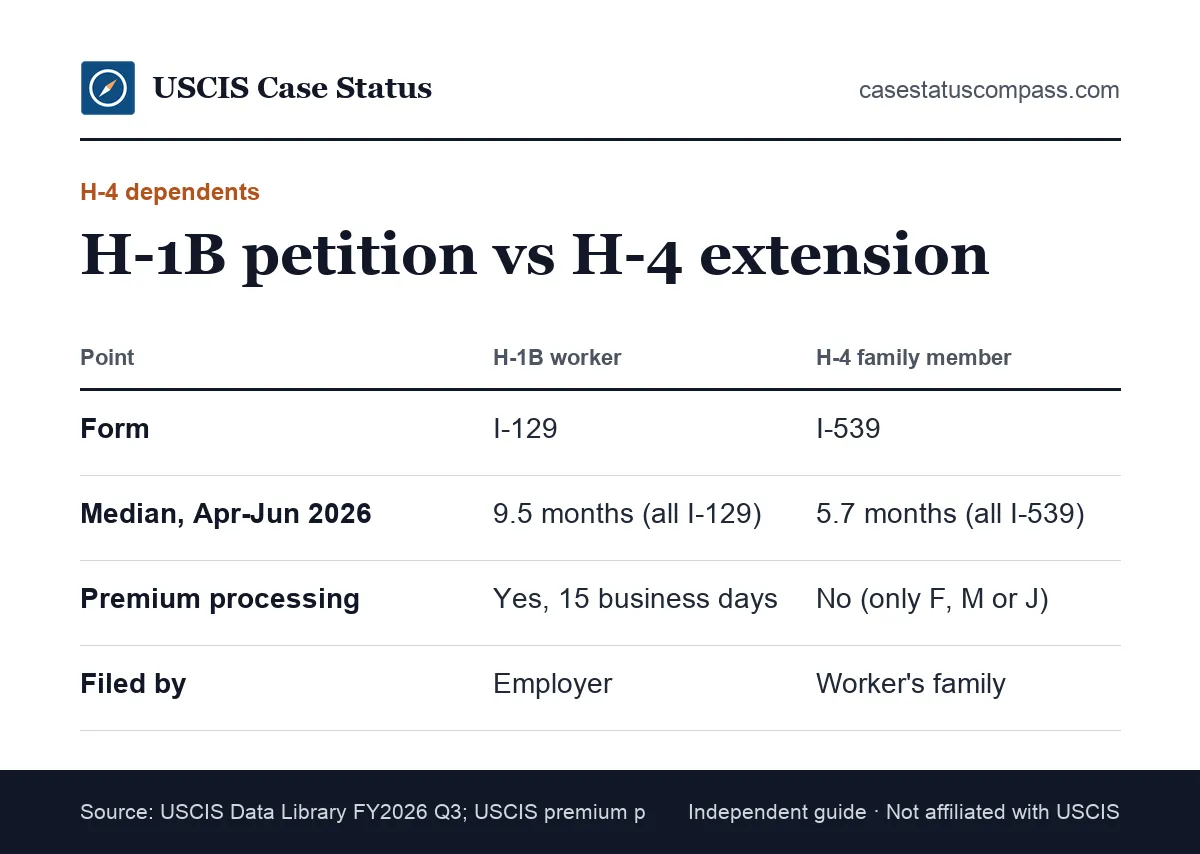
H-4 processing time depends on Form I-539, which family members file to extend or change to H-4 status in the U.S. For April to June 2026, USCIS listed I-539: median 5.7 months (USCIS data, Apr.-June 2026). That median covers every I-539 category, not only H-4.
H-4 extension processing time
The H-4 extension processing time starts at the I-539 receipt date. Filing the I-539 together with the worker's I-129 keeps the dates aligned, but USCIS may still decide them separately. As of October 2026, the I-539 fee is $470 (paper) / $420 (online).
H-4 work permits
An H-4 spouse's work permit uses Form I-765, a different queue with its own times. Our work permit processing time page covers that wait. Automatic EAD extensions also changed (checked October 2026). Ended: renewals filed on or after Oct. 30, 2025 no longer get the up-to-540-day automatic extension (exceptions: TPS by law/Federal Register notice; STEM OPT 180 days).
Why Can an H-4 Extension Take Longer Than the H-1B?
An H-4 extension can take longer because premium processing is not available for H-4 on Form I-539. As of October 2026, premium processing for I-539 covers only a change to F, M or J status. So an H-1B upgraded to premium can be approved weeks before the family's H-4 case.
Separate queues, separate decisions
The worker's I-129 and the family's I-539 are separate filings with separate receipt numbers. Track both receipts in Case Status Online. One can be approved while the other is still pending, so check each one.
What families can do
File the I-539 on time and complete. Keep the receipt notice with travel documents. If the H-4 case falls outside normal processing time, the family can submit its own inquiry.
Which Service Center Handles H-1B Petitions?
The service center that handles an H-1B petition is shown on the I-797C receipt notice. The receipt prefix, such as EAC, WAC or SRC, shows where USCIS first received the case. A prefix tells you where the case started, not always where it sits today.
Reading the prefix
EAC = Vermont SC; WAC = California SC; LIN = Nebraska SC; SRC = Texas SC; NBC/MSC = National Benefits Center; YSC = Potomac SC; MCT = I-539 filings; IOE = online/electronic filing. Our receipt number guide decodes each prefix in more detail.
What Happens If USCIS Transfers an H-1B to Another Center?
USCIS sometimes moves petitions to balance work, so a transfer is a workload step, not a decision on the petition. A transfer notice names the new center. Switch your tool search to that center, because the time already spent still counts from the original receipt date.
Why Do Some H-1B Petitions Take Longer?
Some H-1B petitions take longer because of requests for evidence, questions about the job or employer, office workload or filing errors. With regular processing, the backlog itself is often the main cause. A long wait does not by itself signal a problem.
Common RFE topics
H-1B RFEs often ask for more proof that the job is a specialty occupation, that the worker's degree fits the role, or that the employer has work for the full period.
Filing errors
A wrong fee, a missing signature or an outdated form can lead to a rejection. A rejected petition gets no receipt date, so the clock never starts. Check the current form edition first.
Office workload
Offices with heavy caseloads move slower. The jump in the I-129 median, from 3.6 to 9.5 months in a year, shows how much this can change. Recheck your office's tool line monthly, since the H-1B processing time there moves with it.
How Does an RFE Change the H-1B Timeline?
An RFE pauses the H-1B processing time clock until USCIS receives the response. The deadline is printed on the notice. RFE deadline: up to 12 weeks (the exact date is on your RFE); no extensions. An H-4 spouse's Form I-539 is the exception: RFEs for Form I-539 and Form I-601A allow at most 30 days (all other forms up to 84 days), plus 3 days if mailed. In premium cases, a new 15-business-day period starts when USCIS gets the response. In regular cases, review resumes when an officer reaches the file again.
Response timing
If USCIS mailed the notice, add 3 days to the deadline. Send all requested evidence together, because a partial response is treated as a request for a decision on the record.
Tracking the response
Once the response arrives, the case status usually changes to show it. Our request for evidence guide explains how to prepare a strong response. If nothing changes within a few weeks, confirm delivery with the mail tracking record.
Is My H-1B Outside Normal Processing Time?
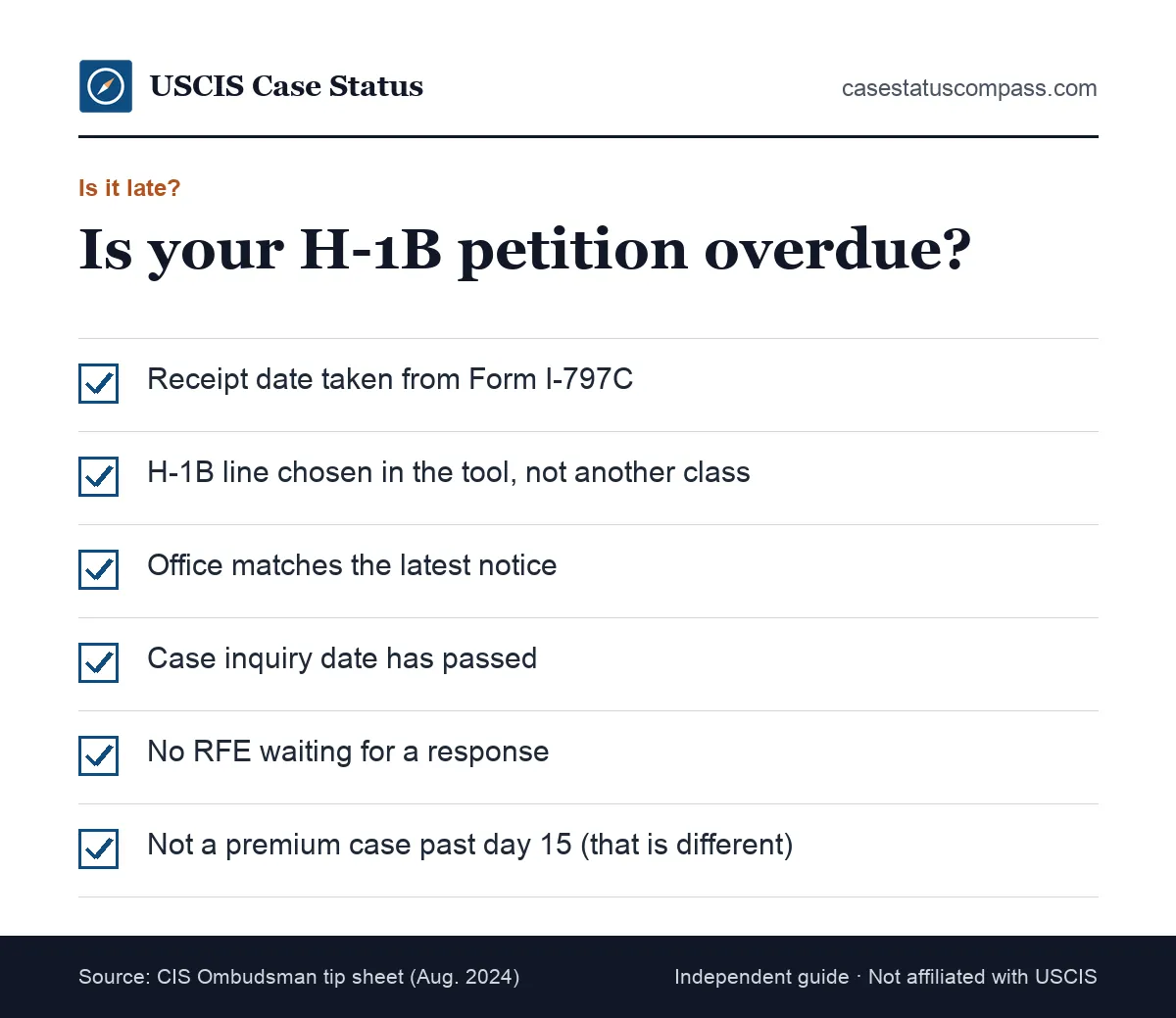
A regular H-1B petition is outside normal processing time once today's date passes the case inquiry date the tool gives for its receipt date. USCIS accepts outside-normal service requests only after that date. A premium case past 15 business days without action is a different issue, handled under premium rules.
What the case inquiry date means
Case inquiry date: the earliest date USCIS will accept a question about your pending case; it can change. Use the receipt date on the I-797C, and recheck it, because the date moves when office speed changes.
Common reasons a case only looks late
- Picking a different I-129 class than H-1B.
- Using the original office after a transfer.
- Counting from the mailing date instead of the receipt date.
- Forgetting an RFE that reset the review.
What to Do If Your H-1B Is Delayed
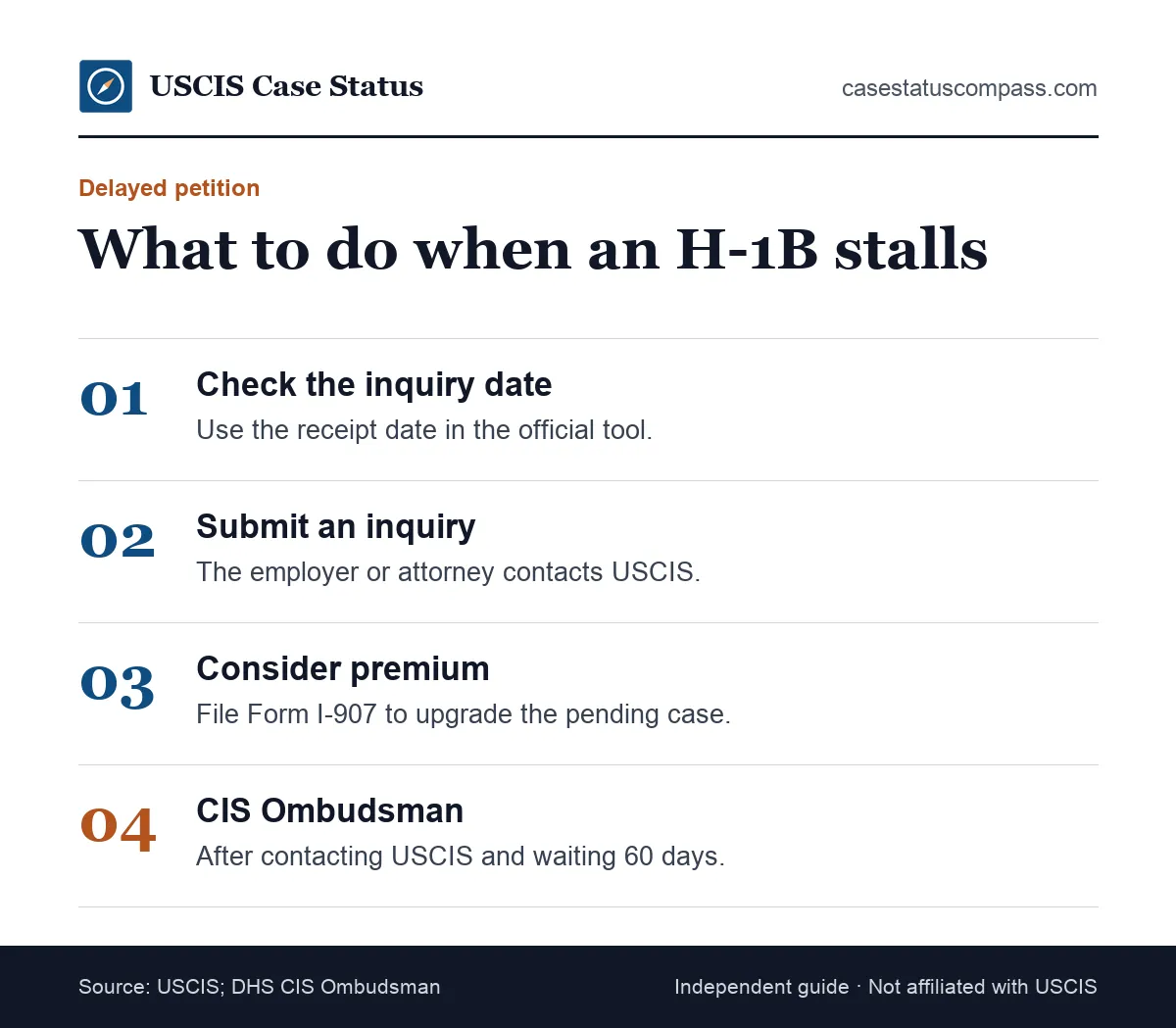
If a regular H-1B is past its case inquiry date, the employer or attorney should submit an outside-normal inquiry. Upgrading to premium processing is often the fastest fix. Expedites are rarely an option. Keep the worker informed, because status deadlines follow the worker's I-94.
Inquiry and Ombudsman
The petitioner can call the USCIS Contact Center at 800-375-5283 or use the tool's inquiry link. If that fails, the CIS Ombudsman may help. Use the Ombudsman only after contacting USCIS within 90 days and waiting at least 60 days. Our ombudsman and congressional help guide explains the next step.
Is an H-1B Expedite Request Possible?
Generally no, so the usual expedite route is closed to most H-1B employers. As of October 2026, USCIS says it will not consider expedites for forms where premium processing is available, with the nonprofit exception. Most employers use a premium upgrade instead. Our expedite request guide covers forms where expedites do apply.
Can You Upgrade a Pending H-1B to Premium?
Yes. The employer can file Form I-907 for an H-1B petition that is already pending in regular processing. The 15-business-day clock starts when USCIS receives the properly completed I-907 at the correct address. The petition keeps its original receipt date.
Who can request the upgrade
Only the petitioner or its attorney or accredited representative can file Form I-907. The fee is the same as at filing: $2,965 for H-1B. The worker can ask the employer, but cannot file it.
When the upgrade makes sense
An upgrade helps when a start date, travel plan or status deadline is near. It is less useful if the case already has an RFE pending, because the premium clock waits for the response.
How Long After H-1B Approval Can You Start Work or Travel?
After H-1B approval, timing depends on where the worker is. A worker in the U.S. with an approved change of status can start on the approved start date. A worker abroad needs a visa stamp from a U.S. embassy, which adds an appointment wait that USCIS does not measure.
Inside the U.S.
The approval notice shows the validity dates. For a new cap worker, the earliest start date is October 1 of the fiscal year. An extension approval lets the worker keep working under the new dates.
Outside the U.S.
The worker books a visa appointment at the embassy. The State Department sets that calendar, not USCIS, so waits differ by country and season. Bring the approval notice and passport to the interview.
How Long Does H-1B Visa Stamping Take?
H-1B visa stamping time depends on the U.S. embassy or consulate, not USCIS. We found no official median for stamping appointments or visa printing. Check the embassy's own appointment page and plan travel buffers around the petition approval date.
Why stamping is separate
USCIS approves the petition; the State Department issues the visa. An approved I-129 is not a visa, and a visa is not needed to stay in the U.S. if the worker never leaves.
H-1B Timeline Estimator: Plan From the Filing Date
You can estimate an H-1B timeline by starting from the receipt date, adding the premium window or the tool's regular figure, and then adding time for stamping if the worker is abroad. This gives a planning date, not a promise, for cap, extension and transfer petitions alike.
Milestones to add up from the receipt date
Add each row's time to the receipt date to build a rough plan.
| Milestone | How to estimate it | Where to confirm it |
|---|---|---|
| Receipt date | Printed on Form I-797C | Notice or online account |
| Premium decision | Receipt of I-907 + 15 business days | USCIS premium processing page |
| Regular decision | Receipt + tool's H-1B line (or 9.5-month all-classes median) | Official processing times tool |
| Case inquiry date | Enter receipt date in the tool | Official processing times tool |
| Start or stamping | Approval + embassy wait if abroad | Embassy appointment page |
Stamping is the least predictable row, so keep extra room for it.
A worked premium example
An employer's I-907 is received on Monday, June 1, 2026. Counting 15 business days from the next day lands on about Monday, June 22, and the Juneteenth holiday on Friday, June 19 pushes that to about Tuesday, June 23. The attorney confirms the count.
A worked regular example
An extension is received on January 5, 2026. Adding the 9.5-month median gives mid-October 2026 as a rough planning month. The employer checks the tool's H-1B line for its office and notes the case inquiry date.
Real-World H-1B Timeline Scenarios
These scenarios use fictional workers and the official figures above. Each is a planning example, not a prediction. Names and dates are made up. They show how the receipt date, the premium choice and family filings shape a plan. Match the scenario closest to yours, then check your own office's tool line before setting any date.
A new cap worker on F-1
Priya was selected in the FY2027 registration. Her employer files with premium processing, so a decision comes within 15 business days unless there is an RFE. Her start date is October 1, 2026.
An extension near year six
Omar's employer files his extension in regular processing many months early. The case follows the tool's H-1B line. His wife's H-4 extension is filed the same day on Form I-539, with its own receipt.
A transfer with a fixed start date
Lena accepts a new job starting in five weeks. The new employer files with premium processing so the approval arrives before her start date. Her H-4 husband files his I-539 at the same time.
Does Filing Online Speed Up an H-1B?
USCIS publishes no separate median for online I-129 filings, so we cannot say online filing is faster. On October 7, 2026, USCIS added PDF-upload online filing for more I-129 categories. It gives an instant receipt. The review speed itself stays the same.
What online filing changes
Online filing changes the steps around the petition, not the officer's review:
- No mail transit time before USCIS gets the case.
- The receipt appears right away.
- Notices arrive in the online account.
- Some evidence can be uploaded.
What it does not change
Online and paper H-1B petitions wait in the same review queue. The premium option and the 15-business-day clock work the same way for both. Choose the method that suits the attorney's workflow.
Did the October 2026 Address Change Affect H-1B Filings?
Yes, for paper filers. New USCIS mailing addresses from Oct. 7, 2026; old addresses accepted if postmarked by Nov. 9, 2026. Forms I-129, I-907 and I-539 are on that list. Mail sent to the wrong address after the grace period can be rejected.
Checking the address before filing
Copy the address from the current uscis.gov form page on the day you file. Premium I-907 filings have their own addresses, which also changed. A wrong address can cost the receipt date.
If a package was rejected
Refile at the correct address with the correct fee. The new receipt date restarts the clock, which is why a rejection close to a start date often leads to premium processing.
Is the $100,000 Payment Slowing H-1B Petitions?
The $100,000 H-1B payment is not being collected right now, so it should not be holding up petitions. As of October 2026: $100,000 H-1B payment: blocked by court order (vacated June 8, 2026; stay denied July 24, 2026). DHS says it still intends to collect if the order is lifted, so check before filing.
What to watch
Court orders can change quickly. Our H-1B visa status guide tracks the details of who the rule covered. Check the USCIS H-1B page before each filing for any new payment instructions.
Cap-Subject vs Cap-Exempt H-1B Timelines
Cap-subject petitions follow the registration season and the October 1 start date. Cap-exempt petitions, and extensions or transfers of workers already counted against the cap, are not tied to the registration window. All of them use the same I-129 processing queues and premium option.
Cap-subject timing
The employer can file only after selection, and the worker usually cannot start before October 1. Filing early in the window gives the most room for a regular case. The selection notice states the window.
Cap-exempt and already-counted workers
These petitions can be filed year-round. Their timing depends only on the office queue or the premium clock, which makes planning simpler. Universities and some nonprofit research groups are common cap-exempt employers.
What Comes After the H-1B: PERM and Green Card Timelines
Many H-1B workers later pursue a green card through their employer. That path usually starts with a PERM labor certification, then Form I-140, then a green card application. Each step has its own processing time. Add them together to plan the full path.
The employment green card steps
Our PERM processing time page covers the Labor Department step. For April to June 2026, USCIS listed I-140: median 3.9 months (USCIS data, Apr.-June 2026). See our green card processing time guide for the full H-1B to green card path.
Why this matters for extensions
A pending green card case can affect how long the worker may stay in H-1B status. Plan each extension with an attorney who sees both cases. Some extensions past six years depend on those steps.
How Accurate Are H-1B Tracker Timelines?
Online H-1B trackers are personal reports, not official data. Many mix premium and regular cases, centers and petition types. The only official figures are the USCIS medians, the live tool and the 15-business-day premium rule. Use trackers for mood, not for dates.
Why trackers mislead
A tracker full of premium approvals makes regular processing look fast. Compare only cases in your exact category, office and processing type. Self-reported entries also skip slow cases that never get posted, which makes the typical H-1B processing time look shorter.
Decision Table: If Your H-1B Is Taking Too Long
Use this table to match the situation to the next step. Most regular H-1B delays only need patience until the case inquiry date. After that, an inquiry or a premium upgrade usually comes first. Premium cases and H-4 filings have their own rows, because their clocks and remedies differ.
H-1B delay situations and next steps
Find the row that matches the case today, then take the step in the second column.
| If this is true | Then do this |
|---|---|
| Regular case, before case inquiry date | Wait, or upgrade to premium if a date is near |
| Regular case, past case inquiry date | Employer submits an outside-normal inquiry |
| Premium case, past 15 business days with no action | Attorney contacts USCIS under premium rules |
| RFE received | Respond fully before the deadline |
| H-1B approved, H-4 still pending | Track the I-539 separately; inquire after its inquiry date |
| No fix 60 days after contacting USCIS | Consider a CIS Ombudsman request |
Most rows point to the employer, since the petitioner controls the filing.
When the table does not fit
Status gaps, a denial, or a case near the six-year limit need individual advice. An immigration attorney can review the notices and dates. Bring every receipt and notice to that review.
Mistakes That Add Time to an H-1B Petition
The mistakes that add the most time are filing late, the wrong fee, an old mailing address, thin job evidence and forgotten H-4 filings. Most are avoidable with a checklist before filing. The lists below split them by who controls the fix.
Employer-side mistakes
- Filing an extension too close to the end date.
- Paying the wrong fee or mixing up fee amounts.
- Sending a paper filing to an old address.
- Thin evidence about the job duties.
Worker-side mistakes
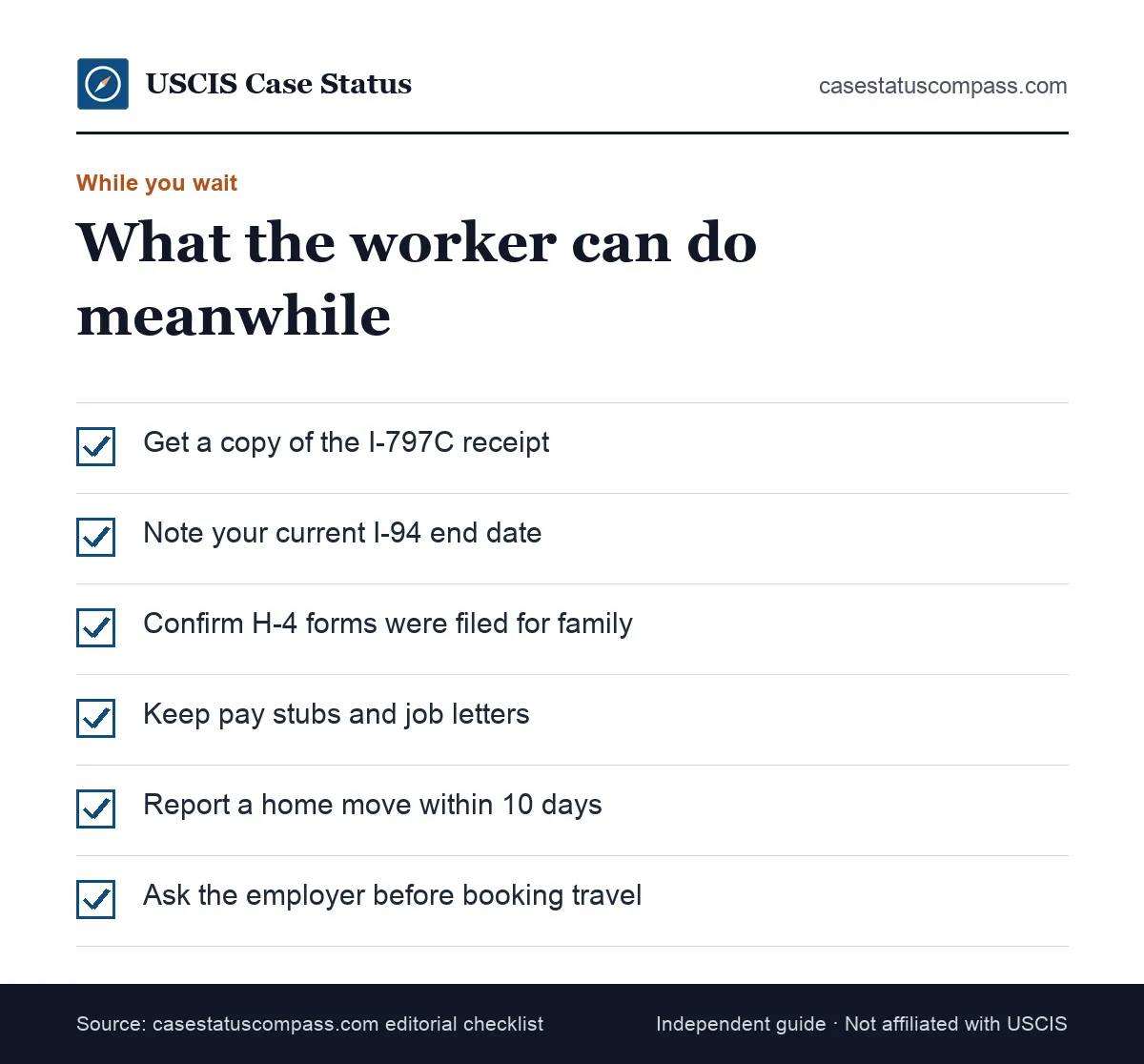
- Not reporting a home move on time. Report a new address to USCIS within 10 days of moving (INA 265).
- Booking travel before the approval.
- Forgetting that H-4 family members need their own filing.
What Can the Worker Do While the H-1B Is Pending?
While the petition is pending, the worker cannot shorten the H-1B processing time but can avoid problems. Get a copy of the receipt notice, track the current I-94 end date, confirm the family's H-4 filings and keep pay and job records in order.
Tracking the case
The worker can check the receipt number in Case Status Online. Our case was received guide explains the first status. The employer's attorney sees all notices. Save screenshots of each change.
Keeping records
Save copies of the I-797C, I-94 and recent pay stubs. They help at a visa interview, at the border and in a later green card case. Keep them together in one folder.
When Should You Get Legal Help About an H-1B Delay?
Get legal help if a delay could cause a gap in status, the case has an RFE about the job or degree, the worker is near the six-year limit, or a denial arrives. Act early; status gaps are hard to fix later.
Warning signs
- The I-94 end date is close and the case is still pending.
- The RFE questions the job's specialty occupation status.
- The worker changed jobs while a petition was pending.
Finding help
Ask the employer's attorney first. A worker with separate concerns can consult a licensed immigration attorney. This site gives general information, not legal advice. Avoid notarios who promise faster approvals.
Where Else Should You Look for Related Timelines?
Start at our USCIS processing times hub to compare every form. For citizenship timing many years later, see how long does naturalization take. Related forms run on separate clocks: an I-140 or a family I-539 never shares the H-1B figure, so check each one there.
Related H-1B guides
Petition tracking and status checks are in our H-1B status guide, linked above. A family member's work permit wait is on the work permit timing page.
Frequently Asked Questions
How long does an H-1B transfer take?
An H-1B transfer is a new I-129 from the new employer, so it follows the same queue as other H-1B petitions. With premium processing, USCIS must act within 15 business days. With regular processing, check the tool's H-1B line for the office.
What is the H-1B regular processing time?
USCIS does not publish an H-1B-only median. The median for all I-129 classes combined was 9.5 months for cases completed in April to June 2026. The official tool shows a separate H-1B line by office, which is the better figure for one case.
Does premium processing guarantee H-1B approval?
No. Premium processing guarantees only that USCIS will take action within 15 business days. That action can be an approval, a denial, a request for evidence or a notice of intent to deny. The extra fee does not change the legal standard the officer applies.
How long does an H-4 extension take?
H-4 extensions use Form I-539. For April to June 2026, USCIS's median for all I-539 filings was 5.7 months. Premium processing is not available for H-4, so an H-4 extension can finish after the H-1B it is based on.
Can I check my H-1B processing time with my receipt number?
Yes. Enter the receipt number in Case Status Online for the latest status. Then use the receipt date in the official processing times tool to see the H-1B line for your office and the case inquiry date.
Does an H-1B extension take as long as a new petition?
Extensions use the same Form I-129 and the same queues, so USCIS does not publish a separate extension time. The tool's H-1B line and the 15-business-day premium option apply to both. Extensions are not tied to the cap season.
How long does H-1B approval take with premium processing?
USCIS must act within 15 business days of receiving a properly completed Form I-907, so an approval usually arrives in about three calendar weeks. An RFE starts a new 15-business-day period once USCIS receives the response.
Is the H-1B processing time different for cap-exempt employers?
No. Cap-exempt petitions use the same Form I-129 queues and premium option. The only difference is that they can be filed year-round, not just after a registration selection.
Sources
- USCIS Check Case Processing Times. egov.uscis.gov/processing-times/. Accessed Oct 27, 2026.
- USCIS Data Library: All USCIS Application and Petition Form Types, FY2026 Q3 (XLSX). www.uscis.gov/sites/default/files/document/data/quarterly_all_forms_fy2026_q3_v1.xlsx. Accessed Oct 27, 2026.
- USCIS Data Library: All USCIS Application and Petition Form Types, FY2025 Q4 (XLSX). www.uscis.gov/sites/default/files/document/data/quarterly_all_forms_fy2025_q4_v1.xlsx. Accessed Oct 27, 2026.
- USCIS: How Do I Request Premium Processing?. www.uscis.gov/forms/all-forms/how-do-i-request-premium-processing. Accessed Oct 27, 2026.
- USCIS: H-1B Specialty Occupations. www.uscis.gov/working-in-the-united-states/h-1b-specialty-occupations. Accessed Oct 27, 2026.
- USCIS: H-1B Electronic Registration Process. www.uscis.gov/working-in-the-united-states/temporary-workers/h-1b-specialty-occupations-and-fashion-models/h-1b-electronic-registration-process. Accessed Oct 27, 2026.
- CIS Ombudsman tip sheet: Check Your USCIS Case Inquiry Date (PDF). dhs.gov/sites/default/files/2024-11/24_0823_cisomb_case-inquiry-date-tip-sheet.pdf. Accessed Oct 27, 2026.
- USCIS: How to Make an Expedite Request. www.uscis.gov/forms/filing-guidance/how-to-make-an-expedite-request. Accessed Oct 27, 2026.
- DHS CIS Ombudsman: How to Submit a Case Assistance Request. www.dhs.gov/case-assistance. Accessed Oct 27, 2026.
- USCIS: Filing Locations and Online Filing Options Updates. www.uscis.gov/forms/us-citizenship-and-immigration-services-filing-locations-and-online-filing-options-updates. Accessed Oct 27, 2026.
- USCIS Form G-1055 Fee Schedule (PDF). www.uscis.gov/sites/default/files/document/forms/g-1055.pdf. Accessed Oct 27, 2026.
- USCIS Service Center Operations Directorate (updated 07/17/2026). www.uscis.gov/about-us/organization/directorates-and-program-offices/service-center-operations-directorate. Accessed Oct 27, 2026.
- USCIS: Automatic EAD Extension (updated 10/29/2025). www.uscis.gov/working-in-the-united-states/information-for-employers-and-employees/automatic-employment-authorization-document-ead-extension. Accessed Oct 27, 2026.
- USCIS Office of Legislative Affairs, Congressional Inquiries Refresher (PDF, 2021). www.uscis.gov/sites/default/files/document/guides/Congressional-Inquiries-Refresher.pdf. Accessed Oct 27, 2026.
- 8 CFR 103.2(b)(8)(iv) (LII). www.law.cornell.edu/cfr/text/8/103.2. Accessed Oct 27, 2026.
- USCIS Policy Manual Vol. 1, Part E, Ch. 6 (current as of Oct. 23, 2026). www.uscis.gov/policy-manual/volume-1-part-e-chapter-6. Accessed Oct 27, 2026.
- 8 CFR 103.8(b) (LII). www.law.cornell.edu/cfr/text/8/103.8. Accessed Oct 27, 2026.
- USCIS Contact Center (uscis.gov). www.uscis.gov/contactcenter. Accessed Oct 27, 2026.
- USCIS: How to Change Your Address (updated 08/04/2026); 8 U.S.C. 1305(a) (LII). www.uscis.gov/addresschange. Accessed Oct 27, 2026.
casestatuscompass.com is an independent publication and is not affiliated with USCIS or any government agency. This page is general information, not legal advice. For denials, court or asylum matters, consult an immigration attorney or a DOJ-accredited representative.